| English | 释义 | 拼音 |
|---|---|---|
| interact | 互动 | hù dòng |
A lace hat in a poor man's cottage, 1922
- In Katherine Mansfield's "The Garden Party" (1922), Laura's wealthy family holds a party on the day a poor carter living below their house is killed. Afterwards Laura carries leftover food down to his widow's cottage — still wearing her big party hat. Inside she feels the hat is wrong, and before the dead man she can only sob, "Forgive my hat."
- What Laura does in the cottage reveals her and the place at once. How characters interact 互动 with their surroundings is evidence about both.
What does Laura say before the dead man in the cottage?
难度 1/5 · 今日首次完成可获 100 金币及少量额外奖励
Her shame shows she sees the class gap.
Behaviour reveals both sides
- The way a character behaves in a place — where they stand, what they touch, what they avoid — shows their attitude to it.
- It also shows what the place is: who belongs there, what it allows, what it forbids.
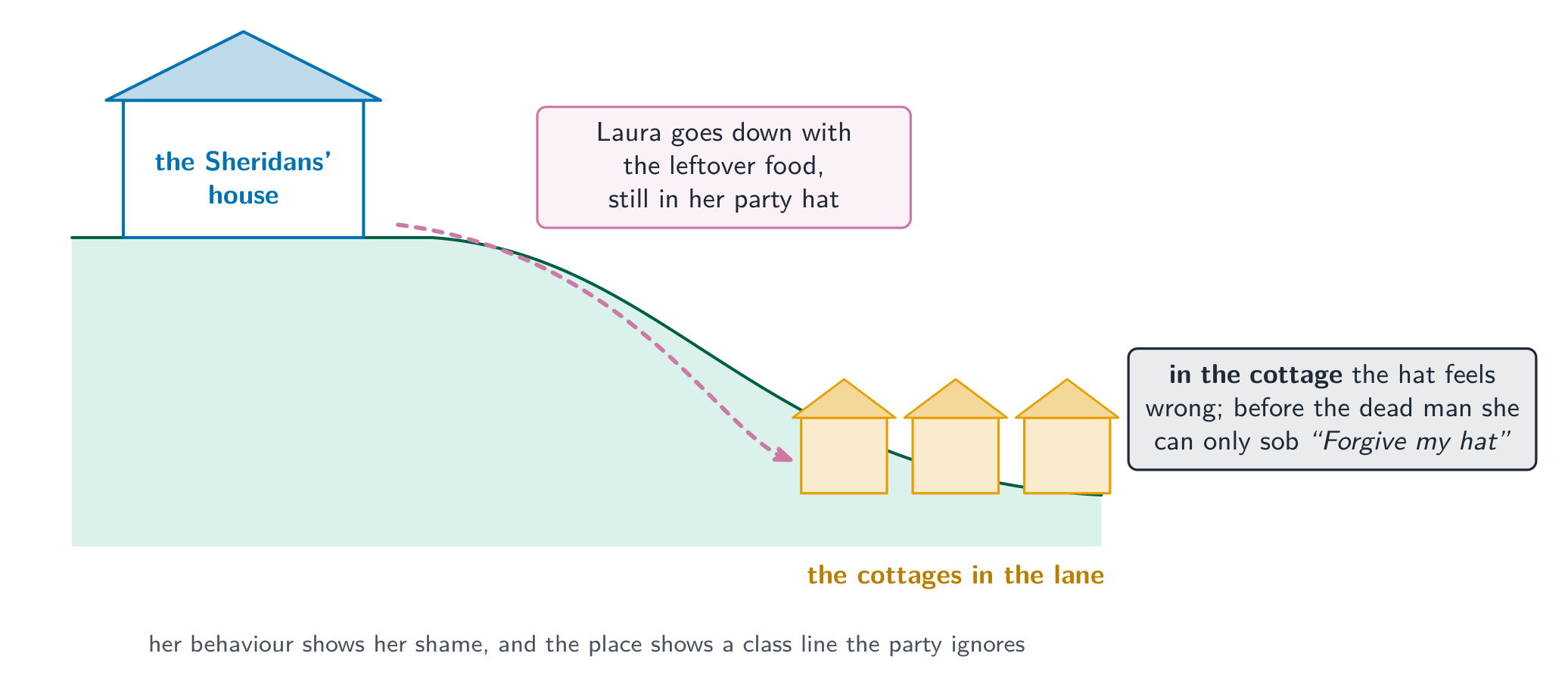
A character's behaviour in a place reveals both the character and the place.
难度 1/5 · 今日首次完成可获 100 金币及少量额外奖励
Interaction is evidence about both.
In the figure, what does keeping her coat on and not sitting suggest?
难度 1/5 · 今日首次完成可获 100 金币及少量额外奖励
Behaviour reveals attitude.
Describing is taking a position
- How a character describes a place reveals an attitude: the narrator, voicing the family's view, calls the cottages "the greatest possible eyesore"; Laura, walking down the lane at dusk, sees them in deep shade.
- The narrator's and characters' words about a place are evidence of values, not neutral description.
What does this evidence tell you?
Sort each detail by the direction it points.
A character's description of a place is neutral and reveals nothing about them.
难度 1/5 · 今日首次完成可获 100 金币及少量额外奖励
Describing is taking a position.
Worked example: Laura in the cottage
- Behaviour: Laura hesitates at the gate, is led inside by the widow's sister, and wants only to escape.
- About Laura: her lace hat and basket mark her as an outsider from the house above; her shame at the hat shows she is beginning to see the class gap her family ignores.
- About the place: the small, dark kitchen full of quiet women holds a real grief that the bright garden party could not admit. Interpretation: Mansfield uses Laura's awkward behaviour to show that the two settings — garden and cottage — belong to different worlds, and that crossing between them changes how Laura sees her own.
Match each piece of evidence to what it reveals.
难度 2/5 · 今日首次完成可获 140 金币及少量额外奖励
The evidence works on both sides.
Setting and character together
- Analyse setting through character: a character who feels at home, one who feels trapped, one who does not notice.
- Contrast how two characters behave in the same place.
Which comparison would deepen an analysis of setting?
难度 1/5 · 今日首次完成可获 100 金币及少量额外奖励
Contrast characters in the same place.
Writing about behaviour in a place
- Quote the action and the description of the place. Say what each reveals about the character and about the setting.
- Link the interaction to the work's ideas — here, class and the limits of sympathy.
Do not jump straight to symbolism. Before claiming the hat "symbolises wealth", analyse what Laura does with it and how she feels in the cottage. Behaviour is the evidence; the symbol, if any, comes after.
You should claim a symbol before analysing behaviour.
难度 1/5 · 今日首次完成可获 100 金币及少量额外奖励
Behaviour is the evidence; symbolism comes after.
How characters behave in and describe a place reveals their attitudes and what the place is. Analyse actions and descriptions as evidence about both character and setting, contrast characters in the same place, and build any symbolic reading on that evidence.
Analyse how a character behaves in a place in a work you know, and what it reveals about both.
Behaviour, character, setting.