| English | 释义 | 拼音 |
|---|---|---|
| unified | 统一的 | tǒng yī de |
| A motif/ə məʊˈtiːf/ | 母题 | mǔ tí |
| motif/məʊˈtiːf/ | 母题 | mǔ tí |
"Macbeth does murder sleep", c. 1606
- Just after killing King Duncan, Macbeth says he heard a voice cry, "Sleep no more! / Macbeth does murder sleep". Later he cannot sleep for fear; in Act 5 Lady Macbeth walks in her sleep, trying to wash invisible blood from her hands.
- Sleep returns again and again, always linked to guilt and lost peace. A recurring, unified pattern like this is a motif 母题.
What does Macbeth hear a voice cry after the murder?
难度 1/5 · 今日首次完成可获 100 金币及少量额外奖励
Sleep becomes a motif of lost peace.
What makes a motif
- A motif is a unified 统一的 pattern of recurring objects, images or ideas that emphasises a significant idea across much of a text.
- Repetition alone is not enough: the occurrences must connect to one idea. Rain mentioned three times by chance is weather; sleep lost after every crime in Macbeth is a motif.
Any repeated word is a motif.
难度 1/5 · 今日首次完成可获 100 金币及少量额外奖励
The occurrences must connect to one idea.
Detail, motif, symbol
- A single detail can become part of a motif when it returns; a motif can make a recurring object into a symbol when the text supports a fixed meaning.
- Track each occurrence and what changes around it.
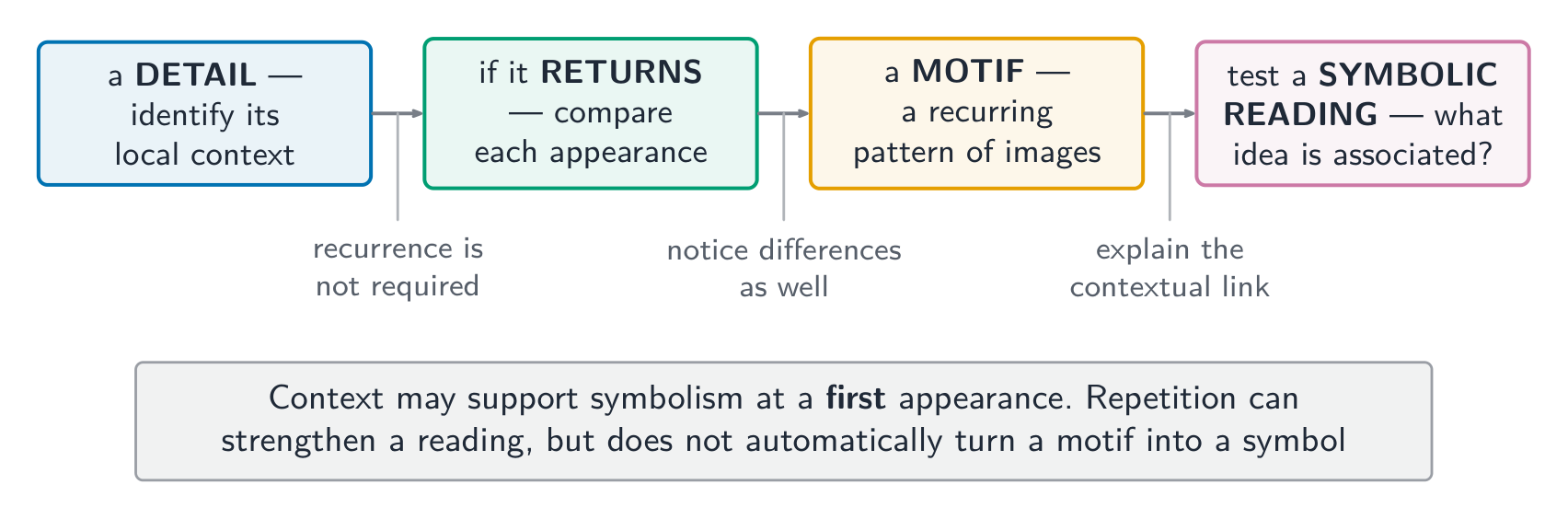
Watch repetition build a symbol
Nothing is a symbol on its first appearance — quote the recurrences.
Order the stages from smallest to largest.
难度 3/5 · 今日首次完成可获 200 金币及少量额外奖励
A returning detail can build a motif and then a symbol.
Worked example: tracing the sleep motif
- Act 2: after the murder, Macbeth hears "Sleep no more!" — sleep, "the balm of hurt minds", is what he has destroyed.
- Act 3: Macbeth envies the dead Duncan, who "after life's fitful fever … sleeps well", while the living Macbeths eat and sleep "in the affliction of these terrible dreams".
- Act 5: Lady Macbeth sleepwalks, rubbing her hands: "Out, damned spot!" Interpretation: the motif shows that the murder did not give the Macbeths power to enjoy but took away the ordinary peace even the poorest have. Guilt is not a single feeling but a lasting sleeplessness.
Order the sleep motif's occurrences.
难度 3/5 · 今日首次完成可获 200 金币及少量额外奖励
Act 2, Act 3, Act 5.
Name the significant idea
- After tracing the pattern, name the idea it emphasises: "sleep as innocence and peace that crime destroys". Without the idea, you have only a list of appearances.
- Consider how the motif develops: does it intensify, change meaning, or reverse?
What idea does the sleep motif emphasise?
难度 1/5 · 今日首次完成可获 100 金币及少量额外奖励
Name the idea, not just the pattern.
A good analysis shows how a motif develops across the text.
难度 1/5 · 今日首次完成可获 100 金币及少量额外奖励
It may intensify, change or reverse.
Writing about a motif
- Use three or more occurrences from different parts of the text. Quote each briefly.
- Explain the development and link it to the work's central conflict.
Counting appearances is not analysis. "Sleep is mentioned eleven times" proves repetition, not meaning. Explain what idea the pattern emphasises and how it develops.
Counting how many times a word appears is enough analysis of a motif.
难度 1/5 · 今日首次完成可获 100 金币及少量额外奖励
Explain the idea and development.
A motif is a unified pattern of recurring objects, images or ideas that emphasises a significant idea. Track occurrences across the text, name the idea they emphasise, show how the motif develops, and link it to the central conflict.
Trace a motif through a work you know with three occurrences and name its idea.
Occurrences, idea, development.