Jane Austen's first draft of Pride and Prejudice, written in 1796–97, was called First Impressions. The old title names the novel's subject: a clever young woman judges two men quickly, gets both wrong, and has to change her mind. A long work has room for this kind of change, and Unit 3 is about tracing it.
In this unit you will:
read a character through description, details and what the character does not do;
show a change with three quotations, not one;
treat setting as a social and historical situation, not only a place;
name a conflict as a clash of values 价值观 and show how two conflicts intersect;
write a literary thesis that states an interpretation and defend it with sufficient evidence.
The CED's points on character:
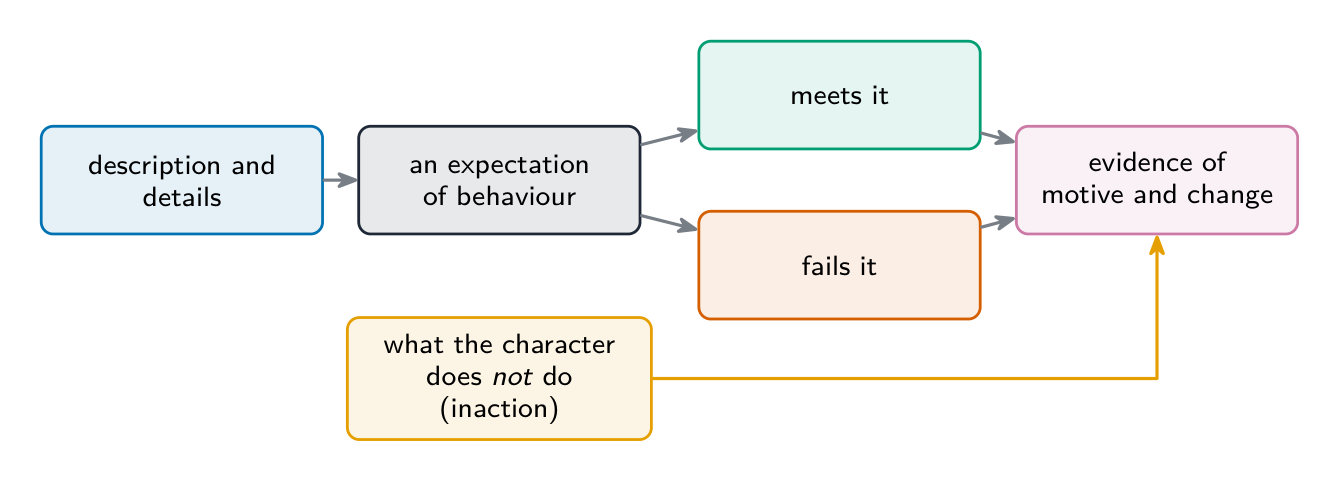
The description of a character creates expectations 期待 for that character's behaviour, and how a character meets or fails those expectations is meaningful.
Details associated with a character contribute to a reader's interpretation of them.
A reader's understanding of a character's perspective may depend on the perspective of the narrator.
A character's perspective may shift during the narrative.
When narrators or characters compare another character to something else, they reveal their own perspective as much as the compared character's.
Readers can infer motive 动机 from a character's actions or inactions.
That last word, inactions, is the one worth keeping. What a character declines to do is evidence, and it is often more revealing than what she does.
Worked example: a detail, an expectation and an inaction. Katherine Mansfield's short story "Miss Brill" (1920) follows an English teacher living alone in a French town on her Sunday visit to the public gardens. It opens:
Although it was so brilliantly fine—the blue sky powdered with gold and great spots of light like white wine splashed over the Jardins Publiques—Miss Brill was glad that she had decided on her fur.
She takes the old fur out of its box and talks to it: "Dear little thing! It was nice to feel it again."
Expectation. A woman who speaks to her fur as a pet is lonely, but she is also cheerful and observant. We expect her to enjoy the afternoon.
The detail. The fur is her companion and her pride. Later a young couple on her bench laugh at it: "It's exactly like a fried whiting." The same object that showed her happiness now shows how the world sees her.
The inaction. On Sundays she usually buys a slice of honey-cake. This time "she passed the baker's by" and went straight home. She says nothing and does nothing dramatic; the missing cake is the evidence of her hurt.
Expectations make behaviour meaningful, including what a character declines to do.
A dynamic character 动态人物 develops over the narrative and often makes choices that directly or indirectly cause change.
Character change can be visible and external (health, wealth, circumstance) or internal, in belief, value or understanding.
A static character 静态人物 remains unchanged or is largely unaffected by events.
An unchanged character is not a failure of characterisation 人物塑造. It is often the measure by which the change in others becomes visible. In Pride and Prejudice, Mrs Bennet is the same at the end as at the start, and that makes Elizabeth's growth easy to see.
To prove a change you need three quotations: one before, one at the turning point, and one after. Students usually give the first and last only, so the change is reported but not explained.
Three quotations, and the middle one is the one students omit
Worked example: Scrooge in three moments. Charles Dickens, A Christmas Carol (1843).
Before. The narrator piles up verbs: "Oh! But he was a tight-fisted hand at the grind-stone, Scrooge! a squeezing, wrenching, grasping, scraping, clutching, covetous, old sinner!" Seven words for holding on to money.
Turning point. At his own neglected grave he cries to the last Spirit: "I am not the man I was." The change is caused by seeing what his life will lead to.
After."Scrooge was better than his word. He did it all, and infinitely more; and to Tiny Tim, who did not die, he was a second father."
Analysis. Scrooge is a dynamic character, and the change is internal before it is external: he first understands, then gives. The middle quotation is the evidence that the change has a cause. Without it, an essay can only say that he is "different" at the end.
Setting now includes the social, cultural and historical situation in which the events take place, not only the time and the place.
This widens what setting can do. A social setting gives the limits a character must act within, and those limits are what turn a choice into a revealing one.
Worked example. In "Miss Brill" the setting is a Sunday band concert in the Jardins Publiques at the start of the season. Mansfield fills it with people Miss Brill watches: couples, children, "odd, silent, nearly all old" people on the benches. Two details make the setting social, not just pretty:
Miss Brill imagines the whole scene as a play: "Oh, how fascinating it was!", and she has a part in it. The setting is her community, or she believes it is.
She does not see that she belongs to the group she describes as old and odd. The setting holds up a mirror she does not look into.
So when the young couple mock her, the setting itself turns against her: the public stage where she felt she had a part is where she is told she has none.
A narrative is delivered through a series of events that relate to a conflict.
Events include episodes 情节片段, encounters and scenes 场景 that introduce and develop the plot.
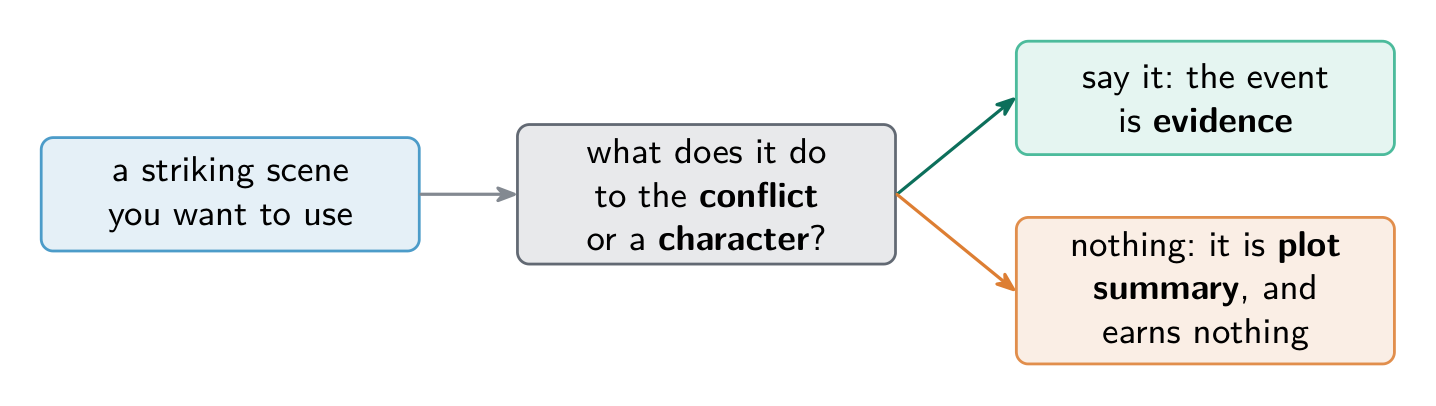
The significance of an event depends on its relationship to the narrative, the conflict and character development 人物发展.
The third point is the test for choosing evidence in an essay: an event matters to your argument only if you can say what it does to the conflict or to a character. Retelling a striking scene that does neither is plot summary 情节概述, which earns nothing.
An event counts only for what it does
Worked example: which events count? Take three moments from A Christmas Carol.
Event
What it does
Use it?
Marley's face appears in the door knocker
Sets a ghostly tone; changes nothing in Scrooge yet
Only briefly
Fezziwig's Christmas party, seen by the young Scrooge
Shows the kind, generous employer Scrooge could have become, and makes him regret his treatment of his own clerk
Yes: it starts the change
Scrooge sees strangers dividing his possessions after his death
Shows the result of his life; it leads straight to "I am not the man I was"
Conflict 冲突 is tension between competing values, either within a character (an internal conflict 内心冲突) or between a character and an external force (an external conflict 外部冲突).
A text may contain multiple conflicts, and often two or more intersect 交叉.
A primary conflict 主要冲突 can be heightened by additional conflicts that intersect with it.
Inconsistencies 不一致之处 in a text may create contrasts that represent conflicts of values or perspectives.
A primary conflict heightened by an intersecting one is the standard shape of a novel or play
Note the definition: conflict is between competing values, not merely between people. Ask which desires or values the struggle exposes. The two values need not be equally admirable.
Worked example: two conflicts that intersect. Charles Dickens, Great Expectations (1860–61).
External conflict. Pip, a village boy raised by the blacksmith Joe Gargery, meets the rich and proud Estella, who sneers: "He calls the knaves, Jacks, this boy!" Social class stands between them.
Internal conflict. Pip wants to be a gentleman so that Estella will respect him. When Joe visits him in London, Pip is ashamed of Joe's manners and clothes, and he is ashamed of being ashamed.
Where they meet. Every step up in class takes Pip further from Joe. Joe sees this and leaves with a kind explanation: "Pip, dear old chap, life is made of ever so many partings welded together."
The values. Gentility against loyalty. The novel treats the wish to rise as natural, but it shows that Pip's way of rising costs him the love that mattered most.
As in Units 1 and 2, a paragraph needs a claim that requires defence, textual evidence, and details read in combination.
Model paragraph.Mansfield shows Miss Brill's hurt through what she stops doing. Every Sunday she buys a slice of honey-cake on her way home, but after the couple mock her fur "she passed the baker's by". The missing treat matters more than any tears would, because it shows that the small pleasures of her week have lost their meaning. When she puts the fur away, "she thought she heard something crying": she gives her own grief to the fur, as she cannot yet admit it is hers.
Claim, two pieces of evidence read together, and a final sentence that explains the link.
A thesis statement 论题句expresses an interpretation of a literary text and requires defence through textual evidence.
It may preview the line of reasoning of that interpretation, but it is not required to list the reasons.
The key word is interpretation. A thesis that states what happens in the text is not a thesis; it is a summary. A thesis says what the text means or does, so a reader could disagree with it.
Summary (not a thesis)
Thesis
Scrooge is visited by three ghosts and becomes kind.
Dickens makes Scrooge's change depend on seeing, not on being told: each Spirit shows him a scene, and only the sight of his own death finishes the work that warnings could not.
Miss Brill is upset by a young couple.
Mansfield lets Miss Brill discover her loneliness through the very scene she thought made her part of a community.
A literary thesis is about what the text does, not what it contains
Writers use evidence strategically: to illustrate, clarify, exemplify, associate or amplify.
Evidence is effective when commentary explains its logical relationship to the claim.
Evidence is sufficient 充分的 when its quantity and quality give apt support.
Developing an interpretation is a recursive process: an interpretation can emerge, and change, as you read and write.
The last point is permission worth taking. If your reading changes while you draft, revise the thesis to match.
Two failures with two opposite fixes: a different quotation, or a richer one
Worked example: two weak choices. Claim: Pip's rise in class costs him Joe.
Irrelevant evidence: a quotation about Miss Havisham's stopped clocks. It is striking, but it says nothing about Pip and Joe. Fix: choose a different quotation.
Insufficient evidence: "Pip is embarrassed by Joe." True, but too thin to carry the claim. Fix: a richer quotation, such as Joe's "life is made of ever so many partings welded together", which shows that Joe understands the distance and accepts it.
Grammar 语法 and mechanics that follow established conventions allow writers to communicate clearly. On this exam, control of language is not a separate mark but a condition of the others: an unclear sentence cannot deliver commentary that a reader can credit.
Worked example: a Question 3 paragraph. A literary-argument prompt asks you to choose a work and analyse how a character's conflict contributes to an interpretation of the work as a whole. A weak answer retells the plot around the conflict. A strong answer names competing values and lets them intersect:
"In Great Expectations, Pip's external conflict with the class that Estella represents is sharpened by an internal one: he wants the gentility that would make her respect him, and he still loves the blacksmith who raised him. Because every gain in the first is a loss in the second, Dickens turns a story of social success into a story of moral failure, and Pip can only recover himself by turning back to Joe."
Two conflicts named as values, and an interpretation of the whole work, in clear sentences.
A real text: Jane Austen, Pride and Prejudice (1813)
It is a truth universally acknowledged, that a single man in possession of a good fortune must be in want of a wife.
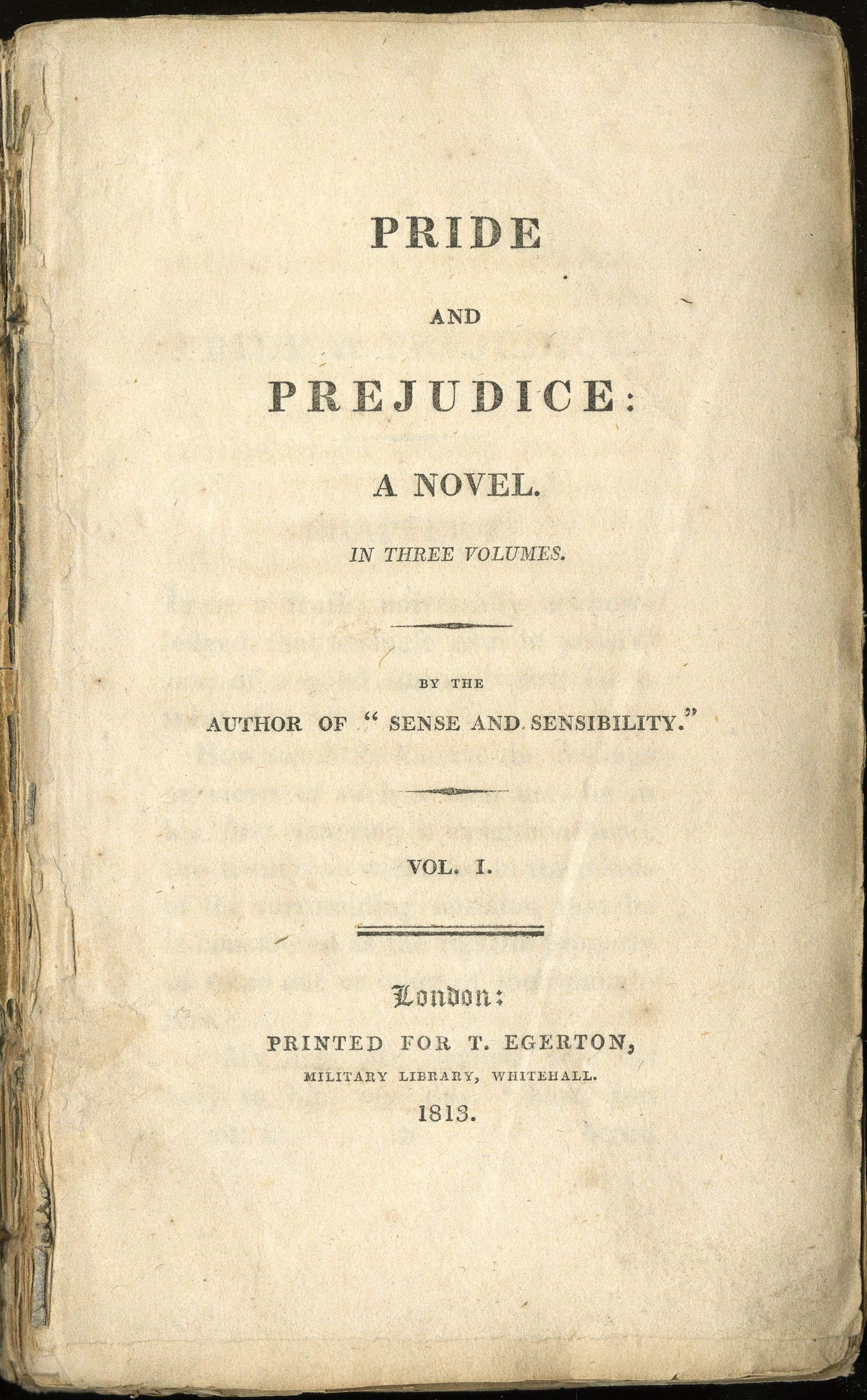
Title page of the first edition (1813), published anonymously as by the author of Sense and Sensibility
"Till this moment, I never knew myself."
Worked analysis.
The narrator's voice. The first sentence sounds like a law of nature, but the next pages show that it is really the wish of mothers with unmarried daughters, Mrs Bennet above all. The narrator states a "truth" in order to laugh at it.
Setting with social and economic weight. The Bennets' house will pass to a male cousin, Mr Collins, when Mr Bennet dies, so the five daughters need to marry. Money and marriage are the pressure under every polite conversation.
Conflicts that intersect. The external conflict is social: rank and money divide Elizabeth from Darcy. The internal conflict is her own quick judgement: she believes Wickham's story against Darcy because it fits her first dislike.
The significant event is reading. Darcy's letter tells her the facts about Wickham. Her words to herself, "Till this moment, I never knew myself", mark the change: she sees that her famous judgement was pride.
Claim: Austen makes Elizabeth's turning point an act of reading rather than an action, so the novel's real conflict is not between two lovers but between a quick first judgement and the patience to revise it.
Reporting a change without its cause. Quoting the start and the end only. Give the turning point too.
Calling a static character a weakness. An unchanged character often shows the change in others.
Treating setting as scenery. Ask what social limits the setting puts on the character.
Conflict as "person against person". Name the values in tension, such as gentility against loyalty.
A summary in place of a thesis. If no reader could disagree with it, it is not a thesis.
Retelling a vivid scene that does nothing to the conflict or to a character.
Ignoring inactions. What a character does not do (Miss Brill passing the baker's) is often the best evidence.
3.10
关键术语
English
dynamic character: a character who changes in an important way during the story.
static character: a character who stays the same from start to end.
motive: the reason behind what a character does or does not do.
internal conflict: a struggle between values inside one character.
external conflict: a struggle between a character and an outside force, such as a person or society.
primary conflict: the main conflict that the work is organised around.
intersect: to meet or cross, as two conflicts can.
plot summary: retelling events without saying what they mean.
thesis statement: a sentence that states an interpretation of the text that needs defending.
line of reasoning: the sequence of claims that together defend the thesis.
commentary: the writer's explanation of how the evidence supports the claim.
sufficient: enough, in quantity and quality, to support the claim.
3.10
自我检测
English
Read the end of James Joyce's short story "Araby" (1914). A boy has promised to bring a present from the Araby bazaar to the girl he admires. He arrives late, as the stalls are closing, and buys nothing.
I heard a voice call from one end of the gallery that the light was out. The upper part of the hall was now completely dark.
Gazing up into the darkness I saw myself as a creature driven and derided by vanity; and my eyes burned with anguish and anger.
Has the boy changed? Use a detail from the passage.
How does the setting reflect a theme 主题 of the story?
Write a thesis that connects the character to the setting.
Answers: 1. Yes, and the change is internal: he now sees his romantic quest as "vanity". The words "saw myself" show that the change is a new self-knowledge, like Elizabeth's "I never knew myself". 2. The bazaar he imagined as a magical, Eastern place is a closing hall with the lights going out. The darkness shows the end of his illusion, so the setting reflects the theme of romantic dreams meeting a dull reality. 3. For example: "Joyce lets the bazaar go dark at the moment the boy's dream fails, so the place he imagined as magical becomes the place where he first sees himself clearly."