持久理解 (STR-1): 文本各部分和章节的排列方式、各部分之间的相互关系,以及文本揭示信息的顺序,都是作者做出的结构性选择,这些选择有助于读者对文本进行解读。
学习目标 3.C: 解释文本中结构的功能。
- STR-1.AC 诗歌中的思想和意象可能跨越单行或单个诗节。
- STR-1.AD 标点符号通常对于理解文本至关重要。
- STR-1.AE 当在文本中创建结构模式时,任何对模式的打断都会形成强调点。
 8:40
单元8:诗歌III
单元8是最后一个诗歌单元,处理课程中最难的材料:基于矛盾的一组修辞装置。但它以最……开始
英文讲解 · 可切换中英文字幕
持久理解 (STR-1): 文本各部分和章节的排列方式、各部分之间的相互关系,以及文本揭示信息的顺序,都是作者做出的结构性选择,这些选择有助于读者对文本进行解读。
学习目标 3.C: 解释文本中结构的功能。
来源:College Board AP 课程与考试说明
Robert Frost wrote "The Road Not Taken" in 1915 (collected in Mountain Interval in 1916) partly as a joke on his friend, the poet Edward Thomas, who on country walks would worry afterwards that they should have taken the other path. Frost later warned audiences that it was "a tricky poem". It is often read at graduations as praise of the brave person who chooses differently, which is close to the opposite of what a careful reading supports.
In this unit you will:
The CED's points on structure:
Establish the pattern before interpreting the interruption. In a poem, a semicolon 分号 and a full stop are different claims about how tightly two statements are joined, and a poem without punctuation has made a decision about how you must read it.
Worked example: a pattern and its break. Robert Frost, "Stopping by Woods on a Snowy Evening" (1923):
Whose woods these are I think I know.
His house is in the village though;
He will not see me stopping here
To watch his woods fill up with snow.My little horse must think it queer
To stop without a farmhouse near
Between the woods and frozen lake
The darkest evening of the year.He gives his harness bells a shake
To ask if there is some mistake.
The only other sound's the sweep
Of easy wind and downy flake.The woods are lovely, dark and deep,
But I have promises to keep,
And miles to go before I sleep,
And miles to go before I sleep.
| English | 中文 | 拼音 |
|---|---|---|
| emphasis/ˈemfəsɪs/ | 强调 | qiáng diào |
| semicolon/ˌsemɪˈkəʊlən/ | 分号 | fēn hào |
| paradox/ˈpærədɒks/ | 悖论 | bèi lùn |
| ambiguity/ˌæmbɪˈɡjuːɪti/ | 歧义 | qí yì |
| conceit/kənˈsiːt/ | 奇喻 | qí yù |

持久理解(STR-1): 文本各部分与章节的排列、各部分之间的关系,以及文本揭示信息的顺序,都是作者做出的结构性选择,这些选择有助于读者对文本进行解读。
学习目标 3.D: 解释文本中对比的作用。
来源:College Board AP 课程与考试说明
Students often confuse these three. Ask what happens to the contradiction 矛盾:
| Device | What happens to the contradiction | Real example |
|---|---|---|
| antithesis | two opposites stand side by side, and both are true | "It was the best of times, it was the worst of times" (Dickens, A Tale of Two Cities, 1859): one age held both |
| situational irony | events turn out against what was expected | Della buys a chain for Jim's watch; Jim has sold the watch ("The Gift of the Magi", 1905) |
| verbal irony | the words mean something different from what they say | Owen calls "It is sweet and fitting to die for one's country" "The old Lie" after showing a gassed soldier dying |
| paradox | it looks impossible, but it is true in a deeper sense | "Death, thou shalt die" (John Donne, Holy Sonnet 10, published 1633): after resurrection, death itself will end |
Worked example: a paradox explained. Donne's sonnet "Death, be not proud" argues that death is only "one short sleep" before eternal life: "One short sleep past, we wake eternally / And death shall be no more; Death, thou shalt die." Death cannot literally die. But if every death leads to waking, then death will one day have no one left to take. The contradiction is the argument: it turns death from a ruler into a servant who will be dismissed.
| English | 中文 | 拼音 |
|---|---|---|
| contradiction/ˌkɒntrəˈdɪkʃn/ | 矛盾 | máo dùn |
| juxtaposition/ˌdʒʌkstəpəˈzɪʃn/ | 并置 | bìng zhì |
| antithesis/ænˈtɪθəsɪs/ | 对偶 | duì ǒu |
| situational irony/ˌsɪtʃuːˈeɪʃənl ˈaɪrəni/ | 情境反讽 | qíng jìng fǎn fěng |
| verbal irony/ˈvɜːbl ˈaɪrəni/ | 言语反讽 | yán yǔ fǎn fěng |
持久理解(FIG-1): 比较、意象和联想将意义从字面层面转向比喻层面,并促使读者对文本进行解读。
学习目标 5.B: 解释文本中特定单词和短语的功能。
来源:College Board AP 课程与考试说明
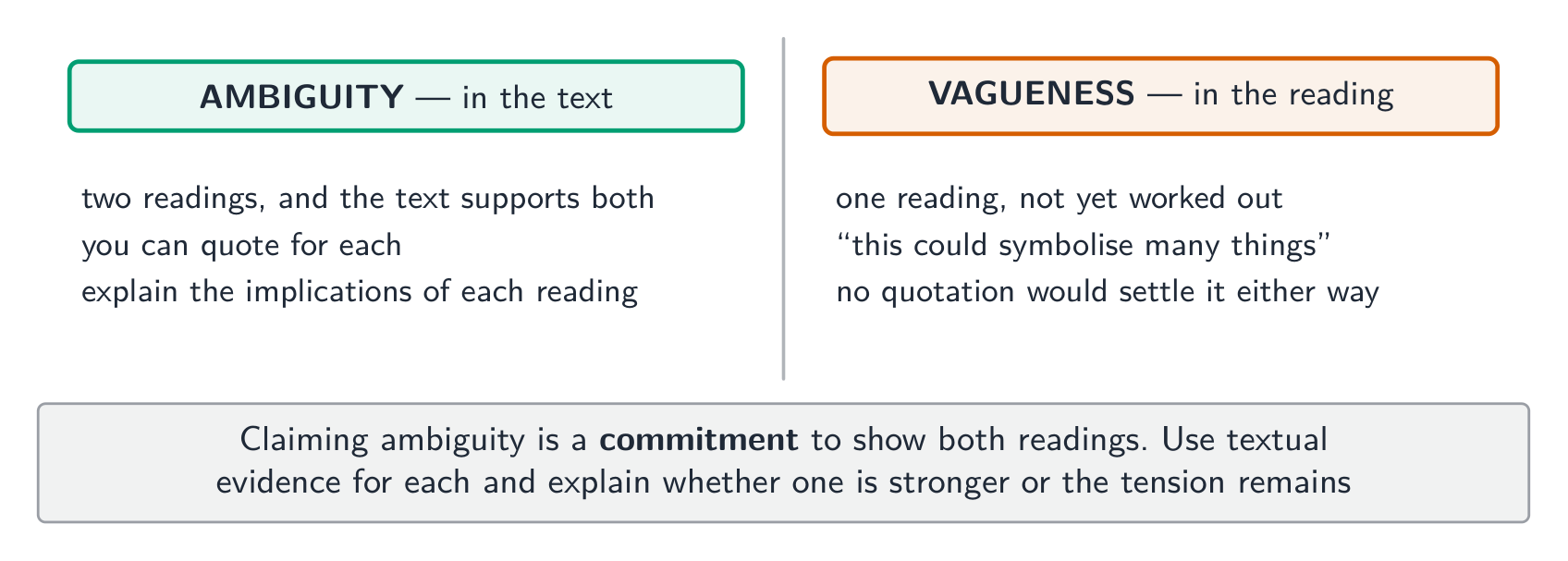
Ambiguity allows for different readings and understandings of a text by different readers.
In this course, ambiguity is a resource. Explore readings that the text really supports and explain what each would mean. You may defend one or explain a tension that lasts.
Worked example. "And miles to go before I sleep." Sleep can be the night's rest at the end of the journey, or death at the end of a life. The first reading fits the horse, the snow and the "promises to keep"; the second fits "The darkest evening of the year" and the pull of the "lovely, dark and deep" woods. Both readings are supported, and the repetition holds them together: the second line seems to move from the first meaning to the second. A strong essay shows both and explains what the tension adds: a quiet moment of temptation that the speaker resists.
用文本证据支持每种合理的解读,并说明哪一种更有力或张力是否依然存在。
持久理解(FIG-1): 比较、表象和联想将意义从字面引向象征,并促使读者对文本进行解读。
学习目标 5.C: 识别并解释符号的功能。
来源:College Board AP 课程与考试说明
Symbols in a text, and the way they are used, may imply that a narrator, character or speaker has a particular perspective.
A symbol is not free-floating. Ask how the wording sets up the association and whose perspective it expresses.
Worked example. In "Stopping by Woods" the woods are "lovely, dark and deep". For the owner, who lives "in the village", they are property; for the horse, a strange place to stop; for the speaker, something beautiful and dangerous that he wants to stay in. The woods become symbolic through the speaker's perspective: they stand for rest, beauty or even death, set against the "promises" of ordinary life.
持久理解 (FIG-1): 比较、表征和联想将意义从字面转化为比喻,并邀请读者解读文本。
学习目标 6.B: 识别并解释隐喻的功能。
来源:College Board AP 课程与考试说明
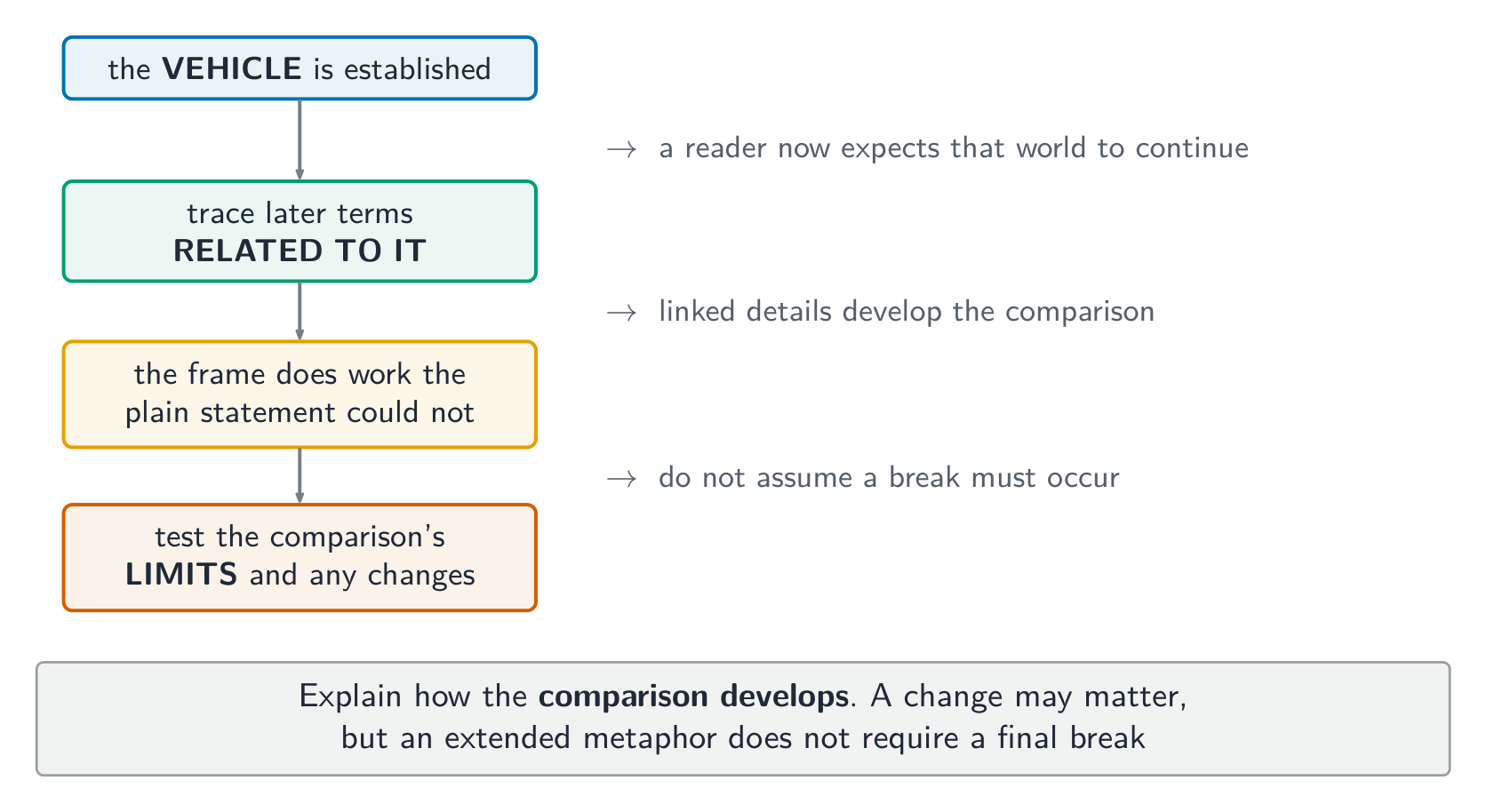
Worked example: Donne's compasses. In "A Valediction: Forbidding Mourning" (published 1633), a man leaving on a journey tells his wife not to grieve. He compares their two souls to the two legs of a pair of compasses, the tool for drawing circles:
If they be two, they are two so
As stiff twin compasses are two;
Thy soul, the fixed foot, makes no show
To move, but doth, if the other do.
He ends: "Thy firmness makes my circle just, / And makes me end where I begun."
追踪关联细节与语境限制。扩展隐喻不必打破其框架。
| English | 中文 | 拼音 |
|---|---|---|
| extended metaphor/ekˈstendɪd ˈmetəfɔː/ | 延伸隐喻 | yán shēn yǐn yù |
持久理解(FIG-1): 类比、表征和联想将意义从字面转向隐喻,并邀请读者对文本进行解读。
学习目标 6.D: 识别并解释典故的功能。
来源:College Board AP 课程与考试说明
Because readers share knowledge of a reference, allusions 典故 create emotional or intellectual associations in readers who recognise them.
Note the condition: shared knowledge. An allusion is a bet on the reader's memory, and a poem that alludes heavily has chosen its audience.
Worked example. Frost's "'Out, Out—'" (1916) tells how a boy cutting wood in Vermont loses his hand to a buzz saw and dies. Its title alludes to Macbeth's speech on hearing that his wife is dead.
Context: Macbeth says, "Out, out, brief candle! / Life's but a walking shadow", and calls life "a tale / Told by an idiot, full of sound and fury, / Signifying nothing."
| English | 中文 | 拼音 |
|---|---|---|
| allusion/əˈluːʒn/ | 典故 | diǎn gù |
持久理解 (LAN-1): 读者通过基于文本证据的论证来建立并阐述其对文学作品的解读。
学习目标 7.B: 构建一个能够传达关于文学解读的可辩护主张的中心论点,该论点可能确立一条推理线索。
持久理解 (LAN-1): 读者通过以文本证据支持的论证来建立并传达其对文学作品的解读。
学习目标 7.C: 撰写评论性分析,确立并阐明文本证据、推理线索与中心论点之间的关系。
持久理解(LAN-1): 读者通过以文本证据支持的论证来确立并阐述其对文学作品的解读。
学习目标 7.D: 选择并使用相关且充分的证据,以构建和支持一条推理线索。
来源:College Board AP 课程与考试说明
Model thesis with significance. In "Stopping by Woods", Frost lets the rhyme scheme stop at the same moment as the speaker, so the poem enacts the pull of rest before turning back to duty; its significance is that the choice to go on is made quietly, without anyone seeing it, which makes it more honest than a public act of courage.
持久理解 (LAN-1): 读者通过有文本证据支持的论证来建立并传达其对文学作品的解读。
学习目标 7.E: 展示对构成要素的控制,以实现清晰表达。
来源:College Board AP 课程与考试说明
Writers must acknowledge the words, ideas, images, texts and intellectual property 知识产权 of others through attribution 注明出处 and citation 引用.
How to quote and cite poetry.
Though as for that the passing there
Had worn them really about the same,
...
I shall be telling this with a sigh
Somewhere ages and ages hence:
Two roads diverged in a wood, and I—
I took the one less traveled by,
And that has made all the difference.
Worked analysis.
Claim: Frost's poem is less about a brave choice than about how people later turn a chance choice into a story of meaning: the last stanza shows the speaker inventing the difference his choice "has made".
| English | 中文 | 拼音 |
|---|---|---|
| intellectual property/ˌɪntəˈlektʃuːəl ˈprɒpəti/ | 知识产权 | zhī shí chǎn quán |
| attribution/ətrɪˈbjuːʃn/ | 注明出处 | zhù míng chū chù |
| citation/saɪˈteɪʃn/ | 引用 | yǐn yòng |
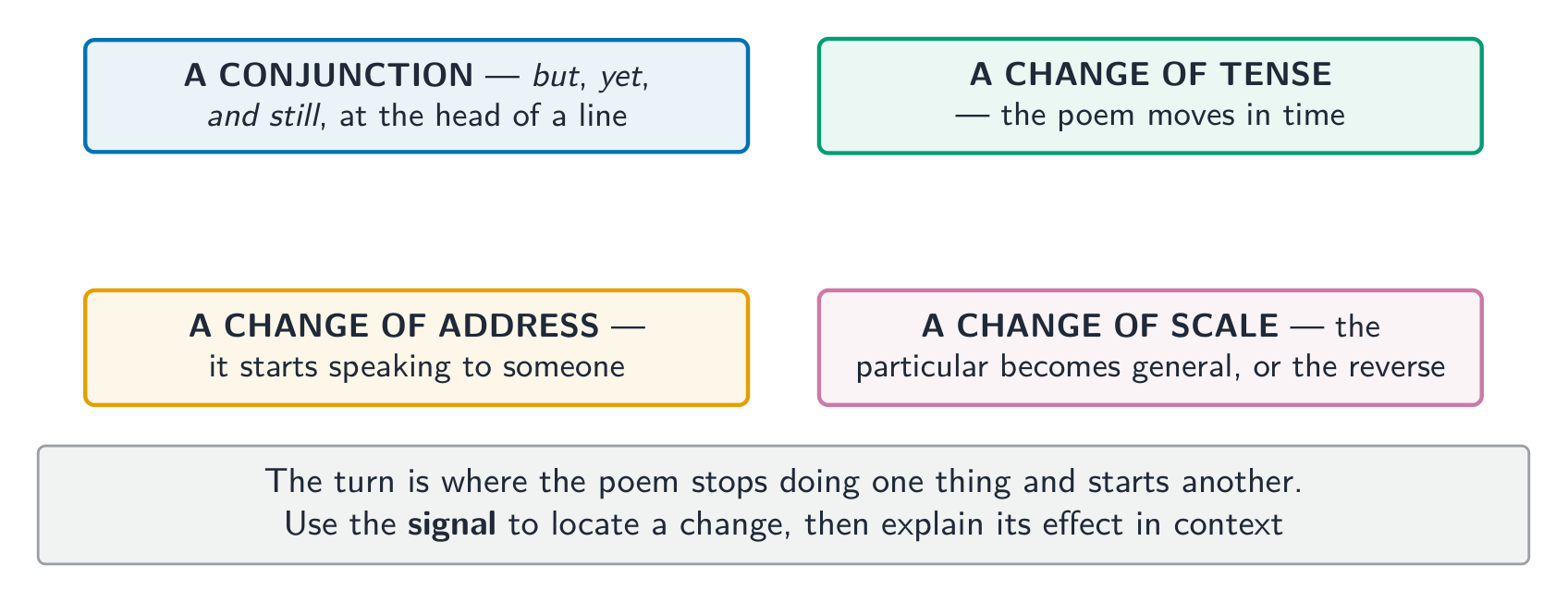
Read the opening and the ending of Shakespeare's Sonnet 130 (1609):
My mistress' eyes are nothing like the sun;
Coral is far more red than her lips' red;
...
I grant I never saw a goddess go;
My mistress, when she walks, treads on the ground:
And yet, by heaven, I think my love as rare
As any she belied with false compare.
Context: love poets of the time usually compared a woman's eyes to the sun, her lips to coral and her walk to a goddess's.
Answers: 1. Line after line denies the usual comparisons ("nothing like the sun", "Coral is far more red"), ending with a plain fact: she "treads on the ground". The turn comes at "And yet" in line 13: the couplet says his love is as rare as any woman praised with false comparisons. 2. It is closest to verbal irony aimed at other poets: it seems to insult her, but the poem's real target is the exaggerated praise of other sonnets. It is not a paradox, because nothing impossible turns out to be true. 3. The poem only works if the reader knows the standard comparisons. Against them, Shakespeare's honesty becomes a better compliment: he loves a real woman, not a "false compare".
出了什么问题?只有网站团队能看到这些信息。
逐步完成,配合即时检查练习。