| English | 释义 | 拼音 |
|---|---|---|
| Ambiguity/ˌæmbɪˈɡjuːɪti/ | 歧义 | qí yì |
One line, two meanings
- In Percy Bysshe Shelley's "Ozymandias" (1818), a broken statue in the desert carries the words of an ancient king: "Look on my Works, ye Mighty, and despair!" When the king wrote them, they were a boast. Today, with nothing left around the statue but sand, they read as a warning.
- That is ambiguity 歧义: a word, phrase or line that allows different readings by different readers. In literature it is usually a resource, not a mistake.
What is ambiguity in literature?
难度 1/5 · 今日首次完成可获 100 金币及少量额外奖励
Ambiguity is a resource that lets one phrase carry more than one meaning.
Read the sestet
And on the pedestal, these words appear:
My name is Ozymandias, King of Kings;
Look on my Works, ye Mighty, and despair!
Nothing beside remains. Round the decay
Of that colossal Wreck, boundless and bare
The lone and level sands stretch far away.
- Pedestal = the base of a statue; colossal = huge; the Mighty = other powerful rulers.
Hold both readings
| Reader | How "despair" reads | Evidence |
|---|---|---|
| A ruler in Ozymandias's time | despair because you can never equal my great works | "King of Kings", the confident command "Look on" |
| A reader of the poem | despair because even the greatest works turn to dust | "Nothing beside remains", "colossal Wreck", "lone and level sands" |
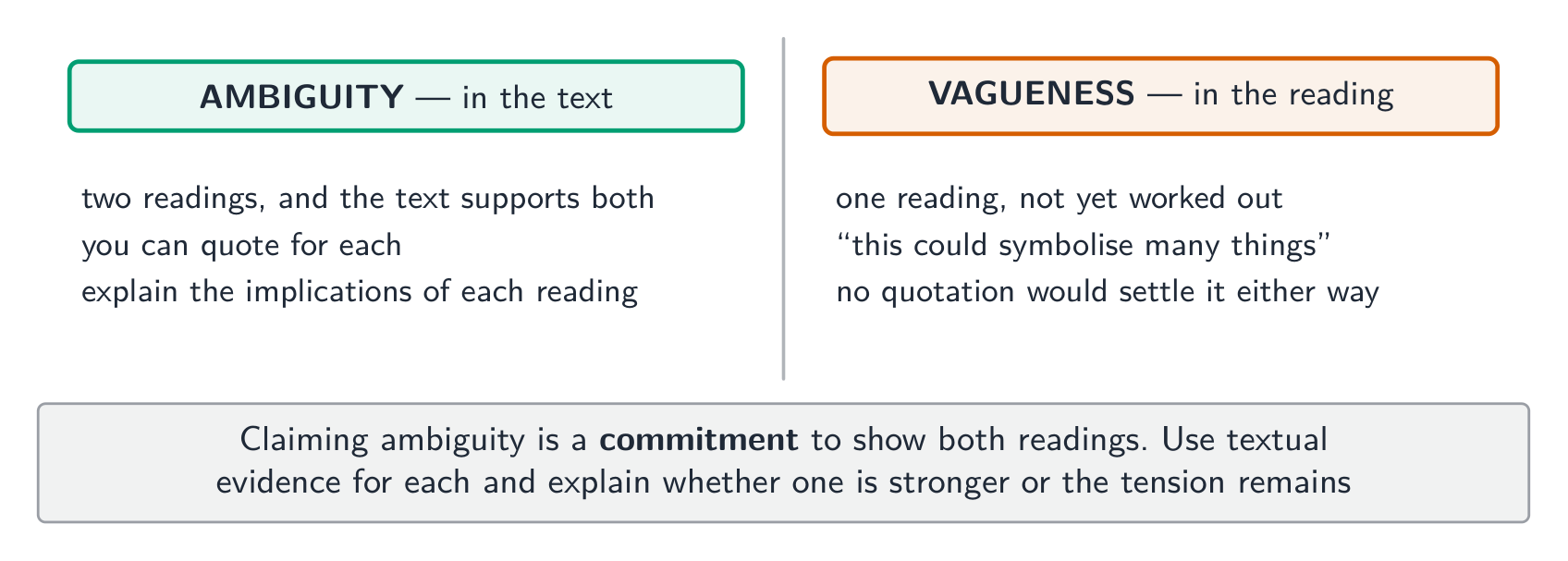
- An essay that chooses only one reading throws away half the evidence. State both, show the text supports each, then explain what holding both does: the king's own words now prove the opposite of what he meant.
这种歧义的运用是否得当?
Sort each treatment by what it does with two possible readings.
Match each reading of "Look on my Works, ye Mighty, and despair!" to its evidence.
难度 2/5 · 今日首次完成可获 140 金币及少量额外奖励
Each reading needs its own evidence from the text.
Ambiguity is local, not general
- "The poem is ambiguous" is not a claim; it describes a feeling. Ambiguity lives in a specific word, phrase or line, and your analysis must quote it.
- One ambiguous word, fully worked out, is worth more than a paragraph about the poem's "mystery". Here, the single word "despair" carries the poem's whole irony.
Which sentence makes a real claim about ambiguity?
难度 1/5 · 今日首次完成可获 100 金币及少量额外奖励
It names the word and both readings.
In an essay, the best move is to choose the likelier reading of an ambiguous line and ignore the other.
难度 1/5 · 今日首次完成可获 100 金币及少量额外奖励
State both, support both, and explain what holding both does.
Model paragraph
Shelley makes the king's boast mean two opposite things at once. Carved for rival rulers, "Look on my Works, ye Mighty, and despair!" orders them to feel hopeless before a power they can never match; the title "King of Kings" supports this proud reading. But the next words of the poem undo it: "Nothing beside remains." The reader now looks for the "Works" and finds only "lone and level sands", so "despair" changes its object from the king's greatness to the fate of all greatness. By keeping the inscription unchanged while its surroundings vanish, Shelley lets time rewrite the king's meaning, and the ambiguity becomes the poem's argument against pride.
- Why it scores: it quotes the exact ambiguous line, supports each reading with evidence, and explains what the double meaning does, which can earn the sophistication point.
"The poem is ambiguous" earns nothing. Quote the word or line, give both readings with evidence, then say why the double meaning matters.
Ambiguity lets different readers read a word, phrase or line in different ways. Locate it precisely, give both readings with evidence, and explain what holding both adds to the meaning. Choosing only one reading throws away half the evidence.
Emily Dickinson begins a poem: "Because I could not stop for Death – / He kindly stopped for me –". Write a short paragraph on two readings of "kindly".
Word, two readings, effect.