| English | 释义 | 拼音 |
|---|---|---|
| significance/sɪɡˈnɪfɪkəns/ | 意义 | yì yì |
| analogy | 类比 | lèi bǐ |
"I would prefer not to", 1853
- In Herman Melville's "Bartleby, the Scrivener", a lawyer hires a quiet copyist. One day Bartleby is asked to check a document and replies: "I would prefer not to." He gives the same answer to every request until he stops working altogether.
- At the end, the lawyer hears that Bartleby once worked in the Dead Letter Office, sorting letters that could never be delivered. "Dead letters! does it not sound like dead men?"
Bartleby answers every request with "I would ____ not to."
难度 1/5 · 今日首次完成可获 100 金币及少量额外奖励
Then he stops working altogether.
Significance
- The significance 意义 of a detail is why it matters to the meaning of the whole work. It answers "so what?"
- The Dead Letter Office is a rumour of one paragraph, yet it changes how we read everything before it.
What question does significance answer?
难度 1/5 · 今日首次完成可获 100 金币及少量额外奖励
Why the detail matters to the whole work.
Analogy carries significance
- An analogy 类比 explains one thing by showing how it is like another. The lawyer himself makes one: Bartleby is like a dead letter.
- A letter carries a message that never reaches anyone; Bartleby is a person whose life never reaches anyone either.
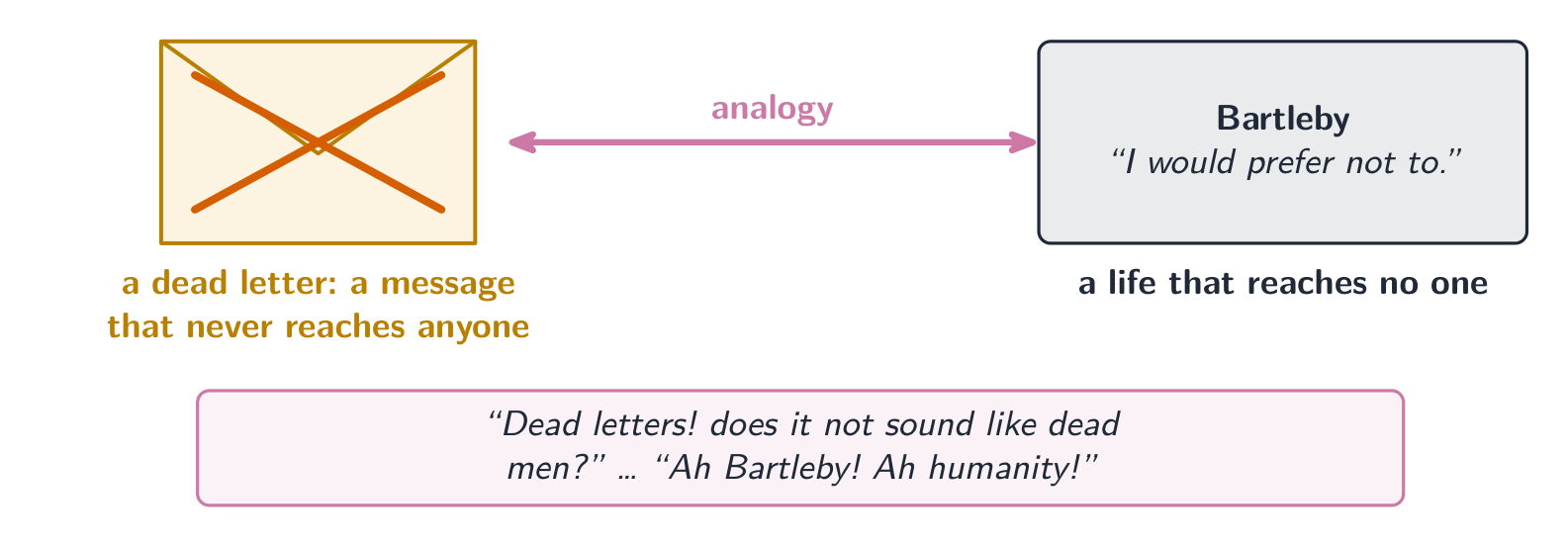
In "Bartleby", the lawyer himself compares dead letters to dead men.
难度 1/5 · 今日首次完成可获 100 金币及少量额外奖励
"Dead letters! does it not sound like dead men?"
Match each side of the analogy.
难度 2/5 · 今日首次完成可获 140 金币及少量额外奖励
The analogy carries the significance.
Worked example: from detail to meaning
- Detail: Bartleby may have sorted dead letters for the government.
- Analogy: like the letters, he is cut off from anyone who could receive him; the lawyer imagines "pardon for those who died despairing".
- Significance: the story stops being about a strange employee and becomes about how a busy world fails to reach the people inside it. The last words widen it: "Ah Bartleby! Ah humanity!"
Move from significance to analogy
The last move of a strong essay generalises without leaving the text behind.
From the character to the world
- Significance often moves outward: from one person to a group, a society or human life in general.
- Melville's last line does this in four words.
How does the last line, "Ah Bartleby! Ah humanity!", widen the story?
难度 1/5 · 今日首次完成可获 100 金币及少量额外奖励
Significance often moves outward.
Ask "so what?" twice
- First: what does this detail show about the character? Second: what does that show about the work's view of the world?
- An analogy is often the bridge between the two.
Put the steps of asking "so what?" twice in order.
难度 3/5 · 今日首次完成可获 200 金币及少量额外奖励
The analogy is often the bridge.
Do not leave significance unstated. Explaining what a detail is ("a rumour about the Dead Letter Office") without saying why it matters leaves the essay half finished.
Significance is why a detail matters to the whole work. Analogies, made by the text or by you, can carry that significance from one character to the wider world. Ask "so what?" twice.
Choose a detail in a text you know. Make an analogy that explains it, and say why it matters to the whole work.
So what, twice.