Emily Dickinson published only about ten poems in her lifetime. After she died in 1886, her sister Lavinia found nearly 1,800 poems in her room, about 800 of them copied into forty small hand-sewn booklets. The first editors, in 1890, changed her dashes and capital letters to look "normal", gave the poems titles, and even cut whole stanzas. Later editions put her choices back, because they are part of how the poems mean. Small choices of form, wording and punctuation are the subject of this unit.
In this unit you will:
tell closed from open forms and explain what a pattern, or a break in it, does;
separate literal meaning from connotations 内涵义 and test each against context;
analyse descriptive words, understatement and hyperbole 夸张;
trace imagery, metaphor and personification 拟人 through a whole poem;
explain an allusion 典故 by what it brings into the new poem.
Most of the unit works on one poem, so that every tool is tested on the same text. Read it now; the line numbers are for reference.
1 Because I could not stop for Death –
2 He kindly stopped for me –
3 The Carriage held but just Ourselves –
4 And Immortality.
5 We slowly drove – He knew no haste
6 And I had put away
7 My labor and my leisure too,
8 For His Civility –
9 We passed the School, where Children strove
10 At Recess – in the Ring –
11 We passed the Fields of Gazing Grain –
12 We passed the Setting Sun –
13 Or rather – He passed Us –
14 The Dews drew quivering and Chill –
15 For only Gossamer, my Gown –
16 My Tippet – only Tulle –
17 We paused before a House that seemed
18 A Swelling of the Ground –
19 The Roof was scarcely visible –
20 The Cornice – in the Ground –
21 Since then – 'tis Centuries – and yet
22 Feels shorter than the Day
23 I first surmised the Horses' Heads
24 Were toward Eternity –
Emily Dickinson, written about 1863. A tippet is a short shoulder cape; tulle is a thin net fabric; a cornice is the decorated top edge of a wall.
The CED's points on form:
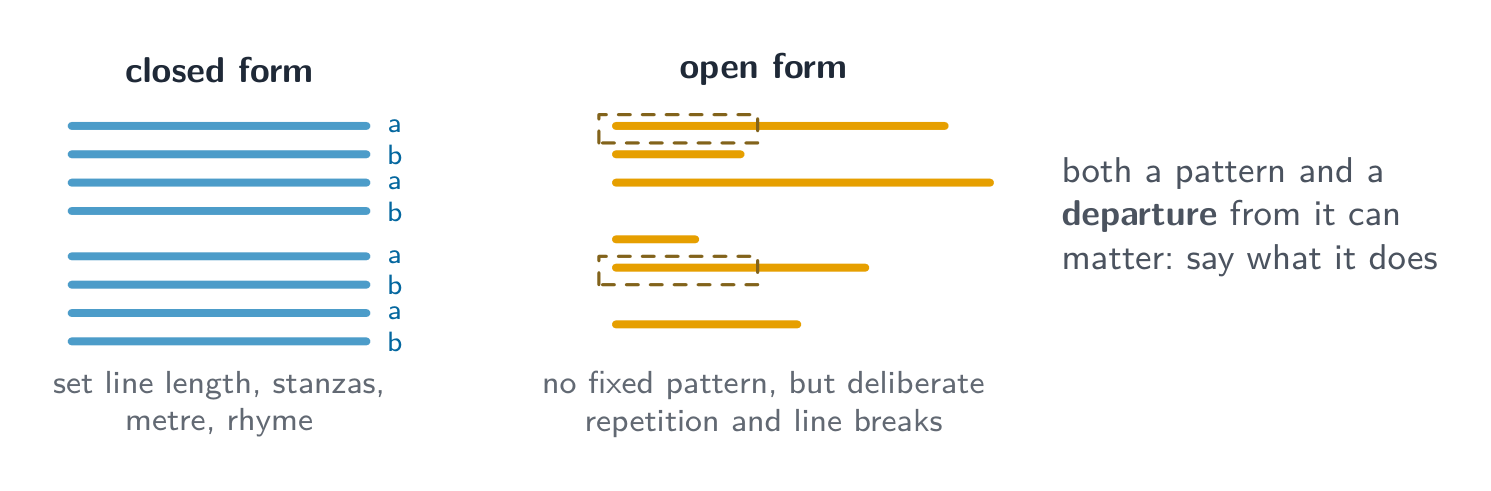
Closed forms 格律诗体 use set patterns of lines, stanzas 诗节, metre 格律 or rhyme 押韵.
Open forms 自由诗体 do not follow a fixed traditional pattern, but they can still use deliberate repetition 重复 and arrangement.
Structures can combine to emphasise ideas. Both a regular pattern and a break from it can matter; neither gives an interpretation 解读 by itself.
Closed and open forms
Worked reading: a closed form. Dickinson's poem is six four-line stanzas in near-hymn metre: lines of eight and six syllables take turns ("Because I could not stop for Death" / "He kindly stopped for me"). The end rhymes 尾韵 are mostly half-rhymes (me / Immortality, away / Civility, Chill / Tulle), so the music is steady but never quite settles. The pattern of the ride is broken once, at line 13: after three lines beginning "We passed", the speaker corrects herself, "Or rather – He passed Us". The form slips at the moment the speaker 说话者 realises that she is no longer moving through life; life is moving past her.
Worked reading: an open form. Walt Whitman's "When I Heard the Learn'd Astronomer" (1865) has no rhyme or regular metre. Four lines begin "When", and they grow longer and more crowded ("When the proofs, the figures, were ranged in columns before me"), like the lecture itself. Then the speaker walks out, and the last line is short and quiet: "Look'd up in perfect silence at the stars." The poem has no fixed pattern, but its arrangement still argues: measured knowledge is long and noisy; wonder is brief and silent.
Words can have a literal meaning 字面意义 and several connotations. Test each possible meaning against the surrounding words; that a dictionary allows a meaning is not enough. You may defend one reading or explain a tension between two.
Worked example. Literally, lines 1–12 describe a slow carriage ride on a fine day with a polite gentleman. Line 17 offers "a House", and lines 18–20 describe it: its roof "scarcely visible", its cornice "in the Ground". A house sunk into the earth is a grave. That detail turns the whole ride into a figurative reading 比喻性解读: the journey from life to the grave, told as a social outing. The literal meaning stays alive beside it, which is why the poem feels calm and strange at once.
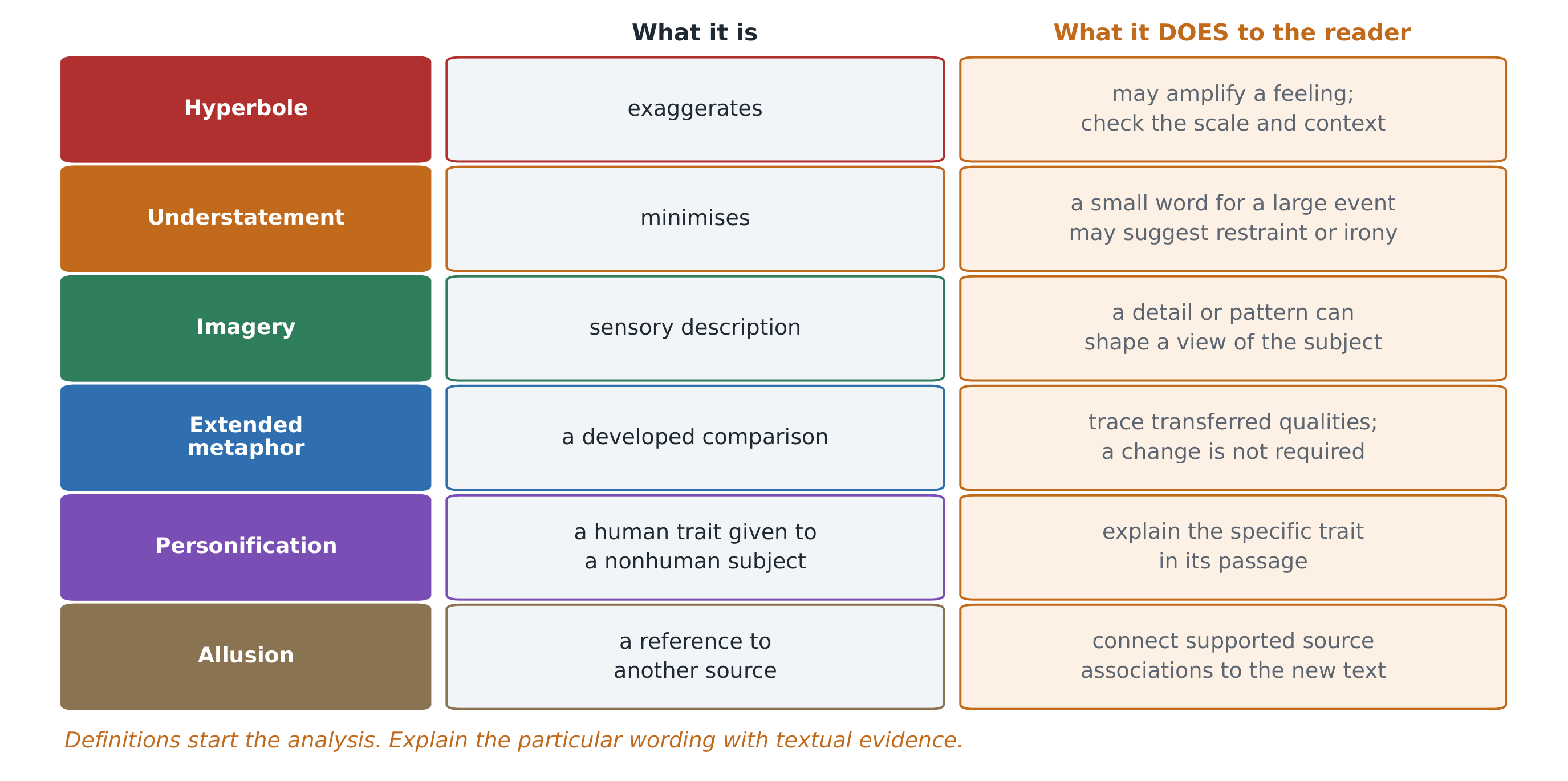
Descriptive words 描述性词语 qualify what they describe and influence how it is seen. Hyperbole exaggerates; understatement 低调陈述 says less than the situation deserves. Neither is always stronger: explain the scale and the context.
Worked example: understatement. Death "kindly stopped" (line 2), and the speaker gives up her work and play "For His Civility" (line 8). These are words for good manners, used for dying. The understatement lets the reader feel the gap: Death's politeness hides the fact that the speaker had no choice.
Worked example: hyperbole. Andrew Marvell's "To His Coy Mistress" (1681) tells a woman how long he would praise her if they had time: "An hundred years should go to praise / Thine eyes." The exaggeration is deliberate and comic, and it sets up the poem's turn: they do not have that time, so they should love now.
An image 意象 can describe a literal sensory detail or work through a comparison. Descriptive words build sensory imagery 感官意象 through sight, sound, touch, taste or smell. A collection of images can develop an idea across a text; one well-placed image can also carry much of the meaning.
Device definitions are starting points; their effects depend on the actual wording.
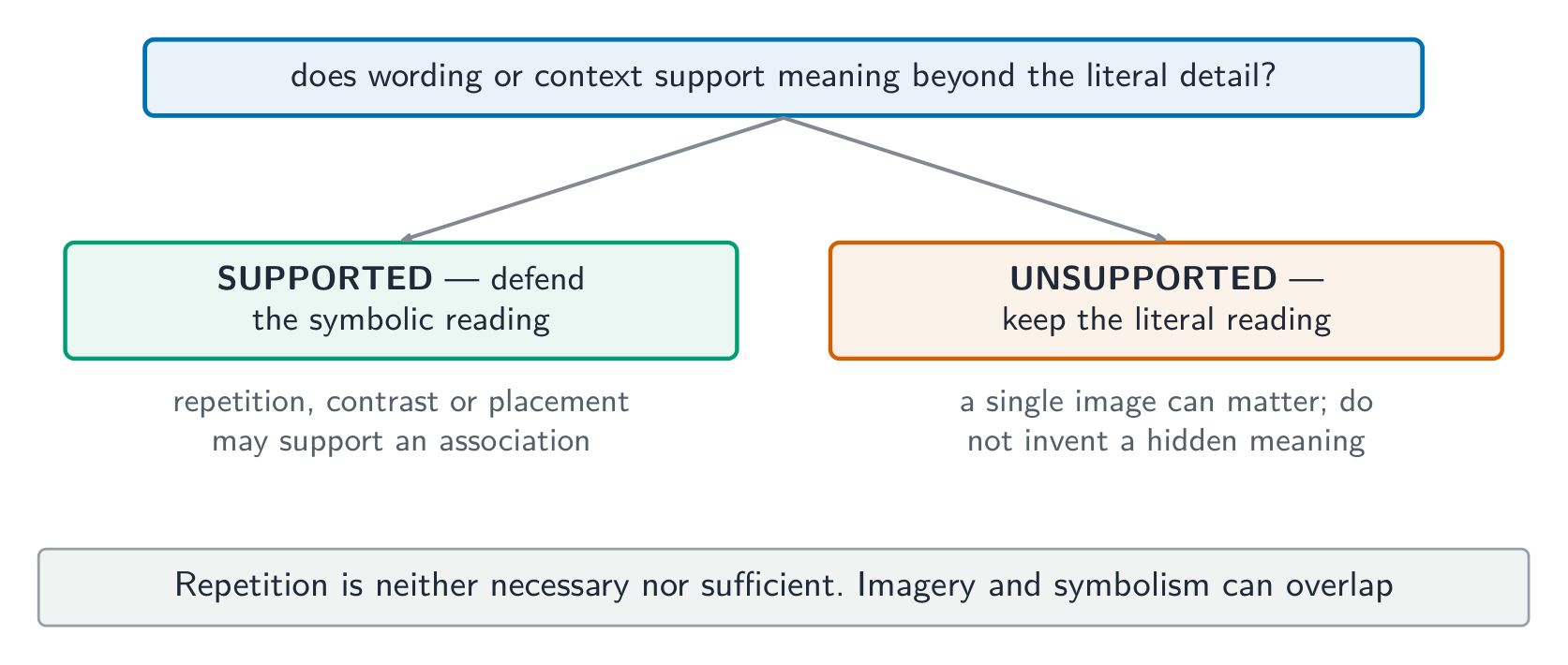
Worked example. Stanza 3 is three images in a row: children playing "in the Ring" at school, "Fields of Gazing Grain", "the Setting Sun". Each is a stage of a life: childhood, ripeness, the end of the day. Stanza 4 adds touch: "The Dews drew quivering and Chill", and her gown is "only Gossamer", her cape "only Tulle". She is dressed for a pleasant drive, perhaps for a wedding, and she is cold. The repeated "only" makes the thinness felt. Imagery and symbolism 象征手法 can overlap here: the "Setting Sun" is a real sunset and also the end of a life.
A symbolic reading needs contextual evidence; repetition is one possible clue.
A metaphor 隐喻 transfers particular qualities between a main subject and a comparison subject. An extended metaphor 延伸隐喻 develops related comparisons across a passage or a whole text. Trace the qualities transferred and their limits.
Worked example. The poem's extended metaphor is dying as a carriage ride with a gentleman caller. The carriage "held but just Ourselves – / And Immortality", like a courting couple with a chaperone; the speaker has "put away" her work; they drive slowly. Each detail carries a quality of courtship across to death: it is calm, polite, perhaps even romantic. The grave as "a House" extends the metaphor to its end: the ride arrives at a new home. What the metaphor leaves out (pain, fear, a deathbed) is part of what it says.
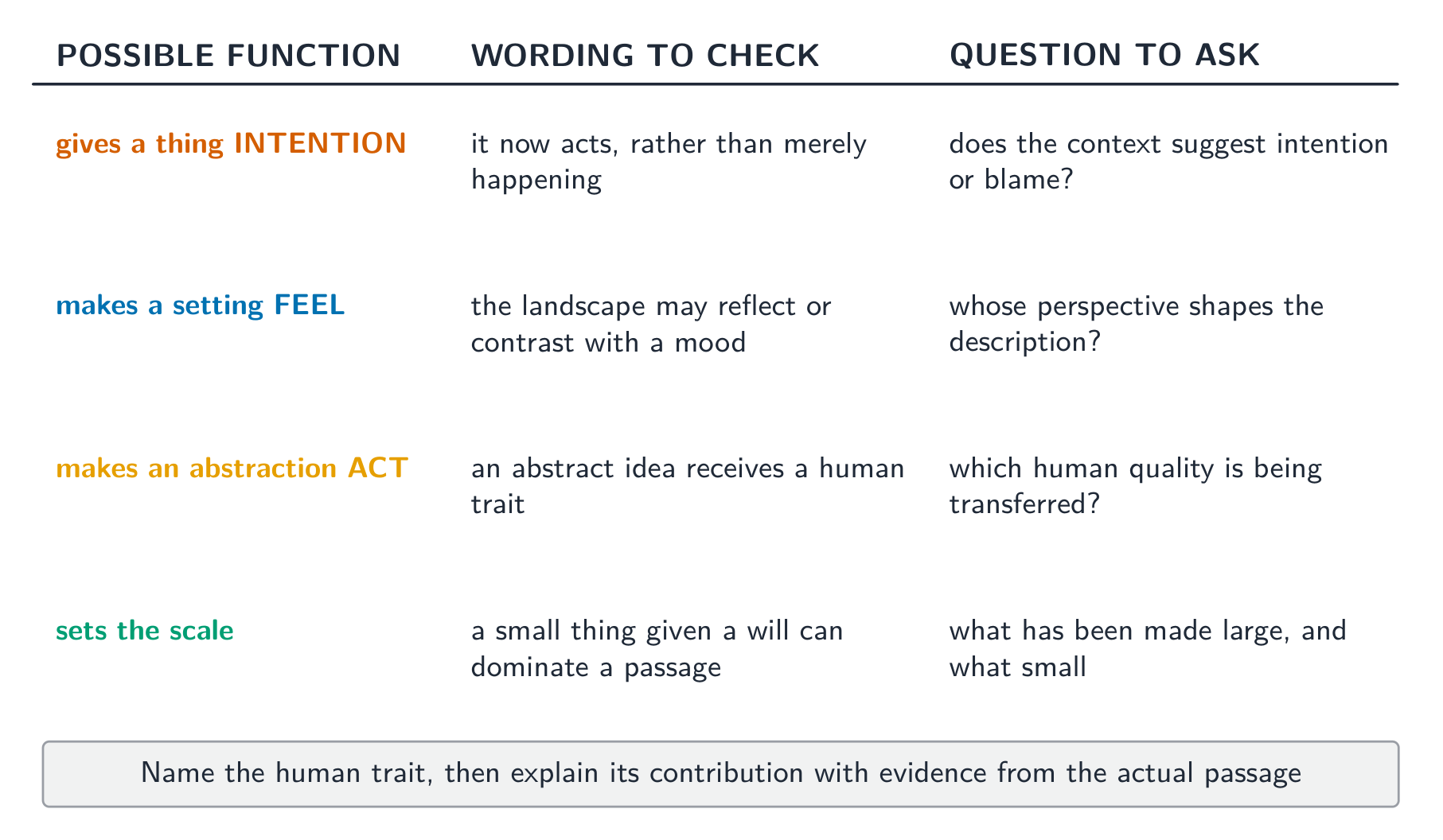
Personification gives a human trait to a nonhuman object, animal or idea. Name the exact trait before explaining what it does.
Worked example. Death is a gentleman: he "kindly stopped", he "knew no haste", he has "Civility". The trait is politeness, and its function is double. It makes death less frightening, and it hides force behind manners: one does not refuse a kind gentleman. By line 13 the courtesy no longer comforts: "He passed Us" makes the speaker passive as the cold comes in.
Explain the specific human trait and its contribution in context.
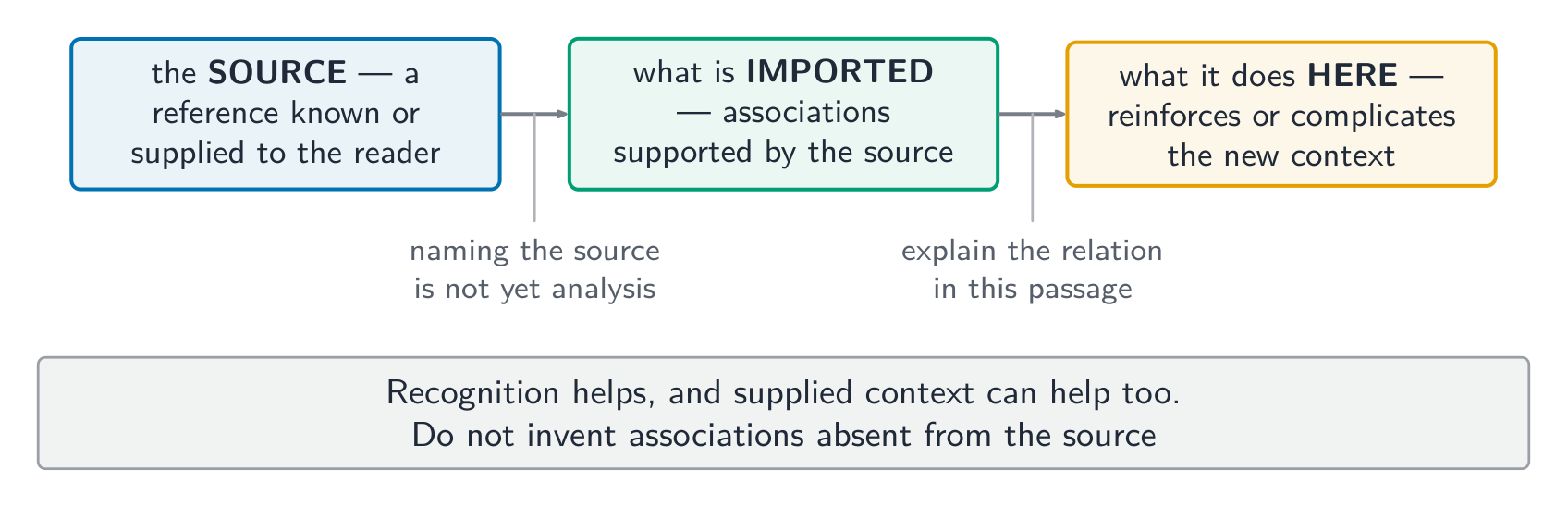
Allusions refer to other works, myths, sacred texts, art or historical events. A recognised reference brings its associations into the new text. Given context can help a reader understand it; do not invent knowledge of the source.
Worked example. Wilfred Owen's "Dulce et Decorum Est" (written 1917, published 1920) describes soldiers in a gas attack and a man dying in agony. It ends:
My friend, you would not tell with such high zest
To children ardent for some desperate glory,
The old Lie: Dulce et decorum est
Pro patria mori.
Context: the Latin is from the Roman poet Horace (Odes 3.2): "It is sweet and fitting to die for one's country." The line was well known in Owen's time and was used to encourage young men to fight.
What the allusion imports. Two thousand years of honour, a schoolroom motto, the voice of tradition.
What the new poem does with it. Owen sets the motto after the image of a choking man, so "sweet" and "fitting" become impossible to believe. He calls it "The old Lie".
The effect. The allusion is not decoration: the poem's whole argument is the clash between the quoted ideal and the described death.
Use source associations and new context together; recognition alone is not analysis.
A thesis 论题 presents an interpretation that can be defended with textual evidence 文本证据. It may preview the line of reasoning; a list of literary devices 文学手法 alone does not explain a meaning.
Prompt. Explain how structure and figurative language convey the speaker's changing understanding of death in "Because I could not stop for Death".
Weak start: "The poem uses personification, imagery and rhyme." This names features but gives no interpretation.
Defensible thesis: "Dickinson presents death as a polite gentleman caller, but as the ride passes from children and sunlight into cold and a sunken house, the poem lets the reader see what the courteous metaphor was hiding: the speaker had no choice and no return." It can be tested against the verbs, the imagery and the break at line 13.
A line of reasoning 推理线索 links claims in support of the thesis. Commentary 评析 explains how particular evidence supports each claim; it goes beyond paraphrase 转述 and naming devices.
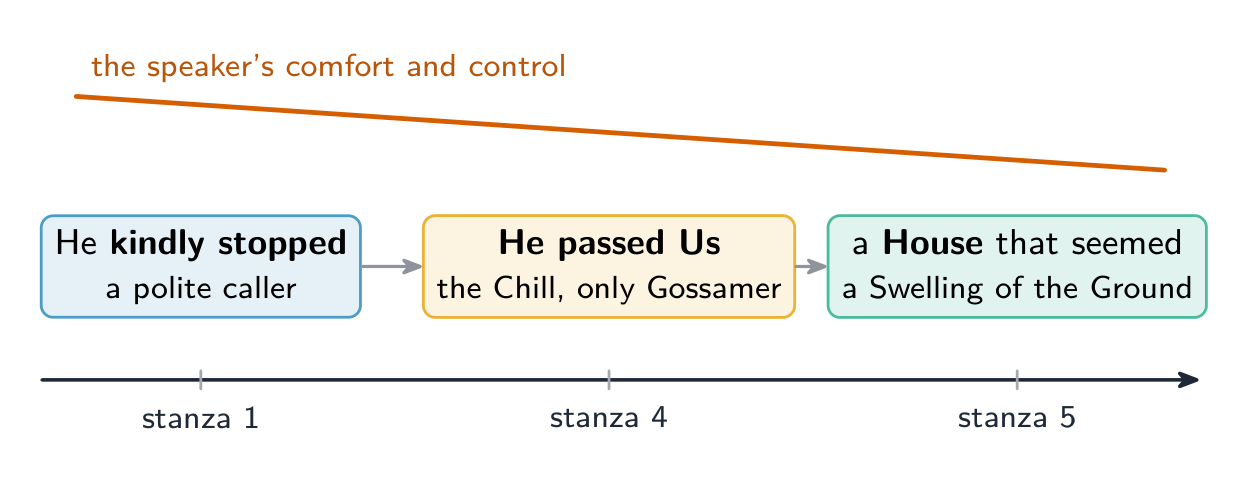
Worked paragraph.Dickinson first makes death feel like a favour. Death "kindly stopped", and the speaker gave up her "labor and my leisure too, / For His Civility", as if accepting an invitation. The pattern of the ride then breaks: after three lines of "We passed", she corrects herself, "Or rather – He passed Us". The correction moves her from traveller to object, and the cold arrives in the same stanza: "quivering and Chill", in a gown of "only Gossamer". The politeness of the opening is not false, but it was never protection; it was the manner in which she was taken.
The verbs carry the commentary: from "kindly stopped" to "He passed Us" to a house in the ground
Choose evidence for the claim you are making. Evidence must be accurate, relevant and sufficient, with commentary explaining what it contributes. Interpretation is recursive: revise a claim when another line complicates it. No fixed number of quotations fits every task.
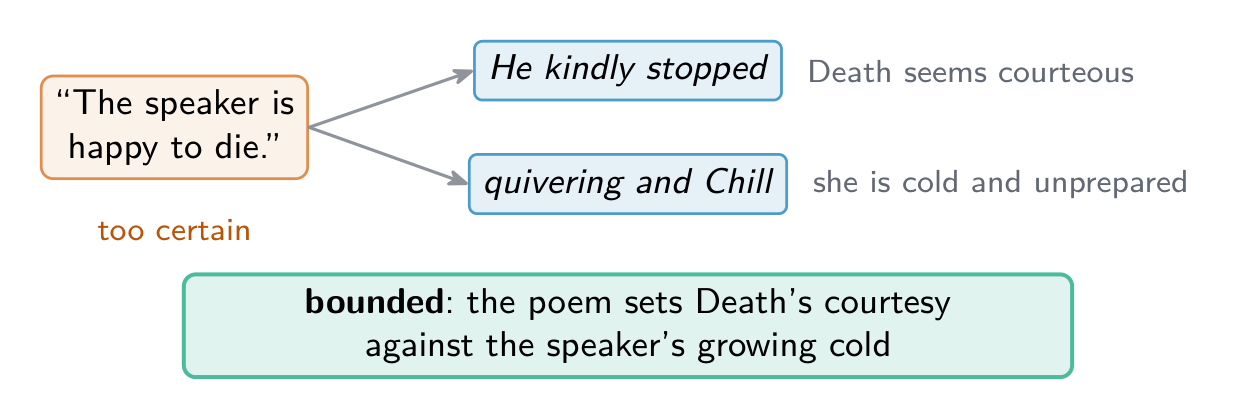
Worked revision. "The speaker is happy to die" is too certain. "He kindly stopped" supports courtesy, but "quivering and Chill" and "only Gossamer" show that she is cold and unprepared. A better, bounded claim: the poem sets Death's courtesy against the speaker's growing cold. A paragraph about change needs evidence from more than one moment, not only the first stanza.
Let the evidence bound the claim: courtesy in stanza 1, cold in stanza 4
Transitional elements 过渡成分 link ideas through words, clauses, sentences or paragraphs. Choose a connection that matches the reasoning; a connector cannot create a relation the text does not support.
Worked connection. "In stanza 1, Death 'kindly stopped' for the speaker. By contrast, in stanza 4 'He passed Us', and she is left in the cold." The contrast lies in the two quoted actions. "Therefore" would need a cause, not just a change from one stanza to another.
The poem's history: what the first editors changed
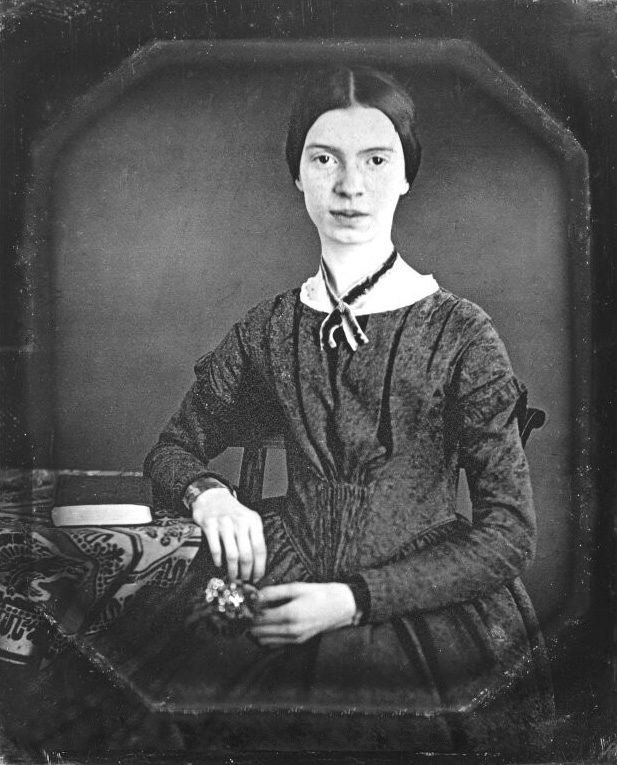
Emily Dickinson in her only authenticated adult photograph, a daguerreotype of about 1847
When the poem was first printed in 1890, the editors titled it "The Chariot", removed most of the dashes, and left out stanza 4 entirely. They also rewrote lines 9–10 as "We passed the school where children played, / Their lessons scarcely done": the children no longer "strove" (struggled), and the circle of the "Ring" disappeared.
Worked analysis.
The missing stanza. Without stanza 4, there is no "Or rather – He passed Us" and no cold. The poem becomes a gentle ride to a gentle grave, and the break in the pattern is gone.
The dashes. Dickinson's dashes interrupt the movement, so the ride feels measured and uneasy at once. Smoothing them out makes the poem sound more certain than it is.
The ending. "Since then – 'tis Centuries – and yet / Feels shorter than the Day": the speaker has been dead for centuries, but they feel shorter than the single day she first "surmised" (guessed) where the horses were heading. The moment of understanding outlasts eternity.
Claim: The editors' changes show what Dickinson's version achieves: by keeping the stanza where the ride turns cold, she makes the poem not a comfort about death but a slow discovery of what the comfort concealed.
Naming a form without its function. Say what the pattern, or the break in it, does to the reader.
Keeping every meaning a word can have. Test each meaning against the context.
Treating understatement as weak. Saying less can make the reader feel more.
Analysing one image at a time. Look for the sequence that images build.
Spotting an allusion and stopping. Explain what it brings in and what the new text does with it.
A thesis that lists devices. State what the poem means and how.
5.11
关键术语
English
closed form: a poem that follows a set pattern of metre or rhyme.
open form: a poem that does not follow a fixed pattern of metre or rhyme.
metre: the pattern of stressed and unstressed syllables in a line.
end rhyme: rhyme between the last words of lines.
connotation: a feeling or idea that a word suggests beyond its literal meaning.
hyperbole: deliberate exaggeration.
understatement: saying less than the situation deserves, so the gap carries meaning.
sensory imagery: detail that lets a reader see, hear, touch, taste or smell a scene.
extended metaphor: a comparison that is carried through several lines or a whole poem.
personification: giving human actions or feelings to something that is not human.
allusion: a brief reference to another text, person or event the reader may know.
transitional element: a word or phrase that shows how two ideas are related.
5.11
自我检测
English
Read Ezra Pound's "In a Station of the Metro" (1913), written after Pound saw a crowd of faces in a Paris underground station:
The apparition of these faces in the crowd;
Petals on a wet, black bough.
What is the main subject and what is the comparison subject? Is this a simile or a metaphor?
Which qualities are transferred?
How does the poem's structure support the comparison?
Answers: 1. The faces in the crowd are the main subject; petals on a wet, black branch are the comparison subject. There is no "like" or "as", so it is a metaphor (some readers call it an implied simile). 2. Paleness and brightness against darkness, delicacy, and the briefness of something seen for a moment; "apparition" adds a ghostly quality, as if the faces appear and vanish. 3. The poem is only two lines. The first line, with the semicolon, presents the scene; the second gives the image, with no verb at all. Placing them side by side, without explaining, makes the reader see the faces and the petals at once, as quickly as Pound saw them.
5.11
本课资料
English
College Board, AP English Literature and Composition Course and Exam Description, Unit 5.
Emily Dickinson, "Because I could not stop for Death" (written about 1863; first printed 1890 as "The Chariot").
Walt Whitman, "When I Heard the Learn'd Astronomer" (1865).
Andrew Marvell, "To His Coy Mistress" (1681).
Wilfred Owen, "Dulce et Decorum Est" (1920); Horace, Odes 3.2.