跳到主要内容

长篇小说或戏剧 三

AP 英语文学与写作 · 第 9 主题

训练
讲义 词汇表
9.1

人物的变化与不变

大纲
Enduring UnderstandingLearning ObjectiveEssential Knowledge

CHR-1
Characters in literature allow readers to study and explore a range of values, beliefs, assumptions, biases, and cultural norms represented by those characters.

1.B
Explain the function of a character changing or remaining unchanged.

  • CHR-1.AE Minor characters often remain unchanged because the narrative doesn’t focus on them. They may only be part of the narrative to advance the plot or to interact with major characters.
  • CHR-1.AF Readers’ interpretations of a text are often affected by a character changing—or not—and the meaning conveyed by such changes or lack thereof.

来源:美国大学理事会 AP 课程与考试说明

第九单元是最后一个单元,它的主题是文本如何结束——以及一个结尾允许读者就整部作品得出什么结论。

  • 次要人物往往保持不变,因为叙事并不聚焦于他们;他们可能承担其他功能。
  • 读者的阐释常常受到某个人物是否变化、以及这一变化性质如何的影响。

第二点正是整门课程一直在铺垫的那个阐释动作。一个人物是否变化不是一项有待报告的事实;它是一种读法赖以立足的基础。

9.2

选择、行动与言语揭示的复杂性

大纲
Enduring UnderstandingLearning ObjectiveEssential Knowledge

CHR-1
Characters in literature allow readers to study and explore a range of values, beliefs, assumptions, biases, and cultural norms represented by those characters.

1.E
Explain how a character’s own choices, actions, and speech reveal complexities in that character, and explain the function of those complexities.

  • CHR-1.AG A character’s responses to the resolution of the narrative—in their words or in their actions—reveal something about that character’s own values; these responses may be inconsistent with the previously established behaviors or perspectives of that character.
  • CHR-1.AH Inconsistencies and unexpected developments in a character affect readers’ interpretation of that character; other characters; events in the plot; conflicts; the perspective of the narrator, character, or speaker; and/or setting.

来源:美国大学理事会 AP 课程与考试说明

  • 人物对叙事结局的反应——无论在言语还是在行动中——都很能说明问题。
  • 人物身上的不一致与出人意料的发展会影响读者的阐释。

一个人物在危机被解决之后如何行事,往往是文本中最压缩的证据,却几乎总是被忽略,因为到那时读者正在收尾。

9.3

情节中的重要事件

大纲
Enduring UnderstandingLearning ObjectiveEssential Knowledge

STR-1
The arrangement of the parts and sections of a text, the relationship of the parts to each other, and the sequence in which the text reveals information are all structural choices made by a writer that contribute to the reader’s interpretation of a text.

3.E
Explain the function of a significant event or related set of significant events in a plot.

  • STR-1.AI Significant events often illustrate competing value systems that relate to a conflict present in the text.
  • STR-1.AJ Events in a plot collide and accumulate to create a sense of anticipation and suspense.

来源:美国大学理事会 AP 课程与考试说明

  • 重要事件常常展示与文本中某一冲突相关的相互竞争的价值体系。
  • 事件相互碰撞并累积,造就期待与悬念(anticipation and suspense)。

注意累积。悬念不是由单一事件产生的,而是由一连串不断收窄"还可能发生什么"的事件产生的。

9.4

冲突在文本中的作用

大纲
Enduring UnderstandingLearning ObjectiveEssential Knowledge

STR-1
The arrangement of the parts and sections of a text, the relationship of the parts to each other, and the sequence in which the text reveals information are all structural choices made by a writer that contribute to the reader’s interpretation of a text.

3.F
Explain the function of conflict in a text.

  • STR-1.AK The resolution of the anticipation, suspense, or central conflicts of a plot may be referred to as the moment of catharsis or emotional release.
  • STR-1.AL Sometimes things not actually shown in a narrative, such as an unseen character or a preceding action, may be in conflict with or result in conflict for a character.
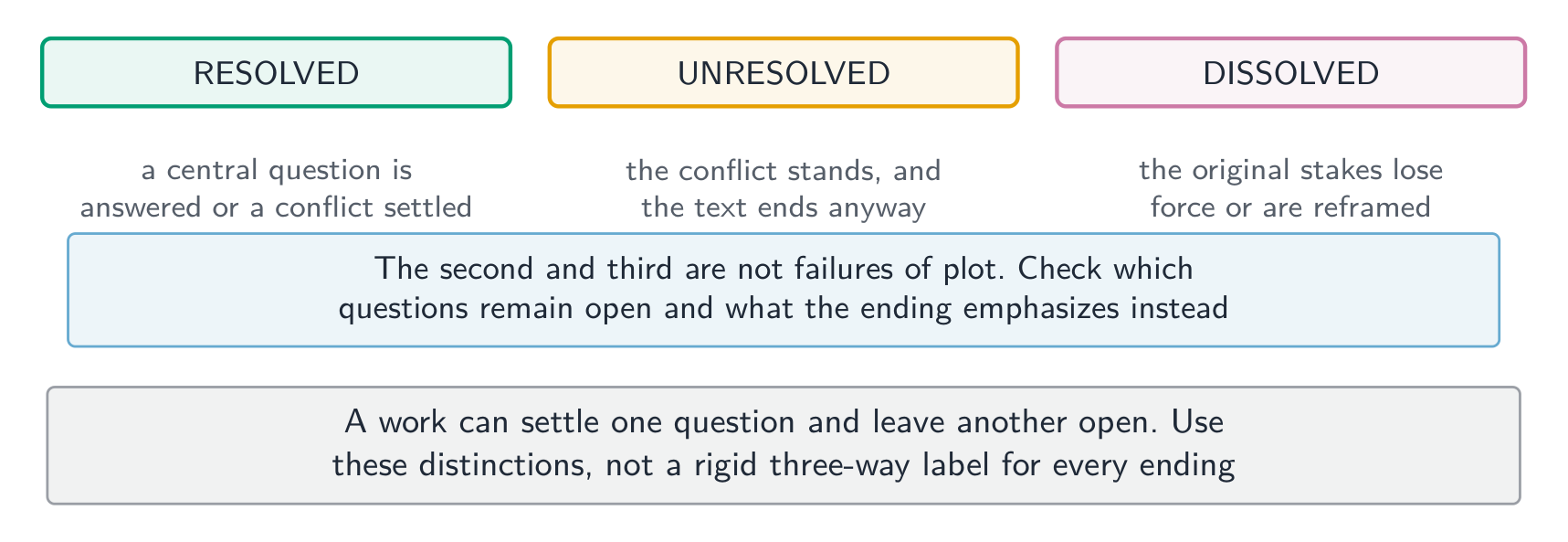
  • STR-1.AM Although most plots end in resolution of the central conflicts, some have unresolved endings, and the lack of resolution may contribute to interpretations of the text.

来源:美国大学理事会 AP 课程与考试说明

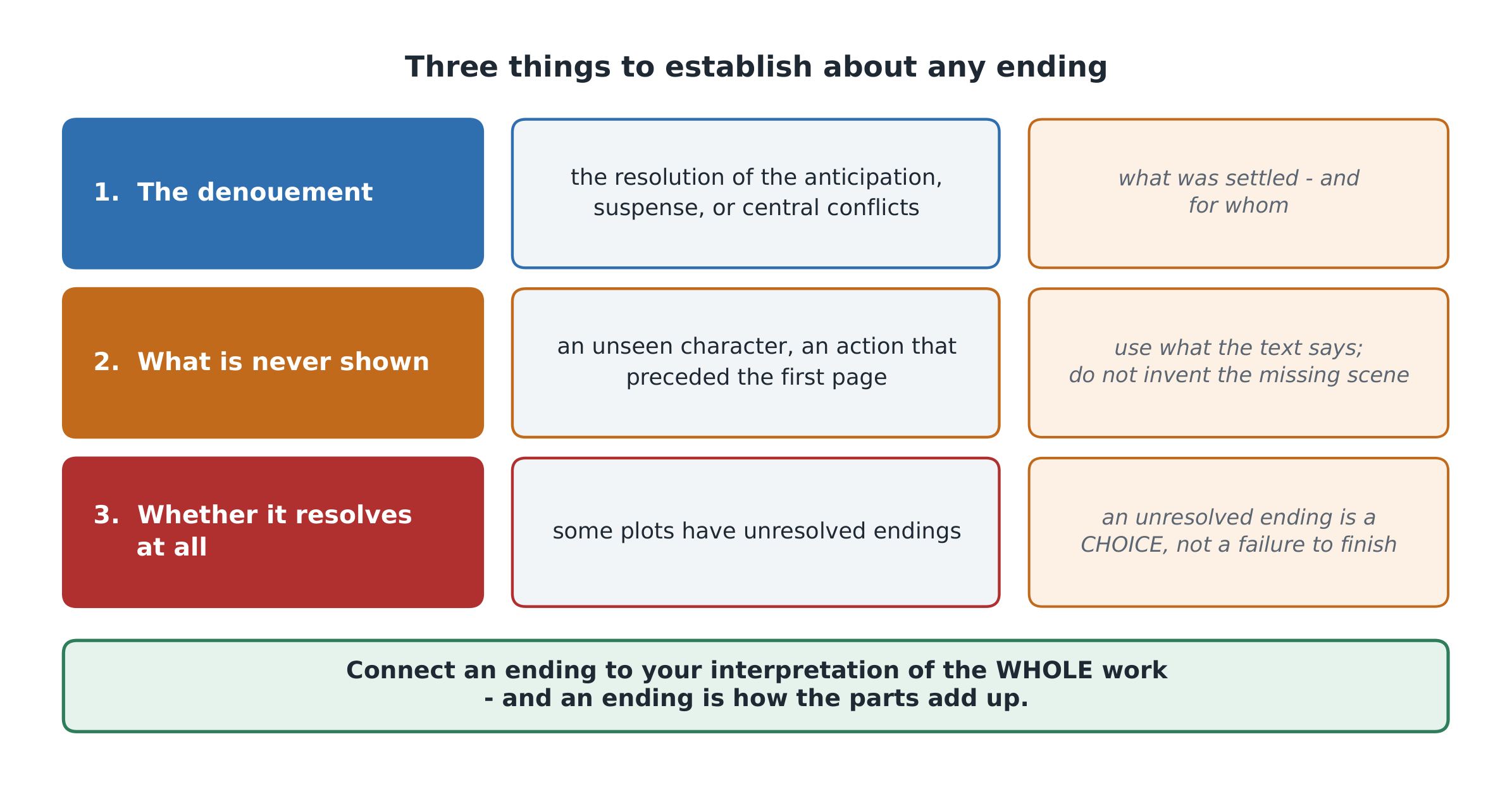
关于任何结尾都要确立的三件事——而第三件是多数答案会漏掉的那一件
什么被解决了,什么从未被呈现,以及文本究竟是否作出了解决
  • 情节中期待、悬念或中心冲突的解决,可以称为结局(denouement)。
  • 有时叙事中并未真正呈现的东西——一个未出场的人物、一次先于开篇的行动——会影响对所呈现之物的阐释
  • 尽管多数情节以解决收场,有些则有开放式结局(unresolved endings),而这同样影响阐释。

中间那一点是最少被使用、也往往最有力的一点。文本置于幕后的东西——发生在第一页之前的一场死亡、一个被反复谈论却从未出场的人物——塑造着读者所看到的一切,而它与任何其他文本证据一样,就是证据。

词汇表 训练
英文 中文 拼音
Events collide and accumulate to create anticipation and suspense 期待与悬念 qī dài yǔ xuán niàn
denouement 结局 jié jú
Although most plots end in resolution, some have unresolved endings 开放式结局 kāi fàng shì jié jú
9.5

细节、措辞与句法揭示的立场

大纲
Enduring UnderstandingLearning ObjectiveEssential Knowledge

NAR-1
A narrator’s or speaker’s perspective controls the details and emphases that affect how readers experience and interpret a text.

4.C
Identify and describe details, diction, or syntax in a text that reveal a narrator’s or speaker’s perspective.

  • NAR-1.X Multiple, and even contrasting, perspectives can occur within a single text and contribute to the complexity of the text.
  • NAR-1.Y A narrator or speaker may change over the course of a text as a result of actions and interactions.
  • NAR-1.Z Changes and inconsistencies in a narrator’s or speaker’s perspective may contribute to irony or the complexity of the text.

来源:美国大学理事会 AP 课程与考试说明

  • 单一文本中可以出现多重、甚至相互对照的视角,并促成其复杂性。
  • 叙述者或说话者可能在文本进程中因行动与互动而发生变化。
  • 叙述者或说话者视角上的变化与不一致,可能促成反讽,或影响读者对其可靠性的判断。

一个发生变化的叙述者是双重可分析的:既作为一个发展了的人物,也作为一片改变了的镜片。当镜片改变时,此前透过它所看到的一切都被追溯性地重新照亮。

9.6

撰写文学论点句

大纲
Enduring UnderstandingLearning ObjectiveEssential Knowledge

LAN-1
Readers establish and communicate their interpretations of literature through arguments supported by textual evidence.

7.B
Develop a thesis statement that conveys a defensible claim about an interpretation of literature and that may establish a line of reasoning.

  • LAN-1.D A thesis statement expresses an interpretation of a literary text, and requires a defense, through use of textual evidence and a line of reasoning, both of which are explained in an essay through commentary.
  • LAN-1.E A thesis statement may preview the development or line of reasoning of an interpretation. This is not to say that a thesis statement must list the points of an interpretation, literary elements to be analyzed, or specific evidence to be used in the argument.

来源:美国大学理事会 AP 课程与考试说明

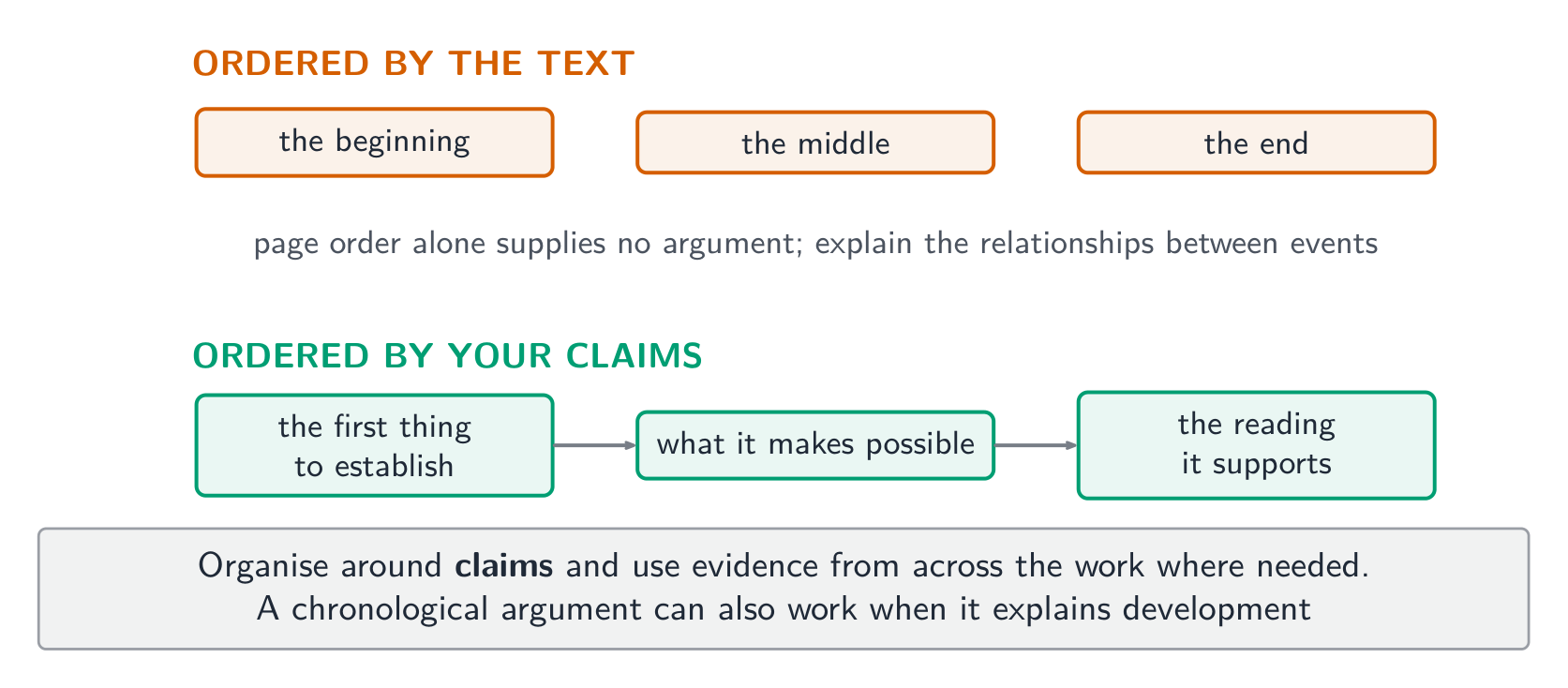
不变:一项需要文本辩护的阐释,并可以预示推理线索。到这一阶段,你所要瞄准的论点是一个在读完整部作品之前写不出来的论点——一项关于各部分如何合起来的主张。
9.7

撰写评述

大纲
Enduring UnderstandingLearning ObjectiveEssential Knowledge

LAN-1
Readers establish and communicate their interpretations of literature through arguments supported by textual evidence.

7.C
Develop commentary that establishes and explains relationships among textual evidence, the line of reasoning, and the thesis.

  • LAN-1.F A line of reasoning is the logical sequence of claims that work together to defend the overarching thesis statement.
  • LAN-1.G A line of reasoning is communicated through commentary that explains the logical relationship between the overarching thesis statement and the claims/evidence within the body of an essay.
  • LAN-1.U More sophisticated literary arguments may explain the significance or relevance of an interpretation within a broader context, discuss alternative interpretations of a text, or use relevant analogies to help an audience better understand an interpretation.

来源:美国大学理事会 AP 课程与考试说明

  • 推理线索是为论点辩护的主张序列,通过评述来传达。
  • 更成熟的文学论证会说明一项阐释的意义或相关性。

尤其是第三题的文学论证,题干中的说法几乎总是*「对整部作品的一种阐释」*。这个说法是一项要求:你的主张必须是关于整体的,而你所分析的段落或人物必须被显示为与之相关。

9.8

选取贴切且充分的证据

大纲
Enduring UnderstandingLearning ObjectiveEssential Knowledge

LAN-1
Readers establish and communicate their interpretations of literature through arguments supported by textual evidence.

7.D
Select and use relevant and sufficient evidence to both develop and support a line of reasoning.

  • LAN-1.H Writers use evidence strategically and purposefully to illustrate, clarify, exemplify, associate, amplify, or qualify a point.
  • LAN-1.I Evidence is effective when the writer of the essay uses commentary to explain a logical relationship between the evidence and the claim.
  • LAN-1.J Evidence is sufficient when its quantity and quality provide apt support for the line of reasoning.
  • LAN-1.K Developing and supporting an interpretation of a text is a recursive process; an interpretation can emerge from analyzing evidence and then forming a line of reasoning, or the interpretation can emerge from forming a line of reasoning and then identifying relevant evidence to support that line of reasoning.

来源:美国大学理事会 AP 课程与考试说明

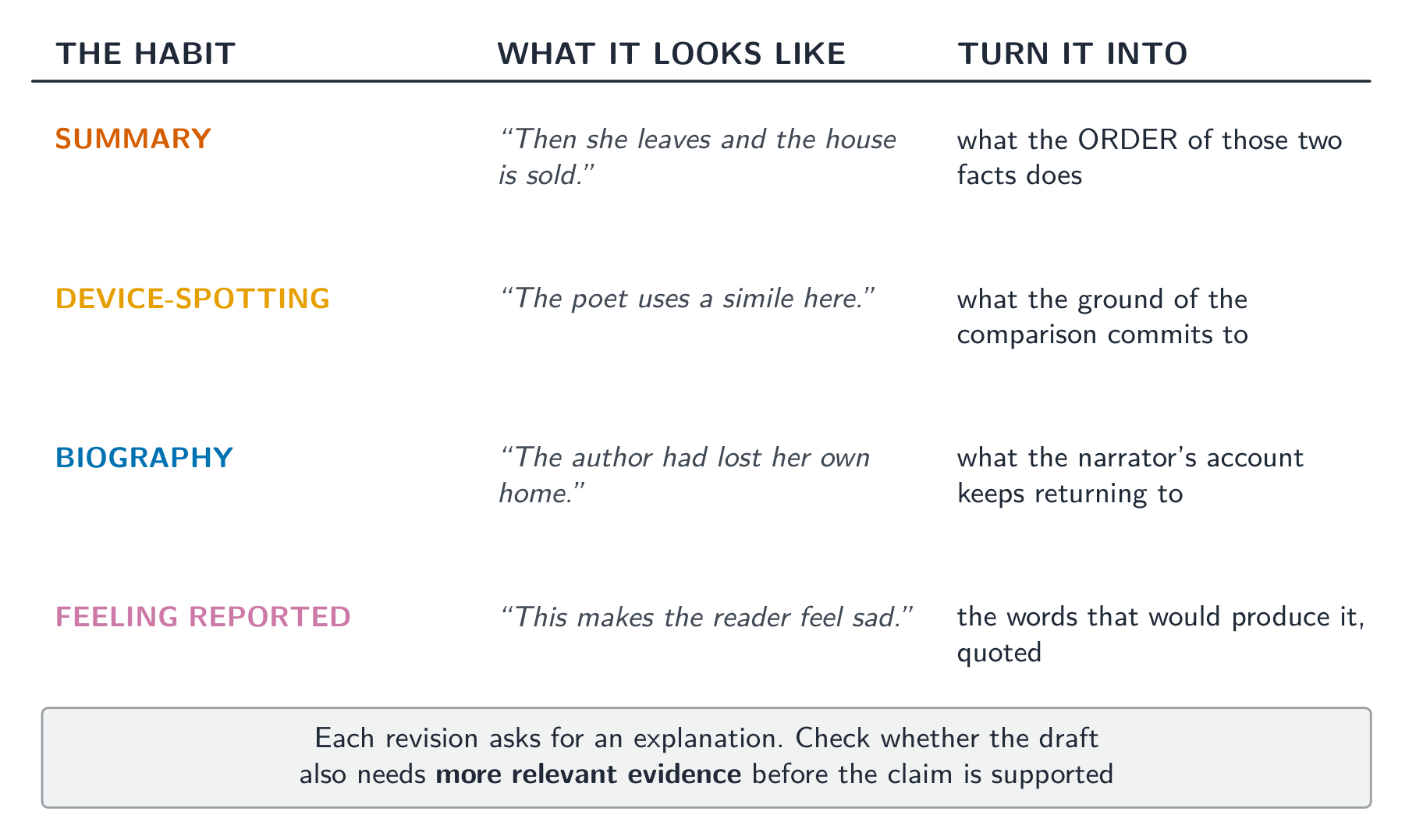
策略性地使用证据;有评述才有效;在数量与质量上充分;而阐释要反复推敲,在证据不支持时加以修改。

**Worked example(一道真实的 AP 考题)。**第三题要求你自选一部作品,其中某个人物对结局的反应促成了对整部作品的一种阐释。薄弱答案会描述结尾。能得分的答案会用上开放式结局与幕后之物:*「这部小说拒绝给出结局:审判的判决从未被交代,而那位其死亡启动了整个情节的兄弟从未出场。我们被呈现的,是主人公在接下来的星期一回去上班。由于文本既扣下了判决,也扣下了起因,那个平常的星期一便成了衡量已发生之事的唯一可用尺度——而这部小说所支持的阐释是:这场失去从来就不会由某个结果来了结,只会被吸收。」*一个开放式结局、一个幕后的起因,以及一项关于整体的主张。

9.8

考试技巧

  • 一个人物是否变化是一种读法的基础,而不是有待报告的事实。
  • 人物在危机之后如何行事是压缩的证据,而且几乎总是被忽略。
  • 悬念是累积而来的。它来自一连串不断收窄可能性的事件,而不是某一个事件。
  • 从未被呈现的东西——未出场的人物、先前的行动——就是文本证据。要用上它。
  • 开放式结局是一个有意味的选择,而不是没能写完。
  • 第三题要的是**"整部作品"**。这是一项要求,也是多数答案不足之处。

本主题的互动课程

逐步学习,并即时检测练习。

AP 英语文学与写作的更多主题

登录或创建账号

IGCSE, A-Level & AP