跳到主要内容

短篇小说 二

AP 英语文学与写作 · 第 4 主题

训练
讲义 词汇表
4.1

文本细节所揭示的人物

大纲
Enduring UnderstandingLearning ObjectiveEssential Knowledge

CHR-1
Characters in literature allow readers to study and explore a range of values, beliefs, assumptions, biases, and cultural norms represented by those characters.

1.A
Identify and describe what specific textual details reveal about a character, that character’s perspective, and that character’s motives.

  • CHR-1.O The significance of characters is often revealed through their agency and through nuanced descriptions.
  • CHR-1.P Characters’ choices—in speech, action, and inaction— reveal what they value.

来源:美国大学理事会 AP 课程与考试说明

第四单元带着大得多的工具箱回到短篇小说。它最有价值的两项新增是叙述距离,以及"选择揭示价值"这一观念。

  • 人物的重要性常常通过其能动性(agency)与细致入微的描写得以揭示。
  • 人物的选择——在言语、作为与不作为中——揭示其所看重之物(reveal what they value)。

第二句是整门课程中对写论述文最实用的一句话。每当你需要一项关于某个人物的主张时,就去看一个选择,并问:必须有什么是真的,这个选择对此人才说得通?

词汇表 训练
英文 中文 拼音
agency 能动性 néng dòng xìng
Characters' choices - in speech, action, and inaction - reveal what they value 揭示其所看重之物 jiē shì qí suǒ kàn zhòng zhī wù
4.2

对比性人物的作用

大纲
Enduring UnderstandingLearning ObjectiveEssential Knowledge

CHR-1
Characters in literature allow readers to study and explore a range of values, beliefs, assumptions, biases, and cultural norms represented by those characters.

1.C
Explain the function of contrasting characters.

  • CHR-1.Q The main character in a narrative is the protagonist; the antagonist in the narrative opposes the protagonist and may be another character, the internal conflicts of the protagonist, a collective (such as society), or nature.
  • CHR-1.R Protagonists and antagonists may represent contrasting values.

来源:美国大学理事会 AP 课程与考试说明

  • 叙事中的主要人物是主人公(protagonist);对立者(antagonist)与之相对。
  • 主人公与对立者可能代表相互对照的价值。

可能这个词用得谨慎。对立者未必是反派;最有力的对立者持有一种读者也能承认为善的价值,这正是那场冲突之所以是冲突而非碾压的原因。

词汇表 训练
英文 中文 拼音
protagonist 主人公 zhǔ rén gōng
antagonist 对立者 duì lì zhě
Conflict among characters often arises from tensions generated by their different value systems 价值体系 jià zhí tǐ xì
A setting may help establish the mood and atmosphere 情绪与氛围 qíng xù yǔ fēn wéi
4.3

人物关系中的微妙之处

大纲
Enduring UnderstandingLearning ObjectiveEssential Knowledge

CHR-1
Characters in literature allow readers to study and explore a range of values, beliefs, assumptions, biases, and cultural norms represented by those characters.

1.D
Describe how textual details reveal nuances and complexities in characters’ relationships with one another.

  • CHR-1.S Conflict among characters often arises from tensions generated by their different value systems.

来源:美国大学理事会 AP 课程与考试说明

人物之间的冲突往往源于他们不同的价值体系(value systems)所产生的张力

这是第三单元的定义在关系上的应用。两个长期不合的人物,他们真正的分歧通常先于他们正在进行的那场争论。
4.4

环境在叙事中的作用

大纲
Enduring UnderstandingLearning ObjectiveEssential Knowledge

SET-1
Setting and the details associated with it not only depict a time and place, but also convey values associated with that setting.

2.B
Explain the function of setting in a narrative.

  • SET-1.C A setting may help establish the mood and atmosphere of a narrative.

来源:美国大学理事会 AP 课程与考试说明

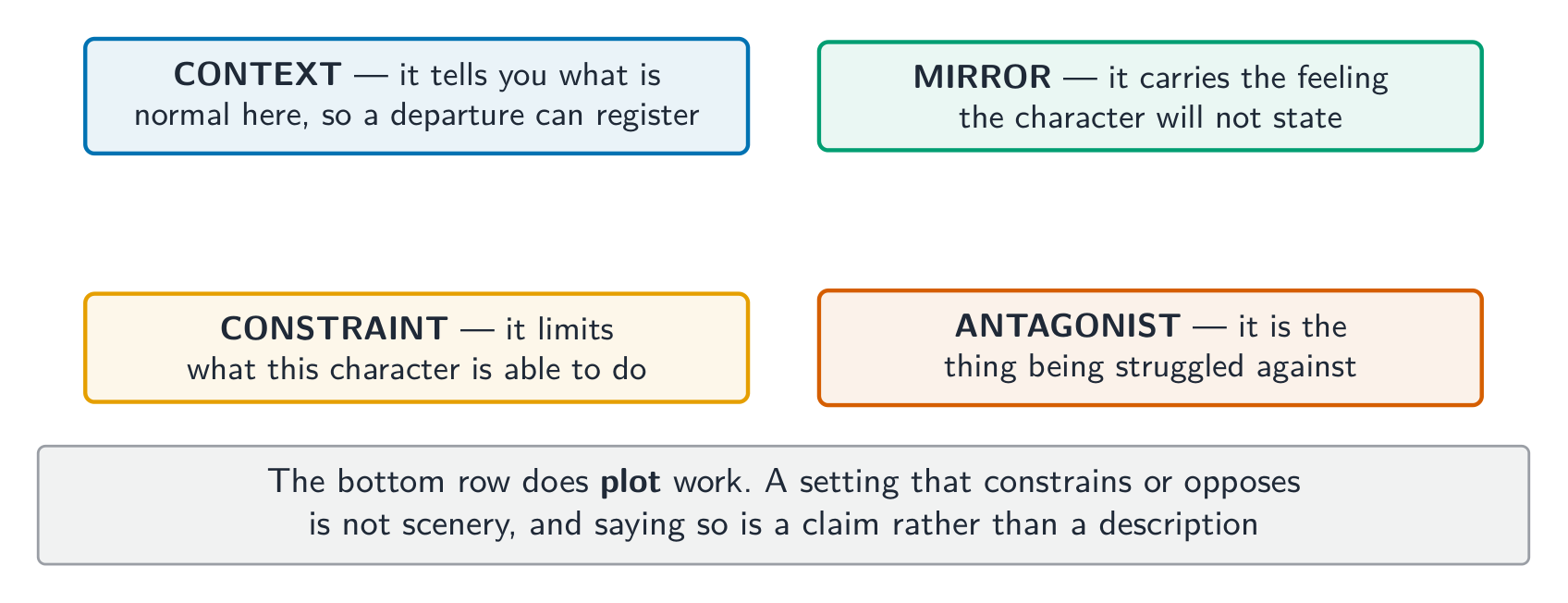
背景可以帮助确立叙事的情绪与氛围(mood and atmosphere)。

情绪是读者的感受;氛围是文本围绕事件所造就的质地。两者都由取舍产生——文本提到了某地的哪些细节,又没有提哪些。

4.5

人物与环境的关系

大纲
Enduring UnderstandingLearning ObjectiveEssential Knowledge

SET-1
Setting and the details associated with it not only depict a time and place, but also convey values associated with that setting.

2.C
Describe the relationship between a character and a setting.

  • SET-1.D The environment a character inhabits provides information about that character.

来源:美国大学理事会 AP 课程与考试说明

人物所居住的环境提供了关于该人物的信息。

这是进入人物的第二条路径,可以避开心理化揣测的陷阱。一个房间被写出它的失修、它的井然,或它借来的家具,就已经告诉了你住在其中的人是怎样的——而这是文本证据,不是猜想。

4.6

情节如何组织事件

大纲
Enduring UnderstandingLearning ObjectiveEssential Knowledge

STR-1
The arrangement of the parts and sections of a text, the relationship of the parts to each other, and the sequence in which the text reveals information are all structural choices made by a writer that contribute to the reader’s interpretation of a text.

3.A
Identify and describe how plot orders events in a narrative.

  • STR-1.R Some patterns in dramatic situations are so common that they are considered archetypes, and these archetypes create certain expectations for how the dramatic situations will progress and be resolved. Note: For the exam, students are not expected to identify or label archetypes.

来源:美国大学理事会 AP 课程与考试说明

戏剧情境中有些模式如此常见,以至于被视为原型(archetypes),而这些原型带着读者自己携带而来的种种联想。

使用原型要谨慎:辨认出一个原型只是起点,而有意思的分析几乎总是在于文本在何处偏离了它所唤起的那个模式。

词汇表 训练
英文 中文 拼音
archetypes 原型 yuán xíng
4.7

文本中对比的作用

大纲
Enduring UnderstandingLearning ObjectiveEssential Knowledge

STR-1
The arrangement of the parts and sections of a text, the relationship of the parts to each other, and the sequence in which the text reveals information are all structural choices made by a writer that contribute to the reader’s interpretation of a text.

3.D
Explain the function of contrasts within a text.

  • STR-1.S The differences highlighted by a contrast emphasize the particular traits, aspects, or characteristics important for comparison of the things being contrasted.
  • STR-1.T Contrasts often represent conflicts in values related to character, narrator, or speaker perspectives on ideas represented by a text.

来源:美国大学理事会 AP 课程与考试说明

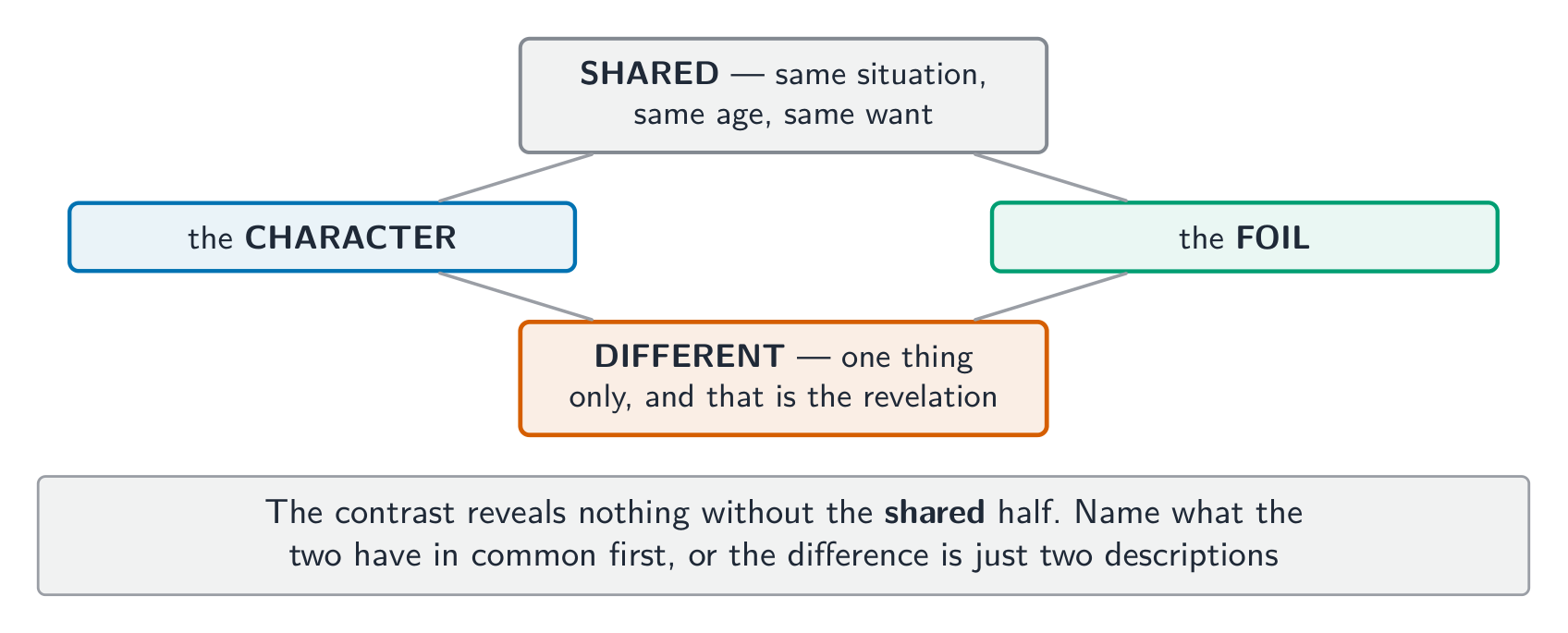
  • 对照所凸显的差异强调了被对照事物中的特定特质或特征
  • 对照往往代表价值上的冲突,与人物、叙述者或说话者的视角相关。
4.8

识别叙述者或说话人

大纲
Enduring UnderstandingLearning ObjectiveEssential Knowledge

NAR-1
A narrator’s or speaker’s perspective controls the details and emphases that affect how readers experience and interpret a text.

4.A
Identify and describe the narrator or speaker of a text.

  • NAR-1.J Narrators may function as characters in the narrative who directly address readers and either recall events or describe them as they occur.

来源:美国大学理事会 AP 课程与考试说明

叙述者可以充当直接向读者说话的人物,他们或是回忆事件,或是在事件发生之际加以讲述。

这一区分——回忆与即时讲述——正是下文叙述距离的第一条轴。
4.9

叙事视角的作用

大纲
Enduring UnderstandingLearning ObjectiveEssential Knowledge

NAR-1
A narrator’s or speaker’s perspective controls the details and emphases that affect how readers experience and interpret a text.

4.B
Identify and explain the function of point of view in a narrative.

  • NAR-1.K Narrative distance refers to the physical distance, chronological distance, relationships, or emotional investment of the narrator to the events or characters of the narrative.
  • NAR-1.L Stream of consciousness is a type of narration in which a character’s thoughts are related through a continuous dialogue or description.

来源:美国大学理事会 AP 课程与考试说明

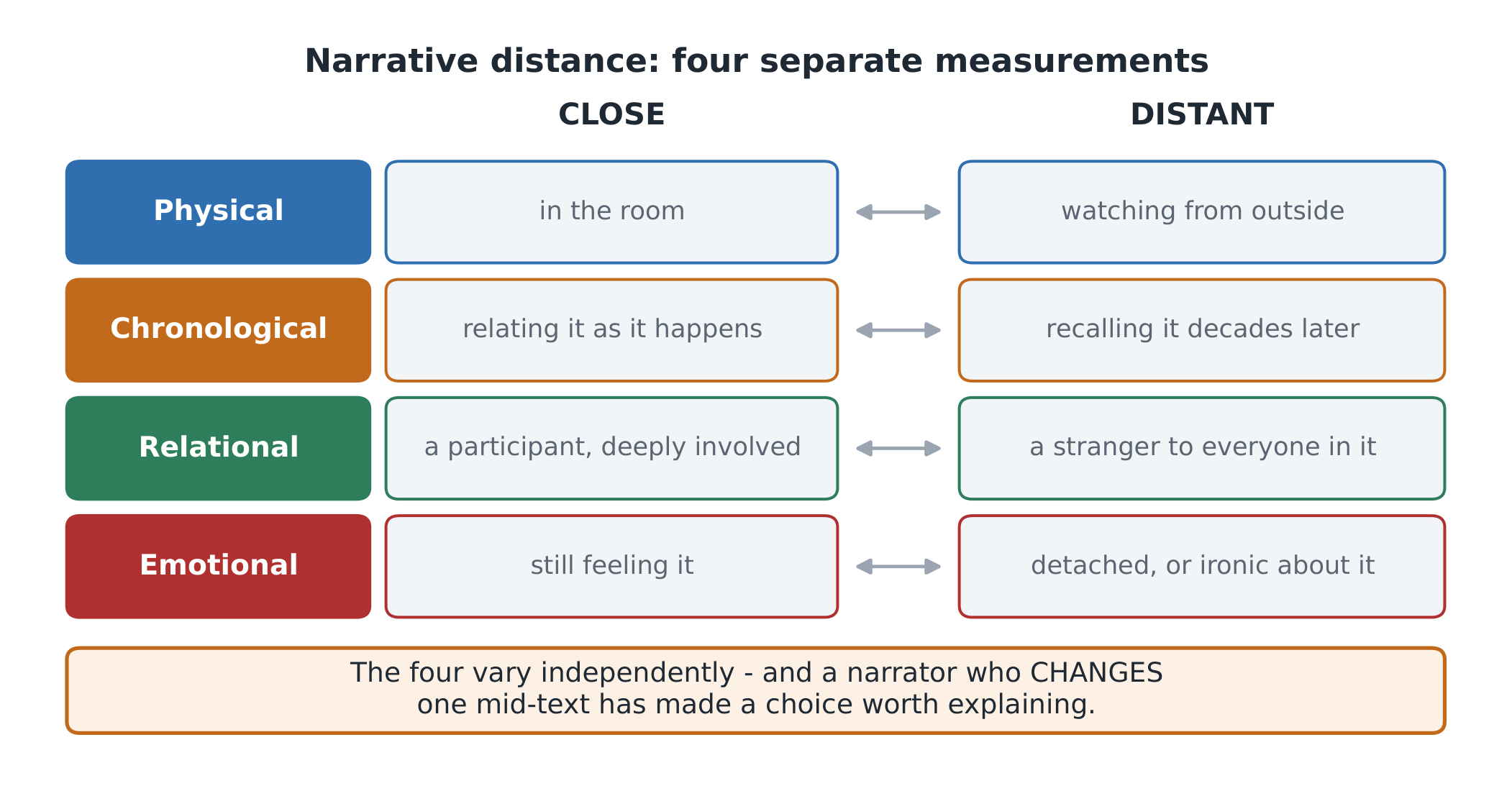
叙述者与事件之间的四种距离——而每一种都是一个选择
叙述者的位置不是一个事实,而是四个,其中任何一个都可能成为分析的所在
  • 叙述距离(narrative distance)指叙述者与事件或人物之间的物理距离、时间距离、关系距离或情感距离
  • 意识流(stream of consciousness)是一种把人物思绪以连续流动方式呈现的叙述,通常少有常规的排序。

叙述距离是本课程中最有力却最少被使用的工具。一位在四十年后回述自己童年的叙述者在时间上是遥远的,而这一距离提供了当年那个孩子不可能拥有的反讽。把距离缩短——让叙述者在事件发生之际讲述——反讽便消失了,取而代之的是即时性与不可靠。

词汇表 训练
英文 中文 拼音
Narrative distance 叙述距离 xù shù jù lí
Stream of consciousness 意识流 yì shí liú
4.10

细节、措辞与句法揭示的立场

大纲
Enduring UnderstandingLearning ObjectiveEssential Knowledge

NAR-1
A narrator’s or speaker’s perspective controls the details and emphases that affect how readers experience and interpret a text.

4.C
Identify and describe details, diction, or syntax in a text that reveal a narrator’s or speaker’s perspective.

  • NAR-1.M The narrators’, characters’, or speakers’ backgrounds and perspectives shape the tone they convey about subjects or events in the text.
  • NAR-1.N Descriptive words, such as adjectives and adverbs, not only qualify or modify the things they describe but also convey a perspective toward those things.
  • NAR-1.O The attitude of narrators, characters, or speakers toward an idea, character, or situation emerges from their perspective and may be referred to as tone.

来源:美国大学理事会 AP 课程与考试说明

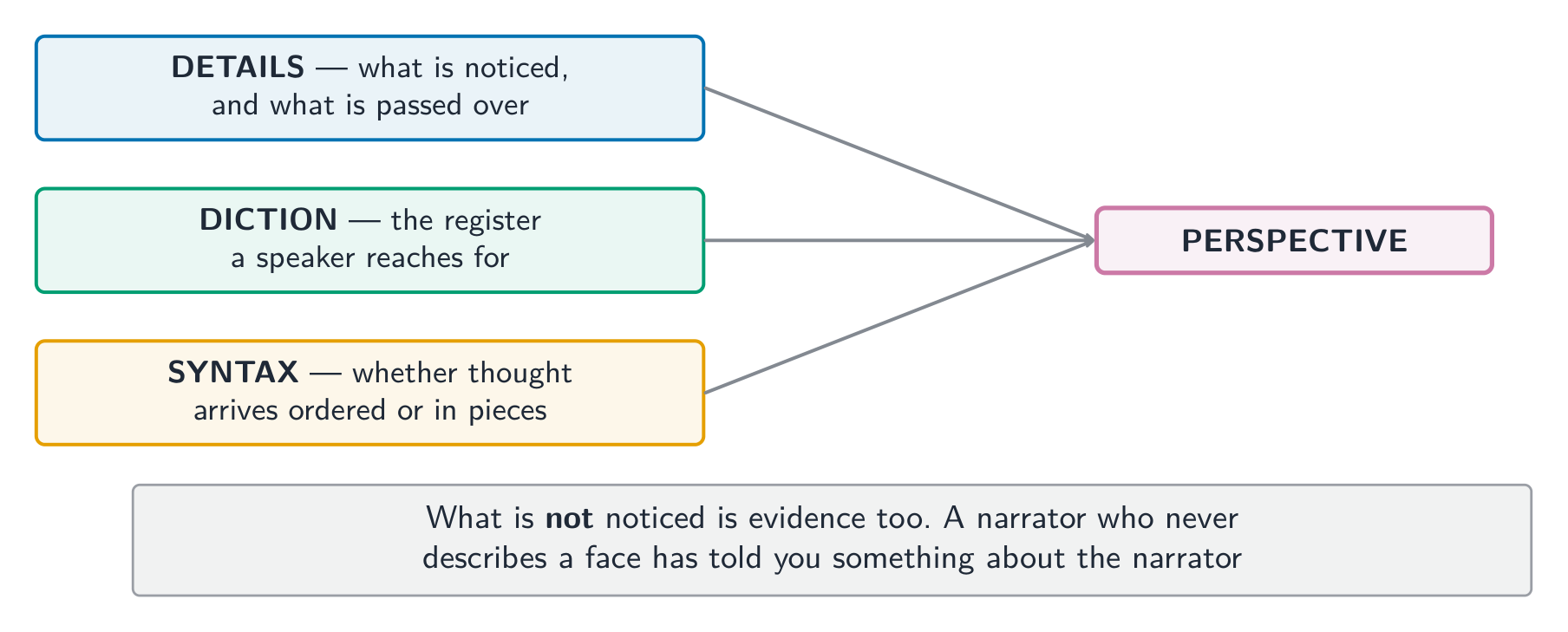
  • 叙述者与人物的背景与视角塑造了他们所传达的语调
  • 描述性词语不仅限定它们所描述之物,还传达一种视角
  • 叙述者或说话者对某个观念、人物或情境的态度,正是从这些选择中浮现出来的
4.11

撰写文学论点句

大纲
Enduring UnderstandingLearning ObjectiveEssential Knowledge

LAN-1
Readers establish and communicate their interpretations of literature through arguments supported by textual evidence.

7.B
Develop a thesis statement that conveys a defensible claim about an interpretation of literature and that may establish a line of reasoning.

  • LAN-1.D A thesis statement expresses an interpretation of a literary text, and requires a defense, through use of textual evidence and a line of reasoning, both of which are explained in an essay through commentary.
  • LAN-1.E A thesis statement may preview the development or line of reasoning of an interpretation. This is not to say that a thesis statement must list the points of an interpretation, literary elements to be analyzed, or specific evidence to be used in the argument.

来源:美国大学理事会 AP 课程与考试说明

不变:论点表达一项阐释并需要文本辩护;它可以预示推理线索。

4.12

撰写评述

大纲
Enduring UnderstandingLearning ObjectiveEssential Knowledge

LAN-1
Readers establish and communicate their interpretations of literature through arguments supported by textual evidence.

7.C
Develop commentary that establishes and explains relationships among textual evidence, the line of reasoning, and the thesis.

  • LAN-1.F A line of reasoning is the logical sequence of claims that work together to defend the overarching thesis statement.
  • LAN-1.G A line of reasoning is communicated through commentary that explains the logical relationship between the overarching thesis statement and the claims/evidence within the body of an essay.
  • LAN-1.M The body paragraphs of a written argument develop the reasoning and justify claims using evidence and providing commentary that links the evidence to the overall thesis.
  • LAN-1.N Effective paragraphs are cohesive and often use topic sentences to state a claim and explain the reasoning that connects the various claims and evidence that make up the body of an essay.

来源:美国大学理事会 AP 课程与考试说明

  • 推理线索是为论点辩护的逻辑主张序列,通过评述来传达。
  • 主体段落展开推理并用证据为主张辩护
  • 有效的段落是有黏合力的,并常以主题句(topic sentences)提出主张并说明推理。
词汇表 训练
英文 中文 拼音
topic sentences 主题句 zhǔ tí jù
4.13

选取贴切且充分的证据

大纲
Enduring UnderstandingLearning ObjectiveEssential Knowledge

LAN-1
Readers establish and communicate their interpretations of literature through arguments supported by textual evidence.

7.D
Select and use relevant and sufficient evidence to both develop and support a line of reasoning.

  • LAN-1.H Writers use evidence strategically and purposefully to illustrate, clarify, exemplify, associate, amplify, or qualify a point.
  • LAN-1.I Evidence is effective when the writer of the essay uses commentary to explain a logical relationship between the evidence and the claim.
  • LAN-1.J Evidence is sufficient when its quantity and quality provide apt support for the line of reasoning.
  • LAN-1.K Developing and supporting an interpretation of a text is a recursive process; an interpretation can emerge from analyzing evidence and then forming a line of reasoning, or the interpretation can emerge from forming a line of reasoning and then identifying relevant evidence to support that line of reasoning.

来源:美国大学理事会 AP 课程与考试说明

与第三单元相同的四点:策略性地使用证据;当评述解释了关系时它才有效;在数量与质量上充分;而阐释是一个反复推敲的过程。

4.14

掌控写作的各项要素

大纲
Enduring UnderstandingLearning ObjectiveEssential Knowledge

LAN-1
Readers establish and communicate their interpretations of literature through arguments supported by textual evidence.

7.E
Demonstrate control over the elements of composition to communicate clearly.

  • LAN-1.O Coherence occurs at different levels in a piece of writing. In a sentence, the idea in one clause logically links to an idea in the next. In a paragraph, the idea in one sentence logically links to an idea in the next. In a text, the ideas in one paragraph logically link to the ideas in the next.
  • LAN-1.P Writers achieve coherence when the arrangement and organization of reasons, evidence, ideas, or details is logical. Writers may use transitions, repetition, synonyms, pronoun references, or parallel structure to indicate relationships between and among those reasons, evidence, ideas, or details.

来源:美国大学理事会 AP 课程与考试说明

连贯发生在不同层级上——句内、句间、全篇——而当理由、证据与细节的排布使推理线索可被追随时,写作者就实现了连贯。

**Worked example(一项真实的 AP 考试任务)。**一道散文小说题要求说明作者的叙事选择如何传达叙述者对一件往事的态度。薄弱答案:*「叙述者很怀旧,并使用了描述性语言。」能得分的答案会用上叙述距离:「叙述者隔着数十年讲述一个下午,而正是这段距离在起作用:他用第三人称描述自己当时的兴奋——『那男孩跑起来』——随后才在失望之处回到『我』。选择在何处合上这道时间的缝隙,使他得以对年轻时的自己不予同情,同时又把那份失落认领为自己的。」*距离、它的变化,以及它所造就的态度。

4.14

考试技巧

  • **选择揭示价值。**要问:必须有什么是真的,这个选择对那个人物才说得通?
  • **对立者不是反派。**最有力的对立者持有一种读者也能承认为善的价值。
  • 环境告诉你人物是怎样的——而这是文本证据,不是猜想。
  • 原型是起点。分析在于文本偏离那个模式之处。
  • 叙述距离有四种——物理、时间、关系、情感。它是这里最少被使用的工具。
  • 在文中合上或拉开距离的叙述者作出了一个选择。说出它造就了什么。

本主题的互动课程

逐步学习,并即时检测练习。

AP 英语文学与写作的更多主题

登录或创建账号

IGCSE, A-Level & AP