| English | 释义 | 拼音 |
|---|---|---|
| Direct address/daɪˈrekt əˈdres/ | 直接称呼 | zhí jiē chēng hū |
"Call me Ishmael", 1851
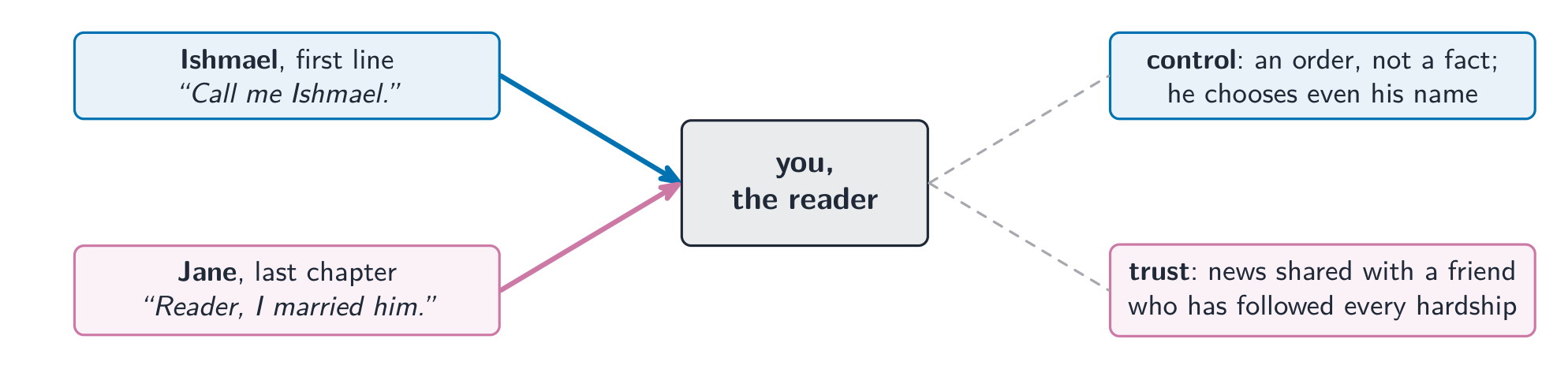
- Herman Melville's Moby-Dick opens with three words spoken to the reader: "Call me Ishmael." The narrator does not even promise that it is his real name.
- Charlotte Brontë's Jane Eyre speaks to us directly too: "Reader, I married him." Some narrators talk to you, and that changes how you read.
How does Moby-Dick open?
难度 1/5 · 今日首次完成可获 100 金币及少量额外奖励
Three words spoken to the reader.
Direct address
- Direct address 直接称呼 is when a narrator speaks to the reader as "you" or "reader", or gives orders: "Call me".
- It turns reading into a conversation. The question is what the narrator wants from that conversation.
When a narrator speaks to the reader as "you" or "reader", this is direct ____.
难度 1/5 · 今日首次完成可获 100 金币及少量额外奖励
Direct address.
What the address does
- It can build trust and closeness: Jane tells us her most important news as if to a friend.
- It can also control us: Ishmael chooses what we call him, and then explains his reasons for going to sea in his own way.
Recall, in-the-moment, or direct address?
Sort each sentence by what it shows about the narration.
Select 所有 the effects direct address can have.
难度 2/5 · 今日首次完成可获 140 金币及少量额外奖励
Length is not an effect of address.
Worked example: "Call me"
- Words: "Call me Ishmael." It is an instruction, not a statement: not "my name is Ishmael".
- What it does: the narrator controls even his name; he may be hiding who he is.
- Why it matters: Ishmael says he has "nothing particular to interest me on shore", so he is an outsider. The opening makes us his companions on the ship before we know anything about him.
"Call me Ishmael" is an instruction rather than a plain statement of the narrator's name.
难度 1/5 · 今日首次完成可获 100 金币及少量额外奖励
He controls what we call him.
Trust, but check
- A narrator who speaks warmly to you may still be selective. Ask what the narrator chooses to tell, and what you are asked to accept without evidence.
- Jane's address comes at the end, after we have shared every hardship, so it feels earned.
A narrator who speaks warmly to the reader always tells the whole truth.
难度 1/5 · 今日首次完成可获 100 金币及少量额外奖励
Trust, but check what is told.
When the address comes
- An address at the start sets up the relationship. An address at a turning point pulls the reader into a judgement. An address at the end can close the story as a shared memory.
- Note where the narrator turns to "you".
Match each moment of address to a typical effect.
难度 2/5 · 今日首次完成可获 140 金币及少量额外奖励
Note when the narrator turns to you.
Do not just point out that the narrator says "reader". Explain what the address does to the reader's trust or position, and why at that moment.
When a narrator addresses the reader directly, ask what the address does: build trust, create closeness or take control. Notice when it happens and what the narrator chooses to tell.
Find a moment where a narrator addresses the reader. Explain what the address does and why at that moment.
Effect and timing.