| English | 释义 | 拼音 |
|---|---|---|
| epiphany/ɪˈpɪfənɪ/ | 顿悟 | dùn wù |
| conflict of values | 价值冲突 | jià zhí chōng tū |
A boy at a closing bazaar, 1914
- In James Joyce's story "Araby" (in Dubliners, 1914), a boy rushes to a bazaar to buy a gift for the girl he adores. He arrives late, the hall is dark, and he hears a shop girl flirting carelessly. The story ends: "Gazing up into the darkness I saw myself as a creature driven and derided by vanity; and my eyes burned with anguish and anger."
- Joyce used the religious word epiphany 顿悟 for such a moment: a sudden realisation that changes how a character sees themselves or the world.
What does the boy in "Araby" see himself as at the end?
难度 1/5 · 今日首次完成可获 100 金币及少量额外奖励
The epiphany is a harsh self-judgement.
Change from a conflict of values
- Character change often grows from a conflict of values 价值冲突: the boy's romantic dream against the dull, commercial reality of the bazaar.
- Change can also come from new circumstances — loss, travel, money — that force a character to act differently.
Which values conflict in "Araby"?
难度 1/5 · 今日首次完成可获 100 金币及少量额外奖励
Change grows from this conflict.
Sudden and gradual change
- Gradual change builds across many scenes; an epiphany arrives in one moment. Both need evidence of what came before and what follows.
- Distinguish change in understanding from change in action: the boy understands, but the story ends before he acts.
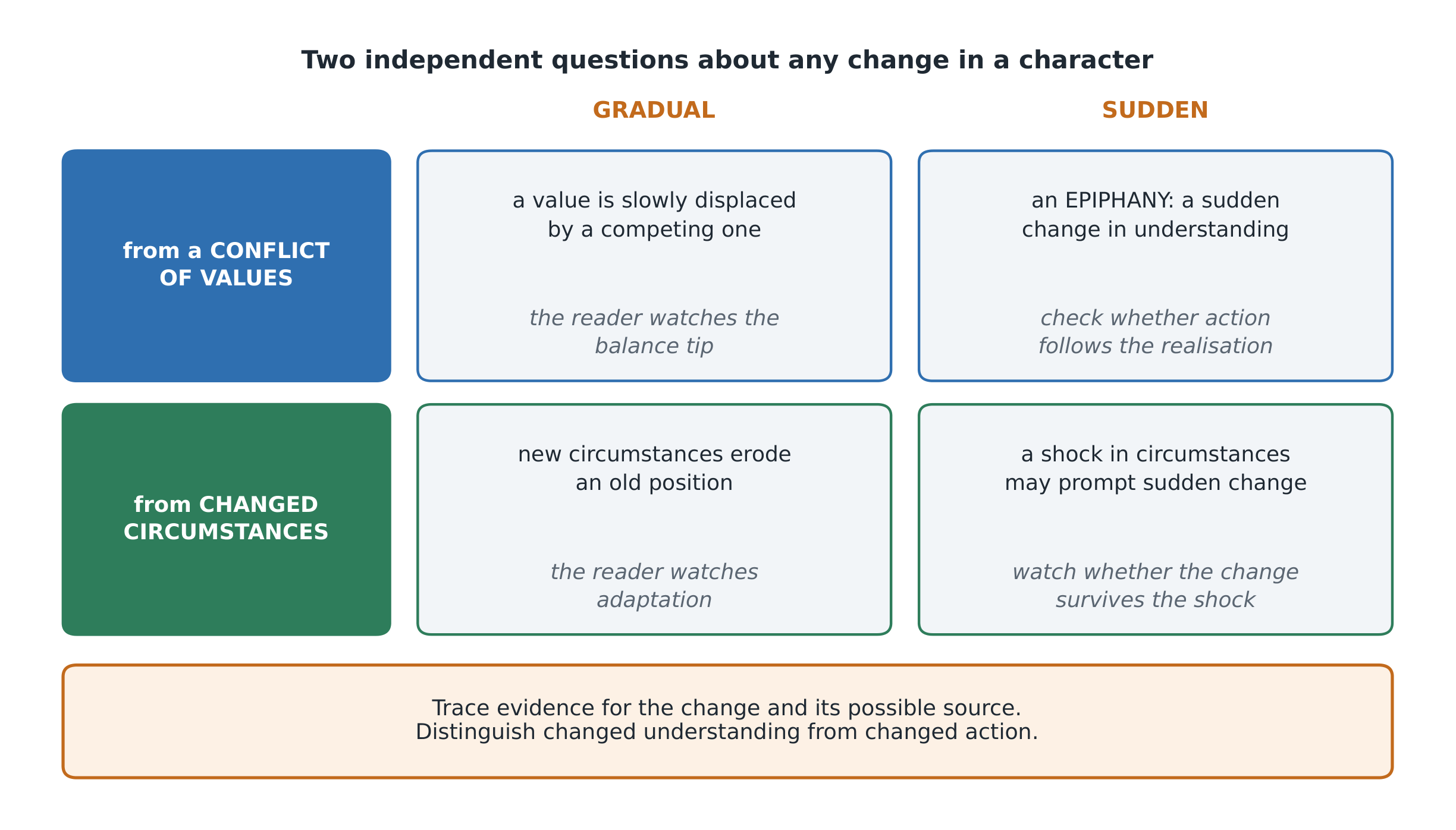
Follow a character to an epiphany
An epiphany is a change in understanding, so it needs a before and an after just as any change does.
Match each type of change to its description.
难度 2/5 · 今日首次完成可获 140 金币及少量额外奖励
Both need before-and-after evidence.
In "Araby", the boy's change is mainly in understanding, not action.
难度 1/5 · 今日首次完成可获 100 金币及少量额外奖励
The story ends at the moment of seeing.
Worked example: reading the epiphany in "Araby"
- Before: the boy imagines carrying his love "safely through a throng of foes", like a knight with a holy object — the language is religious and heroic.
- Trigger: at the bazaar, the empty hall, coins counted and the shop girl's trivial talk show that "Araby" is just a market.
- Epiphany: he sees himself "driven and derided by vanity". Interpretation: the religious, romantic language of the opening collapses into self-judgement; the boy's dream was about his own image, not the girl. The change is in understanding — the story stops at the moment of seeing.
How does the boy imagine himself before the bazaar?
难度 1/5 · 今日首次完成可获 100 金币及少量额外奖励
Religious, heroic language sets up the collapse.
Is the realisation reliable?
- Ask whether the epiphany is complete, partial or mistaken. The boy's harsh judgement of himself may also be exaggerated — the anger of a disappointed teenager.
- Strong essays question how far the realisation can be trusted.
A strong essay can question whether an epiphany is fully reliable.
难度 1/5 · 今日首次完成可获 100 金币及少量额外奖励
The realisation may be exaggerated or partial.
Writing about character change
- Quote the before, the trigger and the realisation. Name the values in conflict.
- Say whether the change is in understanding, action or both, and what the work gains from that.
Do not call every emotional moment an epiphany. Crying or getting angry is not enough. An epiphany changes how a character understands themselves or the world, and the text must show both sides of the change.
Any moment when a character cries is an epiphany.
难度 1/5 · 今日首次完成可获 100 金币及少量额外奖励
An epiphany changes understanding.
Character change often grows from a conflict of values or new circumstances. An epiphany is a sudden realisation that changes understanding. Trace the before, the trigger and the realisation, distinguish understanding from action, and ask whether the realisation is reliable.
Analyse a character's epiphany or turning point in a work you know with before, trigger and realisation.
Before, trigger, realisation.