| English | 释义 | 拼音 |
|---|---|---|
| sophistication | 深度 | shēn dù |
| alternative interpretation | 另一种解读 | lìng yī zhǒng jiě dú |
| analogy | 类比 | lèi bǐ |
The poem everyone misreads, 1916
- Robert Frost's "The Road Not Taken" (1916) ends: "I took the one less traveled by, / And that has made all the difference." It is often quoted as praise for bold, independent choices.
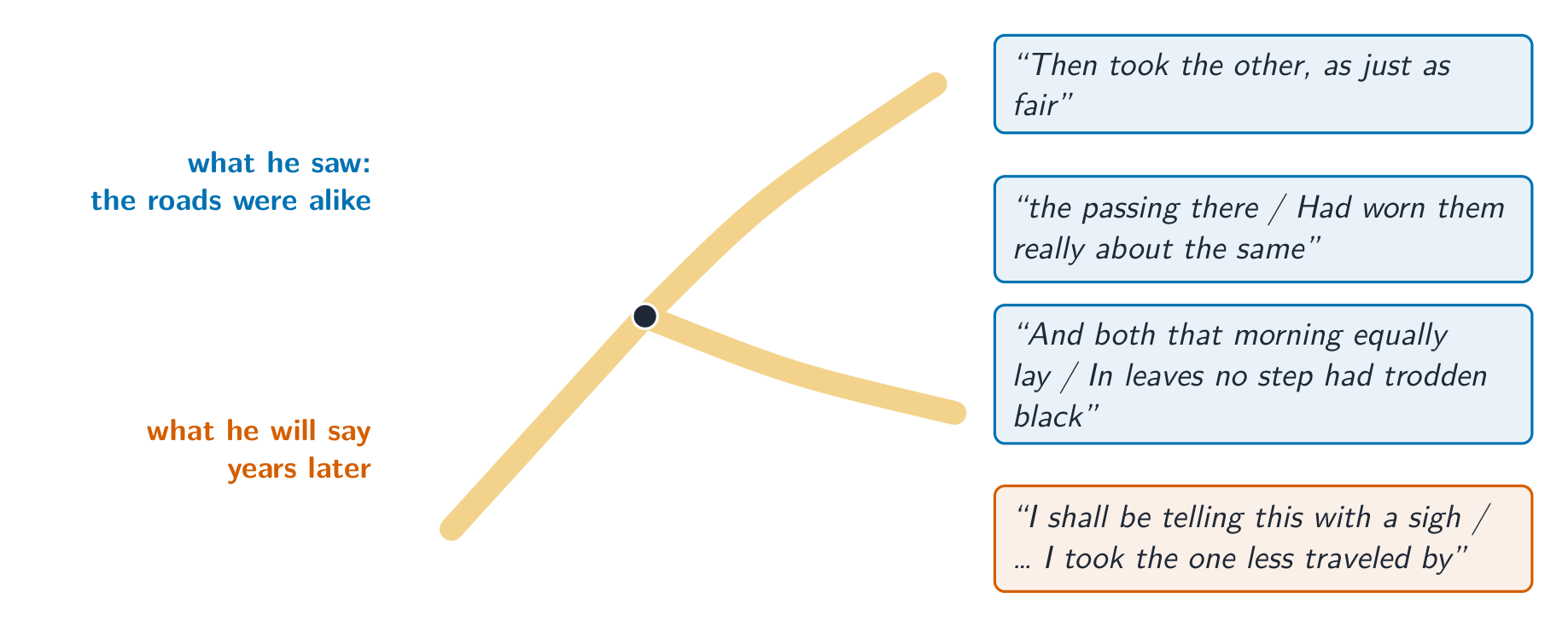
- But earlier the speaker says the two roads were worn "really about the same", and that he will tell the story "with a sigh / Somewhere ages and ages hence". A reading that notices this — and explains what it changes — shows sophistication 深度: the extra credit on the AP Literature essay rubric.
What does Frost's speaker say about the two roads earlier in the poem?
难度 1/5 · 今日首次完成可获 100 金币及少量额外奖励
This complicates the popular reading.
Three routes to sophistication
- Explain the significance of an interpretation in a broader context; discuss an alternative interpretation 另一种解读; or use a relevant analogy 类比 that clarifies your reading.
- The rubric gives one point for sophistication, added to the thesis and the evidence-and-commentary points. It must run through the argument, not sit in one sentence.
Which are routes to sophistication?
难度 2/5 · 今日首次完成可获 140 金币及少量额外奖励
Vocabulary alone is not sophistication.
How many points does the AP Literature essay rubric give for sophistication?
难度 2/5 · 今日首次完成可获 140 金币及少量额外奖励
It is added to thesis and evidence-and-commentary points.
Alternative interpretations
- Name a rival reading fairly, then answer it with evidence. Two sentences can be enough if the answer is specific.
- The rival reading should be one a careful reader might hold — not a straw man.
An alternative reading should be one a careful reader might actually hold.
难度 1/5 · 今日首次完成可获 100 金币及少量额外奖励
Answer a fair rival, not a straw man.
Worked example: Frost's two roads
- Popular reading: the speaker praises his independent choice of the less-travelled road.
- Alternative answered: the speaker admits the roads were "really about the same" and "equally lay / In leaves". So "less traveled" is a story he will tell later, "with a sigh" — the difference was made by the telling, not the road.
- Broader significance: "Frost's poem shows how people turn chance into a story of choice afterwards — which is why the misreading is so common: readers repeat the speaker's own self-flattering version."
Which sophistication move is this — or none?
Sort each sentence by the CED's three routes.
What does "with a sigh" suggest in the worked example?
难度 1/5 · 今日首次完成可获 100 金币及少量额外奖励
The story of choice is told afterwards.
Broader context and analogy
- Context: link the reading to a wider idea — how memory rewrites decisions, or how the poem was published as Europe entered its third year of war.
- Analogy: "the speaker is like a traveller showing holiday photos — the trip becomes what the photos say it was." Use analogies only when they clarify.
An analogy should be used only when it clarifies the reading.
难度 1/5 · 今日首次完成可获 100 金币及少量额外奖励
Analogies must help the audience understand.
Planning the move
- Before writing, decide which route suits your thesis. Build it into the argument — in the thesis, in a body paragraph's turn, in the conclusion.
- Keep the language precise: complexity comes from evidence, not long words.
Sophistication is not big vocabulary or a final flourish. "This poem is truly universal" at the end earns nothing. Show a specific alternative reading answered with evidence, or a broader significance argued throughout.
"This poem is truly universal" at the end of an essay earns the sophistication point.
难度 1/5 · 今日首次完成可获 100 金币及少量额外奖励
Sophistication must be specific and argued.
Sophistication comes from explaining an interpretation's broader significance, answering a fair alternative reading with evidence, or using a clarifying analogy. Build the move into the whole argument, and keep it specific and evidence-based.
State a popular reading of a work you know, then answer an alternative reading with evidence in two or three sentences.
Reading, alternative, significance.