English
| Enduring Understanding | Learning Objective | Essential Knowledge |
|---|---|---|
REO-1 | 5.A |
|
 5:41
单元5:组织、连贯性与风格
CED对主体段落的表述精准且值得背诵。书面论证的主体段落提出主张,用证据支持,并……
英文讲解 · 可切换中英文字幕
| Enduring Understanding | Learning Objective | Essential Knowledge |
|---|---|---|
REO-1 | 5.A |
|
来源:College Board AP 课程与考试说明
On 19 November 1863 two men spoke at the opening of a soldiers' cemetery at Gettysburg, Pennsylvania. The main speaker, Edward Everett, spoke for about two hours. President Abraham Lincoln then spoke for about two minutes: 272 words. The next day Everett wrote to Lincoln that he wished he had come as close to the central idea of the occasion in two hours as Lincoln had in two minutes. Lincoln's speech is short, but every sentence is tied to the one before it. That tightness, called coherence, is what this unit teaches you to see and to build.
Unit 5 turns from what an argument contains to how it holds together. It has two subjects: coherence 连贯 and the beginnings of style 风格.
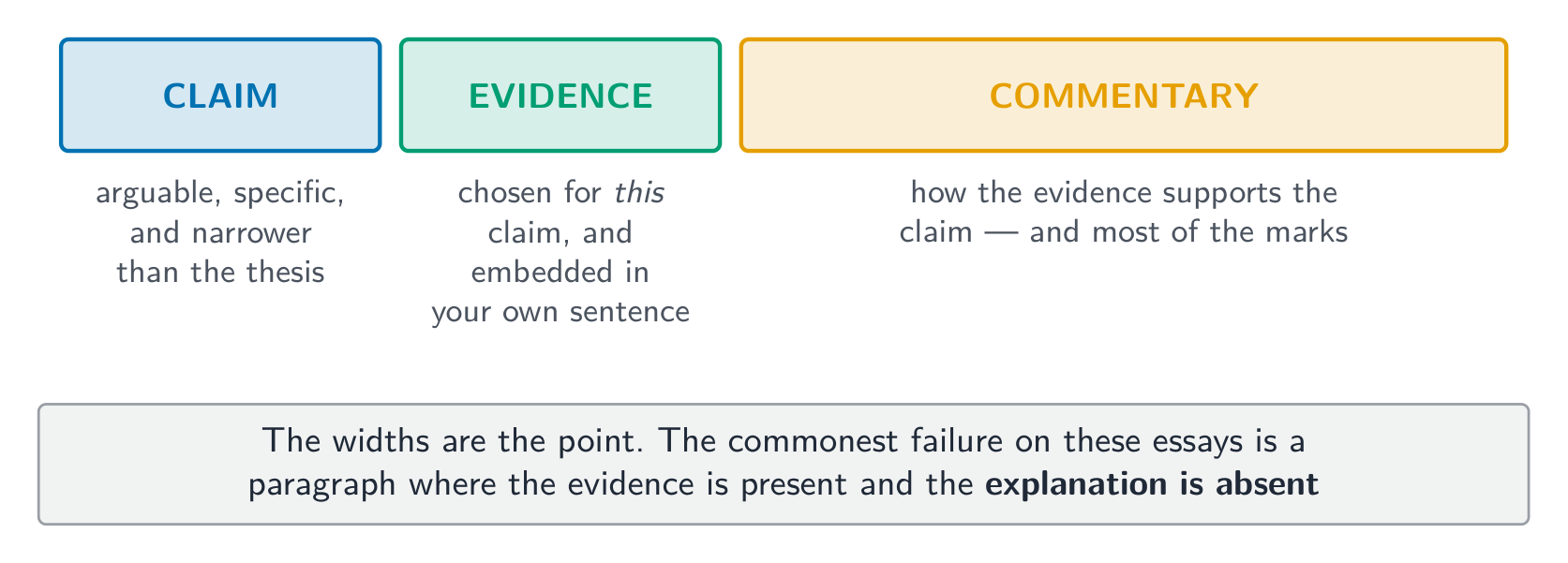
The CED's statement of the body paragraph is exact and worth memorising: the body paragraphs of a written argument make claims, support them with evidence, and provide commentary that explains the relationship of the evidence to the claim.
Three parts, in that order, in every body paragraph. When an AP essay loses evidence-and-commentary points, it is almost always because the third part is missing from paragraphs that have the first two.
| English | 中文 | 拼音 |
|---|---|---|
| coherence/kəʊˈhɪərəns/ | 连贯 | lián guàn |
| style/staɪl/ | 风格 | fēng gé |
| Enduring Understanding | Learning Objective | Essential Knowledge |
|---|---|---|
REO-1 | 6.A |
|
来源:College Board AP 课程与考试说明
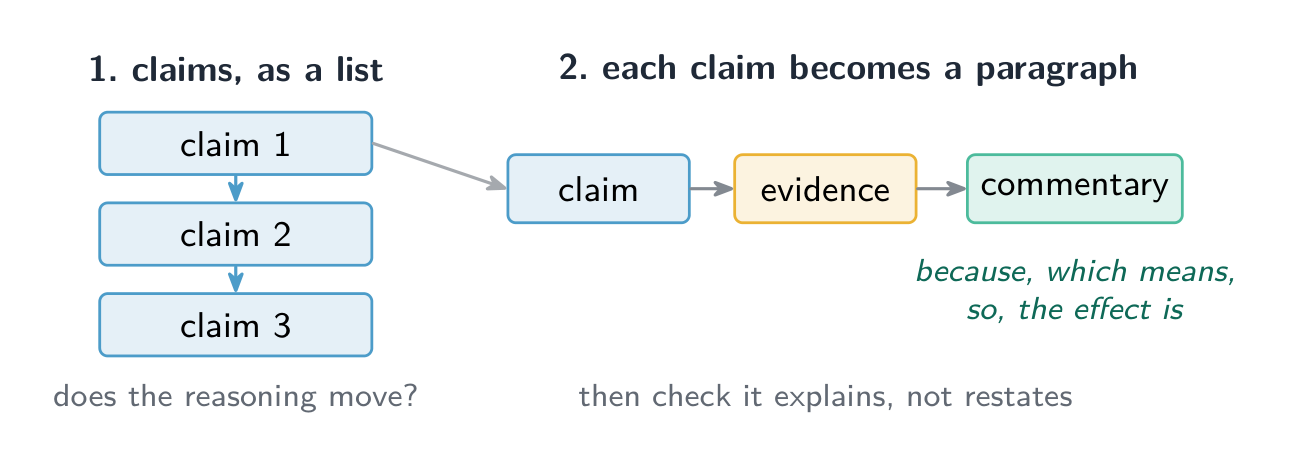
Applied to your own writing: draft the claims first, as a list, before writing any paragraph. You then have the line of reasoning in front of you and can check that it moves.
Then, for each claim, write the paragraph in its three parts deliberately. A useful habit under exam conditions is to make the commentary sentence begin with a word that forces a relationship - because, which means, so, the effect of this is - but those words can still introduce a restatement: check that the sentence actually explains the connection.
Worked example: one body paragraph, weak and strong. Prompt: Should schools ban phones during the school day?
Weak: "Phones are very distracting. Many students use them in class. For example, my friend checks TikTok in maths. This shows phones are bad. So schools should ban them." The claim is vague, the evidence is one friend, and "this shows phones are bad" only repeats the claim.
Strong: "(claim) Classroom phone restrictions may help students concentrate. (evidence) From January 2024 the Netherlands asked schools to keep phones out of classrooms, and in a 2025 study for the Dutch government about three quarters of surveyed secondary schools said that students concentrated better. (commentary) Because a rule removes the choice, a student no longer has to win the same small fight against a notification forty times a day, which may help protect attention. The schools’ reports support that possibility, but do not establish which students benefited most or prove the rule caused the improvement." The commentary uses because and which means, and it explains why the evidence supports the claim.
| Enduring Understanding | Learning Objective | Essential Knowledge |
|---|---|---|
REO-1 | 5.B |
|
来源:College Board AP 课程与考试说明
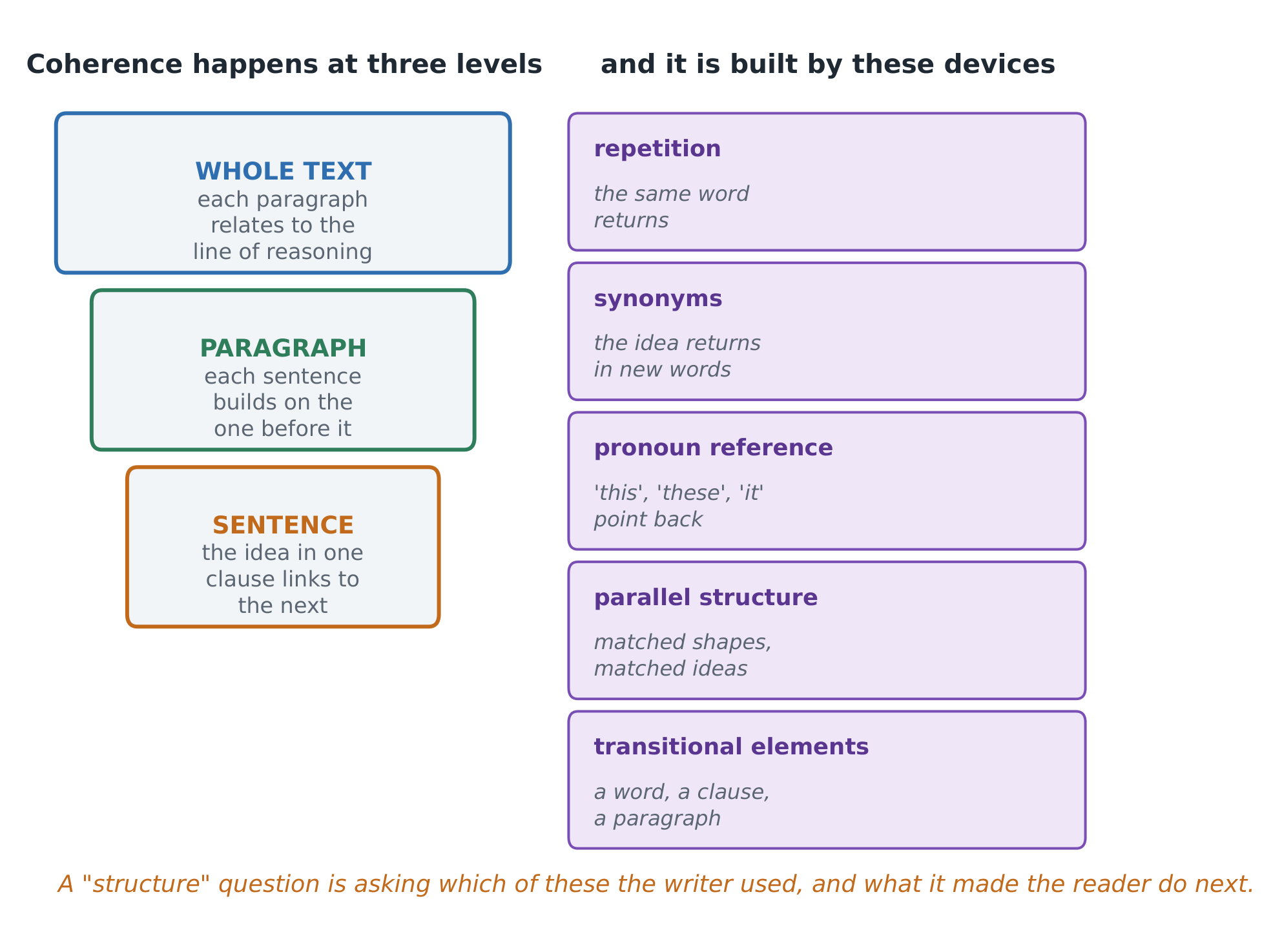
Coherence occurs at different levels in a piece of writing:
The CED then names the devices that create those links:
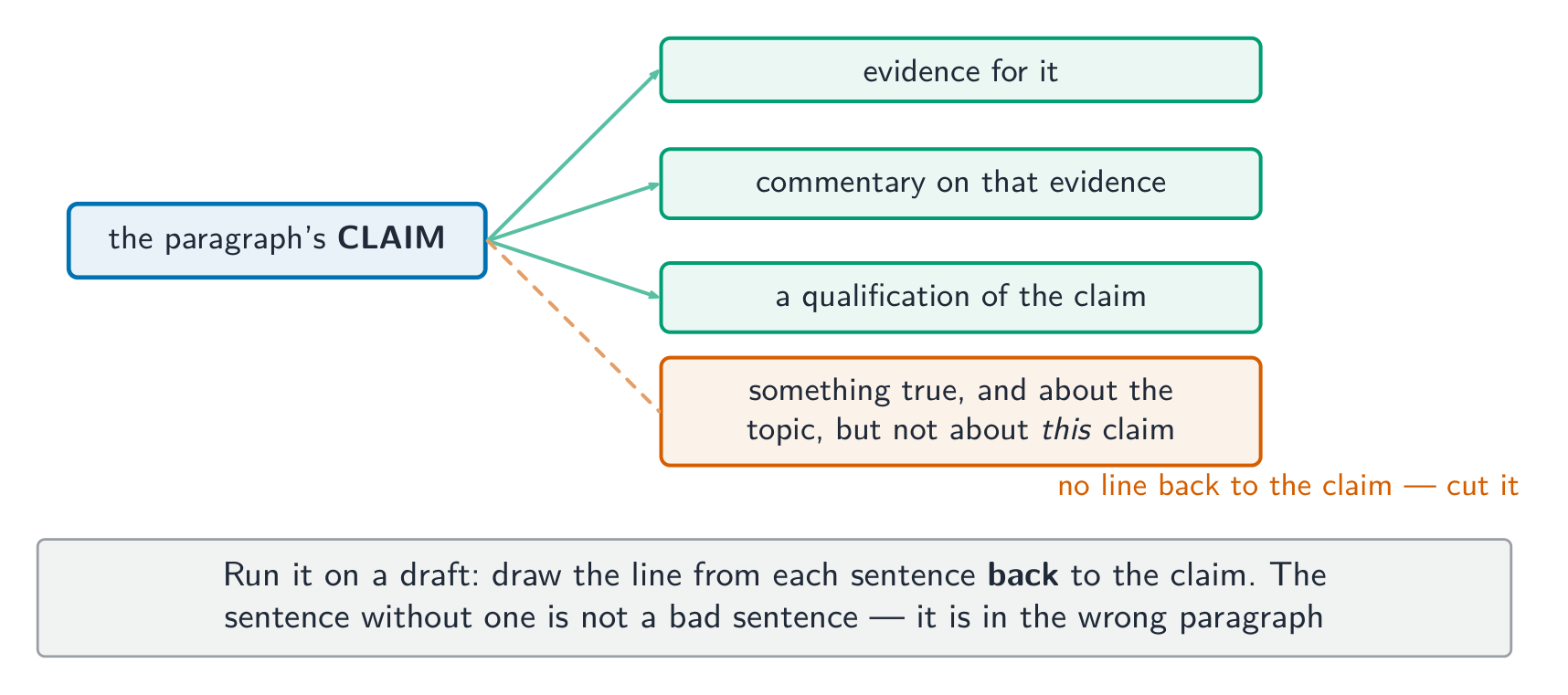
Worked example: the devices in a real text. Each line below is from the Gettysburg Address.
| Words from the speech | Device | What it links |
|---|---|---|
| "Now we are engaged in a great civil war, testing whether that nation, or any nation so conceived ... can long endure." | repetition ("nation", "conceived" from the first sentence) | ties the war to the founding idea of the first sentence |
| "But, in a larger sense, we can not dedicate—we can not consecrate—we can not hallow—this ground." | transition ("But") and parallel structure | turns the speech from what the crowd came to do to what they cannot do |
| "The brave men, living and dead, who struggled here, have consecrated it" | pronoun reference ("it" = the ground) | carries the ground from the last sentence into this one |
| "It is for us the living, rather, to be dedicated here to the unfinished work" | repetition of "dedicate" in a new sense | moves the duty from the dead to the living listeners |
| "government of the people, by the people, for the people" | parallel structure | ends the line of reasoning with one memorable statement of the purpose |
A rhetorical-analysis sentence about it: "Lincoln repeats 'dedicate' but shifts its object from the ground to the living audience, so the ceremony becomes a duty: the listeners leave with a task, not only a memory." The device is named, its effect is traced, and the audience is in the sentence.
| English | 中文 | 拼音 |
|---|---|---|
| clause/klɔːz/ | 分句 | fēn jù |
| repetition/ˌrepəˈtɪʃn/ | 重复 | chóng fù |
| synonym/ˈsɪnənɪm/ | 同义词 | tóng yì cí |
| pronoun reference/ˈprəʊnaʊn ˈrefrəns/ | 代词指代 | dài cí zhǐ dài |
| parallel structure/ˈpærəlel ˈstrʌktʃə/ | 平行结构 | píng xíng jié gòu |
| transitional element/trænˈsɪʃənl ˈelɪmənt/ | 过渡成分 | guò dù chéng fèn |
| Enduring Understanding | Learning Objective | Essential Knowledge |
|---|---|---|
REO-1 | 6.B |
|
来源:College Board AP 课程与考试说明
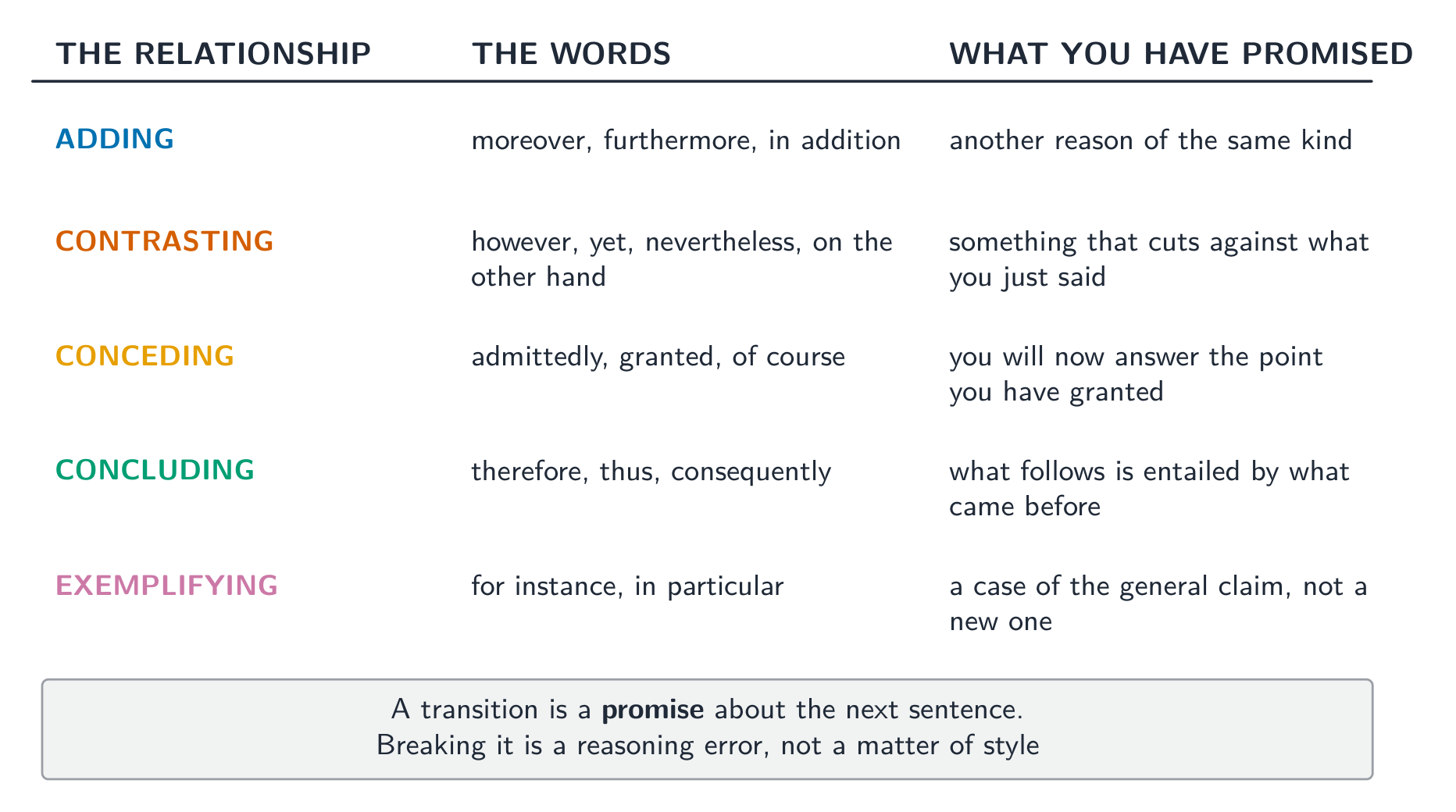
Transitions have a second job the CED names explicitly: they introduce evidence or indicate its relationship to other ideas or evidence.
That is the difference between decorative and functional transitions. Furthermore signals an additional supporting point; it is misleading when the relationship is contrast or cause. Even in the cases where the effect is smallest tells the reader what relationship is coming. Choose transitions that carry information about the relationship, not ones that merely mark a boundary.
Note also that a transitional element may be a whole paragraph. In a long argument, a short paragraph whose only job is to turn the reasoning is legitimate and often elegant.
过渡语是关于两个想法之间关系的声明。违背这一承诺是推理错误,而非风格问题。
| Enduring Understanding | Learning Objective | Essential Knowledge |
|---|---|---|
STL-1 | 7.A |
|
来源:College Board AP 课程与考试说明
Unit 5 opens the course's treatment of style with three claims about diction:
The second is the analytically useful one. When a rhetorical-analysis passage calls a policy ambitious rather than expensive, no fact has changed and the reader's disposition 倾向 has. That is a rhetorical choice, and it is exactly what the question asks you to explain.
| English | 中文 | 拼音 |
|---|---|---|
| denotation/dɪnəʊˈteɪʃn/ | 外延义 | wài yán yì |
| connotation/kɒnəˈteɪʃn/ | 内涵义 | nèi hán yì |
| adjective/ˈædʒɪktɪv/ | 形容词 | xíng róng cí |
| adverb/ˈædvɜːb/ | 副词 | fù cí |
| modify/ˈmɒdɪfaɪ/ | 修饰 | xiū shì |
| word choice/wɜːd tʃɔɪs/ | 用词 | yòng cí |
| disposition/ˌdɪspəˈzɪʃn/ | 倾向 | qīng xiàng |
| Enduring Understanding | Learning Objective | Essential Knowledge |
|---|---|---|
STL-1 | 8.A |
|
来源:College Board AP 课程与考试说明
For your own writing, precision is worth more than range. A concrete rule: prefer the word that is exactly right to the word that is impressive. Examiners reward control, and an inflated word used slightly wrongly reads as loss of control.
Worked example (original AP-style practice). In a rhetorical-analysis passage a writer describes a proposal's supporters as "determined" in one paragraph and "unyielding" in the next. A low-scoring answer notes that the writer uses "strong diction". A scoring answer explains the shift: "Both words denote persistence, but 'determined' carries approval and 'unyielding' carries obstruction. By moving from one to the other without changing the facts described, the writer withdraws sympathy from the supporters while appearing only to continue describing them - so the audience's judgement shifts before any counter-argument is made." That is connotation, tone, and effect on audience in one move.
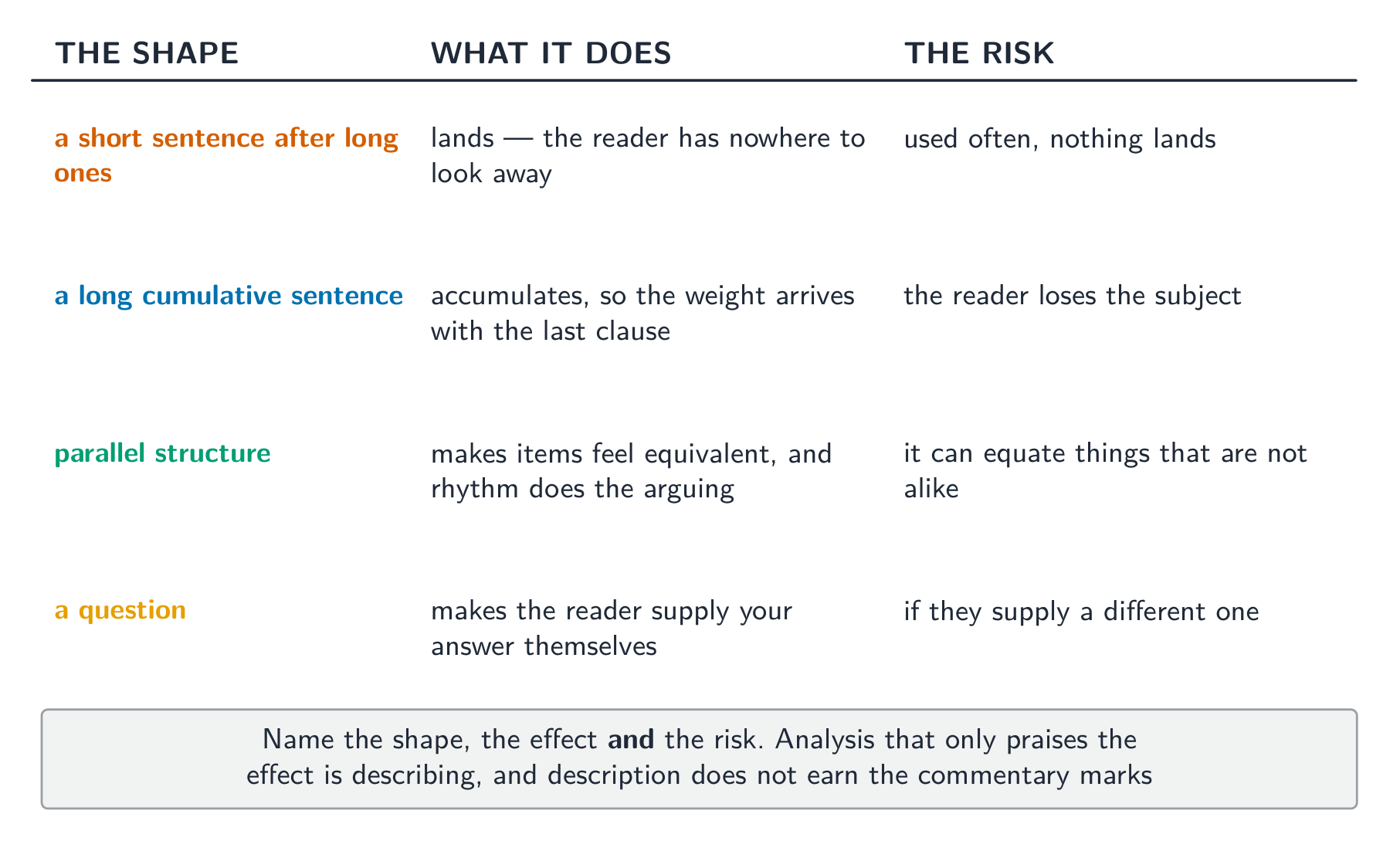
只赞美效果的评论是在描述——而描述无法获得评论分。
Answer each before reading the model answers below.
| English | 中文 | 拼音 |
|---|---|---|
| unified/ˈjuːnɪfaɪd/ | 统一的 | tǒng yī de |
| English | 中文 | 拼音 |
|---|---|---|
| topic sentence/ˈtɒpɪk ˈsentəns/ | 主题句 | zhǔ tí jù |
Vocabulary card meanings
coherence: The way sentences and paragraphs connect into one clear whole. pronoun reference: Making clear which noun a word such as it or they points back to. parallel structure: Repeating the same grammatical shape in a list or a pair. transitional element: A word or sentence that shows how the next idea relates to the last. denotation: A word's dictionary sense. connotation: The feeling or association a word carries beyond its dictionary sense.
出了什么问题?只有网站团队能看到这些信息。
逐步完成,配合即时检查练习。