跳到主要内容

主张、证据与修辞情境

AP 英语语言与写作 · 第 1 主题

训练
讲义 词汇表
1.1

修辞情境的构成要素

大纲
Enduring UnderstandingLearning ObjectiveEssential Knowledge

RHS-1
Individuals write within a particular situation and make strategic writing choices based on that situation.

1.A
Reading – Identify and describe components of the rhetorical situation: the exigence, audience, writer, purpose, context, and message.

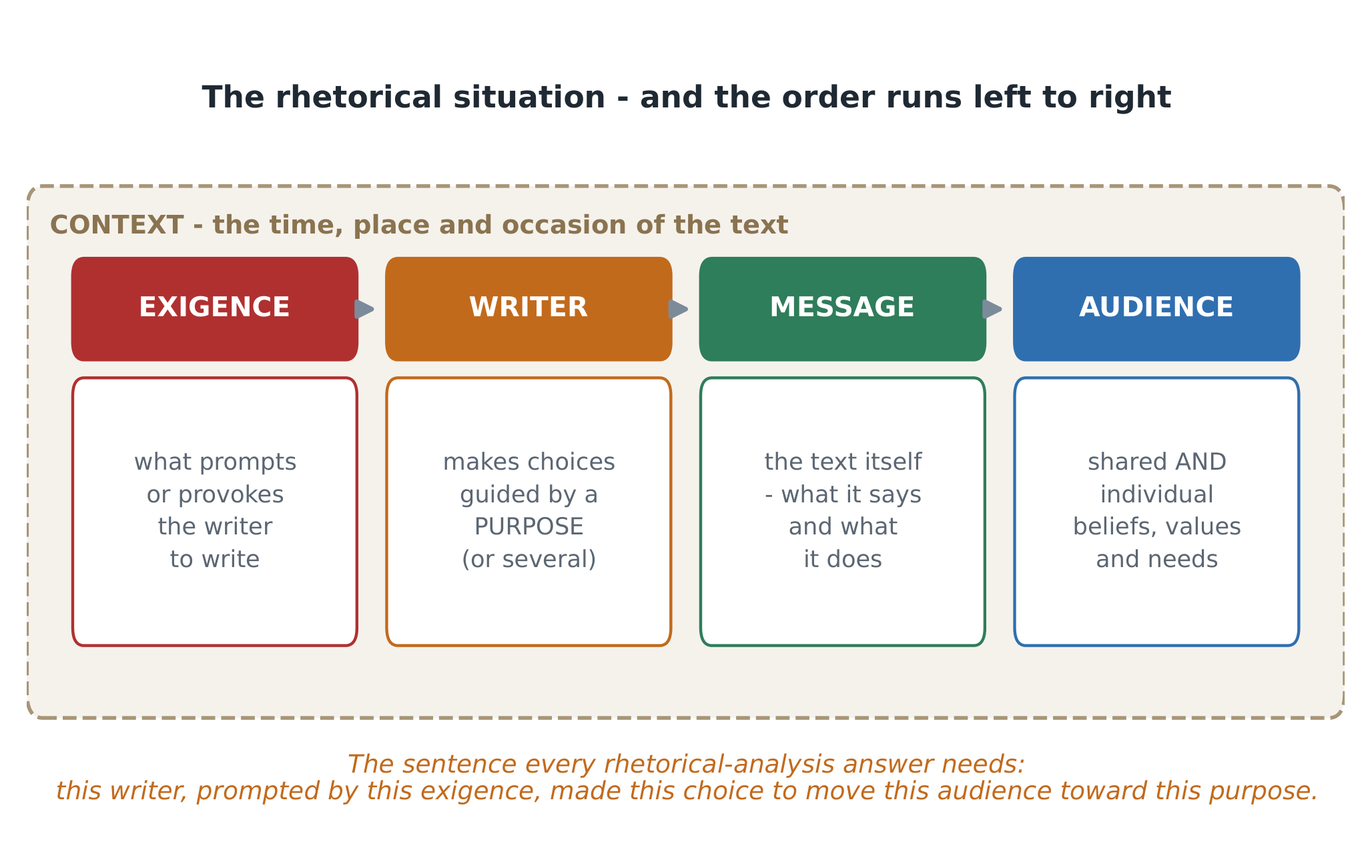
  • RHS-1.A The rhetorical situation of a text collectively refers to the exigence, purpose, audience, writer, context, and message.
  • RHS-1.B The exigence is the part of a rhetorical situation that inspires, stimulates, provokes, or prompts writers to create a text.
  • RHS-1.C The purpose of a text is what the writer hopes to accomplish with it. Writers may have more than one purpose in a text.
  • RHS-1.D An audience of a text has shared as well as individual beliefs, values, needs, and backgrounds.
  • RHS-1.E Writers create texts within a particular context that includes the time, place, and occasion.

来源:美国大学理事会 AP 课程与考试说明

AP 英语语言与写作不是一门文学课。它研究的是文本如何对读者起作用,而第一单元安装了此后一切赖以建立的两个观念:修辞情境主张加证据的段落。

六个组成部分,按因果顺序排列
促因促使写作者动笔;语境包裹着一切——而任何关于"选择"的题目都要从这里作答

CED 把修辞情境(rhetorical situation)定义为促因、目的、受众、写作者、语境与信息的总和。每一项都有精确含义,而精确使用这些术语正是有力答案与含糊答案的分野:

  • 促因(exigence)是情境中激发、刺激、引发或促使写作者创作文本的那一部分。它是这个文本此刻存在的理由。
  • 目的(purpose)是写作者希望达成的事。一个文本可以有不止一个目的
  • 受众(audience)既有共有的也有个体的信念、价值、需求与背景——所以"受众"从来不是单一同质的东西。
  • 语境(context)包括文本被创作时的时间、地点与场合
  • 信息(message)是文本实际所说与所做。

本课程中最常见的薄弱答案是点出一个手法便打住。修辞情境正是把手法变成论证的东西:这位写作者,受这一促因驱动,作出这一选择,以推动这一受众走向这一目的。

词汇表 训练
英文 中文 拼音
rhetorical situation 修辞情境 xiū cí qíng jìng
exigence 促因 cù yīn
purpose 目的 mù dì
audience 受众 shòu zhòng
context 语境 yǔ jìng
1.2

识别主张与证据

大纲
Enduring UnderstandingLearning ObjectiveEssential Knowledge

CLE-1
Writers make claims about subjects, rely on evidence that supports the reasoning that justifies the claim, and often acknowledge or respond to other, possibly opposing, arguments.

3.A
Reading – Identify and explain claims and evidence within an argument.

  • CLE-1.A Writers convey their positions through one or more claims that require a defense.
  • CLE-1.B Writers defend their claims with evidence and/or reasoning.
  • CLE-1.C Types of evidence may include facts, anecdotes, analogies, statistics, examples, details, illustrations, expert opinions, personal observations, personal experiences, testimonies, or experiments.
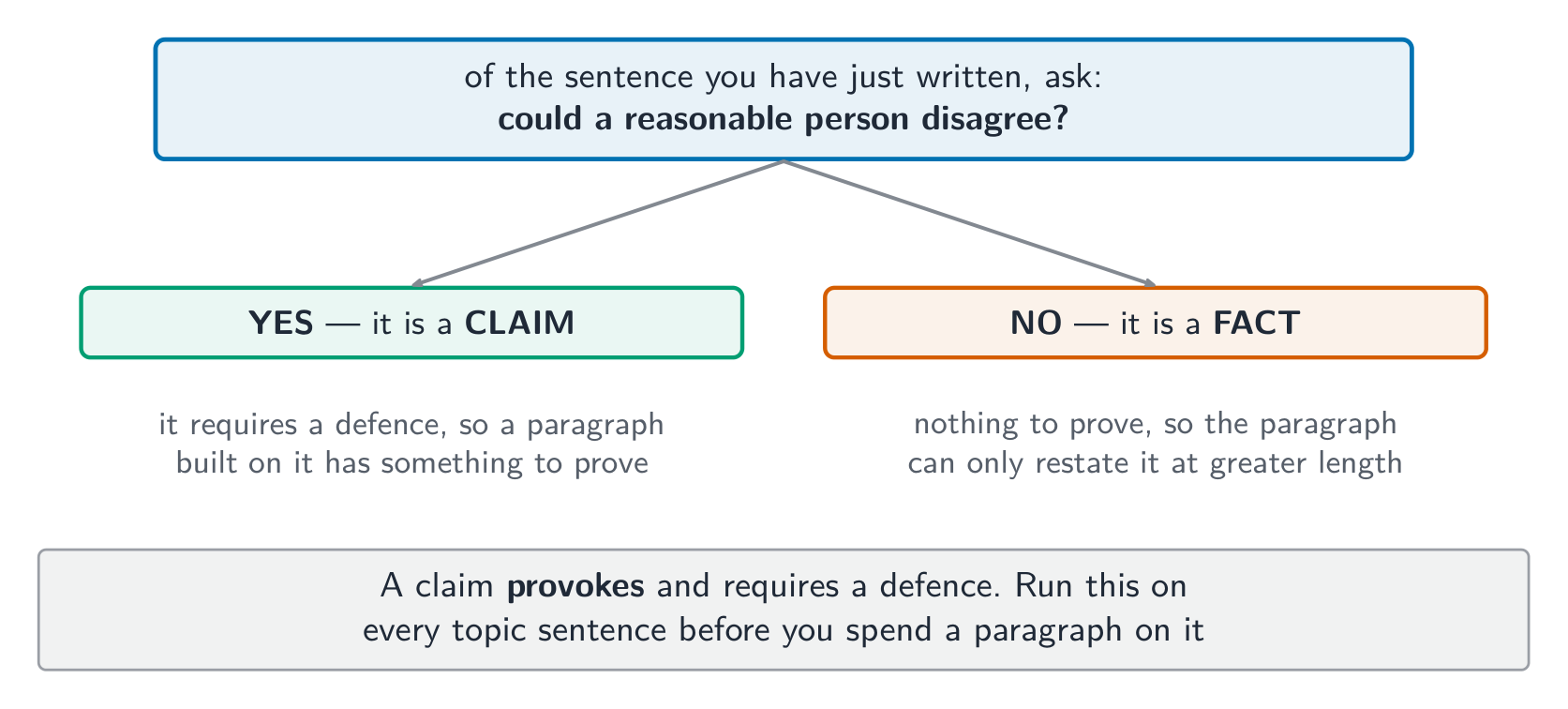
  • CLE-1.D Effective claims provoke interest and require a defense, rather than simply stating an obvious, known fact that requires no defense or justification.
  • CLE-1.E Writers relate source material to their own argument by syntactically embedding particular quoted, paraphrased, or summarized information from one or more sources into their own ideas.

来源:美国大学理事会 AP 课程与考试说明

  • 写作者通过一项或多项需要辩护的主张(claims)来表达立场。
  • 写作者以证据与推理(evidence and/or reasoning)为其主张辩护。
  • 证据的类型包括事实、轶事、类比、统计数据、例证、细节、图示、专家意见与个人经验——这是一份有意开列得很宽的清单,因为把轶事或类比识别为证据本身就是一项能力。
  • 有效的主张会引发兴趣并需要辩护,而不是陈述一个无需证明的显而易见的事实。

第四点是你所能拥有的最有用的检验。对任何一句话都问:*一个通情达理的人会不会不同意?*如果不会,它就不是主张,而是事实;以它为基础搭建段落,写出来的东西便无可证明。

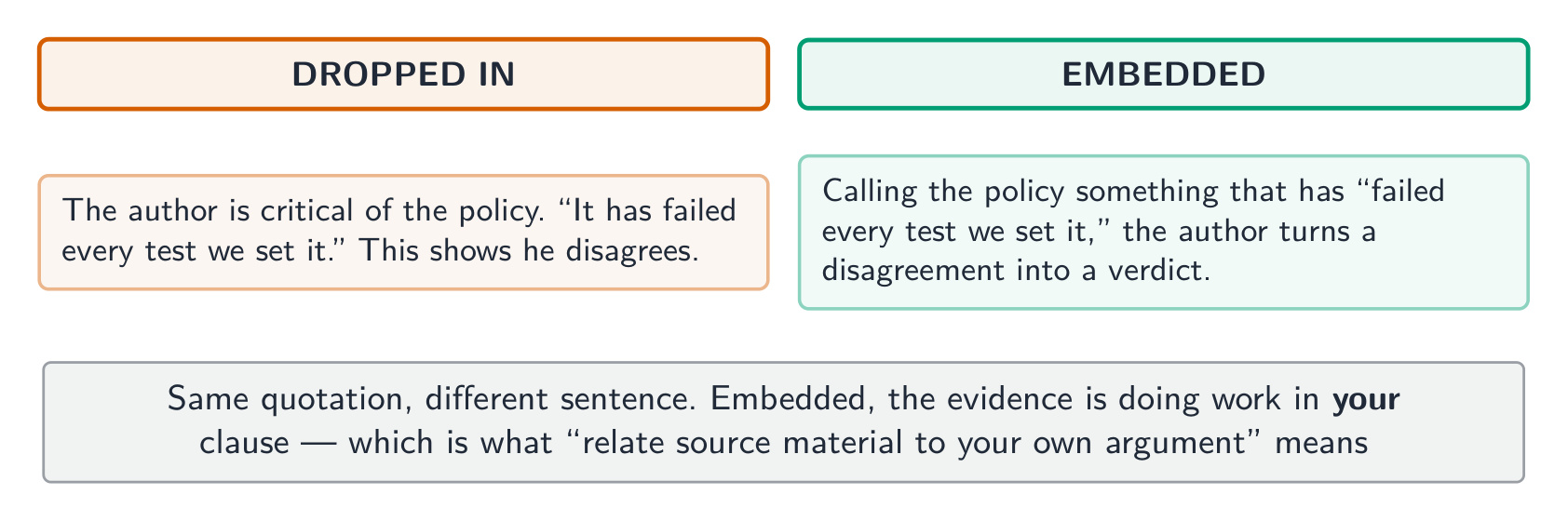
最后,写作者通过在句法上嵌入(syntactically embedding)引用、转述或概括的材料,把源材料与自己的论证联系起来。证据不是被摆在你的句子旁边,而是被建进句子里。

词汇表 训练
英文 中文 拼音
claims 主张 zhǔ zhāng
evidence and/or reasoning 证据与推理 zhèng jù yǔ tuī lǐ
Question 1, Synthesis 综合写作 zōng hé xiě zuò
Question 2, Rhetorical Analysis 修辞分析 xiū cí fēn xī
Question 3, Argument 论证写作 lùn zhèng xiě zuò
1.3

撰写含主张与证据的段落

大纲
Enduring UnderstandingLearning ObjectiveEssential Knowledge

CLE-1
Writers make claims about subjects, rely on evidence that supports the reasoning that justifies the claim, and often acknowledge or respond to other, possibly opposing, arguments.

4.A
Writing – Develop a paragraph that includes a claim and evidence supporting the claim.

  • CLE-1.A Writers convey their positions through one or more claims that require a defense.
  • CLE-1.B Writers defend their claims with evidence and/or reasoning.
  • CLE-1.C Types of evidence may include facts, anecdotes, analogies, statistics, examples, details, illustrations, expert opinions, personal observations, personal experiences, testimonies, or experiments.
  • CLE-1.D Effective claims provoke interest and require a defense, rather than simply stating an obvious, known fact that requires no defense or justification.
  • CLE-1.E Writers relate source material to their own argument by syntactically embedding particular quoted, paraphrased, or summarized information from one or more sources into their own ideas.

来源:美国大学理事会 AP 课程与考试说明

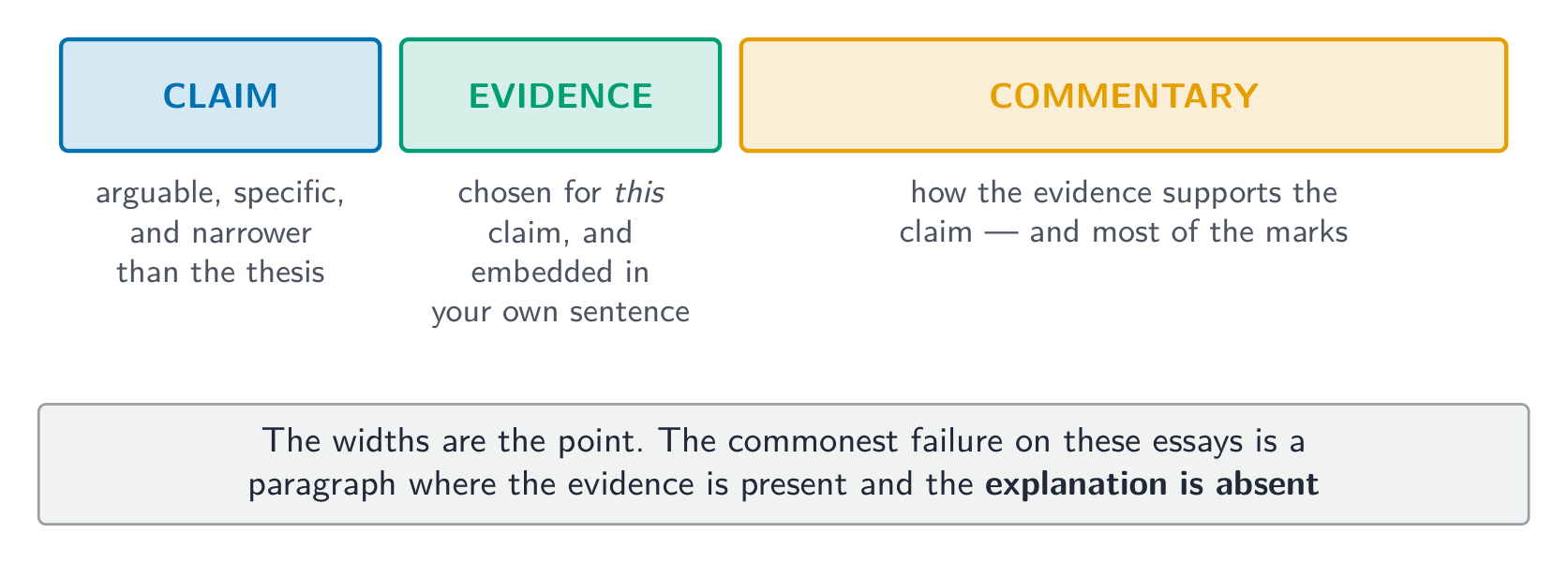
第一单元的写作目标有意设置得很小:写出一个包含主张与支撑该主张之证据的段落。本课程后面的一切都是它的展开。

一个可用的结构:

  1. 一项需要辩护的主张——可争辩、具体,且比整体论点更窄。
  2. 因支撑这一主张而被选取的证据,以句法方式嵌入,而不是被摆放进来。
  3. 解释证据如何支撑主张的评述(commentary)——这是学生会跳过的一步,也是在考试中承载最多分数的一步。

AP 英语语言论述题最常见的失败,是一个证据在场而解释缺席的段落。阅卷人能看到那段引文;他们看不到的是,你为何认为它证明了你的观点。

1.3

考试实际考什么

自由作答部分有三道题,它们以不同的组合运用同样的能力:

  • 第一题,综合写作(synthesis):给你若干来源,你必须建立自己的论证,把来源当作证据来用,而不是概括它们。
  • 第二题,修辞分析(rhetorical analysis):给你一个文本,你必须解释写作者所作的各项选择以及这些选择如何服务于目的——这就是修辞情境的应用。
  • 第三题,论证写作(argument):给你一项主张或一个情境,你必须论证一个立场,用你自己的知识与经验作为证据。

三道题都按六分制评分标准(six-point rubric)评阅,行目相同:论点(1 分)证据与评述(4 分)思辨深度(1 分)。从第一单元就知道这一结构,你便知道分数在哪里:六分中有四分来自证据以及对它的评述,因此一份只产出证据而无解释的写作计划,无论文字听起来多好,都会被封在低分。

Worked example(一项真实的 AP 考试任务)。一道修辞分析题要求你「解释写作者的修辞选择」。能得分的答案不会写「写作者使用了反问句」,而会写:「面对一个已经就问题本身达成一致、却未就其紧迫性达成一致的受众,写作者以问句而非陈述句开篇,迫使读者自行给出答案,从而把这一结论感受为自己的,而不是被强加的。」*注意得分点所在:受众选择,以及对目的的作用*——也就是修辞情境的运用。

1.3

考试技巧

  • 记住六个组成部分的名称并使用这些名称。此处的精确会直接得到奖励。
  • **促因不等于目的。**促因是促使文本产生的东西;目的是写作者想达成的东西。
  • 用*一个通情达理的人会不会不同意?*检验每一项主张。若不会,它就是事实而非主张。
  • 把证据嵌入你自己的句子。摆放式引用读起来像未经处理。
  • **六分中有四分是证据与评述。**要写评述;失分大多在此。
  • 绝不要点出一个手法却不说明它对受众做了什么。没有效果的手法得不到分。

本主题的互动课程

逐步学习,并即时检测练习。

AP 英语语言与写作的更多主题

登录或创建账号

IGCSE, A-Level & AP