跳到主要内容

限定论证、句法与规范

AP 英语语言与写作知识点 7

本主题的视频课程 打开视频页面
6:19

单元7:限定论证、句法与规范

大多数学生认为听起来更强烈的主张得分更高。恰恰相反,这很容易理解。未经限定的主张很容易被一句……推翻

英文讲解 · 可切换中英文字幕

7.1

修辞情境的构成要素

教学大纲
English
Enduring UnderstandingLearning ObjectiveEssential Knowledge

RHS-1
Individuals write within a particular situation and make strategic writing choices based on that situation.

1.A
Reading – Identify and describe components of the rhetorical situation: the exigence, audience, writer, purpose, context, and message.

  • RHS-1.I The introduction of an argument introduces the subject and/ or writer of the argument to the audience. An introduction may present the argument’s thesis. An introduction may orient, engage, and/or focus the audience by presenting quotations, intriguing statements, anecdotes, questions, statistics, data, contextualized information, or a scenario.
  • RHS-1.J The conclusion of an argument brings the argument to a unified end. A conclusion may present the argument’s thesis. It may engage and/or focus the audience by explaining the significance of the argument within a broader context, making connections, calling the audience to act, suggesting a change in behavior or attitude, proposing a solution, leaving the audience with a compelling image, explaining implications, summarizing the argument, or connecting to the introduction.

来源:College Board AP 课程与考试说明

English

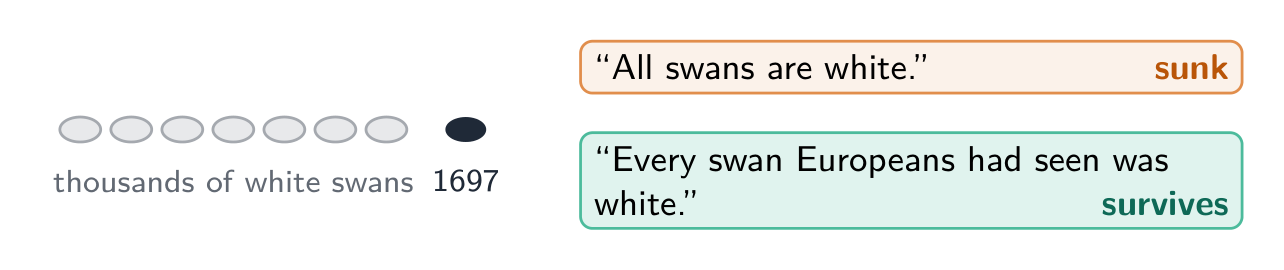
For centuries Europeans said “all swans are white”, and used “a black swan” to mean something impossible. In 1697 the Dutch sea captain Willem de Vlamingh sailed up a river in Western Australia and saw black swans. One sighting destroyed a claim that thousands of white swans had seemed to prove. A writer who had said “every swan I and other Europeans have seen is white” would have been fine. That small difference, between a claim that says all and a claim that says exactly how far its evidence reaches, is what this unit calls qualification.

Unit 7 returns to introductions and conclusions with more experience behind you, then moves to the two things that most separate competent writing from strong writing: qualification 限定 and sentence structure 句子结构.

On introductions and conclusions, the CED's statements are unchanged - the introduction introduces subject and writer to the audience; the conclusion brings the argument to a unified end and may present the thesis, explain its significance, or situate the argument in a broader context.

词汇 训练
English 中文 拼音
qualification/ˌkwɒlɪfɪˈkeɪʃn/ 限定 xiàn dìng
sentence structure/ˈsentəns ˈstrʌktʃə/ 句子结构 jù zi jié gòu
7.2

撰写引言与结论

教学大纲
English
Enduring UnderstandingLearning ObjectiveEssential Knowledge

RHS-1
Individuals write within a particular situation and make strategic writing choices based on that situation.

2.A
Writing – Write introductions and conclusions appropriate to the purpose and context of the rhetorical situation.

  • RHS-1.I The introduction of an argument introduces the subject and/ or writer of the argument to the audience. An introduction may present the argument’s thesis. An introduction may orient, engage, and/or focus the audience by presenting quotations, intriguing statements, anecdotes, questions, statistics, data, contextualized information, or a scenario.
  • RHS-1.J The conclusion of an argument brings the argument to a unified end. A conclusion may present the argument’s thesis. It may engage and/or focus the audience by explaining the significance of the argument within a broader context, making connections, calling the audience to act, suggesting a change in behavior or attitude, proposing a solution, leaving the audience with a compelling image, explaining implications, summarizing the argument, or connecting to the introduction.

来源:College Board AP 课程与考试说明

English

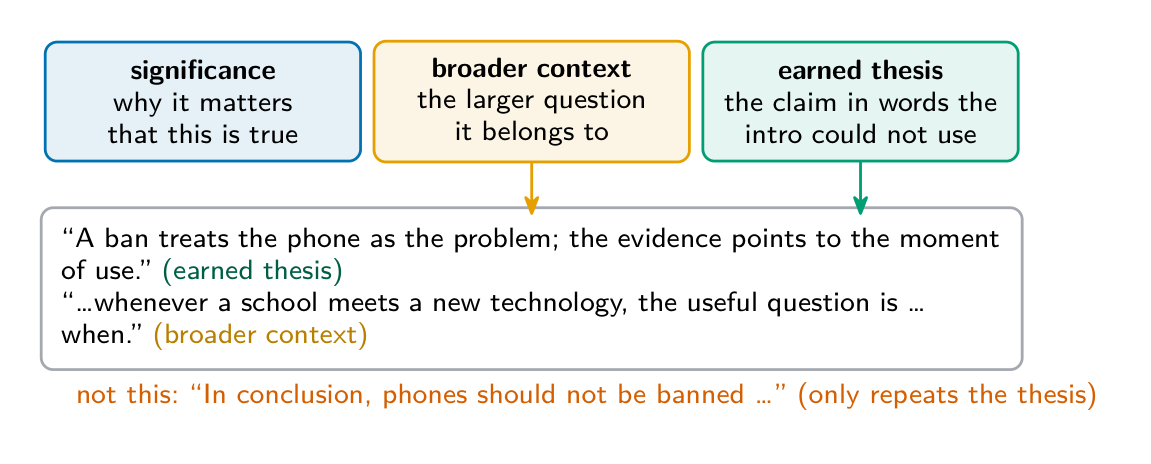
At this stage the useful upgrade is to make the conclusion do the work the CED permits. A conclusion may:

  • Explain the significance of the argument - why it matters that this is true;
  • Situate it in a broader context - what larger question it belongs to;
  • Present the thesis in its final, now-earned form.

The third is the strongest under exam conditions: restate the thesis in language you could not have used in the introduction, because the argument had not yet been made.

Worked example: one essay, two openings and two endings. Prompt: Should schools ban phones?
  • Weak introduction: “Throughout history, technology has changed the world. Phones are a big part of modern life. This essay will discuss whether schools should ban phones.” Two sentences of filler, then an announcement instead of a claim.
  • Strong introduction: “Every school day, a teacher competes with a device designed to hold attention for profit. Schools should not ban phones outright, but they should keep them out of lessons, because the harm comes from use during learning, not from owning a phone at all.” It starts with the real problem, then gives a qualified thesis and previews the line of reasoning.
  • Weak conclusion: “In conclusion, phones should not be banned but should be kept out of lessons.” It only repeats the thesis.
  • Strong conclusion: “A ban treats the phone as the problem; the evidence points to the moment of use. That distinction matters beyond phones: whenever a school meets a new technology, the useful question is not whether to allow it, but when.” It states the thesis in its earned form and then places it in a broader context.
Three things a conclusion may do: explain significance, situate the argument in a broader context, present the earned thesis; the phone essay's strong ending does the last two, while the weak one only repeats the thesis
A conclusion earns its place by saying what follows from the argument.
7.3

主张的限定方式

教学大纲
English
Enduring UnderstandingLearning ObjectiveEssential Knowledge

CLE-1
Writers make claims about subjects, rely on evidence that supports the reasoning that justifies the claim, and often acknowledge or respond to other, possibly opposing, arguments.

3.C
Reading – Explain ways claims are qualified through modifiers, counterarguments, and alternative perspectives.

  • CLE-1.V A lack of understanding of the complexities of a subject or an issue can lead to oversimplification or generalizations.
  • CLE-1.W Because arguments are usually part of ongoing discourse, effective arguments often avoid expressing claims, reasoning, and evidence in absolute terms.
  • CLE-1.X Writers may strategically use words, phrases, and clauses as modifiers to qualify or limit the scope of an argument.

来源:College Board AP 课程与考试说明

English
  • A lack of understanding of the complexities 复杂性 of a subject can lead to oversimplification 过度简化 or generalisation 以偏概全.
  • Because arguments are usually part of an ongoing discourse 讨论, effective arguments often avoid expressing claims in absolute 绝对化的 terms.
  • Writers may strategically use words, phrases, and clauses as modifiers 修饰成分 to qualify or limit the scope 范围 of an argument.

This is counter-intuitive for many students, who assume that a stronger-sounding claim scores better. The opposite is true: an unqualified claim is easy to defeat with one counter-example 反例, while a suitably qualified claim may survive an exception outside its stated scope. Schools should ban phones invites a single exception. Schools should restrict phone use during instructional time, where the cost to attention is measurable does not.

A row of white swans and one black swan from 1697: the claim all swans are white is sunk, while every swan Europeans had seen was white survives
One counter-example sinks an absolute claim
词汇 训练
English 中文 拼音
oversimplification/ˌəʊvəˌsɪmplɪfɪˈkeɪʃn/ 过度简化 guò dù jiǎn huà
generalisation/ˌdʒenərəlaɪˈzeɪʃn/ 以偏概全 yǐ piān gài quán
discourse/ˈdɪskɔːs/ 讨论 tǎo lùn
absolute/ˈæbsəluːt/ 绝对化的 jué duì huà de
modifier/ˈmɒdɪfaɪə/ 修饰成分 xiū shì chéng fèn
scope/skəʊp/ 范围 fàn wéi
counter-example/ˈkaʊntə eɡˈzæmpl/ 反例 fǎn lì
7.4

限定主张

教学大纲
English
Enduring UnderstandingLearning ObjectiveEssential Knowledge

CLE-1
Writers make claims about subjects, rely on evidence that supports the reasoning that justifies the claim, and often acknowledge or respond to other, possibly opposing, arguments.

4.C
Writing – Qualify a claim using modifiers, counterarguments, or alternative perspectives.

  • CLE-1.V A lack of understanding of the complexities of a subject or an issue can lead to oversimplification or generalizations.
  • CLE-1.W Because arguments are usually part of ongoing discourse, effective arguments often avoid expressing claims, reasoning, and evidence in absolute terms.
  • CLE-1.X Writers may strategically use words, phrases, and clauses as modifiers to qualify or limit the scope of an argument.

来源:College Board AP 课程与考试说明

English

The tools are ordinary words used deliberately: in most cases, where X holds, for this population, unless, to the extent that. Each narrows the claim to the ground the evidence actually covers.

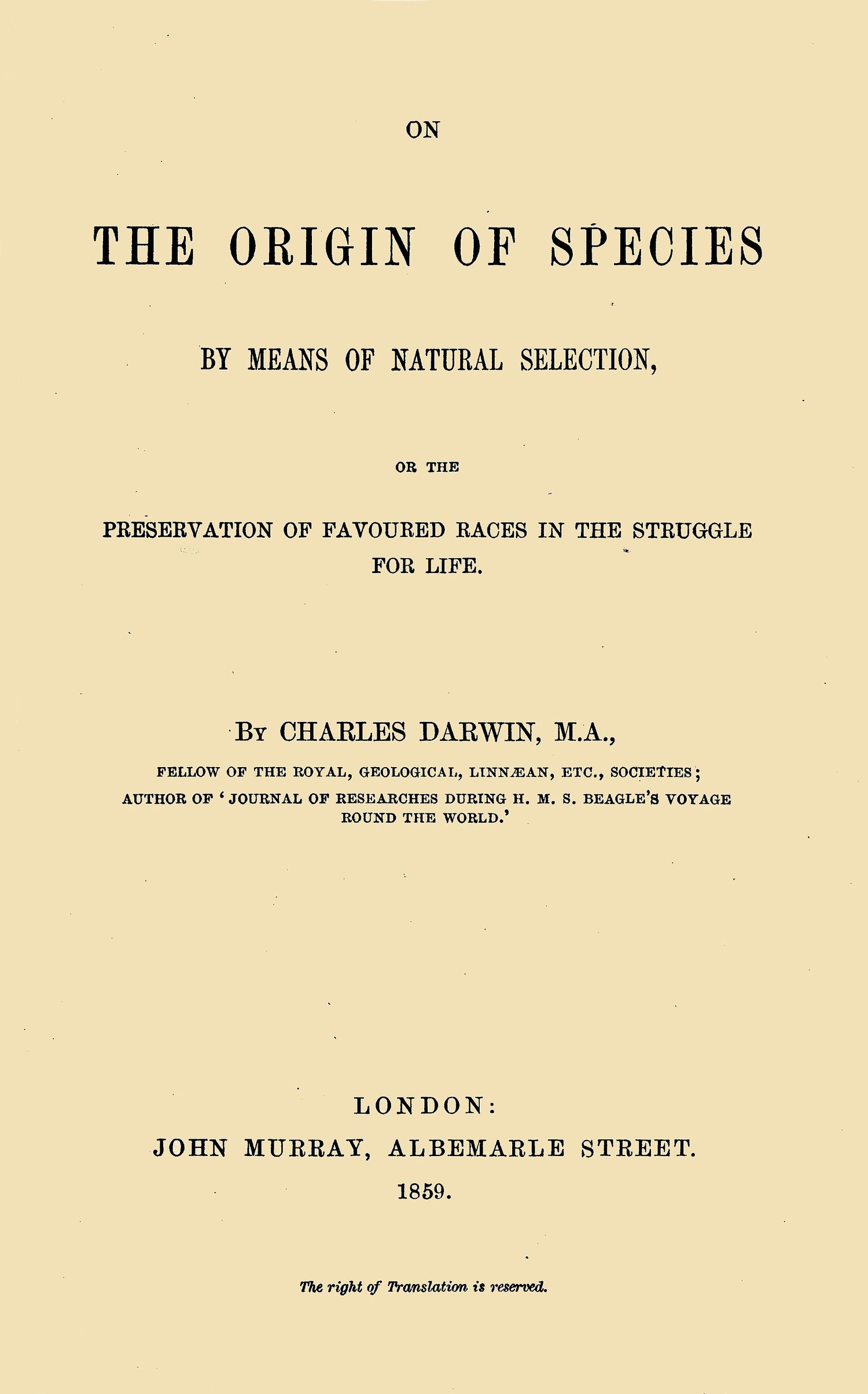
The first edition of On the Origin of Species, 1859: Darwin qualifies his claims with may, probably and if, and invites the reader to test them

Worked example: a scientist who names his own counter-example. In On the Origin of Species (1859), Charles Darwin wrote: “If it could be demonstrated that any complex organ existed, which could not possibly have been formed by numerous, successive, slight modifications, my theory would absolutely break down. But I can find out no such case.” Darwin does not claim his theory cannot be wrong. He says exactly what evidence would defeat it, then reports that he has not found it. The effect on a doubting reader is trust: a writer who shows where his claim could fail seems to have nothing to hide.

Exploring a claim’s limits can contribute to the sophistication point, but a qualifier or concession alone does not earn it. The complexity must be developed as part of the argument; a consistently vivid and persuasive style is another possible route.

A qualified claim is not a weaker claim - it is one you can hold for a whole essay
探索

将每个主张放在限定词量表上

向左每一步都更强且更容易反驳;向右每一步都更安全但价值更低。目标是 scoped position(范围明确的立场)。

词汇 训练
English 中文 拼音
complexity/kəmˈpleksɪti/ 复杂性 fù zá xìng
7.5

分句与观点之间的关系

教学大纲
English
Enduring UnderstandingLearning ObjectiveEssential Knowledge

STL-1
The rhetorical situation informs the strategic stylistic choices that writers make.

7.B
Reading – Explain how writers create, combine, and place independent and dependent clauses to show relationships between and among ideas. (Note: Students should be able to read and analyze these complexities but are not expected to write with them on timed essays.)

  • STL-1.G Writers express ideas in sentences. Sentences are made up of clauses, at least one of which must be independent.
  • STL-1.H The arrangement of sentences in a text can emphasize particular ideas.
  • STL-1.I Subordination and coordination are used to express the intended relationship between ideas in a sentence.
  • STL-1.J Writers frequently use coordination to illustrate a balance or equality between ideas.
  • STL-1.K Writers frequently use subordination to illustrate an imbalance or inequality between ideas.
  • STL-1.L The arrangement of clauses, phrases, and words in a sentence can emphasize ideas.

来源:College Board AP 课程与考试说明

English
  • Writers express ideas in sentences, made up of clauses, at least one of which must be an independent clause 独立分句.
  • The arrangement of sentences in a text can emphasise particular ideas.
  • Subordination 从属 and coordination 并列 express the intended relationship between ideas in a sentence.
  • Writers use coordination to illustrate balance or equality between ideas.
  • Writers use subordination to illustrate imbalance or inequality between ideas.
  • The arrangement of clauses, phrases, and words within a sentence can emphasise ideas.
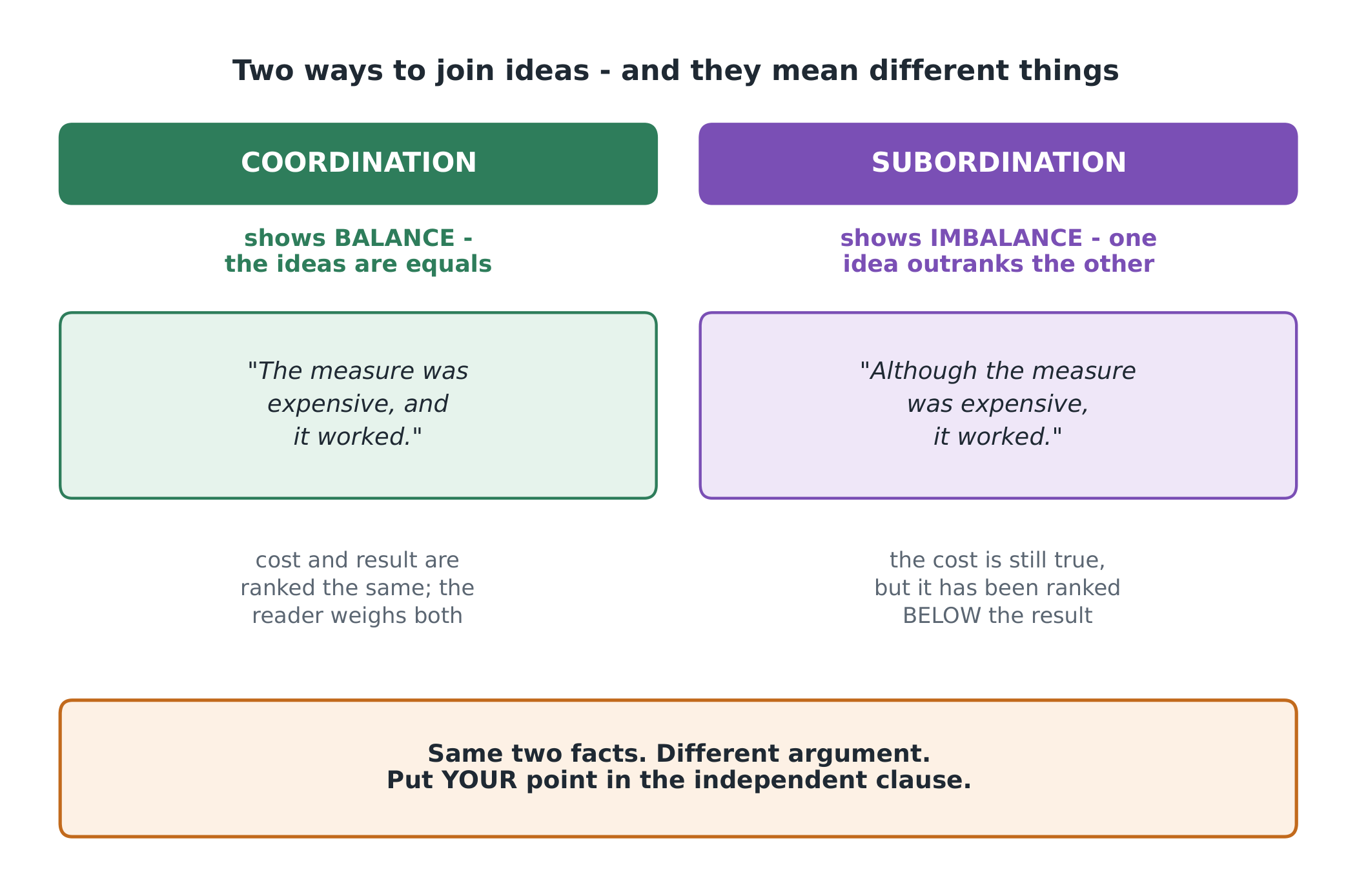
Two ways to join ideas, and they mean different things
The CED is explicit: coordination shows balance, subordination shows imbalance

Those two middle statements make sentence structure analysable rather than decorative. The measure was expensive, and it worked treats cost and effect as equals. Although the measure was expensive, it worked subordinates the cost - it is still true, but it has been ranked below the result. Same facts, different argument.

词汇 训练
English 中文 拼音
independent clause/ˌɪndɪˈpendənt klɔːz/ 独立分句 dú lì fēn jù
subordination/ˌsʌbɔːdɪˈneɪʃn/ 从属 cóng shǔ
coordination/kəʊˈɔːdɪneɪʃn/ 并列 bìng liè
7.6

写出清晰的句子

教学大纲
English
Enduring UnderstandingLearning ObjectiveEssential Knowledge

STL-1
The rhetorical situation informs the strategic stylistic choices that writers make.

8.B
Writing – Write sentences that clearly convey ideas and arguments.

  • STL-1.G Writers express ideas in sentences. Sentences are made up of clauses, at least one of which must be independent.
  • STL-1.H The arrangement of sentences in a text can emphasize particular ideas.
  • STL-1.I Subordination and coordination are used to express the intended relationship between ideas in a sentence.
  • STL-1.J Writers frequently use coordination to illustrate a balance or equality between ideas.
  • STL-1.K Writers frequently use subordination to illustrate an imbalance or inequality between ideas.
  • STL-1.L The arrangement of clauses, phrases, and words in a sentence can emphasize ideas.

来源:College Board AP 课程与考试说明

English

For your own writing: decide the relationship first, then choose the structure that expresses it. If two ideas genuinely carry equal weight, coordinate them. If one is a concession and the other your point, subordinate the concession - and put your point in the independent clause, where the emphasis falls.

All three faults are about where a sentence ends - the mark is for the repair
探索

识别句子错误,然后修复

所有三个错误都与句子结尾有关。命名其中一个毫无价值——分数在于修复。

7.7

语法规范与表达清晰度

教学大纲
English
Enduring UnderstandingLearning ObjectiveEssential Knowledge

STL-1
The rhetorical situation informs the strategic stylistic choices that writers make.

7.C
Reading – Explain how grammar and mechanics contribute to the clarity and effectiveness of an argument.

  • STL-1.M Grammar and mechanics that follow established conventions of language enable clear communication.
  • STL-1.N Writers use punctuation strategically to demonstrate the relationships among ideas in a sentence.
  • STL-1.O Punctuation (commas, colons, semicolons, dashes, hyphens, parentheses, quotation marks, or end marks) advances a writer’s purpose by clarifying, organizing, emphasizing, indicating purpose, supplementing information, or contributing to tone.
  • STL-1.P Some design features, such as italics or boldface, create emphasis.

来源:College Board AP 课程与考试说明

English
  • Grammar and mechanics that follow established conventions enable clear communication.
  • Writers use punctuation strategically to demonstrate relationships among ideas.
  • Punctuation 标点 - commas, colons 冒号, semicolons 分号, dashes 破折号, hyphens 连字符, parentheses 括号, quotation marks, end marks - advances the argument.
  • Design features such as italics 斜体 or boldface create emphasis.
词汇 训练
English 中文 拼音
punctuation/ˌpʌŋktʃuːˈeɪʃn/ 标点 biāo diǎn
colon/ˈkəʊlən/ 冒号 mào hào
semicolon/ˌsemɪˈkəʊlən/ 分号 fēn hào
dash/dæʃ/ 破折号 pò zhé hào
hyphen/ˈhaɪfən/ 连字符 lián zì fú
parentheses/pəˈrenθəsiːz/ 括号 kuò hào
italics/ɪˈtælɪks/ 斜体 xié tǐ
7.8

语法与书写规范

教学大纲
English
Enduring UnderstandingLearning ObjectiveEssential Knowledge

STL-1
The rhetorical situation informs the strategic stylistic choices that writers make.

8.C
Use established conventions of grammar and mechanics to communicate clearly and effectively.

  • STL-1.M Grammar and mechanics that follow established conventions of language enable clear communication.
  • STL-1.N Writers use punctuation strategically to demonstrate the relationships among ideas in a sentence.
  • STL-1.O Punctuation (commas, colons, semicolons, dashes, hyphens, parentheses, quotation marks, or end marks) advances a writer’s purpose by clarifying, organizing, emphasizing, indicating purpose, supplementing information, or contributing to tone.
  • STL-1.P Some design features, such as italics or boldface, create emphasis.

来源:College Board AP 课程与考试说明

English

The examinable framing is that punctuation is argumentative, not merely correct. A colon promises that what follows explains what preceded. A semicolon asserts that two independent statements belong together. A dash interrupts, and the interruption is the point.

Worked example: structure and punctuation in Lincoln's Second Inaugural (1865). “Both parties deprecated war; but one of them would make war rather than let the nation survive; and the other would accept war rather than let it perish. And the war came.”

Choice Effect
the semicolons join three clauses into one long sentence the two sides are held in balance, as equals, while Lincoln weighs them
“make war” against “accept war” coordination shows the sides as parallel, but the verbs are not equal: one side started it
“And the war came.” is four words, a new sentence after the long, balanced sentence, the short one makes war feel abrupt after the contrasting choices; the preceding verbs still assign responsibility

Worked example (original AP-style practice). A rhetorical-analysis passage reads: “The programme was popular; it was also, by every measure the department itself proposed, ineffective.” A low answer notes “the writer uses a semicolon”. A scoring answer explains the structure: “The semicolon joins two complete clauses; “also” and “ineffective” make popularity and failure a pointed contrast, so the reader cannot dismiss the failure as an objection to popularity - both are simply true at once. The parenthetical 'by every measure the department itself proposed' then removes the department's escape route before the word 'ineffective' arrives.” That is syntax analysed as argument.

Each mark is a promise about the second half of the sentence
7.8

练习

English

Answer each before reading the model answers below.

  1. Qualify this claim: “Video games make children violent.”
  2. Fix the misplaced modifier 错位修饰语 (here, a dangling modifier): “Running for the bus, my bag fell open.”
  3. Combine into one clear sentence that shows the relationship: “The library extended its hours. Exam season began.”
  4. Correct the comma splice 逗号粘连句: “The policy failed, it ignored local needs.”
  5. A student says: “Grammar does not matter on AP essays.” Correct the student.
词汇 训练
English 中文 拼音
misplaced modifier/mɪˈspleɪst ˈmɒdɪfaɪə/ 错位修饰语 cuò wèi xiū shì yǔ
comma splice/ˈkɒmə splaɪs/ 逗号粘连句 dòu hào zhān lián jù
7.8

范例答案

English
  1. For example: “Some studies suggest that heavy play of violent games is linked to short-term aggression in some children.”
  2. “As I was running for the bus, my bag fell open.” The bag was not running.
  3. “The library extended its hours because exam season began.”
  4. “The policy failed because it ignored local needs.” (Or use a semicolon or a full stop.)
  5. Grammar errors that obscure meaning cost credit, and clarity alone does not earn sophistication. Grammatical errors that interfere with communication prevent the fourth evidence-and-commentary point. Clarity serves the argument.
7.8

考试技巧

English
  • Qualify your claims. An absolute claim is defeated by one counter-example; a qualified one still needs evidence and can be refuted within its stated scope.
  • Developing a qualification may support the sophistication point; adding a qualifier alone does not earn it.
  • Coordination = balance. Subordination = imbalance. The CED says so, and it makes syntax analysable.
  • Put your point in the independent clause. Concessions belong in the subordinate one.
  • Punctuation advances the argument. A colon explains, a semicolon joins as equals, a dash interrupts.
  • Never write “the writer uses a semicolon” without saying what relationship it asserts.

Vocabulary card meanings

oversimplification: Treating a complex matter as simpler than it is. generalisation: Treating something true of some cases as true of all. subordination: Joining a less important idea under a main one. coordination: Joining two ideas as equals. comma splice: Two full sentences wrongly joined with only a comma.

这有帮助吗?

该知识点的互动课程

逐步完成,配合即时检查练习。

历年真题

更多 AP 英语语言与写作 知识点

登录或创建账户

IGCSE, A-Level & AP