跳到主要内容

完善有限定的论证

AP 英语语言与写作 · 第 9 主题

训练
讲义 词汇表
9.1

主张的限定方式

大纲
Enduring UnderstandingLearning ObjectiveEssential Knowledge

CLE-1
Writers make claims about subjects, rely on evidence that supports the reasoning that justifies the claim, and often acknowledge or respond to other, possibly opposing, arguments.

3.C
Reading – Explain ways claims are qualified through modifiers, counterarguments, and alternative perspectives.

  • CLE-1.AA Writers enhance their credibility when they refute, rebut, or concede opposing arguments and contradictory evidence.
  • CLE-1.AB When writers concede, they accept all or a portion of a competing position or claim as correct, agree that the competing position or claim is correct under a different set of circumstances, or acknowledge the limitations of their own argument.
  • CLE-1.AC When writers rebut, they offer a contrasting perspective on an argument and its evidence or provide alternative evidence to propose that all or a portion of a competing position or claim is invalid.
  • CLE-1.AD When writers refute, they demonstrate, using evidence, that all or a portion of a competing position or claim is invalid.
  • CLE-1.AE Transitions may be used to introduce counterarguments.
  • CLE-1.AF Not all arguments explicitly address a counterargument.
  • CLE-1.Y Effectively entering into an ongoing conversation about a subject means engaging the positions that have already been considered and argued about.
  • CLE-1.Z Evidence and sources will either support, complement, or contradict a writer’s thesis.

来源:美国大学理事会 AP 课程与考试说明

第九单元篇幅很短,却是本课程的最后一步:如何处理与你相对立的论证。这里的一切都在考试中直接得到奖励,而三个关键动词却被不断混用。

先看总体框架:

  • 有效地进入关于某一主题的持续讨论,意味着回应已经被提出的各种立场。忽略它们的论证不是在参与讨论,而只是在向讨论里宣告。
  • 证据与来源要么支持、补充,要么反驳(support, complement, or contradict)写作者的论点。三者都可用——相反的证据不是需要藏起来的麻烦,而是需要被处理的材料。
  • 写作者在驳倒、反驳或让步对立论证与相反证据时,提升了自身的可信度
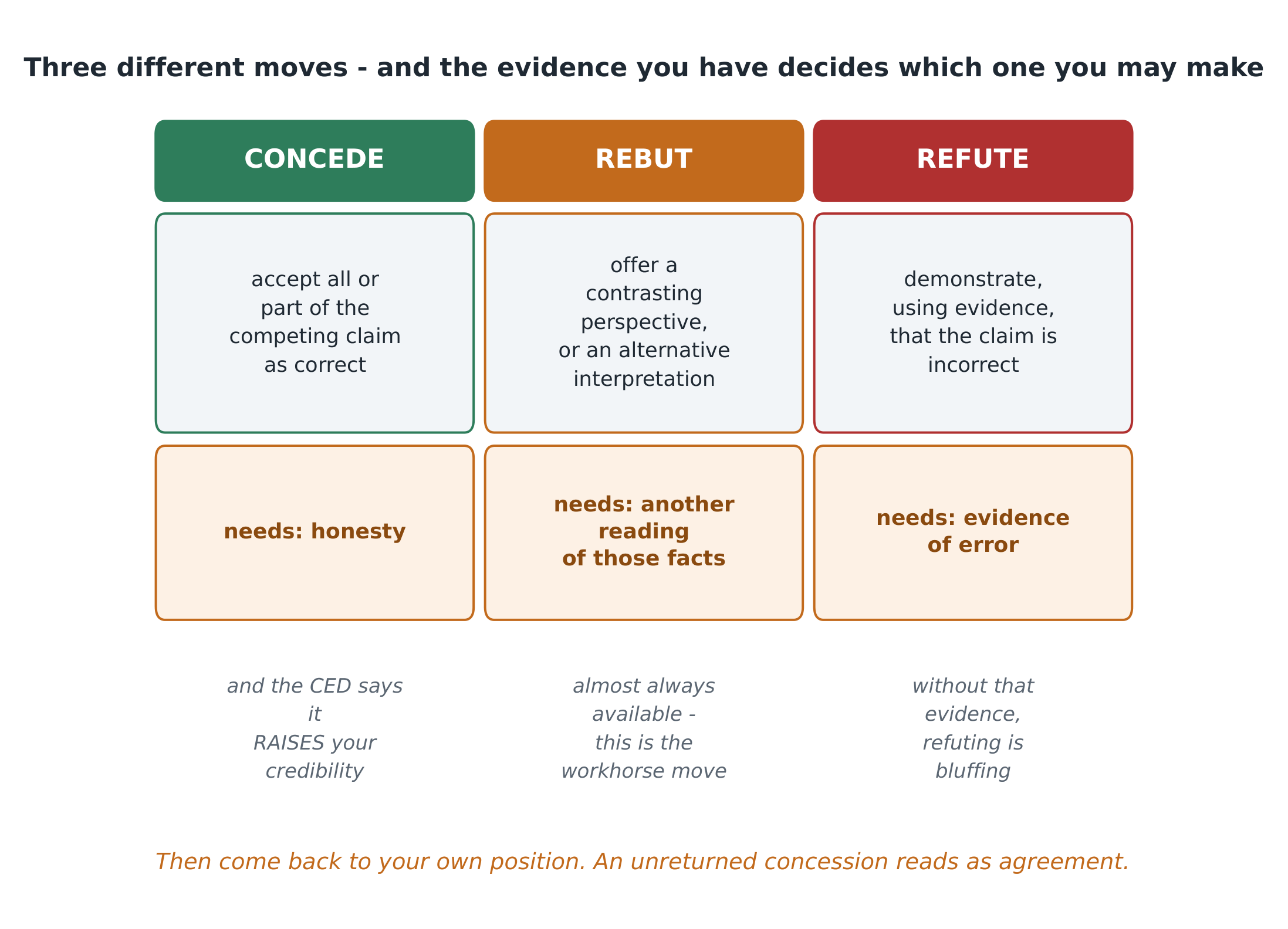
三种不同的动作,三种不同的承认——而学生不断把它们混淆
让步是接受,反驳是提出另一读法,驳倒是证伪。选你的证据真正支撑得起的那一种

按 CED 自身的定义,这三种动作是:

  • 让步(concede):写作者接受对立立场或主张的全部或一部分为正确,并同意对方的要点有其道理。
  • 反驳(rebut):写作者对某一论证及其证据提出对照性的视角,或提供另一种解释。
  • 驳倒(refute):写作者运用证据证明对立立场或主张的全部或一部分是错误的

这一区分取决于你的证据允许你做什么。驳倒需要证明存在错误的证据;如果没有,驳倒就是虚张声势,读者看得出来。反驳只需要对同样事实的另一种读法,而这远为常见。让步需要的是诚实,而它不花任何代价——CED 明确说它提升可信度。

另有两点:

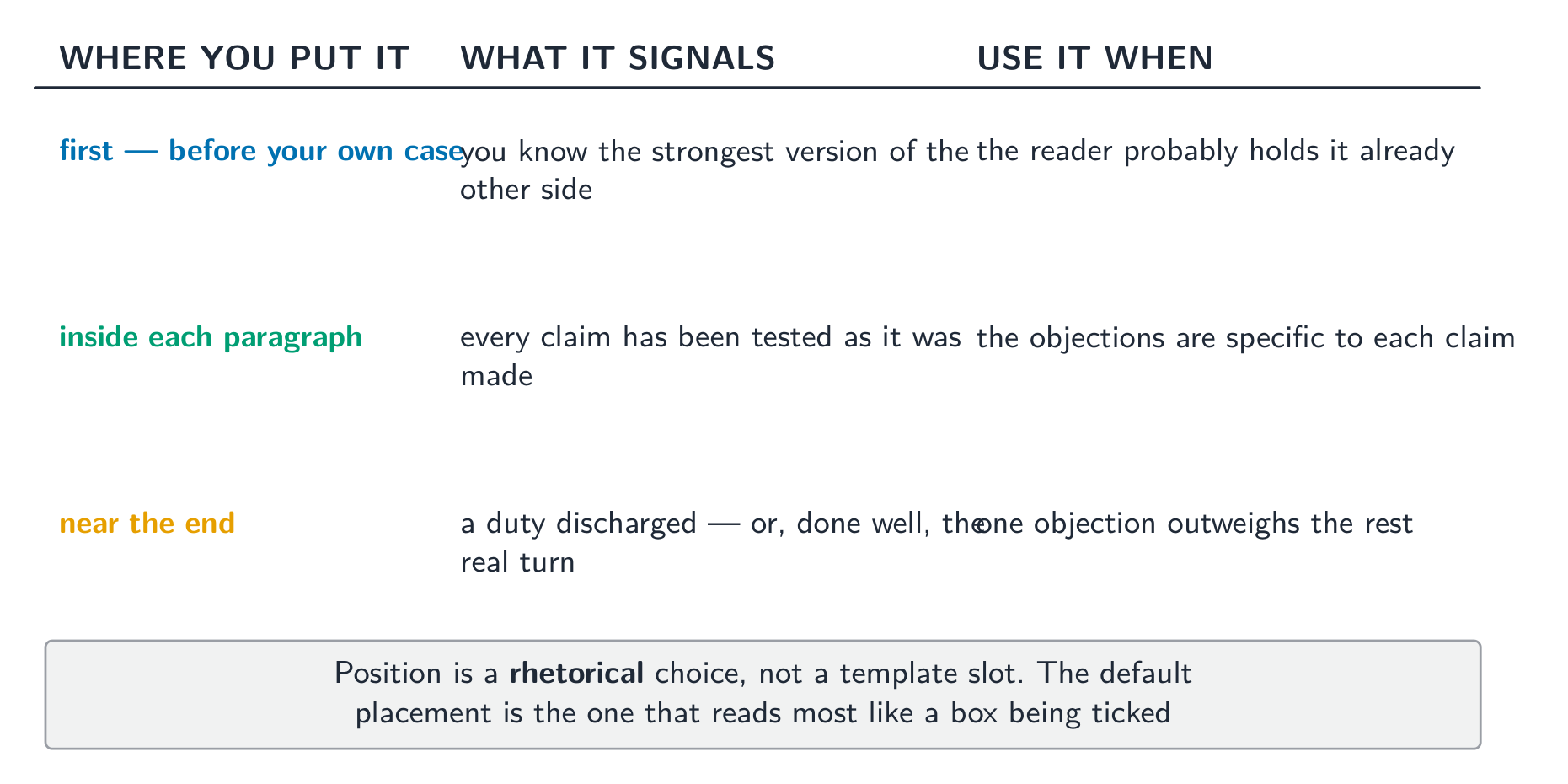
  • 过渡可以用来引出反驳(introduce counterarguments)——而且如第五单元所说,过渡应当标示关系。批评者认为宣告了一项反驳;对此最有力的反对是既宣告了它,也为它排定了位次。
  • **并非所有论证都明确处理反驳。**这对你所读的文本同样成立,在分析时值得注意——一个不回应任何对立意见的论证,已经告诉了你它的预期受众是谁。
词汇表 训练
英文 中文 拼音
support, complement, or contradict 支持、补充或反驳 zhī chí 、 bǔ chōng huò fǎn bó
Concede 让步 ràng bù
Rebut 反驳 fǎn bó
Refute 驳倒 bó dǎo
Transitions may be used to introduce counterarguments 引出反驳 yǐn chū fǎn bó
9.2

限定主张

大纲
Enduring UnderstandingLearning ObjectiveEssential Knowledge

CLE-1
Writers make claims about subjects, rely on evidence that supports the reasoning that justifies the claim, and often acknowledge or respond to other, possibly opposing, arguments.

4.C
Writing – Qualify a claim using modifiers, counterarguments, or alternative perspectives.

  • CLE-1.AA Writers enhance their credibility when they refute, rebut, or concede opposing arguments and contradictory evidence.
  • CLE-1.AB When writers concede, they accept all or a portion of a competing position or claim as correct, agree that the competing position or claim is correct under a different set of circumstances, or acknowledge the limitations of their own argument.
  • CLE-1.AC When writers rebut, they offer a contrasting perspective on an argument and its evidence or provide alternative evidence to propose that all or a portion of a competing position or claim is invalid.
  • CLE-1.AD When writers refute, they demonstrate, using evidence, that all or a portion of a competing position or claim is invalid.
  • CLE-1.AE Transitions may be used to introduce counterarguments.
  • CLE-1.AF Not all arguments explicitly address a counterargument.
  • CLE-1.Y Effectively entering into an ongoing conversation about a subject means engaging the positions that have already been considered and argued about.
  • CLE-1.Z Evidence and sources will either support, complement, or contradict a writer’s thesis.

来源:美国大学理事会 AP 课程与考试说明

就自己的写作而言,第三题最有力也最可靠的结构是:

  1. 表明你的立场,并限定到你的证据所覆盖的范围。
  2. 让步承认对立立场中确实正确的那一部分。
  3. 对其余部分反驳或驳倒——有另一种读法就反驳,有证明错误的证据才驳倒。
  4. 说明你的立场为何能在这一让步之后依然成立

第四步是多数学生漏掉的一步,而思辨深度那一分正在这里。让步之后不回到自己的论证,读起来就像你改变了主意。

Worked example(一道真实的 AP 考题)。在第三题论证题中,比较对同一项反对意见的两种处理。薄弱版本:*「有些人不同意,但他们错了。」这只是点出了一个对立立场却没有回应它——它既不是让步,也不是反驳,更不是驳倒。有力版本:「认为这项政策代价过高的反对意见,就其所及而言是正确的:直接支出确实高于所考虑的任何替代方案。但只有当替代方案能达成同样的结果时,成本才具有决定性,而同一份报告显示它们并不能——因此这项反对意见所依赖的那个比较根本不成立。」*这一段让步承认了成本,用证据驳倒了那个比较,并回到了写作者自己的立场。三个动作,而每一个都在评分标准上。

9.2

考试技巧

  • 让步、反驳、驳倒是三种不同的主张。不要把这些词混用。
  • **只有掌握证明错误的证据才驳倒。**没有就改为反驳——另一种解释几乎总是有的。
  • 按 CED 自己的说法,让步会提高可信度。它不是弱点。
  • 让步之后要回来。不回到自己立场的让步读起来就是同意对方。
  • 使用能为反驳排定位次的过渡:对此最有力的反对是胜过有些人说
  • 分析文本时,注意它在何时完全不处理反驳。这一缺席告诉你它是写给谁的。

本主题的互动课程

逐步学习,并即时检测练习。

AP 英语语言与写作的更多主题

登录或创建账号

IGCSE, A-Level & AP