In 2014 the American Academy of Pediatrics, a body of children's
doctors, said that middle and high schools should start at 8:30 a.m.
or later, because teenagers' body clocks make them sleep later. In
2019 California made it law: from 2022 most public high schools could
not start before 8:30. Doctors supported the change because of health.
Some economists supported it because better-rested students learn
more. Many parents and coaches worried about later sports practice,
after-school jobs and bus timetables. Everyone was looking at the same
clock, from a different place. A synthesis essay asks you to use
voices like these, not just count them.
Unit 6 is the synthesis unit, and it contains the single sharpest distinction in the course.
When synthesising 综合, writers draw on arguments from multiple sources 来源, strategically select the most relevant information, and integrate it into their own argument.
A source provides information for an argument, and some sources are more reliable or credible 可信的 than others.
A position 立场and a perspective 视角are different. Sources may hold the same position on a subject and yet each come from a different perspective.
The strongest arguments recognise and acknowledge 承认 the other positions that exist.
Considering other positions can strengthen credibility. Also assess expertise, evidence, accuracy and purpose; acknowledging opposition alone does not establish reliability.
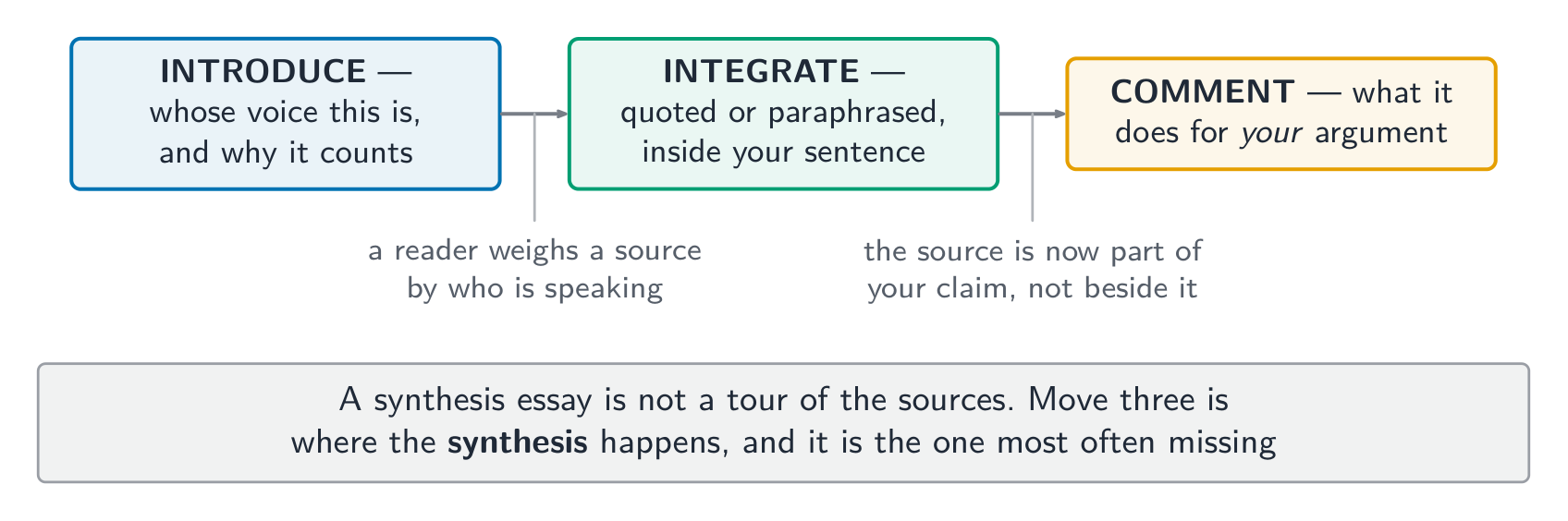
Two sources can agree and still be doing completely different work in your argumentThe verb positions the source before your commentary begins
The position-and-perspective distinction is what makes synthesis possible. If you sort the sources only by position, you get two piles - for and against - and a paragraph per pile. If you sort them by perspective, you can say things like:
Both the economist and the teacher support the measure, but they support it for reasons that do not survive together: one values the measurable gain, the other the change in what students attempt.
That sentence is synthesis. It uses two sources, is grounded in what each actually says, and produces a claim neither source makes.
Worked example: sorting four sources on school start times. Source A is a real statement; B–D are illustrative source descriptions, not identified published documents.
Source
Position
Perspective
A: the pediatricians' 2014 statement
for a later start
health: teenagers need 8.5–9.5 hours of sleep
B: an economics paper on school reforms
for a later start
cost and benefit: a cheap change with a gain in test scores
C: a parents' and coaches' letter
against
family life: sports, jobs and childcare after school
D: a school district's transport report
against, unless funded
operations: one fleet of buses serves several schools in turn
Sorting by position gives two piles. Sorting by perspective gives a
claim: “A and B agree that a later start helps students, but D shows
why schools still resist it: the cost is not in the classroom but in
the bus timetable, so the real question is who pays for more buses,
not whether sleep matters.” That claim uses three sources, and none of
them says it.
Also examinable: use the credibility test. Ignoring a relevant objection can weaken credibility, but a brief factual report need not survey every position. Explain why an omission matters rather than treating it as proof of unreliability.
Three moves turn a source into evidence - the third is where synthesis happens
A short but load-bearing point: consideration and use of new evidence may require revision 修改 of the thesis statement and/or changes to the line of reasoning.
Reading a text, this means a writer's thesis may be responsive - shaped by the evidence rather than imposed on it. Look for where an argument turns.
Writing under time pressure, this is permission you should use. If, while drafting, you find the evidence does not support the thesis you began with, change the thesis, not the evidence. Examiners reward an argument that fits its evidence; there are no marks for having predicted your own conclusion.
A geometry lesson on tablets: should tablets replace printed textbooks? A thesis takes a position the sources can support
In practice, spend the first minutes reading sources and sketching claims before fixing the thesis. A thesis written after the evidence is nearly always better than one written before it.
A thesis written after the evidence fits it
Worked example: from first idea to a thesis that fits. Prompt: Should schools replace printed textbooks with tablets? The sources include a cost study, a teacher's account of distraction in lessons, and a reading study that found students remember less from screens.
Restates the prompt:“There are many views on whether schools should replace textbooks with tablets.” Not a claim: nobody could disagree with it.
First idea:“Schools should replace textbooks with tablets because they are cheaper and more modern.” This is a claim, but the reading study contradicts it, and “more modern” is not a reason.
Revised to fit the evidence:“Tablets may lower costs, but because students remember less from screens, schools should keep printed textbooks for core reading and use tablets for practice and research.”
The revised thesis is defensible 可辩护的: a reasonable reader could disagree, and the sources give evidence for each part. It is qualified (it keeps part of the opposing case), and it already shows the line of reasoning: costs first, then memory, then the divided solution. That order can become the order of the body paragraphs.
A writer's tone 语调 is the writer's attitude or feeling about a subject, conveyed through word choice and writing style.
Readers infer 推断 tone from word choice - especially from the positive, negative, or otherwise charged 带感情色彩的 associations of the words chosen.
A writer's shifts in tone 语调转变 from one part of a text to another may suggest qualification 限定, refinement 完善, or a change in perspective.
A public riverside walk: a writer's word choice (improvement, or enclosure?) shapes how readers see the same plan
The third is the analytical gold. A tone shift is a visible event in a text: something changed at that point, and explaining what the writer wanted the reader to do differently after it is exactly the kind of answer that scores.
Word choice is not the only tool. Comparisons (an analogy 类比 or a metaphor 隐喻) explain something unfamiliar through something the audience already knows, and carry that thing's associations with them. Syntax 句法, the way sentences are built, also shapes how a point lands:
Choice
What it often does
a very short sentence after long ones
stops the reader; puts weight on one point
parallelism 平行结构 (repeated structure: “We waited. We asked. We were ignored.”)
builds rhythm and makes items feel equal, or the pressure grow
a question the writer then answers
anticipates the reader's doubt and takes control of the answer
a sentence that delays its main clause
can build suspense by postponing the main assertion
Worked example: analysing a choice. A writer argues that a town's riverside should stay public: “The developers describe the plan as an improvement. They have drawn new paths, new benches, new lights. They have not drawn a single gate that is open after six.”
Weak analysis: “The writer uses repetition and a short sentence to make the passage effective.” This only names devices.
Strong analysis: “The repeated new paths, new benches, new lights lets the developers' promises pile up, so that the last sentence, built in the same pattern as the one before it, turns that list against them: everything is new except public access. The parallel structure makes the missing gate feel like a deliberate absence, which supports the writer's claim that the plan improves the riverside while quietly closing it to the public.”
The strong answer names the choice, explains how it works on the reader, and connects that effect to the writer's purpose. That last link is what the analysis marks reward.
Same denotation, five judgements - which word was chosen is the analysis
In your own writing, tone should be consistent and controlled, and deliberately shifted only where the argument turns - for example when moving from stating your position to conceding 让步 part of an opposing one.
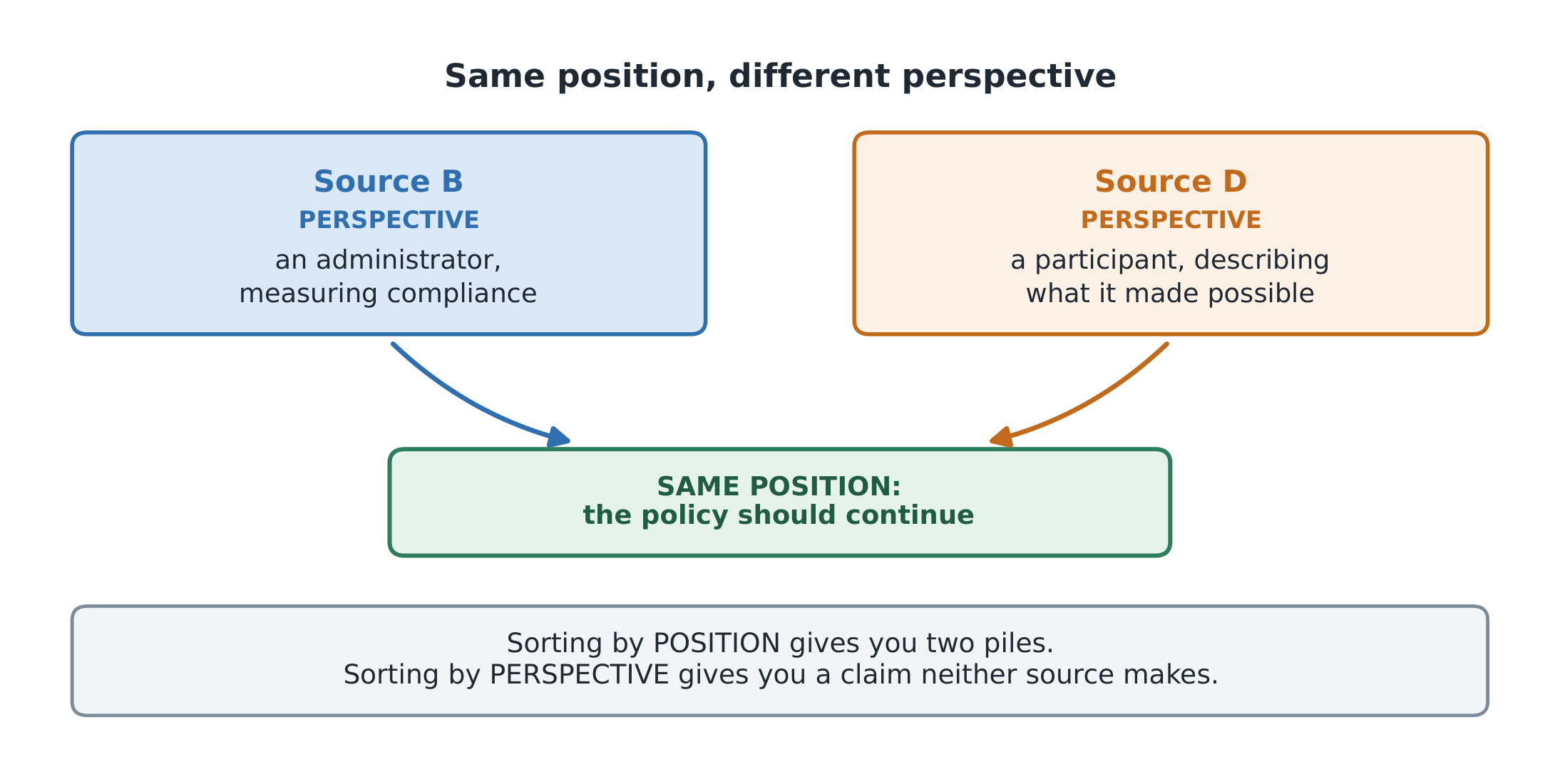
Worked example (original AP-style practice). On a synthesis prompt, compare two uses of the same two sources. Weak: “Source B agrees with Source D that the policy should continue.” That is position-sorting, and it produces nothing. Strong: “Sources B and D both defend the policy, but B defends it as an administrator measuring compliance while D defends it as a participant describing what it made possible - so the agreement is thinner than it appears, and the case rests on whether we are measuring the policy's operation or its effect.” Same two sources, but the perspectives are doing the work, and the claim belongs to the writer.
6.6
练习
English
Answer each before reading the model answers below.
Two sources both support a four-day school week: a head teacher writing about staff burnout 职业倦怠, and an economist writing about energy costs. Same position or same perspective? Explain.
Write one sentence that synthesises the two sources in question 1 into a claim neither makes alone.
A source on a new road never mentions any objection to it. What does the course's credibility test say about it?
Halfway through your essay you find that your best source contradicts your thesis. What should you do?
A passage moves from mocking a plan to “Yet the plan's defenders are not fools.” What does this tone shift suggest?
Same position (for the four-day week) but different perspectives: one argues from teachers' wellbeing, the other from cost.
For example: “A four-day week appeals to schools for two unrelated reasons, staff wellbeing and energy savings, which suggests its support is broader than either group's interest.”
Check whether the omitted objection matters to the source’s purpose and conclusion. Its absence may weaken credibility, but does not by itself establish unreliability.
Revise the thesis to fit the evidence, for example by qualifying it. There are no marks for keeping your first idea.
A shift toward qualification or concession: the writer is about to treat the opposing view more seriously, and wants the reader to judge the plan more fairly from this point.
6.6
考试技巧
English
Position and perspective are different. This one distinction lifts most synthesis essays out of the middle band.
Sort sources by perspective, not by side. Sorting by side produces a paragraph per pile and no argument.
Use the CED's credibility test: explain how omitted relevant objections affect credibility, alongside evidence, expertise and purpose.
If the evidence does not fit the thesis, change the thesis. There are no marks for consistency with your first idea.
A thesis must be defensible: if nobody could disagree with it, it is not yet a claim.
In analysis, name the choice, explain how it works on the reader, then link it to the writer's purpose.
A tone shift is a visible event. Say what changed and what the reader was meant to do after it.
Keep your own tone controlled. Shift it only where the argument genuinely turns.
Vocabulary card meanings
shift in tone: A change in the writer's attitude partway through a text.
position: The side a writer takes on an issue.
perspective: The point of view or background a writer argues from.