| English | 释义 | 拼音 |
|---|---|---|
| position/pəˈzɪʃn/ | 立场 | lì chǎng |
| perspective/pəˈspektɪv/ | 视角 | shì jiǎo |
Same side, different reasons
- In 1776, the economist Adam Smith wrote that slave labour, "though it appears to cost only their maintenance, is in the end the dearest of any": slavery was bad business. In 1789, William Wilberforce told Parliament that the slave trade's wickedness was "so enormous, so dreadful, so irremediable" that he was "completely made up for the abolition": slavery was a moral crime.
- Both opposed slavery: the same position 立场. But they argued from different perspectives 视角, economics and morality, and they would persuade different readers.
Position and perspective
| Position | Perspective | |
|---|---|---|
| Question it answers | Which side? | From where? Through which values or expertise? |
| Smith | against slavery | economic: free labour is more productive |
| Wilberforce | against slavery | moral and religious: slavery is a sin and a crime |
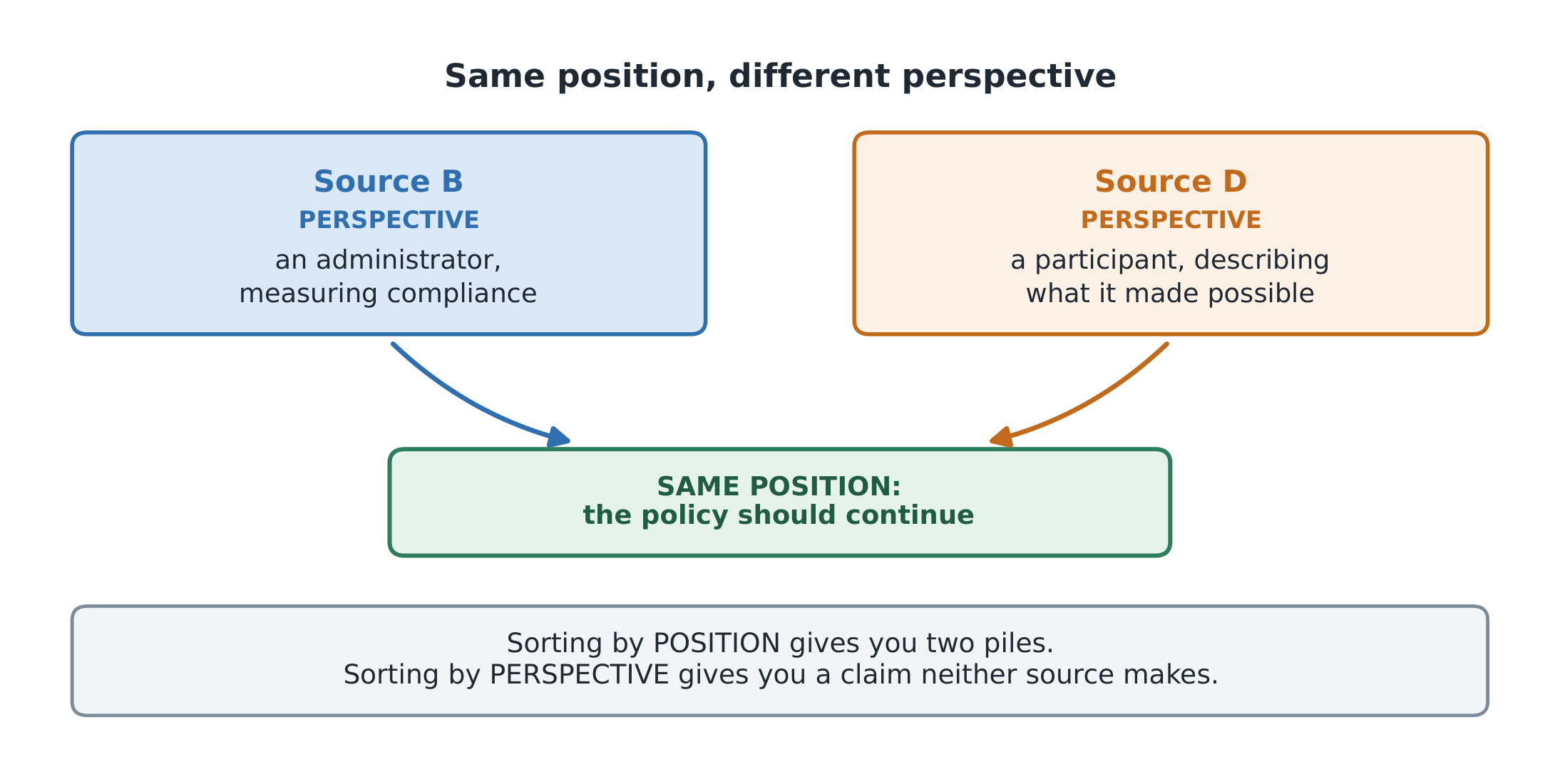
- Sorting sources only by position gives two piles ("for" and "against"). Sorting by perspective shows why people hold a view, and where your own claim can stand.
立场还是视角?
Sort each description by which of the two it names.
Two writers both support a four-day school week. Match each reason to its perspective.
难度 2/5 · 今日首次完成可获 140 金币及少量额外奖励
Same position, different perspectives.
What is the difference between a position and a perspective?
难度 1/5 · 今日首次完成可获 100 金币及少量额外奖励
Two sources can share a position but not a perspective.
Why perspective matters in synthesis
- Two sources with the same position can support different parts of your argument, or even weaken each other. Smith's argument depends on profits: if slavery had been profitable, his case would fail. Wilberforce's does not depend on profit at all.
- That gives you a claim neither source makes alone: "The moral case against slavery was stronger than the economic one, because it could not be answered by showing that slavery paid."
Smith's economic argument against slavery would be weakened if slavery turned out to be profitable.
难度 1/5 · 今日首次完成可获 100 金币及少量额外奖励
It rests on profit; Wilberforce's moral argument does not.
Judging a source's credibility
- Some sources are more reliable than others. Ask: who wrote it, with what expertise, for what purpose, and how far does it consider other positions? A source that acknowledges nothing against itself is usually weaker.
- Say so in your essay: "Source D, written by the company that builds the stadium, does not mention the cost to taxpayers."
Which source is likely to be the least credible on whether a new stadium benefits a city?
难度 1/5 · 今日首次完成可获 100 金币及少量额外奖励
It has an interest in the outcome and ignores other positions.
Worked exam skill: a synthesis sentence from perspectives
Prompt: Argue whether a city should host a major sporting event. Two sources support hosting: a tourism board (perspective: visitor spending) and a public-health charity (perspective: inspiring residents to exercise).
Weak: "Sources A and B both support hosting the event."
Strong: "Although the tourism board and the health charity both support hosting the event, they promise different benefits, and only one lasts: visitor spending ends when the event does (Source A), while new sports facilities can keep residents active for decades (Source B), so the case for hosting depends on what is built, not on who visits."
- Why it scores: it uses perspective to build the student's own claim, holding two sources together, which also shows the complexity that earns the sophistication point.
Agreeing sources are not interchangeable. Ask what each one's perspective adds, and what would weaken it.
A position is which side a source takes; a perspective is the values or expertise it argues from. Sources with the same position can have different perspectives, and comparing them produces your own claim. Judge credibility by who wrote a source, why, and how far it considers other positions.
Practice. Two sources oppose a ban on fireworks: a fireworks seller (perspective: business) and a cultural group (perspective: tradition). Write one synthesis sentence that uses their different perspectives to make your own claim.
Perspective produces your own claim.