跳到主要内容
学科

AP 英语语言与写作

学习建议

AP 英语语言与写作是一门关于修辞的课程:研究写作者如何用语言影响读者。它的必修内容是一组能力,归入四大观念之下——修辞情境主张与证据论证与组织,以及风格

每项能力都有阅读与写作两个方面。你先学会解释别人如何构建论证,再用同样的方法自己构建一个。把两方面放在一起教是有意为之。

修辞情境是全部内容的基础。促因、受众、写作者、目的、语境与信息,解释了一篇文本*为什么*做出这样的选择——在你说清某个手法对那位受众起了什么作用之前,"作者使用了这一手法"并不得分。

所选文本以非虚构为主——随笔、演讲、书信、新闻报道。由于教师自行选择文本与主题,各单元是按其培养的能力来界定的,而不是按指定书目。

下面的笔记按 College Board 的课程框架逐单元展开,列出每项能力及其背后的必备知识。

训练全部词汇
  • 1

    主张、证据与修辞情境

    讲义 词汇表
    1.1

    修辞情境的构成要素

    大纲
    Enduring UnderstandingLearning ObjectiveEssential Knowledge

    RHS-1
    Individuals write within a particular situation and make strategic writing choices based on that situation.

    1.A
    Reading – Identify and describe components of the rhetorical situation: the exigence, audience, writer, purpose, context, and message.

    • RHS-1.A The rhetorical situation of a text collectively refers to the exigence, purpose, audience, writer, context, and message.
    • RHS-1.B The exigence is the part of a rhetorical situation that inspires, stimulates, provokes, or prompts writers to create a text.
    • RHS-1.C The purpose of a text is what the writer hopes to accomplish with it. Writers may have more than one purpose in a text.
    • RHS-1.D An audience of a text has shared as well as individual beliefs, values, needs, and backgrounds.
    • RHS-1.E Writers create texts within a particular context that includes the time, place, and occasion.

    来源:美国大学理事会 AP 课程与考试说明

    AP 英语语言与写作不是一门文学课。它研究的是文本如何对读者起作用,而第一单元安装了此后一切赖以建立的两个观念:修辞情境主张加证据的段落。

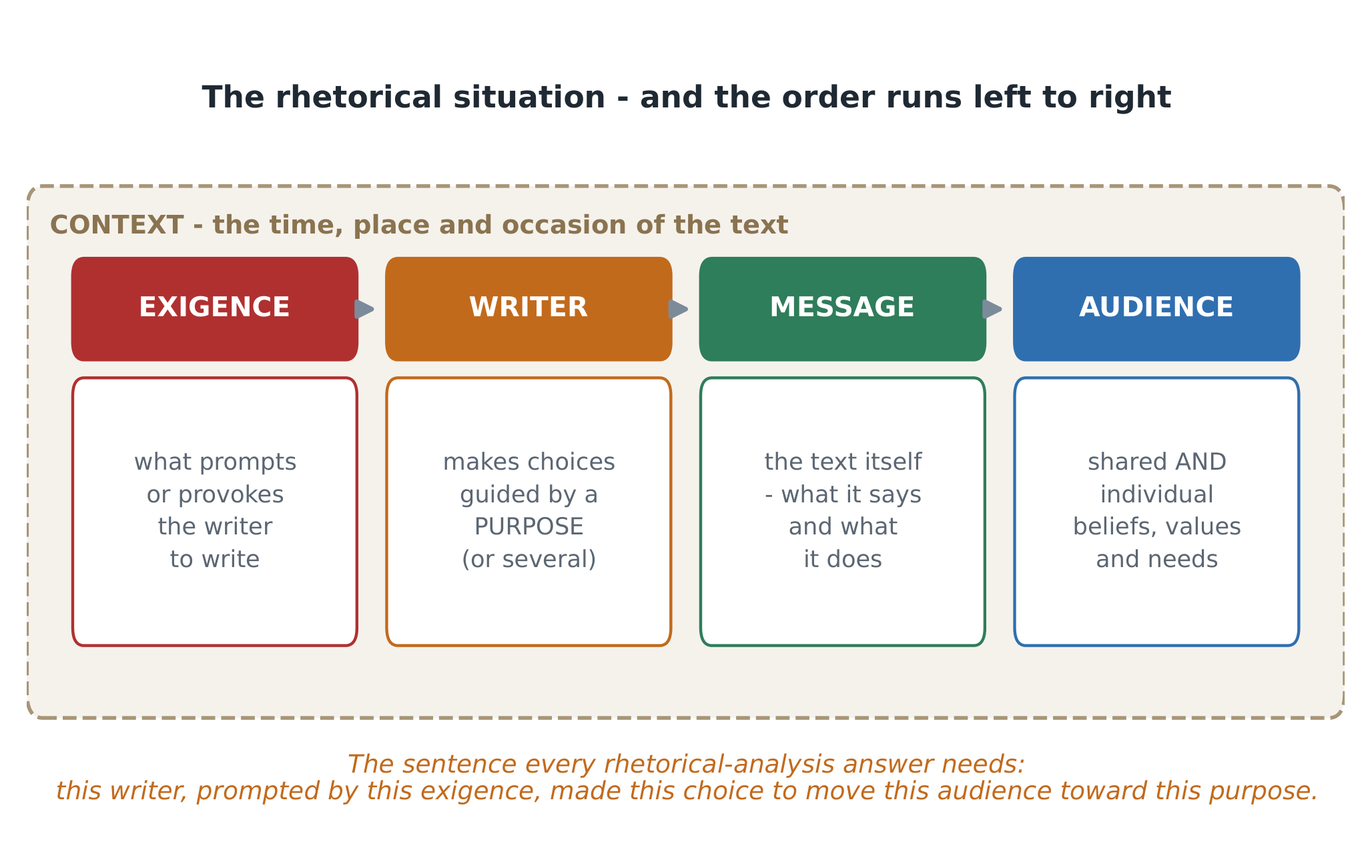
    六个组成部分,按因果顺序排列
    促因促使写作者动笔;语境包裹着一切——而任何关于"选择"的题目都要从这里作答

    CED 把修辞情境(rhetorical situation)定义为促因、目的、受众、写作者、语境与信息的总和。每一项都有精确含义,而精确使用这些术语正是有力答案与含糊答案的分野:

    • 促因(exigence)是情境中激发、刺激、引发或促使写作者创作文本的那一部分。它是这个文本此刻存在的理由。
    • 目的(purpose)是写作者希望达成的事。一个文本可以有不止一个目的
    • 受众(audience)既有共有的也有个体的信念、价值、需求与背景——所以"受众"从来不是单一同质的东西。
    • 语境(context)包括文本被创作时的时间、地点与场合
    • 信息(message)是文本实际所说与所做。

    本课程中最常见的薄弱答案是点出一个手法便打住。修辞情境正是把手法变成论证的东西:这位写作者,受这一促因驱动,作出这一选择,以推动这一受众走向这一目的。

    词汇表 训练
    英文 中文 拼音
    rhetorical situation 修辞情境 xiū cí qíng jìng
    exigence 促因 cù yīn
    purpose 目的 mù dì
    audience 受众 shòu zhòng
    context 语境 yǔ jìng
    1.2

    识别主张与证据

    大纲
    Enduring UnderstandingLearning ObjectiveEssential Knowledge

    CLE-1
    Writers make claims about subjects, rely on evidence that supports the reasoning that justifies the claim, and often acknowledge or respond to other, possibly opposing, arguments.

    3.A
    Reading – Identify and explain claims and evidence within an argument.

    • CLE-1.A Writers convey their positions through one or more claims that require a defense.
    • CLE-1.B Writers defend their claims with evidence and/or reasoning.
    • CLE-1.C Types of evidence may include facts, anecdotes, analogies, statistics, examples, details, illustrations, expert opinions, personal observations, personal experiences, testimonies, or experiments.
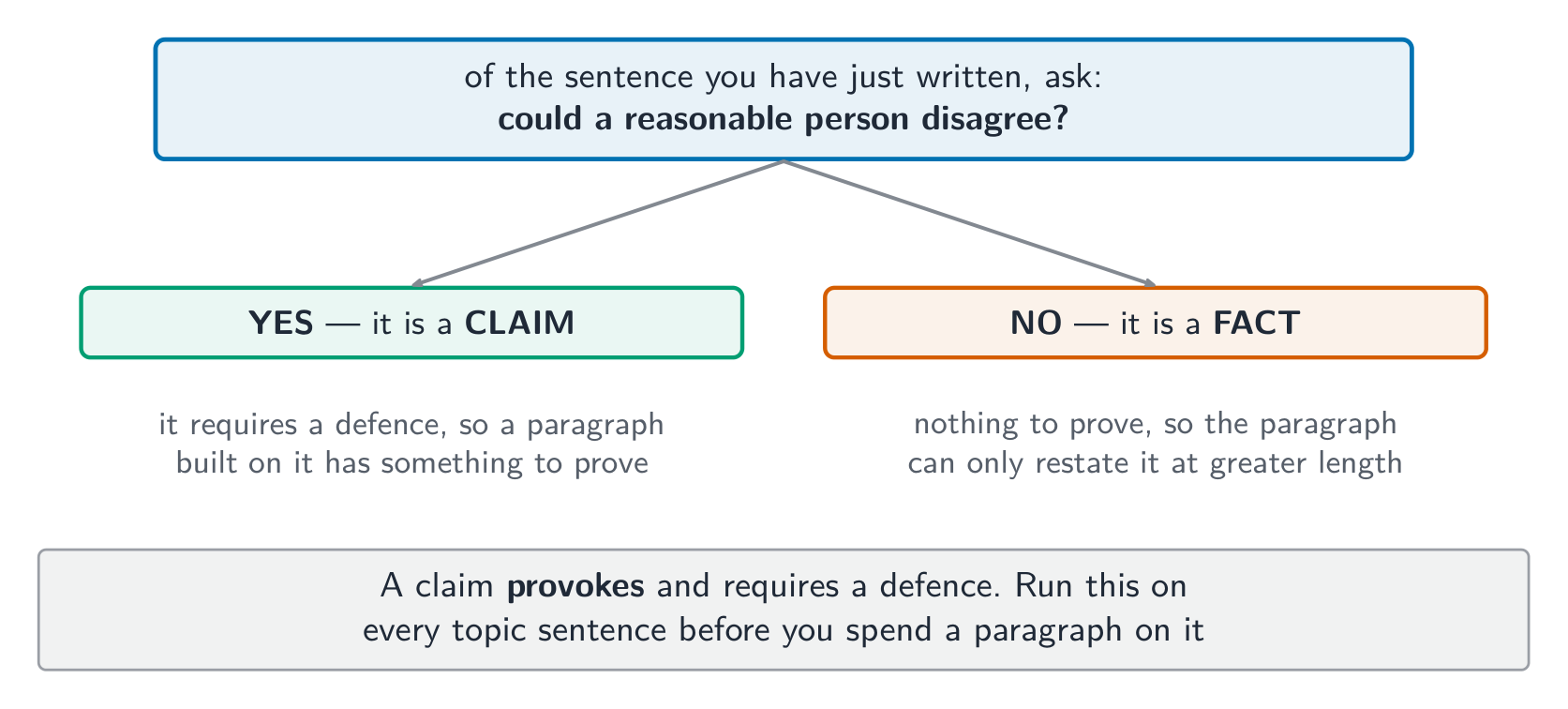
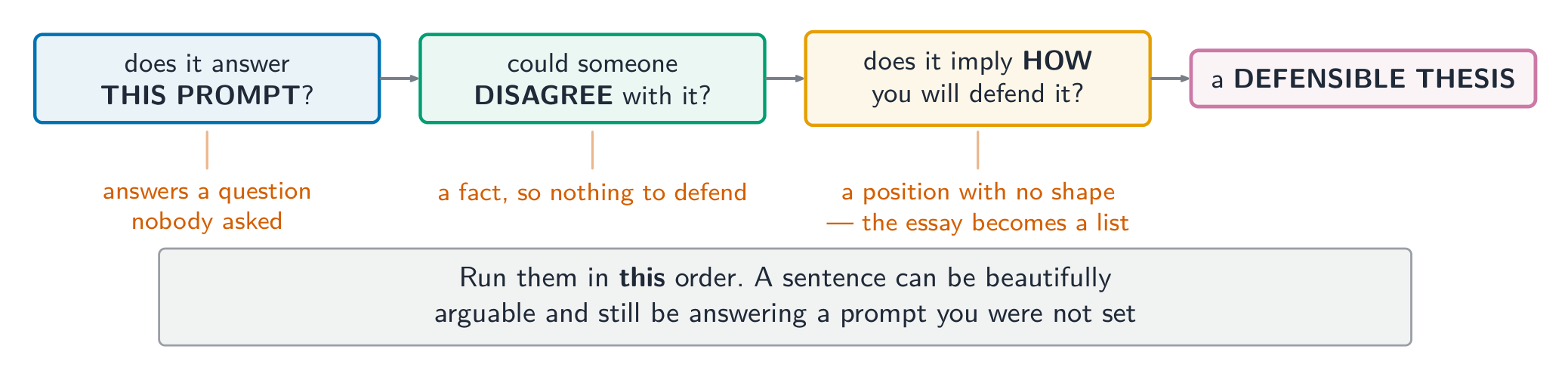
    • CLE-1.D Effective claims provoke interest and require a defense, rather than simply stating an obvious, known fact that requires no defense or justification.
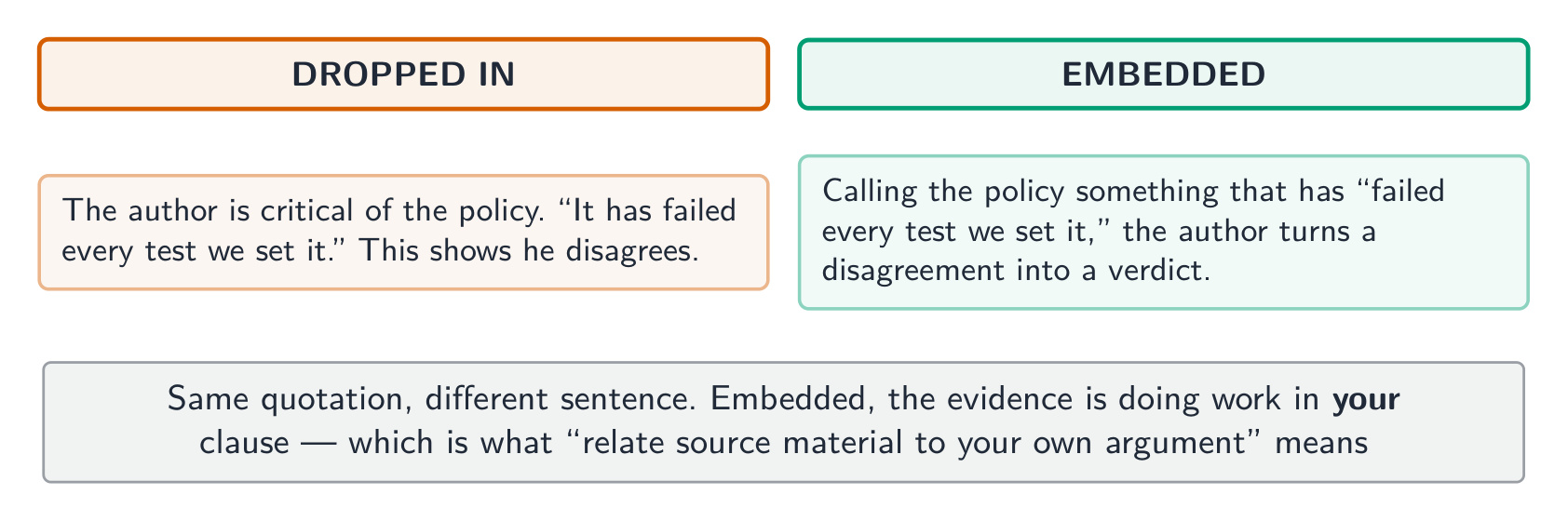
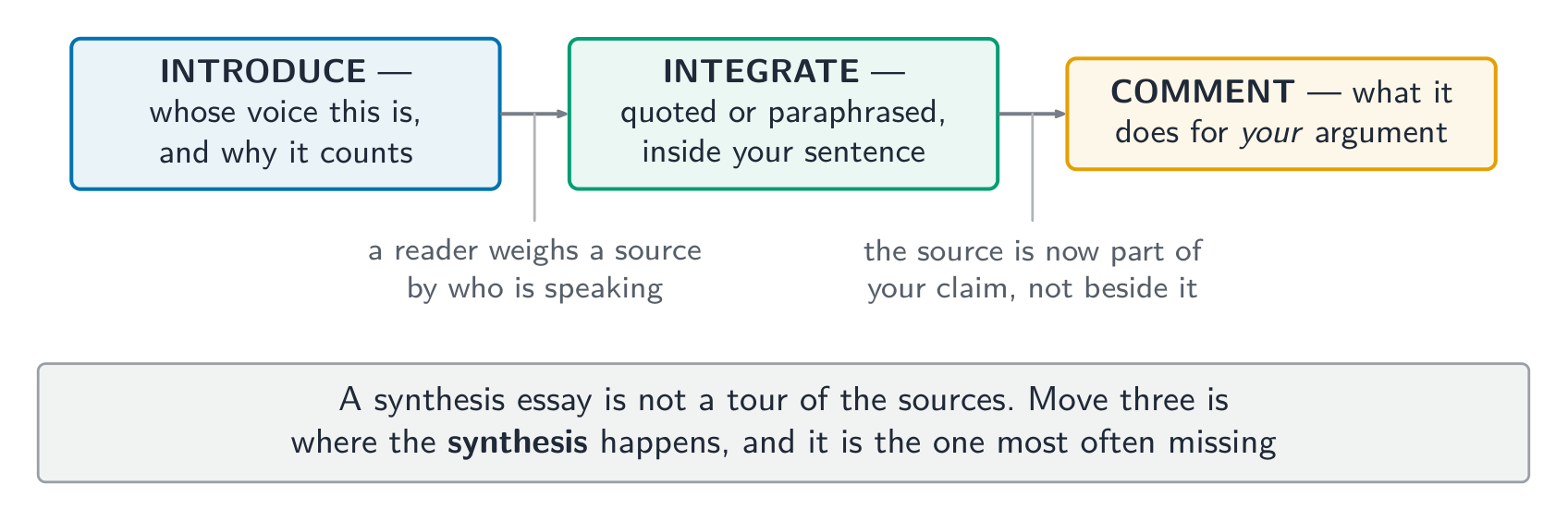
    • CLE-1.E Writers relate source material to their own argument by syntactically embedding particular quoted, paraphrased, or summarized information from one or more sources into their own ideas.

    来源:美国大学理事会 AP 课程与考试说明

    • 写作者通过一项或多项需要辩护的主张(claims)来表达立场。
    • 写作者以证据与推理(evidence and/or reasoning)为其主张辩护。
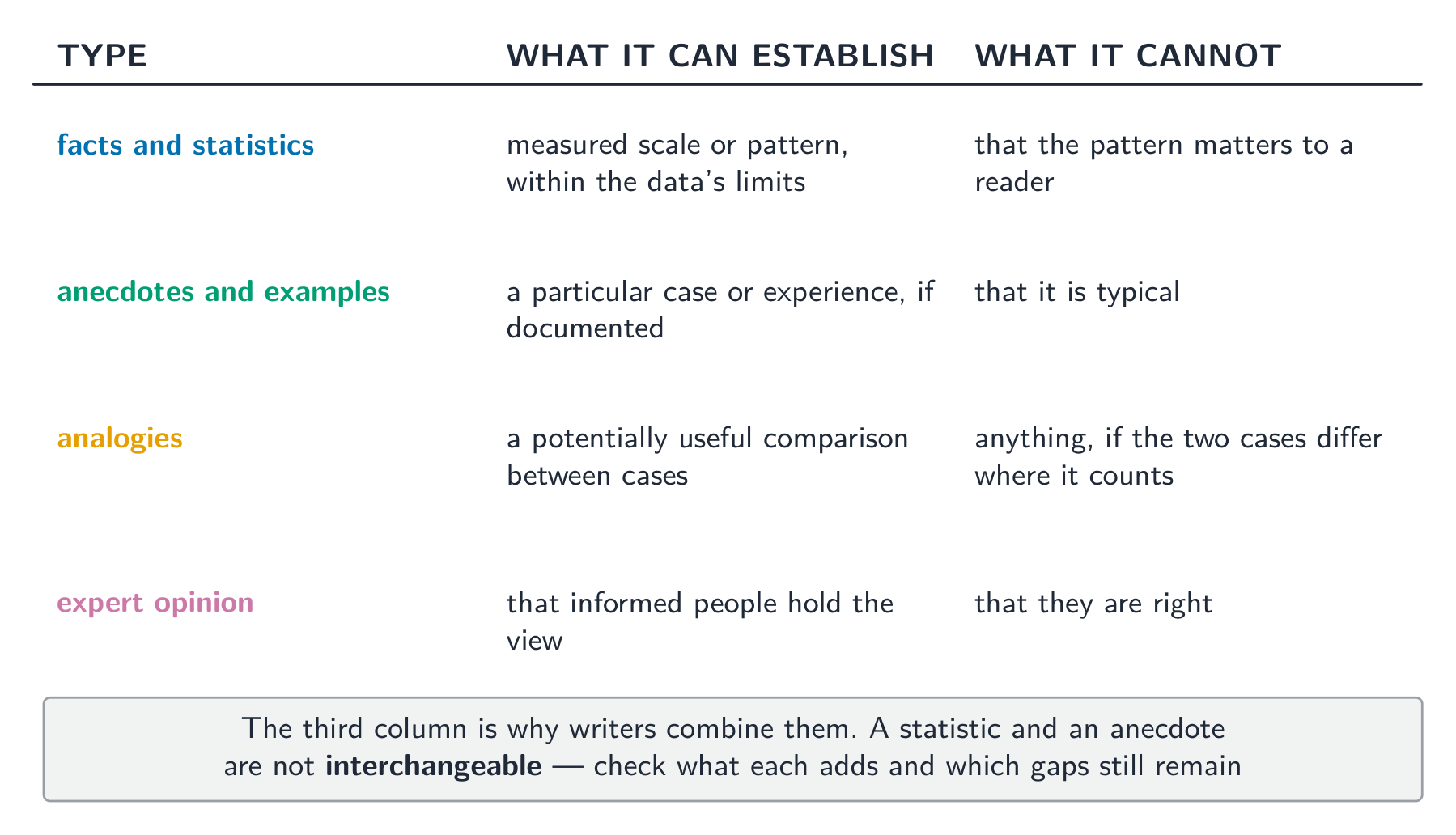
    • 证据的类型包括事实、轶事、类比、统计数据、例证、细节、图示、专家意见与个人经验——这是一份有意开列得很宽的清单,因为把轶事或类比识别为证据本身就是一项能力。
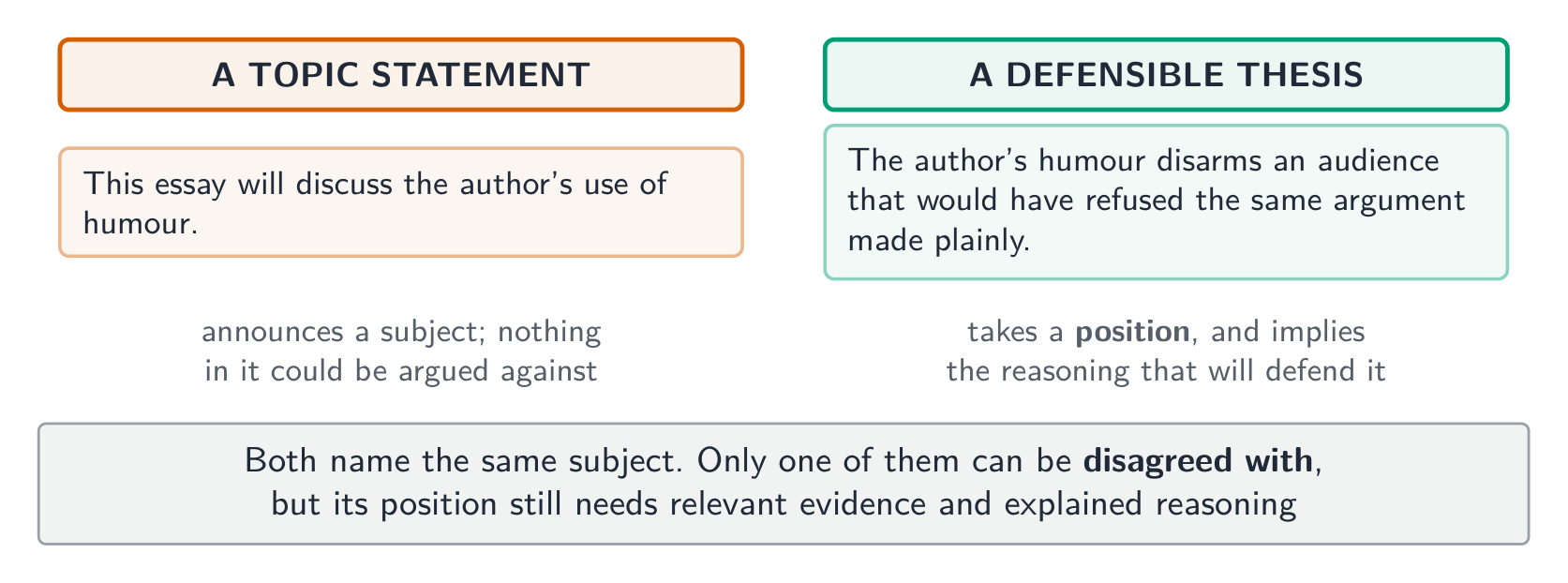
    • 有效的主张会引发兴趣并需要辩护,而不是陈述一个无需证明的显而易见的事实。

    第四点是你所能拥有的最有用的检验。对任何一句话都问:*一个通情达理的人会不会不同意?*如果不会,它就不是主张,而是事实;以它为基础搭建段落,写出来的东西便无可证明。

    最后,写作者通过在句法上嵌入(syntactically embedding)引用、转述或概括的材料,把源材料与自己的论证联系起来。证据不是被摆在你的句子旁边,而是被建进句子里。

    词汇表 训练
    英文 中文 拼音
    claims 主张 zhǔ zhāng
    evidence and/or reasoning 证据与推理 zhèng jù yǔ tuī lǐ
    Question 1, Synthesis 综合写作 zōng hé xiě zuò
    Question 2, Rhetorical Analysis 修辞分析 xiū cí fēn xī
    Question 3, Argument 论证写作 lùn zhèng xiě zuò
    1.3

    撰写含主张与证据的段落

    大纲
    Enduring UnderstandingLearning ObjectiveEssential Knowledge

    CLE-1
    Writers make claims about subjects, rely on evidence that supports the reasoning that justifies the claim, and often acknowledge or respond to other, possibly opposing, arguments.

    4.A
    Writing – Develop a paragraph that includes a claim and evidence supporting the claim.

    • CLE-1.A Writers convey their positions through one or more claims that require a defense.
    • CLE-1.B Writers defend their claims with evidence and/or reasoning.
    • CLE-1.C Types of evidence may include facts, anecdotes, analogies, statistics, examples, details, illustrations, expert opinions, personal observations, personal experiences, testimonies, or experiments.
    • CLE-1.D Effective claims provoke interest and require a defense, rather than simply stating an obvious, known fact that requires no defense or justification.
    • CLE-1.E Writers relate source material to their own argument by syntactically embedding particular quoted, paraphrased, or summarized information from one or more sources into their own ideas.

    来源:美国大学理事会 AP 课程与考试说明

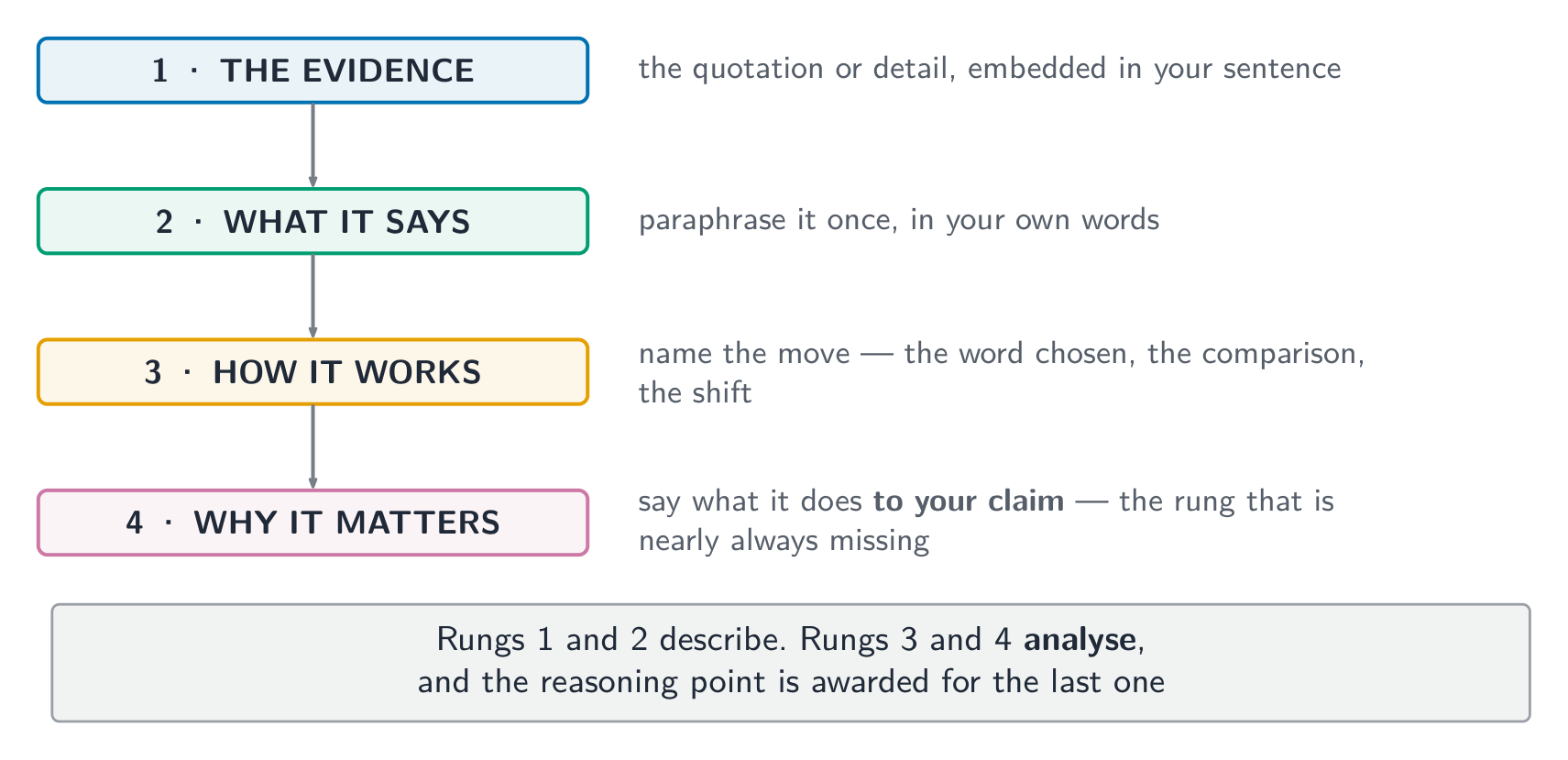
    第一单元的写作目标有意设置得很小:写出一个包含主张与支撑该主张之证据的段落。本课程后面的一切都是它的展开。

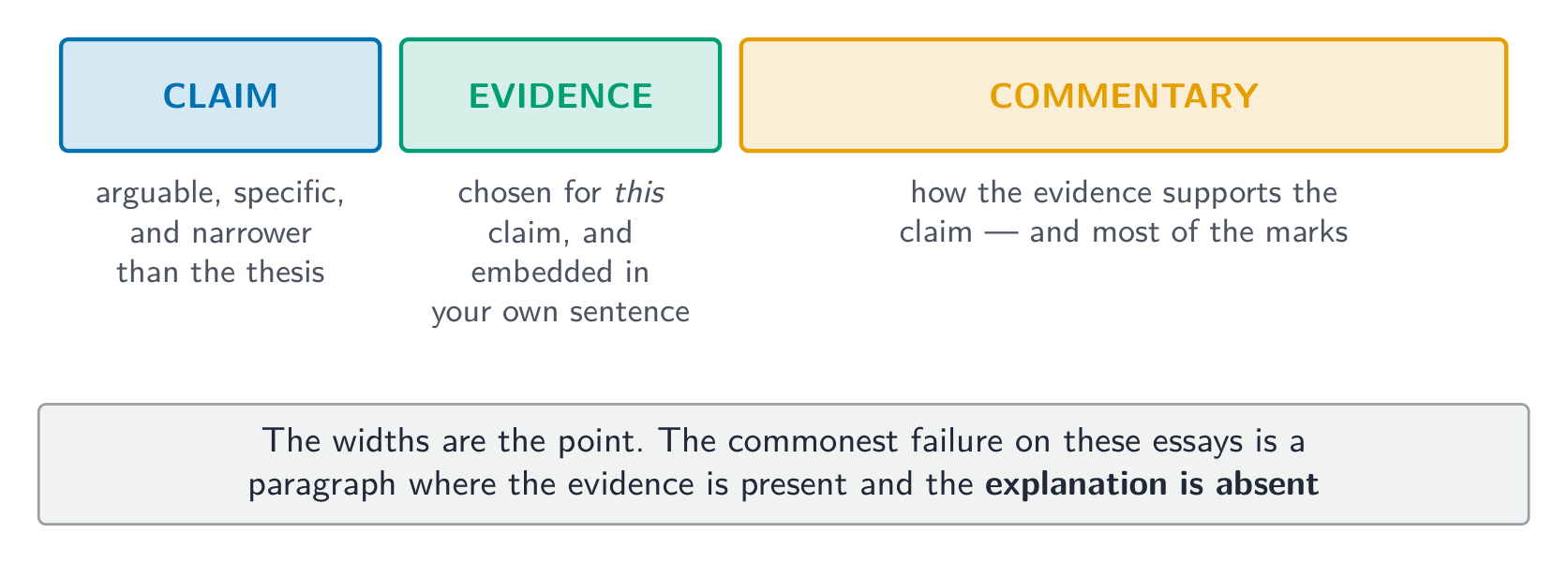
    一个可用的结构:

    1. 一项需要辩护的主张——可争辩、具体,且比整体论点更窄。
    2. 因支撑这一主张而被选取的证据,以句法方式嵌入,而不是被摆放进来。
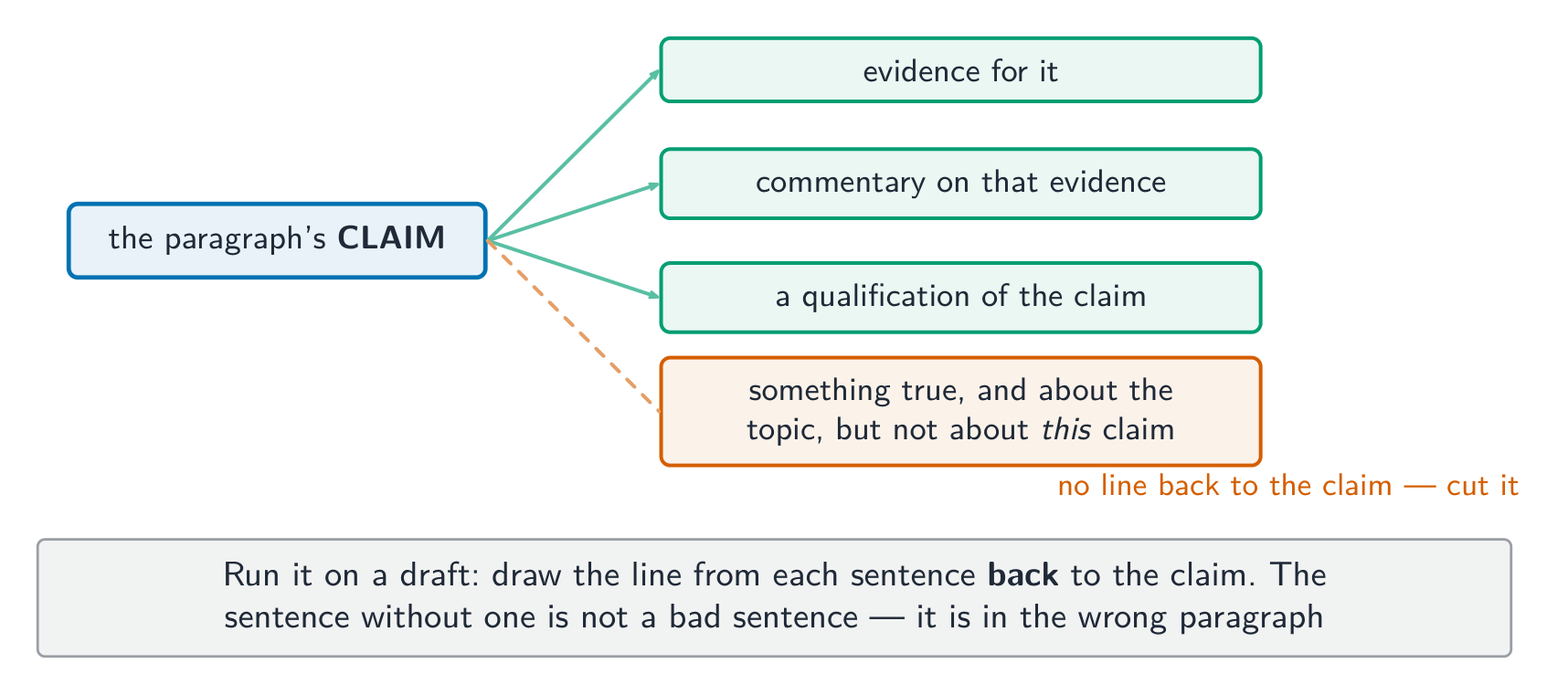
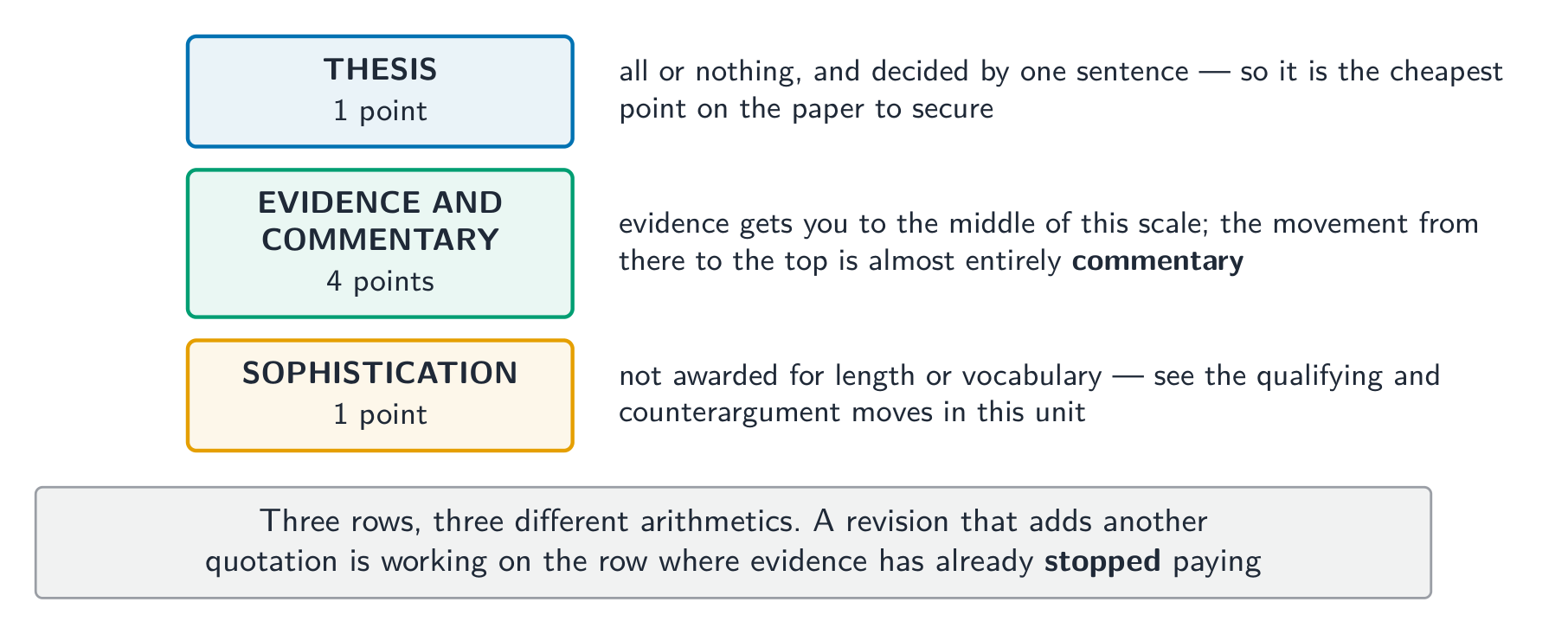
    3. 解释证据如何支撑主张的评述(commentary)——这是学生会跳过的一步,也是在考试中承载最多分数的一步。

    AP 英语语言论述题最常见的失败,是一个证据在场而解释缺席的段落。阅卷人能看到那段引文;他们看不到的是,你为何认为它证明了你的观点。

    1.3

    考试实际考什么

    自由作答部分有三道题,它们以不同的组合运用同样的能力:

    • 第一题,综合写作(synthesis):给你若干来源,你必须建立自己的论证,把来源当作证据来用,而不是概括它们。
    • 第二题,修辞分析(rhetorical analysis):给你一个文本,你必须解释写作者所作的各项选择以及这些选择如何服务于目的——这就是修辞情境的应用。
    • 第三题,论证写作(argument):给你一项主张或一个情境,你必须论证一个立场,用你自己的知识与经验作为证据。

    三道题都按六分制评分标准(six-point rubric)评阅,行目相同:论点(1 分)证据与评述(4 分)思辨深度(1 分)。从第一单元就知道这一结构,你便知道分数在哪里:六分中有四分来自证据以及对它的评述,因此一份只产出证据而无解释的写作计划,无论文字听起来多好,都会被封在低分。

    Worked example(一项真实的 AP 考试任务)。一道修辞分析题要求你「解释写作者的修辞选择」。能得分的答案不会写「写作者使用了反问句」,而会写:「面对一个已经就问题本身达成一致、却未就其紧迫性达成一致的受众,写作者以问句而非陈述句开篇,迫使读者自行给出答案,从而把这一结论感受为自己的,而不是被强加的。」*注意得分点所在:受众选择,以及对目的的作用*——也就是修辞情境的运用。

    1.3

    考试技巧

    • 记住六个组成部分的名称并使用这些名称。此处的精确会直接得到奖励。
    • **促因不等于目的。**促因是促使文本产生的东西;目的是写作者想达成的东西。
    • 用*一个通情达理的人会不会不同意?*检验每一项主张。若不会,它就是事实而非主张。
    • 把证据嵌入你自己的句子。摆放式引用读起来像未经处理。
    • **六分中有四分是证据与评述。**要写评述;失分大多在此。
    • 绝不要点出一个手法却不说明它对受众做了什么。没有效果的手法得不到分。
  • 2

    受众、论点与支撑证据

    讲义 词汇表
    2.1

    理解受众的信念与需求

    大纲
    Enduring UnderstandingLearning ObjectiveEssential Knowledge

    RHS-1
    Individuals write within a particular situation and make strategic writing choices based on that situation.

    1.B
    Reading – Explain how an argument demonstrates understanding of an audience’s beliefs, values, or needs.

    • RHS-1.F Writers’ perceptions of an audience’s values, beliefs, needs, and background guide the choices they make.
    • RHS-1.G To achieve a purpose, writers make choices in an attempt to relate to an intended audience’s emotions and values.
    • RHS-1.H Arguments seek to persuade or motivate action through appeals—the modes of persuasion.

    来源:美国大学理事会 AP 课程与考试说明

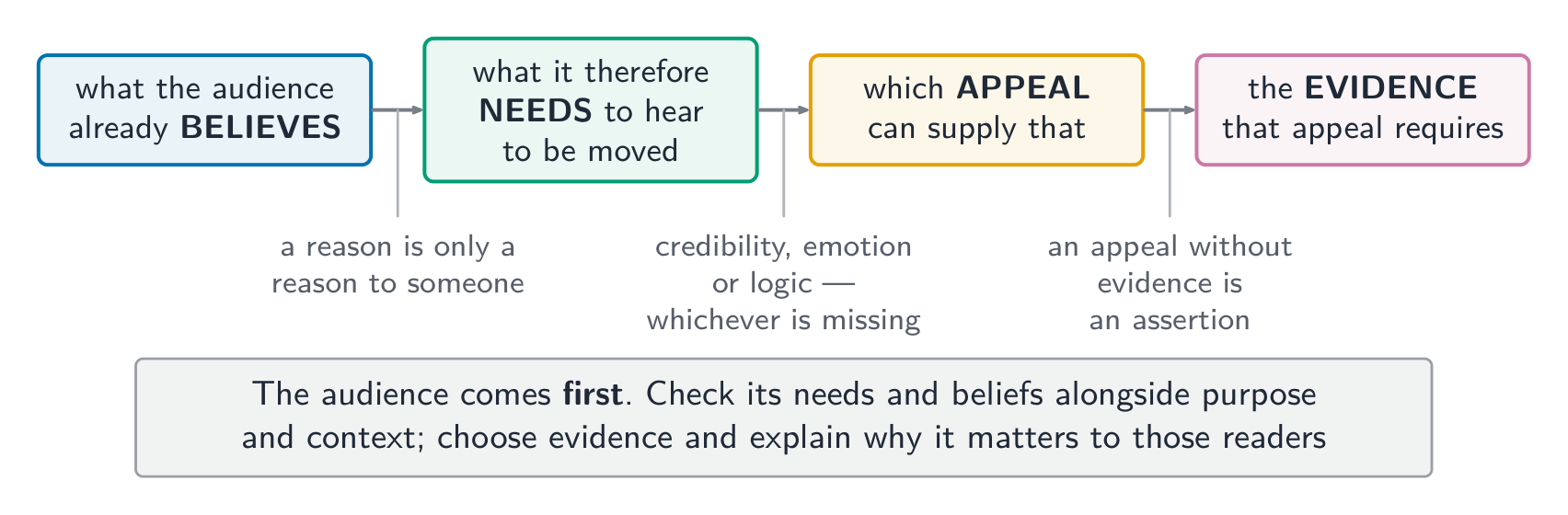
    第一单元确立了文本有其受众。第二单元则把受众变成写作者一切选择的发动机。

    • **写作者对受众之价值、信念、需求与背景的认知,引导着他们所作的选择。**要注意认知这个词:引导写作的是写作者心中的受众图像,而它可能准确,也可能不准确。
    • 为达成目的,写作者所作的选择意在与目标受众的情感与价值观(emotions and values)建立联系
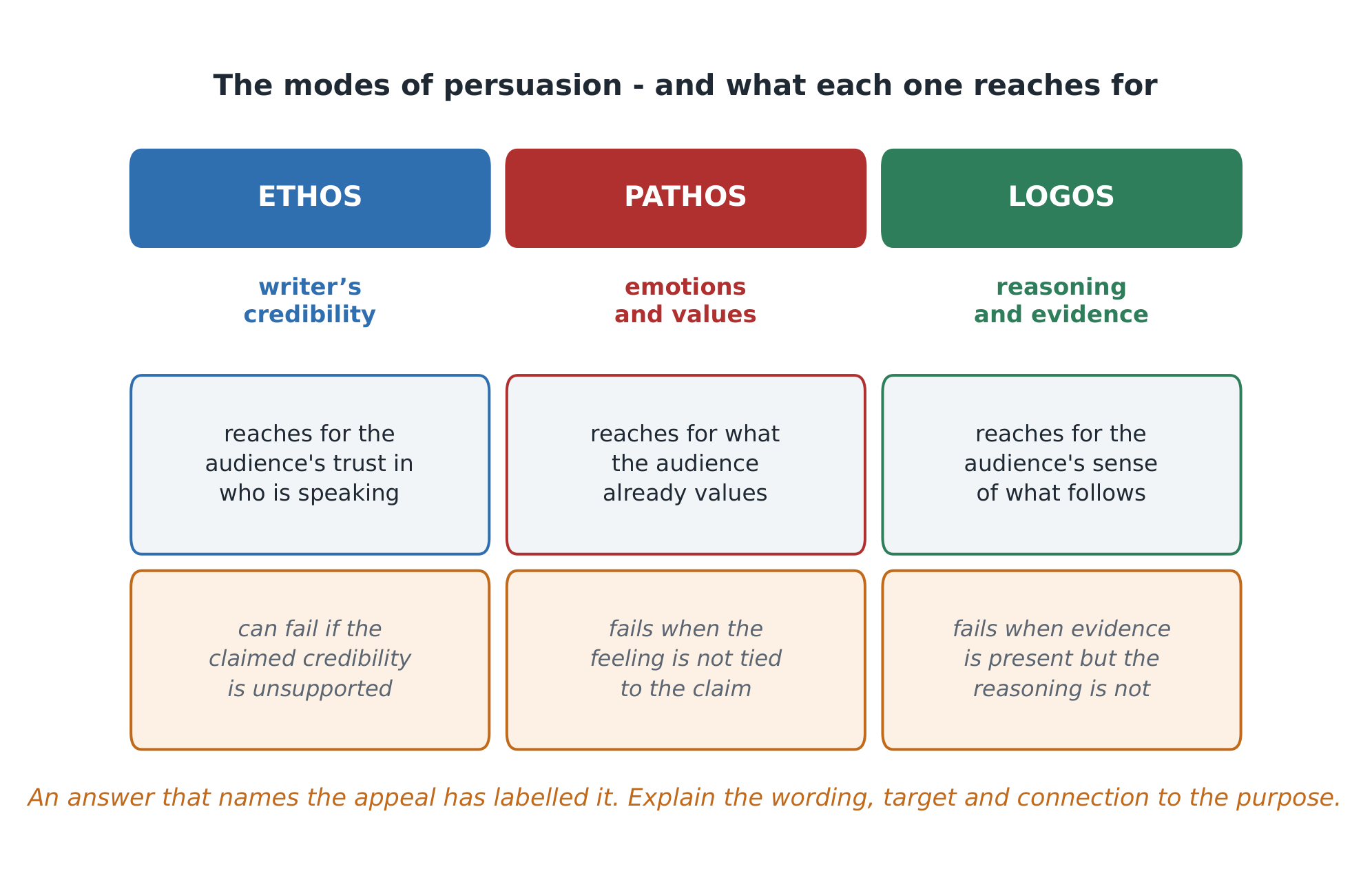
    • 论证通过诉求(appeals)——即说服方式(modes of persuasion)——来说服或促使行动。
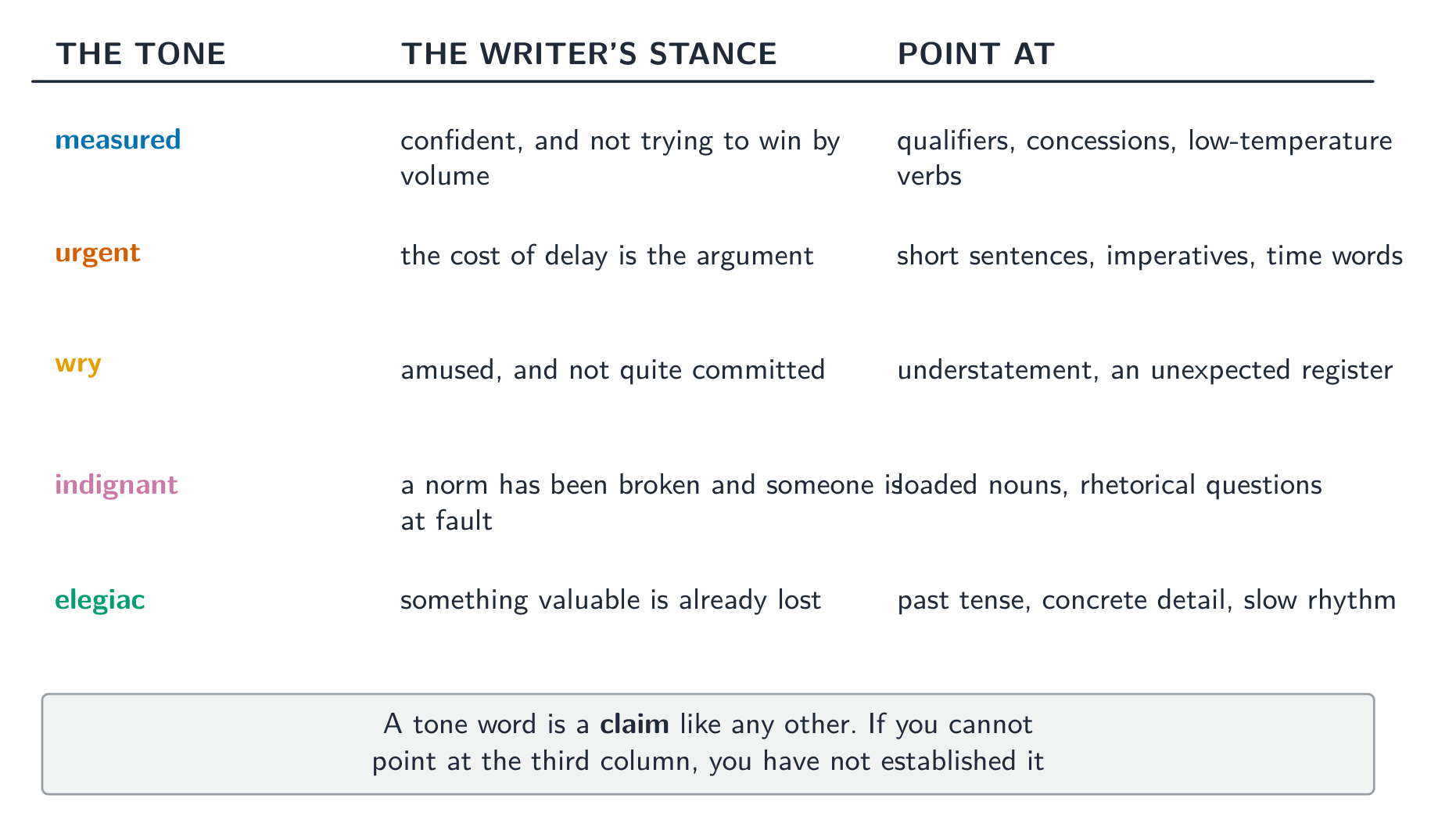
    每种诉求各自伸向受众身上不同的东西——而每一种也各有其失败的方式
    单是点出诉求的名称毫无价值;点出它伸向什么才是分析
    词汇表 训练
    英文 中文 拼音
    relate to an intended audience's emotions and values 情感与价值观 qíng gǎn yǔ jià zhí guān
    appeals 诉求 sù qiú
    modes of persuasion 说服方式 shuō fú fāng shì
    2.2

    针对受众的信念与需求写作

    大纲
    Enduring UnderstandingLearning ObjectiveEssential Knowledge

    RHS-1
    Individuals write within a particular situation and make strategic writing choices based on that situation.

    2.B
    Writing – Demonstrate an understanding of an audience’s beliefs, values, or needs.

    • RHS-1.F Writers’ perceptions of an audience’s values, beliefs, needs, and background guide the choices they make.
    • RHS-1.G To achieve a purpose, writers make choices in an attempt to relate to an intended audience’s emotions and values.
    • RHS-1.H Arguments seek to persuade or motivate action through appeals—the modes of persuasion.

    来源:美国大学理事会 AP 课程与考试说明

    同样这三句话,现在变成了写作指令。动笔之前先决定:

    • 关于这一主题,这个受众已经相信什么?
    • 他们需要什么——信息、安心,还是行动的理由?
    • 他们看重什么,而其中哪些价值可以诚实地与我的立场连接起来?

    忽略这些的论证,写出来的东西不是写给任何人的。而 CED 的这一表述也给了你一个检验自己草稿的好办法:如果这一段换成完全不同的受众读起来一模一样,那它就没有为任何受众塑形。

    2.3

    识别主张与证据

    大纲
    Enduring UnderstandingLearning ObjectiveEssential Knowledge

    CLE-1
    Writers make claims about subjects, rely on evidence that supports the reasoning that justifies the claim, and often acknowledge or respond to other, possibly opposing, arguments.

    3.A
    Reading – Identify and explain claims and evidence within an argument.

    • CLE-1.F Writers use evidence strategically and purposefully to illustrate, clarify, set a mood, exemplify, associate, or amplify a point.
    • CLE-1.G Strategically selected evidence strengthens the validity and reasoning of the argument, relates to an audience’s emotions and values, and increases a writer’s credibility.
    • CLE-1.H An effective argument contains sufficient evidence; evidence is sufficient when its quantity and quality provide apt support for the argument.

    来源:美国大学理事会 AP 课程与考试说明

    第二单元以三项关于证据如何起作用的论断,深化了第一单元对证据的处理:

    • 写作者有策略、有目的地使用证据来举例、澄清、营造氛围、示范、关联或放大(illustrate, clarify, set a mood, exemplify, associate, or amplify)。证据在做一件工作,而点出这件工作就是分析。
    • 经策略性选取的证据能增强论证的有效性与推理,与受众的情感与价值观相关联,并有助于确立写作者的可信度(credibility)。
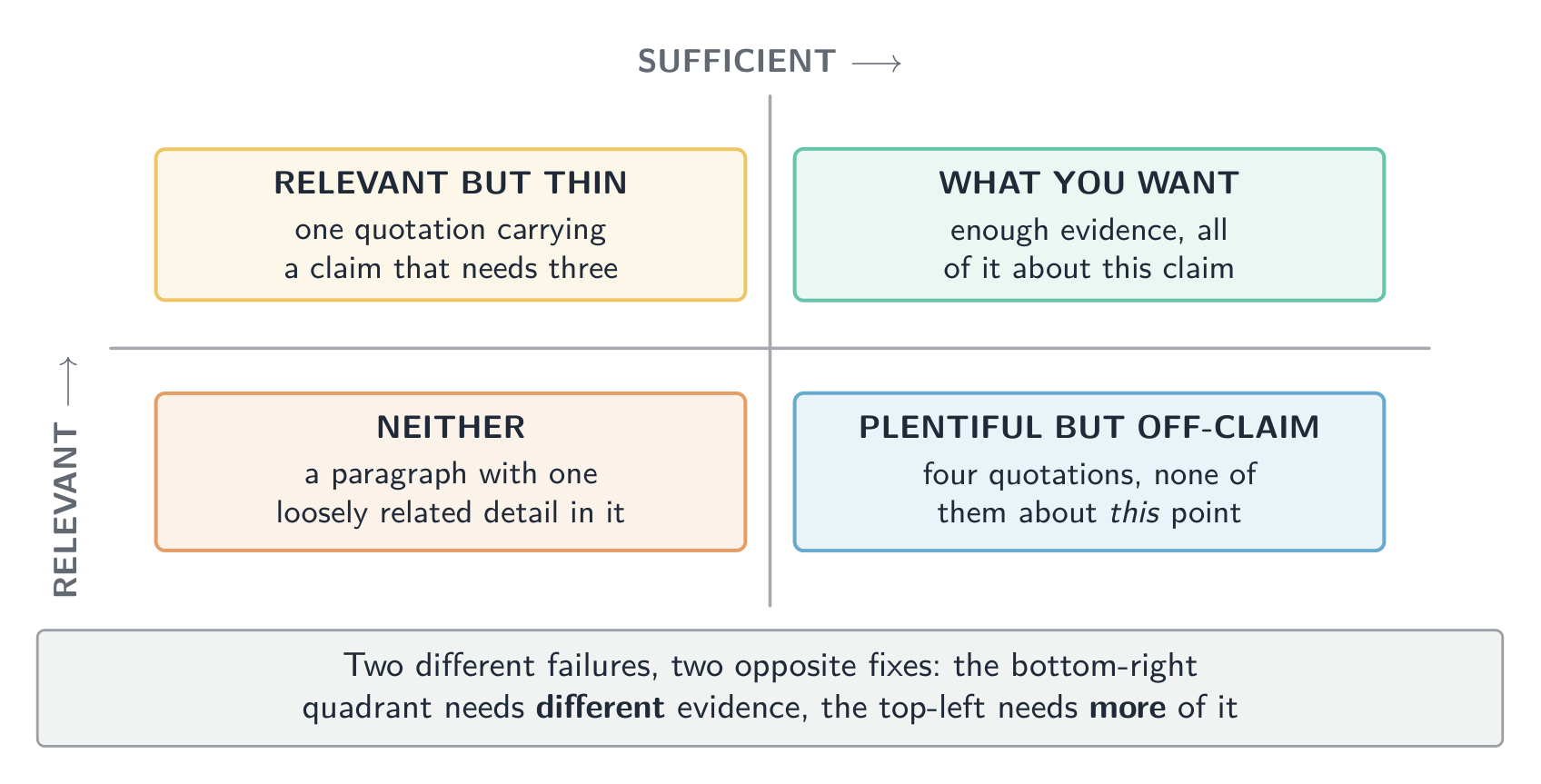
    • 有效的论证包含充分的证据(sufficient evidence)——当其数量与质量为推理线索提供了恰当支撑时,证据即为充分。

    第三点常被误读为"越多越好"。充分性是数量质量的合力:三条直接切中主张的证据,胜过六条只是擦边的证据。

    词汇表 训练
    英文 中文 拼音
    illustrate, clarify, set a mood, exemplify, associate, or amplify 举例、澄清、营造氛围、示范、关联或放大 jǔ lì 、 chéng qīng 、 yíng zào fēn wéi 、 shì fàn 、 guān lián huò fàng dà
    credibility 可信度 kě xìn dù
    sufficient evidence 充分的证据 chōng fèn de zhèng jù
    2.4

    撰写含主张与证据的段落

    大纲
    Enduring UnderstandingLearning ObjectiveEssential Knowledge

    CLE-1
    Writers make claims about subjects, rely on evidence that supports the reasoning that justifies the claim, and often acknowledge or respond to other, possibly opposing, arguments.

    4.A
    Writing – Develop a paragraph that includes a claim and evidence supporting the claim.

    • CLE-1.F Writers use evidence strategically and purposefully to illustrate, clarify, set a mood, exemplify, associate, or amplify a point.
    • CLE-1.G Strategically selected evidence strengthens the validity and reasoning of the argument, relates to an audience’s emotions and values, and increases a writer’s credibility.
    • CLE-1.H An effective argument contains sufficient evidence; evidence is sufficient when its quantity and quality provide apt support for the argument.

    来源:美国大学理事会 AP 课程与考试说明

    把上述内容用于自己的写作,就是要为每一条证据的选取给出理由。实际操作中,这意味着你要能把这句话补完:我用这一条,是因为它……

    • ……把一项否则会停留在抽象层面的主张具体化;
    • ……在读者可能存疑的主题上确立我的可信度;
    • ……把我的立场与受众已经持有的某项价值连接起来。

    以这种方式选出的证据几乎会自动产生评述,因为你已经知道这条证据在做什么。而因为"手边有"而选出的证据,产生的是本该写评述的那块空白。

    2.5

    识别总体论点

    大纲
    Enduring UnderstandingLearning ObjectiveEssential Knowledge

    CLE-1
    Writers make claims about subjects, rely on evidence that supports the reasoning that justifies the claim, and often acknowledge or respond to other, possibly opposing, arguments.

    3.B
    Reading – Identify and describe the overarching thesis of an argument, and any indication it provides of the argument’s structure.

    • CLE-1.I A thesis is the main, overarching claim a writer is seeking to defend or prove by using reasoning supported by evidence.
    • CLE-1.J A writer’s thesis is not necessarily a single sentence or an explicit statement and may require a thorough reading of the text to identify, but when a thesis is directly expressed, it is called a thesis statement. [Note: While the texts you assign your students to analyze may not always contain obvious thesis statements, they should each have a thesis. It can be good practice for students to write a thesis statement for such texts. On the AP Exam, a clear communication of the thesis is required in students’ essays.]

    来源:美国大学理事会 AP 课程与考试说明

    • 论点(thesis)是写作者试图以证据支撑的推理来辩护或证明的主要的、统领性的主张
    • 写作者的论点未必是单独一句话或明确的陈述,可能需要通读全文才能识别。

    第二点对考试的阅读部分很重要。在一篇修辞分析的选文中,论点可能分散于全文,或由结构暗示。不要因为你自己会把论点放在第二段第一句,就假定那里就是它的论点。

    词汇表 训练
    英文 中文 拼音
    thesis 论点 lùn diǎn
    2.6

    撰写论点句

    大纲
    Enduring UnderstandingLearning ObjectiveEssential Knowledge

    CLE-1
    Writers make claims about subjects, rely on evidence that supports the reasoning that justifies the claim, and often acknowledge or respond to other, possibly opposing, arguments.

    4.B
    Writing – Write a thesis statement that requires proof or defense and that may preview the structure of the argument.

    • CLE-1.I A thesis is the main, overarching claim a writer is seeking to defend or prove by using reasoning supported by evidence.
    • CLE-1.J A writer’s thesis is not necessarily a single sentence or an explicit statement and may require a thorough reading of the text to identify, but when a thesis is directly expressed, it is called a thesis statement. [Note: While the texts you assign your students to analyze may not always contain obvious thesis statements, they should each have a thesis. It can be good practice for students to write a thesis statement for such texts. On the AP Exam, a clear communication of the thesis is required in students’ essays.]

    来源:美国大学理事会 AP 课程与考试说明

    写作目标是精确的:写出一句需要证明或辩护、并可预示论证结构的论点陈述

    这句话里含着两项彼此独立的要求:

    • 它必须需要辩护。再次运用第一单元的检验:一个通情达理的人会不会不同意?陈述事实的论点无法被辩护,只能被重复。
    • 可以预示结构——这是可选的,但很有用,因为点明将要展开哪些推理线索的论点,会赋予整篇文章形状。

    在考试中,论点这一分是六分之一,也是评分标准上最容易拿到的一分:针对题目给出一个可辩护的论点即可得分。把题目复述一遍则不能。

    **Worked example(一项真实的 AP 考试任务)。**面对第三题要求你就某项拟议做法的价值表明立场,比较两个开头。「围绕这一做法,支持与反对的论点都有很多。」——这得不到分,因为没有人会不同意。「由于这一做法奖励的是看得见的努力而非真实的进步,它制造出进步的表象,同时抽走了追求进步的动力。」——这能得分:它可辩护、具体,并预示了文章将要展开的推理。

    2.6

    考试技巧

    • 受众驱动一切。如果一段文字换给任何受众读起来都一样,它就没有为受众塑形。
    • 点出证据在做什么——举例、澄清、关联、放大。这才是分析;罗列证据不是。
    • 充分性是数量与质量,而不是分量。三条切中的胜过六条松散的。
    • 选文中的论点可能是隐含的或分散的。通读全文再作判断。
    • 你自己的论点必须可辩护。复述题目在六分中一分也拿不到。
    • 在论点中预示推理线索是可选的,但会让文章其余部分更好组织。
  • 3

    论证线索与展开方法

    讲义 词汇表
    3.1

    识别主张与证据

    大纲
    Enduring UnderstandingLearning ObjectiveEssential Knowledge

    CLE-1
    Writers make claims about subjects, rely on evidence that supports the reasoning that justifies the claim, and often acknowledge or respond to other, possibly opposing, arguments.

    3.A
    Reading – Identify and explain claims and evidence within an argument.

    • CLE-1.K Effective use of evidence uses commentary to establish a logical relationship between the evidence and the claim it supports.
    • CLE-1.L Writers introduce source material by using commentary to properly integrate it into their line of reasoning.
    • CLE-1.M Synthesis requires consideration, explanation, and integration of others’ arguments into one’s own argument.
    • CLE-1.N Writers must acknowledge words, ideas, images, texts, and other intellectual property of others through attribution, citation, or reference.

    来源:美国大学理事会 AP 课程与考试说明

    第三单元是本课程从谈论"部件"转向谈论结构的地方。它的主题是推理线索(line of reasoning)——论证从起点通向所证之事的那条路径。

    首先是关于证据如何被恰当纳入论证的四项论断:

    • 有效地使用证据,要靠评述(commentary)来确立证据与主张之间的逻辑关系
    • 写作者用评述来引入源材料,将其整合进自己的推理线索——因此评述既在证据之后,也在证据之前。
    • 综合(synthesis)要求对他人的论证加以考量、解释,并整合进自己的论证。这正是第一题所考查的能力,而整合这个词排除了那种逐一概括各来源的段落。
    • 写作者必须通过归属与引用(attribution and citation)承认他人的文字、观点、图像与文本。
    词汇表 训练
    英文 中文 拼音
    line of reasoning 推理线索 tuī lǐ xiàn suǒ
    commentary 评述 píng shù
    Synthesis 综合 zōng hé
    attribution and citation 归属与引用 guī shǔ yǔ yǐn yòng
    Flaws in a line of reasoning may render an argument specious or illogical 似是而非 sì shì ér fēi
    3.2

    撰写含主张与证据的段落

    大纲
    Enduring UnderstandingLearning ObjectiveEssential Knowledge

    CLE-1
    Writers make claims about subjects, rely on evidence that supports the reasoning that justifies the claim, and often acknowledge or respond to other, possibly opposing, arguments.

    4.A
    Writing – Develop a paragraph that includes a claim and evidence supporting the claim.

    • CLE-1.K Effective use of evidence uses commentary to establish a logical relationship between the evidence and the claim it supports.
    • CLE-1.L Writers introduce source material by using commentary to properly integrate it into their line of reasoning.
    • CLE-1.M Synthesis requires consideration, explanation, and integration of others’ arguments into one’s own argument.
    • CLE-1.N Writers must acknowledge words, ideas, images, texts, and other intellectual property of others through attribution, citation, or reference.

    来源:美国大学理事会 AP 课程与考试说明

    用于自己的写作时,相较第二单元的变化在于:评述现在有两项工作,而不是一项——把证据引入推理,并在其后解释这一关系。

    两项都做到的段落读起来是:*主张——一句为证据定位的话——嵌入的证据——确立逻辑关系的评述——向下的衔接。*引文之前的那句话所做的工作,不亚于引文之后的那句;而多数学生两句都没写。

    3.3

    描述论证线索

    大纲
    Enduring UnderstandingLearning ObjectiveEssential Knowledge

    REO-1
    Writers guide understanding of a text’s lines of reasoning and claims through that text’s organization and integration of evidence.

    5.A
    Reading – Describe the line of reasoning and explain whether it supports an argument’s overarching thesis.

    • REO-1.A Writers may lead readers through a line of reasoning and then arrive at a thesis.
    • REO-1.B Writers may express a claim and then develop a line of reasoning to justify the claim.
    • REO-1.C Writers explain their reasoning through commentary that connects chosen evidence to a claim.
    • REO-1.D Commentary explains the significance and relevance of evidence in relation to the line of reasoning.
    • REO-1.E The sequence of paragraphs in a text reveals the argument’s line of reasoning.
    • REO-1.F Flaws in a line of reasoning may render an argument specious or illogical.

    来源:美国大学理事会 AP 课程与考试说明

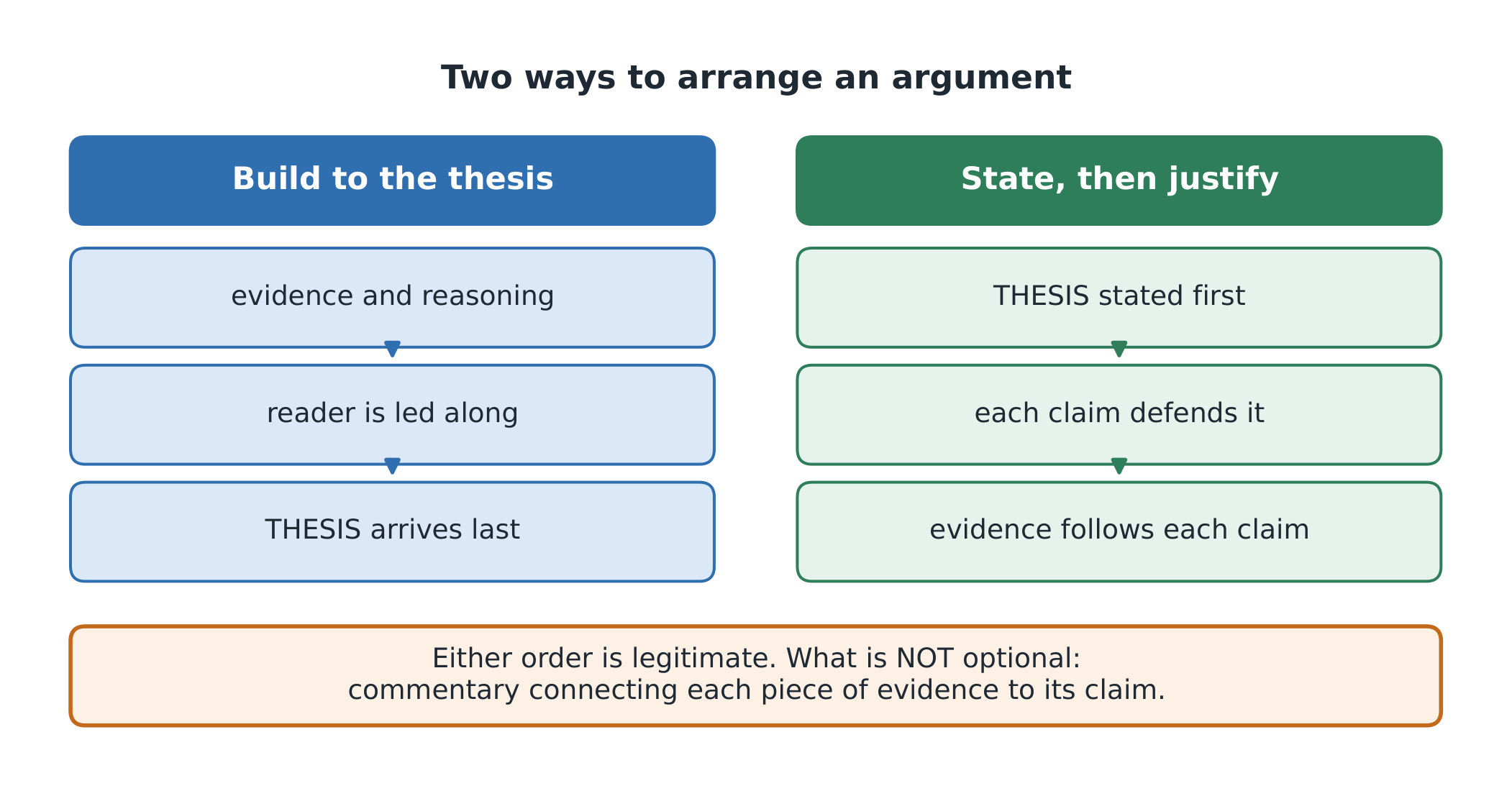
    两种合法的顺序,一项共同要求——而这项要求就是评述
    顺序是可以选择的;起连接作用的组织不是

    CED 允许两种安排,两者都有效:

    • 写作者可以引领读者沿一条推理线索前行,最后抵达论点——论证逐步导向其主张。
    • 写作者也可以先表述一项主张,再展开推理线索为之辩护——论证先宣告,再防守。

    无论采用哪种顺序,同样的要求都成立:

    • 写作者通过把所选证据与主张连接起来的评述来解释自己的推理。
    • 评述要说明证据相对于推理线索的重要性与相关性
    • 文本中段落的先后顺序显示了论证的推理线索——这是阅读时的实用工具。要找出写作者的推理,给每一段写一句概括,再把这份清单读一遍。
    • 推理线索中的缺陷会使论证变得似是而非(specious)或不合逻辑
    3.4

    构建论证线索与评述

    大纲
    Enduring UnderstandingLearning ObjectiveEssential Knowledge

    REO-1
    Writers guide understanding of a text’s lines of reasoning and claims through that text’s organization and integration of evidence.

    6.A
    Writing – Develop a line of reasoning and commentary that explains it throughout an argument.

    • REO-1.A Writers may lead readers through a line of reasoning and then arrive at a thesis.
    • REO-1.B Writers may express a claim and then develop a line of reasoning to justify the claim.
    • REO-1.C Writers explain their reasoning through commentary that connects chosen evidence to a claim.
    • REO-1.D Commentary explains the significance and relevance of evidence in relation to the line of reasoning.
    • REO-1.E The sequence of paragraphs in a text reveals the argument’s line of reasoning.
    • REO-1.F Flaws in a line of reasoning may render an argument specious or illogical.

    来源:美国大学理事会 AP 课程与考试说明

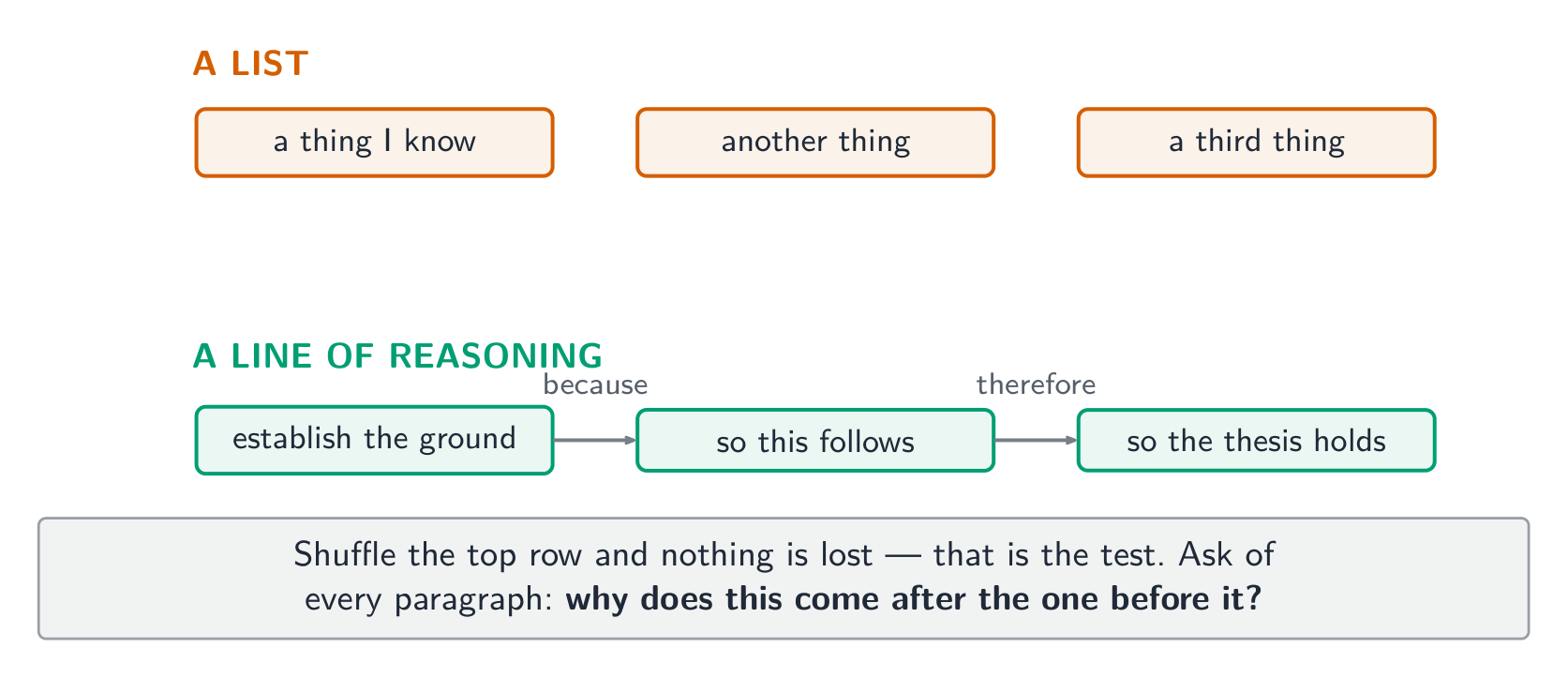
    就自己的文章而言,有用的纪律是在动笔写任何一项主张之前先定下各项主张的顺序。一篇段落可以随意调换而不损失什么的文章,没有推理线索——它只有一份清单。

    检验草稿的办法是对每一段问:*这一段为什么排在上一段之后?*如果唯一的答案是"这是我知道的关于这个题目的另一件事",那么结构就是清单,推理这一分就有风险。

    3.5

    识别展开方法

    大纲
    Enduring UnderstandingLearning ObjectiveEssential Knowledge

    REO-1
    Writers guide understanding of a text’s lines of reasoning and claims through that text’s organization and integration of evidence.

    5.C
    Reading – Recognize and explain the use of methods of development to accomplish a purpose.

    • REO-1.G Methods of development are common approaches writers frequently use to develop and organize the reasoning of their arguments. A method of development provides an audience with the means to trace a writer’s reasoning in an argument.
    • REO-1.H Some typical methods of development are narration, cause-effect, comparison-contrast, definition, and description.
    • REO-1.I When developing ideas through narration, writers offer details about real-life experiences and offer reflections and insights on the significance of those experiences.
    • REO-1.J When developing ideas through cause-effect, writers present a cause, assert effects or consequences of that cause, or present a series of causes and the subsequent effect(s).

    来源:美国大学理事会 AP 课程与考试说明

    展开方法(methods of development)是写作者用来展开并组织论证推理的常见路数。CED 的清单是:叙述、因果、比较对照、下定义与描写。本单元处理前两种。

    • 通过叙述(narration)展开:写作者提供关于真实生活经验的细节,并对其作出反思。反思正是使叙述成为论证而非故事的东西——一个没有反思的轶事并没有提供任何推理。
    • 通过因果(cause-effect)展开:写作者先给出一个原因,再断言该原因的效果或后果——或者从一个结果出发反向追溯。
    词汇表 训练
    英文 中文 拼音
    Methods of development 展开方法 zhǎn kāi fāng fǎ
    narration 叙述 xù shù
    cause-effect 因果 yīn guǒ
    3.6

    运用展开方法

    大纲
    Enduring UnderstandingLearning ObjectiveEssential Knowledge

    REO-1
    Writers guide understanding of a text’s lines of reasoning and claims through that text’s organization and integration of evidence.

    6.C
    Writing – Use appropriate methods of development to advance an argument.

    • REO-1.G Methods of development are common approaches writers frequently use to develop and organize the reasoning of their arguments. A method of development provides an audience with the means to trace a writer’s reasoning in an argument.
    • REO-1.H Some typical methods of development are narration, cause-effect, comparison-contrast, definition, and description.
    • REO-1.I When developing ideas through narration, writers offer details about real-life experiences and offer reflections and insights on the significance of those experiences.
    • REO-1.J When developing ideas through cause-effect, writers present a cause, assert effects or consequences of that cause, or present a series of causes and the subsequent effect(s).

    来源:美国大学理事会 AP 课程与考试说明

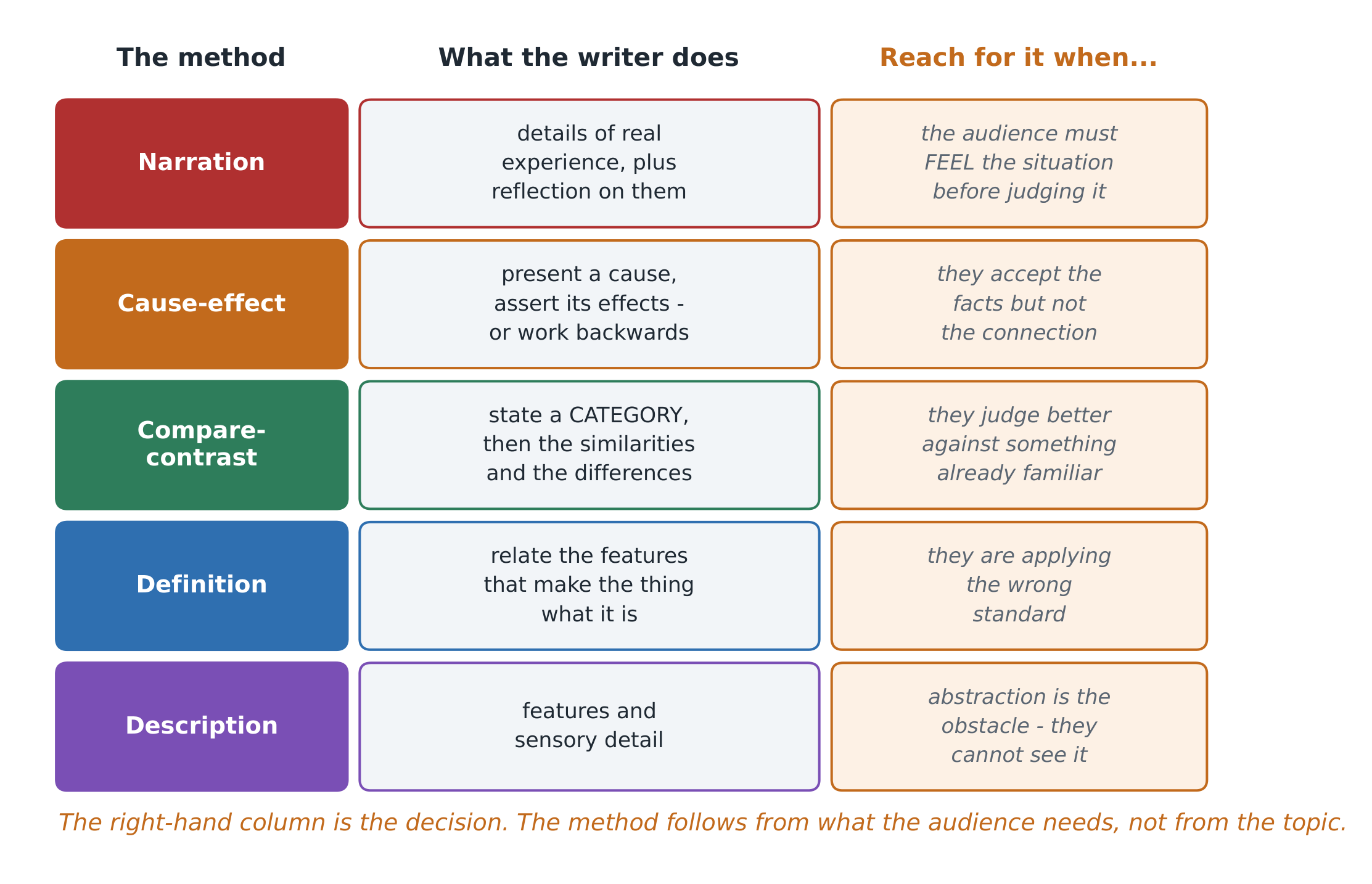
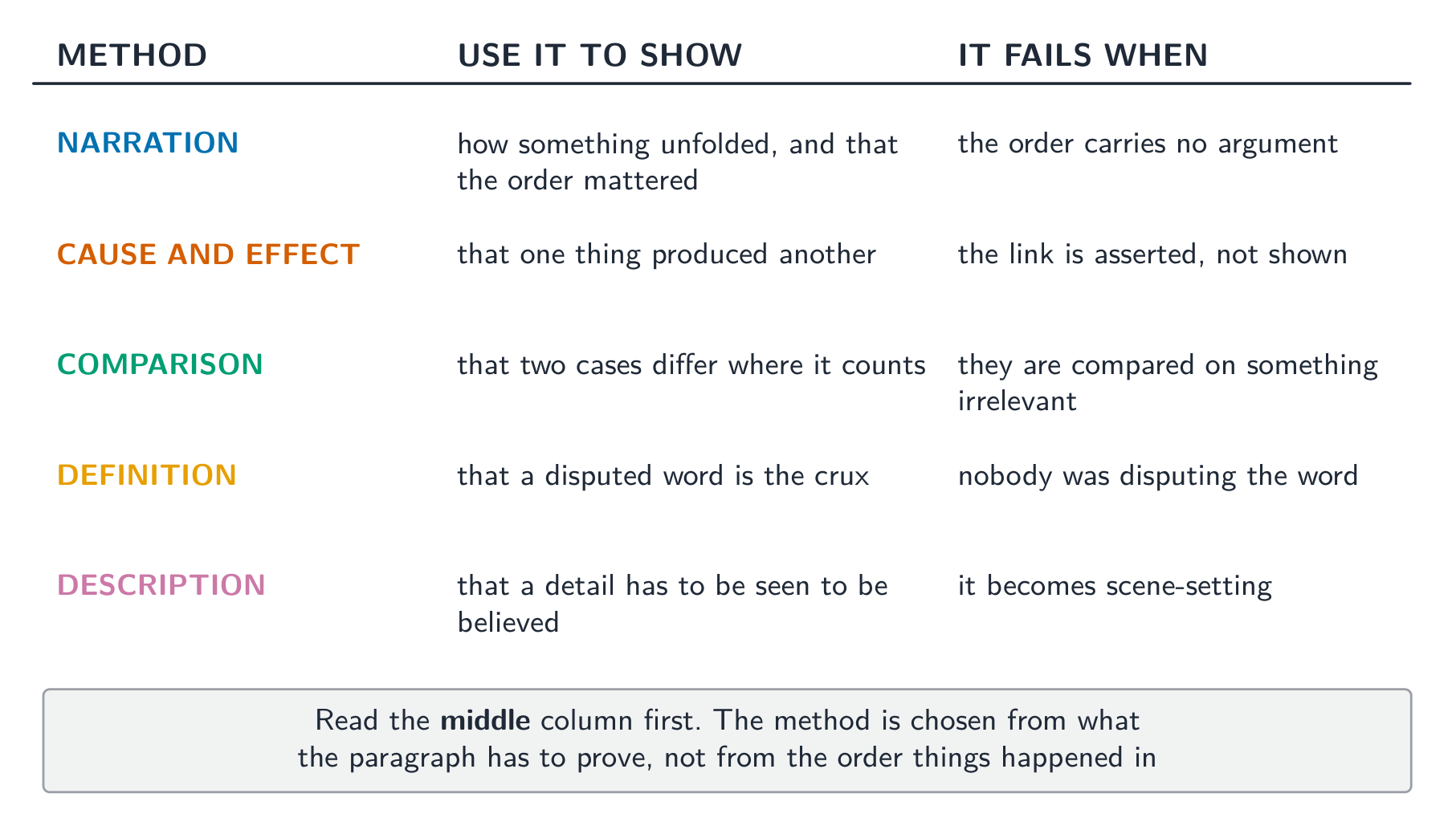
    选择方法是一项修辞决策,而非文体决策。当受众需要先感受某个情境才会接受关于它的主张时,叙述有效。当受众已经接受各项事实、却不接受它们之间的联系时,因果有效。

    Worked example(一项真实的 AP 考试任务)。在第一题综合写作中,比较使用同样两个来源的两个段落。薄弱版本:*「来源 A 说 X。来源 C 说 Y。两者都讨论了这一议题。」这是按顺序作概括——没有主张,没有整合,没有推理。有力版本:「针对该提案最有力的反对意见,不是它失败了,而是它成功得过于狭窄:来源 A 的数据显示预期成果在改善,而来源 C 对同一项目的记述则记录了来源 A 的测量方式从未设计去捕捉的二阶成本。」*这里各来源被整合进写作者自己的主张,评述确立了逻辑关系——这正是"证据与评述"四分所奖励的东西。

    3.6

    考试技巧

    • 评述有两项工作:把证据引入推理,以及其后解释这一关系。两句都要写。
    • 综合意味着整合,而不是按顺序作概括。一段写一个来源是典型的低分形态。
    • 要找出写作者的推理线索,给每一段写一句概括,再读这份清单。
    • 对自己的段落要问:*这一段为什么跟在那一段之后?*答不上来就说明没有推理线索。
    • **叙述需要反思。**没有反思的轶事只是讲了个故事,没有作出论证。
    • 出于修辞理由选择展开方法,并且要能说出这个理由是什么。
  • 4

    引言、结论与展开

    讲义 词汇表
    4.1

    修辞情境的构成要素

    大纲
    Enduring UnderstandingLearning ObjectiveEssential Knowledge

    RHS-1
    Individuals write within a particular situation and make strategic writing choices based on that situation.

    1.A
    Reading – Identify and describe components of the rhetorical situation: the exigence, audience, writer, purpose, context, and message.

    • RHS-1.I The introduction of an argument introduces the subject and/ or writer of the argument to the audience. An introduction may present the argument’s thesis. An introduction may orient, engage, and/or focus the audience by presenting quotations, intriguing statements, anecdotes, questions, statistics, data, contextualized information, or a scenario.
    • RHS-1.J The conclusion of an argument brings the argument to a unified end. A conclusion may present the argument’s thesis. It may engage and/or focus the audience by explaining the significance of the argument within a broader context, making connections, calling the audience to act, suggesting a change in behavior or attitude, proposing a solution, leaving the audience with a compelling image, explaining implications, summarizing the argument, or connecting to the introduction.

    来源:美国大学理事会 AP 课程与考试说明

    第四单元处理文本中写作者选择最为显眼的两个位置——开头与结尾——并补全 CED 关于展开方法的清单。

    • 论证的引言(introduction)向受众介绍主题与/或写作者。它可以为读者定向、确立促因与语境,并吸引注意。
    • 结论(conclusion)把论证带向统一的收束。它可以呈现论证的论点、说明其重要性,或把论证置于更广阔的语境中。

    要注意第二句中的那个词:统一。结论不是概括;它是各部分被显示为同一个论证的那一刻。

    词汇表 训练
    英文 中文 拼音
    introduction 引言 yǐn yán
    conclusion 结论 jié lùn
    4.2

    撰写引言与结论

    大纲
    Enduring UnderstandingLearning ObjectiveEssential Knowledge

    RHS-1
    Individuals write within a particular situation and make strategic writing choices based on that situation.

    2.A
    Writing – Write introductions and conclusions appropriate to the purpose and context of the rhetorical situation.

    • RHS-1.I The introduction of an argument introduces the subject and/ or writer of the argument to the audience. An introduction may present the argument’s thesis. An introduction may orient, engage, and/or focus the audience by presenting quotations, intriguing statements, anecdotes, questions, statistics, data, contextualized information, or a scenario.
    • RHS-1.J The conclusion of an argument brings the argument to a unified end. A conclusion may present the argument’s thesis. It may engage and/or focus the audience by explaining the significance of the argument within a broader context, making connections, calling the audience to act, suggesting a change in behavior or attitude, proposing a solution, leaving the audience with a compelling image, explaining implications, summarizing the argument, or connecting to the introduction.

    来源:美国大学理事会 AP 课程与考试说明

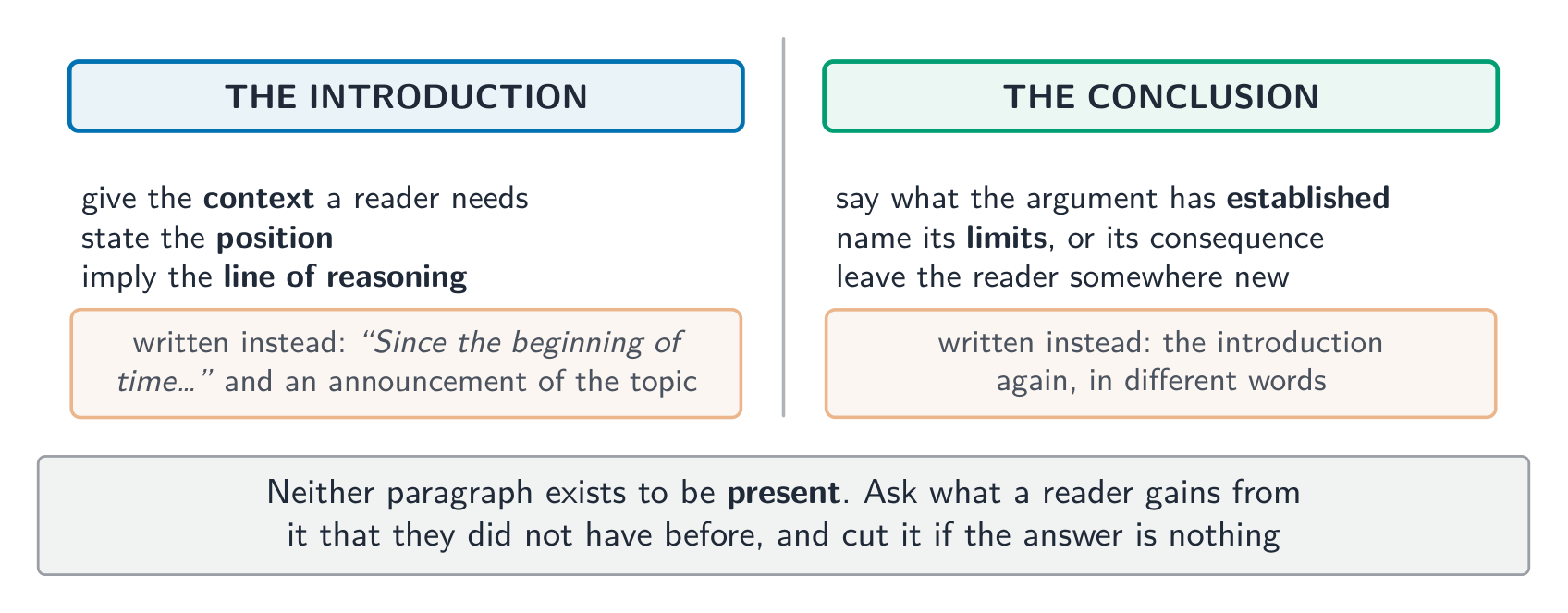
    在考试中,两者都值得写好,但都不值得写长。一条有用的纪律:

    • 用两三句话为主题定位并陈述一个可辩护的论点的引言就是完整的。在限时写作中,其余的一切都更适合花在证据与评述上。
    • 说出论证由此推出什么——它的重要性,或更广的含义——的结论,比复述各段的结论做得更多。

    最弱的结论是把文章已经说过的内容再列一遍。读者刚刚读过。要说的是它意味着什么,或者它要求什么。

    4.3

    识别总体论点

    大纲
    Enduring UnderstandingLearning ObjectiveEssential Knowledge

    CLE-1
    Writers make claims about subjects, rely on evidence that supports the reasoning that justifies the claim, and often acknowledge or respond to other, possibly opposing, arguments.

    3.B
    Reading – Identify and describe the overarching thesis of an argument, and any indication it provides of the argument’s structure.

    • CLE-1.O A thesis statement may preview the line of reasoning of an argument. This is not to say that a thesis statement must list the points of an argument, aspects to be analyzed, or specific evidence to be used in an argument.

    来源:美国大学理事会 AP 课程与考试说明

    CED 在这里加了一条精确的补充:论点陈述可以预示论证的推理线索——紧接着又说,这并不是说论点陈述必须罗列理由。

    这一双重表述值得记住,因为两种错误都很常见。什么也不预示的论点会让文章失去形状。机械罗列三条理由的论点并非必需,而且常常写出一篇僵硬、无法展开的文章。

    4.4

    撰写论点句

    大纲
    Enduring UnderstandingLearning ObjectiveEssential Knowledge

    CLE-1
    Writers make claims about subjects, rely on evidence that supports the reasoning that justifies the claim, and often acknowledge or respond to other, possibly opposing, arguments.

    4.B
    Writing – Write a thesis statement that requires proof or defense and that may preview the structure of the argument.

    • CLE-1.O A thesis statement may preview the line of reasoning of an argument. This is not to say that a thesis statement must list the points of an argument, aspects to be analyzed, or specific evidence to be used in an argument.

    来源:美国大学理事会 AP 课程与考试说明

    用于自己的写作,其实用版本是:

    • 论点必须可辩护。这一点没有商量余地,而它就是论点那一分的全部。
    • 可以指出推理的形状。当这一形状确实起结构作用时就这么做;不要把它当作套路。
    • 它应当具体到足以约束后文。宽泛到任何一段都能归入其下的论点,并没有在指挥这篇文章。
    4.5

    识别展开方法

    大纲
    Enduring UnderstandingLearning ObjectiveEssential Knowledge

    REO-1
    Writers guide understanding of a text’s lines of reasoning and claims through that text’s organization and integration of evidence.

    5.C
    Reading – Recognize and explain the use of methods of development to accomplish a purpose.

    • REO-1.G Methods of development are common approaches writers frequently use to develop and organize the reasoning of their arguments. A method of development provides an audience with the means to trace a writer’s reasoning in an argument.
    • REO-1.K When developing ideas through comparison-contrast, writers present a category of comparison and then examine the similarities and/or differences between the objects of the comparison. When analyzing similarities and/or differences, like categories of comparison must be used.
    • REO-1.L When developing ideas through a definition or description, writers relate the characteristics, features, or sensory details of an object or idea, sometimes using examples or illustrations.

    来源:美国大学理事会 AP 课程与考试说明

    五种方法,以及每一种适合做的工作
    选择推理所需要的方法,而不是题目所暗示的方法

    第三单元讲了叙述与因果。第四单元补上其余:

    • 通过比较对照(comparison-contrast)展开:写作者先确立一个比较的范畴,再在其中考察相似与差异。学生会漏掉的正是那个范畴——没有说明比较基础的对照,只是两段并排的描写。
    • 通过下定义或描写(definition or description)展开:写作者陈述对象的特征与感官细节(characteristics, features, or sensory details)。

    下定义比它看上去更有力量。一场取决于某个词含义的论证——什么才算成功、算公平、算进步——是一场已经被移到真正可以决胜之地的论证。

    词汇表 训练
    英文 中文 拼音
    comparison-contrast 比较对照 bǐ jiào duì zhào
    definition or description 定义与描写 dìng yì yǔ miáo xiě
    characteristics, features, or sensory details 特征与感官细节 tè zhēng yǔ gǎn guān xì jié
    4.6

    运用展开方法

    大纲
    Enduring UnderstandingLearning ObjectiveEssential Knowledge

    REO-1
    Writers guide understanding of a text’s lines of reasoning and claims through that text’s organization and integration of evidence.

    6.C
    Writing – Use appropriate methods of development to advance an argument.

    • REO-1.G Methods of development are common approaches writers frequently use to develop and organize the reasoning of their arguments. A method of development provides an audience with the means to trace a writer’s reasoning in an argument.
    • REO-1.K When developing ideas through comparison-contrast, writers present a category of comparison and then examine the similarities and/or differences between the objects of the comparison. When analyzing similarities and/or differences, like categories of comparison must be used.
    • REO-1.L When developing ideas through a definition or description, writers relate the characteristics, features, or sensory details of an object or idea, sometimes using examples or illustrations.

    来源:美国大学理事会 AP 课程与考试说明

    这一选择是修辞性的。要问的是:受众在接受你的主张之前需要什么?

    • 他们需要看见它,而障碍在于抽象:用描写
    • 他们接受事实,却不接受其间的联系:用因果
    • 他们在套用错误的标准:用下定义
    • 参照熟悉之物他们能判断得更好:用比较对照
    • 他们需要感受那个情境:用叙述

    Worked example(一项真实的 AP 考试任务)。第三题的论证题要求你就某项常见做法是否有益表明立场。一个诉诸描写的学生写出了一段生动却无人争议的文字。而一个诉诸下定义的学生写道:*「这一做法是否有益,取决于我们把什么算作益处。如果益处指的是可测量的短期收益,这一做法是成功的;如果它指的是持久的能力,同样的证据显示它是失败的。」*这一段把论证转移到了证据真正能作出裁决的地方——这正是思辨深度那一分所要奖励的动作。

    4.6

    考试技巧

    • 引言要短而承重:为主题定位,陈述可辩护的论点,继续往下写。
    • 只作复述的结论得分最少。要说出论证意味着什么或要求什么。
    • 论点可以预示推理;它不必罗列理由。两种错误都很常见。
    • **比较需要说明范畴。**没有范畴,你写的就是两段描写,而不是一次比较。
    • 在术语可争议的论证题中,下定义是可用的最强动作。
    • 受众需要什么来挑选展开方法,而不是从题目暗示什么来挑。
  • 5

    组织、连贯与风格

    讲义 词汇表
    5.1

    描述论证线索

    大纲
    Enduring UnderstandingLearning ObjectiveEssential Knowledge

    REO-1
    Writers guide understanding of a text’s lines of reasoning and claims through that text’s organization and integration of evidence.

    5.A
    Reading – Describe the line of reasoning and explain whether it supports an argument’s overarching thesis.

    • REO-1.M The body paragraphs of a written argument make claims, support them with evidence, and provide commentary that explains how the paragraph contributes to the reasoning of the argument.

    来源:美国大学理事会 AP 课程与考试说明

    第五单元从论证包含什么转向它如何黏合在一起。它有两个主题:连贯(coherence)与文体(style)的开端。

    CED 对主体段落的表述十分精确,值得背下来:书面论证的主体段落提出主张,以证据支撑主张,并提供解释证据与主张之关系的评述

    三个部分,按这一顺序,出现在每一个主体段落中。当一篇 AP 文章丢掉"证据与评述"的分数时,几乎总是因为前两部分俱在的段落里缺了第三部分。

    词汇表 训练
    英文 中文 拼音
    coherence 连贯 lián guàn
    style 文体 wén tǐ
    5.2

    构建论证线索与评述

    大纲
    Enduring UnderstandingLearning ObjectiveEssential Knowledge

    REO-1
    Writers guide understanding of a text’s lines of reasoning and claims through that text’s organization and integration of evidence.

    6.A
    Writing – Develop a line of reasoning and commentary that explains it throughout an argument.

    • REO-1.M The body paragraphs of a written argument make claims, support them with evidence, and provide commentary that explains how the paragraph contributes to the reasoning of the argument.

    来源:美国大学理事会 AP 课程与考试说明

    用于自己的写作:在写任何一段之前,先把各项主张列成一张清单。这样推理线索就摆在你眼前,你可以检查它是否在推进。

    然后,针对每一项主张,有意识地按三个部分写出段落。在考场上一个有用的习惯是,让评述那句话以一个强迫产生关系的词开头——因为这意味着所以其效果是——因为这些词后面接不了复述。

    5.3

    组织、统一性与连贯性

    大纲
    Enduring UnderstandingLearning ObjectiveEssential Knowledge

    REO-1
    Writers guide understanding of a text’s lines of reasoning and claims through that text’s organization and integration of evidence.

    5.B
    Reading – Explain how the organization of a text creates unity and coherence and reflects a line of reasoning.

    • REO-1.N Coherence occurs at different levels in a piece of writing. In a sentence, the idea in one clause logically links to an idea in the next. In a paragraph, the idea in one sentence logically links to an idea in the next. In a text, the ideas in one paragraph logically link to the ideas in the next.
    • REO-1.O Repetition, synonyms, pronoun references, and parallel structure may indicate or develop a relationship between elements of a text.
    • REO-1.P Transitional elements are words or other elements (phrases, clauses, sentences, or paragraphs) that assist in creating coherence among sentences, paragraphs, or sections in a text by showing relationships among ideas.
    • REO-1.Q Transitional elements can be used to introduce evidence or to indicate its relationship to other ideas or evidence in that paragraph or in the text as a whole.

    来源:美国大学理事会 AP 课程与考试说明

    连贯在三个层级上建立,并由五种被点名的手段来实现
    这些手段的名称是可考的——而这正是"结构"类题目真正在问的东西

    连贯发生在文章的不同层级上:

    • 句子中,一个分句里的观点与另一个分句里的观点在逻辑上相连。
    • 段落中,每一句都建立在前一句之上。
    • 全文层面,每一段都与推理线索相关。

    CED 随后点名了创造这些连接的各种手段:

    • 重复(repetition)、同义词(synonyms)、代词指代(pronoun references)与平行结构(parallel structure)可以标示或发展观念之间的关系。
    • 过渡成分(transitional elements)是有助于创造连贯的词语或其他成分——短语、分句、句子,乃至整个段落。
    词汇表 训练
    英文 中文 拼音
    Repetition 重复 chóng fù
    synonyms 同义词 tóng yì cí
    pronoun references 代词指代 dài cí zhǐ dài
    parallel structure 平行结构 píng xíng jié gòu
    Transitional elements 过渡成分 guò dù chéng fèn
    5.4

    运用过渡衔接

    大纲
    Enduring UnderstandingLearning ObjectiveEssential Knowledge

    REO-1
    Writers guide understanding of a text’s lines of reasoning and claims through that text’s organization and integration of evidence.

    6.B
    Writing – Use transitional elements to guide the reader through the line of reasoning of an argument.

    • REO-1.N Coherence occurs at different levels in a piece of writing. In a sentence, the idea in one clause logically links to an idea in the next. In a paragraph, the idea in one sentence logically links to an idea in the next. In a text, the ideas in one paragraph logically link to the ideas in the next.
    • REO-1.O Repetition, synonyms, pronoun references, and parallel structure may indicate or develop a relationship between elements of a text.
    • REO-1.P Transitional elements are words or other elements (phrases, clauses, sentences, or paragraphs) that assist in creating coherence among sentences, paragraphs, or sections in a text by showing relationships among ideas.
    • REO-1.Q Transitional elements can be used to introduce evidence or to indicate its relationship to other ideas or evidence in that paragraph or in the text as a whole.

    来源:美国大学理事会 AP 课程与考试说明

    CED 明确点出了过渡的第二项工作:它们引入证据,或指出证据与其他观念或证据之间的关系

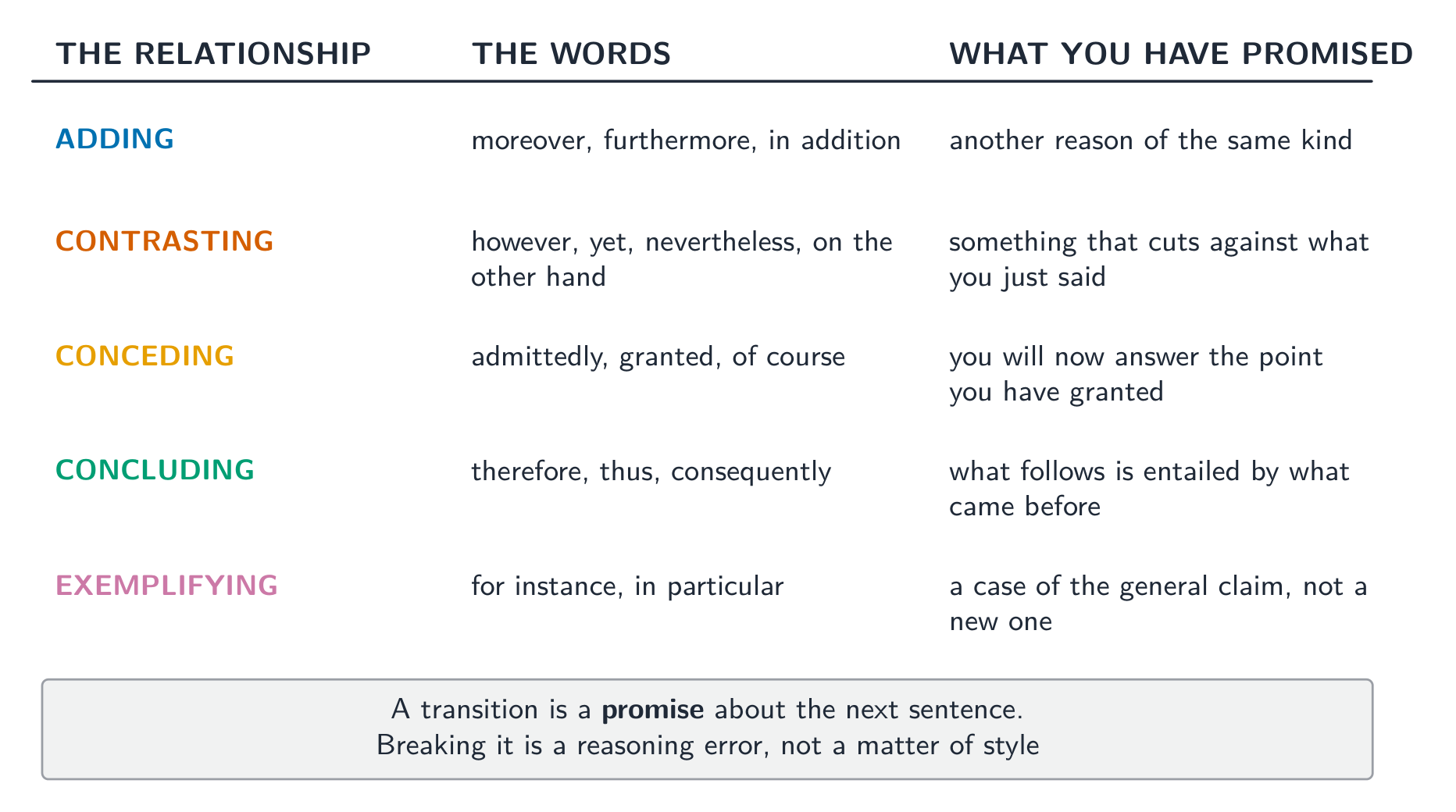
    这正是装饰性过渡与功能性过渡的分别。此外什么也没加,它只说了"这里还有一句";而即使在效果最小的那些情形中则告诉读者接下来会是什么关系。要选择承载关系信息的过渡,而不是仅仅标记分界的过渡。

    还要注意,过渡成分可以是整整一段。在一篇长论证中,一个唯一职责是让推理转向的短段落是正当的,而且往往很漂亮。

    5.5

    用词、比喻与句法

    大纲
    Enduring UnderstandingLearning ObjectiveEssential Knowledge

    STL-1
    The rhetorical situation informs the strategic stylistic choices that writers make.

    7.A
    Reading – Explain how word choice, comparisons, and syntax contribute to the specific tone or style of a text.

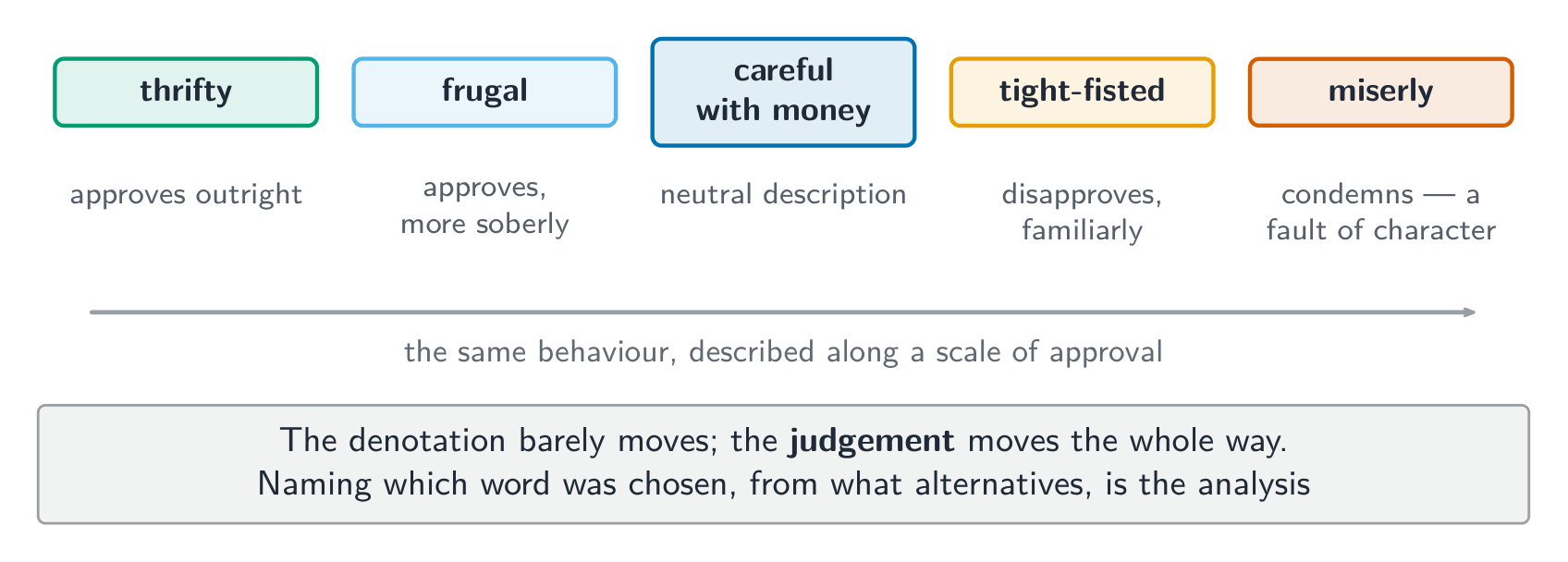
    • STL-1.A Words have both connotative and denotative meanings.
    • STL-1.B Descriptive words, such as adjectives and adverbs, not only qualify or modify the things they describe but also convey a perspective toward those things.
    • STL-1.C Precise word choice reduces confusion and may help the audience perceive the writer’s perspective.

    来源:美国大学理事会 AP 课程与考试说明

    第五单元以三项关于用词的论断开启本课程对文体的处理:

    • 词语同时具有内涵义与外延义(connotative and denotative meanings)。外延义是词所指称的东西;内涵义是它所携带的东西。
    • 描述性词语——形容词与副词——不仅限定或修饰它们所描述的对象,还传达一种视角
    • 精确的用词减少混淆,并帮助受众感知写作者的视角。

    第二项在分析上最有用。当一篇修辞分析选文把某项政策称为雄心勃勃而不是昂贵时,没有任何事实改变,而读者的倾向改变了。这就是一项修辞选择,也正是题目要求你解释的东西。

    词汇表 训练
    英文 中文 拼音
    connotative and denotative meanings 内涵义与外延义 nèi hán yì yǔ wài yán yì
    5.6

    运用词语与句法营造语气与风格

    大纲
    Enduring UnderstandingLearning ObjectiveEssential Knowledge

    STL-1
    The rhetorical situation informs the strategic stylistic choices that writers make.

    8.A
    Writing – Strategically use words, comparisons, and syntax to convey a specific tone or style in an argument.

    • STL-1.A Words have both connotative and denotative meanings.
    • STL-1.B Descriptive words, such as adjectives and adverbs, not only qualify or modify the things they describe but also convey a perspective toward those things.
    • STL-1.C Precise word choice reduces confusion and may help the audience perceive the writer’s perspective.

    来源:美国大学理事会 AP 课程与考试说明

    就自己的写作而言,精确比词汇量更值钱。一条具体的规则:宁取恰好准确的词,不取气派的词。阅卷人奖励的是控制力,而一个用得略微不准的浮夸词读起来正是控制力的丧失。

    **Worked example(一项真实的 AP 考试任务)。*在一篇修辞分析选文中,写作者在一段里把某提案的支持者描述为「坚定的」,在下一段里则称他们「不肯让步的」。低分答案会说写作者使用了"有力的用词"。能得分的答案会解释这一转变:「两个词的外延义都是坚持,但『坚定』带着赞许,『不肯让步』带着阻挠。写作者在不改变所描述事实的情况下从一个词转到另一个词,从而在表面上只是继续描述的同时收回了对支持者的同情——于是在任何反驳被提出之前,受众的判断就已经移动了。」*这一步把内涵义、语调与对受众的作用一并完成。

    5.6

    考试技巧

    • 每一个主体段落:**主张、证据、评述。**丢分的几乎总是第三项。
    • 把主张列成清单再动笔。这是看清推理是否推进的唯一办法。
    • 让评述以因为这意味着所以开头——这些词后面接不了复述。
    • 记住连贯手段的名称:重复、同义词、代词指代、平行结构、过渡。
    • 过渡应当承载关系,而不只是标记分界。此外通常什么也不承载。
    • 内涵义是用词分析的所在。外延义相同而倾向不同,就是一项值得解释的修辞选择。
  • 6

    证据、论点与风格选择

    讲义 词汇表
    6.1

    识别主张与证据

    大纲
    Enduring UnderstandingLearning ObjectiveEssential Knowledge

    CLE-1
    Writers make claims about subjects, rely on evidence that supports the reasoning that justifies the claim, and often acknowledge or respond to other, possibly opposing, arguments.

    3.A
    Reading – Identify and explain claims and evidence within an argument.

    • CLE-1.P When synthesizing, writers draw upon arguments from multiple sources, strategically select the most relevant information, and combine apt and specific source material as part of their own argument.
    • CLE-1.Q A source provides information for an argument, and some sources are more reliable or credible than others.
    • CLE-1.R A position and a perspective are different. Sources may have the same position on a subject, yet each comes from a different perspective based on their background, interests, and expertise.
    • CLE-1.S When incorporating evidence or sources into an argument, the strongest arguments recognize and acknowledge the biases and limitations of the material and account for those limitations in their reasoning.
    • CLE-1.T The degree to which a source does or does not consider other positions reflects the degree to which that source is biased.

    来源:美国大学理事会 AP 课程与考试说明

    第六单元是综合写作单元,它包含着本课程中最锋利的一项区分。

    • 综合时,写作者取用多个来源的论证,策略性地选取最相关的信息,并把它整合进自己的论证。
    • 来源为论证提供信息,而有些来源比另一些更可靠或更可信(reliable or credible)。
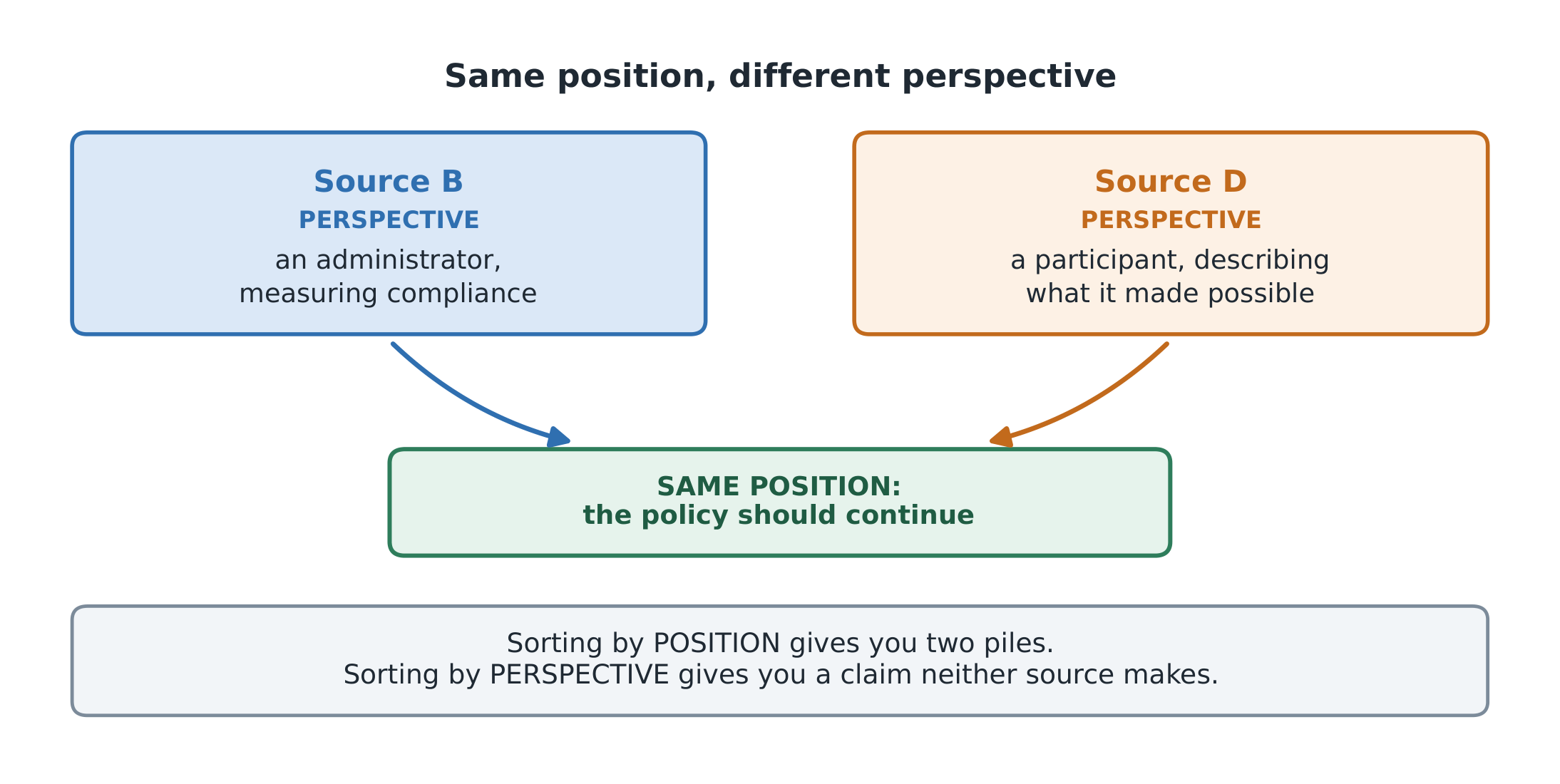
    • 立场与视角是不同的。多个来源可以在某一主题上持相同立场,却各自出自不同视角
    • 最有力的论证会认识并承认存在的其他立场
    • 一个来源在多大程度上考虑了其他立场,反映了这个来源在多大程度上可信——这是你在考场上可以对任何来源施用的检验。
    综合写作题赖以建立的那项区分
    两个来源可以彼此一致,却在你的论证中做着完全不同的工作
    6.2

    撰写含主张与证据的段落

    大纲
    Enduring UnderstandingLearning ObjectiveEssential Knowledge

    CLE-1
    Writers make claims about subjects, rely on evidence that supports the reasoning that justifies the claim, and often acknowledge or respond to other, possibly opposing, arguments.

    4.A
    Writing – Develop a paragraph that includes a claim and evidence supporting the claim.

    • CLE-1.P When synthesizing, writers draw upon arguments from multiple sources, strategically select the most relevant information, and combine apt and specific source material as part of their own argument.
    • CLE-1.Q A source provides information for an argument, and some sources are more reliable or credible than others.
    • CLE-1.R A position and a perspective are different. Sources may have the same position on a subject, yet each comes from a different perspective based on their background, interests, and expertise.
    • CLE-1.S When incorporating evidence or sources into an argument, the strongest arguments recognize and acknowledge the biases and limitations of the material and account for those limitations in their reasoning.
    • CLE-1.T The degree to which a source does or does not consider other positions reflects the degree to which that source is biased.

    来源:美国大学理事会 AP 课程与考试说明

    立场与视角的区分正是综合得以成立的原因。如果你只按立场给来源分类,你得到的是两堆——赞成与反对——以及每堆一段。而如果你按视角分类,你就能写出这样的句子:

    经济学家与教师都支持这项措施,但他们支持的理由无法同时成立:一方看重可测量的收益,另一方看重学生所愿尝试之事的改变。

    这句话就是综合。它用了两个来源,立足于每个来源实际所说,并产生了一项两个来源都没有作出的主张。

    同样可考的是那项可信度检验。一个从不承认任何其他立场的来源,按 CED 自身的标准就是可信度较低的——而在文章中就某个来源这样说,是正当的证据。

    6.3

    识别总体论点

    大纲
    Enduring UnderstandingLearning ObjectiveEssential Knowledge

    CLE-1
    Writers make claims about subjects, rely on evidence that supports the reasoning that justifies the claim, and often acknowledge or respond to other, possibly opposing, arguments.

    3.B
    Reading – Identify and describe the overarching thesis of an argument, and any indication it provides of the argument’s structure.

    • CLE-1.U Consideration and use of new evidence may require revision of the thesis statement and/or changes to the line of reasoning.

    来源:美国大学理事会 AP 课程与考试说明

    一个简短却承重的要点:对新证据的考量与使用,可能要求修正论点陈述,和/或改变推理线索(revision of the thesis statement)。

    在阅读文本时,这意味着写作者的论点可能是回应性的——由证据塑造,而非强加于证据之上。要留意论证在哪里转向。

    6.4

    撰写论点句

    大纲
    Enduring UnderstandingLearning ObjectiveEssential Knowledge

    CLE-1
    Writers make claims about subjects, rely on evidence that supports the reasoning that justifies the claim, and often acknowledge or respond to other, possibly opposing, arguments.

    4.B
    Writing – Write a thesis statement that requires proof or defense and that may preview the structure of the argument.

    • CLE-1.U Consideration and use of new evidence may require revision of the thesis statement and/or changes to the line of reasoning.

    来源:美国大学理事会 AP 课程与考试说明

    在限时写作中,这是一项你应当使用的许可。如果在起草过程中你发现证据并不支持你最初的论点,那就改论点,而不是改证据。阅卷人奖励的是与其证据相称的论证;预言自己的结论是没有分数的。

    在实际操作上,最初几分钟应当用来读来源、勾画各项主张,然后再定下论点。在证据之后写出的论点,几乎总是优于在证据之前写出的论点。

    6.5

    用词、比喻与句法

    大纲
    Enduring UnderstandingLearning ObjectiveEssential Knowledge

    STL-1
    The rhetorical situation informs the strategic stylistic choices that writers make.

    7.A
    Reading – Explain how word choice, comparisons, and syntax contribute to the specific tone or style of a text.

    • STL-1.D A writer’s tone is the writer’s attitude or feeling about a subject, conveyed through word choice and writing style.
    • STL-1.E Readers infer a writer’s tone from the writer’s word choice, and especially the positive, negative, or other connotations of those words.
    • STL-1.F A writer’s shifts in tone from one part of a text to another may suggest the writer’s qualification, refinement, or reconsideration of their perspective on a subject.

    来源:美国大学理事会 AP 课程与考试说明

    • 写作者的语调(tone)是写作者对某一主题的态度或感受,通过用词与写作风格传达。
    • 读者从用词中推断语调——尤其是从所选词语的正面、负面或其他带有色彩的联想中。
    • 写作者在文本不同部分之间的语调转变(shifts in tone)可能提示限定、精炼或视角的改变

    第三项是分析的富矿。语调转变是文本中一个看得见的事件:在那一点上有什么改变了,而说明写作者希望读者在那之后有何不同的反应,恰恰是能得分的那类答案。

    词汇表 训练
    英文 中文 拼音
    some sources are more reliable or credible than others 可靠性与可信度 kě kào xìng yǔ kě xìn dù
    consideration and use of new evidence may require revision of the thesis statement and/or changes to the line of reasoning 修正论点 xiū zhèng lùn diǎn
    tone 语调 yǔ diào
    shifts in tone 语调转变 yǔ diào zhuǎn biàn
    6.6

    运用词语与句法营造语气与风格

    大纲
    Enduring UnderstandingLearning ObjectiveEssential Knowledge

    STL-1
    The rhetorical situation informs the strategic stylistic choices that writers make.

    8.A
    Writing – Strategically use words, comparisons, and syntax to convey a specific tone or style in an argument.

    • STL-1.D A writer’s tone is the writer’s attitude or feeling about a subject, conveyed through word choice and writing style.
    • STL-1.E Readers infer a writer’s tone from the writer’s word choice, and especially the positive, negative, or other connotations of those words.
    • STL-1.F A writer’s shifts in tone from one part of a text to another may suggest the writer’s qualification, refinement, or reconsideration of their perspective on a subject.

    来源:美国大学理事会 AP 课程与考试说明

    在自己的写作中,语调应当一致而受控,只在论证转向之处才有意转变——例如从陈述自己的立场转向承认对立立场的一部分时。

    Worked example(一项真实的 AP 考试任务)。在一道综合写作题中,比较对同样两个来源的两种使用。薄弱版本:*「来源 B 与来源 D 一致认为这项政策应当继续。」这是按立场分类,什么也产生不了。有力版本:「来源 B 与来源 D 都为这项政策辩护,但 B 是以一位衡量合规情况的管理者身份辩护,D 则是以一位描述这项政策使什么成为可能的参与者身份辩护——因此这种一致比表面上看起来更单薄,而整个论证取决于我们衡量的是这项政策的运作还是它的效果。」*同样两个来源,但起作用的是视角,而那项主张属于写作者自己。

    6.6

    考试技巧

    • **立场与视角是不同的。**仅这一项区分就能把多数综合写作文章带出中间分段。
    • 视角给来源分类,而不是按阵营。按阵营分类会得到每堆一段、而无论证。
    • 使用 CED 的可信度检验:忽略所有其他立场的来源较弱,而你可以在文中这样说。
    • 如果证据与论点不合,就改论点。与自己最初的想法保持一致是没有分数的。
    • 语调转变是看得见的事件。说出改变了什么,以及读者在那之后应当作何反应。
    • 保持自己的语调受控。只在论证真正转向之处才转变它。
  • 7

    限定论证、句法与规范

    讲义 词汇表
    7.1

    修辞情境的构成要素

    大纲
    Enduring UnderstandingLearning ObjectiveEssential Knowledge

    RHS-1
    Individuals write within a particular situation and make strategic writing choices based on that situation.

    1.A
    Reading – Identify and describe components of the rhetorical situation: the exigence, audience, writer, purpose, context, and message.

    • RHS-1.I The introduction of an argument introduces the subject and/ or writer of the argument to the audience. An introduction may present the argument’s thesis. An introduction may orient, engage, and/or focus the audience by presenting quotations, intriguing statements, anecdotes, questions, statistics, data, contextualized information, or a scenario.
    • RHS-1.J The conclusion of an argument brings the argument to a unified end. A conclusion may present the argument’s thesis. It may engage and/or focus the audience by explaining the significance of the argument within a broader context, making connections, calling the audience to act, suggesting a change in behavior or attitude, proposing a solution, leaving the audience with a compelling image, explaining implications, summarizing the argument, or connecting to the introduction.

    来源:美国大学理事会 AP 课程与考试说明

    第七单元带着你此时积累的经验回到引言与结论,随后转向最能把合格写作与出色写作区分开的两件事:限定(qualification)与句子结构

    关于引言与结论,CED 的表述没有变——引言把主题与写作者介绍给受众;结论把论证带向统一的收束,并可以呈现论点、说明其重要性,或把论证置于更广阔的语境中。

    词汇表 训练
    英文 中文 拼音
    qualification 限定 xiàn dìng
    7.2

    撰写引言与结论

    大纲
    Enduring UnderstandingLearning ObjectiveEssential Knowledge

    RHS-1
    Individuals write within a particular situation and make strategic writing choices based on that situation.

    2.A
    Writing – Write introductions and conclusions appropriate to the purpose and context of the rhetorical situation.

    • RHS-1.I The introduction of an argument introduces the subject and/ or writer of the argument to the audience. An introduction may present the argument’s thesis. An introduction may orient, engage, and/or focus the audience by presenting quotations, intriguing statements, anecdotes, questions, statistics, data, contextualized information, or a scenario.
    • RHS-1.J The conclusion of an argument brings the argument to a unified end. A conclusion may present the argument’s thesis. It may engage and/or focus the audience by explaining the significance of the argument within a broader context, making connections, calling the audience to act, suggesting a change in behavior or attitude, proposing a solution, leaving the audience with a compelling image, explaining implications, summarizing the argument, or connecting to the introduction.

    来源:美国大学理事会 AP 课程与考试说明

    到这一阶段,有用的提升是让结论做 CED 所允许的那些工作。结论可以:

    • 说明论证的重要性——为什么它成立这件事重要;
    • 把它置于更广阔的语境中——它属于哪个更大的问题;
    • 以其最终的、此刻已被赢得的形式呈现论点

    第三项在考场上最有力:用你在引言里不可能使用的措辞重述论点,因为那时论证尚未作出。

    7.3

    主张的限定方式

    大纲
    Enduring UnderstandingLearning ObjectiveEssential Knowledge

    CLE-1
    Writers make claims about subjects, rely on evidence that supports the reasoning that justifies the claim, and often acknowledge or respond to other, possibly opposing, arguments.

    3.C
    Reading – Explain ways claims are qualified through modifiers, counterarguments, and alternative perspectives.

    • CLE-1.V A lack of understanding of the complexities of a subject or an issue can lead to oversimplification or generalizations.
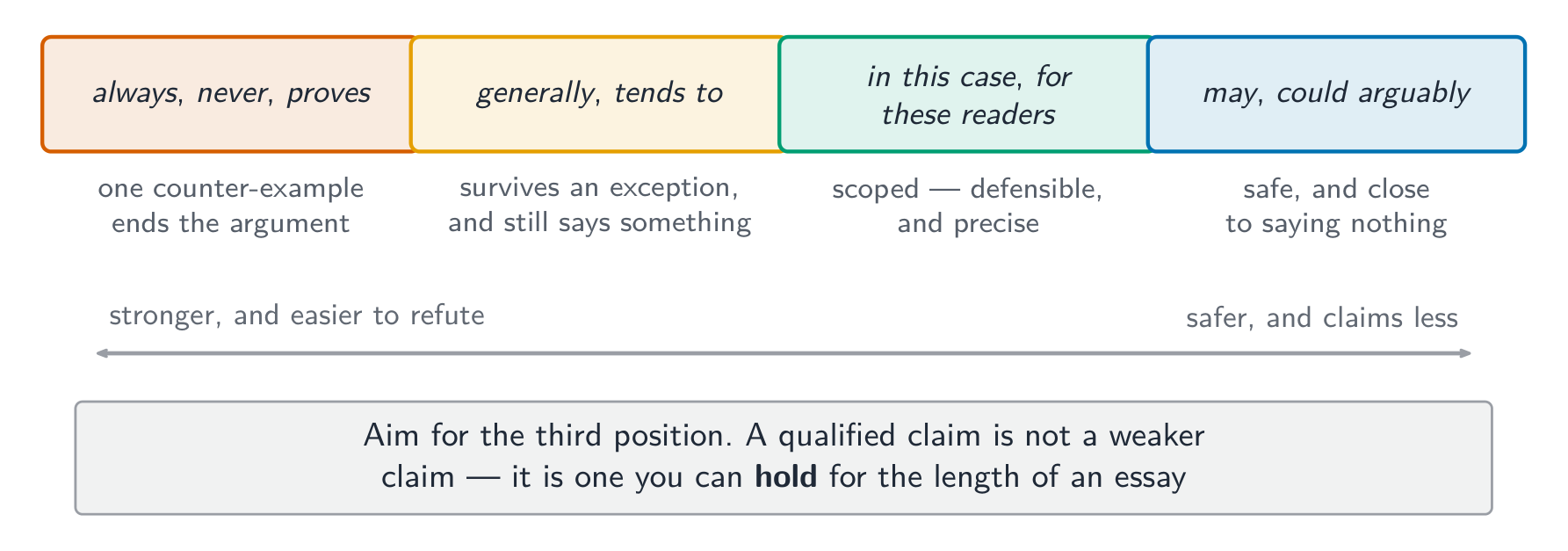
    • CLE-1.W Because arguments are usually part of ongoing discourse, effective arguments often avoid expressing claims, reasoning, and evidence in absolute terms.
    • CLE-1.X Writers may strategically use words, phrases, and clauses as modifiers to qualify or limit the scope of an argument.

    来源:美国大学理事会 AP 课程与考试说明

    • 对某一主题复杂性的理解不足会导致过度简化或以偏概全(oversimplification or generalisation)。
    • 由于论证通常是持续讨论的一部分,有效的论证往往避免以绝对措辞表述主张(absolute terms)。
    • 写作者可以策略性地使用作为修饰成分的词语、短语与分句,来限定或限制论证的范围

    这对许多学生而言是反直觉的,他们以为听起来更强硬的主张能得更高分。事实恰恰相反:未加限定的主张一个反例就能击倒,而经过限定的主张则能挺住。学校应当禁止手机招来的是一个例外。学校应当在教学时段限制手机使用,因为注意力的代价在这一时段是可测量的则不会。

    词汇表 训练
    英文 中文 拼音
    oversimplification or generalisation 过度简化与以偏概全 guò dù jiǎn huà yǔ yǐ piān gài quán
    avoid expressing claims in absolute terms 绝对化表述 jué duì huà biǎo shù
    7.4

    限定主张

    大纲
    Enduring UnderstandingLearning ObjectiveEssential Knowledge

    CLE-1
    Writers make claims about subjects, rely on evidence that supports the reasoning that justifies the claim, and often acknowledge or respond to other, possibly opposing, arguments.

    4.C
    Writing – Qualify a claim using modifiers, counterarguments, or alternative perspectives.

    • CLE-1.V A lack of understanding of the complexities of a subject or an issue can lead to oversimplification or generalizations.
    • CLE-1.W Because arguments are usually part of ongoing discourse, effective arguments often avoid expressing claims, reasoning, and evidence in absolute terms.
    • CLE-1.X Writers may strategically use words, phrases, and clauses as modifiers to qualify or limit the scope of an argument.

    来源:美国大学理事会 AP 课程与考试说明

    工具是些被有意使用的普通词语:在多数情况下在 X 成立之处对这一人群而言除非就……而言。每一个都把主张收窄到证据实际覆盖的范围。

    限定也是思辨深度那一分最常奖励的东西。一个先表明立场、继而显示自己知道这一立场的限度、并仍然为之辩护的学生,恰恰展示了评分标准所要寻找的控制力。

    7.5

    分句与观点之间的关系

    大纲
    Enduring UnderstandingLearning ObjectiveEssential Knowledge

    STL-1
    The rhetorical situation informs the strategic stylistic choices that writers make.

    7.B
    Reading – Explain how writers create, combine, and place independent and dependent clauses to show relationships between and among ideas. (Note: Students should be able to read and analyze these complexities but are not expected to write with them on timed essays.)

    • STL-1.G Writers express ideas in sentences. Sentences are made up of clauses, at least one of which must be independent.
    • STL-1.H The arrangement of sentences in a text can emphasize particular ideas.
    • STL-1.I Subordination and coordination are used to express the intended relationship between ideas in a sentence.
    • STL-1.J Writers frequently use coordination to illustrate a balance or equality between ideas.
    • STL-1.K Writers frequently use subordination to illustrate an imbalance or inequality between ideas.
    • STL-1.L The arrangement of clauses, phrases, and words in a sentence can emphasize ideas.

    来源:美国大学理事会 AP 课程与考试说明

    连接观念的两种方式,而它们的含义不同
    CED 说得很明确:并列表示均衡,从属表示不均衡
    • 写作者用句子表达观念,句子由分句构成,其中至少一个必须是独立分句(independent clause)。
    • 文本中句子的排布可以突出特定观念
    • 从属与并列(subordination and coordination)表达句内观念之间的预期关系。
    • 写作者用并列来体现观念之间的均衡或对等
    • 写作者用从属来体现观念之间的不均衡或不对等
    • 句内分句、短语与词语的排布可以突出观念

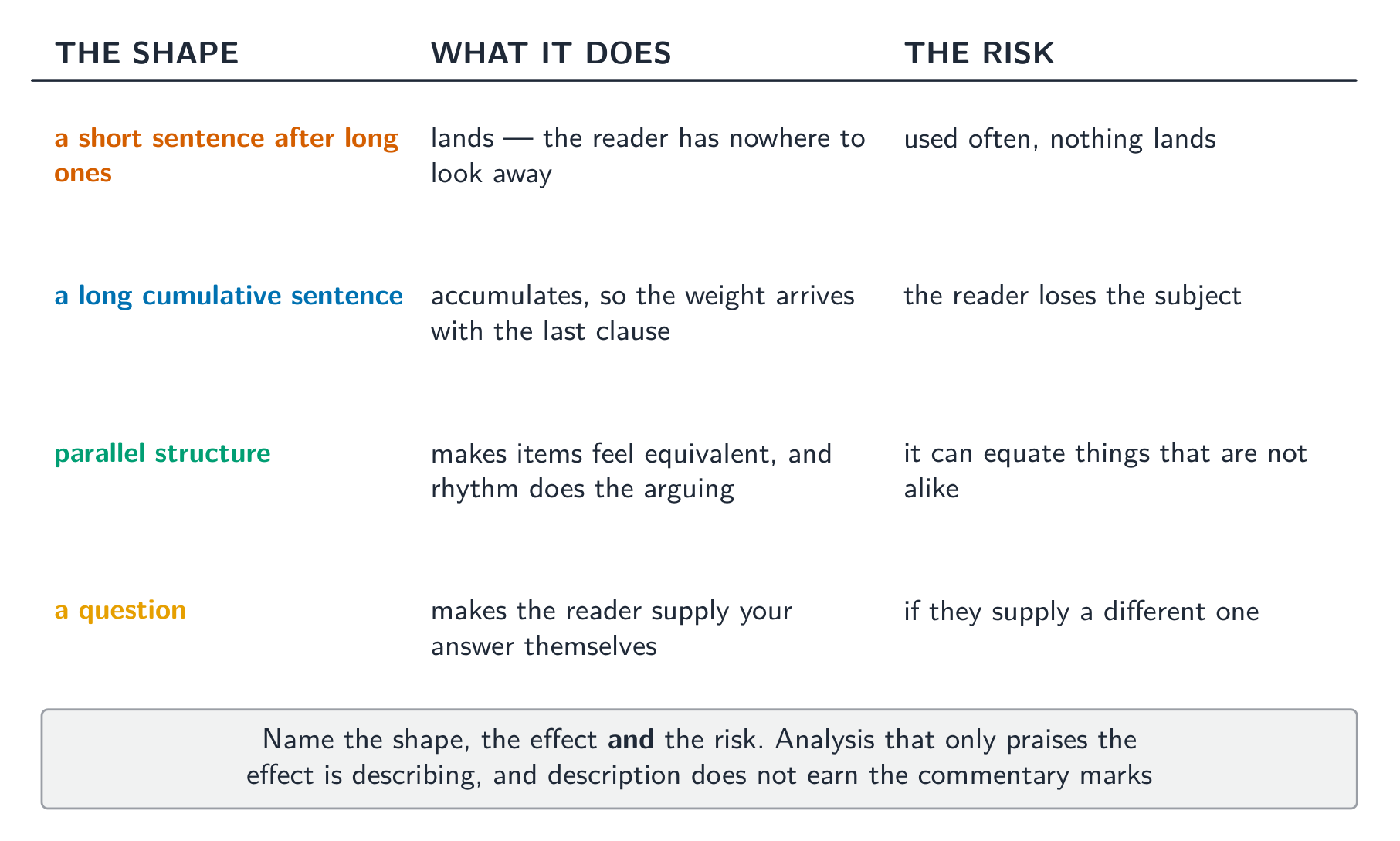
    中间那两句使句子结构变得可分析,而不再只是装饰。这项措施代价高昂,而且它奏效了把成本与效果当作对等项。尽管这项措施代价高昂,它还是奏效了则使成本从属——它依然为真,但已被排在结果之下。同样的事实,不同的论证。

    词汇表 训练
    英文 中文 拼音
    independent 独立分句 dú lì fēn jù
    Subordination and coordination 从属与并列 cóng shǔ yǔ bìng liè
    7.6

    写出清晰的句子

    大纲
    Enduring UnderstandingLearning ObjectiveEssential Knowledge

    STL-1
    The rhetorical situation informs the strategic stylistic choices that writers make.

    8.B
    Writing – Write sentences that clearly convey ideas and arguments.

    • STL-1.G Writers express ideas in sentences. Sentences are made up of clauses, at least one of which must be independent.
    • STL-1.H The arrangement of sentences in a text can emphasize particular ideas.
    • STL-1.I Subordination and coordination are used to express the intended relationship between ideas in a sentence.
    • STL-1.J Writers frequently use coordination to illustrate a balance or equality between ideas.
    • STL-1.K Writers frequently use subordination to illustrate an imbalance or inequality between ideas.
    • STL-1.L The arrangement of clauses, phrases, and words in a sentence can emphasize ideas.

    来源:美国大学理事会 AP 课程与考试说明

    用于自己的写作:先确定关系,再选择表达这一关系的结构。如果两个观念确实分量相当,就把它们并列。如果其中一个是让步、另一个是你的要点,就让让步从属——并把你的要点放进独立分句,重心落在那里。

    7.7

    语法规范与表达清晰度

    大纲
    Enduring UnderstandingLearning ObjectiveEssential Knowledge

    STL-1
    The rhetorical situation informs the strategic stylistic choices that writers make.

    7.C
    Reading – Explain how grammar and mechanics contribute to the clarity and effectiveness of an argument.

    • STL-1.M Grammar and mechanics that follow established conventions of language enable clear communication.
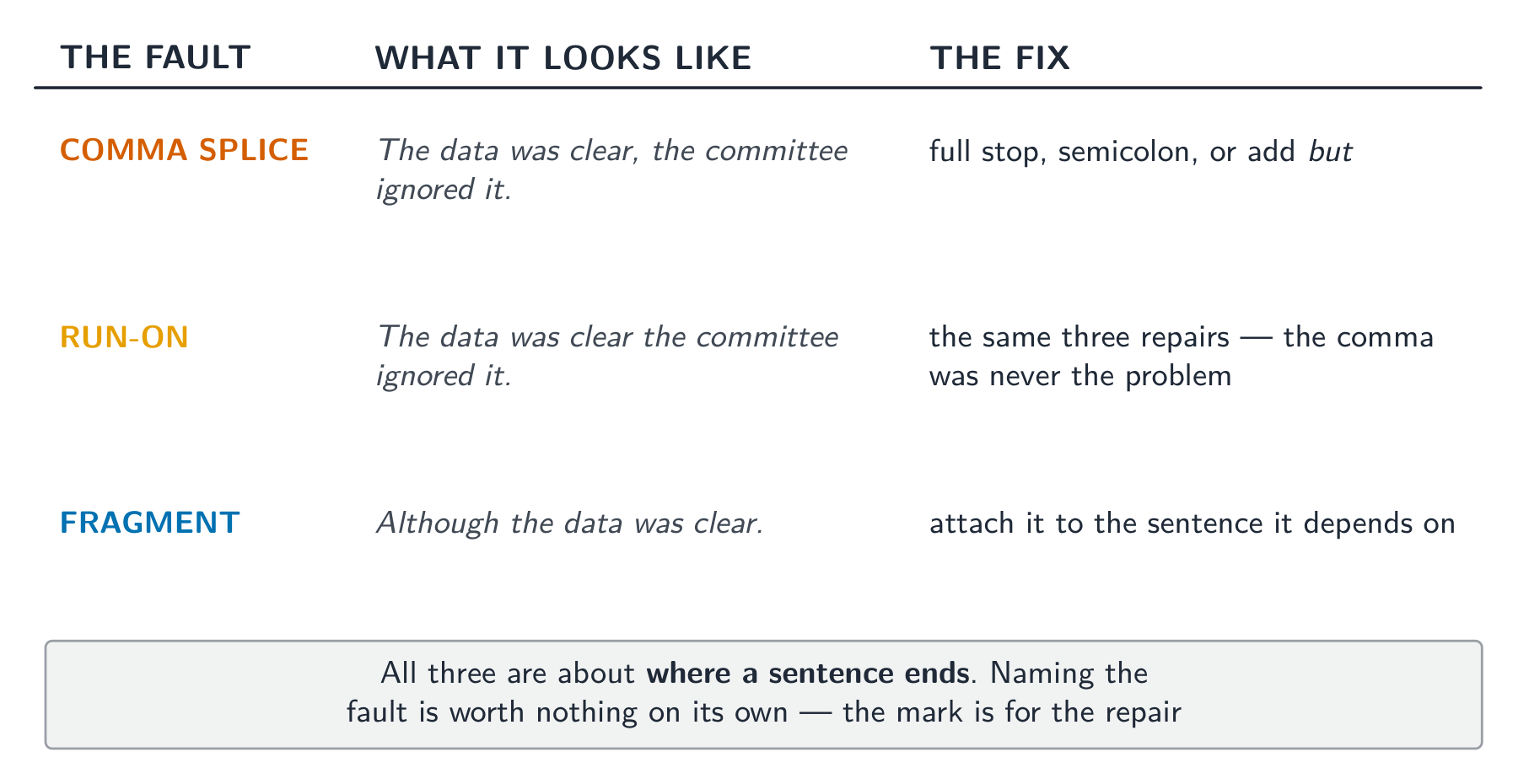
    • STL-1.N Writers use punctuation strategically to demonstrate the relationships among ideas in a sentence.
    • STL-1.O Punctuation (commas, colons, semicolons, dashes, hyphens, parentheses, quotation marks, or end marks) advances a writer’s purpose by clarifying, organizing, emphasizing, indicating purpose, supplementing information, or contributing to tone.
    • STL-1.P Some design features, such as italics or boldface, create emphasis.

    来源:美国大学理事会 AP 课程与考试说明

    • 遵循既定惯例的语法与格式(grammar and mechanics)使清晰的交流成为可能
    • 写作者策略性地使用标点来显示观念之间的关系。
    • 标点——逗号、冒号、分号、破折号、连字符、括号、引号、句末符号——推进论证
    • 版面手段斜体或粗体制造强调。
    7.8

    语法与书写规范

    大纲
    Enduring UnderstandingLearning ObjectiveEssential Knowledge

    STL-1
    The rhetorical situation informs the strategic stylistic choices that writers make.

    8.C
    Use established conventions of grammar and mechanics to communicate clearly and effectively.

    • STL-1.M Grammar and mechanics that follow established conventions of language enable clear communication.
    • STL-1.N Writers use punctuation strategically to demonstrate the relationships among ideas in a sentence.
    • STL-1.O Punctuation (commas, colons, semicolons, dashes, hyphens, parentheses, quotation marks, or end marks) advances a writer’s purpose by clarifying, organizing, emphasizing, indicating purpose, supplementing information, or contributing to tone.
    • STL-1.P Some design features, such as italics or boldface, create emphasis.

    来源:美国大学理事会 AP 课程与考试说明

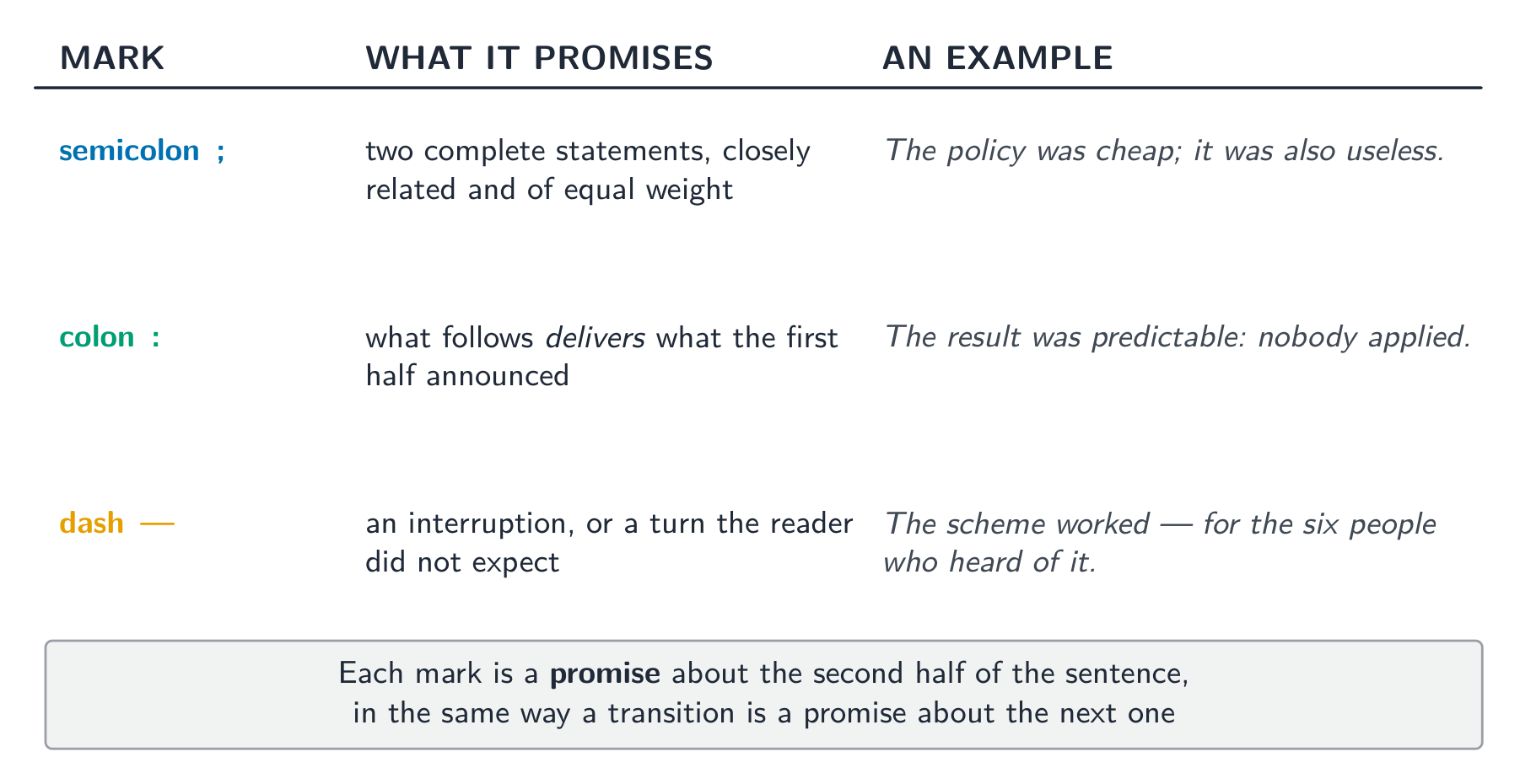
    可考的框架是:标点是论证性的,而不只是正确与否的问题。冒号承诺其后的内容将解释其前的内容。分号断言两个独立陈述属于一处。破折号打断,而这一打断本身就是要点。

    **Worked example(一项真实的 AP 考试任务)。**一篇修辞分析选文写道:*「这一项目很受欢迎;按照该部门自己提出的每一项标准,它也是无效的。」低分答案会说"写作者使用了分号"。能得分的答案会解释这一结构:「分号把两项事实呈现为对等而同时的,而不是呈现为对照,因此读者无法把这一失败当作对'受欢迎'的反驳打发掉——两者只是同时为真。随后的插入成分『按照该部门自己提出的每一项标准』在『无效』一词到来之前,先切断了该部门的退路。」*这就是把句法当作论证来分析。

    7.8

    考试技巧

    • **限定你的主张。**绝对化的主张一个反例就被击倒,经过限定的则不会。
    • 限定是通往思辨深度那一分最可靠的路径。
    • **并列 = 均衡。从属 = 不均衡。**CED 就是这么说的,而这使句法变得可分析。
    • 把你的要点放进独立分句。让步属于从属分句。
    • 标点推进论证。冒号解释,分号以对等身份连接,破折号打断。
    • 绝不要只写"写作者使用了分号",而不说明它断言了什么关系
  • 8

    受众、语气与句子技巧

    讲义 词汇表
    8.1

    理解受众的信念与需求

    大纲
    Enduring UnderstandingLearning ObjectiveEssential Knowledge

    RHS-1
    Individuals write within a particular situation and make strategic writing choices based on that situation.

    1.B
    Reading – Explain how an argument demonstrates understanding of an audience’s beliefs, values, or needs.

    • RHS-1.K Writers may make comparisons (e.g., similes, metaphors, analogies, or anecdotes) in an attempt to relate to an audience. Effective comparisons must be shared and understood by the audience to advance the writer’s purpose.
    • RHS-1.L Writers’ choices regarding syntax and diction influence how the writer is perceived by an audience and may influence the degree to which an audience accepts an argument.
    • RHS-1.M Word choice may reflect writers’ biases and may affect their credibility with a particular audience.
    • RHS-1.N Because audiences are unique and dynamic, writers must consider the perspectives, contexts, and needs of the intended audience when making choices of evidence, organization, and language in an argument.

    来源:美国大学理事会 AP 课程与考试说明

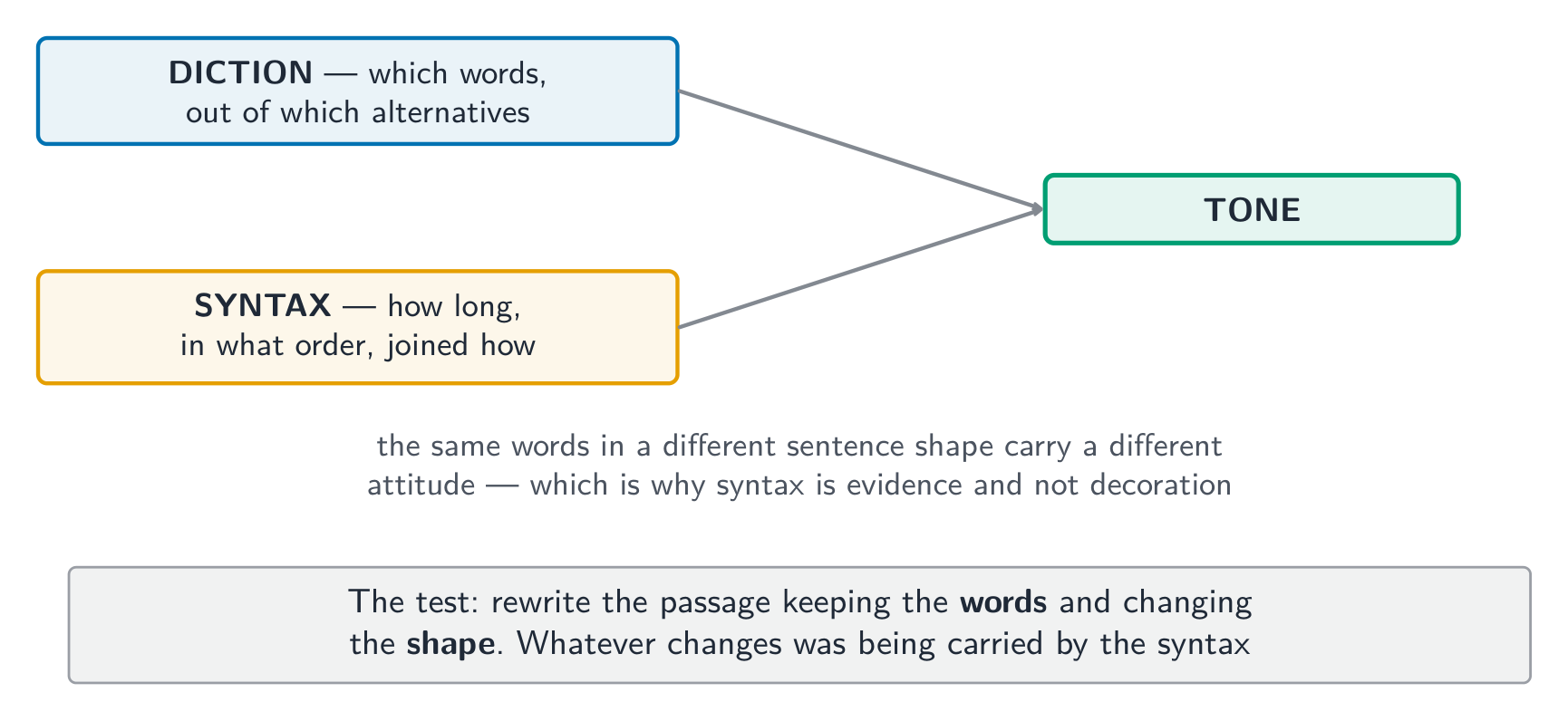
    第八单元是本课程对文体(style)最深入的处理——在这里,用词、句法与受众不再是彼此分开的题目。

    • 写作者可以运用比喻——明喻、隐喻、类比或轶事(similes, metaphors, analogies, or anecdotes)——来试图与受众建立联系。
    • 写作者在句法与措辞(syntax and diction)上的选择,影响受众如何看待写作者
    • 用词可能反映写作者的偏见(biases),并可能影响其对特定受众的可信度
    • 由于受众是独特而流动的,写作者必须考虑目标受众的视角、语境与需求

    第三点值得停留。措辞不只刻画对象,它也刻画写作者。一旦读者察觉到带有色彩的用词,他们就会开始对其后的一切打折扣——这正是不加节制的词汇是可信度风险而非优势的原因。

    词汇表 训练
    英文 中文 拼音
    style 文体 wén tǐ
    similes, metaphors, analogies, or anecdotes 明喻、隐喻、类比与轶事 míng yù 、 yǐn yù 、 lèi bǐ yǔ yì shì
    syntax and diction 句法与措辞 jù fǎ yǔ cuò cí
    Word choice may reflect a writer's biases 偏见 piān jiàn
    8.2

    针对受众的信念与需求写作

    大纲
    Enduring UnderstandingLearning ObjectiveEssential Knowledge

    RHS-1
    Individuals write within a particular situation and make strategic writing choices based on that situation.

    2.B
    Writing – Demonstrate an understanding of an audience’s beliefs, values, or needs.

    • RHS-1.K Writers may make comparisons (e.g., similes, metaphors, analogies, or anecdotes) in an attempt to relate to an audience. Effective comparisons must be shared and understood by the audience to advance the writer’s purpose.
    • RHS-1.L Writers’ choices regarding syntax and diction influence how the writer is perceived by an audience and may influence the degree to which an audience accepts an argument.
    • RHS-1.M Word choice may reflect writers’ biases and may affect their credibility with a particular audience.
    • RHS-1.N Because audiences are unique and dynamic, writers must consider the perspectives, contexts, and needs of the intended audience when making choices of evidence, organization, and language in an argument.

    来源:美国大学理事会 AP 课程与考试说明

    这里的指令是:受众是流动的——他们在阅读过程中会发生变化。刚刚作出让步的论证,面对的已经是一个与文章开头时略有不同的受众。

    在实际操作上,这意味着让步与主张的先后顺序很重要。先让步再施压,你面对的读者此刻已认定你是公允的;先施压再让步,那份让步读起来就像退却。

    8.3

    用词、比喻与句法

    大纲
    Enduring UnderstandingLearning ObjectiveEssential Knowledge

    STL-1
    The rhetorical situation informs the strategic stylistic choices that writers make.

    7.A
    Reading – Explain how word choice, comparisons, and syntax contribute to the specific tone or style of a text.

    • STL-1.Q A writer’s style is made up of the mix of word choice, syntax, and conventions employed by that writer.
    • STL-1.R Writers may signal a complex or ironic perspective through stylistic choices. Irony may emerge from the differences between an argument and the readers’ expectations or values.

    来源:美国大学理事会 AP 课程与考试说明

    • 写作者的文体是该写作者所使用的用词、句法与惯例的组合。文体是一种复合物,这正是"这位写作者的文体是正式的"不算分析的原因——它点出了结果,却不涉及任何构成要素。
    • 写作者可以通过文体选择传达一种复杂或反讽的视角反讽(irony)可能产生于所说与所指之间的差异,或期待与实际发生之事之间的差异。
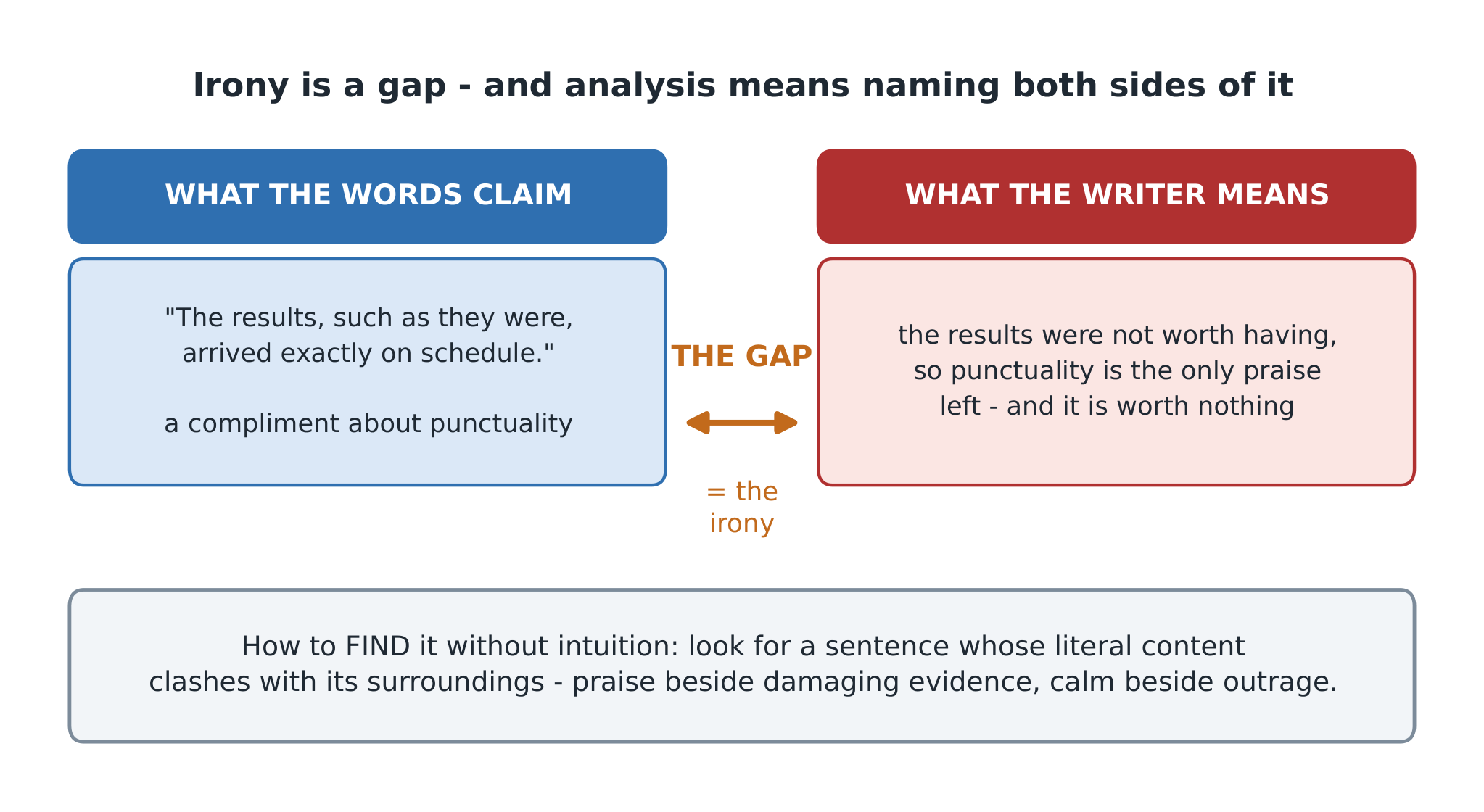
    反讽是一道缝隙,而分析意味着把它的两侧都点出来
    说出这些词语声称什么,说出写作者意指什么,那道缝隙就是论证

    对第二语言读者而言,反讽是这门考试中最难的东西,因为它查不到。可行的方法是结构性的而非直觉性的:找出一个字面内容与其周围环境不相称的句子——过度的赞美紧挨着不利的证据,平静的语域紧挨着骇人的事实——这种不相称就是信号。

    词汇表 训练
    英文 中文 拼音
    Irony 反讽 fǎn fěng
    8.4

    运用词语与句法营造语气与风格

    大纲
    Enduring UnderstandingLearning ObjectiveEssential Knowledge

    STL-1
    The rhetorical situation informs the strategic stylistic choices that writers make.

    8.A
    Writing – Strategically use words, comparisons, and syntax to convey a specific tone or style in an argument.

    • STL-1.Q A writer’s style is made up of the mix of word choice, syntax, and conventions employed by that writer.
    • STL-1.R Writers may signal a complex or ironic perspective through stylistic choices. Irony may emerge from the differences between an argument and the readers’ expectations or values.

    来源:美国大学理事会 AP 课程与考试说明

    就自己的写作而言,对反讽最安全的用法是不用。思辨深度那一分真正奖励的是控制力:一以贯之的语域、精确而不浮夸的词汇,以及有意识地为观念排定次序的句法。

    8.5

    分句与观点之间的关系

    大纲
    Enduring UnderstandingLearning ObjectiveEssential Knowledge

    STL-1
    The rhetorical situation informs the strategic stylistic choices that writers make.

    7.B
    Reading – Explain how writers create, combine, and place independent and dependent clauses to show relationships between and among ideas.

    • STL-1.S Modifiers—including words, phrases, or clauses—qualify, clarify, or specify information about the thing with which they are associated. To reduce ambiguity, modifiers should be placed closest to the word, phrase, or clause that they are meant to modify.
    • STL-1.T Parenthetical elements—though not essential to understanding what they are describing—interrupt sentences to provide additional information that may address an audience’s needs and/or advance a writer’s purpose.

    来源:美国大学理事会 AP 课程与考试说明

    • 修饰成分(modifiers)——词语、短语或分句——对被修饰之物的信息加以限定、澄清或具体化
    • 插入成分(parenthetical elements)——虽然对理解所描述之物并非必需——通过打断句子来添加信息、评论或强调。

    两者都在文体上丰富,在分析上有用。修饰成分是写作者判断的藏身之处:那份久拖不决的报告在表面上只是指认这份报告的同时,已经对它作出了评价。插入成分则是写作者选择要说的旁白——而选择打断本身就是一种强调。

    词汇表 训练
    英文 中文 拼音
    Modifiers 修饰成分 xiū shì chéng fèn
    Parenthetical elements 插入成分 chā rù chéng fèn
    8.6

    写出清晰的句子

    大纲
    Enduring UnderstandingLearning ObjectiveEssential Knowledge

    STL-1
    The rhetorical situation informs the strategic stylistic choices that writers make.

    8.B
    Writing – Write sentences that clearly convey ideas and arguments.

    • STL-1.S Modifiers—including words, phrases, or clauses—qualify, clarify, or specify information about the thing with which they are associated. To reduce ambiguity, modifiers should be placed closest to the word, phrase, or clause that they are meant to modify.
    • STL-1.T Parenthetical elements—though not essential to understanding what they are describing—interrupt sentences to provide additional information that may address an audience’s needs and/or advance a writer’s purpose.

    来源:美国大学理事会 AP 课程与考试说明

    一条具体的纪律:把修饰成分放在它所修饰之物旁边,并且节制使用插入成分。一处位置得当的打断能制造强调;一段里出现三处则会摧毁强调,因为读者无从分辨哪一次打断才是要紧的。

    **Worked example(一项真实的 AP 考试任务)。**一篇修辞分析选文这样谈论某项政策:*「那些成果——姑且算是成果——恰好如期而至。」低分答案会说写作者"使用了插入短语"。能得分的答案会同时解释两部分:「插入成分『姑且算是成果』用几个字就打发掉了那些成果,却并未针对它们给出任何论证——而把它放在『恰好如期而至』之前,意味着对准时的称许落在了读者刚刚被告知要打折扣的成果之上。这个句子表面上在称赞这个项目,实际上却抽走了它唯一可被称赞之处。」*修饰成分、插入成分、反讽,以及对受众的作用,尽在一处。

    8.6

    考试技巧

    • 文体是复合物——用词、句法、惯例。点出构成要素才是分析;点出结果不是。
    • 带有色彩的措辞损害写作者的可信度。要写出这一点;它是可考的。
    • 结构性地寻找反讽:找出字面内容与周围环境相抵触的句子。
    • **先让步再施压。**读到你主张的那个受众,此时已经就你是否公允作出了判断。
    • 修饰成分是判断的藏身之处。那份久拖不决的报告已经对它作了评价。
    • 在自己的写作中节制使用插入成分。一段三处会彼此抵消。
  • 9

    完善有限定的论证

    讲义 词汇表
    9.1

    主张的限定方式

    大纲
    Enduring UnderstandingLearning ObjectiveEssential Knowledge

    CLE-1
    Writers make claims about subjects, rely on evidence that supports the reasoning that justifies the claim, and often acknowledge or respond to other, possibly opposing, arguments.

    3.C
    Reading – Explain ways claims are qualified through modifiers, counterarguments, and alternative perspectives.

    • CLE-1.AA Writers enhance their credibility when they refute, rebut, or concede opposing arguments and contradictory evidence.
    • CLE-1.AB When writers concede, they accept all or a portion of a competing position or claim as correct, agree that the competing position or claim is correct under a different set of circumstances, or acknowledge the limitations of their own argument.
    • CLE-1.AC When writers rebut, they offer a contrasting perspective on an argument and its evidence or provide alternative evidence to propose that all or a portion of a competing position or claim is invalid.
    • CLE-1.AD When writers refute, they demonstrate, using evidence, that all or a portion of a competing position or claim is invalid.
    • CLE-1.AE Transitions may be used to introduce counterarguments.
    • CLE-1.AF Not all arguments explicitly address a counterargument.
    • CLE-1.Y Effectively entering into an ongoing conversation about a subject means engaging the positions that have already been considered and argued about.
    • CLE-1.Z Evidence and sources will either support, complement, or contradict a writer’s thesis.

    来源:美国大学理事会 AP 课程与考试说明

    第九单元篇幅很短,却是本课程的最后一步:如何处理与你相对立的论证。这里的一切都在考试中直接得到奖励,而三个关键动词却被不断混用。

    先看总体框架:

    • 有效地进入关于某一主题的持续讨论,意味着回应已经被提出的各种立场。忽略它们的论证不是在参与讨论,而只是在向讨论里宣告。
    • 证据与来源要么支持、补充,要么反驳(support, complement, or contradict)写作者的论点。三者都可用——相反的证据不是需要藏起来的麻烦,而是需要被处理的材料。
    • 写作者在驳倒、反驳或让步对立论证与相反证据时,提升了自身的可信度
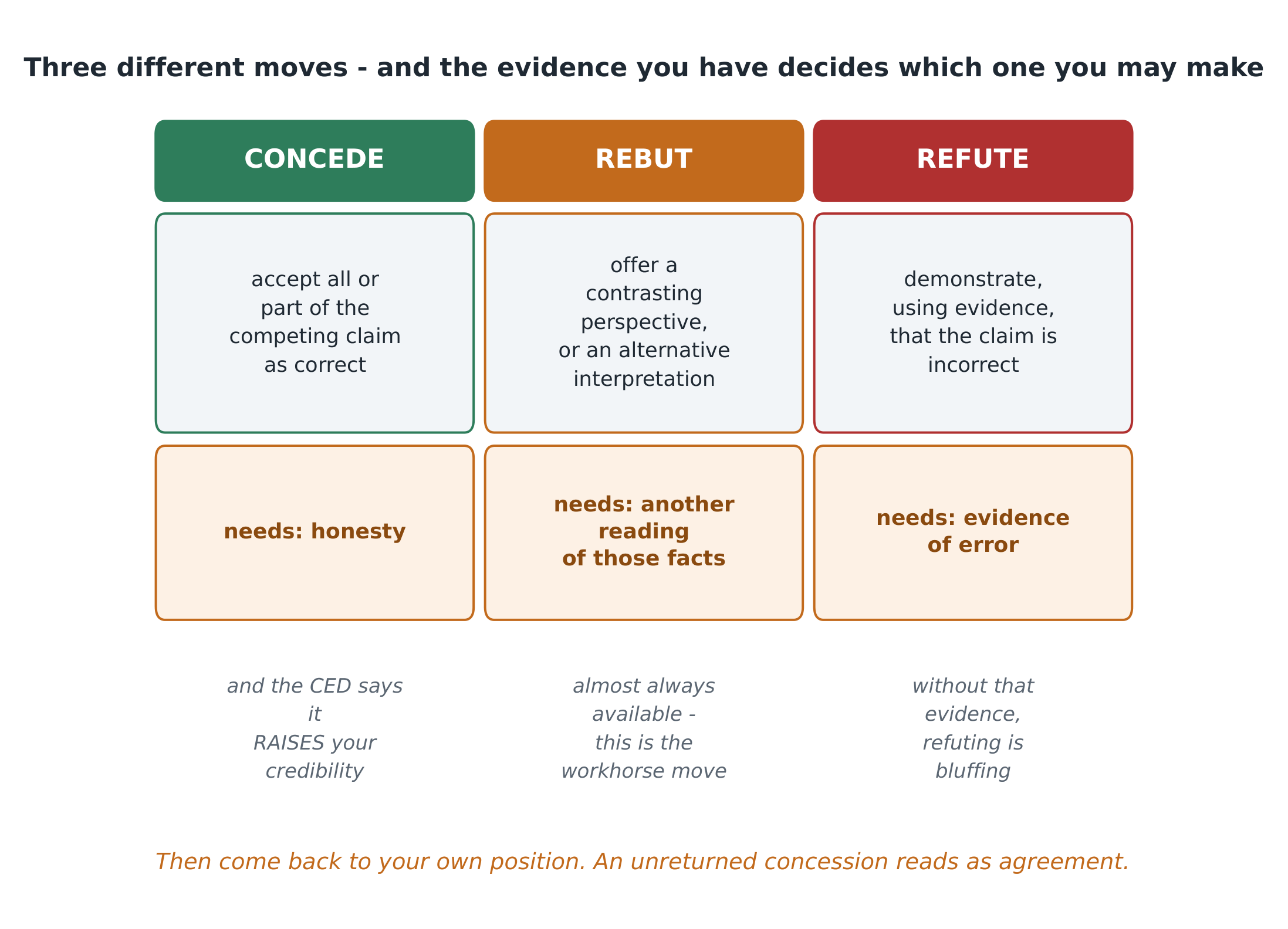
    三种不同的动作,三种不同的承认——而学生不断把它们混淆
    让步是接受,反驳是提出另一读法,驳倒是证伪。选你的证据真正支撑得起的那一种

    按 CED 自身的定义,这三种动作是:

    • 让步(concede):写作者接受对立立场或主张的全部或一部分为正确,并同意对方的要点有其道理。
    • 反驳(rebut):写作者对某一论证及其证据提出对照性的视角,或提供另一种解释。
    • 驳倒(refute):写作者运用证据证明对立立场或主张的全部或一部分是错误的

    这一区分取决于你的证据允许你做什么。驳倒需要证明存在错误的证据;如果没有,驳倒就是虚张声势,读者看得出来。反驳只需要对同样事实的另一种读法,而这远为常见。让步需要的是诚实,而它不花任何代价——CED 明确说它提升可信度。

    另有两点:

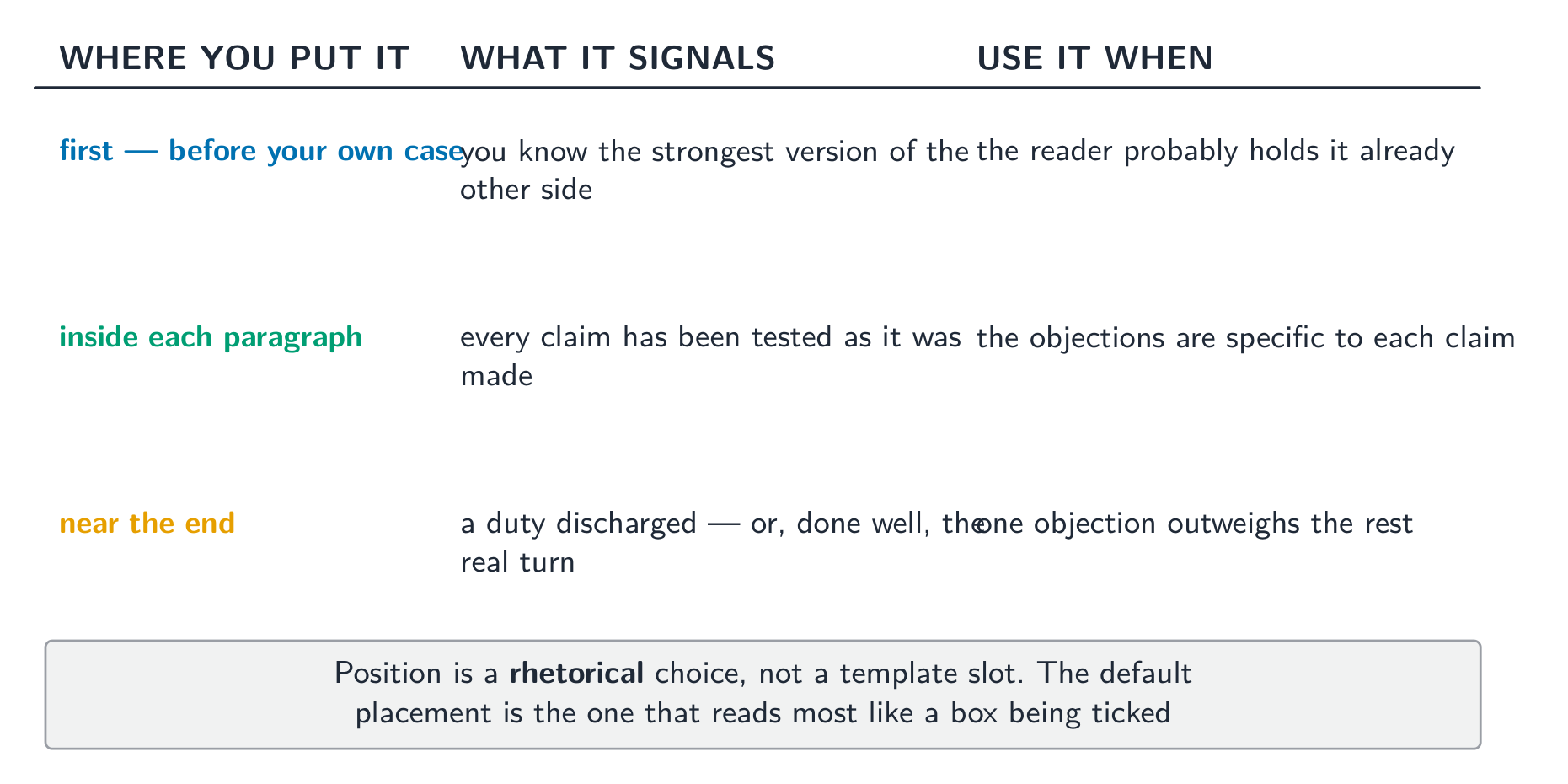
    • 过渡可以用来引出反驳(introduce counterarguments)——而且如第五单元所说,过渡应当标示关系。批评者认为宣告了一项反驳;对此最有力的反对是既宣告了它,也为它排定了位次。
    • **并非所有论证都明确处理反驳。**这对你所读的文本同样成立,在分析时值得注意——一个不回应任何对立意见的论证,已经告诉了你它的预期受众是谁。
    词汇表 训练
    英文 中文 拼音
    support, complement, or contradict 支持、补充或反驳 zhī chí 、 bǔ chōng huò fǎn bó
    Concede 让步 ràng bù
    Rebut 反驳 fǎn bó
    Refute 驳倒 bó dǎo
    Transitions may be used to introduce counterarguments 引出反驳 yǐn chū fǎn bó
    9.2

    限定主张

    大纲
    Enduring UnderstandingLearning ObjectiveEssential Knowledge

    CLE-1
    Writers make claims about subjects, rely on evidence that supports the reasoning that justifies the claim, and often acknowledge or respond to other, possibly opposing, arguments.

    4.C
    Writing – Qualify a claim using modifiers, counterarguments, or alternative perspectives.

    • CLE-1.AA Writers enhance their credibility when they refute, rebut, or concede opposing arguments and contradictory evidence.
    • CLE-1.AB When writers concede, they accept all or a portion of a competing position or claim as correct, agree that the competing position or claim is correct under a different set of circumstances, or acknowledge the limitations of their own argument.
    • CLE-1.AC When writers rebut, they offer a contrasting perspective on an argument and its evidence or provide alternative evidence to propose that all or a portion of a competing position or claim is invalid.
    • CLE-1.AD When writers refute, they demonstrate, using evidence, that all or a portion of a competing position or claim is invalid.
    • CLE-1.AE Transitions may be used to introduce counterarguments.
    • CLE-1.AF Not all arguments explicitly address a counterargument.
    • CLE-1.Y Effectively entering into an ongoing conversation about a subject means engaging the positions that have already been considered and argued about.
    • CLE-1.Z Evidence and sources will either support, complement, or contradict a writer’s thesis.

    来源:美国大学理事会 AP 课程与考试说明

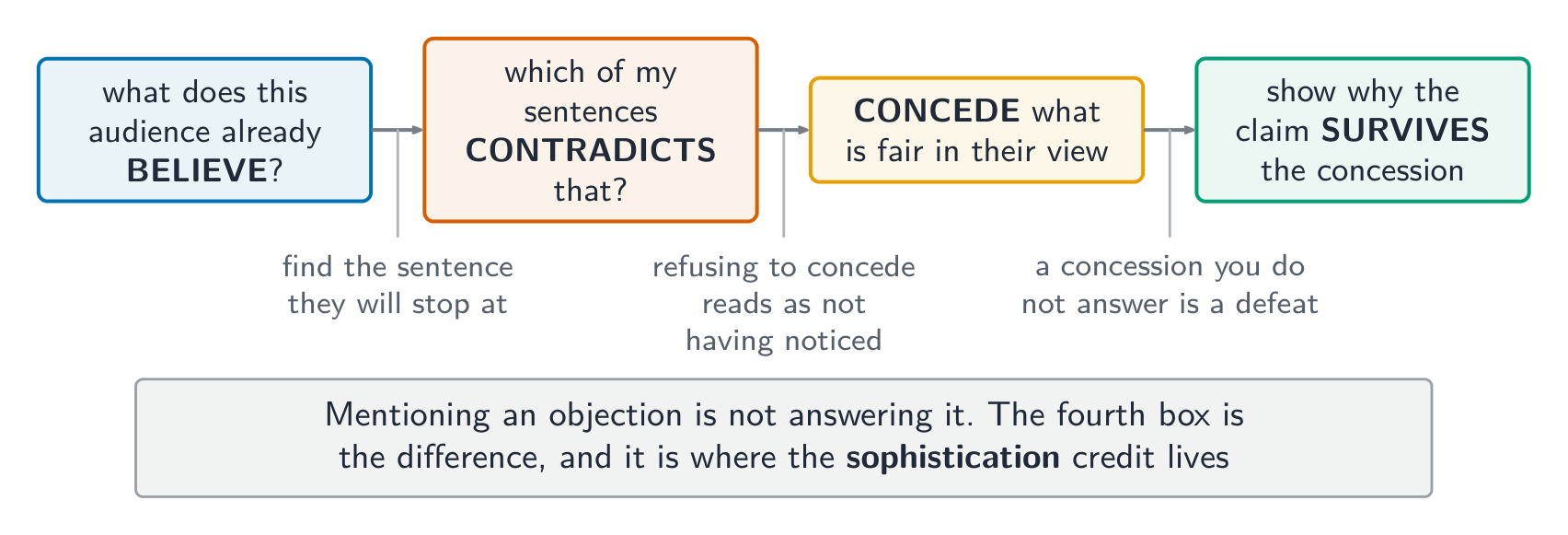
    就自己的写作而言,第三题最有力也最可靠的结构是:

    1. 表明你的立场,并限定到你的证据所覆盖的范围。
    2. 让步承认对立立场中确实正确的那一部分。
    3. 对其余部分反驳或驳倒——有另一种读法就反驳,有证明错误的证据才驳倒。
    4. 说明你的立场为何能在这一让步之后依然成立

    第四步是多数学生漏掉的一步,而思辨深度那一分正在这里。让步之后不回到自己的论证,读起来就像你改变了主意。

    Worked example(一道真实的 AP 考题)。在第三题论证题中,比较对同一项反对意见的两种处理。薄弱版本:*「有些人不同意,但他们错了。」这只是点出了一个对立立场却没有回应它——它既不是让步,也不是反驳,更不是驳倒。有力版本:「认为这项政策代价过高的反对意见,就其所及而言是正确的:直接支出确实高于所考虑的任何替代方案。但只有当替代方案能达成同样的结果时,成本才具有决定性,而同一份报告显示它们并不能——因此这项反对意见所依赖的那个比较根本不成立。」*这一段让步承认了成本,用证据驳倒了那个比较,并回到了写作者自己的立场。三个动作,而每一个都在评分标准上。

    9.2

    考试技巧

    • 让步、反驳、驳倒是三种不同的主张。不要把这些词混用。
    • **只有掌握证明错误的证据才驳倒。**没有就改为反驳——另一种解释几乎总是有的。
    • 按 CED 自己的说法,让步会提高可信度。它不是弱点。
    • 让步之后要回来。不回到自己立场的让步读起来就是同意对方。
    • 使用能为反驳排定位次的过渡:对此最有力的反对是胜过有些人说
    • 分析文本时,注意它在何时完全不处理反驳。这一缺席告诉你它是写给谁的。

登录或创建账号

IGCSE, A-Level & AP