跳到主要内容

论证线索与展开方法

AP 英语语言与写作 · 第 3 主题

训练
讲义 词汇表
3.1

识别主张与证据

大纲
Enduring UnderstandingLearning ObjectiveEssential Knowledge

CLE-1
Writers make claims about subjects, rely on evidence that supports the reasoning that justifies the claim, and often acknowledge or respond to other, possibly opposing, arguments.

3.A
Reading – Identify and explain claims and evidence within an argument.

  • CLE-1.K Effective use of evidence uses commentary to establish a logical relationship between the evidence and the claim it supports.
  • CLE-1.L Writers introduce source material by using commentary to properly integrate it into their line of reasoning.
  • CLE-1.M Synthesis requires consideration, explanation, and integration of others’ arguments into one’s own argument.
  • CLE-1.N Writers must acknowledge words, ideas, images, texts, and other intellectual property of others through attribution, citation, or reference.

来源:美国大学理事会 AP 课程与考试说明

第三单元是本课程从谈论"部件"转向谈论结构的地方。它的主题是推理线索(line of reasoning)——论证从起点通向所证之事的那条路径。

首先是关于证据如何被恰当纳入论证的四项论断:

  • 有效地使用证据,要靠评述(commentary)来确立证据与主张之间的逻辑关系
  • 写作者用评述来引入源材料,将其整合进自己的推理线索——因此评述既在证据之后,也在证据之前。
  • 综合(synthesis)要求对他人的论证加以考量、解释,并整合进自己的论证。这正是第一题所考查的能力,而整合这个词排除了那种逐一概括各来源的段落。
  • 写作者必须通过归属与引用(attribution and citation)承认他人的文字、观点、图像与文本。
词汇表 训练
英文 中文 拼音
line of reasoning 推理线索 tuī lǐ xiàn suǒ
commentary 评述 píng shù
Synthesis 综合 zōng hé
attribution and citation 归属与引用 guī shǔ yǔ yǐn yòng
Flaws in a line of reasoning may render an argument specious or illogical 似是而非 sì shì ér fēi
3.2

撰写含主张与证据的段落

大纲
Enduring UnderstandingLearning ObjectiveEssential Knowledge

CLE-1
Writers make claims about subjects, rely on evidence that supports the reasoning that justifies the claim, and often acknowledge or respond to other, possibly opposing, arguments.

4.A
Writing – Develop a paragraph that includes a claim and evidence supporting the claim.

  • CLE-1.K Effective use of evidence uses commentary to establish a logical relationship between the evidence and the claim it supports.
  • CLE-1.L Writers introduce source material by using commentary to properly integrate it into their line of reasoning.
  • CLE-1.M Synthesis requires consideration, explanation, and integration of others’ arguments into one’s own argument.
  • CLE-1.N Writers must acknowledge words, ideas, images, texts, and other intellectual property of others through attribution, citation, or reference.

来源:美国大学理事会 AP 课程与考试说明

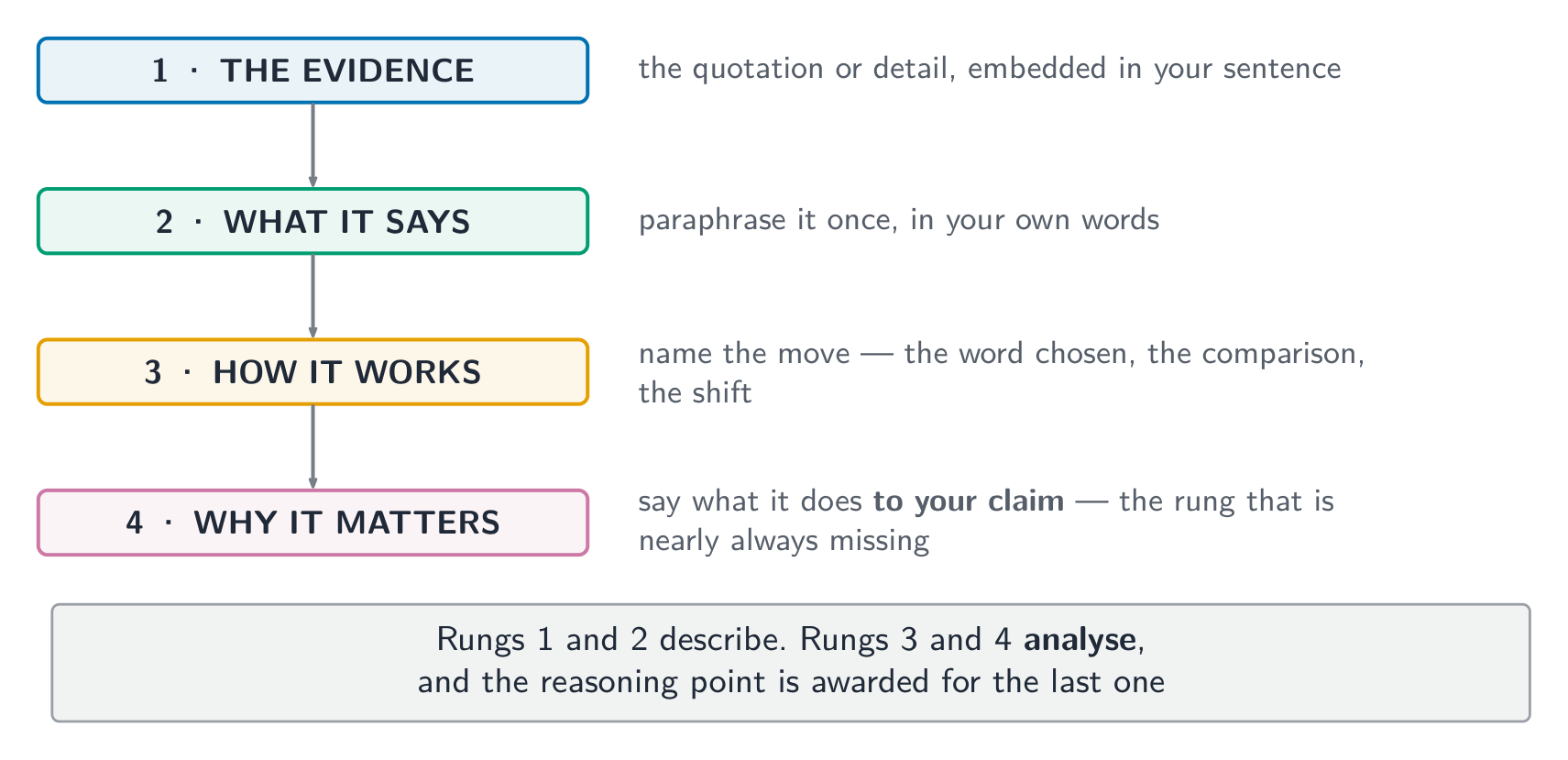
用于自己的写作时,相较第二单元的变化在于:评述现在有两项工作,而不是一项——把证据引入推理,并在其后解释这一关系。

两项都做到的段落读起来是:*主张——一句为证据定位的话——嵌入的证据——确立逻辑关系的评述——向下的衔接。*引文之前的那句话所做的工作,不亚于引文之后的那句;而多数学生两句都没写。

3.3

描述论证线索

大纲
Enduring UnderstandingLearning ObjectiveEssential Knowledge

REO-1
Writers guide understanding of a text’s lines of reasoning and claims through that text’s organization and integration of evidence.

5.A
Reading – Describe the line of reasoning and explain whether it supports an argument’s overarching thesis.

  • REO-1.A Writers may lead readers through a line of reasoning and then arrive at a thesis.
  • REO-1.B Writers may express a claim and then develop a line of reasoning to justify the claim.
  • REO-1.C Writers explain their reasoning through commentary that connects chosen evidence to a claim.
  • REO-1.D Commentary explains the significance and relevance of evidence in relation to the line of reasoning.
  • REO-1.E The sequence of paragraphs in a text reveals the argument’s line of reasoning.
  • REO-1.F Flaws in a line of reasoning may render an argument specious or illogical.

来源:美国大学理事会 AP 课程与考试说明

两种合法的顺序,一项共同要求——而这项要求就是评述
顺序是可以选择的;起连接作用的组织不是

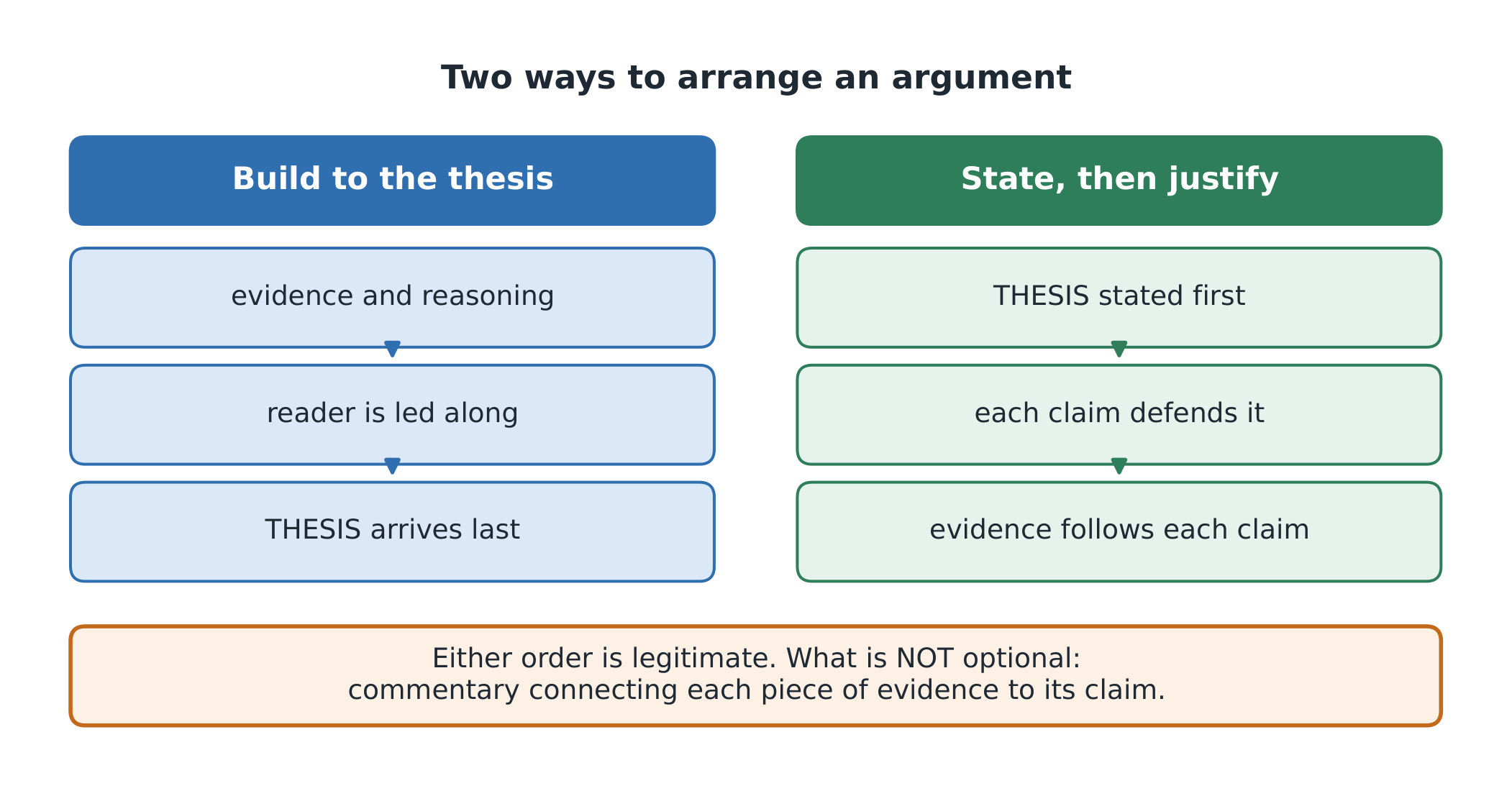
CED 允许两种安排,两者都有效:

  • 写作者可以引领读者沿一条推理线索前行,最后抵达论点——论证逐步导向其主张。
  • 写作者也可以先表述一项主张,再展开推理线索为之辩护——论证先宣告,再防守。

无论采用哪种顺序,同样的要求都成立:

  • 写作者通过把所选证据与主张连接起来的评述来解释自己的推理。
  • 评述要说明证据相对于推理线索的重要性与相关性
  • 文本中段落的先后顺序显示了论证的推理线索——这是阅读时的实用工具。要找出写作者的推理,给每一段写一句概括,再把这份清单读一遍。
  • 推理线索中的缺陷会使论证变得似是而非(specious)或不合逻辑
3.4

构建论证线索与评述

大纲
Enduring UnderstandingLearning ObjectiveEssential Knowledge

REO-1
Writers guide understanding of a text’s lines of reasoning and claims through that text’s organization and integration of evidence.

6.A
Writing – Develop a line of reasoning and commentary that explains it throughout an argument.

  • REO-1.A Writers may lead readers through a line of reasoning and then arrive at a thesis.
  • REO-1.B Writers may express a claim and then develop a line of reasoning to justify the claim.
  • REO-1.C Writers explain their reasoning through commentary that connects chosen evidence to a claim.
  • REO-1.D Commentary explains the significance and relevance of evidence in relation to the line of reasoning.
  • REO-1.E The sequence of paragraphs in a text reveals the argument’s line of reasoning.
  • REO-1.F Flaws in a line of reasoning may render an argument specious or illogical.

来源:美国大学理事会 AP 课程与考试说明

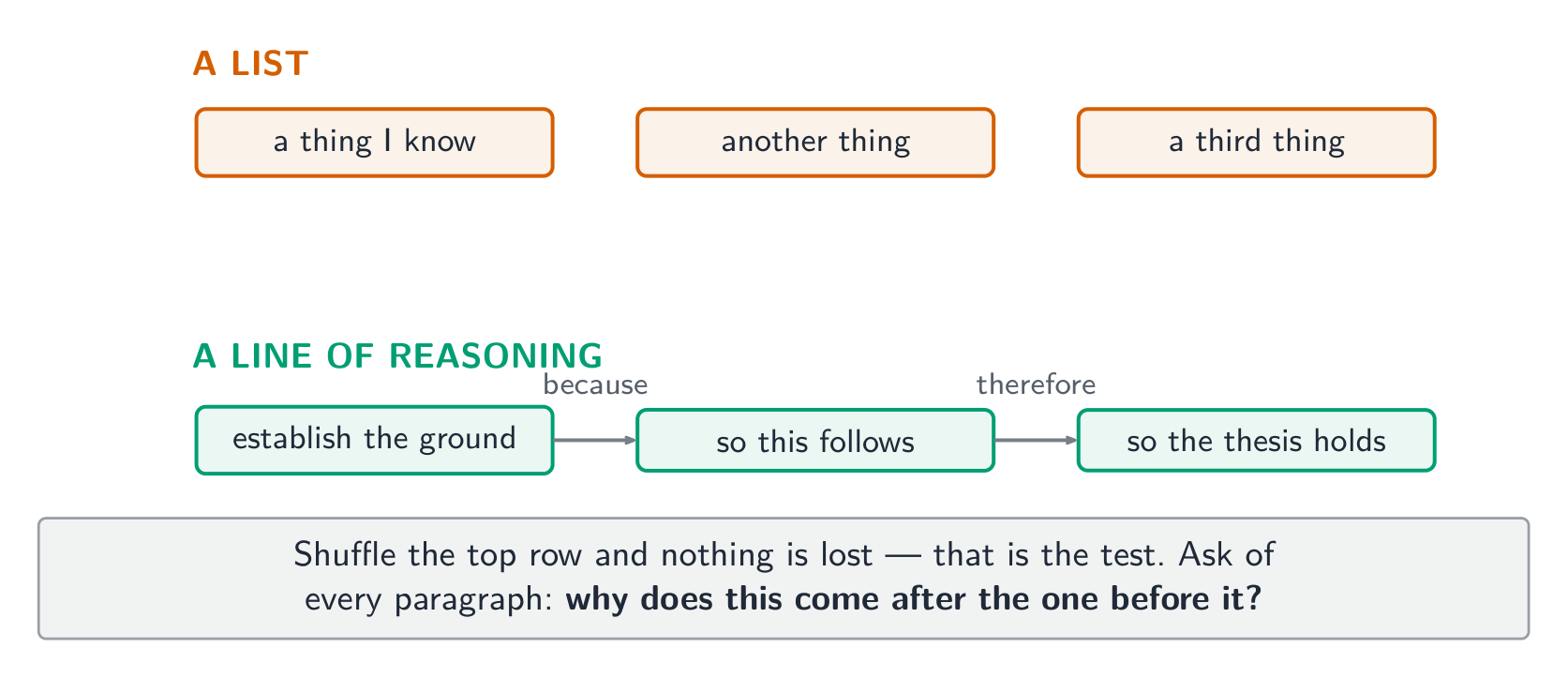
就自己的文章而言,有用的纪律是在动笔写任何一项主张之前先定下各项主张的顺序。一篇段落可以随意调换而不损失什么的文章,没有推理线索——它只有一份清单。

检验草稿的办法是对每一段问:*这一段为什么排在上一段之后?*如果唯一的答案是"这是我知道的关于这个题目的另一件事",那么结构就是清单,推理这一分就有风险。

3.5

识别展开方法

大纲
Enduring UnderstandingLearning ObjectiveEssential Knowledge

REO-1
Writers guide understanding of a text’s lines of reasoning and claims through that text’s organization and integration of evidence.

5.C
Reading – Recognize and explain the use of methods of development to accomplish a purpose.

  • REO-1.G Methods of development are common approaches writers frequently use to develop and organize the reasoning of their arguments. A method of development provides an audience with the means to trace a writer’s reasoning in an argument.
  • REO-1.H Some typical methods of development are narration, cause-effect, comparison-contrast, definition, and description.
  • REO-1.I When developing ideas through narration, writers offer details about real-life experiences and offer reflections and insights on the significance of those experiences.
  • REO-1.J When developing ideas through cause-effect, writers present a cause, assert effects or consequences of that cause, or present a series of causes and the subsequent effect(s).

来源:美国大学理事会 AP 课程与考试说明

展开方法(methods of development)是写作者用来展开并组织论证推理的常见路数。CED 的清单是:叙述、因果、比较对照、下定义与描写。本单元处理前两种。

  • 通过叙述(narration)展开:写作者提供关于真实生活经验的细节,并对其作出反思。反思正是使叙述成为论证而非故事的东西——一个没有反思的轶事并没有提供任何推理。
  • 通过因果(cause-effect)展开:写作者先给出一个原因,再断言该原因的效果或后果——或者从一个结果出发反向追溯。
词汇表 训练
英文 中文 拼音
Methods of development 展开方法 zhǎn kāi fāng fǎ
narration 叙述 xù shù
cause-effect 因果 yīn guǒ
3.6

运用展开方法

大纲
Enduring UnderstandingLearning ObjectiveEssential Knowledge

REO-1
Writers guide understanding of a text’s lines of reasoning and claims through that text’s organization and integration of evidence.

6.C
Writing – Use appropriate methods of development to advance an argument.

  • REO-1.G Methods of development are common approaches writers frequently use to develop and organize the reasoning of their arguments. A method of development provides an audience with the means to trace a writer’s reasoning in an argument.
  • REO-1.H Some typical methods of development are narration, cause-effect, comparison-contrast, definition, and description.
  • REO-1.I When developing ideas through narration, writers offer details about real-life experiences and offer reflections and insights on the significance of those experiences.
  • REO-1.J When developing ideas through cause-effect, writers present a cause, assert effects or consequences of that cause, or present a series of causes and the subsequent effect(s).

来源:美国大学理事会 AP 课程与考试说明

选择方法是一项修辞决策,而非文体决策。当受众需要先感受某个情境才会接受关于它的主张时,叙述有效。当受众已经接受各项事实、却不接受它们之间的联系时,因果有效。

Worked example(一项真实的 AP 考试任务)。在第一题综合写作中,比较使用同样两个来源的两个段落。薄弱版本:*「来源 A 说 X。来源 C 说 Y。两者都讨论了这一议题。」这是按顺序作概括——没有主张,没有整合,没有推理。有力版本:「针对该提案最有力的反对意见,不是它失败了,而是它成功得过于狭窄:来源 A 的数据显示预期成果在改善,而来源 C 对同一项目的记述则记录了来源 A 的测量方式从未设计去捕捉的二阶成本。」*这里各来源被整合进写作者自己的主张,评述确立了逻辑关系——这正是"证据与评述"四分所奖励的东西。

3.6

考试技巧

  • 评述有两项工作:把证据引入推理,以及其后解释这一关系。两句都要写。
  • 综合意味着整合,而不是按顺序作概括。一段写一个来源是典型的低分形态。
  • 要找出写作者的推理线索,给每一段写一句概括,再读这份清单。
  • 对自己的段落要问:*这一段为什么跟在那一段之后?*答不上来就说明没有推理线索。
  • **叙述需要反思。**没有反思的轶事只是讲了个故事,没有作出论证。
  • 出于修辞理由选择展开方法,并且要能说出这个理由是什么。

本主题的互动课程

逐步学习,并即时检测练习。

AP 英语语言与写作的更多主题

登录或创建账号

IGCSE, A-Level & AP