跳到主要内容

受众、论点与支撑证据

AP 英语语言与写作 · 第 2 主题

训练
讲义 词汇表
2.1

理解受众的信念与需求

大纲
Enduring UnderstandingLearning ObjectiveEssential Knowledge

RHS-1
Individuals write within a particular situation and make strategic writing choices based on that situation.

1.B
Reading – Explain how an argument demonstrates understanding of an audience’s beliefs, values, or needs.

  • RHS-1.F Writers’ perceptions of an audience’s values, beliefs, needs, and background guide the choices they make.
  • RHS-1.G To achieve a purpose, writers make choices in an attempt to relate to an intended audience’s emotions and values.
  • RHS-1.H Arguments seek to persuade or motivate action through appeals—the modes of persuasion.

来源:美国大学理事会 AP 课程与考试说明

第一单元确立了文本有其受众。第二单元则把受众变成写作者一切选择的发动机。

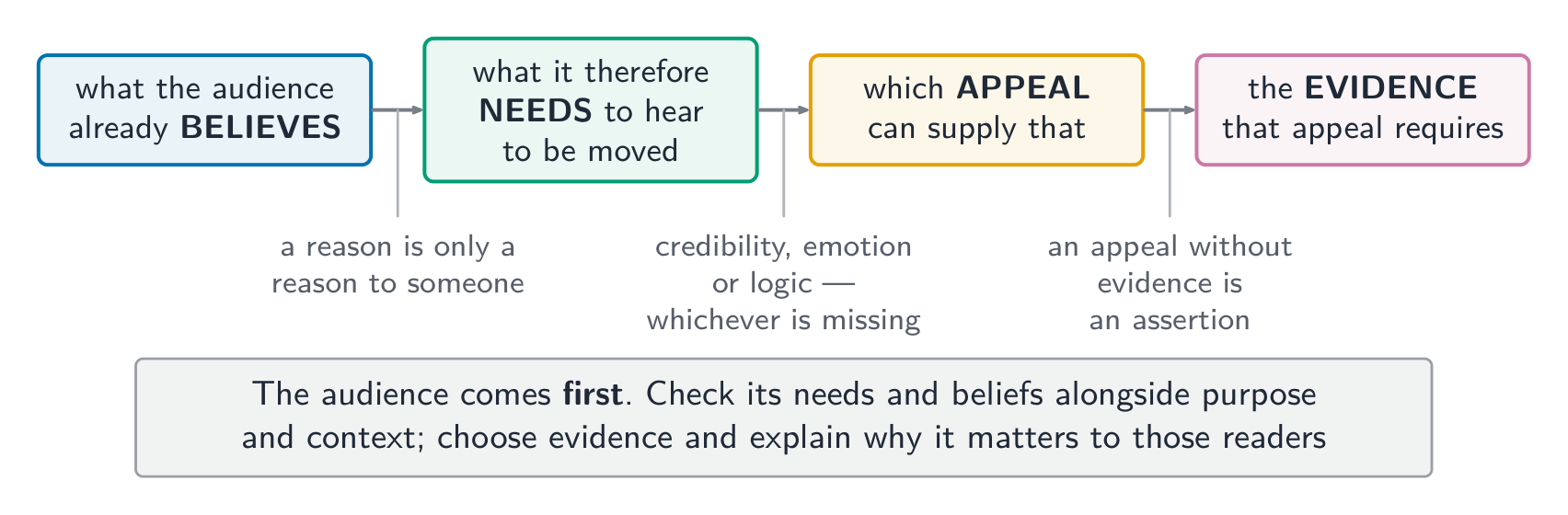
  • **写作者对受众之价值、信念、需求与背景的认知,引导着他们所作的选择。**要注意认知这个词:引导写作的是写作者心中的受众图像,而它可能准确,也可能不准确。
  • 为达成目的,写作者所作的选择意在与目标受众的情感与价值观(emotions and values)建立联系
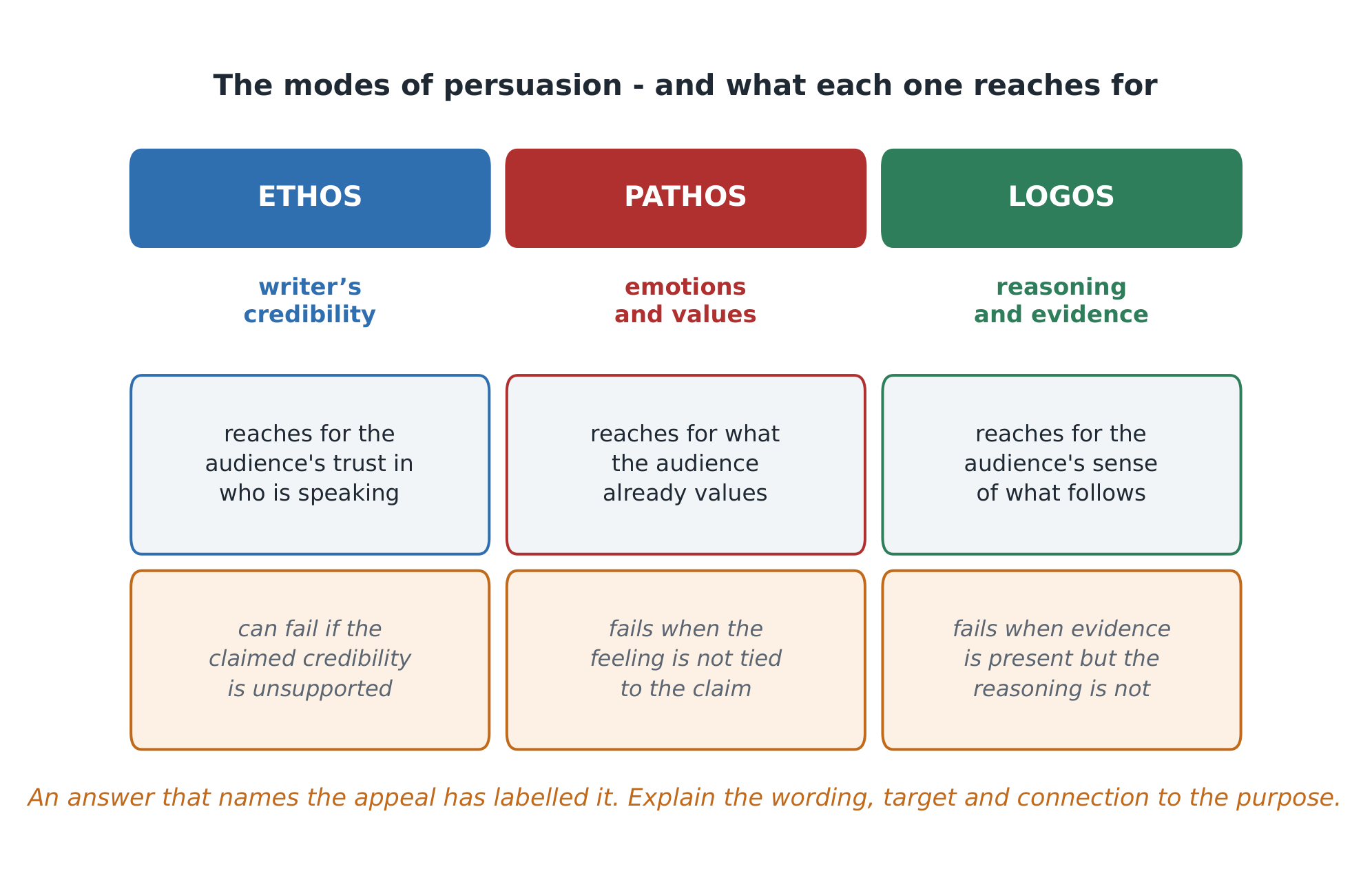
  • 论证通过诉求(appeals)——即说服方式(modes of persuasion)——来说服或促使行动。
每种诉求各自伸向受众身上不同的东西——而每一种也各有其失败的方式
单是点出诉求的名称毫无价值;点出它伸向什么才是分析
词汇表 训练
英文 中文 拼音
relate to an intended audience's emotions and values 情感与价值观 qíng gǎn yǔ jià zhí guān
appeals 诉求 sù qiú
modes of persuasion 说服方式 shuō fú fāng shì
2.2

针对受众的信念与需求写作

大纲
Enduring UnderstandingLearning ObjectiveEssential Knowledge

RHS-1
Individuals write within a particular situation and make strategic writing choices based on that situation.

2.B
Writing – Demonstrate an understanding of an audience’s beliefs, values, or needs.

  • RHS-1.F Writers’ perceptions of an audience’s values, beliefs, needs, and background guide the choices they make.
  • RHS-1.G To achieve a purpose, writers make choices in an attempt to relate to an intended audience’s emotions and values.
  • RHS-1.H Arguments seek to persuade or motivate action through appeals—the modes of persuasion.

来源:美国大学理事会 AP 课程与考试说明

同样这三句话,现在变成了写作指令。动笔之前先决定:

  • 关于这一主题,这个受众已经相信什么?
  • 他们需要什么——信息、安心,还是行动的理由?
  • 他们看重什么,而其中哪些价值可以诚实地与我的立场连接起来?

忽略这些的论证,写出来的东西不是写给任何人的。而 CED 的这一表述也给了你一个检验自己草稿的好办法:如果这一段换成完全不同的受众读起来一模一样,那它就没有为任何受众塑形。

2.3

识别主张与证据

大纲
Enduring UnderstandingLearning ObjectiveEssential Knowledge

CLE-1
Writers make claims about subjects, rely on evidence that supports the reasoning that justifies the claim, and often acknowledge or respond to other, possibly opposing, arguments.

3.A
Reading – Identify and explain claims and evidence within an argument.

  • CLE-1.F Writers use evidence strategically and purposefully to illustrate, clarify, set a mood, exemplify, associate, or amplify a point.
  • CLE-1.G Strategically selected evidence strengthens the validity and reasoning of the argument, relates to an audience’s emotions and values, and increases a writer’s credibility.
  • CLE-1.H An effective argument contains sufficient evidence; evidence is sufficient when its quantity and quality provide apt support for the argument.

来源:美国大学理事会 AP 课程与考试说明

第二单元以三项关于证据如何起作用的论断,深化了第一单元对证据的处理:

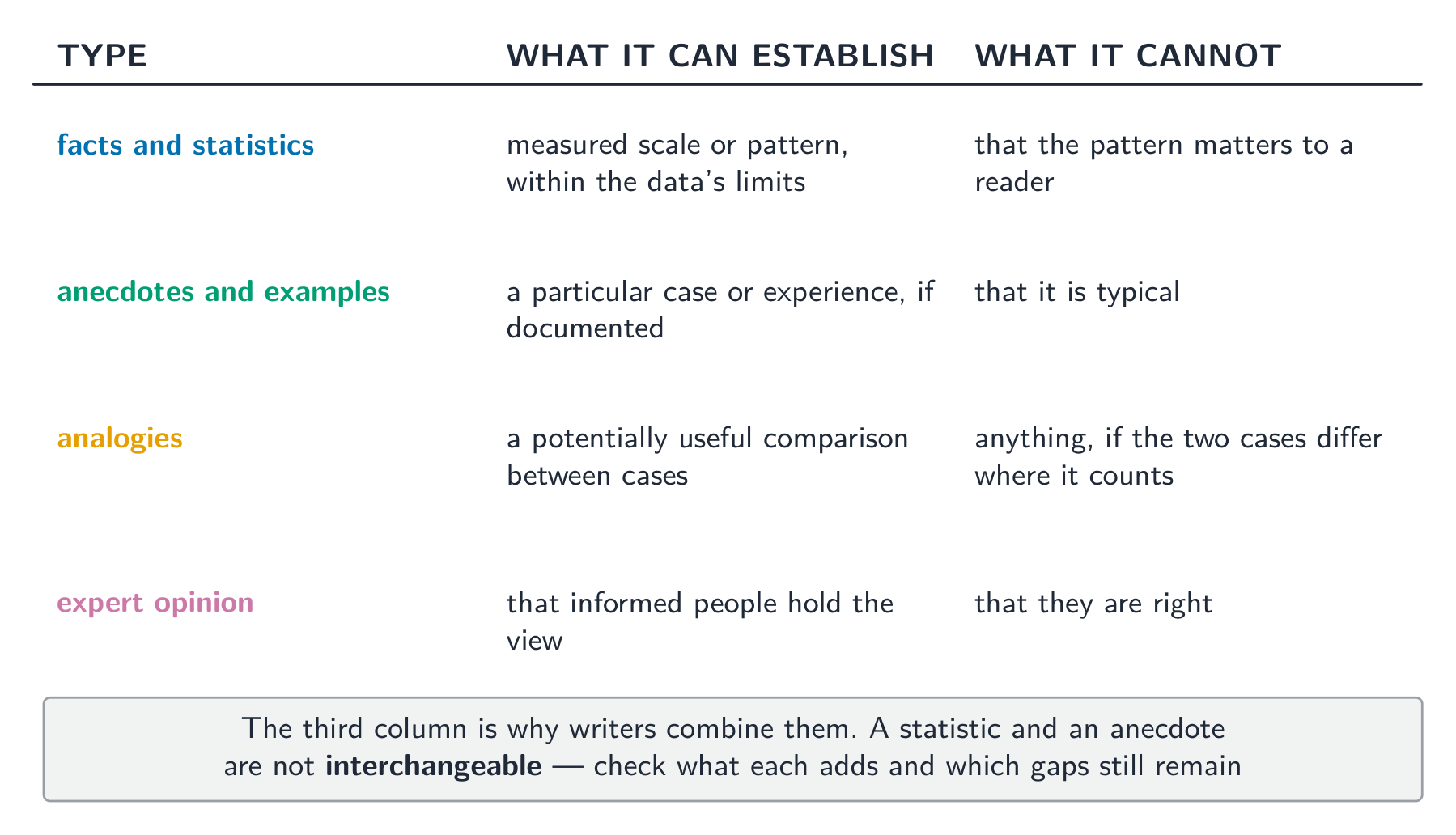
  • 写作者有策略、有目的地使用证据来举例、澄清、营造氛围、示范、关联或放大(illustrate, clarify, set a mood, exemplify, associate, or amplify)。证据在做一件工作,而点出这件工作就是分析。
  • 经策略性选取的证据能增强论证的有效性与推理,与受众的情感与价值观相关联,并有助于确立写作者的可信度(credibility)。
  • 有效的论证包含充分的证据(sufficient evidence)——当其数量与质量为推理线索提供了恰当支撑时,证据即为充分。

第三点常被误读为"越多越好"。充分性是数量质量的合力:三条直接切中主张的证据,胜过六条只是擦边的证据。

词汇表 训练
英文 中文 拼音
illustrate, clarify, set a mood, exemplify, associate, or amplify 举例、澄清、营造氛围、示范、关联或放大 jǔ lì 、 chéng qīng 、 yíng zào fēn wéi 、 shì fàn 、 guān lián huò fàng dà
credibility 可信度 kě xìn dù
sufficient evidence 充分的证据 chōng fèn de zhèng jù
2.4

撰写含主张与证据的段落

大纲
Enduring UnderstandingLearning ObjectiveEssential Knowledge

CLE-1
Writers make claims about subjects, rely on evidence that supports the reasoning that justifies the claim, and often acknowledge or respond to other, possibly opposing, arguments.

4.A
Writing – Develop a paragraph that includes a claim and evidence supporting the claim.

  • CLE-1.F Writers use evidence strategically and purposefully to illustrate, clarify, set a mood, exemplify, associate, or amplify a point.
  • CLE-1.G Strategically selected evidence strengthens the validity and reasoning of the argument, relates to an audience’s emotions and values, and increases a writer’s credibility.
  • CLE-1.H An effective argument contains sufficient evidence; evidence is sufficient when its quantity and quality provide apt support for the argument.

来源:美国大学理事会 AP 课程与考试说明

把上述内容用于自己的写作,就是要为每一条证据的选取给出理由。实际操作中,这意味着你要能把这句话补完:我用这一条,是因为它……

  • ……把一项否则会停留在抽象层面的主张具体化;
  • ……在读者可能存疑的主题上确立我的可信度;
  • ……把我的立场与受众已经持有的某项价值连接起来。

以这种方式选出的证据几乎会自动产生评述,因为你已经知道这条证据在做什么。而因为"手边有"而选出的证据,产生的是本该写评述的那块空白。

2.5

识别总体论点

大纲
Enduring UnderstandingLearning ObjectiveEssential Knowledge

CLE-1
Writers make claims about subjects, rely on evidence that supports the reasoning that justifies the claim, and often acknowledge or respond to other, possibly opposing, arguments.

3.B
Reading – Identify and describe the overarching thesis of an argument, and any indication it provides of the argument’s structure.

  • CLE-1.I A thesis is the main, overarching claim a writer is seeking to defend or prove by using reasoning supported by evidence.
  • CLE-1.J A writer’s thesis is not necessarily a single sentence or an explicit statement and may require a thorough reading of the text to identify, but when a thesis is directly expressed, it is called a thesis statement. [Note: While the texts you assign your students to analyze may not always contain obvious thesis statements, they should each have a thesis. It can be good practice for students to write a thesis statement for such texts. On the AP Exam, a clear communication of the thesis is required in students’ essays.]

来源:美国大学理事会 AP 课程与考试说明

  • 论点(thesis)是写作者试图以证据支撑的推理来辩护或证明的主要的、统领性的主张
  • 写作者的论点未必是单独一句话或明确的陈述,可能需要通读全文才能识别。

第二点对考试的阅读部分很重要。在一篇修辞分析的选文中,论点可能分散于全文,或由结构暗示。不要因为你自己会把论点放在第二段第一句,就假定那里就是它的论点。

词汇表 训练
英文 中文 拼音
thesis 论点 lùn diǎn
2.6

撰写论点句

大纲
Enduring UnderstandingLearning ObjectiveEssential Knowledge

CLE-1
Writers make claims about subjects, rely on evidence that supports the reasoning that justifies the claim, and often acknowledge or respond to other, possibly opposing, arguments.

4.B
Writing – Write a thesis statement that requires proof or defense and that may preview the structure of the argument.

  • CLE-1.I A thesis is the main, overarching claim a writer is seeking to defend or prove by using reasoning supported by evidence.
  • CLE-1.J A writer’s thesis is not necessarily a single sentence or an explicit statement and may require a thorough reading of the text to identify, but when a thesis is directly expressed, it is called a thesis statement. [Note: While the texts you assign your students to analyze may not always contain obvious thesis statements, they should each have a thesis. It can be good practice for students to write a thesis statement for such texts. On the AP Exam, a clear communication of the thesis is required in students’ essays.]

来源:美国大学理事会 AP 课程与考试说明

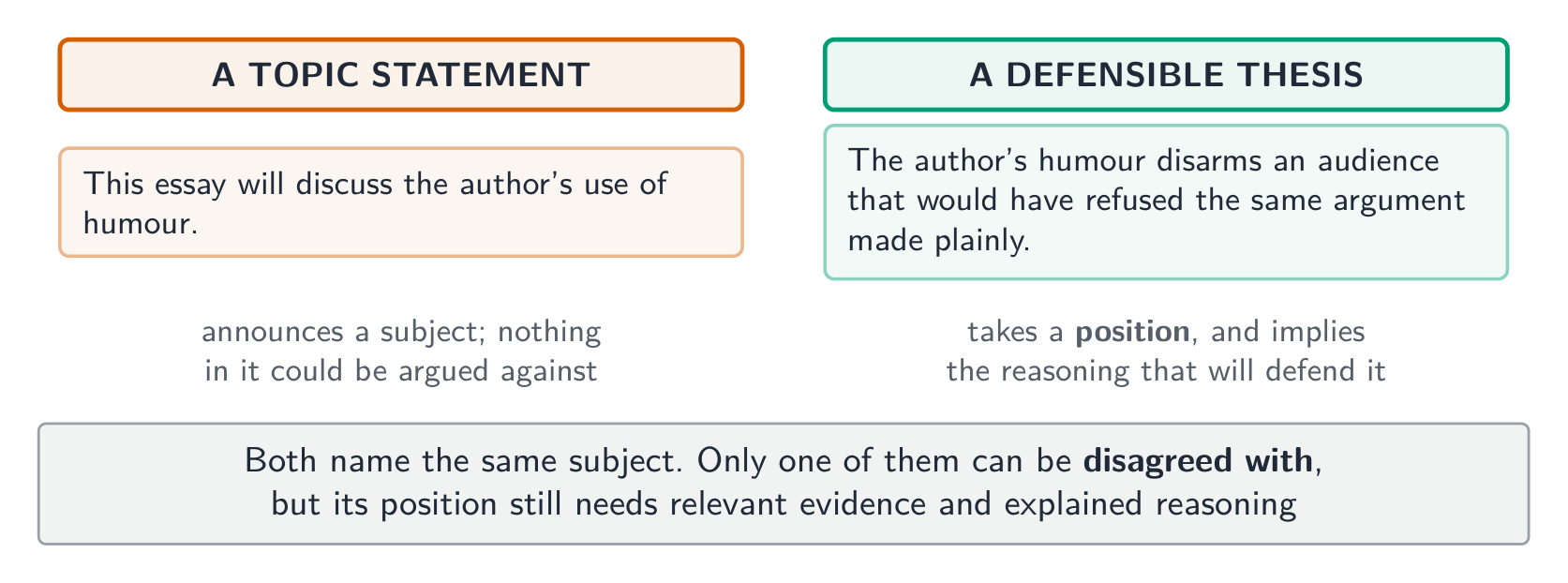
写作目标是精确的:写出一句需要证明或辩护、并可预示论证结构的论点陈述

这句话里含着两项彼此独立的要求:

  • 它必须需要辩护。再次运用第一单元的检验:一个通情达理的人会不会不同意?陈述事实的论点无法被辩护,只能被重复。
  • 可以预示结构——这是可选的,但很有用,因为点明将要展开哪些推理线索的论点,会赋予整篇文章形状。

在考试中,论点这一分是六分之一,也是评分标准上最容易拿到的一分:针对题目给出一个可辩护的论点即可得分。把题目复述一遍则不能。

**Worked example(一项真实的 AP 考试任务)。**面对第三题要求你就某项拟议做法的价值表明立场,比较两个开头。「围绕这一做法,支持与反对的论点都有很多。」——这得不到分,因为没有人会不同意。「由于这一做法奖励的是看得见的努力而非真实的进步,它制造出进步的表象,同时抽走了追求进步的动力。」——这能得分:它可辩护、具体,并预示了文章将要展开的推理。

2.6

考试技巧

  • 受众驱动一切。如果一段文字换给任何受众读起来都一样,它就没有为受众塑形。
  • 点出证据在做什么——举例、澄清、关联、放大。这才是分析;罗列证据不是。
  • 充分性是数量与质量,而不是分量。三条切中的胜过六条松散的。
  • 选文中的论点可能是隐含的或分散的。通读全文再作判断。
  • 你自己的论点必须可辩护。复述题目在六分中一分也拿不到。
  • 在论点中预示推理线索是可选的,但会让文章其余部分更好组织。

本主题的互动课程

逐步学习,并即时检测练习。

AP 英语语言与写作的更多主题

登录或创建账号

IGCSE, A-Level & AP