跳到主要内容

引言、结论与展开

AP 英语语言与写作 · 第 4 主题

训练
讲义 词汇表
4.1

修辞情境的构成要素

大纲
Enduring UnderstandingLearning ObjectiveEssential Knowledge

RHS-1
Individuals write within a particular situation and make strategic writing choices based on that situation.

1.A
Reading – Identify and describe components of the rhetorical situation: the exigence, audience, writer, purpose, context, and message.

  • RHS-1.I The introduction of an argument introduces the subject and/ or writer of the argument to the audience. An introduction may present the argument’s thesis. An introduction may orient, engage, and/or focus the audience by presenting quotations, intriguing statements, anecdotes, questions, statistics, data, contextualized information, or a scenario.
  • RHS-1.J The conclusion of an argument brings the argument to a unified end. A conclusion may present the argument’s thesis. It may engage and/or focus the audience by explaining the significance of the argument within a broader context, making connections, calling the audience to act, suggesting a change in behavior or attitude, proposing a solution, leaving the audience with a compelling image, explaining implications, summarizing the argument, or connecting to the introduction.

来源:美国大学理事会 AP 课程与考试说明

第四单元处理文本中写作者选择最为显眼的两个位置——开头与结尾——并补全 CED 关于展开方法的清单。

  • 论证的引言(introduction)向受众介绍主题与/或写作者。它可以为读者定向、确立促因与语境,并吸引注意。
  • 结论(conclusion)把论证带向统一的收束。它可以呈现论证的论点、说明其重要性,或把论证置于更广阔的语境中。

要注意第二句中的那个词:统一。结论不是概括;它是各部分被显示为同一个论证的那一刻。

词汇表 训练
英文 中文 拼音
introduction 引言 yǐn yán
conclusion 结论 jié lùn
4.2

撰写引言与结论

大纲
Enduring UnderstandingLearning ObjectiveEssential Knowledge

RHS-1
Individuals write within a particular situation and make strategic writing choices based on that situation.

2.A
Writing – Write introductions and conclusions appropriate to the purpose and context of the rhetorical situation.

  • RHS-1.I The introduction of an argument introduces the subject and/ or writer of the argument to the audience. An introduction may present the argument’s thesis. An introduction may orient, engage, and/or focus the audience by presenting quotations, intriguing statements, anecdotes, questions, statistics, data, contextualized information, or a scenario.
  • RHS-1.J The conclusion of an argument brings the argument to a unified end. A conclusion may present the argument’s thesis. It may engage and/or focus the audience by explaining the significance of the argument within a broader context, making connections, calling the audience to act, suggesting a change in behavior or attitude, proposing a solution, leaving the audience with a compelling image, explaining implications, summarizing the argument, or connecting to the introduction.

来源:美国大学理事会 AP 课程与考试说明

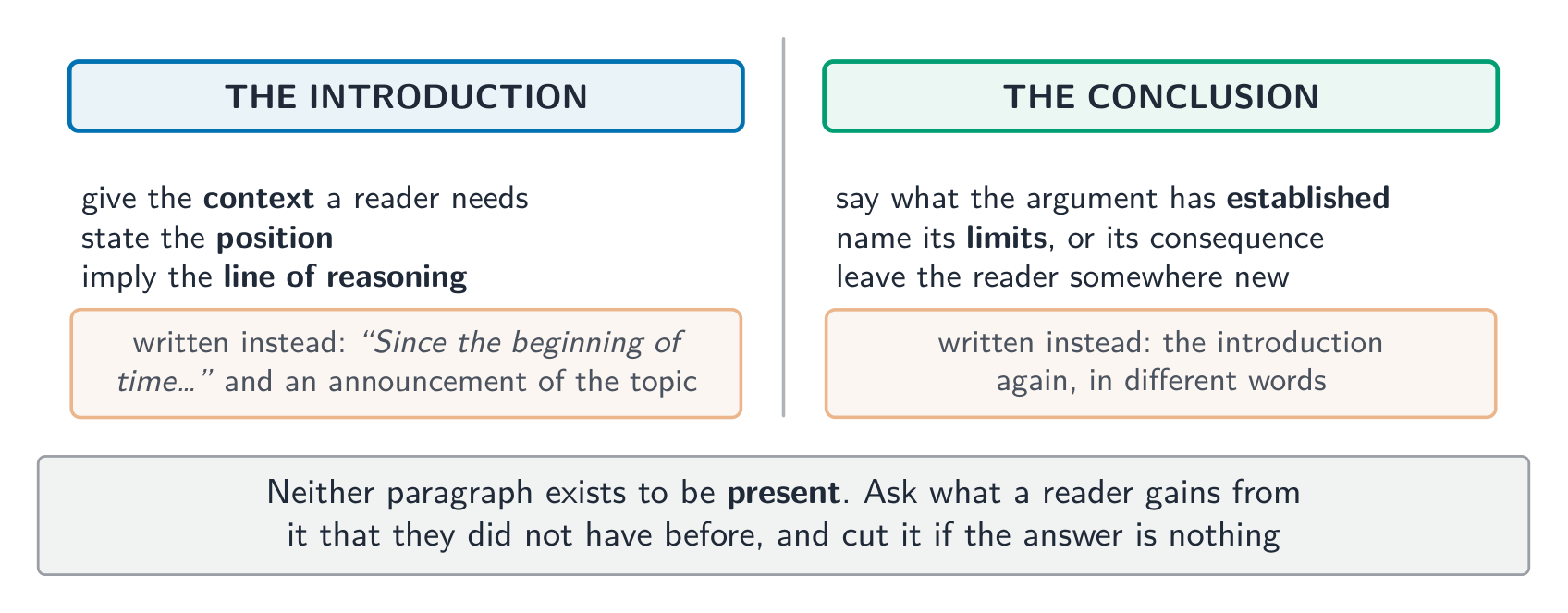
在考试中,两者都值得写好,但都不值得写长。一条有用的纪律:

  • 用两三句话为主题定位并陈述一个可辩护的论点的引言就是完整的。在限时写作中,其余的一切都更适合花在证据与评述上。
  • 说出论证由此推出什么——它的重要性,或更广的含义——的结论,比复述各段的结论做得更多。

最弱的结论是把文章已经说过的内容再列一遍。读者刚刚读过。要说的是它意味着什么,或者它要求什么。

4.3

识别总体论点

大纲
Enduring UnderstandingLearning ObjectiveEssential Knowledge

CLE-1
Writers make claims about subjects, rely on evidence that supports the reasoning that justifies the claim, and often acknowledge or respond to other, possibly opposing, arguments.

3.B
Reading – Identify and describe the overarching thesis of an argument, and any indication it provides of the argument’s structure.

  • CLE-1.O A thesis statement may preview the line of reasoning of an argument. This is not to say that a thesis statement must list the points of an argument, aspects to be analyzed, or specific evidence to be used in an argument.

来源:美国大学理事会 AP 课程与考试说明

CED 在这里加了一条精确的补充:论点陈述可以预示论证的推理线索——紧接着又说,这并不是说论点陈述必须罗列理由。

这一双重表述值得记住,因为两种错误都很常见。什么也不预示的论点会让文章失去形状。机械罗列三条理由的论点并非必需,而且常常写出一篇僵硬、无法展开的文章。

4.4

撰写论点句

大纲
Enduring UnderstandingLearning ObjectiveEssential Knowledge

CLE-1
Writers make claims about subjects, rely on evidence that supports the reasoning that justifies the claim, and often acknowledge or respond to other, possibly opposing, arguments.

4.B
Writing – Write a thesis statement that requires proof or defense and that may preview the structure of the argument.

  • CLE-1.O A thesis statement may preview the line of reasoning of an argument. This is not to say that a thesis statement must list the points of an argument, aspects to be analyzed, or specific evidence to be used in an argument.

来源:美国大学理事会 AP 课程与考试说明

用于自己的写作,其实用版本是:

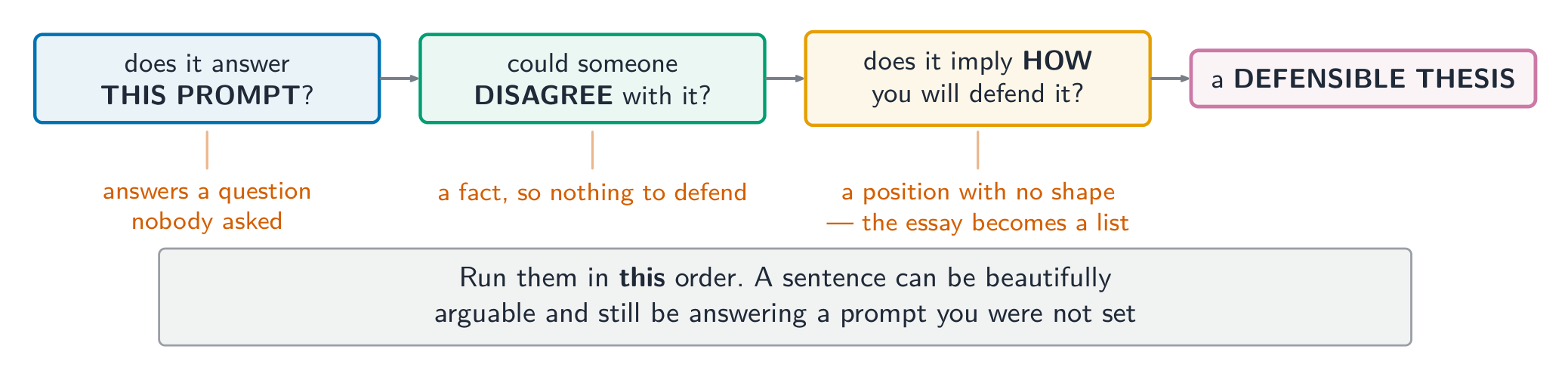
  • 论点必须可辩护。这一点没有商量余地,而它就是论点那一分的全部。
  • 可以指出推理的形状。当这一形状确实起结构作用时就这么做;不要把它当作套路。
  • 它应当具体到足以约束后文。宽泛到任何一段都能归入其下的论点,并没有在指挥这篇文章。
4.5

识别展开方法

大纲
Enduring UnderstandingLearning ObjectiveEssential Knowledge

REO-1
Writers guide understanding of a text’s lines of reasoning and claims through that text’s organization and integration of evidence.

5.C
Reading – Recognize and explain the use of methods of development to accomplish a purpose.

  • REO-1.G Methods of development are common approaches writers frequently use to develop and organize the reasoning of their arguments. A method of development provides an audience with the means to trace a writer’s reasoning in an argument.
  • REO-1.K When developing ideas through comparison-contrast, writers present a category of comparison and then examine the similarities and/or differences between the objects of the comparison. When analyzing similarities and/or differences, like categories of comparison must be used.
  • REO-1.L When developing ideas through a definition or description, writers relate the characteristics, features, or sensory details of an object or idea, sometimes using examples or illustrations.

来源:美国大学理事会 AP 课程与考试说明

五种方法,以及每一种适合做的工作
选择推理所需要的方法,而不是题目所暗示的方法

第三单元讲了叙述与因果。第四单元补上其余:

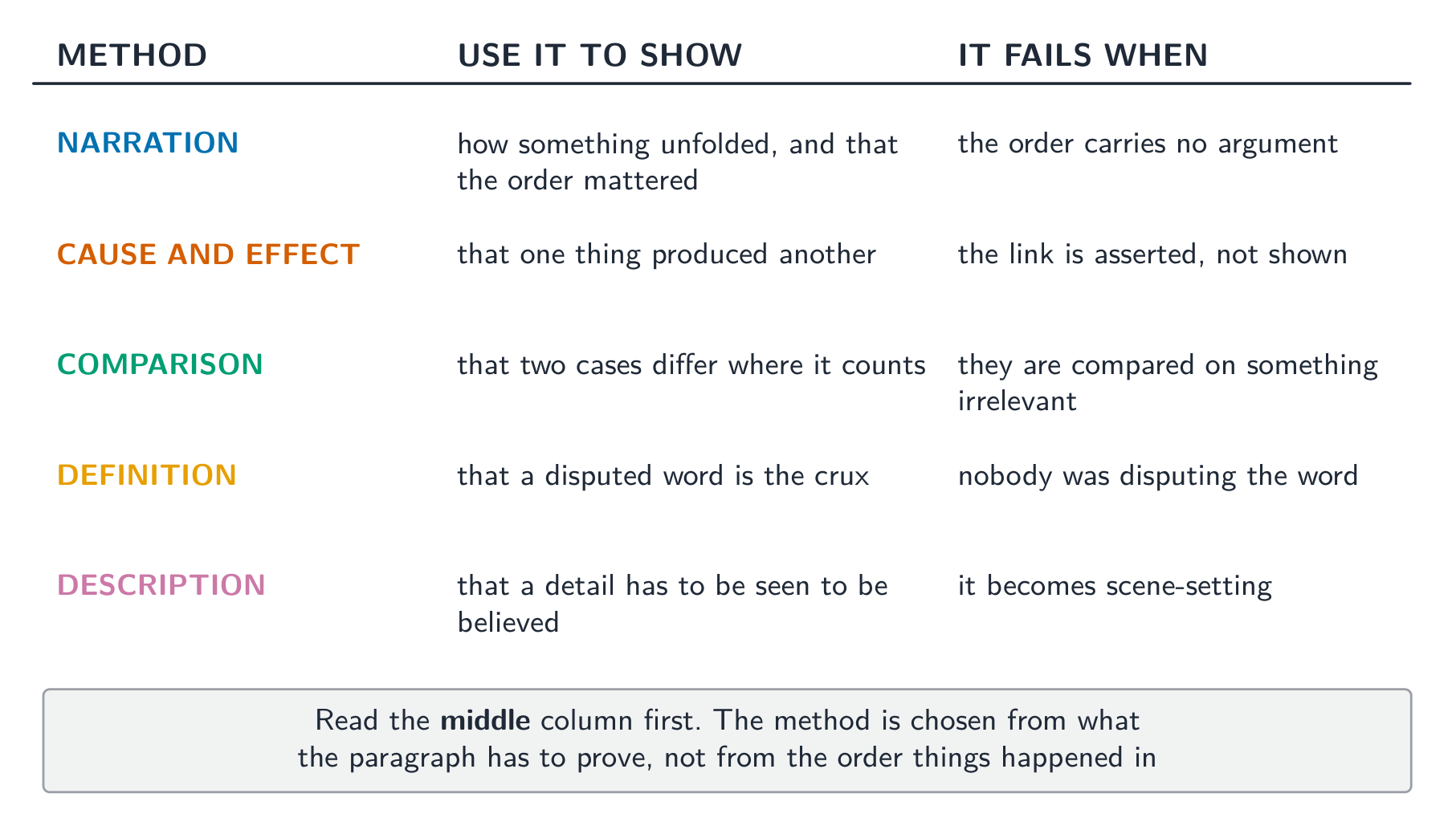
  • 通过比较对照(comparison-contrast)展开:写作者先确立一个比较的范畴,再在其中考察相似与差异。学生会漏掉的正是那个范畴——没有说明比较基础的对照,只是两段并排的描写。
  • 通过下定义或描写(definition or description)展开:写作者陈述对象的特征与感官细节(characteristics, features, or sensory details)。

下定义比它看上去更有力量。一场取决于某个词含义的论证——什么才算成功、算公平、算进步——是一场已经被移到真正可以决胜之地的论证。

词汇表 训练
英文 中文 拼音
comparison-contrast 比较对照 bǐ jiào duì zhào
definition or description 定义与描写 dìng yì yǔ miáo xiě
characteristics, features, or sensory details 特征与感官细节 tè zhēng yǔ gǎn guān xì jié
4.6

运用展开方法

大纲
Enduring UnderstandingLearning ObjectiveEssential Knowledge

REO-1
Writers guide understanding of a text’s lines of reasoning and claims through that text’s organization and integration of evidence.

6.C
Writing – Use appropriate methods of development to advance an argument.

  • REO-1.G Methods of development are common approaches writers frequently use to develop and organize the reasoning of their arguments. A method of development provides an audience with the means to trace a writer’s reasoning in an argument.
  • REO-1.K When developing ideas through comparison-contrast, writers present a category of comparison and then examine the similarities and/or differences between the objects of the comparison. When analyzing similarities and/or differences, like categories of comparison must be used.
  • REO-1.L When developing ideas through a definition or description, writers relate the characteristics, features, or sensory details of an object or idea, sometimes using examples or illustrations.

来源:美国大学理事会 AP 课程与考试说明

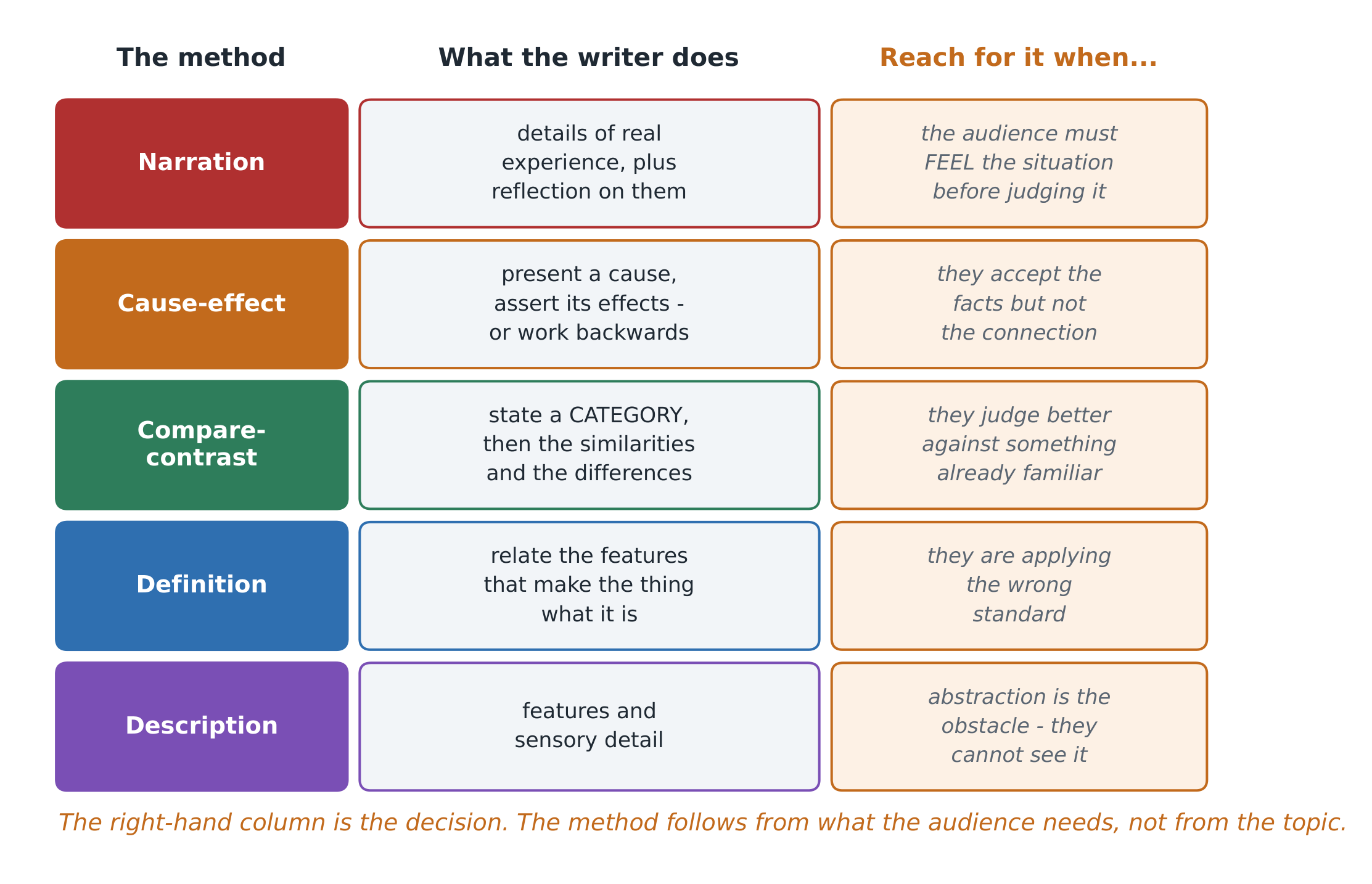
这一选择是修辞性的。要问的是:受众在接受你的主张之前需要什么?

  • 他们需要看见它,而障碍在于抽象:用描写
  • 他们接受事实,却不接受其间的联系:用因果
  • 他们在套用错误的标准:用下定义
  • 参照熟悉之物他们能判断得更好:用比较对照
  • 他们需要感受那个情境:用叙述

Worked example(一项真实的 AP 考试任务)。第三题的论证题要求你就某项常见做法是否有益表明立场。一个诉诸描写的学生写出了一段生动却无人争议的文字。而一个诉诸下定义的学生写道:*「这一做法是否有益,取决于我们把什么算作益处。如果益处指的是可测量的短期收益,这一做法是成功的;如果它指的是持久的能力,同样的证据显示它是失败的。」*这一段把论证转移到了证据真正能作出裁决的地方——这正是思辨深度那一分所要奖励的动作。

4.6

考试技巧

  • 引言要短而承重:为主题定位,陈述可辩护的论点,继续往下写。
  • 只作复述的结论得分最少。要说出论证意味着什么或要求什么。
  • 论点可以预示推理;它不必罗列理由。两种错误都很常见。
  • **比较需要说明范畴。**没有范畴,你写的就是两段描写,而不是一次比较。
  • 在术语可争议的论证题中,下定义是可用的最强动作。
  • 受众需要什么来挑选展开方法,而不是从题目暗示什么来挑。

本主题的互动课程

逐步学习,并即时检测练习。

AP 英语语言与写作的更多主题

登录或创建账号

IGCSE, A-Level & AP