| English | 释义 | 拼音 |
|---|---|---|
| introduction/ˌɪntrəˈdʌkʃn/ | 引言 | yǐn yán |
| conclusion/kənˈkluːʒn/ | 结论 | jié lùn |
| unified end/ˈjuːnɪfaɪd end/ | 统一的收束 | tǒng yī de shōu shù |
| exigence/ˈeksɪdʒəns/ | 紧迫起因 | jǐn pò qǐ yīn |
"Four score and seven years ago", 1863
- Abraham Lincoln's Gettysburg Address (19 November 1863) is about 270 words. It opens by placing the audience in time: "Four score and seven years ago our fathers brought forth on this continent, a new nation, conceived in Liberty, and dedicated to the proposition that all men are created equal."
- It closes on a purpose: "that government of the people, by the people, for the people, shall not perish from the earth." An introduction 引言 orients the audience; a conclusion 结论 brings the argument to a unified end.
What does "Four score and seven years ago" refer back to?
难度 1/5 · 今日首次完成可获 100 金币及少量额外奖励
It links the battlefield to the founding.
What an introduction does
- It introduces the subject and/or the writer, may establish the exigence 紧迫起因 and context, and gains attention.
- It need not state the thesis: many published arguments delay their main claim.
What may an introduction do?
难度 2/5 · 今日首次完成可获 140 金币及少量额外奖励
It orients the audience.
An introduction must state the thesis.
难度 1/5 · 今日首次完成可获 100 金币及少量额外奖励
Many arguments delay their claim.
What a conclusion does
- It brings the parts together and may restate the thesis, explain its significance, or set the argument in a broader context.
- "Unified" is the key word: the end shows the parts were one argument.
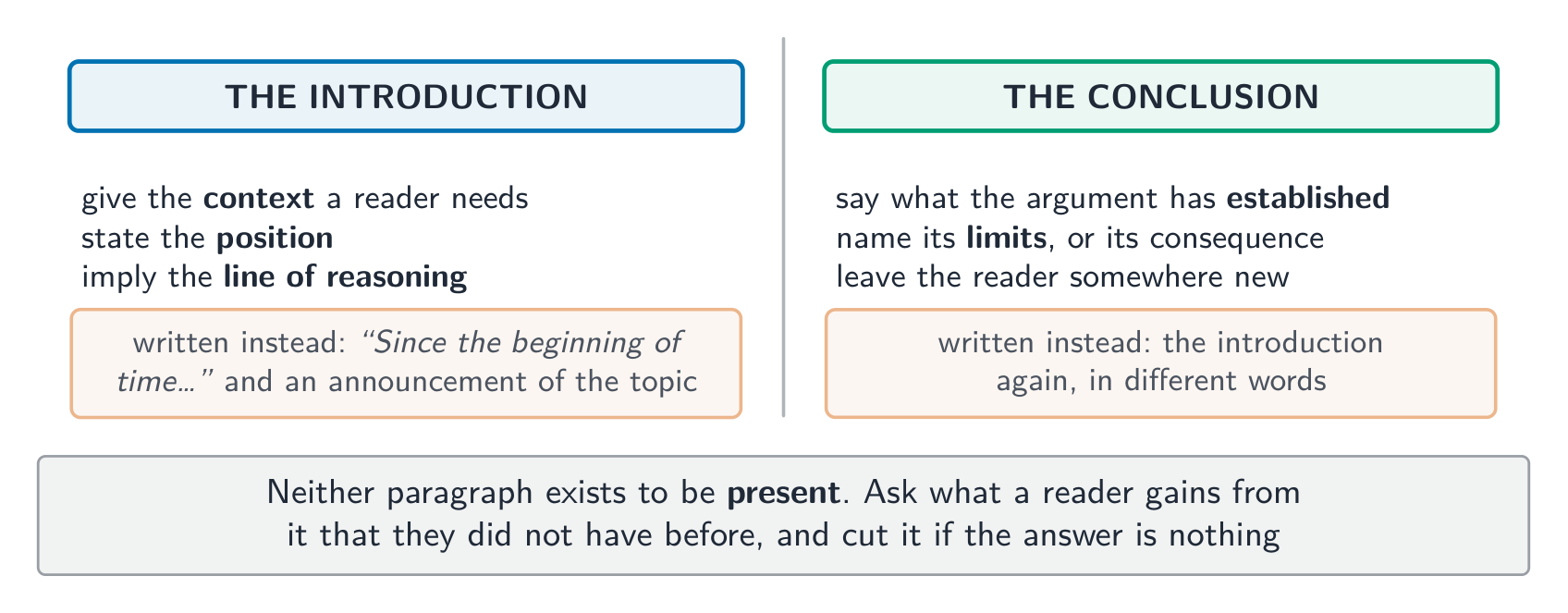
Which job is this opening or ending doing?
Match each move to the job the CED permits it.
A conclusion shows the parts were one argument.
难度 1/5 · 今日首次完成可获 100 金币及少量额外奖励
"Unified" is the key word.
Worked example: Gettysburg's frame
- Opening: "Four score and seven years ago" reaches back to 1776, linking the battlefield to the founding and its "proposition that all men are created equal". The exigence — a cemetery for the dead of a civil war — is set against the nation's founding promise.
- Closing: "a new birth of freedom" and "shall not perish from the earth" look forward.
- Effect: "Lincoln frames the speech as past, present and future: the opening recalls the founding promise, the conclusion turns grief into a duty to keep it, so the dedication of a cemetery becomes a renewal of the nation."
How is the Gettysburg Address framed?
难度 1/5 · 今日首次完成可获 100 金币及少量额外奖励
Grief becomes a duty.
Openings that work
- A question, an anecdote, a striking fact, a quotation or a historical frame. Choose the one that suits the audience and purpose.
- Ask what the audience needs first.
Which are effective ways to open?
难度 2/5 · 今日首次完成可获 140 金币及少量额外奖励
Choose for the audience and purpose.
Conclusions that work
- Return to an opening image with new meaning, widen to a larger stake, or call to action.
- Avoid summary that repeats each paragraph in order.
The strongest conclusion repeats each paragraph in order.
难度 1/5 · 今日首次完成可获 100 金币及少量额外奖励
Widen, return with new meaning or call to action.
An introduction is not required to state the thesis. When reading, do not assume the main claim sits at the end of the first paragraph; look for where the argument actually commits.
An introduction orients the audience, establishes exigence and gains attention; a conclusion unifies the argument and shows its significance. Analyse what each gives the audience at that moment, not just that it is present.
Analyse the opening and conclusion of a speech or essay you know.
Opening, closing, effect.