Two minutes that save an essay
- Many students discover in their fourth paragraph that they have no evidence for one of their three claims. By then the thesis has already promised it. The essay either stops making sense or fills the paragraph with general statements, and the reader notices.
- The fix takes about two minutes before you write: list your claims, check each against the evidence you actually have, cut what the evidence cannot reach, and write the thesis to cover exactly what is left.
The two-minute plan, worked
Prompt: Should cities replace parking spaces with bike lanes?
| Planned claim | Evidence I have | Keep? |
|---|---|---|
| Bike lanes make cycling safer | protected lanes in a city study cut cyclist injuries | keep |
| Shops gain customers | a survey: cyclists visit local shops more often and spend more per month | keep |
| Bike lanes end traffic jams | nothing; and fewer lanes for cars may slow traffic | cut |
Thesis written last: "Cities should replace some parking with protected bike lanes, because they make cycling safer and bring regular customers to local shops, even if they do little to reduce traffic."
- The cut claim did not disappear: it became a concession ("even if they do little to reduce traffic"), which makes the thesis more honest and harder to attack.
You plan three claims for "Schools should ban junk-food vending machines": (a) students eat more healthily at school, with a study; (b) grades rise, with no evidence; (c) the school saves money, with a budget report. What should you do with (b)?
难度 1/5 · 今日首次完成可获 100 金币及少量额外奖励
A claim without evidence weakens the essay.
Put the two-minute plan in order.
难度 3/5 · 今日首次完成可获 200 金币及少量额外奖励
The thesis comes last in planning.
Narrowing is not hedging
- A narrowed thesis adds the ground the claim holds on: some parking, protected lanes, for local shops. It still takes a clear side.
- Hedging is different: "Bike lanes may possibly be good in some ways" commits to nothing. Narrow with precise conditions, not with weak words.
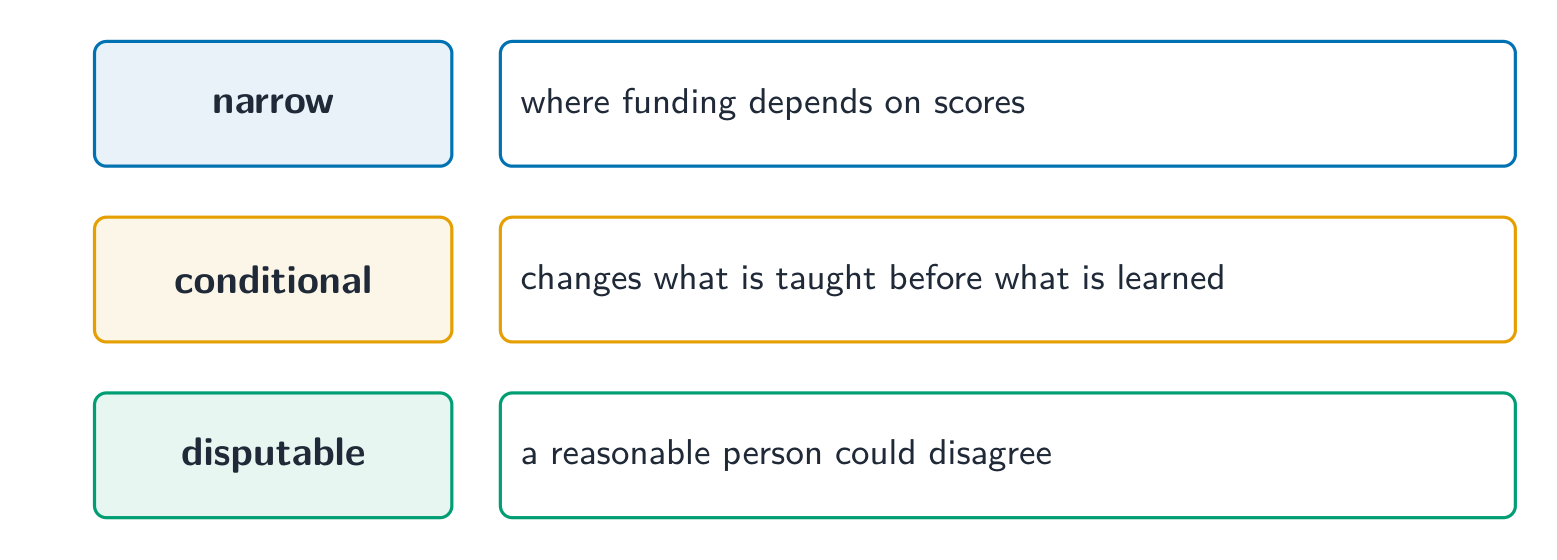
缩小范围还是含糊其辞?
Sort each revised thesis by whether it still says something.
Which thesis is narrowed rather than hedged?
难度 1/5 · 今日首次完成可获 100 金币及少量额外奖励
Narrowing adds precise conditions and still takes a side.
Change the line of reasoning too
- When the thesis changes, the paragraph plan changes with it. The bike-lane essay now needs: (1) safety, (2) shops, (3) answering the traffic objection. The third paragraph is now a concession and response, not a claim.
- A narrowed thesis with the old paragraph order often no longer has a clear path.
A final pass before you stop
- Read your thesis, then your last body paragraph, with nothing in between. Does that paragraph still defend the thesis?
- If your essay has argued something narrower than your thesis, take a minute to rewrite the thesis so it matches.
If your last body paragraph argues something narrower than your thesis, you should rewrite the thesis to match.
难度 1/5 · 今日首次完成可获 100 金币及少量额外奖励
The thesis must catch up with the essay you actually wrote.
Do not keep a claim because you planned it. A claim with no evidence costs more than it adds; turn it into a concession or cut it.
Before writing, list your claims, test each against your evidence, and cut or concede what the evidence cannot reach. Write the thesis last to cover what remains, adjust the line of reasoning to match, and check at the end that your final paragraph still defends your thesis. Narrow with precise conditions; do not hedge.
Practice. Prompt: "Should homework be banned?" Your evidence: a review showing homework helps older students more than young ones; teachers' reports that long homework causes stress. Write a thesis that covers only what this evidence can prove, and list your three paragraphs.
Thesis and reasoning change together.