| English | 释义 | 拼音 |
|---|---|---|
| exigence/ˈeksɪdʒəns/ | 促因 | cù yīn |
| purpose/ˈpɜːpəs/ | 目的 | mù dì |
| audience/ˈɔːdɪəns/ | 受众 | shòu zhòng |
| context/ˈkɒntekst/ | 语境 | yǔ jìng |
"A date which will live in infamy", 1941
- On 7 December 1941, Japanese aircraft attacked the US naval base at Pearl Harbor, Hawaii. The next day, President Franklin D. Roosevelt spoke to Congress, and millions of Americans listened on the radio. His speech lasted about seven minutes, and within an hour Congress declared war.
- Roosevelt did not write in a vacuum. Every choice in the speech can be explained by its rhetorical situation: who wrote it, why, for whom, and when.
The six components
| Component | Question it answers | In Roosevelt's speech |
|---|---|---|
| Exigence 促因 | What prompted the text, right now? | the attack on Pearl Harbor the day before |
| Purpose 目的 | What does the writer want to achieve? | ask Congress to declare war; unite and reassure the nation |
| Audience 受众 | Who is it for, and what do they already believe? | Congress, and an American public that had wanted to stay out of the war |
| Context 语境 | When, where, on what occasion? | a joint session of Congress, broadcast live, one day after the attack |
| Writer | Who speaks, with what authority and stake? | the president, as commander in chief |
| Message | What does the text say and do? | the attack was deliberate, the danger is real, and America will win |
属于修辞情境的哪个要素?
Sort each detail by the component it names.
Match each part of Roosevelt's situation to its component.
难度 2/5 · 今日首次完成可获 140 金币及少量额外奖励
Trigger, aim, listeners, occasion.
Exigence is not the topic
- The topic of the speech is war with Japan. The exigence is the specific event that made the speech necessary now: the attack the day before.
- Exigence and purpose are also different: exigence is what prompted the text; purpose is what the writer wants to happen because of it.
A school cancels the late bus, and a student writes to the head teacher asking for it back. What is the exigence?
难度 1/5 · 今日首次完成可获 100 金币及少量额外奖励
The cancellation prompted the letter; restoring the route is the purpose.
The exigence of a text is the same as its topic.
难度 1/5 · 今日首次完成可获 100 金币及少量额外奖励
Exigence is the specific trigger that made the text necessary now.
From situation to choice
- Opening: "Yesterday, December 7, 1941 – a date which will live in infamy – the United States of America was suddenly and deliberately attacked..." Roosevelt dates the event precisely and calls it "deliberate", because his audience must accept that this was planned aggression, not an accident, before it will accept war.
- Short speech: the audience already knew the news and felt shock and anger, so a long argument was unnecessary; brevity sounds decisive.
Worked exam skill: situation in the thesis
Prompt (rhetorical analysis): Analyse the rhetorical choices Roosevelt makes to achieve his purpose.
Weak thesis: "Roosevelt uses repetition and strong words to persuade his audience." (Devices only; no situation, no purpose.)
Strong thesis: "Speaking the day after the attack to a nation that had hoped to avoid war, Roosevelt stresses that the attack was deliberate and lists Japan's other attacks, so that Congress and the public see war not as a choice but as a necessary response."
- Why it scores: the strong thesis names the exigence and audience, states the purpose, and previews the choices it will analyse, which is what the thesis row (0–1 point) and the line of reasoning in the evidence-and-commentary row (0–4 points) reward.
Which thesis best reflects the rhetorical situation?
难度 1/5 · 今日首次完成可获 100 金币及少量额外奖励
It names the exigence, audience, choices and purpose.
Do not lead with a device. "The writer uses a rhetorical question" earns little. Explain how the choice serves the purpose for this audience in this situation.
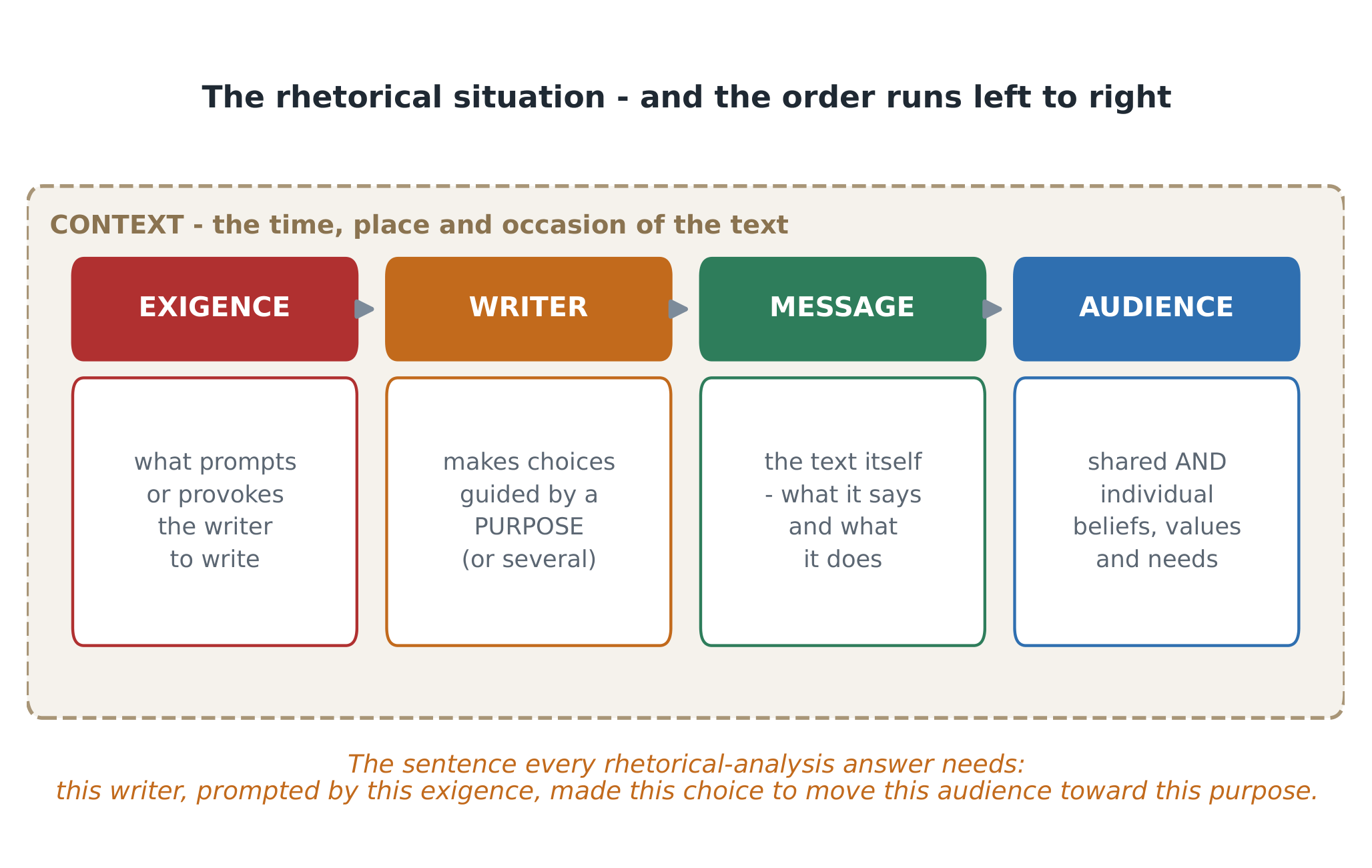
The rhetorical situation has six parts: exigence (the trigger), purpose (the aim), audience, context, writer and message. Exigence is not the topic, and it is not the purpose. Strong analysis explains each choice by the situation: this writer, prompted by this exigence, made this choice to move this audience toward this purpose.
Practice. A mayor publishes a letter the week after the town's main bridge closes. Write one sentence naming the exigence, purpose and audience, and one sentence explaining how ONE likely choice in the letter would serve that purpose.
Situation first, then the choice it explains.