| English | 释义 | 拼音 |
|---|---|---|
| connotative and denotative meanings/kɒnəˈtætɪv ænd dɪˈnəʊtətɪv ˈmiːnɪŋz/ | 内涵义与外延义 | nèi hán yì yǔ wài yán yì |
"Chains and slavery", 1775
- In March 1775, Patrick Henry urged the Virginia Convention to prepare for war with Britain. He did not call British rule "unfair taxation". He asked: "Is life so dear, or peace so sweet, as to be purchased at the price of chains and slavery?" To many of his listeners, the same facts now felt like an insult to their freedom.
- No fact changed; the words did. Diction (word choice) shapes how readers feel about a subject, because words carry more than their dictionary meaning.
Denotation and connotation
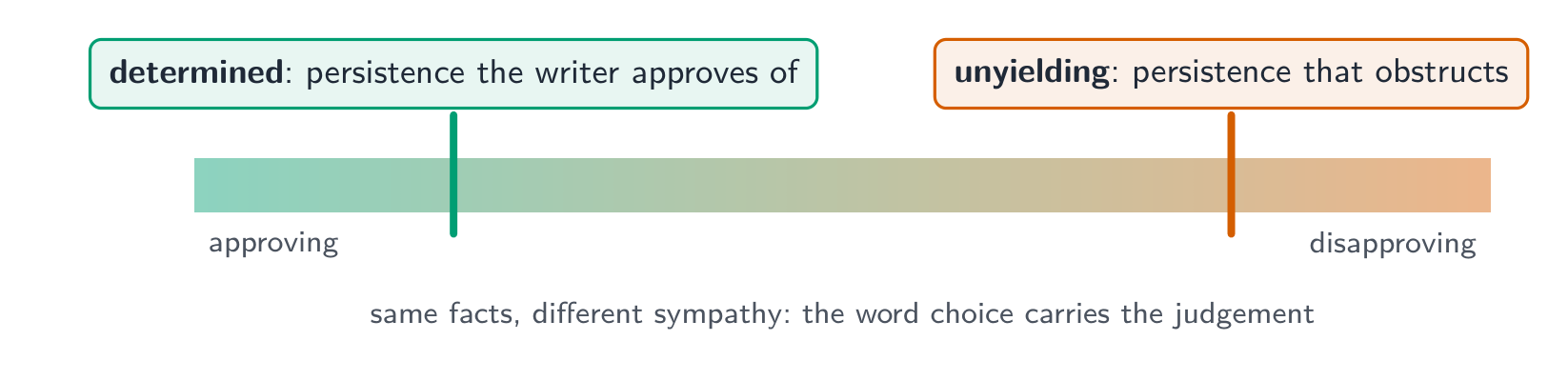
- Words have denotative and connotative meanings 内涵义与外延义. Denotation is what a word refers to; connotation is the feeling or judgement it carries.
| Neutral word | Positive connotation | Negative connotation |
|---|---|---|
| spends a lot | invests | wastes |
| firm | determined | stubborn |
| new | innovative | untested |
| a large group | a crowd of supporters | a mob |
字面义相同,内涵不同
Sort each pair member by the disposition it carries.
Match each word to its connotation.
难度 2/5 · 今日首次完成可获 140 金币及少量额外奖励
Same denotation, different judgement.
Descriptive words carry a perspective
- Adjectives and adverbs do not only describe; they convey the writer's perspective. "A reckless plan" and "a bold plan" describe the same plan but take opposite positions.
- Precise word choice reduces confusion and lets readers see the writer's view clearly. The exactly right common word is better than an impressive word used slightly wrongly.
A news report calls a protest "a mob". What does this word choice suggest about the writer's perspective?
难度 1/5 · 今日首次完成可获 100 金币及少量额外奖励
"Mob" carries a negative judgement that "crowd" does not.
A method for analysing diction
- Step 1: find a loaded word. Step 2: ask what a neutral word would have been. Step 3: the difference is what the writer added; explain how it changes the reader's attitude.
- Example: Henry could have said "British rule" (neutral). "Chains and slavery" adds images of physical bondage and total loss of freedom.
Put the method for analysing diction in order.
难度 3/5 · 今日首次完成可获 200 金币及少量额外奖励
The difference from the neutral word is the analysis.
Worked exam skill: commentary on diction
Claim: Henry's diction turns a political disagreement into a choice between freedom and bondage.
Evidence and commentary: by calling submission to Britain "chains and slavery", Henry replaces the colonists' practical complaints with an image of personal bondage, which no free listener could accept. The word "purchased" adds a second judgement: peace becomes something bought at a shameful price, so choosing peace sounds like selling one's freedom. Together, these words make war seem not only justified but honourable.
- Why it scores: compares the loaded words with what a neutral version would say, and explains the effect on this audience (listeners who prized their liberty).
Do not stop at "the writer uses strong words". Name the word, its connotation, and what it makes the audience feel or believe.
Writing "the writer uses strong words" is enough to analyse diction.
难度 1/5 · 今日首次完成可获 100 金币及少量额外奖励
Name the word, its connotation and its effect.
Denotation is a word's meaning; connotation is the feeling or judgement it carries. Descriptive words convey a perspective. Analyse diction by finding a loaded word, comparing it with a neutral alternative, and explaining how the difference shapes the audience's attitude.
Practice. Two headlines: "City invests $5 million in new park" and "City spends$5 million on park as roads crumble". Analyse the diction of each in two or three sentences.
Word, connotation, effect.