| English | 释义 | 拼音 |
|---|---|---|
| transitional elements/trænˈsɪʃənl ˈelɪmənts/ | 过渡成分 | guò dù chéng fèn |
| coherence/kəʊˈhɪərəns/ | 连贯性 | lián guàn xìng |
"Furthermore" says almost nothing
- Read two student sentences: "Uniforms are cheap. Furthermore, they reduce bullying." The word furthermore only tells the reader "here is another point". Compare: "Uniforms are cheap; more importantly, because no one can show off expensive brands, they remove one common reason for bullying." Now the reader knows how the two ideas relate.
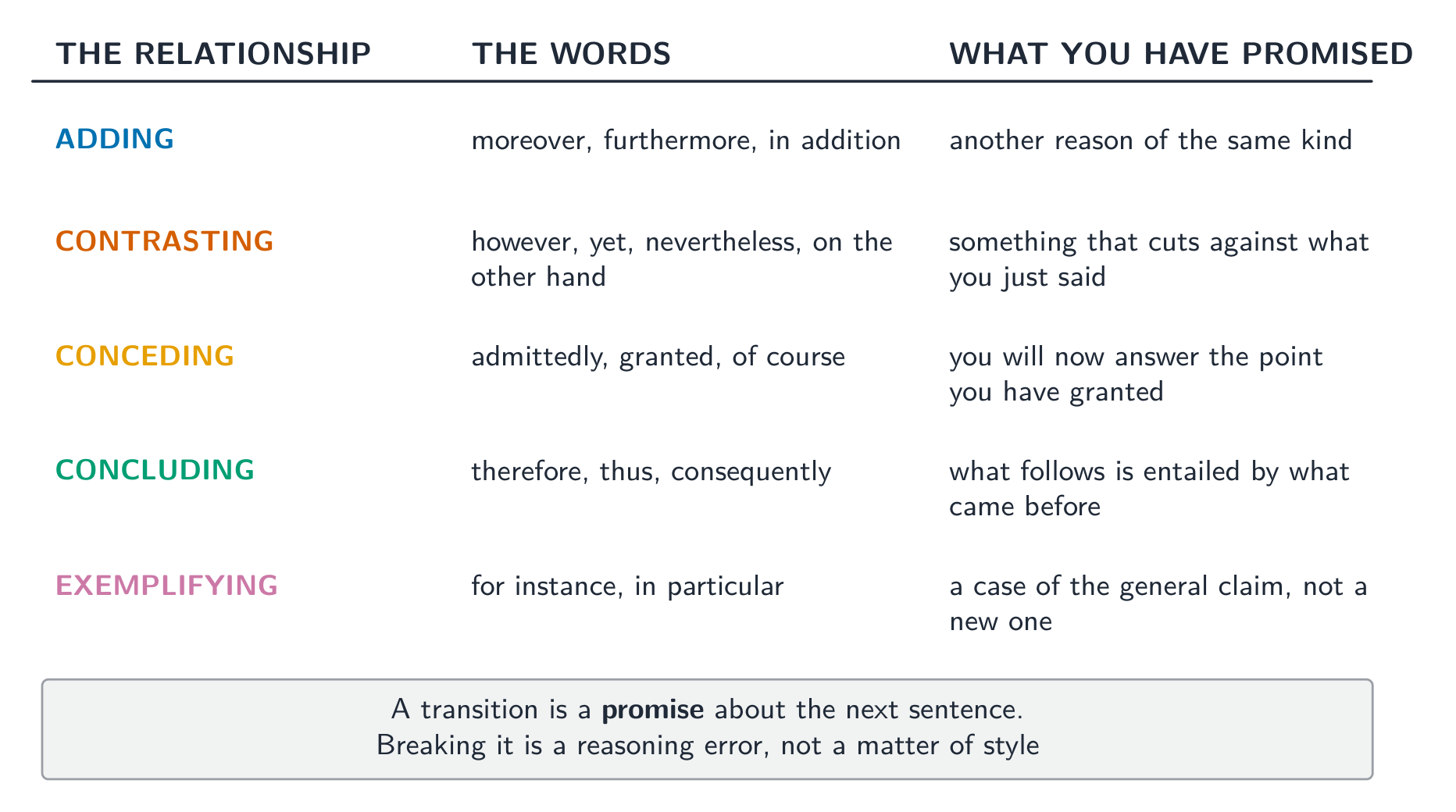
- Transitional elements 过渡成分 (words, phrases, clauses, sentences or even whole paragraphs) create coherence 连贯性: they show the relationship between ideas and between evidence and claims.
Transitions by relationship
| Relationship | Weak (marks a boundary) | Strong (states the relationship) |
|---|---|---|
| Adding | also, furthermore | more importantly, a second cost follows from the first |
| Contrasting | however, but | yet this ignores, the opposite is true when |
| Conceding | although | the strongest objection to this is, this is true as far as it goes |
| Cause and effect | so, therefore | which means, as a result, the effect of this is |
| Limiting | in some cases | even where, to the extent that, only when |
Does this transition carry a relationship?
Sort each transition by what it does.
Match each transition to the relationship it shows.
难度 2/5 · 今日首次完成可获 140 金币及少量额外奖励
Strong transitions name the relationship.
Which transition best links "Phones distract students" and "they can also help with research"?
难度 1/5 · 今日首次完成可获 100 金币及少量额外奖励
It shows the contrast and ties both ideas to the same device.
Transitions in a real argument
- Lincoln's Gettysburg Address (1863) turns on one transition: "But, in a larger sense, we can not dedicate, we can not consecrate, we can not hallow this ground." The "But" changes the speech's direction, from dedicating a cemetery to dedicating the living to "the unfinished work".
- A transition can also be a whole short paragraph that turns the argument, for example from conceding a point to pressing your case.
In the Gettysburg Address, the word "But" marks a turn from dedicating a cemetery to dedicating the living to unfinished work.
难度 1/5 · 今日首次完成可获 100 金币及少量额外奖励
One transition changes the direction of the whole speech.
Worked revision
Before: "Online classes are flexible. Also, students can replay lessons. However, some students feel lonely. Therefore, schools should use online classes."
After: "Online classes are flexible, and the ability to replay a lesson helps exactly the students who fall behind in a live class. Yet that same flexibility removes the daily contact that keeps many students motivated, which means online classes work best as an addition to school, not a replacement for it."
- Why it is better: "exactly the students who" links the two benefits; "Yet that same flexibility" ties the drawback to the benefit; "which means" leads to a qualified conclusion instead of a jump.
Diagnosing your own transitions
- Delete the transition and read the two sentences together. If nothing is lost, it was decoration. If the connection now looks wrong, the transition was hiding a gap in your reasoning: fix the reasoning, not the word.
"Therefore" does not create logic. If the conclusion does not follow from the sentences before it, a transition word cannot make it follow.
Adding "therefore" makes a conclusion logical even if it does not follow from the evidence.
难度 1/5 · 今日首次完成可获 100 金币及少量额外奖励
Fix the reasoning, not the transition word.
Transitional elements (words, phrases, clauses, sentences, paragraphs) create coherence by showing relationships between ideas. Strong transitions state the relationship (concession, contrast, cause, limitation), not just a boundary. Test each one by deleting it: if nothing is lost, it did no work.
Practice. Revise with transitions that state relationships: "Homework helps practice. Also, it teaches time management. However, it can cause stress. So schools should limit it."
Name the relationship, not just the boundary.