Pular para o conteúdo
Matérias

GRE · GRE Subject Test · GRE Mathematics

  • 1

    C.1 · Cálculo de uma variável e aplicações

    1

    Escopo e pré-requisitos

    Preparação de graduação para o GRE. Objetivos locais dentro do escopo revisado do ETS; este é ensino original, não um teste oficial ou preditor de nota.

    Pré-requisitos: Álgebra exata, trigonometria em radianos, funções e desigualdades.

    • Usar limites, continuidade e diferenciabilidade
    • Aplicar derivadas, integrais e o teorema fundamental
    • Reconhecer somas de Riemann e distingui-las de séries infinitas

    continuidade: Concordância do valor da função com seu limite.

    convergência: Aproximação a um valor limite finito.

    Vocabulário Treinar
    English Português
    continuity/kɒntɪˈnjuːɪti/ Continuidade
    convergence/kənˈvɜːdʒəns/ Convergência
    1

    Escolher e justificar um método

    Um limite descreve valores próximos a um ponto, sem exigir que a função esteja definida ali. Continuidade adiciona o requisito de que o valor da função existe e concorda com o limite. Cancelamento algébrico é válido apenas longe do zero cancelado, mas pode revelar um limite removível. Limites laterais devem concordar para um limite bilateral. Para limites de quociente, verifique o denominador e as hipóteses antes de aplicar uma regra; 0/0 é uma forma indeterminada, não uma resposta.

    Uma derivada é um limite de quocientes de diferença e implica continuidade; o contrário falha, como mostra |x| em zero. Regras do produto, quociente e cadeia descrevem estruturas diferentes: a derivada de f(g(x)) é f′(g(x))g′(x), não um produto de valores não relacionados. Diferenciar uma composição pela segunda vez geralmente produz dois termos. Verifique domínios, denominadores não nulos e suposições de diferenciabilidade antes de usar uma expressão simbólica como derivada.

    O teorema fundamental diz que a derivada de ∫ de a a x de um integrando contínuo f(t) é f(x). Com um limite superior variável h(x), multiplique por h′(x); com dois limites variáveis, subtraia a contribuição correspondente do limite inferior. Uma integral definida também surge como um limite de somas de Riemann. Reescreva a soma como (1/n)Σf(k/n) antes de identificar a integral em [0,1], em vez de tratar termos dependentes de n como constantes.

    Por exemplo, Σ de k=1 até n de n/(n²+k²) é igual a (1/n)Σ1/(1+(k/n)²), tendendo a ∫₀¹1/(1+t²)dt=π/4. Este limite usa continuidade e a largura da partição 1/n. Uma série sobre um número ilimitado de termos é um limite diferente: termos tendendo a zero não garantem convergência por si só. Para Σ1/k, as somas parciais divergem; compare, estime ou aplique um teste de série válido em vez de usar a condição necessária de termo como suficiente.

    1

    Raciocínio resolvido

    Para F(x)=integral de 0 a x² de e^t dt, o teorema fundamental e a regra da cadeia fornecem F′(x)=e^(x²)·2x. Em x=1, F′(1)=2e. O limite superior é x², portanto omitir 2x ignora sua taxa de variação.

    Cálculo de uma variável e aplicações: exemplo de curso
    Ilustração de curso original; seus valores pertencem ao exemplo resolvido, não à prática posterior.
    1

    Condições e contraexemplos

    O cálculo A-level é material pré-requisito útil, mas não cobre a análise universitária e as aplicações testadas aqui.

    1

    Aplicação guiada

    Seja $F(x)=\int_x^{x^2}(1+t^2)\,dt$. Encontre $F'(x)$ e $F'(2)$. Explique por que o teorema se aplica.

    Solução resolvida

    O integrando é contínuo na reta real. O teorema fundamental e a regra da cadeia se aplicam em ambos os limites:

    $$F'(x)=(1+x^4)2x-(1+x^2).$$
    $$F'(2)=(1+2^4)\,2\cdot2-(1+2^2)=63.$$
    Independentemente, uma primitiva é $t+t^3/3$. Logo $F=x^2+x^6/3-x-x^3/3$, com a mesma derivada.

    1

    Transferência independente

    Encontre $\lim_{n\to\infty}\sum_{k=1}^n k/(n^2+k^2)$. Explique por que este é um limite de soma de Riemann. Em seguida, decida se $\sum_{k=1}^{\infty}1/k$ converge.

    Verificar após tentar

    Reescreva cada termo como $\frac1n\frac{k/n}{1+(k/n)^2}$. A função contínua $f(t)=t/(1+t^2)$ em $[0,1]$ e a malha $1/n$ fornecem

    $$L=\int_0^1\frac{t}{1+t^2}\,dt=\frac12\ln2.$$
    A série harmônica diverge: o bloco de $2^{j-1}+1$ até $2^j$ contém pelo menos $2^{j-1}$ termos maiores ou iguais a $1/2^j$, logo cada bloco adiciona pelo menos $1/2$. Termos tendendo a zero são necessários, mas insuficientes. O integrando da soma finita aqui depende do índice escalado; não é a série harmônica.

  • 2

    C.2 · Cálculo multivariável e análise vetorial

    2

    Escopo e pré-requisitos

    Preparação de graduação para o GRE. Objetivos locais dentro do escopo revisado do ETS; este é ensino original, não um teste oficial ou preditor de nota.

    Pré-requisitos: Derivadas de variável única, produtos escalares e integração iterada.

    • Calcular derivadas parciais, gradientes e derivadas direcionais
    • Usar integrais múltiplas e mudanças de coordenadas
    • Usar condições de derivada para distinguir planos de superfícies curvas

    gradiente: Vetor de derivadas parciais.

    Jacobiana: O fator local de escala de área ou volume em uma mudança de coordenadas.

    Vocabulário Treinar
    English Português
    gradient/ˈɡreɪdɪənt/ Gradiente
    Jacobian/dʒæˈkəʊbɪən/ Jacobiana
    2

    Escolher e justificar um método

    Uma derivada parcial altera uma coordenada enquanto fixa as outras. Para f=x²+3xy, tem-se f_x=2x+3y e f_y=3x. O gradiente agrupa essas derivadas; se f for diferenciável, a derivada direcional ao longo de um vetor unitário v é grad f·v. Normalize a direção antes de calcular esse produto escalar. Um vetor direção de comprimento dois duplicaria a resposta se usado sem normalização.

    Diferenciabilidade significa uma aproximação linear válida, não meramente a existência de algumas derivadas parciais em um ponto. Derivadas parciais contínuas de primeira ordem em uma vizinhança são condição suficiente. Para uma composição f(x(t),y(t)), a regra da cadeia fornece f_x x′+f_y y′. Derivadas segundas podem introduzir termos diretos e mistos; uma derivada mista nula sozinha não impõe restrição às derivadas puras de segunda ordem.

    Uma integral múltipla soma contribuições sobre uma região especificada. Descreva a região antes de escolher limites iterados; limites não retangulares podem mudar quando a ordem é invertida. Em coordenadas polares, a área é r dr dtheta, não apenas dr dtheta. Uma mudança geral de coordenadas usa o determinante absoluto da Jacobiana. O sinal pertence a quantidades orientadas vetoriais, enquanto a escala de área e volume usa um fator não negativo.

    Se ambas as derivadas parciais de primeira ordem de uma função definida globalmente em R² forem constantes, f_x=a e f_y=b, a integração sucessiva resulta em f=ax+by+c, um plano. Isso não pode ser inferido apenas a partir de conjuntos de nível paralelos: e^x tem linhas de nível verticais paralelas, mas seu gráfico é curvo. Tampouco f_xy=f_yx=0 garante um plano: x²+y² é um contraexemplo. Distinga a constância da derivada de primeira ordem da ausência de dependência mista e da forma dos conjuntos de nível selecionados.

    2

    Raciocínio resolvido

    Para f(x,y)=x²+3y², gradiente f=(2x,6y). Em (1,1), este é (2,6). Na direção (3,4), o vetor unitário é (3/5,4/5), resultando na derivada direcional 2·3/5+6·4/5=6.

    Cálculo multivariável e análise vetorial: exemplo de curso
    Ilustração de curso original; seus valores pertencem ao exemplo resolvido, não à prática posterior.
    2

    Condições e contraexemplos

    Um vetor direção não unitário fornece uma taxa direcional escalada, não a derivada por unidade de distância.

    2

    Aplicação guiada

    Para $f(x,y)=x^2+xy+2y^2$, encontre a derivada direcional em $(1,-1)$ na direção de $(3,4)$. Avalie $\iint_D(x^2+y^2)\,dA$ para o disco unitário $D$.

    Solução resolvida

    O polinômio é diferenciável. Normalize a direção: $u=(3/5,4/5)$. O gradiente é $(2x+y,x+4y)$, logo $(1,-3)$ no ponto.

    $$D_uf(1,-1)=\nabla f(1,-1)\cdot u=1\cdot3/5-3\cdot4/5=-9/5.$$
    Coordenadas polares fornecem $x^2+y^2=r^2$ e $dA=r\,dr\,d\theta$:
    $$I=\int_0^{2\pi}\int_0^1r^3\,dr\,d\theta=\pi/2.$$

    2

    Transferência independente

    Defina $g(x,y)=xy/\sqrt{x^2+y^2}$ longe da origem e $g(0,0)=0$. Ambas as derivadas parciais na origem são zero. $g$ é diferenciável ali? É contínua?

    Verificar após tentar

    Ao longo de cada eixo $g=0$, logo ambas as derivadas parciais são zero. A continuidade segue de $|xy|\le(x^2+y^2)/2$, que implica $|g(x,y)|\le\sqrt{x^2+y^2}/2\to0$. Se for diferenciável, sua derivada linear seria zero. Ao longo de $x=y=t\ne0$,

    $$\frac{|g(t,t)|}{\sqrt{t^2+t^2}}=\frac12.$$
    A razão do resto necessário não tende a zero. Assim, continuidade e existência de derivadas parciais não estabelecem diferenciabilidade.

  • 3

    A.1 · Álgebra linear

    3

    Escopo e pré-requisitos

    Preparação de graduação para o GRE. Objetivos locais dentro do escopo revisado do ETS; este é ensino original, não um teste oficial ou preditor de nota.

    Pré-requisitos: Equações lineares, multiplicação de matrizes, polinômios e raízes complexas.

    • Relacionar posto, nulidade e soluções de sistemas lineares
    • Analisar espaços vetoriais e transformações lineares
    • Calcular autovalores, determinantes e condições de diagonalização

    posto: Dimensão da imagem de uma transformação linear.

    autovalor: Um escalar que satisfaz Av=λv para v diferente de zero.

    Vocabulário Treinar
    English Português
    rank/ræŋk/ posto
    eigenvalue/ˈaɪdʒənvæljuː/ valor próprio
    3

    Escolher e justificar um método

    Um espaço vetorial real é fechado sob sua adição e multiplicação por escalar especificadas e satisfaz os axiomas do espaço vetorial. Uma base é uma lista independente geradora: todo vetor tem uma representação de coordenadas única nessa lista. Para testar a independência das colunas de uma matriz, resolva o sistema homogêneo Ac=0; apenas o vetor coeficiente nulo indica independência. Um conjunto gerador pode conter vetores redundantes, portanto gerar sozinho não constitui uma base.

    A redução por linhas expõe pivôs e variáveis livres sem alterar o conjunto solução de um sistema linear. O posto é a dimensão da imagem das colunas, equivalentemente ao número de pivôs. A nulidade é a dimensão do núcleo: para uma transformação de um domínio de dimensão n, posto + nulidade = n. Em um sistema não homogêneo, uma linha com coeficientes nulos e lado direito não nulo indica inconsistência; variáveis livres resultam em infinitas soluções apenas após a consistência ser estabelecida. A dimensão do codomínio não precisa ser igual ao posto.

    Uma matriz quadrada é invertível se, e somente se, seu determinante for não nulo, seu núcleo for nulo e seu posto for igual à sua ordem. Essas afirmações não exigem que cada entrada seja não nula. Determinantes triangulares são produtos das entradas diagonais, logo uma matriz dependente de uma variável complexa pode ser singular em raízes complexas ausentes em cálculos restritos aos reais. Permutações de linhas invertem o sinal do determinante; somar um múltiplo de uma linha a outra o mantém inalterado. Verifique a singularidade antes de aplicar uma fórmula inversa.

    Um autovetor é não nulo e satisfaz Av=λv, logo os autovalores são raízes de det(A−λI). A diagonalização exige uma base completa de autovetores independentes sobre o campo escolhido. Autovalores distintos fornecem autovetores independentes, enquanto autovalores repetidos podem ter um espaço próprio demasiado pequeno. Uma matriz simétrica real possui uma base ortonormal de autovetores reais. Uma matriz real de dimensão ímpar tem pelo menos um autovalor real porque seu polinômio característico real tem grau ímpar; isso sozinho não implica diagonalização nem todos os autovalores sendo reais.

    3

    Raciocínio resolvido

    A=[[1,1],[0,1]] tem polinômio característico (1−λ)². Autovetores satisfazem y=0, logo seu autoespaço tem dimensão um. São necessários dois autovetores independentes para diagonalizar uma matriz 2×2; A não é diagonalizável.

    Álgebra linear: exemplo de curso
    Ilustração de curso original; seus valores pertencem ao exemplo resolvido, não à prática posterior.
    3

    Condições e contraexemplos

    A multiplicidade algébrica de um autovalor não é automaticamente a dimensão do seu autoespaço.

    3

    Aplicação guiada

    Para $T:\mathbb R^3\to\mathbb R^2$ com $T(x,y,z)=(x+2y+z,2x+4y+2z)$, encontre bases do núcleo e da imagem. Resolva $T(v)=(3,6)$ e $T(v)=(3,7)$.

    Solução resolvida

    A segunda linha é o dobro da primeira, logo o posto é um. A equação homogênea resulta em $x=-2y-z$.

    $$\ker T=\operatorname{span}\{(-2,1,0),(-1,0,1)\}.$$
    Os dois vetores exibidos são independentes. Toda saída é $(s,2s)$, e $(1,2)$ ocorre; este é um conjunto gerador da imagem. Postos mais nulidade totalizam $1+2=3$, a dimensão do domínio. Para $(3,6)$, todas as soluções são $(3-2a-b,a,b)$, com $a,b\in\mathbb R$. Para $(3,7)$ não há solução, pois $7\ne2\cdot3$.

    3

    Transferência independente

    Seja $A=\begin{pmatrix}2&1\\0&2\end{pmatrix}$. Determine seus autovalores, determinante e diagonalização sobre $\mathbb R$ e $\mathbb C$. Encontre $A^n$ para inteiros $n\ge1$ sem multiplicação repetida.

    Verificar após tentar

    O polinômio característico é $(2-\lambda)^2$ e $\det A=4$. Resolver $(A-2I)v=0$ resulta em $v_2=0$, logo o espaço próprio tem dimensão um sobre qualquer campo. São necessários dois autovetores independentes; a matriz é invertível, mas não diagonalizável sobre nenhum dos campos. Escreva $A=2I+N$ onde $N^2=0$. A expansão binomial comutativa deixa apenas dois termos:

    $$A^n=2^nI+n2^{n-1}N=\begin{pmatrix}2^n&n2^{n-1}\\0&2^n\end{pmatrix}.$$
    Multiplicar esta expressão por $A$ resulta na fórmula em $n+1$, verificando independentemente o coeficiente.

  • 4

    A.2 · Álgebra abstrata e teoria dos números

    4

    Escopo e pré-requisitos

    Preparação de graduação para o GRE. Objetivos locais dentro do escopo revisado do ETS; este é ensino original, não um teste oficial ou preditor de nota.

    Pré-requisitos: Aritmética inteira, conjuntos, funções e prova por contraexemplo.

    • Utilizar grupos, subgrupos, homomorfismos e estruturas quociente
    • Diferenciar anéis, domínios de integridade e corpos
    • Aplicar divisibilidade, congruências e teoria elementar dos números

    homomorfismo: Um mapeamento que preserva a operação relevante.

    corpo: Um anel comutativo em que cada elemento não nulo possui inverso.

    Vocabulário Treinar
    English Português
    homomorphism/ˈhɒməmɔːfɪzəm/ homomorfismo
    field/fiːld/ corpo
    4

    Escolher e justificar um método

    Um grupo exige fecho, associatividade, identidade e inversos. Comutatividade é uma condição adicional.

    Um homomorfismo preserva a operação. Seu núcleo é um subgrupo normal e identifica elementos mapeados para a identidade.

    Um corpo permite divisão por todo elemento não nulo. Os inteiros formam um anel, mas não um corpo.

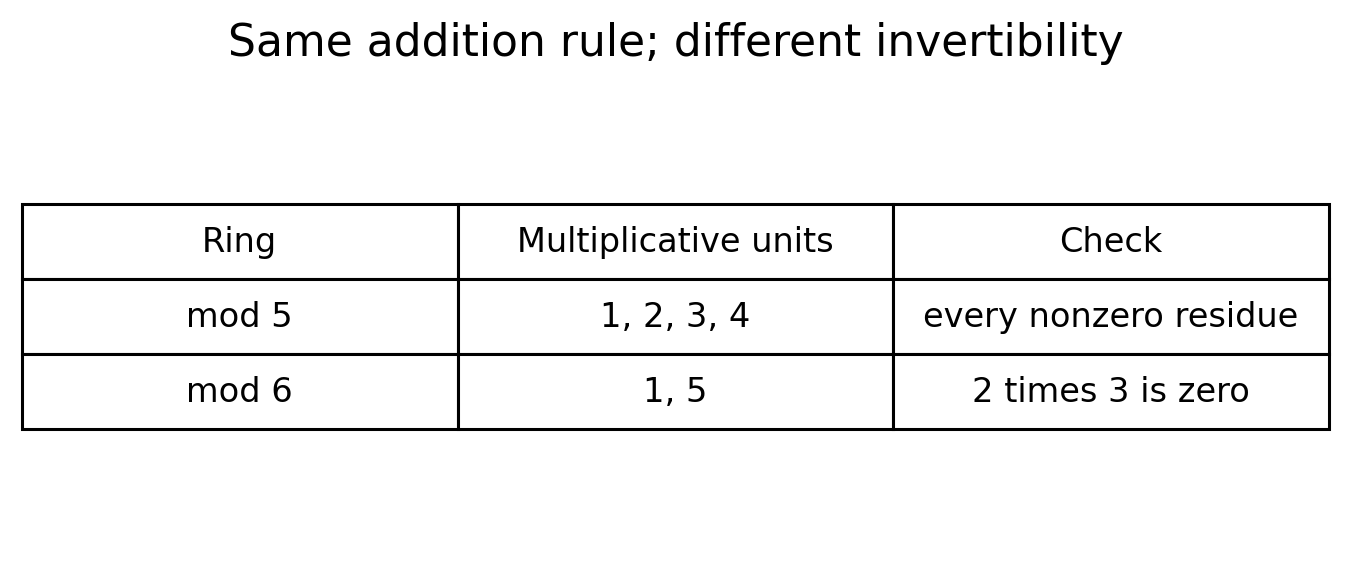
    Trabalhar com congruências módulo n. Um resíduo a tem inverso multiplicativo exatamente quando mdc(a,n)=1.

    4

    Raciocínio resolvido

    Módulo 8, 3 tem inverso 3 porque 3·3=9≡1. Mas 2 não tem inverso porque gcd(2,8)=2. Módulo um primo, todo resíduo não nulo tem um inverso; isso gera um corpo finito.

    Álgebra abstrata e teoria dos números: exemplo de curso
    Ilustração de curso original; seus valores pertencem ao exemplo resolvido, não à prática posterior.
    4

    Condições e contraexemplos

    Não cancele um fator em uma equação modular sem verificar se ele é invertível.

    4

    Aplicação guiada

    Comparar os grupos aditivos e as estruturas multiplicativas de $\mathbb Z/5\mathbb Z$ e $\mathbb Z/6\mathbb Z$. Listar todas as unidades multiplicativas em cada. Explicar por que remover zero nem sempre deixa um grupo multiplicativo.

    Solução resolvida

    Ambos os conjuntos completos de resíduos são grupos aditivos: fecho, associatividade e identidade provêm da soma inteira, e $-a$ é inverso aditivo. Um resíduo multiplicativo é unidade precisamente quando seu maior divisor comum com o módulo é um. As unidades módulo cinco são $1,2,3,4$; módulo seis são $1,5$. Módulo seis, $2\cdot3=0$ embora ambos os fatores sejam não nulos. O conjunto não nulo nem sequer é fechado sob multiplicação. Módulo cinco todo resíduo não nulo tem inverso; este anel é um corpo. Um anel, seu grupo aditivo e seu grupo de unidades são estruturas diferentes.

    4

    Transferência independente

    O mapa de redução $\phi:\mathbb Z\to\mathbb Z/6\mathbb Z$ é dado por $\phi(n)=[n]$. Determinar seu núcleo, imagem e quociente. Resolver $2x\equiv2\pmod6$ completamente e explicar por que cancelar 2 módulo 6 falha.

    Verificar após tentar

    O mapa preserva adição e multiplicação. Seu núcleo é $6\mathbb Z$ e sua imagem são todos os seis resíduos. O quociente identifica inteiros com o mesmo resto, logo $\mathbb Z/\ker\phi\cong\mathbb Z/6\mathbb Z$. A congruência significa $6\mid2(x-1)$, equivalentemente $3\mid x-1$. Logo $x\equiv1\pmod3$, resultando nos resíduos $1$ e $4$ módulo seis. Ambos substituem corretamente. Cancelar 2 mantendo módulo seis descartaria 4; 2 não tem inverso multiplicativo ali.

  • 5

    T.1 · Real analysis and topology

    5

    Scope and prerequisites

    English

    Undergraduate GRE preparation. Local objectives within the reviewed ETS scope; this is original teaching, not an official test or score predictor.

    Prerequisites: Quantified statements, inequalities, sequences and continuous functions.

    • Apply sequence and function limit definitions
    • Distinguish compactness, connectedness and completeness
    • Use metric-space and elementary topological reasoning

    compact 紧致的: Every open cover has a finite subcover.

    supremum 上确界: The least upper bound of a set.

    Vocabulário Treinar
    English Português
    compact/kəmˈpækt/ compacto
    supremum/suːˈpreməm/ supremo
    5

    Choose and justify a method

    English

    An epsilon–delta statement controls all sufficiently close inputs. The quantifier order matters.

    In real Euclidean space, closed and bounded sets are compact. Do not apply this equivalence to every metric space.

    Continuous images of compact sets are compact, so a real continuous function on a compact domain attains extrema.

    Connectedness rules out a separation into disjoint nonempty open parts. Continuity preserves connectedness; completeness is a separate property.

    5

    Worked reasoning

    English

    f(x)=x on (0,1) is continuous and bounded but never equals its supremum 1. On [0,1], the same function attains its maximum at 1. The missing endpoint explains why the compact-domain theorem does not apply to the first case.

    Real analysis and topology: course example
    Original course illustration; its values belong to the worked example, not the later practice.
    5

    Conditions and counterexamples

    English

    A theorem’s conclusion cannot be used before its hypotheses have been checked.

    5

    Guided application

    English

    Prove continuity of $f(x)=x^2$ at 2 using an explicit epsilon–delta choice. Explain separately why it attains a minimum on $[1,3]$.

    Worked solution

    Given $\epsilon>0$, choose $\delta=\min(1,\epsilon/5)$. If $|x-2|<\delta$, then $1<x<3$, so $|x+2|<5$.

    $$|x^2-4|=|x-2||x+2|<5\delta\le\epsilon.$$
    The choice depends on epsilon, not on the later input x. The interval $[1,3]$ is nonempty and compact in the ordinary real metric. Continuity gives attained extrema. Here $x^2\ge1$, with equality at 1, so the minimum is 1.

    5

    Independent transfer

    English

    In the metric space $X=(0,1)$ with ordinary distance, is X bounded? Is it closed in itself? Is it compact or complete? Explain why “closed and bounded implies compact” cannot be used here.

    Check after attempting

    X is bounded and closed relative to itself, since its complement in X is empty. The Cauchy sequence $1/(n+2)$ has no limit in X, so X is not complete and therefore not compact as a metric space. Directly, the relative open cover $\{(1/n,1):n\ge2\}$ covers X but has no finite subcover. Heine–Borel requires closed and bounded as a subset of Euclidean space, not merely closed in an arbitrary chosen space. X is not closed in $\mathbb R$. No theorem hypothesis may change its ambient space halfway through the argument.

  • 6

    T.2 · Matemática discreta, probabilidade e métodos numéricos

    6

    Scope and prerequisites

    English

    Undergraduate GRE preparation. Local objectives within the reviewed ETS scope; this is original teaching, not an official test or score predictor.

    Prerequisites: Finite counting, elementary probability, recurrences and derivatives.

    • Use counting, recurrences, graph reasoning and logic
    • Calculate probabilities and distribution properties
    • Apply numerical approximation and assess error

    recurrence 递推关系: A rule linking a sequence term to earlier terms.

    mutually exclusive 互斥的: Events that cannot happen together.

    Vocabulário Treinar
    English Português
    recurrence/rɪˈkʌrəns/ relação de recorrência
    mutually exclusive/ˈmjuːtʃuːəli eksˈkluːsɪv/ mutuamente exclusivos
    6

    Choose and justify a method

    English

    Choose the counting model first: ordered selections of r distinct objects use n(n−1)⋯(n−r+1), while unordered subsets use C(n,r). A complete simple graph on n vertices has one edge per unordered vertex pair, giving n(n−1)/2 edges; loops and multiple edges would change the model. For n lines in general position in a plane, the kth line crosses the prior k−1 lines in distinct points and adds k regions. The total is 1+n(n+1)/2; parallels or triple concurrence invalidate that count.

    Use complements to count at least one occurrence, and condition on the actual remaining population after a draw without replacement. For r iid outcomes chosen from n equally likely values, the probability that all are distinct is n(n−1)⋯(n−r+1)/n^r when r≤n. Its complement counts repeated outcomes. For a binomial count with N independent trials and fixed success probability p, mean is Np and variance Np(1−p). Identical probabilities alone do not establish independence.

    A recurrence describes later values from earlier ones and needs enough initial data to determine a sequence. Separate the index from the value: a_n=2a_(n−1) with a_0=3 gives a_n=3·2^n. Graph and algorithm arguments often establish a recurrence by identifying what a new vertex or step adds. A closed formula should satisfy both the recurrence and its initial conditions; fitting a few observed terms does not prove it for every index.

    Numerical approximation needs an error argument. Bisection preserves a sign-changing bracket for a continuous function and halves its width at each step; a zero may be absent if continuity fails. Newton’s update is x_new=x−f(x)/f′(x), requiring a nonzero derivative at the current point; convergence is not automatic from every starting value. An approximation’s residual and its error in x are different. State the method’s assumptions and a stopping criterion, rather than treating extra displayed decimals as accuracy.

    6

    Worked reasoning

    English

    For f(x)=x²−2 and x₀=1, Newton’s step gives 1−(1−2)/2=1.5. The next value is 1.5−0.25/3=1.4167. These approximate sqrt(2), but f′(0)=0 makes zero an invalid starting point.

    Discrete mathematics, probability and numerical methods: course example
    Original course illustration; its values belong to the worked example, not the later practice.
    6

    Conditions and counterexamples

    English

    Events with positive probabilities cannot be both independent and mutually exclusive.

    6

    Guided application

    English

    Four labelled draws are independent and uniform from five symbols, with replacement. Find the probability that at least two draws agree. Compare the number of ordered and unordered selections of four distinct symbols.

    Worked solution

    There are $5^4$ equally likely ordered draw strings. The no-repeat strings number $5\cdot4\cdot3\cdot2=120$.

    $$P(\text{repeat})=1-\frac{5\cdot4\cdot3\cdot2}{5^4}=\frac{101}{125}.$$
    Ordered distinct selections number 120; unordered subsets number $\binom54=5$. Each subset occurs in $4!=24$ orders. Dividing by $4!$ is appropriate only for the unordered count, not the draw probability denominator.

    6

    Independent transfer

    English

    Apply bisection to $f(x)=x^3-2$ on $[1,2]$. Give the first two retained brackets and a bound for midpoint error after ten bisections. Would a sign change alone justify bisection for $1/x$ on $[-1,1]$?

    Check after attempting

    The polynomial is continuous; $f(1)<0<f(2)$. The first midpoint is $1.5$ with positive value, retaining $[1,1.5]$. The next is $1.25$ with negative value, retaining $[1.25,1.5]$. After ten halvings, width is $2^{-10}$ and the midpoint of that retained bracket differs from the bracketed root by at most $2^{-11}=1/2048$. The error bound uses the bracket, not a small residual alone. For $1/x$, zero is a singularity and there is no root. Continuity on the bracket fails; opposite endpoint signs do not justify the method.

  • 7

    T.3 · Análise complexa e resíduos

    7

    Escopo e pré-requisitos

    Preparação de graduação para o GRE. Objetivos locais dentro do escopo revisado do ETS; este é ensino original, não um teste oficial ou preditor de nota.

    Pré-requisitos: Aritmética complexa, derivadas parciais, séries e contornos orientados.

    • Testar diferenciabilidade complexa
    • Usar integrais de contorno e resíduos
    • Avaliar integrais de contorno com resíduos de polos simples e de ordem superior

    analytic: Diferenciável complexamente em toda uma vizinhança.

    residue: Coeficiente de (z−a)^−1 em uma série de Laurent.

    Vocabulário Treinar
    English Português
    analytic/ˌænəˈlɪtɪk/ analítico
    residue/ˈresɪdjuː/ resíduo
    7

    Escolher e justificar um método

    Escreva f(z)=u(x,y)+iv(x,y). A diferenciabilidade complexa impõe u_x=v_y e u_y=−v_x; com derivadas parciais contínuas localmente, as equações de Cauchy–Riemann estabelecem analiticidade ali. Elas diferem da diferenciabilidade real de um mapa de duas coordenadas. A função conjugada x−iy falha nessas equações em toda vizinhança aberta, embora existam derivadas parciais reais. Declare a região sendo verificada, não apenas um ponto conveniente.

    Uma função analítica é complexamente diferenciável em toda uma vizinhança e possui uma série de potências localmente convergente. Uma singularidade removível pode ser preenchida analiticamente quando a função é limitada próximo ao ponto ausente. Um polo tem parte principal finita em sua série de Laurent; uma singularidade essencial tem infinitos termos de potência negativa. O resíduo é o coeficiente de (z−a)⁻¹, não necessariamente o termo de maior ou maior potência negativa.

    Para um polo isolado de ordem m, escreva f(z)=g(z)/(z−a)^m com g analítico em a. O resíduo é g^(m−1)(a)/(m−1)!. Um polo simples usa g(a); um polo duplo usa g′(a). Isso segue expandindo g em sua série de Taylor. Assim, e^z/(z−a)² tem resíduo e^a, enquanto um numerador constante sobre um polo duplo puro tem resíduo zero. A ordem do polo sozinha não determina a integral de contorno.

    Para um contorno orientado positivamente que envolve singularidades isoladas, o teorema dos resíduos dá ∮f(z)dz=2πi vezes a soma dos resíduos envolvidos, desde que a função seja analítica no contorno e em outro lugar no interior necessário. Inverter a orientação muda o sinal. A fórmula das derivadas de Cauchy é ∮g(z)/(z−a)^(m+1)dz=2πi g^(m)(a)/m! sob suas hipóteses de domínio analítico. Uma singularidade no contorno impede aplicação direta; uma singularidade fora contribui nada para este contorno.

    7

    Raciocínio resolvido

    Para f(z)=conjugado(z), temos u=x e v=−y. Então u_x=1 mas v_y=−1, logo f não é diferenciável no complexo. Para 1/(z−2), um círculo orientado positivamente |z−2|=1 envolve um polo simples de resíduo 1, portanto a integral é 2πi.

    Análise complexa e resíduos: exemplo de curso
    Ilustração de curso original; seus valores pertencem ao exemplo resolvido, não à prática posterior.
    7

    Condições e contraexemplos

    A continuidade ou a diferenciabilidade real sozinhas não implicam analiticidade complexa.

    7

    Aplicação guiada

    Use as equações de Cauchy–Riemann para comparar $z^2$ e $\overline z$. Encontre o resíduo de $e^z/z^2$ em zero e sua integral ao redor do círculo unitário anti-horário.

    Solução resolvida

    Para $z^2$, $u=x^2-y^2$ e $v=2xy$: $u_x=2x=v_y$ e $u_y=-2y=-v_x$. As derivadas parciais são contínuas em todo lugar, então a função é analítica em todo lugar. Para $\overline z$, $u=x,v=-y$ e $u_x=1\ne-1=v_y$; ela não é complexamente diferenciável em lugar nenhum. Como $e^z=1+z+z^2/2+\cdots$, o coeficiente de $z^{-1}$ em $e^z/z^2$ é 1. Portanto o resíduo é 1 e a integral é $2\pi i$. O polo duplo não força um resíduo zero.

    7

    Transferência independente

    Integre $1/[z(z-2)]$ ao redor de $|z|=1$, primeiro anti-horário e depois horário. O mesmo argumento do teorema dos resíduos pode ser usado em $|z|=2$?

    Verificar após tentar

    Apenas zero está dentro do círculo unitário. Seu resíduo é $\lim_{z\to0}1/(z-2)=-1/2$. Assim a integral anti-horária é $-\pi i$ e a horária é $\pi i$. O polo em 2 está fora e não contribui nada. O círculo $|z|=2$ passa por um polo. A integral de contorno ordinária não é definida por esta fórmula; o teorema requer analiticidade no contorno. Um recorte ou prescrição de valor principal seria um problema diferente, explicitamente especificado.

  • 8

    C.3 · Equações diferenciais e condições iniciais

    8

    Scope and prerequisites

    English

    Undergraduate GRE preparation. Local objectives within the reviewed ETS scope; this is original teaching, not an official test or score predictor.

    Prerequisites: Differentiation, integration, exponentials and quadratic equations.

    • Solve separable first-order equations
    • Solve constant-coefficient second-order equations
    • Use initial conditions and uniqueness conditions

    initial condition 初始条件: A value of the solution or derivative specified at a starting point.

    characteristic root 特征根: A root of the polynomial governing exponential solutions.

    Vocabulário Treinar
    English Português
    initial condition/ɪˈnɪʃl kənˈdɪʃn/ condição inicial
    characteristic root/ˌkærɪktəˈrɪstɪk ruːt/ raiz característica
    8

    Choose and justify a method

    English

    For y′=ky, separation and integration give y=Ce^(kt); recover the zero solution if division by y was used. An initial value determines C.

    A linear second-order constant-coefficient equation uses a characteristic polynomial. Distinct roots yield exponentials; a repeated root requires (C1+C2t)e^(rt).

    Complex roots α±iβ give e^(αt)(C1 cos βt+C2 sin βt). The real motion includes both amplitude and phase information.

    Existence and uniqueness depend on hypotheses near the initial point. A singular coefficient or a failure of local Lipschitz behaviour can defeat the familiar uniqueness conclusion.

    8

    Worked reasoning

    English

    Solve y″+4y=0 with y(0)=3 and y′(0)=4. The characteristic roots are ±2i, so y=A cos2t+B sin2t. The first condition gives A=3; differentiating gives y′(0)=2B=4, so B=2.

    Differential equations and initial conditions: course example
    Original course illustration; its values belong to the worked example, not the later practice.
    8

    Conditions and counterexamples

    English

    A repeated characteristic root needs the factor t; two copies of the same exponential are not independent solutions.

    8

    Guided application

    English

    Solve $y''-4y'+4y=0$ with $y(0)=1$, $y'(0)=0$. Check both initial conditions and the equation.

    Worked solution

    The characteristic polynomial is $(r-2)^2$. Independent solutions are $e^{2t}$ and $te^{2t}$, hence $y=(C_1+C_2t)e^{2t}$. The initial value gives $C_1=1$; the derivative at zero gives $2C_1+C_2=0$, so $C_2=-2$.

    $$y(t)=(1-2t)e^{2t},\quad y'(t)=-4te^{2t},\quad y''(t)=(-4-8t)e^{2t}.$$
    Substitution gives $y''-4y'+4y=0$, and the two initial values hold. Two copies of $e^{2t}$ would not span the solution space.

    8

    Independent transfer

    English

    Show that the initial-value problem $y'=2\sqrt{|y|}$, $y(0)=0$ has more than one solution for $t\ge0$. Identify the missing standard uniqueness hypothesis.

    Check after attempting

    One solution is identically zero. For any $a\ge0$, set $y_a(t)=0$ for $0\le t\le a$ and $y_a(t)=(t-a)^2$ for $t>a$. The derivative is zero on the first interval and $2(t-a)$ on the second; both sides have derivative zero at a. Therefore $y_a$ is differentiable and satisfies the equation and initial value. The right side is continuous but is not locally Lipschitz in y at zero: $|2\sqrt h-0|/|h|=2/\sqrt h$ is unbounded. Existence does not imply uniqueness, and division by $\sqrt y$ would lose the waiting-time solutions.

  • 9

    A.3 · Grupos, classes laterais e mapas quociente

    9

    Scope and prerequisites

    English

    Undergraduate GRE preparation. Local objectives within the reviewed ETS scope; this is original teaching, not an official test or score predictor.

    Prerequisites: Group axioms, functions, integer divisibility and permutations.

    • Verify group structure and compute element orders and subgroup indices
    • Use kernels and images to identify quotient groups
    • Distinguish normal subgroups from arbitrary subgroups
    • Classify permutation conjugacy by cycle type

    coset 陪集: A translate of a subgroup that forms one part of the coset partition.

    normal subgroup 正规子群: A subgroup invariant under conjugation by every group element.

    Vocabulário Treinar
    English Português
    coset/ˈkɒset/ classe lateral
    normal subgroup/ˈnɔːml ˈsʌbɡruːp/ subgrupo normal
    9

    Choose and justify a method

    English

    Before computing an order, check closure, associativity, an identity and an inverse for every element under the stated operation. A subset can inherit associativity yet fail closure or omit the identity. In a finite group, the order of an element is the least positive power giving the identity. In the additive group Z/nZ, it is the least positive multiple giving zero; the order of residue a is n/gcd(a,n). Lagrange's theorem says subgroup orders divide the group order. The converse is not a general existence theorem, and the order of a group is not the order of each element.

    A left coset gH is a translate of a subgroup H. Cosets have equal size and partition the group, so the index is |G|/|H| in a finite group. In an additive group write g+H. Membership in the same coset means the difference lies in H. A coset usually is not itself a subgroup because it may omit the identity.

    A homomorphism preserves the operation. Its kernel consists of elements sent to the identity, and its image consists of values actually reached. Every kernel is normal. The first isomorphism theorem identifies G/ker(phi) with im(phi); do not replace the image with the whole codomain unless the map is onto.

    Quotient multiplication is well defined only when H is normal. All subgroups of an abelian group are normal. In a nonabelian group test gHg^−1=H; a subgroup of index two is normal. For permutations compose in the stated convention, here rightmost first. Disjoint cycle lengths give the permutation order by their least common multiple. Conjugation hσh⁻¹ relabels the elements in σ’s cycles, so it preserves cycle lengths; conversely permutations with the same cycle lengths can be related by a relabelling. Thus conjugacy classes in S_n correspond to partitions of n, including fixed-point cycles. In S4 the types are 1+1+1+1, 2+1+1, 2+2, 3+1 and 4: five classes, not one class for each possible element order. The types 2+1+1 and 2+2 both have order two but are not conjugate.

    9

    Worked reasoning

    English

    Define phi from Z/12Z to Z/3Z by reducing residues modulo 3. It is onto and preserves addition. Its kernel H is {0,3,6,9}, so |H|=4 and the index is 12/4=3. The other cosets are {1,4,7,10} and {2,5,8,11}. Thus (Z/12Z)/H is isomorphic to Z/3Z. The element 3 in the original group has order 12/gcd(3,12)=4, not 3.

    Groups, cosets and quotient maps: course example
    Original course illustration; its values belong to the worked example, not the later practice.
    9

    Conditions and counterexamples

    English

    A quotient has one element per coset, not one per element of its kernel. A homomorphism need not be onto its stated codomain.

    9

    Guided application

    English

    In the additive group $\mathbb Z/18\mathbb Z$, let $H=\langle6\rangle$. List H and its cosets. Determine the order of 6 and identify the quotient.

    Worked solution

    $H=\{0,6,12\}$ has size three. The six cosets are $r+H=\{r,r+6,r+12\}$ for $r=0,1,2,3,4,5$. They partition all 18 residues. The element 6 has order three, while the quotient has order six. Reduction modulo six is onto with kernel H, so $(\mathbb Z/18\mathbb Z)/H\cong\mathbb Z/6\mathbb Z$. Normality holds because the original group is abelian.

    9

    Independent transfer

    English

    In $S_3$, let $H=\{e,(12)\}$. Check whether $H$ is normal, and decide whether coset multiplication defines a quotient group. Separately find the order of $(123)(45)$ in $S_5$.

    Check after attempting

    Conjugation by $(123)$ sends $(12)$ to $(23)$, which is outside H. Thus H is not normal. Left cosets still partition $S_3$, but multiplication of those cosets is not well defined independently of representatives. The disjoint cycles in $(123)(45)$ have lengths three and two, so its order is $\operatorname{lcm}(3,2)=6$. Element order and subgroup index are different quantities.

  • 10

    A.4 · Anéis, ideais e módulos

    10

    Scope and prerequisites

    English

    Undergraduate GRE preparation. Local objectives within the reviewed ETS scope; this is original teaching, not an official test or score predictor.

    Prerequisites: Rings, fields, additive subgroups and homomorphisms.

    • Distinguish units, zero divisors and integral domains
    • Identify ideals and interpret quotient rings
    • Compare modules over rings with vector spaces over fields
    • Derive Boolean-ring properties without assuming commutativity

    ideal 理想: An additive subgroup of a ring absorbing multiplication by all ring elements.

    torsion 挠性: An element is annihilated by a nonzero scalar in the stated module.

    Vocabulário Treinar
    English Português
    ideal/aɪˈdɪəl/ ideal
    torsion/ˈtɔːʃn/ torção
    10

    Choose and justify a method

    English

    For the domain, ideal and quotient examples below, use a commutative ring with identity 1 distinct from 0. A source problem may specify a general ring instead; do not assume its multiplication commutes unless stated or proved. A unit has a multiplicative inverse. A nonzero zero divisor multiplies some nonzero element to zero. An integral domain has no such zero divisors; cancellation of a nonzero factor then works. A field is a domain in which every nonzero element is a unit. Z is a domain but not a field; Z/6Z is neither.

    An ideal I is an additive subgroup that absorbs multiplication by every ring element. This is stronger than being a subring. In Z, nZ is an ideal; quotient elements are integer residue classes modulo n. In a commutative ring, R/I is a field exactly when I is maximal, and it is a domain exactly when I is prime. The ideal must be proper in both statements.

    A module allows scalars from a ring instead of requiring a field. Every abelian group is a Z-module by repeated addition, but it need not have a vector-space basis. In Z/6Z as a Z-module, 6 times the nonzero residue 1 is zero; this is torsion. For a vector space over a field, a nonzero scalar is invertible and cannot annihilate a nonzero vector.

    A submodule is closed under addition and all permitted scalar actions. A linear map of modules preserves both. The kernel and image are submodules, and the quotient by the kernel is isomorphic to the image. Do not apply finite-dimensional rank-nullity to an arbitrary module without establishing an appropriate free-module setting; integer row operations and field row operations permit different divisions. In a general Boolean ring, every a satisfies a²=a. Do not assume commutativity to prove it: idempotence of a+a gives 4a=2a, hence 2a=0. Expanding (a+b)²=a+b gives ab+ba=0, and characteristic two makes −ba=ba; therefore ab=ba. Idempotence does not imply nilpotence: in F2, the nonzero element 1 satisfies 1^n=1 for every positive n.

    10

    Worked reasoning

    English

    In Z/6Z, 2·3=0, so 2 and 3 are zero divisors. The units are 1 and 5 because their gcd with 6 is 1. In Z, the ideal 5Z gives the field Z/5Z, while 6Z gives a quotient with zero divisors. As Z-modules, the map from Z to Z/6Z has kernel 6Z; the quotient identifies integers differing by a multiple of 6, rather than producing a real vector space.

    Rings, ideals and modules: course example
    Original course illustration; its values belong to the worked example, not the later practice.
    10

    Conditions and counterexamples

    English

    A set can be a submodule without being a vector space over the rationals. Scalar division is valid only when the scalar inverse belongs to the structure.

    10

    Guided application

    English

    In $\mathbb Z/12\mathbb Z$, list the units and nonzero zero divisors. Is the ideal $(4)$ prime or maximal?

    Worked solution

    Units are the residues coprime to 12: $1,5,7,11$. The remaining nonzero residues $2,3,4,6,8,9,10$ are zero divisors. For each such a, $a\cdot(12/\gcd(a,12))=0$ modulo 12, with the second factor nonzero. The ideal $(4)=\{0,4,8\}$ gives quotient isomorphic to $\mathbb Z/4\mathbb Z$. This is not a domain, since $2\cdot2=0$, and is not a field. Hence the ideal is neither prime nor maximal.

    10

    Independent transfer

    English

    As a $\mathbb Z$-module, can $\mathbb Z/6\mathbb Z$ be free? Compare the ideals $(2)$ and $(x)$ in $\mathbb Z$ and $\mathbb Q[x]$, respectively, using their quotients.

    Check after attempting

    A nonzero free $\mathbb Z$-module has no nonzero vector annihilated by a nonzero integer: examine each integer coordinate. But $6[1]=0$ in $\mathbb Z/6\mathbb Z$. It is not free; a field-style basis argument is invalid. $\mathbb Z/(2)\cong\mathbb F_2$ is a field, so $(2)$ is maximal and prime. Evaluation at zero maps $\mathbb Q[x]$ onto $\mathbb Q$ with kernel $(x)$; its quotient is a field too. Both arguments use proper ideals in commutative rings with identity.

  • 11

    A.5 · Polinômios e extensões de corpo

    11

    Scope and prerequisites

    English

    Undergraduate GRE preparation. Local objectives within the reviewed ETS scope; this is original teaching, not an official test or score predictor.

    Prerequisites: Polynomial division, fields and vector-space dimension.

    • Test polynomial irreducibility over the specified field
    • Construct small finite fields from irreducible polynomials
    • Use extension degrees and the tower law
    • Use cyclotomic roots and coefficient relations to compute sums and products

    irreducible polynomial 不可约多项式: A positive-degree polynomial with no factorisation into smaller positive degrees over the stated field.

    extension degree 扩张次数: The dimension of an extension field as a vector space over its base field.

    Vocabulário Treinar
    English Português
    irreducible polynomial/ɪrɪˈdjuːsɪbl ˌpɒlɪˈnəʊmɪəl/ polinômio irredutível
    extension degree/ekˈstenʃn dɪˈɡriː/ grau de extensão
    11

    Choose and justify a method

    English

    A polynomial is irreducible over a field if it has positive degree and no factorisation into polynomials of smaller positive degrees there. A quadratic or cubic is irreducible exactly when it has no root in that field. This root test alone fails for degree four or higher; for instance (x²+1)(x²+2) has no real root but is reducible over R. Always name the base field.

    The quotient F[x]/(p) is a field when p is irreducible. Reduce powers using p(alpha)=0, where alpha is the residue class of x. If F has q elements and p has degree d, the quotient has q^d elements represented by polynomials of degree below d. Z/4Z has four elements but has zero divisors, so it is not the field with four elements.

    Over F2, p(x)=x²+x+1 has values 1 at both 0 and 1 and is irreducible. In its quotient alpha²=alpha+1 because subtraction equals addition in characteristic two. The four elements are 0,1,alpha,alpha+1. All three nonzero elements must be units; compute their products rather than treating alpha as an ordinary real number.

    For nested finite-degree fields K inside L inside M, the tower law gives [M:K]=[M:L][L:K]. The degree of an algebraic element is the degree of its minimal polynomial. A finite extension of degree two does not contain an element of degree three over the base field. Over Q, sqrt(2) has degree two; adjoining sqrt(3) as well produces a degree-four extension, since sqrt(3) is not in Q(sqrt(2)). Over C, primitive nth roots of unity have exact order n and are the roots of the cyclotomic polynomial Φ_n. For n=10, divide x⁵+1 by x+1 to exclude the order-two root −1: Φ_10=x⁴−x³+x²−x+1. Vieta’s formulas give sum 1 and product 1 of its four primitive roots. Do not sum all tenth roots, or assume every nontrivial tenth root is primitive; a root’s order must be checked. For a monic degree d polynomial, product of its roots is (−1)^d times the constant coefficient.

    11

    Worked reasoning

    English

    In F2[alpha] with alpha²+alpha+1=0, multiply alpha(alpha+1) = alpha² + alpha = (alpha+1) + alpha = 1. Thus alpha^−1=alpha+1. Also alpha³=1 and alpha is not 1, so its multiplicative order is 3. This produces a field of four elements. By contrast 2·2=0 in Z/4Z, proving that quotient is not a field.

    Polynomials and field extensions: course example
    Original course illustration; its values belong to the worked example, not the later practice.
    11

    Conditions and counterexamples

    English

    Polynomial reducibility changes with the coefficient field. The polynomial x²−2 is irreducible over Q but splits over R.

    11

    Guided application

    English

    Construct $\mathbb F_2[x]/(x^2+x+1)$. List its elements and find the inverse of the residue $\alpha=[x]$.

    Worked solution

    The quadratic takes value one at both elements of $\mathbb F_2$, so it has no root and is irreducible. Its quotient is a field. Division leaves a representative of degree below two: $0,1,\alpha,1+\alpha$. The relation is $\alpha^2=\alpha+1$ in characteristic two. Consequently $\alpha(\alpha+1)=\alpha^2+\alpha=1$, so $\alpha^{-1}=\alpha+1$. This is not $\mathbb Z/4\mathbb Z$, which has a nonzero zero divisor.

    11

    Independent transfer

    English

    Is $x^4+4$ irreducible over $\mathbb Q$? Does the absence of rational roots answer that question? Can a degree-two extension of $\mathbb Q$ contain a root of an irreducible cubic over $\mathbb Q$?

    Check after attempting

    Direct multiplication gives $x^4+4=(x^2-2x+2)(x^2+2x+2)$, so it is reducible over $\mathbb Q$ despite having no real, hence no rational, roots. The no-root test characterises irreducibility only for degree two or three over a field. If an irreducible cubic root $\beta$ belonged to a degree-two extension L, then $\mathbb Q\subset\mathbb Q(\beta)\subset L$ and the tower law would make 3 divide 2. This is impossible. The conclusion uses irreducibility, not merely a cubic equation.

  • 12

    A.6 · Congruências, divisibilidade e funções aritméticas

    12

    Scope and prerequisites

    English

    Undergraduate GRE preparation. Local objectives within the reviewed ETS scope; this is original teaching, not an official test or score predictor.

    Prerequisites: Euclidean algorithm, prime factors and modular arithmetic.

    • Solve linear congruences using gcd conditions
    • Combine coprime congruences with the Chinese remainder theorem
    • Apply Euler's theorem only to invertible residues
    • Use prime-exponent divisibility to find least admissible integers

    congruence 同余: Equality of residues because the modulus divides their difference.

    totient 欧拉函数: The count of residues coprime to the positive integer modulus.

    Vocabulário Treinar
    English Português
    congruence/ˈkɒŋɡruːəns/ congruência
    totient/ˈtəʊʃənt/ função totiente
    12

    Choose and justify a method

    English

    The equation ax≡b modulo n has a solution exactly when d=gcd(a,n) divides b. If it does, divide a,b,n by d to obtain an equation with an invertible coefficient. It has one residue solution modulo n/d and d distinct solutions modulo n. Dividing the coefficient but leaving the original modulus generally loses solutions. Prime factorisation gives another divisibility tool: if n^k must be divisible by a product of prime powers p^a, each prime exponent in n must be at least ceil(a/k). These minimum exponents independently produce the least positive admissible n. For n⁴ divisible by 2⁷·3⁵, n must contain 2² and 3², so the least value is 36. This is a prime-exponent condition, not a congruence solved by modular division.

    The extended Euclidean algorithm expresses gcd(a,n) as ua+vn. When the gcd is 1, u is an inverse of a modulo n. Choose a representative in the required range after reduction. For 7 and 26, 1=15·7−4·26, so 15 is the inverse of 7 modulo 26; verify the product to catch a sign error.

    For coprime positive moduli m,n, the Chinese remainder theorem gives exactly one solution modulo mn for each pair of residue conditions. Substitute x=r+mk into the second congruence and solve for k. If the moduli are not coprime, their residue values must agree modulo gcd(m,n); when consistent, uniqueness is modulo the least common multiple, not the product.

    Euler's totient phi(n) counts residues coprime to n. For distinct prime divisors p, phi(n)=n times the product of (1−1/p). Euler's theorem gives a^phi(n)≡1 only when gcd(a,n)=1. The prime case is Fermat's little theorem. Reduce exponents only after checking this condition; a nonunit can become zero under repeated powers instead.

    12

    Worked reasoning

    English

    Solve 6x≡9 modulo 15. The gcd is 3 and divides 9. Divide all three quantities to get 2x≡3 modulo 5; the inverse of 2 is 3, so x≡9≡4 modulo 5. The original solutions modulo 15 are 4,9,14. For x≡2 modulo 4 and x≡3 modulo 7, write x=2+4k; then 4k≡1 modulo 7, giving k≡2. Hence x≡10 modulo 28.

    Congruences, divisibility and arithmetic functions: course example
    Original course illustration; its values belong to the worked example, not the later practice.
    12

    Conditions and counterexamples

    English

    The expression a^phi(n)≡1 is false for arbitrary a. For example 2 is not invertible modulo 8 and 2^4 is zero modulo 8.

    12

    Guided application

    English

    Solve $8x\equiv12\pmod{20}$ completely. Find an inverse of 7 modulo 20. Explain why Euler's theorem cannot be used to replace $2^8$ by 1 modulo 20.

    Worked solution

    The gcd is four and divides 12. Dividing all three numbers gives $2x\equiv3\pmod5$, so $x\equiv4\pmod5$. Modulo 20 the four answers are $4,9,14,19$; substitution gives remainder 12 each time. Since $7\cdot3=21$, the inverse of 7 is 3. Although $\phi(20)=8$, Euler's theorem requires a unit. The gcd of 2 and 20 is two, and $2^8=256\equiv16$, not 1.

    12

    Independent transfer

    English

    Solve $x\equiv2\pmod6$, $x\equiv5\pmod9$, or prove inconsistency. State the modulus for uniqueness. Find the least positive n such that $2^5\cdot3^7$ divides $n^3$.

    Check after attempting

    The residues agree modulo the gcd three. Put $x=2+6k$: then $6k\equiv3\pmod9$, hence $2k\equiv1\pmod3$ and $k\equiv2\pmod3$. Thus $x\equiv14\pmod{18}$. The modulus is the lcm, not 54. For the divisibility problem, write prime exponents in n. They must satisfy $3a\ge5$, $3b\ge7$, so $a\ge2$, $b\ge3$. The least n is $2^2\cdot3^3=108$; other prime factors can only increase it.

  • 13

    T.4 · Sequências, séries e convergência uniforme

    13

    Escopo e pré-requisitos

    Preparação de graduação para o GRE. Objetivos locais dentro do escopo revisado do ETS; este é ensino original, não um teste oficial ou preditor de nota.

    Pré-requisitos: Limites de sequências, supremo, continuidade e séries numéricas.

    • Use critérios de Cauchy, convergência monótona e subsequência
    • Distinga convergência pontual da convergência uniforme de funções
    • Verifique hipóteses antes de permutar limites e integrais

    sequência de Cauchy: Uma sequência cujos termos suficientemente tardios são arbitrariamente próximos uns dos outros.

    convergência uniforme: Convergência com um índice de limiar de erro válido em todo ponto do domínio.

    Vocabulário Treinar
    English Português
    Cauchy sequence/ˈkɔːtʃi ˈsiːkwəns/ sequência de Cauchy
    uniform convergence/ˈjuːnɪfɔːm kənˈvɜːdʒəns/ convergência uniforme
    13

    Escolher e justificar um método

    Uma sequência real convergente é de Cauchy, e toda sequência de Cauchy real converge porque R é completo. Em Q, uma sequência de Cauchy pode se aproximar de um número irracional e falhar em convergir dentro de Q. Uma sequência real monótona limitada converge. Uma sequência limitada pode não convergir, mas Bolzano–Weierstrass garante uma subsequência convergente; (-1)^n tem dois limites subsequenciais diferentes.

    Para uma série numérica, a convergência absoluta implica convergência; a convergência condicional não permite rearranjos arbitrários sem alterar a soma. A série harmônica alternada converge, mas sua série de valores absolutos diverge. No teste da razão, um limite abaixo 1 prova convergência absoluta e um acima 1 prova divergência; um limite igual a 1 é inconclusivo, como demonstram tanto a soma 1/n quanto a soma 1/n².

    A convergência pontual escolhe um índice N separado para cada x e tolerância. A convergência uniforme escolhe um único N que funciona para todo x no domínio. Para funções reais, verifique o supremo de |f_n−f| sobre todo o domínio. Um limite pontualmente contínuo não prova por si só convergência uniforme. Extremidades do domínio e picos decrescentes frequentemente distinguem os dois conceitos.

    Um limite uniforme de funções contínuas é contínuo. Em um intervalo fechado e limitado, a convergência uniforme de funções Riemann-integráveis permite trocar limite e integral. Trocar derivadas exige hipóteses extras; a convergência uniforme das funções sozinha é insuficiente. O teste M de Weierstrass estabelece convergência absoluta uniforme de uma série de funções se cada termo for limitado por M_n em todo o domínio e a soma de M_n convergir.

    13

    Raciocínio resolvido

    Em [0,1], f_n(x)=x^n tende a 0 para x<1 e a 1 em x=1. O limite é descontínuo, logo a convergência não pode ser uniforme; diretamente, o erro supremo é 1, aproximado abaixo de 1. Em [0,a] com 0≤a<1, o limite é zero e o supremo é a^n, que tende a zero, logo a convergência é uniforme. Mudar o domínio altera a conclusão.

    Sequências, séries e convergência uniforme: exemplo do curso
    Ilustração de curso original; seus valores pertencem ao exemplo resolvido, não à prática posterior.
    13

    Condições e contraexemplos

    Verificar vários valores fixos de x não prova nem um limite superior do supremo nem convergência uniforme. O ponto que produz o maior erro pode mudar com n.

    13

    Aplicação guiada

    Determine a convergência pontual e uniforme de $f_n(x)=x^n$ em $[0,1]$ e em $[0,a]$ para $0<a<1$ fixo. Compare $\sum1/n^2$ com a série harmônica alternada quanto à convergência absoluta.

    Solução resolvida

    Em $[0,1]$, o limite é zero para $x<1$ e um em 1. Este limite é descontínuo, logo funções contínuas $f_n$ não podem convergir uniformemente. Mais diretamente, o erro supremo em $[0,1)$ é um. Em $[0,a]$, o supremo é $a^n\to0$, logo a convergência é uniforme para zero. A p-série com p=2 converge absolutamente. A série harmônica alternada converge por termos decrescentes tendendo a zero, mas a série absoluta diverge; sua convergência é condicional.

    13

    Transferência independente

    Seja $g_n(x)=\sin(nx)/n$ em $\mathbb R$. A convergência é uniforme? Suas derivadas podem convergir para a derivada de seu limite? Use um ponto explícito para decidir.

    Verificar após tentar

    $\sup_{x\in\mathbb R}|g_n(x)|=1/n\to0$, então as funções convergem uniformemente para zero. Mas $g_n'(x)=\cos(nx)$, e em $x=0$ essas derivadas são todas 1. A derivada do limite zero é 0. Assim, a convergência uniforme das funções sozinha não justifica diferenciar um limite; são necessárias hipóteses adicionais sobre a convergência das derivadas.

  • 14

    T.5 · Conjuntos abertos, compacidade e conexidade

    14

    Scope and prerequisites

    English

    Undergraduate GRE preparation. Local objectives within the reviewed ETS scope; this is original teaching, not an official test or score predictor.

    Prerequisites: Sets, relative open sets, continuous functions and sequences.

    • Compute closure, interior and boundary in a stated space
    • Apply compactness and connectedness to continuous maps
    • Distinguish relative topology from the ambient Euclidean topology

    relative topology 相对拓扑: Open subsets inherited by intersecting a subspace with ambient open sets.

    connectedness 连通性: Absence of a separation into disjoint nonempty relatively open subsets.

    Vocabulário Treinar
    English Português
    relative topology/ˈrelətɪv təˈpɒlədʒi/ topologia relativa
    connectedness/kəˈnektɪdnəs/ conectividade
    14

    Choose and justify a method

    English

    In a metric space, an open set contains a small ball around each of its points. The interior consists of such points; the closure includes all limit points; the boundary is closure minus interior. Open and closed are not mutually exclusive labels; the empty set and the whole space are both. In R, the set [0,1) has interior (0,1), closure [0,1] and boundary {0,1}.

    In a subspace X, an open set has the form X intersected with an ambient open set. Thus [0,1) is open relative to [0,2], using intersection with (-1,1), although it is not open in R. A set may also be relatively closed without being closed in the ambient space. Always state which space defines neighbourhoods and which metric is used.

    Compactness means every open cover has a finite subcover. In Euclidean R^n, Heine–Borel makes this equivalent to closed and bounded. In a metric space, compactness is equivalent to sequential compactness; completeness and boundedness alone do not suffice in arbitrary metric spaces. A continuous image of a compact set is compact, giving attained maxima and minima for real continuous functions on a nonempty compact domain.

    Connected sets cannot be separated into two disjoint nonempty relatively open parts; connected subsets of R are precisely intervals. A continuous image of a connected set is connected, which yields the intermediate value theorem. Path connectedness implies connectedness, but not conversely in every space. A compact set need not be connected, and a connected set need not be compact; a finite two-point set and an open interval supply the contrasting cases.

    14

    Worked reasoning

    English

    Let X=[0,1] with its usual relative topology. The set U=[0,0.5) equals X intersected with (-1,0.5), so U is open in X. Its closure in X is [0,0.5], and its boundary in X is {0.5}; zero is an interior point relative to X. For a continuous f on X with f(0)<0<f(1), connectedness ensures a zero, while compactness separately ensures attained extrema.

    Open sets, compactness and connectedness: course example
    Original course illustration; its values belong to the worked example, not the later practice.
    14

    Conditions and counterexamples

    English

    Heine–Borel's closed-and-bounded test is a Euclidean-space theorem. Connectedness and compactness answer different questions.

    14

    Guided application

    English

    In $X=[0,2]$ with its relative topology, find the interior, closure and boundary of $A=[0,1)$. Is A open or closed in X?

    Worked solution

    $A=X\cap(-1,1)$ is open in X, so its relative interior is A. Its closure is $[0,1]$ and its boundary is $\{1\}$. Zero is interior relative to X because a sufficiently small ball in X has no negative part. A is not closed in X: the sequence $1-1/n$ for $n\ge2$ tends to the missing point 1. In the ambient real line, interior and boundary would instead be $(0,1)$ and $\{0,1\}$.

    14

    Independent transfer

    English

    Give a compact disconnected real set and a connected noncompact real set. Must a continuous real function on the latter attain an extreme value? Explain which property gives the intermediate value theorem.

    Check after attempting

    The finite set $\{0,2\}$ is compact but disconnected. The interval $(0,1)$ is connected but not compact. The continuous identity function on $(0,1)$ attains neither a maximum nor a minimum. Connectedness makes a continuous real image an interval and therefore supplies intermediate values. Compactness instead makes a nonempty continuous real image attain its extreme values. Neither property substitutes for the other.

  • 15

    C.4 · Expansões de Taylor e extremidades de séries de potências

    15

    Escopo e pré-requisitos

    Preparação de graduação para o GRE. Objetivos locais dentro do escopo revisado do ETS; este é ensino original, não um teste oficial ou preditor de nota.

    Pré-requisitos: Derivadas, séries geométricas e testes de convergência.

    • Construir polinômios de Taylor e controlar o erro de aproximação
    • Determinar raios de convergência e testar os extremos separadamente
    • Diferenciar e integrar séries potências dentro de seu intervalo de convergência

    raio de convergência: A distância a partir do centro da série dentro da qual uma série potência converge absolutamente.

    resto: A diferença entre uma função e sua aproximação finita.

    Vocabulário Treinar
    English Português
    radius of convergence/ˈreɪdɪəs ɒv kənˈvɜːdʒəns/ raio de convergência
    remainder/rɪˈmeɪndə/ resto
    15

    Escolher e justificar um método

    O polinômio de Taylor de grau m em a é a soma de f^(k)(a)(x−a)^k/k! para k de zero a m. O fatorial pertence a cada coeficiente. Se a próxima derivada for limitada em magnitude por M entre a e x, o resto de Lagrange tem magnitude no máximo M|x−a|^(m+1)/(m+1)!. A suavidade sozinha não garante que a série de Taylor infinita seja igual à função em todos os pontos.

    Uma série potência sum c_n(x−a)^n converge absolutamente dentro de seu raio R e diverge fora dele. Testes da razão ou da raiz geralmente determinam R, com valores possíveis zero e infinito. Em x=a−R e x=a+R, o teste frequentemente se torna inconclusivo; substitua cada extremo na série original. Os comportamentos nos dois extremos podem diferir.

    Dentro do intervalo aberto de convergência, a diferenciação e a integração termo a termo preservam o raio. Podem alterar a inclusão dos extremos. Comece com a série geométrica 1/(1−x)=sum x^n para |x|<1, depois integre de zero a x para obter −ln(1−x)=sum x^n/n para n≥1. Verifique a constante de integração e o domínio do logaritmo real.

    Séries também resolvem formas indeterminadas removíveis. Para avaliar (e^x−1−x)/x² próximo a zero, mantenha o primeiro termo sobrevivente x²/2 em vez de usar apenas e^x≈1+x. Uma truncação assintótica estabelece o limite; uma desigualdade de intervalo finito precisa de um argumento separado de sinal ou magnitude do resto. Não substitua em uma série fora de seu intervalo de convergência.

    15

    Raciocínio resolvido

    Para sum x^n/n com n≥1, o teste da razão dá raio 1. Em x=1 é a série harmônica divergente; em x=−1 é uma série alternante convergente. Assim, seu intervalo de convergência real é [−1,1). Diferenciar internamente resulta em sum x^(n−1)=1/(1−x), que não converge em nenhuma extremidade. O raio permaneceu 1 enquanto a inclusão das extremidades mudou.

    Expansões de Taylor e extremos de séries potências: exemplo de curso
    Ilustração de curso original; seus valores pertencem ao exemplo resolvido, não à prática posterior.
    15

    Condições e contraexemplos

    Um raio não é um intervalo completo de convergência. Testes de extremidade e coeficientes fatoriais devem ser verificados explicitamente.

    15

    Aplicação guiada

    Encontre o intervalo de convergência de $\sum_{n=1}^{\infty}x^n/n$ e de sua diferenciação termo a termo. Aproxime $e^{0.1}$ pelo seu polinômio de Taylor quadrático com um limite de erro justificado.

    Solução resolvida

    O teste da razão dá raio um. Em 1 a série harmônica original diverge; em -1 a série alternada converge. Assim, o intervalo original é $[-1,1)$. A derivada é $\sum_{n=1}^{\infty}x^{n-1}=1/(1-x)$ apenas para $|x|<1$; seus termos não tendem a zero em nenhum dos extremos. $P_2(0.1)=1+0.1+0.1^2/2=1.105$. Em $[0,0.1]$, a terceira derivada é $e^x<2$. O limite de Lagrange fornece $|R_2|\le2(0.1)^3/6=1/3000$. O limite é propositalmente conservador, não uma afirmação de erro exato.

    15

    Transferência independente

    Avalie $\lim_{x\to0}(\cos x-1+x^2/2)/x^4$. Explique por que substituir o cosseno por apenas $1-x^2/2$ não pode determinar este limite.

    Verificar após tentar

    O teorema de Taylor próximo a zero dá $\cos x=1-x^2/2+x^4/24+O(x^6)$. A subtração cancela os termos constantes e quadráticos, deixando $x^4/24+O(x^6)$. Após a divisão, o limite é $1/24$. Uma truncação com resto meramente $o(x^2)$ não oferece controle após a divisão por $x^4$; mantenha e limite a primeira ordem sobrevivente.

  • 16

    C.5 · Integrais impróprias e aplicações geométricas

    16

    Escopo e pré-requisitos

    Preparação de graduação para o GRE. Objetivos locais dentro do escopo revisado do ETS; este é ensino original, não um teste oficial ou preditor de nota.

    Pré-requisitos: Antiderivadas, limites, comparação e integração geométrica.

    • Definir integrais impróprias por limites em cada fronteira singular
    • Selecionar fórmulas de área, volume e comprimento de arco da geometria
    • Separar a convergência das integrais do cancelamento com sinal

    integral imprópria: Uma integral definida por limites em fronteiras infinitas ou singulares.

    valor principal: Um limite usando cancelamento simétrico prescrito que pode existir quando uma integral imprópria ordinária diverge.

    Vocabulário Treinar
    English Português
    improper integral/ɪmˈprɒpə ˈɪntɪɡrəl/ integral imprópria
    principal value/ˈprɪnsɪpl ˈvæljuː/ valor principal
    16

    Escolher e justificar um método

    Um limite de integração infinito é substituído por um limite finito. Em um ponto singular dentro do intervalo, separe a integral e exija que ambas as integrais unilaterais converjam separadamente. O cancelamento simétrico pode definir um valor principal de Cauchy, mas não prova a convergência da integral imprópria ordinária. Para 1/x através de zero, os dois lados divergem mesmo que os cortes simétricos cancelem.

    A integral de x^(−p) de 1 a infinito converge exatamente quando p>1. De zero a 1, converge exatamente quando p<1. O mesmo expoente comporta-se diferentemente nas duas fronteiras. Para integrandos positivos, a comparação transfere a convergência de uma função maior integrável ou a divergência de uma menor não integrável; mantenha a direção da desigualdade correta. Para a integral de um máximo ou mínimo, resolva cruzamentos de ramos e verifique qual expressão domina cada intervalo. Para max(√(1−x²),x+1) em [−1,1], o cruzamento interno é zero; use o semicírculo em [−1,0] e a reta em [0,1]. A área é π/4+3/2, não a integral de nenhum ramo sobre todo o intervalo.

    Para rotação em torno do eixo x, discos ou anéis integram π(R²−r²) dx. Cascas cilíndricas usam 2π vezes raio vezes altura e integram na variável correspondente. Selecione o método pela geometria e verifique raios não negativos. Área entre curvas integra superior menos inferior, dividindo onde sua ordem muda. Uma integral com sinal não é automaticamente área geométrica.

    Para uma curva plana diferenciável y=f(x), o comprimento de arco é a integral de sqrt(1+(f′(x))²) dx. Uma superfície formada pela rotação de uma f não negativa em torno do eixo x tem área de integral 2πf sqrt(1+(f′)²) dx. Estas são quantidades diferentes do volume. Se um intervalo for ilimitado, a fórmula geométrica ainda precisa de um teste de convergência.

    16

    Raciocínio resolvido

    Gire y=1/x para x≥1 em torno do eixo x. O volume do disco é π vezes a integral de 1/x², então V=π. O integrando da superfície lateral é 2π(1/x)sqrt(1+1/x⁴), pelo menos 2π/x; sua integral imprópria diverge. Volume finito, portanto, não implica área de superfície finita. Esta comparação evita tentar encontrar uma primitiva desnecessária.

    Integrais impróprias e aplicações geométricas: exemplo do curso
    Ilustração de curso original; seus valores pertencem ao exemplo resolvido, não à prática posterior.
    16

    Condições e contraexemplos

    Nunca conte um valor principal como uma integral imprópria convergente, nem inferir a finitude de uma quantidade geométrica a partir de outra.

    16

    Aplicação guiada

    Para qual p real $\int_0^\infty x^{-p}\,dx$ converge? Compare a integral imprópria ordinária de $1/x$ em $[-1,1]$ com seu valor principal simétrico.

    Solução resolvida

    Divida em 1. Próximo de zero, a convergência exige $p<1$; próximo de infinito, exige $p>1$. Nenhum p real atende ambos, e p=1 diverge logaritmicamente em ambas as extremidades. Ambas as partes unilaterais devem convergir independentemente. Para $1/x$ através de zero, as partes negativa e positiva divergem separadamente, então a integral imprópria ordinária diverge. Cortes simétricos cancelem para zero, resultando apenas em um valor principal. Zero não é o valor da integral ordinária.

    16

    Transferência independente

    Gire a região sob $y=1/x$, $x\ge1$, em torno do eixo x. Prove que seu volume é finito e sua área lateral é infinita.

    Verificar após tentar

    Discos dão $V=\pi\lim_{b\to\infty}\int_1^b x^{-2}\,dx=\pi\lim(1-1/b)=\pi$. Para área de superfície, $y'=-1/x^2$ e

    $$S=2\pi\int_1^\infty x^{-1}\sqrt{1+x^{-4}}\,dx.$$
    Seu integrando não negativo é pelo menos $2\pi/x$, cuja integral diverge. A comparação prova área lateral infinita. Isso inclui tanto uma tampa final nem a afirmação de que volume finito implica área finita.

  • 17

    C.6 · Extremos multivariáveis e otimização com restrições

    17

    Escopo e pré-requisitos

    Preparação de graduação para o GRE. Objetivos locais dentro do escopo revisado do ETS; este é ensino original, não um teste oficial ou preditor de nota.

    Pré-requisitos: Derivadas parciais, formas quadráticas, compacidade e restrições.

    • Classificar pontos críticos de duas variáveis com Hessiana
    • Usar multiplicadores de Lagrange com restrição regular
    • Comparar extremos e valores alcançáveis sob restrições regulares

    Hessiana: A matriz das derivadas parciais de segunda ordem usada para estudar a curvatura local.

    Multiplicador de Lagrange: Um escalar que relaciona os gradientes da função objetivo e da restrição em um extremo restrito.

    Vocabulário Treinar
    English Português
    Hessian/ˈheʃn/ hessiana
    Lagrange multiplier/ˈlæɡreɪndʒ ˌmʌltɪˈplaɪə/ multiplicador de Lagrange
    17

    Escolher e justificar um método

    Para uma função diferenciável em um domínio aberto, um extremo local interno possui gradiente nulo. Essa condição é necessária, mas não suficiente. Para duas variáveis em um ponto crítico, seja D=f_xx f_yy−(f_xy)². Se D>0, f_xx>0 indica um mínimo local estrito e f_xx<0 indica um máximo local estrito; D<0 indica uma sela. Esses testes exigem regularidade adequada nas segundas derivadas próximas ao ponto.

    Quando D=0, o teste das segundas derivadas é inconclusivo, não evidência de uma sela. As funções x⁴+y⁴ e x⁴−y⁴ possuem a mesma Hessiana nula na origem, mas uma tem um mínimo estrito e a outra muda de sinal. Avalie em direções contrastantes ou use uma desigualdade direta. Para uma forma quadrática, a positividade definida oferece uma interpretação mais geral da Hessiana.

    Sobre uma restrição igualdade suave g(x,y)=c com gradiente não nulo g, resolva grad f=lambda grad g junto com g=c. Essas equações geram candidatos; elas não classificam nem garantem um extremo global. Se o gradiente da restrição se anular, a condição de regularidade falha e as equações do multiplicador podem omitir um extremo restrito. Trate esses pontos separadamente. Para x²+y²=a e xy=b>0, (x−y)²=a−2b mostra a necessidade de a≥2b. Isso também é suficiente: tome s=√(a+2b), d=√(a−2b), x=(s+d)/2 e y=(s−d)/2. Esses valores reais satisfazem xy=b e x²+y²=a. Uma condição de mínimo sozinha exige essa verificação de alcance para estabelecer a solvabilidade.

    Uma função contínua em um conjunto viável compacto atinge extremos globais. Para encontrá-los, compare todos os candidatos internos e todas as peças da fronteira, incluindo cantos e extremidades. Para um retângulo, otimize as restrições em cada aresta. Para um disco, a fronteira circular pode usar um parâmetro ou multiplicador. Resolver apenas o gradiente sem restrição ignora possíveis vencedores na fronteira.

    17

    Raciocínio resolvido

    Minimize x²+y² sujeito a x+y=6. O gradiente da restrição é (1,1), logo 2x=λ e 2y=λ. Assim x=y e a restrição fornece x=y=3, com valor 18. Completar o quadrado na reta resulta em x²+(6−x)²=2(x−3)²+18, provando um mínimo global. Não há máximo nesta reta ilimitada, apesar da existência de um candidato multiplicador.

    Extremos multivariados e otimização com restrição: exemplo de curso
    Ilustração de curso original; seus valores pertencem ao exemplo resolvido, não à prática posterior.
    17

    Condições e contraexemplos

    Uma solução por multiplicador de Lagrange é um candidato, não automaticamente um máximo ou mínimo. Verifique a regularidade e todo o conjunto viável.

    17

    Aplicação guiada

    Classifique a origem para $f(x,y)=x^2-y^2$ e para $g(x,y)=x^4+y^4$. Explique o que um determinante de Hessiana nulo permite concluir.

    Solução resolvida

    Para f, a Hessiana é $\operatorname{diag}(2,-2)$ com determinante -4; a origem é uma sela. Ao longo dos eixos, os valores têm sinais opostos. Para g, a Hessiana em zero é nula, então o teste das segundas derivadas é inconclusivo. Nevertheless $x^4+y^4\ge0$, com igualdade apenas na origem; é um mínimo global estrito. Um teste inconclusivo não é uma classificação do ponto.

    17

    Transferência independente

    Encontre todos os extremos de $f(x,y)=xy$ sujeito a $x^2+y^2=2$. Compare com a minimização de $x^2+y^2$ na reta $x+y=4$, incluindo a existência de máximos.

    Verificar após tentar

    O círculo é compacto e seu gradiente de restrição ⟨$(2x,2y)$⟩ nunca se anula nele. Os multiplicadores fornecem $y=2\lambda x$, $x=2\lambda y$. Nenhuma coordenada pode ser zero em um ponto estacionário; logo $y=\pm x$. Os quatro candidatos $(1,1),(-1,-1),(1,-1),(-1,1)$ dão o máximo global 1 e o mínimo -1. O limite $2|xy|\le x^2+y^2=2$ verifica a completude. Na reta, $x^2+(4-x)^2=2(x-2)^2+8$, então o mínimo é 8 em $(2,2)$. Não há máximo porque a expressão é ilimitada. Os candidatos de multiplicador sozinhos não estabelecem a compacidade.

  • 18

    C.7 · Mudanças de coordenadas e teoremas integrais vetoriais

    18

    Escopo e pré-requisitos

    Preparação de graduação para o GRE. Objetivos locais dentro do escopo revisado do ETS; este é ensino original, não um teste oficial ou preditor de nota.

    Pré-requisitos: Integrais múltiplas, derivadas parciais e fronteiras orientadas.

    • Transformar integrais duplas e triplas com seus jacobianos
    • Aplicar os teoremas de Green, Stokes e divergência com orientação correta
    • Verificar singularidades do domínio antes de afirmar independência de caminho

    divergência: A soma das derivadas parciais coordenadas de um campo vetorial que mede o fluxo local para fora.

    campo conservativo: Um campo vetorial igual ao gradiente de um potencial escalar com integrais de linha independentes do caminho.

    Vocabulário Treinar
    English Português
    divergence/daɪˈvɜːdʒəns/ divergência
    conservative field/kənˈsɜːvətɪv fiːld/ campo conservativo
    18

    Escolher e justificar um método

    A mudança de variáveis escala área ou volume pelo determinante absoluto do Jacobiano. Coordenadas polares usam r dr dtheta; coordenadas cilíndricas usam r dr dtheta dz; coordenadas esféricas com phi medido a partir do eixo z positivo usam rho² sin(phi) dρ dphi dtheta. Declare convenções angulares e transforme tanto o integrando quanto a região. Um Jacobiano ausente transforma uma integral de densidade uniforme na quantidade física errada.

    O teorema de Green iguala a integral de circulação da fronteira planar orientada positivamente P dx+Q dy à integral dupla de Q_x−P_y sobre a região. As hipóteses usuais exigem derivadas primeiras contínuas em um conjunto aberto contendo a região. Um buraco precisa de sua própria fronteira interna orientada negativamente, ou outro tratamento válido para o domínio ausente. O teorema não pode integrar através de uma singularidade de campo.

    O teorema de Stokes iguala a circulação na fronteira de uma superfície com a integral de superfície do rotacional F pontual ao normal orientado. A regra da mão direita vincula a direção da fronteira ao normal. O teorema da divergência iguala o fluxo externo através de uma superfície fechada à integral de volume do divergente F. Circulação, fluxo, rotacional e divergência são distintos; uma superfície fechada é necessária para o teorema usual da divergência.

    Um campo gradiente possui integrais de linha independentes do caminho, determinadas por diferenças de potencial nos pontos extremos. Um campo livre de rotacional e continuamente diferenciável em um domínio aberto simplesmente conexo é conservativo. Ser livre de rotacional isoladamente em um domínio com furo é insuficiente. Para F=(−y/(x²+y²),x/(x²+y²)), a origem está excluída; a circulação no círculo unitário é 2π, embora o rotacional seja zero onde o campo estiver definido.

    18

    Raciocínio resolvido

    Para F=(x,y,z), a divergência é 3. O fluxo externo através da esfera de raio 2 é, portanto, 3 vezes seu volume, ou 3·(4π·2³/3)=32π. Isso evita uma parametrização de superfície. Para o campo plano (−y,x), o teorema de Green dá a circulação no sentido anti-horário ao redor do círculo unitário como a integral de 1−(−1)=2 sobre o disco, resultando em 2π. Inverter a orientação inverte o sinal da circulação.

    Mudanças de coordenadas e teoremas de integral vetorial: exemplo de curso
    Ilustração de curso original; seus valores pertencem ao exemplo resolvido, não à prática posterior.
    18

    Condições e contraexemplos

    Rotacional nulo não é suficiente quando o domínio tem um buraco. Fluxo externo e circulação anti-horária usam teoremas diferentes e regras de orientação.

    18

    Aplicação guiada

    Avalie $\iint_D(x^2+y^2)\,dA$ sobre $1\le x^2+y^2\le4$. Encontre o fluxo externo de $F=(x,y,z)$ através da esfera unitária.

    Solução resolvida

    O anel possui limites polares $1\le r\le2$, $0\le\theta\le2\pi$. Incluindo o jacobiano,

    $$I=\int_0^{2\pi}\int_1^2r^3\,dr\,d\theta=15\pi/2.$$
    F é continuamente diferenciável em toda a bola e tem divergência três. O teorema da divergência fornece fluxo externo $3(4\pi/3)=4\pi$. Uma orientação interna inverteria seu sinal.

    18

    Transferência independente

    Seja $G=(-y/(x^2+y^2),x/(x^2+y^2))$ no plano perfurado. Seu rotacional escalar é zero ali. Avalie sua circulação no círculo unitário antihorário. Explique por que o teorema de Green não o torna zero.

    Verificar após tentar

    Parametrize $r(t)=(\cos t,\sin t)$ para $0\le t\le2\pi$. Então $G(r(t))=(-\sin t,\cos t)=r'(t)$, logo $G\cdot r'=1$ e a integral é $2\pi$. O campo está indefinido na origem dentro do disco. O teorema de Green exige suavidade necessária em uma vizinhança da região, não apenas em sua fronteira. Rotacional nulo em um domínio perfurado não estabelece um potencial global; um campo fechado não exato pode circular em torno de seu furo.

  • 19

    T.6 · Funções, ramos inversos e composição

    19

    Scope and prerequisites

    English

    Undergraduate GRE preparation. Local objectives within the reviewed ETS scope; this is original teaching, not an official test or score predictor.

    Prerequisites: Function domains, quadratic equations and composition.

    • Distinguish injectivity and surjectivity using the stated domain and codomain
    • Choose and verify an inverse branch by composing in both directions
    • Trace repeated function composition while preserving the domain

    bijection 双射: A function that is both injective and surjective between its specified sets.

    involution 对合: A function whose composition with itself is the identity on its domain.

    Vocabulário Treinar
    English Português
    bijection/baɪˈdʒekʃn/ bijeção
    involution/ɪnvəˈluːʃn/ involução
    19

    Choose and justify a method

    English

    A function assigns exactly one output to each allowed input. Injective means equal outputs force equal inputs; surjective means every element of the stated codomain is reached. The map x↦x² from R to [0,∞) is surjective but not injective. From [0,∞) to [0,∞) it is both, hence bijective. From [0,∞) to R it remains injective but fails surjectivity. Keep domain, image and codomain separate when testing each claim.

    An inverse function reverses a bijection. Solve y=f(x) for x, then use the original domain to choose a branch. For f(x)=(x−2)²−5 on x≥2, the inverse is 2+√(y+5) on y≥−5. The minus branch would return inputs outside the chosen domain. Check f⁻¹(f(x))=x for allowed x and f(f⁻¹(y))=y for allowed y; one unchecked composition can conceal a domain error.

    The inverse graph reflects the original graph across y=x; it does not take reciprocals of output values. A self-inverse function, or involution, satisfies f(f(x))=x wherever the composition is defined. Both −x on R and 1/x on R excluding zero are involutions. A strictly increasing involution on an interval must be the identity: if f(x)>x, increasingness gives f(f(x))>f(x)>x, and the analogous argument rules out f(x)<x.

    Iteration fⁿ means repeated composition, not the power (f(x))ⁿ. Calculate the first few compositions and check their domains before looking for a period. For f(x)=1/(1−x) on R excluding 0 and 1, f²(x)=(x−1)/x and f³(x)=x. The image stays in the same allowed domain. Therefore reduce an iteration count modulo three. A displayed formula equal to x after cancellation does not restore forbidden inputs.

    19

    Worked reasoning

    English

    For f(x)=(x−2)²−5 with x≥2, f(5)=4 and f⁻¹(4)=2+√9=5. The unrestricted quadratic would have two inputs, −1 and 5, giving output 4. For g(x)=1/(1−x), the orbit 3→−1/2→2/3→3 has period three, so g⁸(3)=2/3; the count concerns compositions, not eighth powers.

    Functions, inverse branches and composition: course example
    Original course illustration; its values belong to the worked example, not the later practice.
    19

    Conditions and counterexamples

    English

    Changing a codomain changes surjectivity. Reflection across y=x is an inverse graph; reciprocating y-values is a different operation. Do not cancel away excluded inputs.

    19

    Guided application

    English

    Restrict $f(x)=(x-1)^2+2$ to $x\ge1$. State its image and inverse, including domains. Verify both inverse compositions.

    Worked solution

    The image is $[2,\infty)$. Solving $y=(x-1)^2+2$ with $x\ge1$ selects $x=1+\sqrt{y-2}$. Thus $f^{-1}:[2,\infty)\to[1,\infty)$ has that formula. For allowed x, $1+\sqrt{(x-1)^2}=x$ because $x-1\ge0$. For allowed y, $(\sqrt{y-2})^2+2=y$. The negative square-root branch belongs to a different restriction, not a second inverse on this domain.

    19

    Independent transfer

    English

    Let $h(x)=1/(1-x)$. Determine the domain of $h\circ h\circ h$ and its formula. May the simplified expression be extended to the excluded points without changing the original composite?

    Check after attempting

    The first stage requires $x\ne1$. The second requires $h(x)\ne1$, which excludes x=0. For $x\ne0,1$, $h^2(x)=(x-1)/x$. This never equals one, so the third stage adds no exclusion. Then $h^3(x)=x$ on $\mathbb R\setminus\{0,1\}$. The identity formula is defined more widely, but adding 0 or 1 defines an extension, not the original composite. Each intermediate input must be permitted before cancellation.

  • 20

    T.7 · Imagens de conjuntos, relações de equivalência e negação lógica

    20

    Escopo e pré-requisitos

    Preparação de graduação para o GRE. Objetivos locais dentro do escopo revisado do ETS; este é ensino original, não um teste oficial ou preditor de nota.

    Pré-requisitos: Operações de conjuntos, quantificadores, funções e prova elementar.

    • Prove identidades de imagem e distinga inclusão estrita de igualdade
    • Verifique reflexividade, simetria e transitividade com casos explícitos
    • Negue implicações e afirmações quantificadas sem alterar seu escopo

    pré-imagem: O conjunto de entradas cujas saídas pertencem a um conjunto-alvo especificado.

    relação de equivalência: Uma relação que é reflexiva, simétrica e transitiva.

    Vocabulário Treinar
    English Português
    preimage/ˌpriːˈɪmɪdʒ/ pré-imagem
    equivalence relation/ɪˈkwɪvələns rɪˈleɪʃn/ relação de equivalência
    20

    Escolher e justificar um método

    Para f:X→Y e A⊆X, a imagem f(A) consiste em todas as saídas f(a) com a em A. Um ponto pertence a f(A∪B) exatamente quando vem de A ou B, logo f(A∪B)=f(A)∪f(B). Se A⊆B, então f(A)⊆f(B). Para interseção apenas, f(A∩B)⊆f(A)∩f(B) é automático: a mesma saída pode vir de entradas diferentes. Use f(x)=x², A={−1}, B={1}; a imagem à esquerda é vazia enquanto a interseção à direita é {1}.

    Pré-imagens comportam-se diferentemente. Para C⊆Y, f⁻¹(C) denota aqui o conjunto de todas as entradas enviadas para C, mesmo se f não tiver função inversa. Pertença a duas pré-imagens significa a mesma entrada mapeia para ambos os conjuntos-alvo. Consequentemente, pré-imagens preservam uniões, interseções e complementos relativos ao domínio/codomínio declarado. Não transfira teoremas sobre pré-imagens para imagens. Se f for injetora, interseções de imagem tornam-se iguais, pois saídas iguais forçam entrada comum.

    Uma relação R em X é reflexiva quando xRx para todo x, simétrica quando xRy implica yRx, e transitiva quando xRy e yRz implicam xRz. As três formam uma relação de equivalência; suas classes particionam X. Nos inteiros, xRy quando x e y têm o mesmo resto módulo quatro dá quatro classes. A relação |x−y|≤1 é reflexiva e simétrica, mas não transitiva: 0R1 e 1R2 enquanto 0 não está relacionado a 2. Verificar apenas um diagrama ou duas propriedades é insuficiente.

    Uma implicação P⇒Q é falsa exatamente quando P é verdadeira e Q falsa. Logo, a negação de P⇒(Q∧R) é P∧(¬Q∨¬R), não ¬P⇒(¬Q∧¬R). Negar “todo x tem propriedade A” resulta em “existe x sem A”; negar “existe x” resulta em “todo x não”. Um contraexemplo pode refutar uma afirmação universal, enquanto exemplos não podem prová-la. Os quantificadores mantêm sua ordem ao serem negados individualmente: ¬(∀x∃y S(x,y)) é ∃x∀y ¬S(x,y).

    20

    Raciocínio resolvido

    Seja f mapeando tanto a quanto b para o rótulo L. Com A={a} e B={b}, f(A∩B)=∅, mas f(A)∩f(B)={L}. Para xRy definido por x=y ou x=−y em ℝ, a reflexividade e simetria seguem diretamente, e duas trocas de sinal ainda resultam em z=±x, provando a transitividade. As classes são {x,−x}, com {0} sendo um conjunto unitário. Um enunciado falso “todo arquivo armazenado tem um hash” significa que pelo menos um arquivo armazenado não tem hash; não significa que todos os arquivos carecem de hashes.

    Imagens de conjuntos, relações de equivalência e negação lógica: exemplo do curso
    Ilustração de curso original; seus valores pertencem ao exemplo resolvido, não à prática posterior.
    20

    Condições e contraexemplos

    f⁻¹(C) pode significar um conjunto pré-imagem sem uma função inversa. Uma relação reflexiva e simétrica ainda pode falhar na transitividade. Negue a declaração inteira antes de simplificar suas partes.

    20

    Aplicação guiada

    Prove $f(A\cap B)\subseteq f(A)\cap f(B)$. Dê um exemplo de inclusão estrita. Sob qual suposição adicional em f a igualdade segue para todos A e B?

    Solução resolvida

    Se $y=f(x)$ para $x\in A\cap B$, então x pertence a cada conjunto, logo y pertence a cada imagem. Para rigor, mapeie distintos a,b para o mesmo c e tome $A=\{a\}$, $B=\{b\}$. A imagem à esquerda é vazia e a interseção à direita é $\{c\}$. Se f for injetora e $y=f(a)=f(b)$ com $a\in A,b\in B$, a injetividade garante a=b na interseção, provando inclusão reversa. Por outro lado, o exemplo do singleton mostra que a igualdade para todos os pares força a injetividade.

    20

    Transferência independente

    Nos inteiros, defina $aRb$ quando $a-b$ é divisível por 4. Prove que é uma relação de equivalência e descreva cada classe. Negue: “Para todo inteiro n existe um inteiro m maior que n com propriedade P.”

    Verificar após tentar

    Reflexividade usa $a-a=0$; simetria usa o negativo de um múltiplo de quatro; transitividade usa a soma de dois tais múltiplos. As classes são os quatro resíduos módulo quatro; a classe de a é $a+4\mathbb Z$. A negação é: existe um inteiro n tal que todo inteiro m maior que n falha P. Equivalentemente $\exists n\,\forall m\,(m>n\Rightarrow\neg P(m))$. Não afirma que P falha para todo inteiro, nem que m é no máximo n para cada m.

  • 21

    T.8 · Condicionamento, inferência bayesiana e erro amostral

    21

    Scope and prerequisites

    English

    Undergraduate GRE preparation. Local objectives within the reviewed ETS scope; this is original teaching, not an official test or score predictor.

    Prerequisites: Probability tables, expectation, variance and independent sampling.

    • Separate conditional, joint and independent-event probabilities
    • Calculate posterior probabilities with a complete base-rate table
    • Use variance and sample size to determine a sample mean standard error

    posterior probability 后验概率: A probability conditional on the observed evidence after accounting for prior proportions.

    standard error 标准误: The standard deviation of a statistic across repeated samples.

    Vocabulário Treinar
    English Português
    posterior probability/pɒˈstɪərɪə ˌprɒbəˈbɪlɪti/ probabilidade a posteriori
    standard error/ˈstændəd ˈerə/ erro padrão
    21

    Choose and justify a method

    English

    For P(B)>0, P(A|B)=P(A∩B)/P(B): restrict the population to B before computing the fraction in A. Independence means P(A∩B)=P(A)P(B), equivalently P(A|B)=P(A) when the denominator is nonzero. Mutually exclusive events with positive probabilities cannot be independent, because their joint probability is zero. Sampling without replacement usually changes later probabilities; a fixed denominator for successive draws would describe a different experiment.

    Build joint probabilities by multiplying a prior category proportion by the relevant conditional probability. If D is the condition and + a positive result, P(D∩+)=P(D)P(+|D). The total positive probability is P(D)P(+|D)+P(not D)P(+|not D), because these are disjoint and cover every positive result. Bayes divides the first joint probability by this total. Sensitivity is P(+|D), while specificity is P(−|not D); the false-positive rate is one minus specificity.

    For a hypothetical test with prevalence 2%, sensitivity 90% and specificity 95%, use a population of 10,000 for clarity. Of 200 people with the condition, 180 test positive. Of 9,800 without it, 490 test positive. Therefore 180 of 670 positive results have the condition: posterior 18/67, about 26.9%. Reversing the conditional would give 90%, answering a different question. This is a mathematical model, not a recommendation about clinical decisions.

    For independent identically distributed observations with finite variance σ², the sample mean has expectation μ and variance σ²/n; its standard error is σ/√n. This is spread of repeated sample means, not the spread of individual observations. Quadrupling n halves the standard error, rather than quartering it. Normal population data give an exactly normal mean; otherwise a central-limit approximation needs adequate conditions and sample size. Correlation invalidates the simple independent variance calculation.

    21

    Worked reasoning

    English

    Let P(A)=0.4, P(B)=0.5 and P(A∩B)=0.3. Then P(A|B)=0.6, so A and B are not independent, since 0.3≠0.4·0.5. If a variable has standard deviation 12, an independent sample of size 36 has mean standard error 2. Increasing the sample size to 144 gives 1; the individual-observation standard deviation stays 12.

    Conditioning, Bayesian inference and sampling error: course example
    Original course illustration; its values belong to the worked example, not the later practice.
    21

    Conditions and counterexamples

    English

    Do not reverse P(+|D) into P(D|+). Include false positives in the posterior denominator. Standard deviation of individual observations and standard error of their mean have different sample-size behaviour.

    21

    Guided application

    English

    In a stated model, 10% of devices have a defect. A test is positive for 80% of defective and 5% of nondefective devices. Find the probability of a defect given a positive result using 1000 expected devices.

    Worked solution

    Expected counts are 100 defective and 900 nondefective. Positive counts are $100(0.8)=80$ and $900(0.05)=45$, respectively. The conditioned group contains 125 positives, hence

    $$P(D\mid+)={80\over80+45}={16\over25}=0.64.$$
    Negative counts 20 and 855 check both row totals. The sensitivity 0.8 is $P(+\mid D)$, not the requested reversed condition. These are illustrative model rates, not measured performance claims.

    21

    Independent transfer

    English

    Independent observations have variance 25. Find the standard error of their mean for n=100. If instead every distinct pair has covariance 1, find the mean's variance. Does quadrupling n necessarily halve the standard error in that second model?

    Check after attempting

    Independence gives $\operatorname{Var}(\overline X)=25/n$ and at 100 standard error $5/10=0.5$. With covariance one,

    $$\operatorname{Var}(\overline X)=\frac{25n+n(n-1)}{n^2}=1+\frac{24}{n}.$$
    At 100 it is 1.24. The standard error tends to one as n grows, rather than to zero; quadrupling n need not halve it. Covariance terms may be dropped only under justified uncorrelatedness, with independence a sufficient condition.

  • 22

    T.9 · Semelhança, escalonamento e loci de distância cônica

    22

    Scope and prerequisites

    English

    Undergraduate GRE preparation. Local objectives within the reviewed ETS scope; this is original teaching, not an official test or score predictor.

    Prerequisites: Similar triangles, distance formula and quadratic equations.

    • Match triangle vertices by equal angles before forming a side ratio
    • Apply length, area and volume scale factors to geometric changes
    • Identify conic distance conditions and retain a signed hyperbola branch

    similarity 相似: Equality of corresponding angles and a common ratio of corresponding lengths.

    focus 焦点: A fixed point used in a conic distance definition.

    Vocabulário Treinar
    English Português
    similarity/ˌsɪmɪˈlærɪti/ semelhança
    focus/ˈfəʊkəs/ foco
    22

    Choose and justify a method

    English

    Triangles are similar when their corresponding angles agree; their corresponding side ratios are then equal. Write the vertex correspondence explicitly. If triangle APQ has angle A equal to angle A of ABC and angle P equal to angle C, its ordered correspondence is A↔A, P↔C, Q↔B. Thus AP/AC=AQ/AB=PQ/CB. The side AP lies on AB but corresponds to AC; matching by where a side lies or by the letter P can give the wrong ratio.

    With a common length scale factor k>0, lengths multiply by k, areas by k² and volumes by k³. A 30% length increase means k=1.30, hence an area increase of 1.30²−1=0.69, or 69%; it is not 60%. For similar solids with a volume ratio of 27, the length ratio is 3 and the surface-area ratio 9. Percentage changes and absolute differences are different quantities; write the new-to-old ratio before converting it to a percent.

    A circle fixes distance to one point. An ellipse fixes the sum of distances to two foci. A hyperbola fixes the absolute difference of those distances; a parabola fixes equality of distance to a focus and to a directrix. These are definitions of point sets, not sketches to memorise. For foci (−c,0) and (c,0), an ellipse uses a sum 2a with a>c. A nondegenerate hyperbola uses an absolute difference 2a with 0<a<c; a signed difference distinguishes its two branches.

    For the hyperbola with horizontal transverse axis, c²=a²+b² and the equation is x²/a²−y²/b²=1. Let r_A be distance to (−c,0) and r_B distance to (c,0). The condition r_A−r_B=2a>0 selects the right branch x≥a; the negative condition selects the left. Squaring can lose this sign, so check the original distance condition after obtaining the equation. Difference zero gives the perpendicular bisector rather than a hyperbola; a difference exceeding the focal separation is impossible by the triangle inequality.

    22

    Worked reasoning

    English

    Let AB=10, AC=15 and BC=20. A point P on AB has AP=6, and Q on AC makes angle APQ equal to angle ACB. Then AP/AC=6/15=2/5, so PQ=8 and AQ=4. Separately, foci at (−5,0),(5,0) and distance-to-left minus distance-to-right equal to 6 give a=3, b²=25−9=16: x²/9−y²/16=1 with x≥3. The point (−3,0) satisfies the squared equation but fails the signed condition.

    Similarity, scaling and conic distance loci: course example
    Original course illustration; its values belong to the worked example, not the later practice.
    22

    Conditions and counterexamples

    English

    Match angles before sides. Area percentages use the square of the length factor. A squared distance equation may describe both branches even when the original problem asks for only one.

    22

    Guided application

    English

    Similar solids have surface-area ratio 9:25. Find their corresponding length and volume ratios. Explain why matching vertices matters before forming a triangle ratio.

    Worked solution

    Taking positive square roots gives length ratio 3:5. Cubing gives volume ratio 27:125. The area ratio is not itself a length scale. Corresponding vertices must match equal angles; otherwise ratios can compare unrelated sides. Similarity is an assumption here; area ratios alone do not prove that arbitrary solids are similar.

    22

    Independent transfer

    English

    For foci $A=(-5,0)$ and $B=(5,0)$, find the locus $|PA|-|PB|=6$. Derive its standard equation, choose its branch and check the vertex in the unsquared relation. What happens if the requested difference is 12?

    Check after attempting

    Write $r_A=\sqrt{(x+5)^2+y^2}$ and $r_B=\sqrt{(x-5)^2+y^2}$. The original condition is $r_A-r_B=6$. Since $r_A^2-r_B^2=20x$, multiplying the distance difference by their sum gives $r_A+r_B=10x/3$. Hence $r_B=5x/3-3$, which must be nonnegative. Squaring this equality gives $(x-5)^2+y^2=(5x/3-3)^2$. Expanding and collecting gives $16x^2/9-y^2=16$. Thus the half focal distance is c=5, half difference is a=3, and the hyperbola is $x^2/9-y^2/16=1$, using $b^2=c^2-a^2=16$. The original positive difference selects the right branch $x\ge3$. At $(3,0)$ the distances are 8 and 2, difference six; at $(-3,0)$ the difference is negative six. Squaring alone retains this invalid branch. A difference of 12 exceeds $|AB|=10$ and is impossible by the reverse triangle inequality.

  • 23

    C.8 · Fase trigonométrica e curvas paramétricas

    23

    Escopo e pré-requisitos

    Preparação de graduação para o GRE. Objetivos locais dentro do escopo revisado do ETS; este é ensino original, não um teste oficial ou preditor de nota.

    Pré-requisitos: Trigonometria em radianos, derivadas e parametrização de curvas.

    • Distinguir amplitude, frequência angular, ângulo de fase e deslocamento horizontal
    • Eliminar um parâmetro mantendo seu domínio e direção de traçado
    • Usar derivadas paramétricas sem assumir que uma tangente vertical é estacionária

    ângulo de fase: O desvio angular dentro do argumento de uma função periódica, definido módulo um período completo.

    curva paramétrica: Curva cujas coordenadas são especificadas como funções de um parâmetro compartilhado.

    Vocabulário Treinar
    English Português
    phase angle/feɪz ˈæŋɡl/ ângulo de fase
    parametric curve/ˌpærəˈmetrɪk kɜːv/ curva paramétrica
    23

    Escolher e justificar um método

    Para y=A cos(ωx−φ) com A>0 e ω>0, a amplitude é A, o período é 2π/ω e o deslocamento horizontal é φ/ω. O ângulo de fase φ é medido dentro do argumento do cosseno; não é em si o deslocamento horizontal a menos que ω=1. Comece com a espaçamento pico-a-pico para o período e a distância linha-médio-a-pico para a amplitude. Para encontrar a fase, substitua um ponto conhecido e verifique a direção do movimento ali. Fases equivalentes diferem por 2π.

    Para y=−2 cos(3x), reescreva o modelo com amplitude positiva como 2 cos(3x−π). Sua amplitude é 2, período 2π/3 e fase π; o deslocamento horizontal equivalente é π/3. Os picos ocorrem quando 3x−π for um múltiplo de 2π. Um ponto do gráfico em x=0 e y=0 sozinho não determina a fase unicamente: inclinações ou outro ponto distinguem os ângulos possíveis. Unidades e convenções angulares importam; derivadas trigonométricas ordinárias em cálculo usam radianos.

    Uma curva paramétrica especifica x=x(t), y=y(t). Eliminar t descreve um conjunto de pontos, mas pode perder restrições e direção. Para x=cos³t, y=sin³t, raízes cúbicas reais dão |x|^(2/3)+|y|^(2/3)=1, uma astroid com cúspides nos eixos. Quando t varia de 0 a 2π, começa em (1,0), passa por (0,1) em π/2 e percorre no sentido antihorário. Restringir t para [0,π/2] fornece apenas o arco do primeiro quadrante, não todo o locus implícito.

    Quando dx/dt≠0, dy/dx=(dy/dt)/(dx/dt). Uma tangente horizontal geralmente exige dy/dt=0 e dx/dt≠0; uma tangente vertical inverte essas condições. Se ambos se anularem, inspecione um limite ou a expansão local em vez de tomar 0/0 como inclinação. Para x=t², y=t³ em t=0, o quociente para t≠0 é 3t/2 e tende a zero: a cúspide tem tangente horizontal. Uma velocidade paramétrica nula não é, por si só, um máximo ou mínimo local de y como função de x.

    23

    Raciocínio resolvido

    Para y=−2 cos(3x), mínimos incluem x=0 e máximos incluem x=π/3. A representação de fase 2 cos(3x−π) dá os mesmos valores. Para x=2 cos t,y=sin t, a eliminação dá x²/4+y²=1; em t=π/4, dx/dt=−√2 e dy/dt=√2/2, logo inclinação −1/2. O intervalo de parâmetro completo [0,2π] traça a elipse uma vez no sentido antihorário.

    Fase trigonométrica e curvas paramétricas: exemplo de curso
    Ilustração de curso original; seus valores pertencem ao exemplo resolvido, não à prática posterior.
    23

    Condições e contraexemplos

    O ângulo de fase e o deslocamento horizontal diferem pelo fator de frequência. Uma equação implícita pode adicionar partes da curva não traçadas. Se ambas as derivadas paramétricas se anularem, use raciocínio local em vez de rotular cada tal ponto como um extremo.

    23

    Aplicação guiada

    Para $y=-3\cos(2x)$, indique amplitude, período, representação de fase com amplitude positiva e o correspondente deslocamento horizontal. Parametrize a elipse $x^2/9+y^2/4=1$ no sentido antihorário.

    Solução resolvida

    A amplitude é três e o período $2\pi/2=\pi$. Escreva $y=3\cos(2x-\pi)$, com fase $\pi$ e deslocamento à direita $\pi/2$. Fase e deslocamento não são a mesma coisa. Uma parametrização é $x=3\cos t,y=2\sin t$, $0\le t\le2\pi$, que começa em $(3,0)$ e inicialmente sobe. Eliminar t verifica a equação da elipse.

    23

    Transferência independente

    Para $x=t^2,y=t^3$ sobre $-1\le t\le1$, determine o locus traçado e a tangente em t=0. A anulação da velocidade paramétrica prova que não há tangente? A equação implícita sozinha retém toda a restrição paramétrica?

    Verificar após tentar

    A eliminação resulta em $y^2=x^3$, com $0\le x\le1$ e ambos os sinais de y. Para t diferente de zero, $dy/dx=3t/2\to0$. A inclinação da secante pela origem é $y/x=t\to0$ também, logo a cúspide tem tangente horizontal. Ambas as derivadas paramétricas se anulam em zero, tornando o quociente bruto $0/0$ inconclusivo, sem provar ausência de tangente. A equação implícita sem restrições também possui pontos com x>1; a restrição de intervalo deve ser levada separadamente.

  • 24

    T.10 · Geometria vetorial, projeções e área orientada

    24

    Scope and prerequisites

    English

    Undergraduate GRE preparation. Local objectives within the reviewed ETS scope; this is original teaching, not an official test or score predictor.

    Prerequisites: Coordinate vectors, dot/cross products and norms.

    • Use dot products to classify angles and compute projections
    • Calculate triangle area and orientation using a cross product
    • Construct or rule out planar dot-product sign configurations

    orthogonal 正交: Having a zero dot product in a real inner-product space.

    cross product 叉积: An oriented perpendicular vector in three dimensions whose magnitude is spanned parallelogram area.

    Vocabulário Treinar
    English Português
    orthogonal/ɔːˈθɒɡənl/ ortogonal
    cross product/krɒs ˈprɒdʌkt/ produto vetorial
    24

    Choose and justify a method

    English

    For nonzero real vectors u,v, u·v=|u||v| cos θ. A positive, zero or negative dot product corresponds to an acute, right or obtuse smaller angle. The scalar projection of v along u is (v·u)/|u|; its vector projection is ((v·u)/(u·u))u. The difference from this projection is orthogonal to u. Do not confuse a projected vector with its signed scalar component. The zero vector is orthogonal to every vector but has no defined angle direction.

    For three-dimensional vectors, u×v is perpendicular to both with length |u||v| sin θ. Coordinate calculation uses (u₂v₃−u₃v₂, u₃v₁−u₁v₃, u₁v₂−u₂v₁). This length is the parallelogram area, so a triangle from two edge vectors has half that area. Reversing their order reverses the cross product but preserves area. Build both edge vectors from the same vertex; crossing two unrelated position vectors generally measures the wrong triangle.

    The plane through a point p with nonzero normal n has equation n·(x−p)=0. Distance from q to the plane is |n·(q−p)|/|n|; the denominator normalises the scale of the equation. A scalar triple product u·(v×w) gives signed parallelepiped volume; its absolute value is geometric volume. Zero triple product means dependence of the three edge vectors, not necessarily that each pair is perpendicular or parallel.

    For four planar vectors, there are six unordered dot products. The configuration e₁,−e₁,e₂,−e₂ has two negative products and four zeros; e₁,e₁,e₂,e₂ has two positive products and four zeros. Four nonzero vectors cannot have every pairwise dot product negative. Order their directions around the circle: each consecutive angular gap would have to exceed 90°, forcing the sum of four gaps above 360°. A zero vector cannot rescue a strict-negative requirement, because its dot products vanish.

    24

    Worked reasoning

    English

    With p=(0,0,0), q=(2,0,0), r=(0,3,0), the edges are u=(2,0,0), v=(0,3,0). Their cross product is (0,0,6), giving triangle area 3. For w=(3,4) and u=(1,0), the vector projection is (3,0) and the orthogonal remainder is (0,4). The plane 2x−y+2z=6 has normal length 3, so its distance from the origin is 6/3=2.

    Vector geometry, projections and oriented area: course example
    Original course illustration; its values belong to the worked example, not the later practice.
    24

    Conditions and counterexamples

    English

    A cross-product magnitude is parallelogram area, so halve it for a triangle. Dot-product zero is an algebraic orthogonality statement even for a zero vector. Plane distance must divide by normal length.

    24

    Guided application

    English

    Project $v=(2,3,6)$ onto $u=(1,0,2)$. Find the area of the triangle with vertices O, u and v. Check the projection residual is orthogonal to u.

    Worked solution

    $v\cdot u=14$ and $u\cdot u=5$, so the vector projection is $(14/5)u=(14/5,0,28/5)$. The residual is $(-4/5,3,2/5)$, whose dot product with u is zero. The cross product is $u\times v=(-6,-2,3)$ with norm seven. Triangle area is half the parallelogram area, or $7/2$. Both edge vectors start at O; crossing unrelated position vectors would not generally compute the requested triangle.

    24

    Independent transfer

    English

    Can four nonzero vectors in $\mathbb R^2$ have all six pairwise dot products strictly negative? Give a proof. How does allowing zero products change the possibilities?

    Check after attempting

    Order their directions around the circle. Every consecutive gap must exceed $\pi/2$: if a gap were at most $\pi/2$, that pair would have nonnegative dot product. Four such gaps would sum to more than $2\pi$, impossible. Therefore not all six products can be strictly negative. With nonpositive products, $e_1,e_2,-e_1,-e_2$ works: consecutive pairs are perpendicular and opposite pairs have negative products. A zero vector cannot satisfy strict negativity.

  • 25

    C.9 · Fatores integrantes e equações diferenciais não homogêneas

    25

    Escopo e pré-requisitos

    Preparação de graduação para o GRE. Objetivos locais dentro do escopo revisado do ETS; este é ensino original, não um teste oficial ou preditor de nota.

    Pré-requisitos: Regra do produto de primeira ordem, exponenciais e equações características.

    • Resolver equações lineares de primeira ordem usando um fator integrante
    • Construir as partes homogênea e particular de uma solução de coeficientes constantes
    • Tratar ressonância e verificar o resultado na equação original

    fator integrante: Um multiplicador que transforma uma equação linear de primeira ordem em uma derivada de produto.

    solução particular: Uma solução que fornece a forçação não homogênea especificada.

    Vocabulário Treinar
    English Português
    integrating factor/ˈɪntɪɡreɪtɪŋ ˈfæktə/ fator integrante
    particular solution/pəˈtɪkjʊlə səˈluːʃn/ solução particular
    25

    Escolher e justificar um método

    Uma equação linear de primeira ordem tem a forma y′+p(x)y=q(x) em um intervalo onde seus coeficientes são contínuos. Ela não precisa ser separável. Defina μ(x)=exp(∫p(x)dx). Como μ′=pμ, a multiplicação resulta em (μy)′=μq, logo y=μ⁻¹(∫μq dx+C). Escolha qualquer primitiva conveniente para p; sua constante de integração apenas reescala μ e cancela-se na solução. Aplique os dados iniciais após a integração e mantenha quaisquer pontos de coeficiente singular fora do intervalo escolhido.

    Para y′+2xy=x com y(0)=1, μ=e^(x²). Então (e^(x²)y)′=x e^(x²), cuja integral é e^(x²)/2+C. Logo, y=1/2+C e^(−x²), e a condição inicial dá C=1/2. A substituição direta verifica y′+2xy=x. O fator integrante torna o lado esquerdo uma derivada de produto; ele não é um fator extra que permanece multiplicando o lado direito original na resposta final.

    Para ay″+by′+cy=r(x) com a diferente de zero, resolva a equação característica aλ²+bλ+c=0 para a parte homogênea. Raízes reais distintas fornecem duas exponenciais; uma raiz repetida λ gera (C₁+C₂x)e^(λx); raízes α±iβ resultam em e^(αx)(C₁ cos βx+C₂ sin βx). A solução completa é y_h+y_p. Uma forçação polinomial sugere uma tentativa polinomial particular; uma forçação exponencial ou seno/cosseno sugere a família correspondente, com coeficientes suficientes para cobrir as derivações.

    Se uma tentativa particular duplica uma solução homogênea, ela não pode produzir a forçação: multiplique por x uma vez para raiz simples, duas vezes para raiz repetida. Para y″−3y′+2y=e^x, a Ke^x ingênua é aniquilada. Tentar Kxe^x resulta em −Ke^x, logo y_p=−xe^x. As condições iniciais determinam as constantes homogêneas apenas após adicionar y_p. Substitua a função final na equação original para verificar sinais e forçação; uma verificação baseada apenas em valores iniciais não pode confirmar a equação diferencial.

    25

    Raciocínio resolvido

    Para y″−3y′+2y=4, as raízes características são 1 e 2. Uma solução particular constante y_p=2 resulta em ⟨2⟩y_p=4, logo y=C₁e^x+C₂e^(2x)+2. Para y′+2xy=x e y(0)=1, a solução separada de primeira ordem é y=(1+e^(−x²))/2. Estes ilustram métodos distintos; nenhuma equação se torna homogênea apenas porque seu lado esquerdo é linear.

    Fatores integrais e equações diferenciais não homogêneas: exemplo do curso
    Ilustração de curso original; seus valores pertencem ao exemplo resolvido, não à prática posterior.
    25

    Condições e contraexemplos

    Mantenha a solução particular. Uma tentativa ressonante precisa de um fator x. A derivação do fator integrador aplica-se em um intervalo de coeficiente válido e não deve dividir por y nem descartar silenciosamente soluções nulas.

    25

    Aplicação guiada

    Resolva $y'+2y=e^x$ e $y(0)=1$ usando um fator integrante. Verifique a resposta diretamente.

    Solução resolvida

    Os coeficientes são contínuos em todo lugar. O fator integrante é $\mu=e^{2x}$. A multiplicação resulta em $(e^{2x}y)'=e^{3x}$. A integração produz $y=e^x/3+Ce^{-2x}$. A condição inicial fornece C=2/3, logo $y=e^x/3+2e^{-2x}/3$. A diferenciação resulta em $y'=e^x/3-4e^{-2x}/3$; somando 2y obtém-se $e^x$, e y(0)=1.

    25

    Transferência independente

    Resolva $y''-2y'+y=e^x$ com $y(0)=0,y'(0)=0$. Explique por que nem $Ke^x$ nem $Kxe^x$ constituem tentativas particulares suficientes.

    Verificar após tentar

    A raiz homogênea é 1 com multiplicidade dois, logo $y_h=(C_1+C_2x)e^x$. Ambas as tentativas sugeridas já pertencem a esse espaço homogêneo e são aniquiladas. Use $y=e^xv$; então $y''-2y'+y=e^xv''$. Portanto $v''=1$ e $v=x^2/2+C_2x+C_1$. As duas condições iniciais fornecem $C_1=C_2=0$, logo $y=x^2e^x/2$. Essa substituição também verifica a forçação sem depender apenas dos valores iniciais.

  • 26

    T.11 · Composições fracas, invariantes de laço e rastreamento de fluxogramas

    26

    Scope and prerequisites

    English

    Undergraduate GRE preparation. Local objectives within the reviewed ETS scope; this is original teaching, not an official test or score predictor.

    Prerequisites: Binomial coefficients, complements and assignment tracing.

    • Count indistinguishable allocations with nonnegative or positive constraints
    • Trace a flowchart in statement order with correct reset behaviour
    • Use a loop invariant and a progress measure to justify an algorithm

    weak composition 弱组合分拆: An ordered allocation of a total into nonnegative integer parts.

    loop invariant 循环不变量: A property preserved before and after each iteration of a loop.

    Vocabulário Treinar
    English Português
    weak composition/wiːk ˌkɒmpəˈzɪʃn/ composição fraca
    loop invariant/luːp ɪnˈveərɪənt/ invariante de laço
    26

    Choose and justify a method

    English

    The number of nonnegative integer solutions of x₁+⋯+x_k=n is C(n+k−1,k−1), for n≥0 and k≥1. Represent n identical stars separated into k named boxes by k−1 bars; adjacent bars and end bars allow zero entries. Boxes are distinguishable, objects are not. Counting distinct tokens would instead assign each token independently, giving k^n before other constraints. Decide the model from what the objects and recipients represent, not from a familiar-looking binomial coefficient.

    For positive allocations x_i≥1, put z_i=x_i−1; the remaining total is n−k, giving C(n−1,k−1) when n≥k. More general lower bounds x_i≥a_i are handled by subtracting each a_i. At least one zero is the complement of every entry positive: subtract C(n−1,k−1) from the nonnegative total. Overlapping cases such as exactly two empty boxes need a different count; subtracting each empty-box case independently double-counts their intersections.

    Trace a flowchart one executed statement at a time, recording variables in a table. Distinguish assignment from a mathematical equality test; the right side of an assignment uses the old value before replacement. Record which branch executes next and which variables reset. A new outer-loop candidate may reset an inner sum without resetting the candidate itself. For a process that adds 1,3,5,… to S from zero, after m additions S=m² and the next addend is 2m+1.

    A loop invariant is true before and after each iteration. The square-sum invariant holds initially at m=0 and is preserved because m²+(2m+1)=(m+1)². An invariant alone does not prove termination. To test whether an integer N≥0 is square by adding odd numbers until S≥N, S grows without bound; equivalently m increases and must reach a bound such as N. At exit, equality means square and overshoot means nonsquare. A printed value must be reached on an actual execution path; a plausible numerical pattern alone is not a trace.

    26

    Worked reasoning

    English

    Distribute 11 identical tokens among 4 named boxes. Nonnegative allocations number C(14,3)=364; all-positive allocations number C(10,3)=120. Therefore 244 allocations have at least one empty box. For the odd-sum test with N=10, S progresses 0,1,4,9,16; it overshoots and rejects 10. For N=9 it exits at S=9 after three additions. The next addends are 1,3,5,7,9; sum and next-addend columns must not be confused.

    Weak compositions, loop invariants and flowchart tracing: course example
    Original course illustration; its values belong to the worked example, not the later practice.
    26

    Conditions and counterexamples

    English

    Identical objects and distinct objects use different models. At least one empty box is not the same as exactly one. In a flowchart, preserve update order and reset only variables that the executed path actually resets.

    26

    Guided application

    English

    Count nonnegative solutions of $a+b+c=8$ with $a\ge2$. How many also have $b,c\ge1$? How many of the first set have at least one of b,c equal to zero?

    Worked solution

    Put $u=a-2$. Then $u+b+c=6$ has $\binom82=28$ nonnegative solutions. Requiring b,c positive and subtracting one from each gives total four in three nonnegative variables, counted by $\binom62=15$. The complement count is $28-15=13$. Directly b=0 gives seven, c=0 gives seven, and both zero is counted twice, giving $7+7-1=13$.

    26

    Independent transfer

    English

    Trace this algorithm for N=15 and N=16: initialise S=0, k=1; while S<N, execute S=S+k, then k=k+2; report whether S=N. State an invariant, and justify termination for integer $N\ge0$.

    Check after attempting

    After m iterations, $S=m^2$ and $k=2m+1$. The trace pairs (S,k) are $(0,1),(1,3),(4,5),(9,7),(16,9)$. Thus 15 is rejected by overshoot and 16 accepted. The invariant holds initially and is preserved since $m^2+(2m+1)=(m+1)^2$. The sum grows without bound, so it eventually reaches or exceeds N; for example m=N suffices when N is positive. For N=0 the loop is skipped and equality holds. An invariant alone would not establish termination.

  • 27

    C.10 · Diferenciação implícita e jacobiano inverso

    27

    Scope and prerequisites

    English

    Undergraduate GRE preparation. Local objectives within the reviewed ETS scope; this is original teaching, not an official test or score predictor.

    Prerequisites: Chain rule, matrix inversion and local inverse hypotheses.

    • Differentiate a coupled implicit system as a linear system
    • Use a nonzero Jacobian determinant to justify a local inverse
    • Distinguish inverse partial derivatives from scalar reciprocal rules

    Jacobian matrix 雅可比矩阵: The matrix of first partial derivatives of a vector-valued map.

    local inverse 局部逆映射: An inverse defined on neighbourhoods of a particular input and output point.

    Vocabulário Treinar
    English Português
    Jacobian matrix/dʒæˈkəʊbɪən ˈmeɪtrɪks/ matriz jacobiana
    local inverse/ˈləʊkl ɪnˈvɜːs/ inverso local
    27

    Choose and justify a method

    English

    For a differentiable map F(u,v)=(x,y)=(f(u,v),g(u,v)), its Jacobian is J=[[f_u,f_v],[g_u,g_v]]. Small changes satisfy [dx,dy] (transpose)=J[du,dv] (transpose) to first order. To find u_x while holding y fixed, differentiate both defining equations with respect to x: f_u u_x+f_v v_x=1 and g_u u_x+g_v v_x=0. These are a coupled linear system, not two independent scalar inverse rules.

    If f and g are continuously differentiable near the point and det J=f_u g_v−f_v g_u is nonzero there, the inverse-function theorem supplies a differentiable local inverse. Its derivative is J⁻¹=(1/det J)[[g_v,−f_v],[−g_u,f_u]]. Thus u_x=g_v/det J, u_y=−f_v/det J, v_x=−g_u/det J and v_y=f_u/det J. Evaluate every derivative at the corresponding point. A local inverse need not extend to a global one.

    For implicit equations H(u,v,x,y)=0 and K(u,v,x,y)=0, differentiate while fixing the requested independent coordinate. Solve [[H_u,H_v],[K_u,K_v]][u_x,v_x] (transpose)=−[H_x,K_x] (transpose). The determinant in the unknown variables u,v must be nonzero to use the usual implicit-function theorem. Signs on the right come from moving known derivatives to the other side. If the determinant vanishes, this theorem is inconclusive; it does not by itself prove no inverse or no implicit solution exists.

    The scalar shortcut du/dx=1/(dx/du) holds for a one-variable inverse with nonzero derivative, but usually fails for a coupled system because v changes to keep y fixed. For x=u+v,y=u+2v, J=[[1,1],[1,2]] has determinant 1 and inverse [[2,−1],[−1,1]]. Therefore u_x=2 while 1/f_u=1. An inverse Jacobian transforms differential sensitivities; a change-of-variables integral instead uses the absolute determinant for area or volume scaling, not a selected inverse entry.

    27

    Worked reasoning

    English

    Take x=u²+v and y=u−v. At (u,v)=(1,0), the output is (1,1), and J=[[2,1],[1,−1]] has determinant −3. The inverse is [[1/3,1/3],[1/3,−2/3]], so u_x=1/3 and v_y=−2/3 there. Multiplying J by this inverse gives the identity. The reciprocal 1/f_u=1/2 is not u_x because changing u also requires changing v to keep y fixed.

    Implicit differentiation and the inverse Jacobian: course example
    Original course illustration; its values belong to the worked example, not the later practice.
    27

    Conditions and counterexamples

    English

    Differentiate both equations and state which output is held fixed. Nonzero determinant guarantees a local inverse under the regularity hypotheses; zero determinant is not a proof of impossibility. Use an inverse entry for sensitivities and an absolute determinant for integration.

    27

    Guided application

    English

    Let $x=u^2+v,y=u-v$. At $(u,v)=(1,0)$, find the inverse Jacobian and the four inverse partial derivatives. Check by multiplication.

    Worked solution

    The corresponding output is $(1,1)$. The Jacobian is $J=\begin{pmatrix}2&1\\1&-1\end{pmatrix}$ with determinant -3, nonzero. Continuous partials give a differentiable local inverse. Thus

    $$J^{-1}=\begin{pmatrix}1/3&1/3\\1/3&-2/3\end{pmatrix}.$$
    Read rows as (u_x,u_y) and (v_x,v_y), all at output (1,1). Multiplication gives the identity. In particular $u_x=1/3$, not $1/x_u=1/2$: v changes to keep y fixed.

    27

    Independent transfer

    English

    For $F(u,v)=(u^2-v^2,2uv)$, decide whether its derivative is invertible away from the origin and whether F is globally injective on the punctured plane. What does a zero determinant at the origin establish by itself?

    Check after attempting

    $\det DF=4(u^2+v^2)>0$ away from zero, so the inverse-function theorem supplies a local inverse at each such point. But $F(u,v)=F(-u,-v)$, so it is not globally injective on the punctured plane. A vanishing determinant at zero means this theorem cannot guarantee a differentiable local inverse there. It is not, by itself, a general proof that no local set-theoretic inverse can exist for any map; for example the scalar cube map is bijective despite derivative zero at zero.

  • 28

    A.7 · Fatoração LU e nulidade de composições

    28

    Escopo e pré-requisitos

    Preparação de graduação para o GRE. Objetivos locais dentro do escopo revisado do ETS; este é ensino original, não um teste oficial ou preditor de nota.

    Pré-requisitos: Operações elementares, sistemas triangulares e posto-nulidade.

    • Resolver um sistema linear fatorado por substituição direta e regressiva
    • Aplicar permutações de linhas consistentemente quando o pivô exige
    • Limitar a dimensão do núcleo de uma composição usando interseções imagem-núcleo

    substituição direta: Resolver um sistema triangular inferior partindo da primeira equação para baixo.

    nulidade: A dimensão do núcleo de uma aplicação linear.

    28

    Escolher e justificar um método

    Uma factorização A=LU expressa uma matriz quadrada como triangular inferior L e triangular superior U. Com diagonal unitária em L, a substituição direta é especialmente simples. Uma matriz invertível pode não admitir esta forma sem trocas de linhas: um pivô principal nulo pode exigir uma permutação. Para PA=LU, resolva Ly=Pb, depois Ux=y. A permutação atua tanto no lado direito quanto na matriz de coeficientes. Pivôs principais não nulos justificam a eliminação usual sem troca, não apenas a invertibilidade sozinha.

    Em Ly=b, calcule y de cima para baixo, subtraindo termos já conhecidos; divida pelo elemento diagonal atual a menos que seja um. Em Ux=y, calcule x de baixo para cima. Para cada equação, substitua de volta na linha original como verificação. Reutilizar LU para muitos lados direitos evita repetir a eliminação: a factorização densa requer trabalho de ordem cúbica na dimensão, enquanto cada resolução triangular requer trabalho de ordem quadrática. A aritmética exata pode verificar exemplos pequenos; o pivô numérico reduz alguns problemas de arredondamento, mas não elimina a mal-condição inerente.

    Para B:V→W e A:W→Z, ker B está contido em ker(A∘B), mas o último pode ser maior. Vetores extras são aqueles mapeados por B para dentro de ker A. Restrinja B a ker(A∘B): sua imagem é im B∩ker A e seu núcleo é ker B. Rank-nullity nesta aplicação restrita dá dim ker(A∘B)=dim ker B+dim(im B∩ker A). A interseção, não todo o núcleo de A, determina a nulidade extra.

    Para endomorfismos de R⁶ com nulidade A=2 e nulidade B=3, posto B=3 e a dimensão da interseção pode variar de 0 a 2. Assim a nulidade de A∘B varia de 3 a 5. Limites dependem do espaço intermediário comum: para subespaços de dimensões r e s em um espaço de dimensão m, sua interseção tem dimensão entre max(0,r+s−m) e min(r,s). Inverter a composição pode alterar sua nulidade, mesmo que AB e BA estejam ambos definidos. Escolha espaços compatíveis antes de aplicar estas fórmulas.

    Vocabulário Treinar
    English Português
    forward substitution/ˈfɔːwəd ˌsʌbstɪˈtjuːʃn/ substituição direta
    nullity/ˈnʌlɪti/ nulidade
    28

    Raciocínio resolvido

    Seja L=[[1,0,0],[2,1,0],[−1,3,1]], U=[[2,1,−1],[0,3,2],[0,0,4]], e b=(−1,−1,12). Substituição direta dá y=(−1,1,8). Substituição retroativa dá x₃=2, x₂=(1−4)/3=−1, e x₁=(−1−(−1)+2)/2=1. Portanto x=(1,−1,2). Multiplicar Ux dá y e multiplicar Ly dá b, verificando independentemente a ordem da fatoração.

    Factorização LU e nulidade de aplicações compostas: exemplo do curso
    Ilustração de curso original; seus valores pertencem ao exemplo resolvido, não à prática posterior.
    28

    Condições e contraexemplos

    Resolva com L primeiro e U segundo, e permute b se PA=LU. A nulidade de uma composição não é automaticamente a soma das duas nulidades; apenas a interseção imagem-núcleo adiciona à nulidade B.

    28

    Aplicação guiada

    Sejam $L=\begin{pmatrix}1&0\\2&1\end{pmatrix}$, $U=\begin{pmatrix}3&1\\0&2\end{pmatrix}$ e $b=(5,12)^T$. Resolva LUx=b e verifique na matriz produto. Para PA=LU, onde P atua ao resolver Ax=b?

    Solução resolvida

    Primeiro resolva Ly=b: $y_1=5$, $2y_1+y_2=12$, logo $y_2=2$. Então Ux=y resulta em $x_2=1$ e $3x_1+1=5$, portanto $x_1=4/3$. A matriz produto é $A=\begin{pmatrix}3&1\\6&4\end{pmatrix}$; aplicá-la a $(4/3,1)^T$ resulta em $(5,12)^T$. Se PA=LU, multiplique a equação original por P e resolva Ly=Pb, seguido de Ux=y. Omitir P em b resolve um sistema diferente.

    28

    Transferência independente

    Sejam A e B endomorfismos de $\mathbb R^5$ com nulidades dois e três, respectivamente. Encontre todas as possíveis nulidades de AB e justifique tanto o limite quanto sua atingibilidade.

    Verificar após tentar

    O posto de B é dois. Restrinja B a $\ker(AB)$ para obter

    $$\dim\ker(AB)=\dim\ker B+\dim(\operatorname{im}B\cap\ker A).$$
    Os dois subespaços na interseção têm dimensão dois em cinco dimensões, então a dimensão da interseção pode ser zero, uma ou duas. Assim, a nulidade é 3, 4 ou 5. Para realizar cada caso, tome $\ker A=\operatorname{span}(e_1,e_2)$ e a imagem de B como $\operatorname{span}(e_3,e_4)$, $\operatorname{span}(e_1,e_3)$ ou $\operatorname{span}(e_1,e_2)$. Escolha qualquer B de posto dois sobre essa imagem. Essas construções provam a atingibilidade, não apenas um limite frouxo.

  • 29

    C.11 · Integração por partes, reversão de ordem e simetria

    29

    Escopo e pré-requisitos

    Preparação de graduação para o GRE. Objetivos locais dentro do escopo revisado do ETS; este é ensino original, não um teste oficial ou preditor de nota.

    Pré-requisitos: Regra do produto, limites impróprios e regiões de integração planas.

    • Derivar reduções de integração por partes com limites de extremidade válidos
    • Inverter uma integral dupla reconstruindo sua região
    • Usar simetria de reflexão verificando comportamento removível nos extremos

    integração por partes: Uma identidade de integração derivada da regra do produto com um termo de fronteira.

    simetria de reflexão: Uma relação entre valores do integrando em pontos refletidos através do ponto médio de um intervalo.

    Vocabulário Treinar
    English Português
    integration by parts/ˌɪntɪˈɡreɪʃn baɪ pɑːts/ integração por partes
    reflection symmetry/rɪˈflekʃn ˈsɪmətri/ simetria de reflexão
    29

    Escolher e justificar um método

    A integração por partes vem da regra do produto: ∫u dv=uv−∫v du. Para integrais definidas, inclua o termo de fronteira em ambas as extremidades. Com I_n(x)=∫₁ˣ(ln t)^n dt, escolha u=(ln t)^n e dv=dt. Para n≥1, o limite inferior se anula, resultando em I_n=x(ln x)^n−n I_(n−1). Um sinal mais violaria a identidade diferenciada. Mantenha o mesmo limite inferior em uma recorrência; alterá-lo muda as constantes.

    Para integrais impróprias, aplique primeiro a identidade em extremidades finitas, depois justifique o limite de fronteira e a integral restante. Se ∫₋∞^∞e^(−x²)dx=√π, defina u=x e dv=x e^(−x²)dx para ∫x²e^(−x²)dx. Como v=−e^(−x²)/2 e x e^(−x²)→0 em ambos os infinito, o momento completo é √π/2. A paridade fornece o momento do semieixo positivo √π/4. A fronteira que se anula faz parte do argumento, não uma propriedade automática de toda integral imprópria.

    Para inverter ∫₀¹∫ₓ¹F(x,y)dy dx, descreva o triângulo 0≤x≤y≤1, reescreva-o como ∫₀¹integral de 0 até y F(x,y)dx dy. Tanto o intervalo externo quanto os limites internos mudam; trocar apenas os símbolos altera a região. Para F=e^(y²), integrar em x primeiro resulta em ∫₀¹y e^(y²)dy=(e−1)/2. A continuidade neste triângulo compacto torna a inversão de ordem válida; casos singulares ou condicionalmente convergentes exigem maior cuidado.

    Se uma função integrável em [a,b] satisfaz f(a+b−x)=−f(x), a reflexão torna sua integral igual à sua negativa, logo zero. Para sin(2mx)/sin x em [0,π] com m inteiro positivo, a reflexão x↦π−x inverte o sinal do numerador e preserva o denominador. As supostas singularidades nas extremidades são removíveis: os limites são 2m em zero e −2m em π. Verifique esses limites antes de invocar simetria; cancelamento não substitui a integrabilidade.

    29

    Raciocínio resolvido

    Para I₂(x)=∫₁ˣ(ln t)²dt, a recorrência resulta em x(ln x)²−2I₁(x), com I₁(x)=x ln x−x+1. Portanto I₂=x[(ln x)²−2ln x+2]−2. A constante −2 garante que I₂(1)=0. Separadamente, inverter a integral triangular e^(y²) produz um fator y do comprimento interno em x; omitir esse fator restauraria a dificuldade original e alteraria o valor.

    Integração por partes, inversão de ordem e simetria: exemplo de curso
    Ilustração de curso original; seus valores pertencem ao exemplo resolvido, não à prática posterior.
    29

    Condições e contraexemplos

    A integração por partes imprópria exige limites de extremidade. Reconstrua a região antes de inverter a ordem. Um integrando refletido de aparência ímpar deve ser integrável, incluindo quaisquer extremidades removíveis.

    29

    Aplicação guiada

    Avalie $\int_0^1\int_x^1 e^{y^2}\,dy\,dx$ invertendo a ordem. Descreva a região antes e depois da inversão. Derive uma fórmula para $I_2(x)=\int_1^x(\ln t)^2\,dt$, $x>0$.

    Solução resolvida

    A região é $0\le x\le y\le1$. Na ordem invertida, y varia de zero a um e x de zero a y. A continuidade no triângulo compacto permite a inversão de ordem, resultando em $\int_0^1 ye^{y^2}\,dy=(e-1)/2$. Integração por partes com $u=(\ln t)^2$, $dv=dt$ resulta em $I_2=x(\ln x)^2-2I_1$. Como $I_1=x\ln x-x+1$,

    $$I_2=x[(\ln x)^2-2\ln x+2]-2.$$
    A diferenciação verifica o integrando; substituir x=1 verifica a constante.

    29

    Transferência independente

    Para inteiro positivo m, avalie $\int_0^{\pi}\sin(2mx)/\sin x\,dx$. Justifique a integrabilidade nos extremos antes de invocar simetria.

    Verificar após tentar

    Os limites dos extremos são 2m em zero e -2m em π, pelo limite do seno de primeira ordem. Ambas as singularidades são removíveis, logo o integrando estendido continuamente é integrável. A reflexão $x\mapsto\pi-x$ preserva o denominador e inverte o numerador. A integral é igual ao seu negativo e, portanto, é zero. A cancelamento simétrico não estabelece convergência para um extremo genuinamente divergente; os limites removíveis são essenciais.

  • 30

    C.12 · Taxas relacionadas e limites quocientes removíveis

    30

    Scope and prerequisites

    English

    Undergraduate GRE preparation. Local objectives within the reviewed ETS scope; this is original teaching, not an official test or score predictor.

    Prerequisites: Chain rule, circular cross-sections and limits.

    • Translate a geometric rate into a derivative of the relevant quantity
    • Derive and differentiate a spherical-cap volume formula
    • Separate continuous quotient extension from differentiable extension

    related rate 相关变化率: A rate obtained by differentiating the relationship between changing quantities.

    removable limit 可去极限: A finite nearby limit used to fill in a missing function value continuously.

    Vocabulário Treinar
    English Português
    related rate/rɪˈleɪtɪd reɪt/ taxa relacionada
    removable limit/rɪˈmuːvəbl ˈlɪmɪt/ limite removível
    30

    Choose and justify a method

    English

    For a quantity V depending on a changing depth h(t), the chain rule gives dV/dt=V′(h) dh/dt. A draining tank has dh/dt<0, so signed dV/dt is negative; an outflow magnitude is its negative. Draw the geometry and name the instantaneous depth before substituting numbers. Do not treat the rate as a static volume divided by elapsed time unless the situation actually specifies a constant average rate.

    A spherical tank of radius R has cross-section radius squared R²−(R−h)²=2Rh−h² at depth h from the bottom. Integrating these circular areas gives the cap volume V(h)=π(Rh²−h³/3), for 0≤h≤2R. Its derivative π(2Rh−h²) is the current cross-sectional area. At R=3,h=1,dh/dt=−1/4, signed volume rate is −5π/4 and outflow magnitude 5π/4. The formula works for both shallow and deep caps within the stated range.

    If f and g are continuously differentiable near zero, f(0)=g(0)=0 and g′(0)≠0, then f(x)/g(x) tends to f′(0)/g′(0). This follows from f(x)=f′(0)x+o(x) and g(x)=g′(0)x+o(x); continuity of g′ keeps the quotient defined nearby except at zero. Filling in this limit gives a continuous extension. The argument does not require f′(0) nonzero, and it does not prove the extended quotient differentiable.

    For f(x)=x|x| and g(x)=x, both are continuously differentiable, f(0)=g(0)=0 and g′(0)=1. Their quotient for x≠0 is |x|, which extends continuously at zero but has unequal one-sided derivatives there. For (f²−f)/(2g−g³), factor to (f/g)(f−1)/(2−g²); its removable limit is −f′(0)/(2g′(0)). Additional factors approach −1 and 2. Distinguish the limit of the quotient from the derivative of its extension.

    30

    Worked reasoning

    English

    For a sphere with R=3 and depth h=1, cross-sectional area is π(6−1)=5π. A depth decrease of 1/4 per time unit therefore removes volume at magnitude 5π/4 per time unit. For f(x)=sin(2x),g(x)=3x, the quotient extends at zero with value 2/3. This limit says nothing about the size of a tank and should not be substituted as a derivative rate without identifying the dependent quantities.

    Related rates and removable quotient limits: course example
    Original course illustration; its values belong to the worked example, not the later practice.
    30

    Conditions and counterexamples

    English

    Use instantaneous cross-section area, not total tank surface area. Report a signed volume change or a positive outflow as requested. A finite removable quotient limit establishes continuity, not differentiability of the filled-in quotient.

    30

    Guided application

    English

    A spherical tank has radius 2 m and water depth h measured from its bottom. Derive V(h). At h=1 m and $dh/dt=-0.1\ \mathrm{m/min}$, find signed volume change and outflow magnitude.

    Worked solution

    At depth s, the cross-sectional radius obeys $r(s)^2=2Rs-s^2$. Integrating disks gives $V(h)=\pi(Rh^2-h^3/3)$ for $0\le h\le2R$.

    $$\frac{dV}{dt}=\pi(2Rh-h^2)\frac{dh}{dt}.$$
    $$\frac{dV}{dt}=\pi[2(2\ \mathrm m)(1\ \mathrm m)-(1\ \mathrm m)^2](-0.1\ \mathrm{m/min})=-0.3\pi\ \mathrm{m^3/min}.$$
    The outflow magnitude is $0.3\pi\ \mathrm{m^3/min}$. The sign describes loss of stored water, not negative physical outflow.

    30

    Independent transfer

    English

    Suppose f,g are continuously differentiable near zero, $f(0)=g(0)=0$, $f'(0)=4$, $g'(0)=2$. Find the removable limit of $(f^2-f)/(2g-g^3)$. Do these assumptions imply differentiability of the extended quotient? Give a counterexample to that general implication.

    Check after attempting

    Since g'(0) is nonzero, the denominator is nonzero near zero except at zero. Factor the expression as $(f/g)(f-1)/(2-g^2)$. Its limit is $(4/2)(-1)/2=-1$. First-order differentiability gives $f/g\to f'(0)/g'(0)$; it does not give second-order control. For a counterexample preserving these derivatives, take $f(x)=4x+x|x|$ and $g(x)=2x$. They are continuously differentiable. For nonzero x the quotient becomes $(2+|x|/2)(-1+4x+x|x|)/(2-4x^2)$. Its expansion is $-1+4x-|x|/4+O(x^2)$, giving different one-sided derivatives. Thus the extension is continuous but not differentiable.

  • 31

    T.12 · Completude métrica e fechamento a partir de uma base

    31

    Escopo e pré-requisitos

    Preparação de graduação para o GRE. Objetivos locais dentro do escopo revisado do ETS; este é ensino original, não um teste oficial ou preditor de nota.

    Pré-requisitos: Axiomas métricos, sequências de Cauchy e topologia por uma base.

    • Verificar uma métrica de puxar usando as propriedades do seu mapa definidor
    • Decidir completude através da imagem de uma isometria
    • Determinar o fecho usando cada vizinhança básica em vez da intuição euclidiana

    espaço métrico completo: Um espaço métrico no qual toda sequência de Cauchy converge para um ponto desse espaço.

    base de vizinhanças: Vizinhanças básicas suficientes para testar propriedades topológicas locais.

    Vocabulário Treinar
    English Português
    complete metric space/kəmˈpliːt ˈmetrɪk speɪs/ espaço métrico completo
    neighbourhood basis/ˈneɪbəhʊd ˈbeɪsɪs/ base de vizinhança
    31

    Escolher e justificar um método

    Para um mapa injetor h:X→R, d(x,y)=|h(x)−h(y)| é uma métrica: simetria e desigualdade triangular vêm de R, e a injetividade garante que d(x,y)=0 apenas quando x=y. O mapa h é uma isometria sobre sua imagem h(X). Se h não for injetor, esta construção pode ser apenas uma pseudométrica. Distâncias limitadas não provam que um espaço seja completo, e um conjunto familiar de pontos pode ter comportamento de Cauchy muito diferente sob diferentes métricas.

    A métrica de puxar é completa exatamente quando a imagem h(X) é completa na distância real ordinária. Um subconjunto fechado de R é completo. Para h(x)=arctan x em R, a imagem é (−π/2,π/2), que omite seus extremos. A sequência n é de Cauchy na métrica de puxar porque arctan n→π/2, mas nenhum x real tem arctan x=π/2, logo a métrica é incompleta. Para h(x)=x³, a imagem é todo R e a métrica de puxar é completa. Equivalência topológica sozinha não preserva completude.

    Em uma topologia com base, x pertence ao fecho de A quando toda vizinhança aberta básica de x intersecta A. Este é um teste de pertinência, não automaticamente uma operação de extremo euclidiano. A base deve cobrir o espaço, e para um ponto em duas conjuntos básicos deve haver uma menor vizinhança básica contendo-o dentro de sua interseção. Um ponto pode pertencer ao fecho de um conjunto unitário mesmo quando não é o próprio ponto desse conjunto; essa possibilidade depende da topologia.

    Em X={2,3,4,…}, tome conjuntos básicos U_k={n in X: n divides k}, para k≥2. Eles cobrem X pois x∈U_x; interseções são U_gcd(k,l) quando o mdc é pelo menos 2, ou vazias. Um ponto x está no fecho de {n} exatamente quando todo k divisível por x também é divisível por n: equivalentemente, n divide x. Mais diretamente, a menor vizinhança básica U_x contém n precisamente quando n divide x, e toda outra vizinhança contendo x inclui esses divisores. Assim, o fecho de {8} consiste nos múltiplos positivos de 8, não nos divisores de 8.

    31

    Raciocínio resolvido

    Sob d(x,y)=|arctan x−arctan y|, a sequência de inteiros tende para um ponto final ausente da imagem em vez de um ponto de ℝ, sendo Cauchy mas sem convergência nesse espaço. Na base de divisores, 16 pertence ao fecho de {8}, pois qualquer conjunto básico contendo 16 também contém 8. Mas 4 não: U_4={2,4} é uma vizinhança de 4 que não contém 8. Isso separa explicitamente múltiplos de divisores.

    Completude métrica e fecho a partir de uma base: exemplo do curso
    Ilustração de curso original; seus valores pertencem ao exemplo resolvido, não à prática posterior.
    31

    Condições e contraexemplos

    Um limite de Cauchy deve pertencer ao mesmo espaço. Completude é uma propriedade métrica, não apenas topológica. Para o fecho, teste cada vizinhança do ponto candidato, em vez de cada vizinhança do valor unitário.

    31

    Aplicação guiada

    Em $\mathbb R$ compare $d_1(x,y)=|x^3-y^3|$ e $d_2(x,y)=|\arctan x-\arctan y|$. Prove que são métricas e decidam a completude.

    Solução resolvida

    Ambos os mapas definidores são injetores, dando separação positiva; a distância absoluta dá simetria e a desigualdade triangular. Cada mapa é uma isometria sobre sua imagem real. O mapa cúbico tem imagem todo $\mathbb R$, um espaço completo, então d1 é completo. A imagem da tangente inversa é o intervalo aberto $(-\pi/2,\pi/2)$, que é incompleto. A sequência n é d2-de Cauchy porque arctan n tende a pi/2, mas nenhum ponto real tem essa imagem, logo não tem limite d2. Valores de métrica limitados não implicam completude.

    31

    Transferência independente

    Em $X=\{2,3,4,\ldots\}$ use a base dos divisores $U_k=\{n\in X:n\mid k\}$. Encontre o fecho de $\{6\}$ e o interior de $\{6\}$. Verifique as condições da base, incluindo interseções vazias.

    Verificar após tentar

    Todo x pertence a Ux. Uma interseção é $U_{\gcd(k,l)}$ se o mdc for pelo menos dois, e é vazia para mdc igual a um. Assim, um ponto em uma interseção tem uma vizinhança básica dentro dela. A menor vizinhança básica de x é Ux, contida em toda Uk que contém x. Ela intersecta {6} exatamente quando $6\mid x$. Portanto o fecho é $\{6,12,18,\ldots\}$, os múltiplos de seis. O ponto seis não é interior a seu conjunto unitário porque U6 também contém dois e três. Nenhum outro ponto está naquele conjunto unitário, logo seu interior é vazio. Este cálculo de fecho usa todas as vizinhanças básicas, não a intuição euclidiana.

Entrar ou criar conta

IGCSE, A-Level & AP