Skip to content · ⁨ข้ามไปยังเนื้อหา⁩

The macroeconomy · ⁨มหภาคเศรษฐศาสตร์ (Macroeconomy)⁩

A-Level Economics · ⁨Economics A-Level⁩ · Topic 4 · ⁨หัวข้อ 4⁩

Video lesson for this topic · ⁨บทเรียนวิดีโอสำหรับหัวข้อนี้⁩ Open the video page · ⁨เปิดหน้าวิดีโอ⁩
17:12

มหภาคเศรษฐศาสตร์ (Macroeconomy)

เมืองในเวลากลางคืน: แสงทุกดวงคือคนกำลังทำงาน สร้าง หรือขาย ของวางอาหาร: ป้ายราคาทุกใบเปลี่ยนไปในปีนี้ เศรษฐกิจมีขนาดใหญ่เกินกว่าจะมองเห็นได้ เราจึง…

English narration · English + 中文 subtitles burned in · ⁨การบรรยายภาษาอังกฤษ · คำบรรยายภาษาอังกฤษ + 中文 ลอยตัวบนภาพ⁩

English

Macroeconomics 宏观经济学 looks at the whole economy at once: its total output, its jobs, and its prices. This handout covers how we measure the economy and the main problems it can face.

ไทย

Macroeconomics (เศรษฐศาสตร์มหภาค) พิจารณาเศรษฐกิจทั้งระบบในครั้งเดียว: ผลผลิตทั้งหมด การจ้างงาน และระดับราคา เอกสารนี้ครอบคลุมวิธีการวัดเศรษฐกิจและปัญหาหลักที่อาจเกิดขึ้น

4.1

National income statistics · ⁨สถิติรายได้แห่งชาติ⁩

Syllabus · ⁨หลักสูตร⁩
English
  1. define GDP, GNI and national income and distinguish nominal and real, and total and per capita values
  2. explain the uses and limitations of national income statistics for measuring living standards and making comparisons
ไทย
  1. นิยาม GDP, GNI และ รายได้แห่งชาติ พร้อมแยกแยะค่า นามิ และ จริง性以及 ค่ารวมและค่าต่อหัว
  2. อธิบายการใช้และข้อจำกัดของสถิติรายได้แห่งชาติสำหรับการวัดมาตรฐานการครองชีพและการเปรียบเทียบ

Source: Cambridge International syllabus · ⁨แหล่งที่มา: หลักสูตร Cambridge International⁩

English

To judge how an economy is doing, we measure its national income 国民收入 — the total value of everything it produces in a year.

  • gross domestic product 国内生产总值 (GDP) is the value of all goods and services made inside a country in a year.
  • gross national income 国民总收入 (GNI) is GDP plus the income a country's people and firms earn abroad, minus income foreigners earn inside it.

Two important differences:

  • nominal 名义 values are measured at current prices. real 实际 values are adjusted to remove the effect of rising prices, so they show the true change in output. Always compare real values over time.
  • total values cover the whole country. per capita 人均 values are divided by the population, so they show the average per person.

Uses and limitations

National income is used to measure the standard of living 生活水平 and to compare countries. But it has limits:

  • it ignores the distribution 分配 of income — a high average can hide great inequality.
  • it leaves out unpaid work (housework) and the informal economy 非正规经济 (hidden, untaxed activity).
  • it says nothing about pollution, leisure time, or health.

So a higher GDP per capita usually means a better life, but not always.

ไทย

เพื่อประเมินสถานะของเศรษฐกิจ เราใช้วัด national income (รายได้แห่งชาติ) ซึ่งเป็นมูลค่ารวมของสิ่งที่ประเทศนั้นๆ ผลิตได้ในหนึ่งปี

ภาพทิวทัศน์เมืองตอนกลางคืน: รายได้แห่งชาติวัดมูลค่าของสิ่งที่ประเทศผลิตทั้งหมด
National income (GDP) คือมูลค่าของสินค้าและบริการทั้งหมดที่ประเทศผลิตได้ในหนึ่งปี
  • gross domestic product (GDP) คือมูลค่าของสินค้าและบริการทั้งหมดที่ผลิตขึ้น ภายใน ประเทศในช่วงหนึ่งปี
  • gross national income (GNI) คือ GDP บวกกับรายได้ที่ประชาชนและบริษัทในประเทศ kiếmได้ ต่างประเทศ ลบด้วยรายได้ที่ชาวต่างชาติ kiếmได้ ภายใน ประเทศนั้น

ความแตกต่างที่สำคัญสองประการ:

  • nominal (ค่า nomi) วัดที่ราคาปัจจุบัน real (ค่าจริง) ปรับแล้วเพื่อกำจัดผลกระทบจากเงินเฟ้อ เพื่อแสดงการเปลี่ยนแปลงที่แท้จริงของผลผลิต เสมอให้เปรียบเทียบค่า real ตามเวลา
  • total (รวม) ครอบคลุมทั้งประเทศ per capita (ต่อหัว) นำไปหารด้วยประชากร เพื่อแสดงค่าเฉลี่ยต่อคน

การใช้และข้อจำกัด

รายได้แห่งชาติใช้วัด standard of living (มาตรฐานการครองชีพ) และเปรียบเทียบระหว่างประเทศ แต่มีข้อจำกัด:

  • มันไม่พิจารณาถึง distribution (การกระจาย) ของรายได้ — ค่าเฉลี่ยสูงอาจบดบังความเหลื่อมล้ำที่รุนแรง
  • มันละเลยงานที่ไม่ได้รับค่าตอบแทน (งานบ้าน) และ informal economy (เศรษฐกิจนอกระบบ) (กิจกรรมที่ซ่อนเร้นและไม่เสียภาษี)
  • มันไม่ได้บอกอะไรเกี่ยวกับมลพิษ เวลาพักผ่อน หรือสุขภาพ

ดังนั้น GDP ต่อหัวที่สูงขึ้นมักหมายถึงชีวิตที่ดีขึ้น แต่ไม่ใช่เสมอไป

GDP ต่อหัวแสดงรายได้เฉลี่ย ผลผลิต และเติบโต แต่ขาดการกระจายรายได้ งานที่ไม่ได้รับค่าจ้าง งานนอกระบบ มลพิษ และความบันเทิง/สุขภาพ
GDP per capita แสดงค่าเฉลี่ย收入和ผลผลิต แต่ขาดการพิจารณาเรื่องการกระจาย รายได้ งานที่ไม่ได้รับค่าตอบแทน และมลพิษ
Explore · ⁨สำรวจ⁩

National income flow · ⁨กระแสรายได้แห่งชาติ⁩

Watch spending become income, output and expenditure in the circular flow. · ⁨สังเกตการใช้จ่ายเปลี่ยนเป็นรายได้ ผลผลิต และการใช้จ่ายในวงจรไหลเวียน⁩

Vocabulary · ⁨คำศัพท์⁩ Train · ⁨ฝึกฝน⁩
English ไทย
macroeconomics/ˌmækrəˌriːkəˈnɒmɪks/ macroeconomics
national income/ˈnæʃənl ˈɪŋkʌm/ รายได้แห่งชาติ
gross domestic product/ɡrəʊs dəˈmestɪk ˈprɒdʌkt/ gross domestic product
gross national income/ɡrəʊs ˈnæʃənl ˈɪŋkʌm/ รายได้แห่งชาติสุทธิ
nominal/ˈnɒmɪnl/ nominal
real/rɪəl/ จริง
per capita/pɜː ˈkæpɪtə/ ต่อหัว
standard of living/ˈstændəd ɒv ˈlɪvɪŋ/ ระดับชีวิต
distribution/ˌdɪstrɪˈbjuːʃn/ การกระจาย
informal economy/ɪnˈfɔːml ɪˈkɒnəmi/ informal economy
4.2

The circular flow of income · ⁨การไหลเวียนของรายได้⁩

Syllabus · ⁨หลักสูตร⁩
English
  1. explain the circular flow of income with injections (investment, government spending, exports) and leakages (saving, taxation, imports)
  2. explain equilibrium in the circular flow and the distinction between a closed and open economy
ไทย
  1. อธิบาย การไหลเวียนของรายได้ พร้อม การฉีดเข้า (การลงทุน, การใช้จ่ายของรัฐบาล, การส่งออก) และ การรั่วไหลออก (การออม, ภาษี, การนำเข้า)
  2. อธิบายสมดุลในการไหลเวียนของรายได้และความแตกต่างระหว่าง เศรษฐกิจปิด และ เศรษฐกิจเปิด

Source: Cambridge International syllabus · ⁨แหล่งที่มา: หลักสูตร Cambridge International⁩

English
The circular flow of income

The circular flow of income 收入循环流 shows money moving around the economy. Households 家庭 supply factors of production to firms 企业 and receive income (wages, rent, interest, profit). They spend that income on goods and services, and the money flows back to firms.

Money also leaves and enters this flow:

  • leakages 漏出 take money out of the flow: saving 储蓄, taxation 税收, and spending on imports 进口.
  • injections 注入 put money into the flow: investment 投资, government spending 政府支出, and exports 出口.

The flow is in equilibrium 均衡 when total injections equal total leakages. If injections are greater, the economy grows; if leakages are greater, it shrinks.

A closed economy 封闭经济 has no trade with other countries. An open economy 开放经济 trades, so it has exports and imports.

ไทย
The circular flow of income

circular flow of income (การไหลเวียนของรายได้) แสดงการหมุนเวียนของเงินในระบบเศรษฐกิจ Households (ครัวเรือน) จัดหาปัจจัยการผลิตให้กับ firms (กิจการ) และรับรายได้ (ค่าจ้าง, ค่าเช่า, ดอกเบี้ย, กำไร) พวกเขาใช้จ่ายรายได้นั้นบนสินค้าและบริการ และเงินก็ไหลกลับไปยังกิจการ

เงินยังมีการไหลเข้าและออกจากการไหลเวียนนี้:

  • leakages (การรั่วไหล) ดึงเงิน ออก จากวงจร: saving (ออม), taxation (ภาษี), และการซื้อ imports (นำเข้า)
  • injections (การฉีด资金投入) เติมเงิน เข้า สู่วงจร: investment (การลงทุน), government spending (ใช้จ่ายภาครัฐ), และ exports (ส่งออก)

วงจรอยู่ใน equilibrium (สมดุล) เมื่อ injection รวมเท่ากับ leakage รวม ถ้า injection มากกว่า เศรษฐกิจจะเติบโต; ถ้า leakage มากกว่า จะหดตัว

วงจรการไหลเวียนของรายได้ระหว่างครัวเรือนและกิจการ พร้อมจุดรั่วไหลและการฉีดเข้า
เงินหมุนเวียนระหว่างครัวเรือนและกิจการ; Leakages (ออม, ภาษี, การนำเข้า) ทำให้เงินลดลง ในขณะที่ Injections (การลงทุน, ใช้จ่ายภาครัฐ, การส่งออก) เพิ่มจำนวนเงินเข้าไป

closed economy (เศรษฐกิจปิด) ไม่มีการค้ากับประเทศอื่น open economy (เศรษฐกิจเปิด) มีการค้า จึงมีทั้งการส่งออกและการนำเข้า

Explore · ⁨สำรวจ⁩

Injections & leakages · ⁨ injections & leakages⁩

Money loops between households and firms. Injections grow national income, leakages shrink it; they are equal at equilibrium. · ⁨เงินวนระหว่างครัวเรือนและกิจการ Injections เพิ่มรายได้แห่งชาติ Leakages ลดรายได้;它们在 Equilibrium相等的⁩

Explore · ⁨สำรวจ⁩

The circular flow of income · ⁨วงจรไหลเวียนของรายได้⁩

Money flows in a loop: households earn income from firms, then spend it back on the firms' goods. Step round the cycle. · ⁨เงินไหลเป็นวง: ครัวเรือนได้รับรายได้จากกิจการ แล้วใช้จ่ายกลับไปในสินค้าของกิจการ รอบวงจร⁩

Vocabulary · ⁨คำศัพท์⁩ Train · ⁨ฝึกฝน⁩
English ไทย
circular flow of income/ˈsɜːkjʊlə fləʊ ɒv ˈɪŋkʌm/ การไหลเวียนของรายได้
household/ˈhaʊshəʊld/ ครัวเรือน
firm/fɜːm/ บริษัท
leakages/ˈliːkɪdʒɪz/ การรั่วไหล
saving/ˈseɪvɪŋ/ การออม
taxation/tækˈseɪʃn/ ภาษีอากร
imports/ɪmˈpɔːts/ การนำเข้า
injections/ɪnˈdʒekʃnz/ การลงทุนเพิ่ม
investment/ɪnˈvestmənt/ การลงทุน
government spending/ˈɡʌvənmənt ˈspendɪŋ/ การใช้จ่ายของรัฐบาล
exports/ˈekspɔːts/ การส่งออก
equilibrium/ˌiːkwɪˈlɪbrɪəm/ จุดดุลยภาพ
closed economy/kləʊzd ɪˈkɒnəmi/ เศรษฐกิจปิด
open economy/ˈəʊpən ɪˈkɒnəmi/ เศรษฐกิจเปิด
4.3

Aggregate demand and aggregate supply · ⁨Aggregate demand และ aggregate supply⁩

Syllabus · ⁨หลักสูตร⁩
English
  1. define the components of aggregate demand (C + I + G + (X−M)) and explain the shape of the AD curve
  2. explain short-run and long-run aggregate supply and the determinants of AD and AS
  3. use AD/AS analysis to determine macroeconomic equilibrium and the price level and real output
ไทย
  1. นิยามองค์ประกอบของ อุปสงค์รวม (C + I + G + (X−M)) และอธิบายรูปร่างของ เส้น AD
  2. อธิบาย อุปทานรวมระยะสั้น และ อุปทานรวมระยะยาว และปัจจัยกำหนดของ AD และ AS
  3. ใช้การวิเคราะห์ AD/AS เพื่อหาสมดุลทางเศรษฐกิจมหภาค ระดับราคา และผลผลิตจริง

Source: Cambridge International syllabus · ⁨แหล่งที่มา: หลักสูตร Cambridge International⁩

English
Aggregate demand and supply

Aggregate demand

aggregate demand 总需求 (AD) is the total spending on a country's goods and services at each price level. It has four parts:

$$AD = C + I + G + (X - M)$$
  • C is consumption 消费 — spending by households.
  • I is investment — spending by firms on capital.
  • G is government spending.
  • (X − M) is net exports 净出口 — exports minus imports.

The AD curve slopes downward: a lower price level means higher real spending, so a greater real output is demanded. AD shifts when any of its four parts changes (for example, a tax cut raises C).

Aggregate supply

aggregate supply 总供给 (AS) is the total output firms are willing to make at each price level.

  • short-run aggregate supply 短期总供给 (SRAS) slopes upward. In the short run, higher prices make production more profitable, so firms supply more. SRAS shifts when costs change (wages, raw materials, taxes).
  • long-run aggregate supply 长期总供给 (LRAS) shows the economy's full productive capacity 生产能力. It shifts only when the quantity or quality of factors changes.

Macroeconomic equilibrium

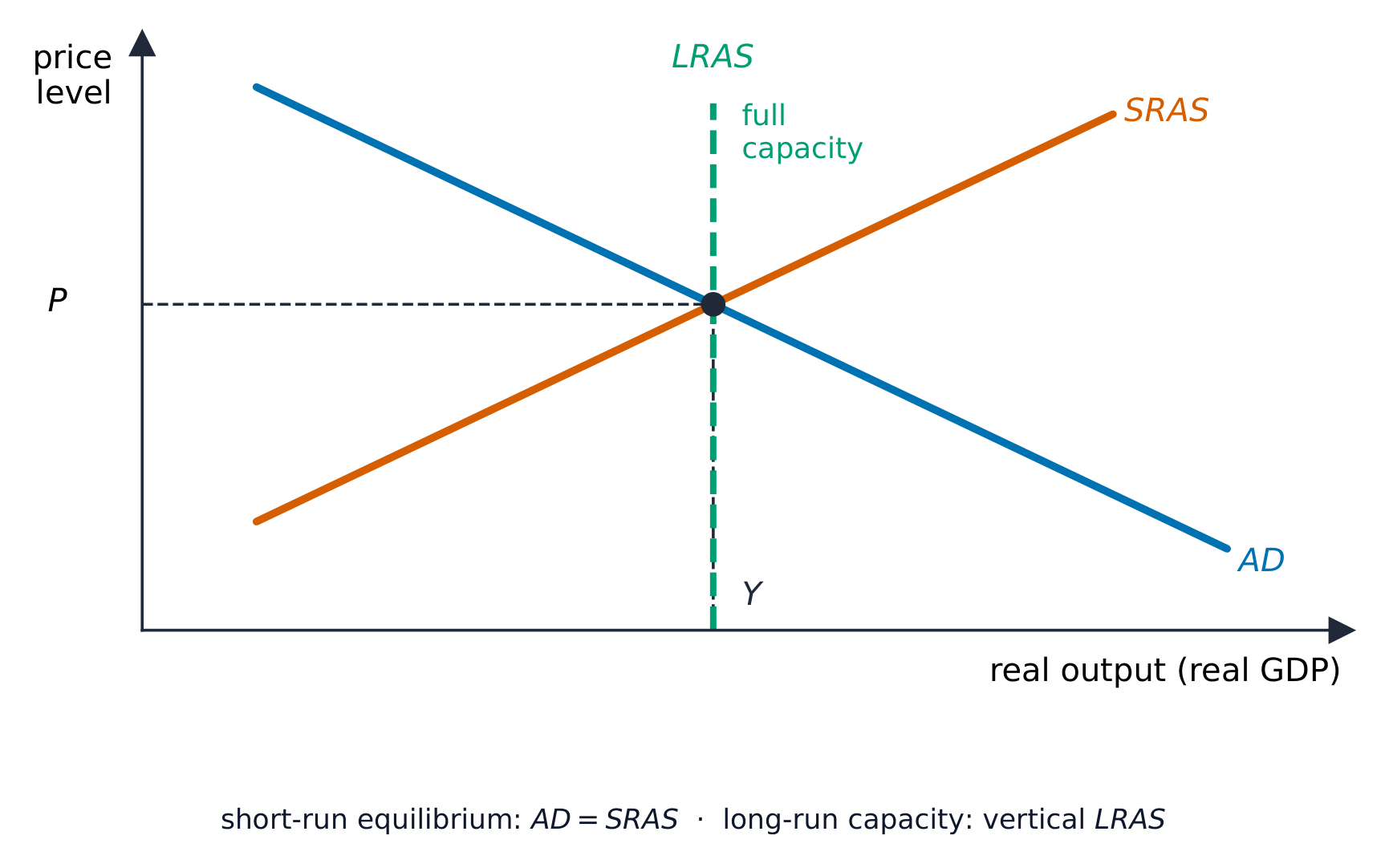
macroeconomic equilibrium 宏观经济均衡 is where AD crosses AS. It sets the price level 价格水平 and the real output 实际产出 of the economy. A shift in AD or AS changes both.

ไทย
Aggregate demand และ supply

Aggregate demand

aggregate demand (AD) คือการใช้จ่ายรวมบนสินค้าและบริการของประเทศที่ระดับราคาต่างๆ มีสี่ส่วนประกอบ:

$$AD = C + I + G + (X - M)$$
  • C คือ consumption (การบริโภค) — การใช้จ่ายของครัวเรือน
  • I คือ investment (การลงทุน) — การใช้จ่ายของกิจการบนทุน
  • G คือ government spending (ใช้จ่ายภาครัฐ)
  • (X − M) คือ net exports ( صادراتสุทธิ) — การส่งออกลบด้วยการนำเข้า
กราฟแท่งซ้อนแสดง Aggregate Demand จากสี่ส่วน: Consumption เป็นส่วนใหญ่ ตามด้วย Investment, Government Spending และ Net Exports
Aggregate demand คือการใช้จ่ายรวม: การบริโภค, การลงทุน, ใช้จ่ายภาครัฐ และ صادراتสุทธิ

เส้น AD ลาดลง: ระดับราคาลดลงทำให้การใช้จ่ายจริงสูงขึ้น ดังนั้นความต้องการผลผลิตจริงจึงเพิ่มขึ้น AD เลื่อนเมื่อส่วนประกอบใดส่วนหนึ่งเปลี่ยนไป (เช่น การลดภาษีทำให้ C เพิ่มขึ้น)

Aggregate supply

aggregate supply (AS) คือผลผลิตรวมที่กิจการยินดีผลิตที่ระดับราคาต่างๆ

  • short-run aggregate supply (SRAS) ลาดขึ้น ในระยะสั้น ราคาที่สูงขึ้นทำให้การผลิตทำกำไรมากขึ้น กิจการจึงเสนอขายมากขึ้น SRAS เลื่อนเมื่อต้นทุนเปลี่ยน (ค่าจ้าง, วัตถุดิบ, ภาษี)
  • long-run aggregate supply (LRAS) แสดงถึง productive capacity (ขีดความสามารถในการผลิต) ที่เต็มของเศรษฐกิจ มันเลื่อนได้เฉพาะเมื่อปริมาณหรือคุณภาพของปัจจัยการผลิตเปลี่ยนไป

Macroeconomic equilibrium

macroeconomic equilibrium (สมดุลทางเศรษฐศาสตร์มหภาค) คือจุดที่ AD ตัดกับ AS จุดนี้กำหนด price level (ระดับราคา) และ real output (ผลผลิตจริง) ของเศรษฐกิจ การเลื่อนของ AD หรือ AS จะส่งผลต่อทั้งสองอย่าง

Aggregate Demand ตัดกับ Aggregate Supply ที่จุดสมดุลทางมหภาค
สมดุลกำหนดระดับราคา $P$ และผลผลิตจริง $Y$ ที่จุดตัดของ AD กับ SRAS; เส้น LRAS แนวตั้งบ่งชี้ถึงขีดความสามารถเต็มที่
Explore · ⁨สำรวจ⁩

Aggregate demand & supply · ⁨อุปสงค์รวม & อุปทานรวม⁩

AD and AS cross at the price level and national output. · ⁨AD และ AS ตัดกันที่ระดับราคาและผลผลิตแห่งชาติ⁩

Vocabulary · ⁨คำศัพท์⁩ Train · ⁨ฝึกฝน⁩
English ไทย
aggregate demand/ˈæɡrɪɡeɪt dɪˈmænd/ อุปสงค์รวม
consumption/kənˈsʌmpʃn/ การบริโภค
net exports/net ˈekspɔːts/ صادراتสุทธิ
aggregate supply/ˈæɡrɪɡeɪt səˈplaɪ/ อุปทานรวม
short-run aggregate supply/ʃɔːt rʌn ˈæɡrɪɡeɪt səˈplaɪ/ short-run aggregate supply
long-run aggregate supply/lɒŋ rʌn ˈæɡrɪɡeɪt səˈplaɪ/ long-run aggregate supply
productive capacity/prəˈdʌktɪv kəˈpæsɪti/ กำลังการผลิต
macroeconomic equilibrium/ˌmækrəˌriːkəˈnɒmɪk ˌiːkwɪˈlɪbrɪəm/ สมดุลทางมหภาค
price level/praɪs ˈlevl/ ระดับราคา
real output/rɪəl ˈaʊtpʊt/ ผลผลิตจริง
4.4

Economic growth · ⁨การเติบโตทางเศรษฐกิจ⁩

Syllabus · ⁨หลักสูตร⁩
English
  1. distinguish actual and potential growth and explain the causes of economic growth
  2. explain the costs and benefits of economic growth and the business (trade) cycle
ไทย
  1. แยกแยะการเติบโตจริง (actual) และการเติบโตที่คาดหวัง (potential) อธิบายสาเหตุของการเติบโตทางเศรษฐกิจ
  2. อธิบายต้นทุนและประโยชน์ของการเติบโตทางเศรษฐกิจ以及วัฏจักรธุรกิจ (business/trade cycle)

Source: Cambridge International syllabus · ⁨แหล่งที่มา: หลักสูตร Cambridge International⁩

English

economic growth 经济增长 is a rise in a country's real output (real GDP) over time.

  • actual growth 实际增长 is the rise in output that really happens (a movement to a point further out, or from inside the LRAS towards it).
  • potential growth 潜在增长 is the rise in the economy's capacity (the LRAS shifting outward).

Growth is caused by more or better factors of production: a bigger or more skilled workforce, more investment in capital, new technology, and higher productivity 生产率 (output per worker).

The business cycle

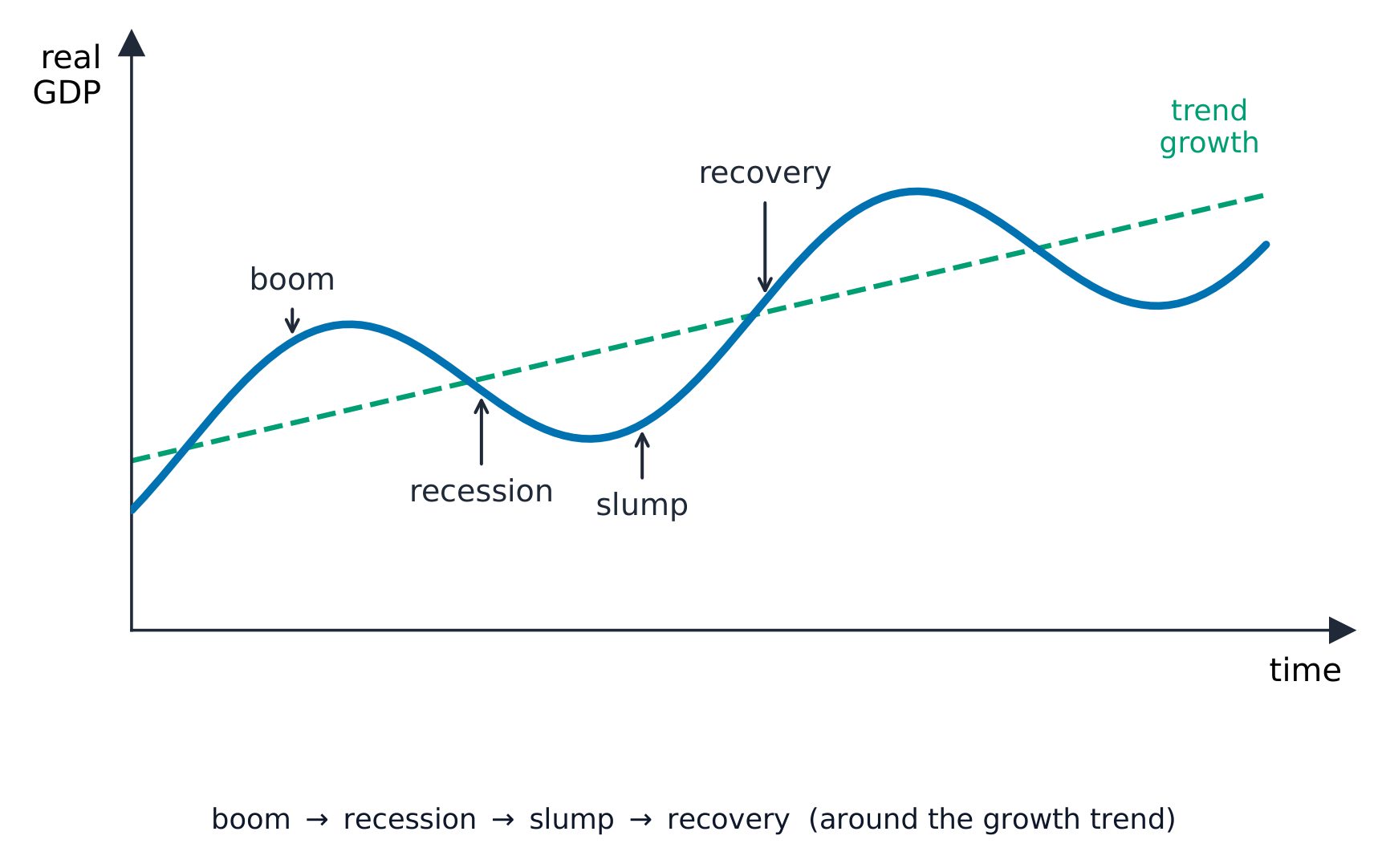
Real output does not grow smoothly. The business cycle 经济周期 (also called the trade cycle) is the up-and-down pattern of output over the years. It has four phases: boom 繁荣 (fast growth), recession 衰退 (falling output), slump 萧条 (the low point), and recovery 复苏.

Costs and benefits of growth

Benefits Costs
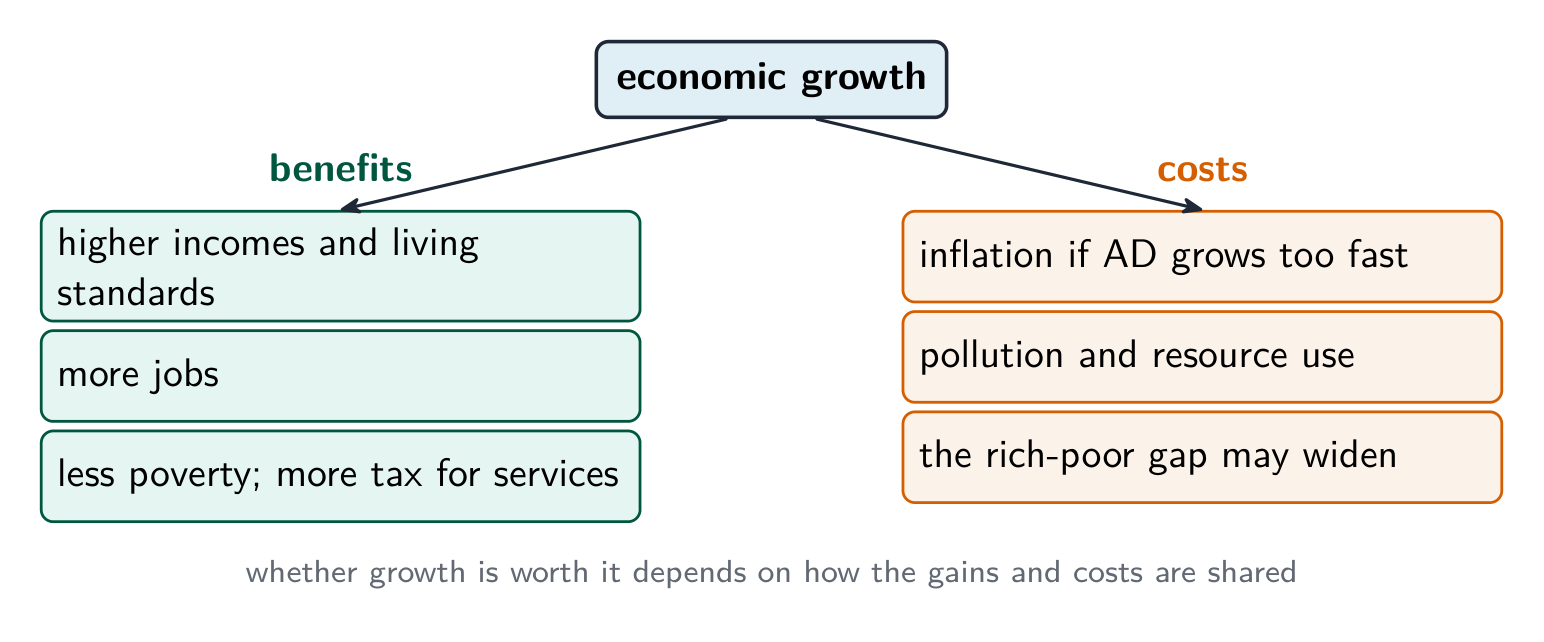
higher incomes and living standards can cause inflation if AD grows too fast
more jobs pollution and use of resources
less poverty; more tax for public services the gap between rich and poor may widen
ไทย

economic growth (การเติบโตทางเศรษฐกิจ) คือการเพิ่มขึ้นของผลผลิตจริงของประเทศ (Real GDP) ตามกาลเวลา

  • actual growth (การเติบโตจริง) คือการเพิ่มขึ้นของผลผลิตที่เกิดขึ้นจริง (การเคลื่อนที่ไปยังจุดที่ไกลออกไป หรือจากภายในเส้น LRAS เข้าหาเส้นนั้น)
  • potential growth (ศักยภาพการเติบโต) คือการเพิ่มขึ้นของขีดความสามารถของเศรษฐกิจ (เส้น LRAS เลื่อนออกไปด้านนอก)

การเติบโตเกิดจากปัจจัยการผลิตที่มากขึ้นหรือมีคุณภาพดีขึ้น: แรงงานที่มีขนาดใหญ่ขึ้นหรือมีทักษะสูงขึ้น การลงทุนในทุนที่เพิ่มขึ้น เทคโนโลยีใหม่ และ ผลผลิต (ผลผลิตต่อแรงงาน) ที่สูงขึ้น

วัฏจักรทางธุรกิจ

ผลผลิตจริงไม่เติบโตอย่างราบรื่น วัฏจักรทางธุรกิจ (หรือเรียกว่าวัฏจักรการค้า) คือรูปแบบการขึ้นลงของผลผลิตตลอดหลายปี มีสี่ระยะ: ช่วงเฟื่องฟู (การเติบโตอย่างรวดเร็ว), ช่วง recession (ผลผลิตลดลง), ช่วงวิกฤต (จุดต่ำสุด) และ ช่วงฟื้นตัว

GDP จริงเพิ่มขึ้นและลดลงเป็นคลื่นรอบเส้นแนวโน้มที่เพิ่มขึ้น
GDP จริงแกว่งตัวผ่านช่วงเฟื่องฟู recession วิกฤต และฟื้นตัวรอบเส้นแนวโน้มระยะยาวที่เพิ่มขึ้น

ค่าใช้จ่ายและผลประโยชน์ของการเติบโต

ผลประโยชน์ ค่าใช้จ่าย
รายได้และมาตรฐานชีวิตสูงขึ้น อาจทำให้เกิดเงินเฟ้อหาก AD เติบโตเร็วเกินไป
งานเพิ่มมากขึ้น มลพิษและการใช้ทรัพยากร
ความยากจนลดลง; ภาษีสำหรับบริการสาธารณะเพิ่มขึ้น ช่องว่างระหว่างคนรวยและคนจนอาจกว้างขึ้น
การประเมินการเติบโตทางเศรษฐกิจ: ผลประโยชน์เช่นรายได้สูงขึ้น งานเพิ่มขึ้น และความยากจนลดลง เทียบกับค่าใช้จ่ายเช่นเงินเฟ้อ มลพิษ และช่องว่างระหว่างคนรวยและคนจนที่กว้างขึ้น
การเติบโตทางเศรษฐกิจนำมาซึ่งรายได้สูงขึ้นและงาน แต่สามารถนำไปสู่เงินเฟ้อ มลพิษ และความไม่เท่าเทียมกัน
Explore · ⁨สำรวจ⁩

Economic growth shifts the frontier out · ⁨การเติบโตทางเศรษฐกิจทำให้เส้น PPF ขยับออกด้านนอก⁩

Growth means the economy can produce more of BOTH goods — the whole frontier moves outward as resources or technology improve. · ⁨การเติบโตหมายถึงเศรษฐกิจสามารถผลิตสินค้าทั้งสองชนิดได้มากขึ้น – เส้นโค้งทั้งหมดเคลื่อนย้ายออกเมื่อทรัพยากรหรือเทคโนโลยีดีขึ้น⁩

Vocabulary · ⁨คำศัพท์⁩ Train · ⁨ฝึกฝน⁩
English ไทย
economic growth/ˌiːkəˈnɒmɪk ɡrəʊθ/ การเติบโตทางเศรษฐกิจ
actual growth/ˈæktʃuːəl ɡrəʊθ/ การเติบโตจริง
potential growth/pəˈtenʃl ɡrəʊθ/ การเติบโตที่อาจเกิดขึ้น
productivity/ˌprɒdəkˈtɪvɪti/ ประสิทธิภาพการผลิต
business cycle/ˈbɪznəs ˈsaɪkl/ วัฏจักรธุรกิจ
boom/buːm/ boom
recession/rɪˈseʃn/ ภาวะเศรษฐกิจถดถอย
slump/slʌmp/ ภาวะเศรษฐกิจตกต่ำ
recovery/rɪˈkʌvəri/ การฟื้นตัว
4.5

Unemployment · ⁨การว่างงาน⁩

Syllabus · ⁨หลักสูตร⁩
English
  1. define and measure unemployment (claimant count and labour force survey)
  2. explain the types and causes of unemployment (frictional, structural, cyclical, seasonal) and its consequences
ไทย
  1. นิยามและวัดการว่างงาน (claimant count และ labour force survey)
  2. อธิบายประเภทและสาเหตุของการว่างงาน (frictional, structural, cyclical, seasonal) รวมถึงผลกระทบ

Source: Cambridge International syllabus · ⁨แหล่งที่มา: หลักสูตร Cambridge International⁩

English

unemployment 失业 means people who are able and willing to work, and are looking for a job, but cannot find one.

Measuring unemployment

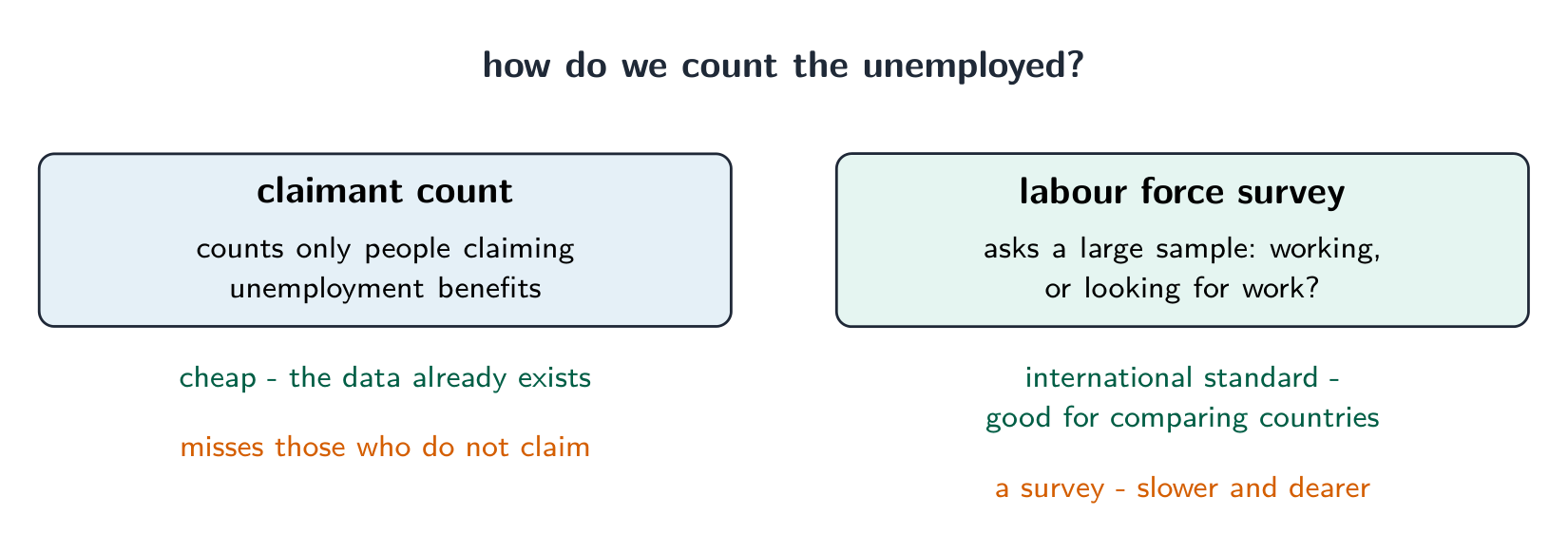
  • the claimant count 申领救济人数 counts only people claiming unemployment benefits. It is cheap but misses those who do not claim.
  • the labour force survey 劳动力调查 asks a large sample whether they are working or seeking work. It follows an international standard, so it is better for comparing countries. The labour force 劳动力 is everyone working or looking for work.

Types and causes

  • frictional unemployment 摩擦性失业 — short-term, while people move between jobs.
  • structural unemployment 结构性失业 — when an industry declines and workers' skills no longer match the jobs available.
  • cyclical unemployment 周期性失业 — caused by low AD in a recession. This is usually the largest type.
  • seasonal unemployment 季节性失业 — when work is only available at certain times of the year (such as farming or tourism).

Consequences

Unemployment wastes output (the economy produces inside its PPC), lowers incomes, and costs the government (more benefits, less tax). It also harms families and can raise crime and ill health.

ไทย

การว่างงาน หมายถึงบุคคลที่มีความสามารถและพร้อมจะทำงาน และกำลังมองหางานแต่ไม่สามารถหาได้

การวัดการว่างงาน

  • จำนวนผู้ขอรับสิทธิประโยชน์ นับเฉพาะผู้ที่ขอรับเงินสวัสดิการว่างงาน มีต้นทุนต่ำแต่ขาดผู้ที่ไม่ได้ขอรับ
  • การสำรวจกำลังแรงงาน สำรวจกลุ่มตัวอย่างขนาดใหญ่ว่าพวกเขาทำงานหรือกำลังมองหาหรือไม่ เป็นไปตามมาตรฐานสากลจึงเหมาะสำหรับการเปรียบเทียบประเทศ กำลังแรงงาน คือทุกคนที่กำลังทำงานหรือกำลังมองหา
สองวิธีข้างกัน: จำนวนผู้ขอรับสิทธิประโยชน์มีต้นทุนต่ำแต่ขาดผู้ที่ไม่ได้ขอ; การสำรวจกำลังแรงงานเป็นไปตามมาตรฐานสากลแต่ช้าและมีค่าแพงกว่า
สองวิธีการนับผู้ว่างงาน - และสิ่งที่แต่ละวิธีขาด

ประเภทและสาเหตุ

  • การว่างงานแบบเสียดทาน — ระยะสั้น ในขณะที่บุคคลเปลี่ยนงาน
  • การว่างงานแบบโครงสร้าง — เมื่ออุตสาหกรรมถดถอยและทักษะของแรงงานไม่ตรงกับงานที่มีอยู่
  • การว่างงานแบบวัฏจักร — เกิดจาก AD ต่ำในช่วง recession มักเป็นประเภทที่ใหญ่ที่สุด
  • การว่างงานตามฤดูกาล — เมื่อมีงานเฉพาะ在某些季节 (เช่น การเกษตรหรือการท่องเที่ยว)
สามประเภทของการว่างงาน: แบบเสถียรภาพ, แบบโครงสร้าง และแบบรอบ周期的

ผลกระทบ

การว่างงานทำให้ผลผลิตสูญเปล่า (เศรษฐกิจผลิตภายใน PPC ของตัวเอง) ลดรายได้นี้ และสร้างภาระให้รัฐบาล (สวัสดิการมากขึ้น ภาษีน้อยลง) ยังทำลายครอบครัวและอาจเพิ่มอาชญากรรมและโรคภัย

Explore · ⁨สำรวจ⁩

Unemployment in the labour market · ⁨การว่างงานในตลาดแรงงาน⁩

If the wage is stuck ABOVE the equilibrium, more workers want jobs than firms will hire — that gap is unemployment. · ⁨หากค่าจ้างติดอยู่เหนือจุดสมดุล มีคนต้องการงานมากกว่าที่บริษัทรับเข้า – ช่องว่างนี้คือการว่างงาน⁩

Vocabulary · ⁨คำศัพท์⁩ Train · ⁨ฝึกฝน⁩
English ไทย
unemployment/ʌnemˈplɔɪmənt/ อัตราการว่างงาน
claimant count/ˈkleɪmənt kaʊnt/ จำนวนผู้ขอรับสวัสดิการ
labour force survey/ˈleɪbə fɔːs ˈsɜːveɪ/ การสำรวจแรงงาน
labour force/ˈleɪbə fɔːs/ กำลังแรงงาน
frictional unemployment/ˈfrɪkʃənl ʌnemˈplɔɪmənt/ การว่างงานแบบเสียดทาน (frictional unemployment)
structural unemployment/ˈstrʌktʃərəl ʌnemˈplɔɪmənt/ การว่างงานเชิงโครงสร้าง (structural unemployment)
cyclical unemployment/ˈsaɪklɪkl ʌnemˈplɔɪmənt/ การว่างงานตามรอบธุรกิจ (cyclical unemployment)
seasonal unemployment/ˈsiːzənl ʌnemˈplɔɪmənt/ การว่างงานตามฤดูกาล (seasonal unemployment)
4.6

Price stability · ⁨ความมั่นคงของราคา⁩

Syllabus · ⁨หลักสูตร⁩
English
  1. define inflation, deflation and disinflation and explain how the price level is measured
  2. explain the causes (demand-pull and cost-push) and consequences of inflation and deflation
ไทย
  1. นิยาม inflation, deflation และ disinflation พร้อมอธิบายวิธีการวัดระดับราคา
  2. อธิบายสาเหตุ (demand-pull และ cost-push) และผลกระทบของ inflation และ deflation

Source: Cambridge International syllabus · ⁨แหล่งที่มา: หลักสูตร Cambridge International⁩

English

Inflation, deflation and disinflation

  • inflation 通货膨胀 is a sustained rise in the general price level. Money then buys less, so its purchasing power 购买力 falls.
  • deflation 通货紧缩 is a sustained fall in the general price level.
  • disinflation 反通货膨胀 is when inflation is still positive but is slowing down (prices rise, but more slowly).

The price level is measured with the consumer price index 消费者价格指数 (CPI). A typical household's spending is used to build a "basket" of goods. Each good is given a weight 权重 for how much is spent on it, and the change in the basket's cost from year to year is the inflation rate:

$$\text{inflation rate} = \frac{\text{change in index}}{\text{starting index}} \times 100\%.$$

Worked example. A country's CPI rises from $100$ to $104$ over one year, then to $107$ the year after. Find the inflation rate in each year.

Year 1: $\dfrac{104 - 100}{100} \times 100\% = 4\%$. Year 2: $\dfrac{107 - 104}{104} \times 100\% = 2.9\%$.

Notice that prices are still rising in year 2, just more slowly — this fall in the inflation rate (from $4\%$ to $2.9\%$) is disinflation, not deflation.

Worked example. A worker's wage rises from $\text{\pounds} 500$ to $\text{\pounds} 520$ a week (a $4\%$ rise) while the CPI rises by $4\%$. What happens to the real wage?

Money (nominal) pay is up $4\%$, but prices are also up $4\%$, so the real wage — what the pay can actually buy — is unchanged. A pay rise only raises living standards if it beats inflation.

Causes of inflation

  • demand-pull inflation 需求拉动型通货膨胀 — AD rises faster than AS, so "too much money chases too few goods".
  • cost-push inflation 成本推动型通货膨胀 — firms' costs rise (wages or raw materials), so they raise prices, shifting SRAS to the left.

Consequences

Inflation lowers purchasing power, especially for people on fixed incomes. It creates uncertainty, can make a country's exports dearer, and helps borrowers but harms savers. Deflation sounds good but can be harmful: people delay buying (waiting for lower prices), so AD falls, firms cut output, and unemployment rises.

ไทย

เงินเฟ้อ การลดทอนราคา และการชะลอเงินเฟ้อ

  • เงินเฟ้อ คือการเพิ่มขึ้นอย่างต่อเนื่องของระดับราคาทั่วไป เงินซื้อสิ่งของได้น้อยลง ดังนั้น อำนาจซื้อ จึงลดลง
  • การลดทอนราคา คือการลดลงอย่างต่อเนื่องของระดับราคาทั่วไป
  • การชะลอเงินเฟ้อ คือเมื่อเงินเฟ้อยังเป็นบวกแต่กำลังชะลอตัว (ราคาเพิ่มขึ้นแต่ช้าลง)
ชั้นวางสินค้าในซูเปอร์มาร์เก็ต: เงินเฟ้อวัดจากราคาตะกร้าสินค้าประจำวัน
เงินเฟ้อวัดจากราคาตะกร้าสินค้าประจำวันเหล่านี้

ระดับราคาวัดด้วย ดัชนีราคาผู้บริโภค (CPI) ใช้การใช้จ่ายของครัวเรือนทั่วไปเพื่อสร้าง "ตะกร้า" สินค้า แต่ละสินค้าได้รับ น้ำหนัก ตามสัดส่วนการใช้จ่าย และการเปลี่ยนแปลงต้นทุนของตะกร้าจากปีหนึ่งไปยังอีกปีหนึ่งคืออัตราเงินเฟ้อ:

$$\text{inflation rate} = \frac{\text{change in index}}{\text{starting index}} \times 100\%.$$

ตัวอย่างคำนวณ. CPI ของประเทศหนึ่งเพิ่มขึ้นจาก $100$ เป็น $104$ ในหนึ่งปี แล้ว增加到 $107$ ในปีถัดไป หาอัตราเงินเฟ้อในแต่ละปี

ปีที่ 1: $\dfrac{104 - 100}{100} \times 100\% = 4\%$. ปีที่ 2: $\dfrac{107 - 104}{104} \times 100\% = 2.9\%$.

สังเกตว่าราคายังคง เพิ่มขึ้น ในปี 2 เพียงแต่ช้าลง — การลดลงของอัตราเงินเฟ้อนี้ (จาก $4\%$ ไปยัง $2.9\%$) คือ Disinflation ไม่ใช่ Deflation.

ตัวอย่างคำนวณ. เงินเดือนของลูกจ้างเพิ่มขึ้นจาก $\text{\pounds} 500$ เป็น $\text{\pounds} 520$ ต่อสัปดาห์ (เพิ่มขึ้น $4\%$) ขณะเดียวกัน CPI เพิ่มขึ้น $4\%$ เงินเดือนจริง会发生什么?

เงินเดือน (นามิINAL) เพิ่มขึ้น $4\%$ แต่价格也ขึ้น $4\%$ ดังนั้นเงินเดือนจริง — สิ่งที่เงินเดือนนั้นซื้อได้จริง — ไม่เปลี่ยนแปลง การขึ้นเงินเดือนจะยกระดับชีวิตได้ก็ต่อเมื่อชนะเงินเฟ้อเท่านั้น

สาเหตุของเงินเฟ้อ

  • เงินเฟ้อจากแรงดึงด้านความต้องการ — AD เติบโตเร็วกว่า AS ทำให้ "เงินมากเกินไปไล่ล่าสินค้า不足的"
  • เงินเฟ้อจากแรงดันด้านต้นทุน — ต้นทุนของกิจการเพิ่มขึ้น (ค่าจ้างหรือวัตถุดิบ) ทำให้ họขึ้นราคา เลื่อน SRAS ไปทางซ้าย
เงินเฟ้อจากแรงดึงและแรงดันแสดงบนแผนภูมิ AD-AS สองชุด
เงินเฟ้อจากแรงดึงมาจาก AD เลื่อนไปทางขวา; เงินเฟ้อจากแรงดันมาจาก SRAS เลื่อนไปทางซ้าย ทั้งสองทำให้ระดับราคาสูงขึ้น

ผลกระทบ

เงินเฟ้อลดอำนาจซื้อ โดยเฉพาะสำหรับคนที่มีรายได้คงที่ สร้างความไม่แน่นอน อาจทำให้ صادراتของประเทศแพงขึ้น ช่วยผู้กู้แต่ทำร้ายผู้ออม การลดทอนราคาฟังดูดีแต่อาจเป็นอันตราย: คนรอซื้อ (รอให้ราคาถูกกว่า) ทำให้ AD ลดลง กิจการตัดผลผลิต และการว่างงานเพิ่มขึ้น

Explore · ⁨สำรวจ⁩

Aggregate demand and supply · ⁨อุปสงค์รวมและอุปทานรวม⁩

The overall price level sits where aggregate demand meets aggregate supply — a shock to either moves prices and output. · ⁨ระดับราคารวมอยู่ที่จุดที่อุปสงค์รวมตัดกับอุปทานรวม – การกระแทก (shock) ต่อ任何一方จะส่งผลต่อราคาและผลผลิต⁩

Vocabulary · ⁨คำศัพท์⁩ Train · ⁨ฝึกฝน⁩
English ไทย
inflation/ɪnˈfleɪʃn/ เงินเฟ้อ
purchasing power/ˈpɜːtʃɪsɪŋ ˈpaʊə/ อำนาจซื้อ
deflation/diːˈfleɪʃn/ ภาวะเงินฝืด
disinflation/ˌdɪsɪnˈfleɪʃn/ ภาวะเงินเฟ้อลดลง
consumer price index/kənˈsuːmə praɪs ˈɪndeks/ ดัชนีราคาสินค้าผู้บริโภค
weight/weɪt/ น้ำหนัก
demand-pull inflation/dɪˈmænd pʊl ɪnˈfleɪʃn/ เงินเฟ้อจากแรงดึงด้านความต้องการ
cost-push inflation/kɒst pʊʃ ɪnˈfleɪʃn/ เงินเฟ้อจากฝั่งต้นทุน (cost-push inflation)
4.6

Exam tips · ⁨ข้อแนะนำสำหรับการสอบ⁩

English
  • Distinguish real vs nominal (real removes inflation) and calculate an inflation rate from a price index.
  • Explain AD $= C + I + G + (X - M)$ and what shifts each part; distinguish an AD shift from an AS shift.
  • Distinguish the types of unemployment (frictional, structural, cyclical) and how each is tackled.
  • Distinguish demand-pull vs cost-push inflation on an AD/AS diagram.
ไทย
  • แยกแยะ จริง vs นามิINAL (จริงลบเงินเฟ้อออก) และคำนวณ อัตราเงินเฟ้อ จากดัชนีราคา
  • อธิบาย AD $= C + I + G + (X - M)$ และสิ่งที่เลื่อนแต่ละส่วน; แยกแยะการเลื่อน AD จาก SRAS
  • แยกแยะ ประเภทของการว่างงาน (เสียดทาน โครงสร้าง วัฏจักร) และวิธีแก้ไขแต่ละประเภท
  • แยกแยะ เงินเฟ้อจากแรงดึง vs แรงดัน บนแผนภูมิ AD/AS

Interactive lessons on this topic · ⁨บทเรียนเชิงโต้ตอบสำหรับหัวข้อนี้⁩

Work through it step by step, with instant-check exercises. · ⁨ทำทีละขั้นตอน พร้อมแบบฝึกหัดตรวจสอบผลทันที⁩

Past Papers · ⁨ข้อสอบย้อนหลัง⁩

More topics in A-Level Economics · ⁨Economics A-Level⁩ · ⁨หัวข้อเพิ่มเติมใน A-Level Economics · ⁨Economics A-Level⁩⁩

Log in or create account · ⁨เข้าสู่ระบบหรือสร้างบัญชี⁩

IGCSE, A-Level & AP