The circular flow of income
Introduced| English | Meaning |
|---|---|
| firms/fɜːmz/ | Organisations that use inputs to produce goods or services for sale. |
| circular flow of income/ˈsɜːkjʊlə fləʊ ɒv ˈɪŋkʌm/ | A model showing flows of income, expenditure and resources between households, firms and other sectors of an economy. |
| households/ˈhaʊshəʊldz/ | Individuals or groups living together who consume goods and services and supply productive resources. |
| injections/ɪnˈdʒekʃnz/ | Spending entering the circular flow from investment, government purchases and exports. |
| withdrawals/wɪθˈdrɔːlz/ | Saving, taxes and import spending that remove expenditure from the domestic circular flow of income. |
| savings/ˈseɪvɪŋz/ | Income not spent on consumption and retained for future use. |
| investment/ɪnˈvestmənt/ | Spending on assets intended to provide future returns or increase productive capacity. |
The economy as a loop
- Your wages come from a firm; you spend them at firms 企业; those firms pay wages again. Money goes round and round.
- The circular flow of income 收入循环流 captures this loop — and shows what makes an economy grow or shrink.
Households 家庭 and firms
- Households supply factors of production and receive income; they spend it on goods.
- Firms produce goods and pay households' incomes. Spending and income chase each other around the loop.
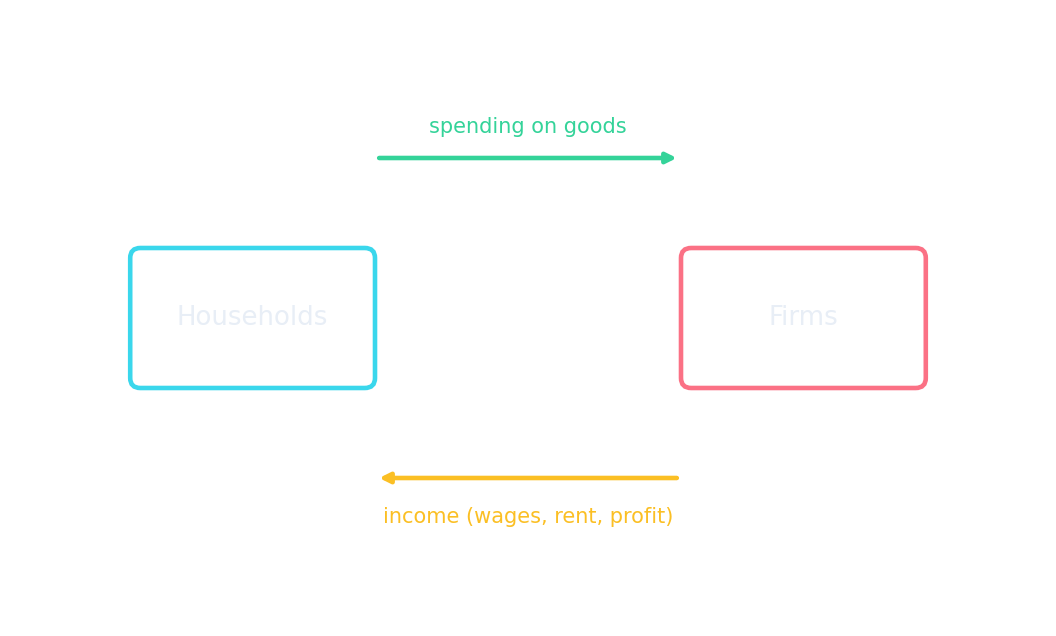
Spending flows from households to firms; income flows back — the basic two-sector circular flow.
Injections & leakages
Money loops between households and firms. Injections grow national income, leakages shrink it; they are equal at equilibrium.
The circular flow of income
Money flows in a loop: households earn income from firms, then spend it back on the firms' goods. Step round the cycle.
Injections 注入 and withdrawals 漏出
- Withdrawals (leakages) take money out of the loop: savings 储蓄 (S), taxes (T), imports (M).
- Injections add money in: investment 投资 (I), government spending (G), exports (X).

The circular flow of income with leakages and injections
Which is an injection into the circular flow?
Difficulty 1/5 · 100 coins + a small bonus on first completion today
Injections are investment, government spending and exports; the others are withdrawals.
Classify each flow.
Difficulty 2/5 · 140 coins + a small bonus on first completion today
Withdrawals (S, T, M) leak out; injections (I, G, X) add in.
Savings, taxes and imports are the three ______ from the circular flow.
Difficulty 1/5 · 100 coins + a small bonus on first completion today
They leak money out of the flow.
Equilibrium
- National income is in equilibrium when injections = withdrawals (S + T + M = I + G + X).
- If injections exceed withdrawals, income grows; if withdrawals exceed injections, it shrinks.
Saving is a withdrawal, not a boost. It may feel virtuous, but money saved leaves the circular flow — it only returns if it's borrowed and invested (an injection).
National income is in equilibrium when injections equal withdrawals.
Difficulty 1/5 · 100 coins + a small bonus on first completion today
When I + G + X = S + T + M, income is stable.
If injections exceed withdrawals, national income will:
Difficulty 1/5 · 100 coins + a small bonus on first completion today
More money enters the loop than leaves, so income rises.
You've got it
- the circular flow: households' spending → firms → income → households
- withdrawals (S, T, M) leak out; injections (I, G, X) add in
- equilibrium when injections = withdrawals; injections > withdrawals → income grows