Economic growth
Introduced| English | Meaning |
|---|---|
| business cycle/ˈbɪznəs ˈsaɪkl/ | Fluctuations in economic activity between expansion and contraction over time. |
| potential growth/pəˈtenʃl ɡrəʊθ/ | An increase in an economy's capacity to produce goods and services sustainably. |
| actual growth/ˈæktʃuːəl ɡrəʊθ/ | Real GDP rise. |
| recession/rɪˈseʃn/ | A significant, sustained decline in an economy's overall activity. |
| recovery/rɪˈkʌvəri/ | A phase in which economic activity rises again after a downturn. |
| human capital/ˈhjuːmən ˈkæpɪtl/ | The knowledge, skills, experience and health that contribute to people's productive ability. |
Why economies boom and bust
- No economy grows in a smooth line — it surges, overheats, slumps, and recovers, again and again.
- Understanding the business cycle 经济周期 and what drives growth is the heart of macro policy.
Potential growth is best shown on a PPF as:
Difficulty 1/5 · 100 coins + a small bonus on first completion today
Potential (capacity) growth shifts the whole PPF out; actual growth can be a move toward/along it.
Actual vs potential growth 潜在增长
- Actual growth 实际增长 = the real rise in GDP this year (moving toward, or along, the PPF).
- Potential growth = the rise in the economy's capacity (the PPF shifting out) — from more or better resources and technology.
Economic growth shifts the frontier out
Growth means the economy can produce more of BOTH goods — the whole frontier moves outward as resources or technology improve.
A recession is conventionally two consecutive quarters of falling real GDP.
Difficulty 1/5 · 100 coins + a small bonus on first completion today
Two quarters of negative real GDP growth is the common definition.
Put the phases of the business cycle in order, starting from the peak.
Difficulty 3/5 · 200 coins + a small bonus on first completion today
The cycle runs boom → slowdown → recession → recovery, then back to boom.
The business cycle
- Real GDP cycles around its long-run trend: boom → slowdown → recession 衰退 → recovery 复苏.
- A recession is conventionally two consecutive quarters of falling real GDP.
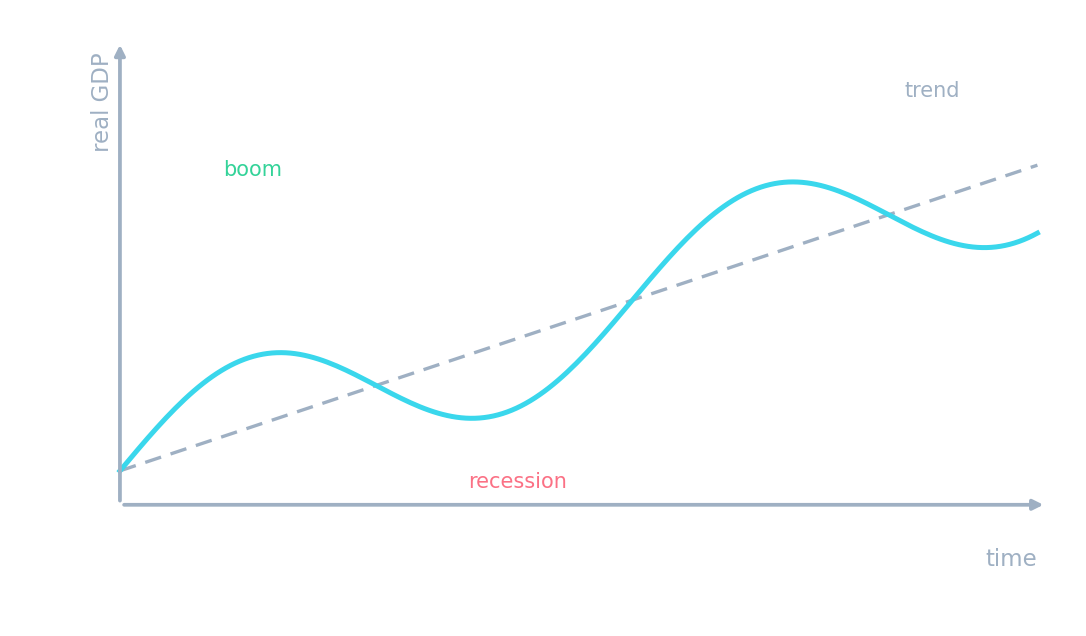
Real GDP swings above and below its long-run trend — booms and recessions.
Worked example. GDP rises from 500bn to 520bn in a year. Growth rate = (20 ÷ 500) × 100 = 4%.
GDP rises from 500bn to 520bn in a year. What is the growth rate (%)?
Difficulty 2/5 · 140 coins + a small bonus on first completion today
(20 / 500) × 100 = 4%.
Causes and costs
- Causes of growth: investment, technology, education (human capital 人力资本), more labour.
- Benefits: higher incomes, more jobs, better public services. Costs: inflation risk, inequality, environmental damage, resource depletion.
Spending by firms on capital goods, which raises future capacity, is called ______.
Difficulty 1/5 · 100 coins + a small bonus on first completion today
Investment is a key driver of both actual and potential growth.
You've got it
- actual growth = real GDP rise; potential growth = capacity rise (PPF shifts out)
- the business cycle: boom → slowdown → recession → recovery, around a rising trend
- growth comes from investment, technology, human capital; it has benefits and costs