English
This final topic covers trade imbalances, exchange rates in depth, and how countries develop and connect.
日本語
この最終トピックでは、貿易不均衡、為替レートの詳細な分析、そして国々の発展や相互接続について扱う。
A-Level Economics · Aレベル経済学 · Topic 11 · トピック 11
 8:57
8:57
国際経済問題 (A-Level)
ある国の通貨が一夜にして価値の五分の一を失いました。輸出は突然安くなり、輸入は高くなりますが、貿易黒字化はすぐに実現するはずです。しかし実際にはそうはなりませんでした。…
English narration · English + 中文 subtitles burned in · 英語ナレーション・英語+中文字幕 burning-in
This final topic covers trade imbalances, exchange rates in depth, and how countries develop and connect.
この最終トピックでは、貿易不均衡、為替レートの詳細な分析、そして国々の発展や相互接続について扱う。
Source: Cambridge International syllabus · 出典: Cambridge International シラバス
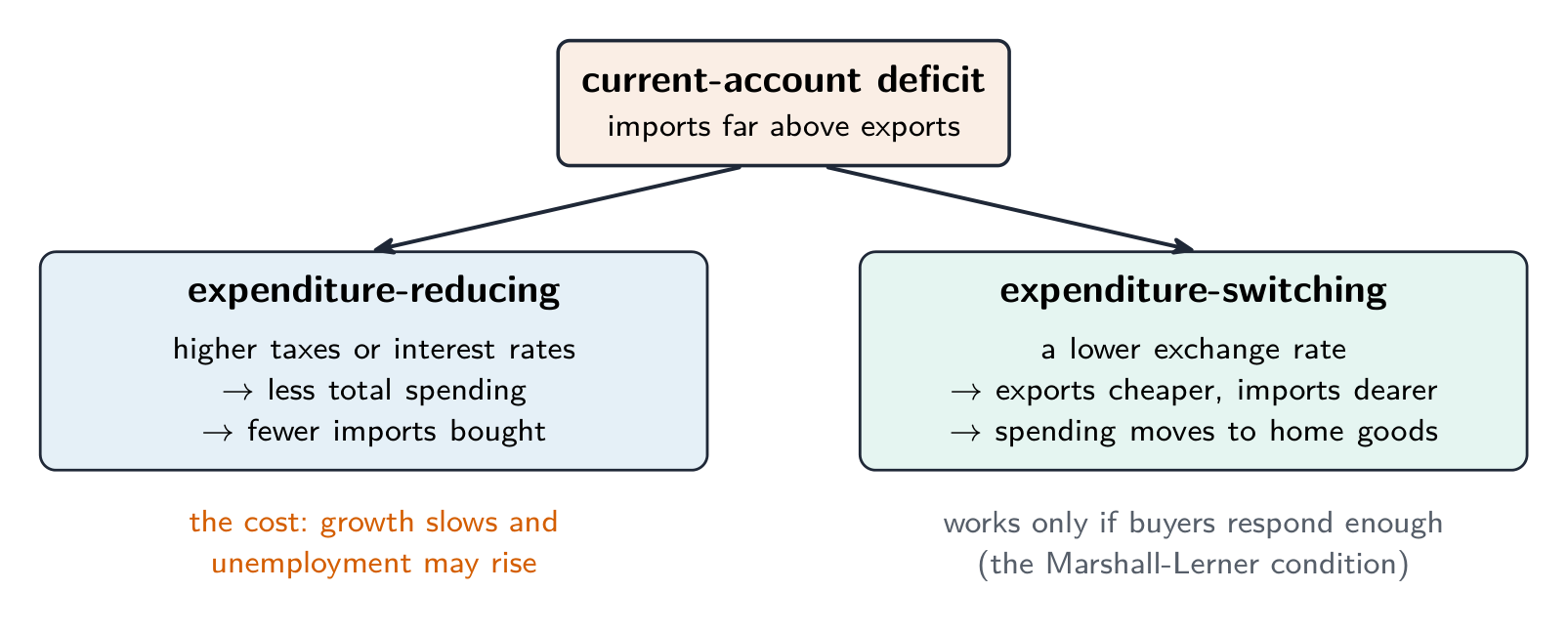
A country with a large balance of payments 国际收支 problem — usually a deficit on the current account 经常账户 — can use two kinds of policy.
A lower exchange rate only improves the current account if buyers respond enough. The Marshall-Lerner condition 马歇尔勒纳条件 says the sum of the price elasticities of demand for exports and imports must be greater than one:
Worked example. After a depreciation, the demand for a country's exports has $PED = 0.6$ and its demand for imports has $PED = 0.7$. Will the current account improve?
so the Marshall-Lerner condition is met, and the depreciation should improve the current account in the long run. (If the two elasticities had summed to less than $1$ — for example $0.3 + 0.4 = 0.7$ — a depreciation would make the deficit worse.)
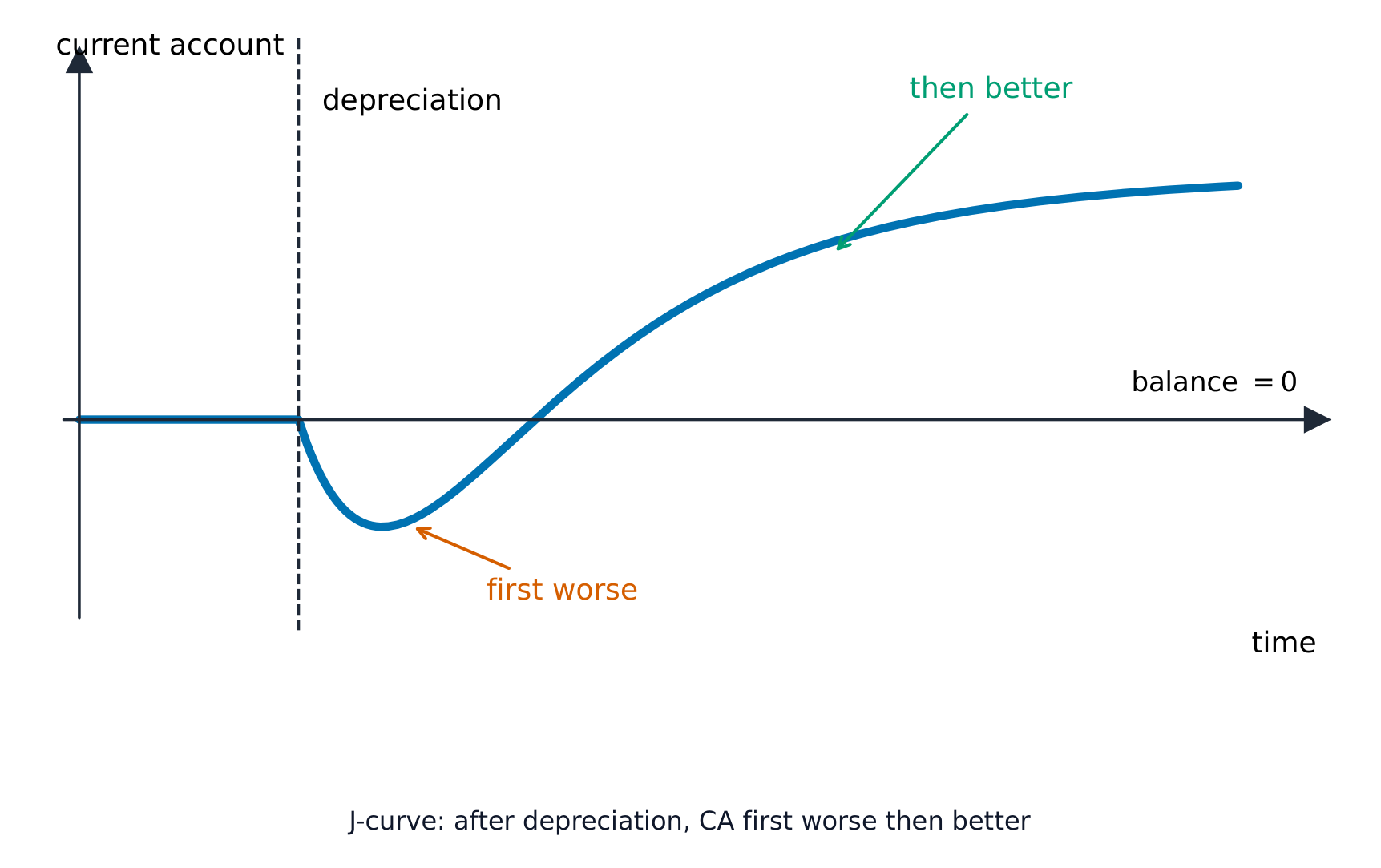
Even when this holds, the gain takes time. The J-curve effect J曲线效应 describes what happens: just after a depreciation, the current account first gets worse (imports cost more straight away, but trade volumes are slow to change), then later improves as buyers adjust — tracing the shape of a letter J.
国際収支に大きな問題がある国—通常は経常収支の赤字—は、2種類の政策を使用できる。
為替レートの引き下げが経常収支を改善するには、買い手の反応が十分である必要がある。マーシャル・ラーナー条件とは、輸出および輸入の需要価格弾力性の合計が1より大きいことを指す:
計算例。 デバリューエーション後、ある国の輸出に対する需要が$PED = 0.6$、輸入に対する需要が$PED = 0.7$であった場合、経常収支は改善されるか?
したがってマーシャル・ラーナー条件は満たされており、長期的にはデバリューエーションが経常収支を改善すると考えられる。(もし2つの弾力性の和が$1$未満、例えば$0.3 + 0.4 = 0.7$であった場合、デバリューエーションは赤字を悪化させる。)
この条件が成立していても、改善には時間がかかる。Jカーブ効果 J は以下のような現象を説明する:デバリューエーション直後、経常収支はまず悪化する(輸入費は即座に高くなるが、貿易量は変化に遅れる)、その後買い手が調整するにつれて改善し、文字「J」の形状を描く。
Classify real examples by the economic idea they show. · 經濟の概念を示す実例を分類せよ。
| English | 日本語 |
|---|---|
| balance of payments/ˈbæləns ɒv ˈpeɪmənts/ | 国際収支 |
| current account/ˈkʌrənt əˈkaʊnt/ | 経常収支 |
| expenditure-reducing/ekˈspendɪtʃə rɪˈdjuːsɪŋ/ | 支出抑制政策 |
| expenditure-switching/ekˈspendɪtʃə ˈswɪtʃɪŋ/ | 支出転換政策 |
| exchange rate/eksˈtʃeɪndʒ reɪt/ | 為替レートである |
| depreciation/dɪˌpriːʃɪˈeɪʃn/ | 高値 |
| devaluation/diːˌvæljuːˈeɪʃn/ | 評価額引き上げ |
| Marshall-Lerner condition/ˈmɑːʃl ˈlɜːnə kənˈdɪʃn/ | マーシャル・ラーerner条件 |
| J-curve effect/dʒeɪ kɜːv ɪˈfekt/ | Jカーブ効果 |
| nominal exchange rate/ˈnɒmɪnl eksˈtʃeɪndʒ reɪt/ | 名目為替レート |
| real exchange rate/rɪəl eksˈtʃeɪndʒ reɪt/ | 実質為替レート |
| trade-weighted exchange rate/treɪd ˈweɪtɪd eksˈtʃeɪndʒ reɪt/ | 貿易加重為替レート |
| effective exchange rate/ɪˈfektɪv eksˈtʃeɪndʒ reɪt/ | 実効為替レート |
| floating exchange rate/ˈfləʊtɪŋ eksˈtʃeɪndʒ reɪt/ | 変動為替レート |
| fixed exchange rate/fɪkst eksˈtʃeɪndʒ reɪt/ | 固定為替レート |
| managed exchange rate/ˈmænɪdʒd eksˈtʃeɪndʒ reɪt/ | 管理為替レート |
| appreciation/əˌpriːʃɪˈeɪʃn/ | 評価額引き下げ |
| revaluation/rɪˌvæljuːˈeɪʃn/ | ある国の輸出に対する需要が減少した場合、その floating 為替レートに与える影響を、通貨需給図を用いて説明せよ。 |
| economic growth/ˌiːkəˈnɒmɪk ɡrəʊθ/ | 経済成長である |
| economic development/ˌiːkəˈnɒmɪk dɪˈveləpmənt/ | 経済発展 |
| standard of living/ˈstændəd ɒv ˈlɪvɪŋ/ | 生活水準 |
| Human Development Index/ˈhjuːmən dɪˈveləpmənt ˈɪndeks/ | 人間開発指数(HDI) |
| life expectancy/laɪf ekˈspektənsi/ | 平均寿命 |
| years of schooling/jɪəz ɒv ˈskuːlɪŋ/ | 就学年数 |
| developed country/dɪˈveləpt ˈkʌntri/ | 先進国 |
| developing country/dɪˈveləpɪŋ ˈkʌntri/ | 開発途上国 |
| birth rate/bɜːθ reɪt/ | 出生率 |

Source: Cambridge International syllabus · 出典: Cambridge International シラバス
An exchange rate is the price of one currency in terms of another. There is more than one way to measure it:
Under floating rates, a rise in value is an appreciation 升值 and a fall is a depreciation. Under a fixed system, a deliberate rise is a revaluation 法定升值 and a deliberate fall is a devaluation. A weaker currency tends to raise exports and inflation; a stronger currency does the opposite.
為替レートとは、ある通貨を別の通貨で表した価格のことである。その計測方法は複数ある:
浮動相場制において、価値の上昇を上昇(アpreciエーション)、低下を下落(デプレシエーション)と呼ぶ。固定相場制において、意図的な上昇を再評価(リバリューエーション)、意図的な低下を**価値引き下げ(ディバリューエーション)**と呼ぶ。安値の通貨は輸出を増やしインフレを招きやすいが、高値の通貨はその逆効果を持つ。
The exchange rate is set by the demand for and supply of the currency. Shift either to see the rate appreciate or depreciate. · 為替レートは通貨の需給によって決定される。どちらかにシフトさせて、高値または安値を確認せよ。

Source: Cambridge International syllabus · 出典: Cambridge International シラバス
It is important not to confuse two ideas:
A country can grow without developing much (if the extra income goes to a few people). Development usually means rising incomes plus better health, more schooling, and less poverty.
The best-known measure is the Human Development Index 人类发展指数 (HDI). It combines three things into one number between 0 and 1:
Other useful signs of development include access to clean water, the number of doctors per person, and mobile-phone and internet use.
2つの概念を混同しないことが重要である:

ある国は発展せずにおそらく成長だけをするかもしれない(追加の income が限られた人にしか回らない場合)。発展とは通常、income の上昇加上 better health、more schooling、less poverty を意味する。
最も有名な指標は**人間開発指数(HDI)**です。これは、0から1の間の単一の数値に3つの要素を統合しています:

その他の有用な発展の兆しには、清潔な水へのアクセス、一人当たりの医師数、携帯電話およびインターネットの利用が含まれます。
Follow how policy and resources can change living standards. · 政策と資源が生活水準をどのように変化させるかを追跡せよ。
Source: Cambridge International syllabus · 出典: Cambridge International シラバス
We often compare a developed country 发达国家 (high income, like Germany) with a developing country 发展中国家 (lower income, like Kenya). They differ in clear ways:
| Feature | Developed | Developing |
|---|---|---|
| income per person | high | low |
| birth rate 出生率 and population growth | low | often high |
| life expectancy | high | lower |
| share of workers in farming | small | large |
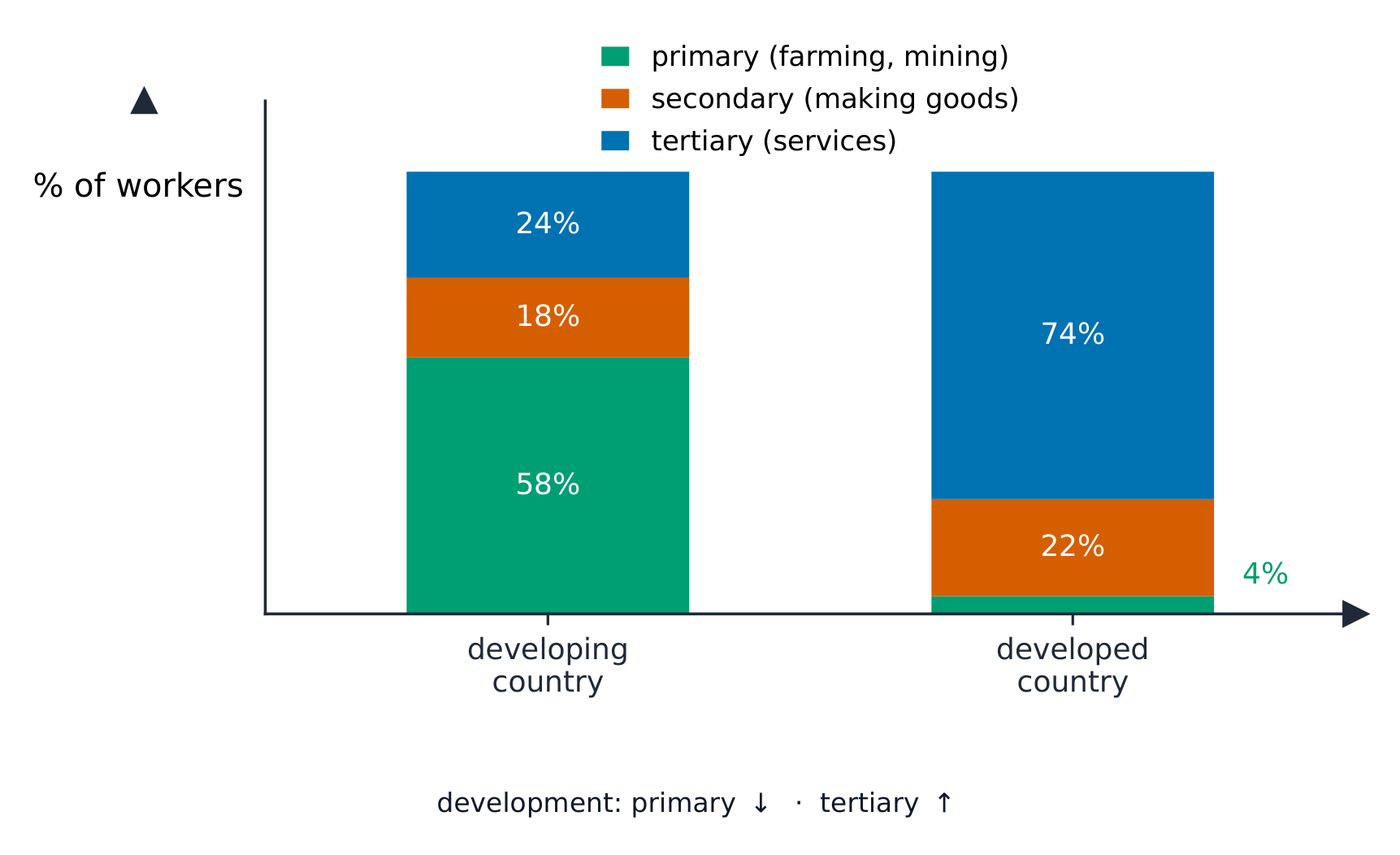
The employment structure 就业结构 also differs. As a country develops, workers move out of the primary sector 第一产业 (farming and mining), into the secondary sector 第二产业 (making goods), and later into the tertiary sector 第三产业 (services).
Many things shape development: savings and investment, the quality of education and health, infrastructure, stable government and law, and access to world markets.
私たちはよく、先進国(所得が高く、ドイツなど)と発展途上国(所得が低く、ケニアなど)を比較します。これらは明確な違いがあります:
| 特徴 | 先進国 | 発展途上国 |
|---|---|---|
| 一人当たり所得 | 高い | 低い |
| 出生率と人口増加 | 低い | しばしば高い |
| 平均余命 | 高い | 低い |
| 農業に従事する労働者の割合 | 少ない | 多い |
雇用構造も異なります。国が発展するにつれて、労働者は一次産業(農業および鉱業)から離れ、二次産業(製造業)へ、そして後には三次産業(サービス業)へと移行していきます。
発展を形作る要因は多岐にわたります:貯蓄と投資、教育および医療の質、インフラ、安定した政府と法制度、世界市場へのアクセスなどです。
Classify real examples by the economic idea they show. · 經濟の概念を示す実例を分類せよ。
| English | 日本語 |
|---|---|
| employment structure/emˈplɔɪmənt ˈstrʌktʃə/ | 雇用構造 |
| primary sector/ˈpraɪməri ˈsektə/ | 一次産業 |
| secondary sector/ˈsekəndəri ˈsektə/ | 二次産業 |
| tertiary sector/ˈtɜːʃjəri ˈsektə/ | 三次産業 |
| aid/eɪd/ | 援助 |
| debt/det/ | 借金 |
| foreign direct investment/ˈfɒrən daɪˈrekt ɪnˈvestmənt/ | 外国直接投資 |
| multinational corporation/ˌmʌltɪˈnæʃənl ˌkɔːpəˈreɪʃn/ | 多国籍企業 |
| migration/maɪˈɡreɪʃn/ | 移住 |
| remittances/rɪˈmɪtənsɪz/ | 送金(remittances) |
Source: Cambridge International syllabus · 出典: Cambridge International シラバス
Richer and poorer countries are linked in several ways, each with good and bad sides.
富裕国と貧困国は、それぞれ利点と欠点を持つ複数の方法で結びついています。
Classify real examples by the economic idea they show. · 經濟の概念を示す実例を分類せよ。

Source: Cambridge International syllabus · 出典: Cambridge International シラバス
globalisation 全球化 is the growing links between countries — in trade, money, technology and people — so that the world acts more like one market. Its causes include cheaper transport and communication, free trade 自由贸易 agreements, and the spread of multinational firms.
Countries often join a trade bloc 贸易集团 — a group that trades freely among themselves (like the European Union).
| Benefits | Costs |
|---|---|
| lower prices and more choice | some industries and jobs are lost to cheaper countries |
| faster growth and technology transfer | the gap between rich and poor can widen |
| larger markets for firms | more pollution and use of resources |
| poorer countries can industrialise | powerful multinationals may avoid tax and dodge protectionism 贸易保护主义 rules |
Globalisation helps developed and developing economies in different ways, but the gains are not shared evenly, which is why it remains so argued about.
グローバリゼーションとは、貿易、金融、技術、人々の間での国々のつながりが増大し、世界がより一つの市場のように機能することです。その要因には、輸送および通信コストの低下、自由貿易協定、多国籍企業の拡大が含まれます。
国々は often 貿易ブロック(自国内で自由に貿易を行う集団、例えば欧州連合など)に参加します。
| ベネフィット | コスト |
|---|---|
| 安価化と選択肢の拡大 | 安価な国々への産業および雇用の流失 |
| 成長の加速と技術移転 | 富裕層と貧困層の格差の拡大 |
| 企業の市場拡大 | 汚染の増加と資源の使用量増加 |
| 貧困国の工業化 | 強力な多国籍企業が税務回避や保護主義規則の回避を行う可能性 |
グローバリゼーションは先進国と発展途上国の経済を異なる方法で助けますが、利益が均等に分配されないため、依然として議論の対象となっています。
See how trade or exchange-rate pressure changes domestic outcomes. · 貿易や為替レートの変動が国内の結果にどう影響するかを確認せよ。
| English | 日本語 |
|---|---|
| globalisation/ˌɡləʊbəlaɪˈzeɪʃn/ | グローバル化 |
| free trade/friː treɪd/ | 自由貿易 |
| trade bloc/treɪd blɒk/ | 貿易ブロック |
| protectionism/prəˈtekʃənɪzəm/ | 保護主義 |
Work through it step by step, with instant-check exercises. · 一歩ずつ進め、即時チェック付きの問題で学習します。
Loading subjects… · 科目を読み込み中...