Characteristics of countries
Introduced| English | Meaning |
|---|---|
| primary sector/ˈpraɪməri ˈsektə/ | The part of the economy that extracts or harvests natural resources. |
| informal sector/ɪnˈfɔːml ˈsektə/ | informal sector |
| savings gap/ˈseɪvɪŋz ɡæp/ | savings gap |
| infrastructure/ˈɪnfrəstrʌktʃə/ | Basic facilities and networks, such as transport, energy and communications, that support economic and social activity. |
| poverty trap/ˈpɒvəti træp/ | A self-reinforcing situation in which low income limits the resources needed to escape poverty. |
| microfinance/ˌmaɪkrəʊfaɪˈnæns/ | Small-scale financial services, including credit or savings, intended for people or businesses with limited access to conventional finance. |
What developing economies have in common
- Developing countries differ hugely — but many share recognisable features that shape their economic challenges.
- Spotting these patterns helps explain why development is hard, and where policy can help.
Economics case lab
Classify real examples by the economic idea they show.
Many developing economies rely heavily on the:
Difficulty 1/5 · 100 coins + a small bonus on first completion today
Primary-product dependence (with volatile prices) is a common feature.
A large informal sector means much economic activity is:
Difficulty 1/5 · 100 coins + a small bonus on first completion today
The informal sector operates outside official taxation and regulation.
Common characteristics
- Heavy reliance on the primary sector 第一产业 (agriculture, raw materials) and volatile commodity prices.
- Low HDI: lower incomes, life expectancy and schooling.
- A large informal sector 非正规部门 (untaxed, unregulated work).
- Rapid population growth and a young population.
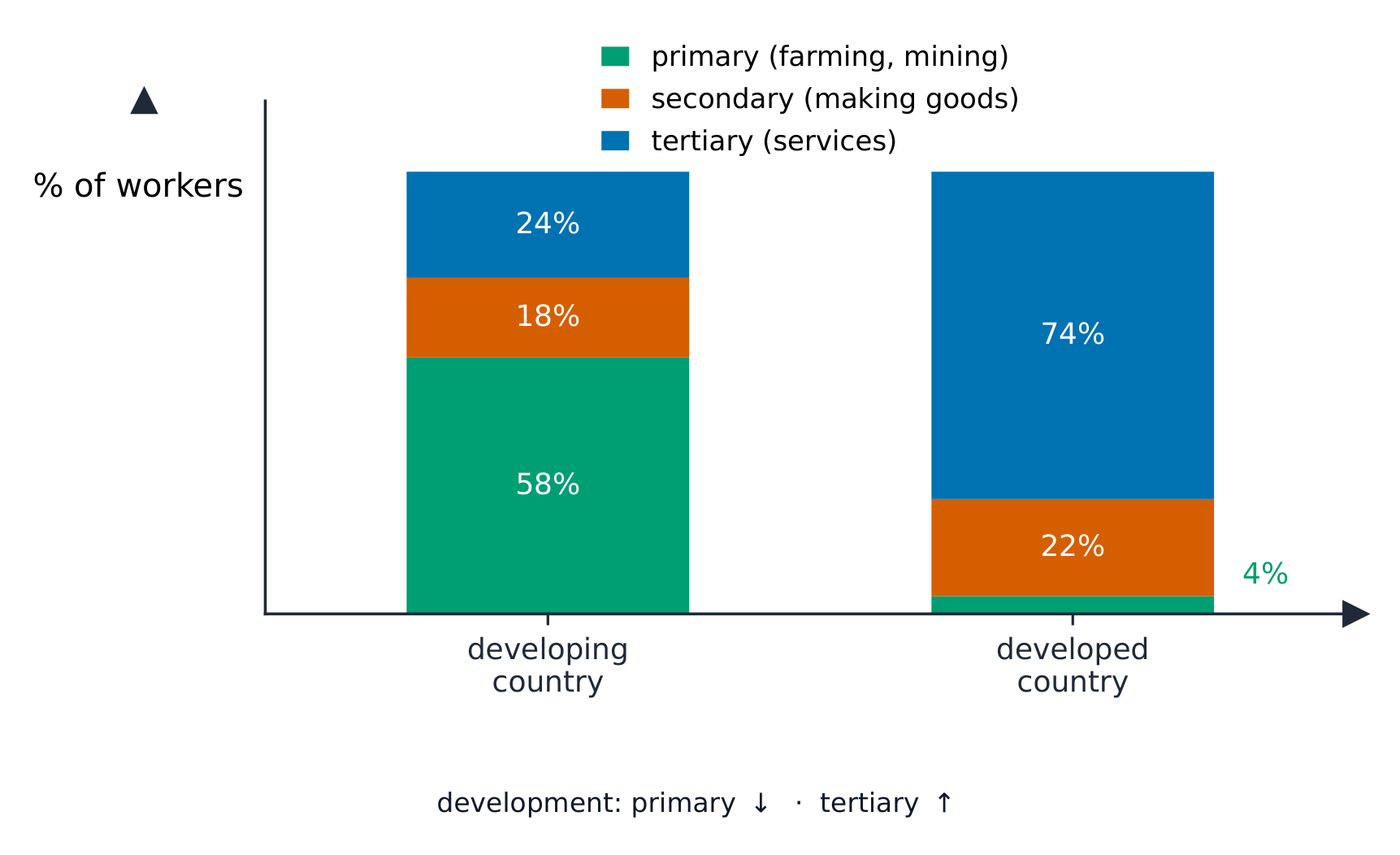
Workers shift from primary to tertiary sectors as a country develops
In a poverty trap, low incomes lead to low saving and investment, keeping incomes low.
Difficulty 1/5 · 100 coins + a small bonus on first completion today
The self-reinforcing cycle that makes development hard to start.
Match each barrier to development to its description.
Difficulty 2/5 · 140 coins + a small bonus on first completion today
These barriers reinforce low productivity and slow development.
The self-reinforcing cycle of low income → low saving → low investment is the poverty ______.
Difficulty 1/5 · 100 coins + a small bonus on first completion today
The poverty trap (or cycle).
Barriers to development
- Low savings and investment (the savings gap 储蓄缺口), poor infrastructure 基础设施, weak institutions and education, high debt, and dependence on a few exports.
The poverty trap 贫困陷阱. Low incomes mean low saving, so little investment, so low productivity — keeping incomes low. Breaking the cycle often needs outside help or a big push.
Routes forward
- Investment in human and physical capital, diversifying away from primary exports, better institutions, and microfinance 小额信贷 to fund small enterprise.
You've got it
- common features: primary-sector reliance, low HDI, large informal sector, rapid population growth
- barriers: low saving/investment, weak infrastructure/institutions, debt, export dependence
- the poverty trap: low income → low saving → low investment → low income