Exchange rates
Introduced| English | Meaning |
|---|---|
| fixed/fɪkst/ | Describing an exchange rate kept at a stated peg by the monetary authorities. |
| floating/ˈfləʊtɪŋ/ | Describing an exchange rate determined mainly by currency demand and supply rather than a maintained peg. |
| managed float/ˈmænɪdʒd fləʊt/ | managed float |
| depreciation/dɪˌpriːʃɪˈeɪʃn/ | A fall in the value of an asset or currency over time. |
| appreciation/əˌpriːʃɪˈeɪʃn/ | An increase in the value of an asset or currency. |
| speculation/ˌspekjʊˈleɪʃn/ | Buying or selling assets in the hope of profiting from future price changes while accepting the risk of loss. |
The price that links economies
- The exchange rate quietly sets the price of every import and export — and a government must decide whether to let it float or hold it fixed 固定的.
- Its movements ripple through inflation, trade and growth.
A fixed exchange rate is maintained by:
Difficulty 1/5 · 100 coins + a small bonus on first completion today
A peg is defended with foreign-exchange reserves; a floating rate is market-set.
A managed float is mostly market-determined but with occasional central-bank intervention.
Difficulty 1/5 · 100 coins + a small bonus on first completion today
It blends floating with discretionary intervention.
Exchange-rate systems
- Floating 浮动的: set by market demand and supply for the currency.
- Fixed: pegged by the central bank, which buys/sells reserves to hold it.
- Managed float 管理浮动: mostly market-driven, but the central bank intervenes at times.

In a floating system the currency's demand and supply set the rate; a fixed rate needs reserves to defend it.
Exchange rates in the FX market
The exchange rate is set by the demand for and supply of the currency. Shift either to see the rate appreciate or depreciate.
If 1 pound = 1.25 dollars, how many dollars is 400 pounds?
Difficulty 2/5 · 140 coins + a small bonus on first completion today
400 × 1.25 = 500 dollars.
A currency depreciation tends to:
Difficulty 1/5 · 100 coins + a small bonus on first completion today
A weaker currency lowers export prices abroad and raises import prices at home.
A depreciation improves the current account only if the Marshall–______ condition holds.
Difficulty 1/5 · 100 coins + a small bonus on first completion today
PED of exports + PED of imports > 1.
Effects of a change
- Depreciation 贬值/devaluation: exports cheaper, imports dearer → can improve the current account (if Marshall–Lerner holds) but raises import-price inflation.
- Appreciation 升值/revaluation: the reverse — cheaper imports (lower inflation) but dearer exports.
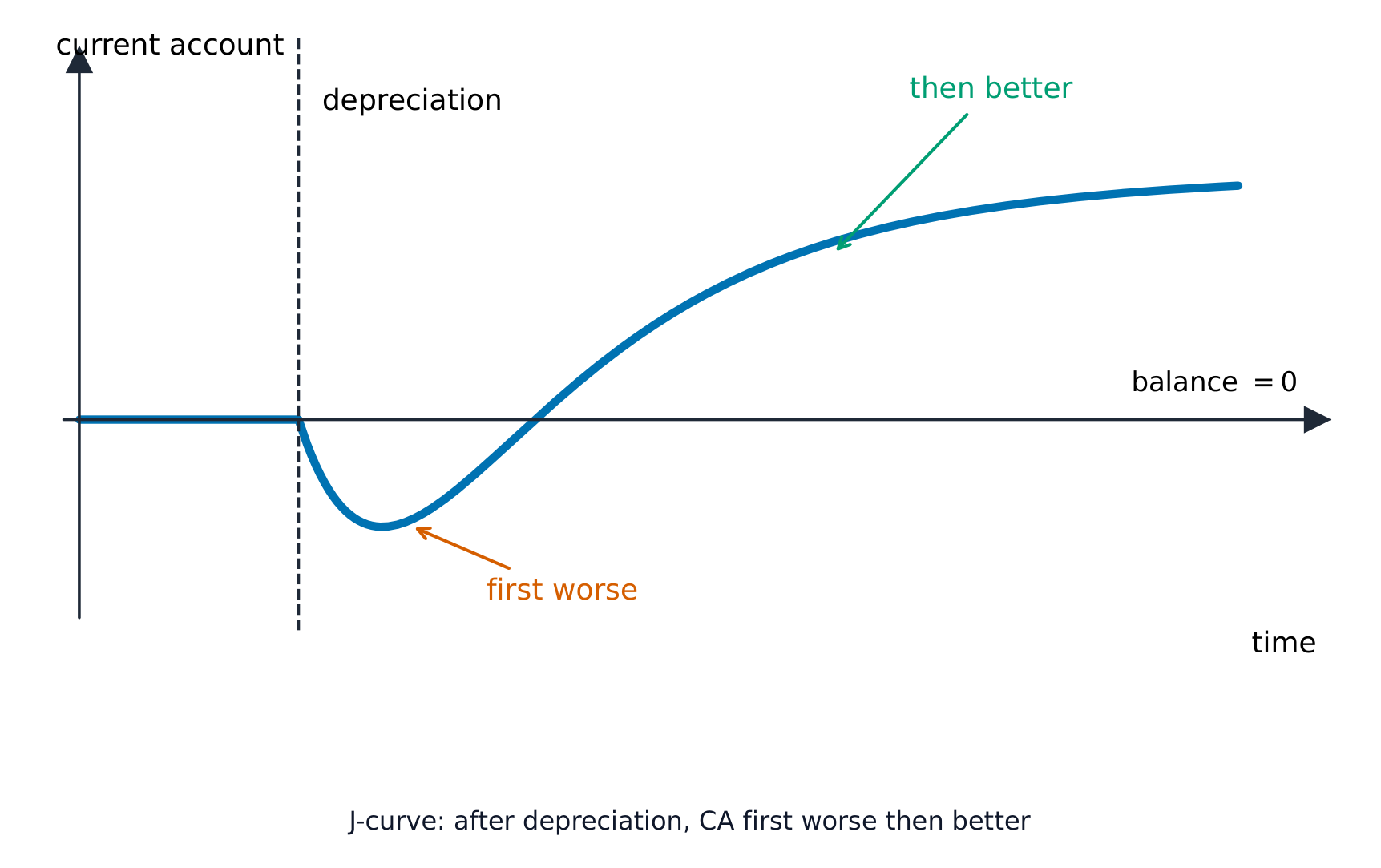
After a depreciation the current account first worsens, then improves — the J-curve
Worked example. If 1 pound = 1.25 dollars, then 400 pounds converts to 400 × 1.25 = 500 dollars.
What moves a floating rate
- Demand for exports (raises demand for the currency), interest rates (higher rates attract savers), investment inflows, and speculation 投机.
- Central banks may intervene to smooth or steer the rate.
You've got it
- systems: floating (market), fixed (pegged with reserves), managed float (mostly market + intervention)
- depreciation → cheaper exports/dearer imports (helps trade, raises inflation); appreciation is the reverse
- improvement from depreciation depends on the Marshall–Lerner condition