跳到主要内容

细胞结构与功能

AP 生物 · 第 2 主题

训练
讲义 词汇表
2.1

细胞结构与功能

大纲
Big IdeaLearning ObjectiveEssential Knowledge

Big Idea 4 — Systems Interactions
Biological systems interact, and these systems and their interactions exhibit complex properties.

2.1.A
Explain how the structure and function of subcellular components and organelles contribute to the function of cells.

  • 2.1.A.1 Ribosomes are comprised of ribosomal RNA (rRNA) and protein. These non-membrane, subcellular structures are found in cells in all forms of life and reflect the common ancestry in all known life. Ribosomes synthesize proteins according to messenger RNA (mRNA) sequences.
  • 2.1.A.2 The endomembrane system consists of a group of membrane-bound organelles and subcellular components (endoplasmic reticulum (ER), Golgi complex, lysosomes, vacuoles and transport vesicles, the nuclear envelope, and the plasma membrane) that work together to modify, package, and transport polysaccharides, lipids, and proteins intercellularly.
  • 2.1.A.3 Endoplasmic reticulum provides mechanical support by helping cells maintain shape and plays a role in intracellular transport.
    • i. Rough ER is associated with membrane-bound ribosomes, allows for the compartmentalization of cells, and helps carry out protein synthesis.
    • ii. Smooth ER functions include the detoxification of cells and lipid synthesis.
    • Exclusion statement: Knowledge of the specific functions of smooth ER in specialized cells is beyond the scope of the AP Exam.
  • 2.1.A.4 The Golgi complex is a membrane-bound structure that consists of a series of flattened membrane sacs. Functions of the Golgi include:
    • i. Correctly folding and chemically modifying newly synthesized cellular products
    • ii. Packaging proteins for trafficking
    • Exclusion statement: Knowledge of the role of Golgi in the synthesis of specific phospholipids and packaging of specific enzymes for lysosomes, peroxisomes, and secretory vesicles is beyond the scope of the AP Exam.
    • Illustrative examples for 2.1.A.4:
      • Glycosylation and other chemical modifications of proteins that take place within the Golgi and determine protein function or targeting
  • 2.1.A.5 Mitochondria have a double membrane that provides compartments for different metabolic reactions involved in aerobic cellular respiration. The outer membrane is smooth, while the inner membrane is highly convoluted, forming folds that enable ATP to be synthesized more efficiently.
  • 2.1.A.6 Lysosomes are membrane-enclosed sacs that contain hydrolytic enzymes that digest material. Lysosomes also play a role in programmed cell death (apoptosis).
  • 2.1.A.7 Vacuoles are membrane-bound sacs that play many different roles.
    • i. In plant cells, a specialized large vacuole maintains turgor pressure through nutrient and water storage.
    • ii. In animal cells, vacuoles are smaller in size, are more plentiful than in plant cells, and store cellular materials.
  • 2.1.A.8 Chloroplasts are specialized organelles that are found in plants and photosynthetic algae. Chloroplasts contain a double membrane and serve as the location for photosynthesis.

来源:美国大学理事会 AP 课程与考试说明

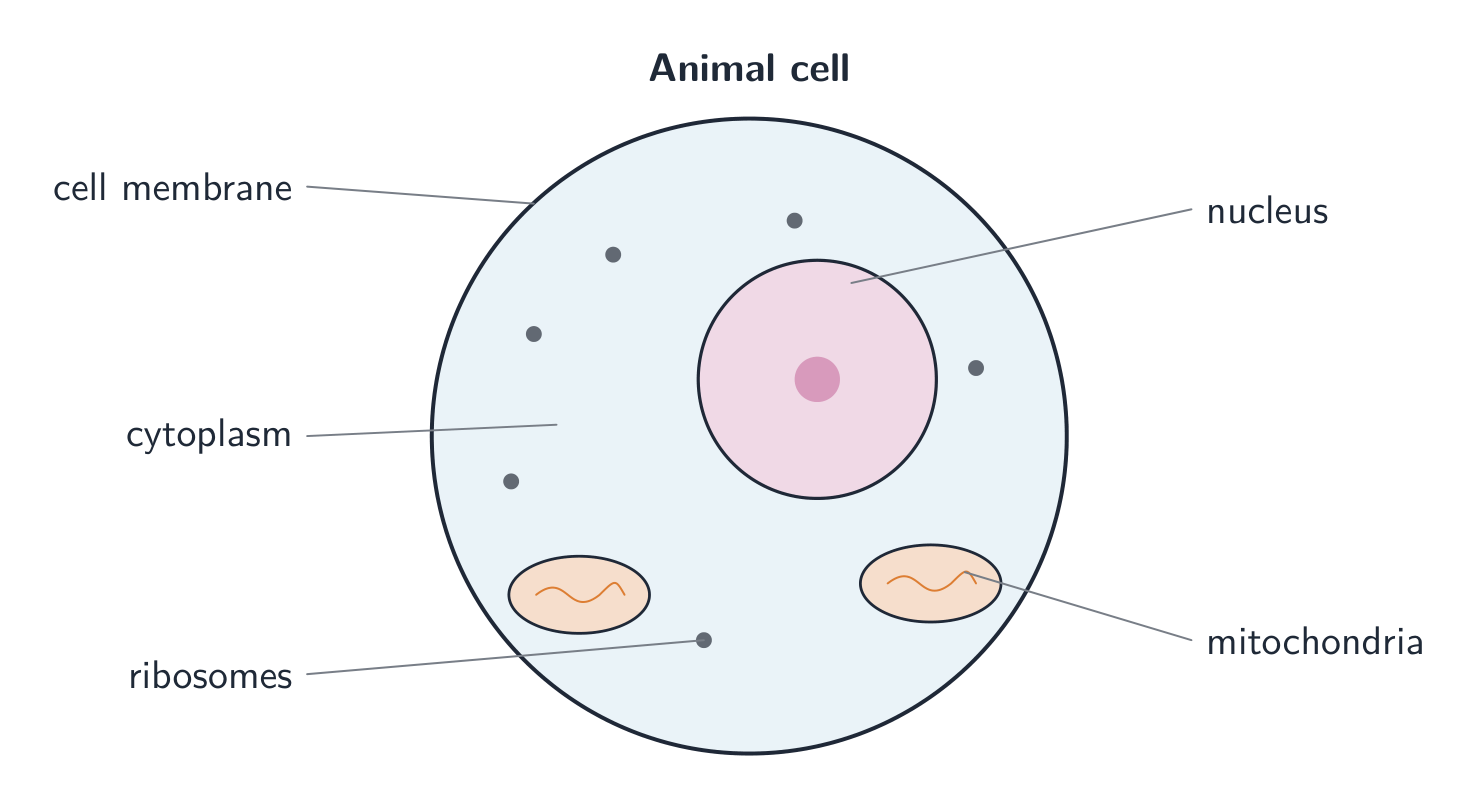
一个真核细胞在细胞器(organelles)之间分工。内膜系统(endomembrane system)是一套相连的组成部分,制造、修饰和运送分子:细胞核(nucleus)(容纳 DNA)、粗面和滑面内质网(endoplasmic reticulum)(蛋白质和脂质合成)、高尔基体(Golgi)(修饰和包装)、溶酶体(lysosomes)(消化),和在它们之间携带物质的囊泡。线粒体(mitochondria)(呼吸)和叶绿体(chloroplasts)(光合作用)有它们自己的膜。
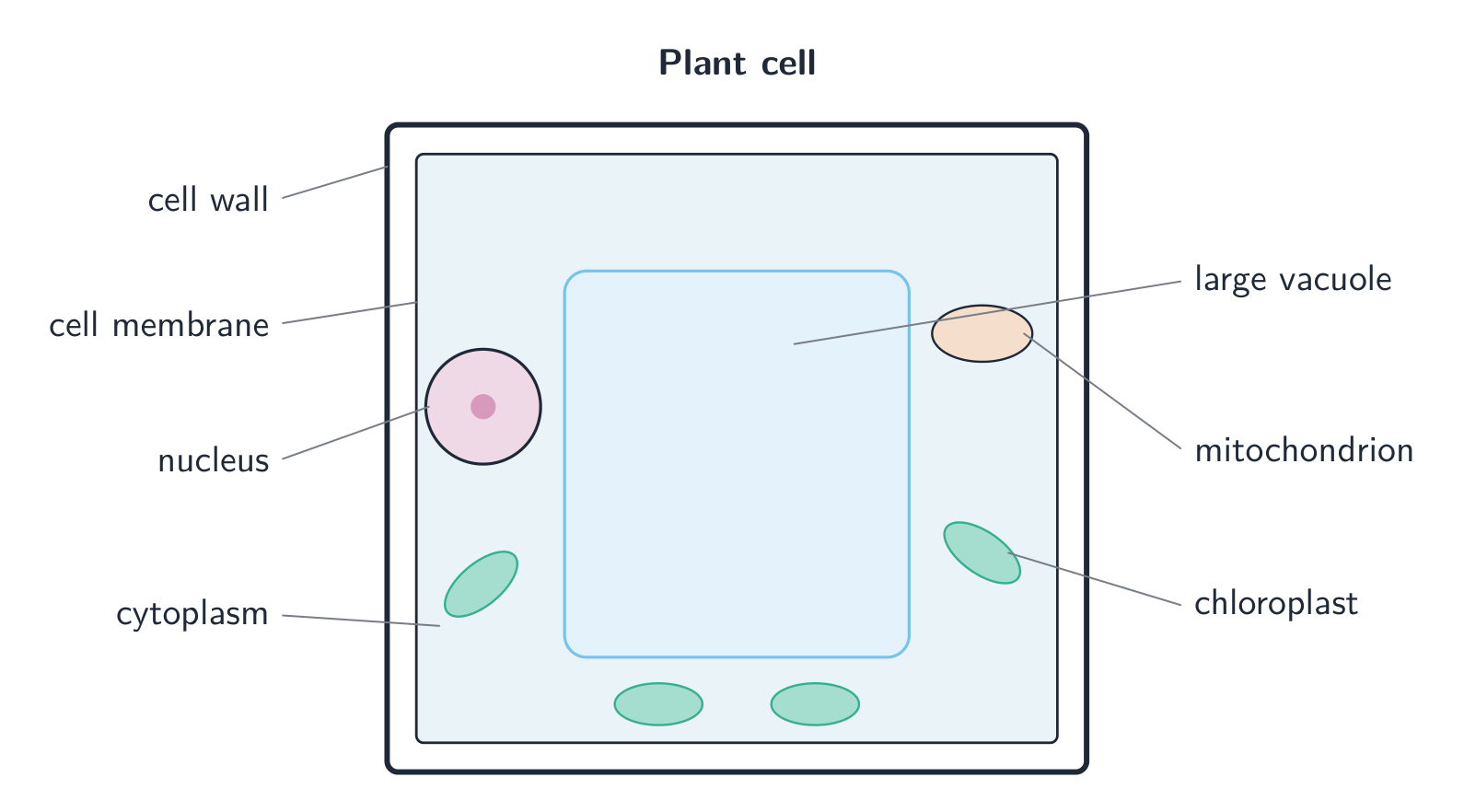
一个植物细胞也有一个细胞壁、一个大液泡和叶绿体
一个概化的动物细胞及其细胞器
一个概化的动物细胞及其细胞器
词汇表 训练
英文 中文 拼音
organelles 细胞器 xì bāo qì
endomembrane system 内膜系统 nèi mó xì tǒng
nucleus 细胞核 xì bāo hé
endoplasmic reticulum 内质网 nèi zhì wǎng
Golgi 高尔基体 gāo ěr jī tǐ
lysosomes 溶酶体 róng méi tǐ
Mitochondria 线粒体 xiàn lì tǐ
chloroplasts 叶绿体 yè lǜ tǐ
2.2

细胞大小

大纲
Big IdeaLearning ObjectiveEssential Knowledge

Big Idea 2 — Energetics
Biological systems use energy and molecular building blocks to grow, reproduce, and maintain dynamic homeostasis.

2.2.A
Explain the effect of surface area-to-volume ratios on the exchange of materials between cells or organisms and the environment.

  • 2.2.A.1 Surface area-to-volume ratios affect the ability of a biological system to obtain necessary nutrients, eliminate waste products, acquire or dissipate thermal energy, and otherwise exchange chemicals and energy with the environment.
    • Relevant equations:
      • Volume of a Sphere: $V = \dfrac{4}{3}\pi r^3$
      • Volume of a Cube: $V = s^3$
      • Volume of a Rectangular Solid: $V = lwh$
      • Volume of a Cylinder: $V = \pi r^2 h$
      • Surface Area of a Sphere: $SA = 4\pi r^2$
      • Surface Area of a Cube: $SA = 6s^2$
      • Surface Area of a Rectangular Solid: $SA = 2lh + 2lw + 2wh$
      • Surface Area of a Cylinder: $SA = 2\pi rh + 2\pi r^2$
      • $r$ = radius
      • $l$ = length
      • $h$ = height
      • $w$ = width
      • $s$ = length of one side of a cube
    • Illustrative examples for 2.2.A.1:
      • SA/V Ratios and Exchanges
        • Root hairs
        • Guard cells
        • Gut epithelial cells
      • Cilia
      • Stomata
  • 2.2.A.2 The surface area of the plasma membrane must be large enough to adequately exchange materials.
    • i. The surface area-to-volume ratio can restrict cell size and shape. Smaller cells typically have a higher surface area-to-volume ratio as well as a more efficient exchange of materials with the environment than do larger cells.
    • ii. As cells increase in volume, the surface area-to-volume ratio decreases and the demand for internal resources increases.
    • iii. More complex cellular structures (e.g., membrane folds) are necessary to adequately exchange materials with the environment.
    • iv. As organisms increase in size, their surface area-to-volume ratio decreases, affecting properties like rate of heat exchange with the environment. Smaller amounts of mass exchange proportionally more heat with the ambient environment than do larger masses. As mass increases, both the surface area-to-volume ratio and the rate of heat exchange decrease.
    • v. There is a relationship between metabolic rate per unit body mass and the size of multicellular organisms; typically, the smaller the organism, the higher the metabolic rate per unit body mass.

来源:美国大学理事会 AP 课程与考试说明

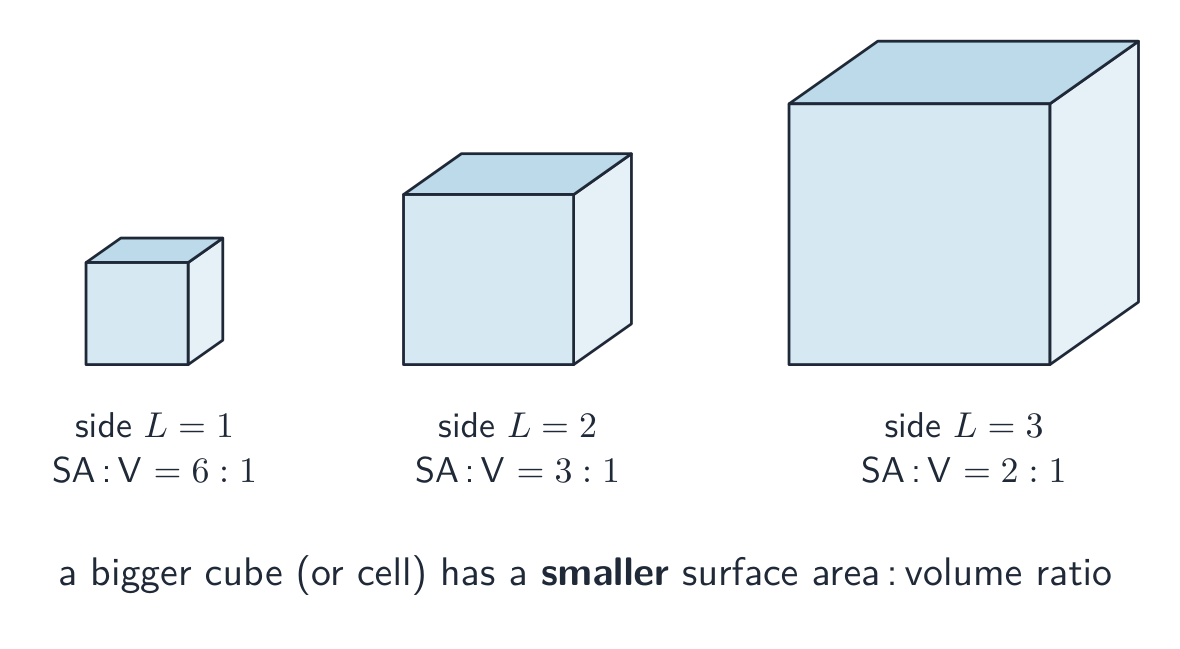
细胞保持小,因为表面积与体积比(surface-area-to-volume ratio)。随着一个细胞生长,它的体积比它的表面积上升得更快,所以它的膜不能为内部足够快地交换物质。保持小(或扁平或折叠)保持足够的表面来服务体积。

随着一个细胞变大表面积与体积比下降
随着一个细胞变大表面积与体积比下降

Worked example. 一个边长 $2\ \mu\text{m}$ 的立方体形状的细胞有表面积 $6\times2^2=24\ \mu\text{m}^2$ 和体积 $2^3=8\ \mu\text{m}^3$,所以它的表面积与体积比是 $\tfrac{24}{8}=3$。把边长加倍到 $4\ \mu\text{m}$:表面积 $=6\times4^2=96$,体积 $=4^3=64$,比 $=\tfrac{96}{64}=1.5$。把大小加倍使比减半——较大的细胞每单位内部有远少的膜,这就是为什么细胞保持小。

探索

See surface area vs volume as a cube grows

As a cell grows, volume rises faster than surface area, so the surface-area-to-volume ratio falls. A small cell keeps enough membrane to exchange materials fast enough.

词汇表 训练
英文 中文 拼音
surface-area-to-volume ratio 表面积与体积比 biǎo miàn jī yǔ tǐ jī bǐ
2.3

质膜

大纲
Big IdeaLearning ObjectiveEssential Knowledge

Big Idea 2 — Energetics
Biological systems use energy and molecular building blocks to grow, reproduce, and maintain dynamic homeostasis.

2.3.A
Describe the roles of each of the components of the cell membrane in maintaining the internal environment of the cell.

  • 2.3.A.1 Phospholipids have both hydrophilic and hydrophobic regions. The polar hydrophilic phosphate regions of the phospholipids are oriented toward the aqueous external or internal environment, while the nonpolar hydrophobic fatty acid regions face each other within the interior of the membrane.
  • 2.3.A.2 Embedded proteins can be hydrophilic (with charged and polar side groups), hydrophobic (with nonpolar side groups), or both.
    • i. Hydrophilic regions of the proteins are either inside the interior of the protein or exposed to the cytosol (cytoplasm).
    • ii. Hydrophobic regions of proteins make up the protein surface that interacts with the fatty acids in the interior membrane.

2.3.B
Describe the fluid mosaic model of cell membranes.

  • 2.3.B.1 Plasma membranes consist of a structural framework of phospholipid molecules embedded with proteins, steroids (such as cholesterol in vertebrate animals), glycoproteins, and glycolipids. All of these can move around the surface of the cell within the membrane, as illustrated by the fluid mosaic model.

来源:美国大学理事会 AP 课程与考试说明

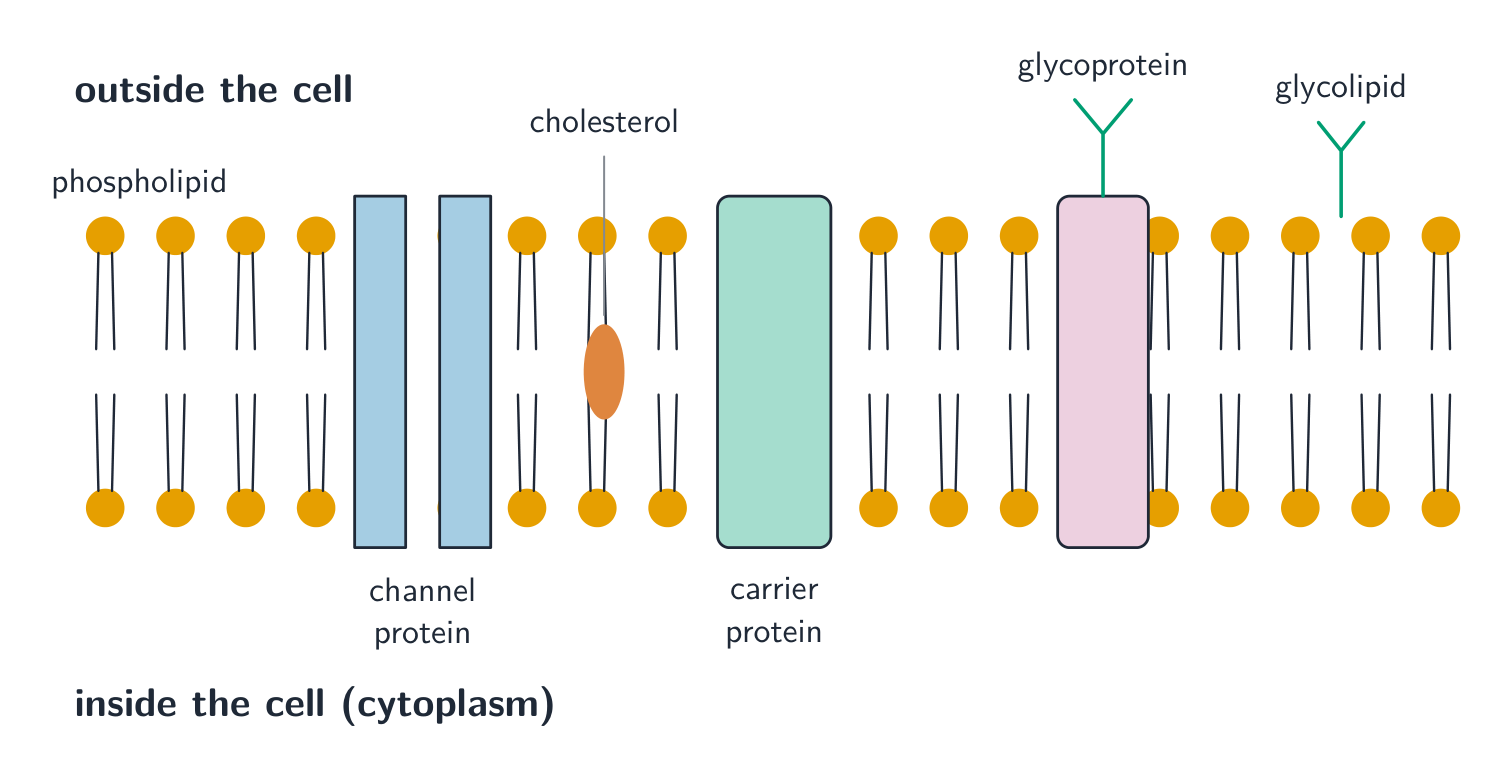
细胞膜是一个磷脂双分子层(phospholipid bilayer)——极性头朝向水、非极性尾在里面——镶嵌着蛋白质。流动镶嵌模型(fluid mosaic model)把它描绘成一张流动的片,其中脂质和蛋白质漂移。胆固醇(cholesterol)和不饱和程度调节它的流动性。

细胞膜的流动镶嵌模型
细胞膜的流动镶嵌模型
词汇表 训练
英文 中文 拼音
phospholipid bilayer 磷脂双分子层 lín zhī shuāng fèn zǐ céng
fluid mosaic model 流动镶嵌模型 liú dòng xiāng qiàn mó xíng
2.4

膜的通透性

大纲
Big IdeaLearning ObjectiveEssential Knowledge

Big Idea 2 — Energetics
Biological systems use energy and molecular building blocks to grow, reproduce, and maintain dynamic homeostasis.

2.4.A
Explain how the structure of biological membranes influences selective permeability.

  • 2.4.A.1 Plasma membranes separate the internal environment of the cell from the external environment. Selective permeability is the result of the plasma membrane having a hydrophobic interior.
  • 2.4.A.2 Small nonpolar molecules, including $\mathrm{N_2}$, $\mathrm{O_2}$, and $\mathrm{CO_2}$, freely pass across the membrane. Hydrophilic substances, such as large polar molecules and ions, move across the membrane through embedded channels and transport proteins.
  • 2.4.A.3 The nonpolar hydrocarbon tails of phospholipids prevent the movement of ions and polar molecules across the membrane. Small polar, uncharged molecules, like $\mathrm{H_2O}$ or $\mathrm{NH_3}$ (ammonia), pass through the membrane in small amounts.

2.4.B
Describe the role of the cell wall in maintaining cell structure and function.

  • 2.4.B.1 Cell walls of Bacteria, Archaea, Fungi, and plants provide a structural boundary as well as a permeability barrier for some substances to the internal or external cellular environments and protection from osmotic lysis.

来源:美国大学理事会 AP 课程与考试说明

膜是选择透过性(selectively permeable)的。小的非极性分子($\text{O}_2$$\text{CO}_2$)和水容易穿过;大的或带电/极性的颗粒(离子、葡萄糖)没有帮助不能通过非极性核心。这种选择性让细胞控制它的内部环境。

物质穿过膜的三种方式
物质穿过膜的三种方式
词汇表 训练
英文 中文 拼音
selectively permeable 选择透过性 xuǎn zé tòu guò xìng
2.5

膜运输

大纲
Big IdeaLearning ObjectiveEssential Knowledge

Big Idea 2 — Energetics
Biological systems use energy and molecular building blocks to grow, reproduce, and maintain dynamic homeostasis.

2.5.A
Describe the mechanisms that organisms use to maintain solute and water balance.

  • 2.5.A.1 The selective permeability of membranes allows for the formation of concentration gradients of solutes across the membrane.
  • 2.5.A.2 Passive transport is the net movement of molecules from regions of high concentration to regions of low concentration without the direct input of metabolic energy.
  • 2.5.A.3 Active transport requires the direct input of energy to move molecules. In some cases, active transport is utilized to move molecules from regions of low concentration to regions of high concentration.

2.5.B
Describe the mechanisms that organisms use to transport large molecules across the plasma membrane.

  • 2.5.B.1 The processes of endocytosis and exocytosis require energy to move large substances or large amounts of substances into and out of cells.
    • i. In endocytosis, the cell takes in large molecules and particulate matter by folding the plasma membrane in on itself and forming new (small) vesicles that engulf material from the external environment.
    • ii. In exocytosis, internal vesicles release material from cells by fusing with the plasma membrane and secreting large molecules from the cell.

来源:美国大学理事会 AP 课程与考试说明

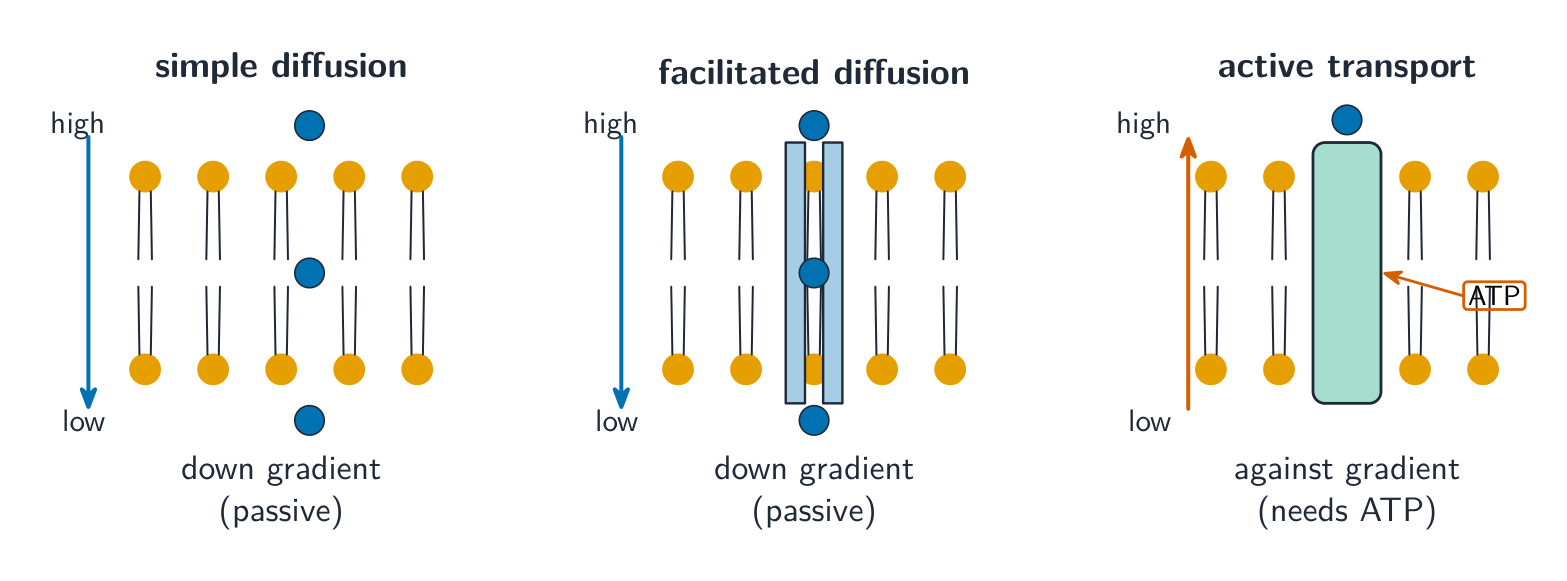
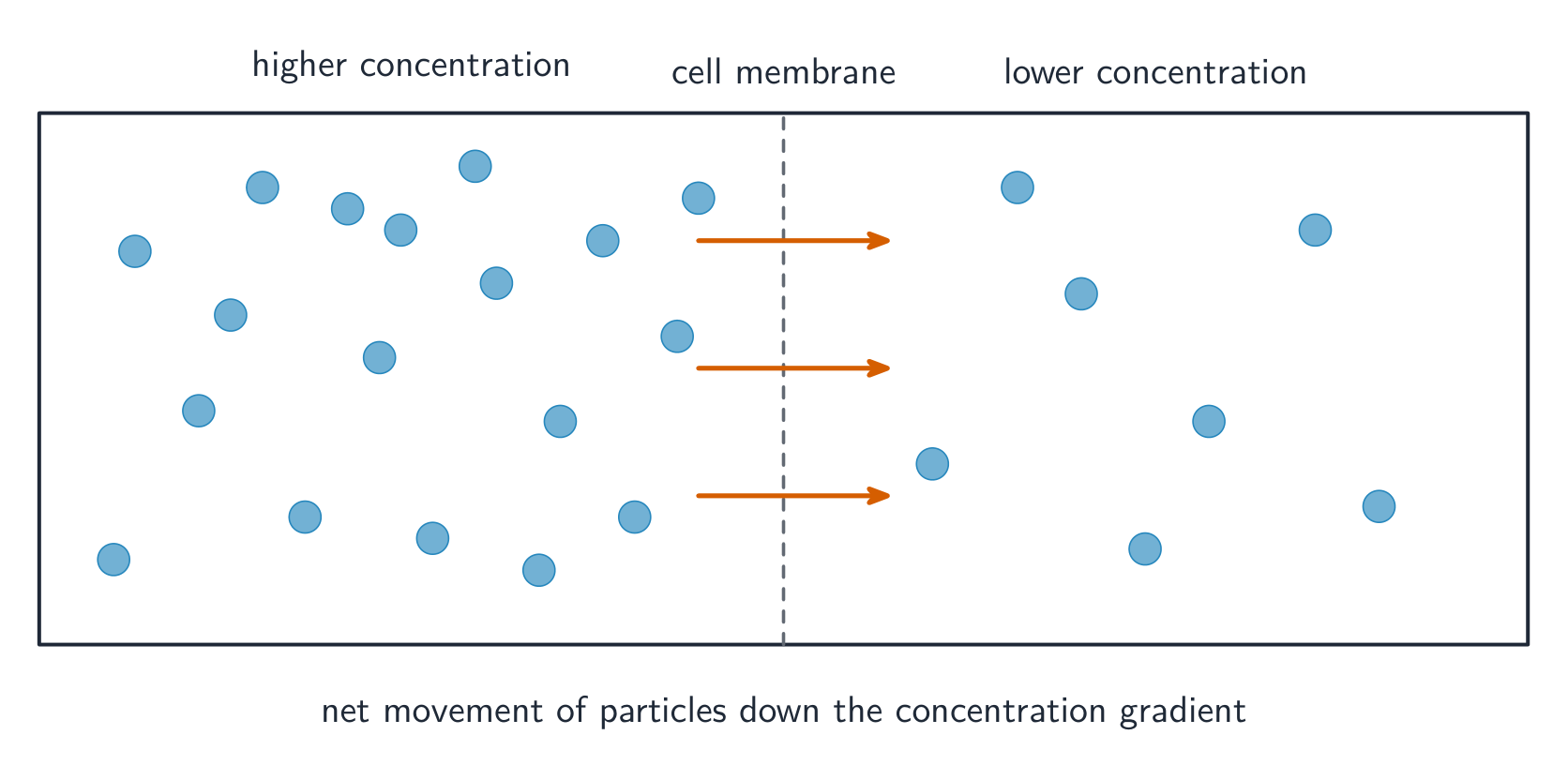
  • 被动运输(passive transport)顺着它们的浓度梯度(高 → 低)移动物质,没有能量——扩散(diffusion)。
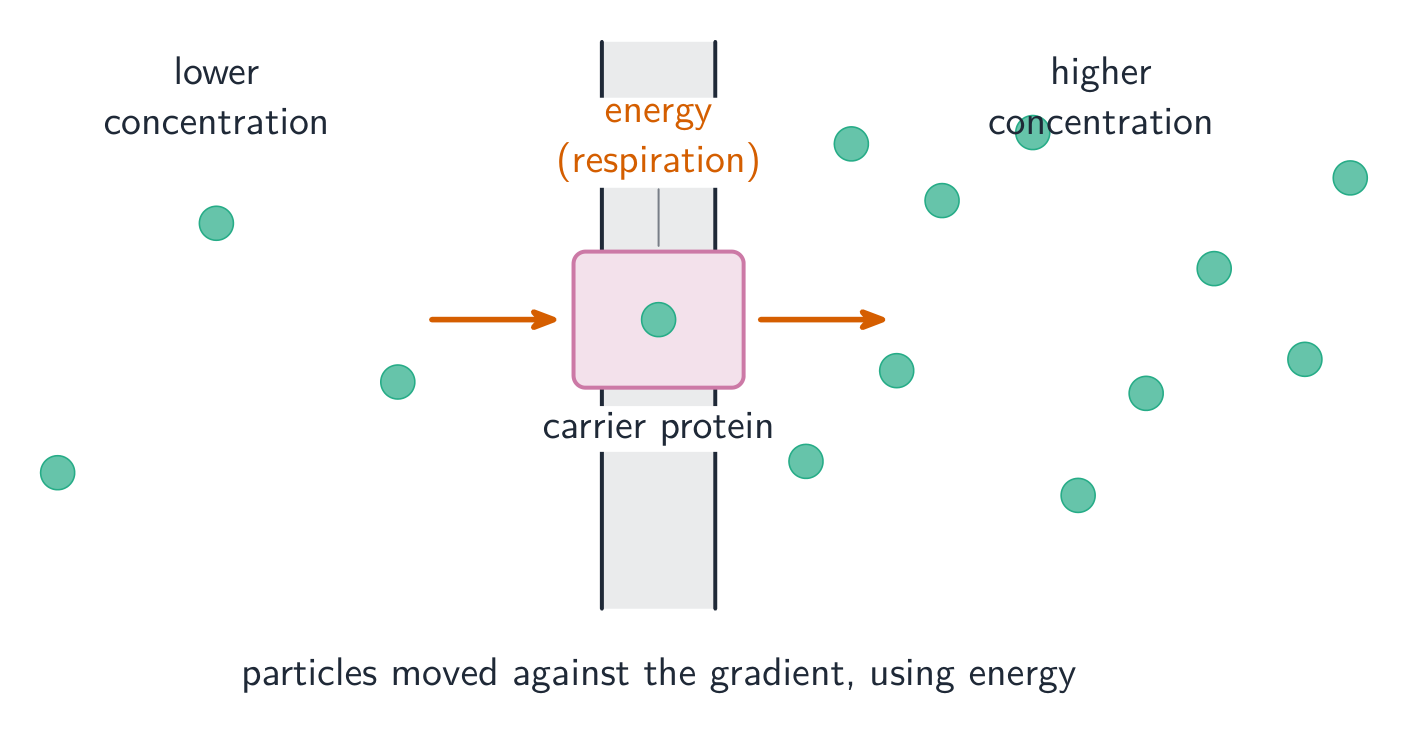
  • 主动运输(active transport)逆着梯度(低 → 高)移动物质,需要能量(ATP),通过像钠钾泵这样的蛋白质泵。
主动运输逆着梯度移动颗粒,使用 ATP 和一个载体蛋白
探索

Pump a solute against its gradient

Passive transport moves solutes down their gradient for free; active transport uses ATP to pump them the other way, from low to high concentration.

词汇表 训练
英文 中文 拼音
Passive transport 被动运输 bèi dòng yùn shū
diffusion 扩散 kuò sàn
Active transport 主动运输 zhǔ dòng yùn shū
练习卷
2.6

易化扩散

大纲
Big IdeaLearning ObjectiveEssential Knowledge

Big Idea 2 — Energetics
Biological systems use energy and molecular building blocks to grow, reproduce, and maintain dynamic homeostasis.

2.6.A
Explain how the structure of a molecule affects its ability to pass through the plasma membrane.

  • 2.6.A.1 Facilitated diffusion requires transport or channel proteins to enable the movement of charged ions across the membrane.
    • i. Membranes may become polarized by the movement of ions across the membrane.
    • ii. Charged ions, including $\mathrm{Na^+}$ (sodium) and $\mathrm{K^+}$ (potassium), require channel proteins to move through the membrane.
  • 2.6.A.2 Facilitated diffusion enables the movement of large polar molecules through membranes with no energy input. In this type of diffusion, substances move down the concentration gradient.
  • 2.6.A.3 Aquaporins transport large quantities of water across membranes.

来源:美国大学理事会 AP 课程与考试说明

易化扩散(facilitated diffusion)是通过一个膜蛋白——一个通道(channel)或载体(carrier)——的被动运输,用于不能单独穿过脂质的颗粒。它仍然顺着梯度并不需要能量,但当所有蛋白质都忙时它的速率能饱和。

扩散:颗粒从较高浓度向较低浓度扩散,顺着梯度
词汇表 训练
英文 中文 拼音
Facilitated diffusion 易化扩散 yì huà kuò sàn
carrier 载体 zài tǐ
2.7

渗透压与渗透调节

大纲
Big IdeaLearning ObjectiveEssential Knowledge

Big Idea 2 — Energetics
Biological systems use energy and molecular building blocks to grow, reproduce, and maintain dynamic homeostasis.

2.7.A
Explain how concentration gradients affect the movement of molecules across membranes.

  • 2.7.A.1 External environments can be hypotonic, hypertonic, or isotonic to internal environments of cells. Movement of water can also be described as moving from hypotonic to hypertonic regions. Water moves by osmosis from regions of high water potential to regions of low water potential.
    • Equation (Water Potential): $\psi = \psi_p + \psi_s$
      • where:
      • $\psi_p$ = pressure potential
      • $\psi_s$ = solute potential
    • Illustrative examples for 2.7.A.1:
      • Contractile vacuole in protists
      • Central vacuole in plant cells

2.7.B
Explain how osmoregulatory mechanisms contribute to the health and survival of organisms.

  • 2.7.B.1 Growth and homeostasis are maintained by the constant movement of molecules across membranes.
  • 2.7.B.2 Osmoregulation maintains water balance and allows organisms to control their internal solute composition and water potential. Water moves from regions of low osmolarity or solute concentration to regions of high osmolarity or solute concentration.
    • Equation (Solute Potential of a Solution): $\psi_s = -iCRT$
      • where:
      • $i$ = ionization constant
      • $C$ = molar concentration
      • $R$ = pressure constant $\left(R = 0.0831 \dfrac{L \cdot bars}{mol \cdot K}\right)$
      • $T$ = temperature in Kelvin (°C + 273)

来源:美国大学理事会 AP 课程与考试说明

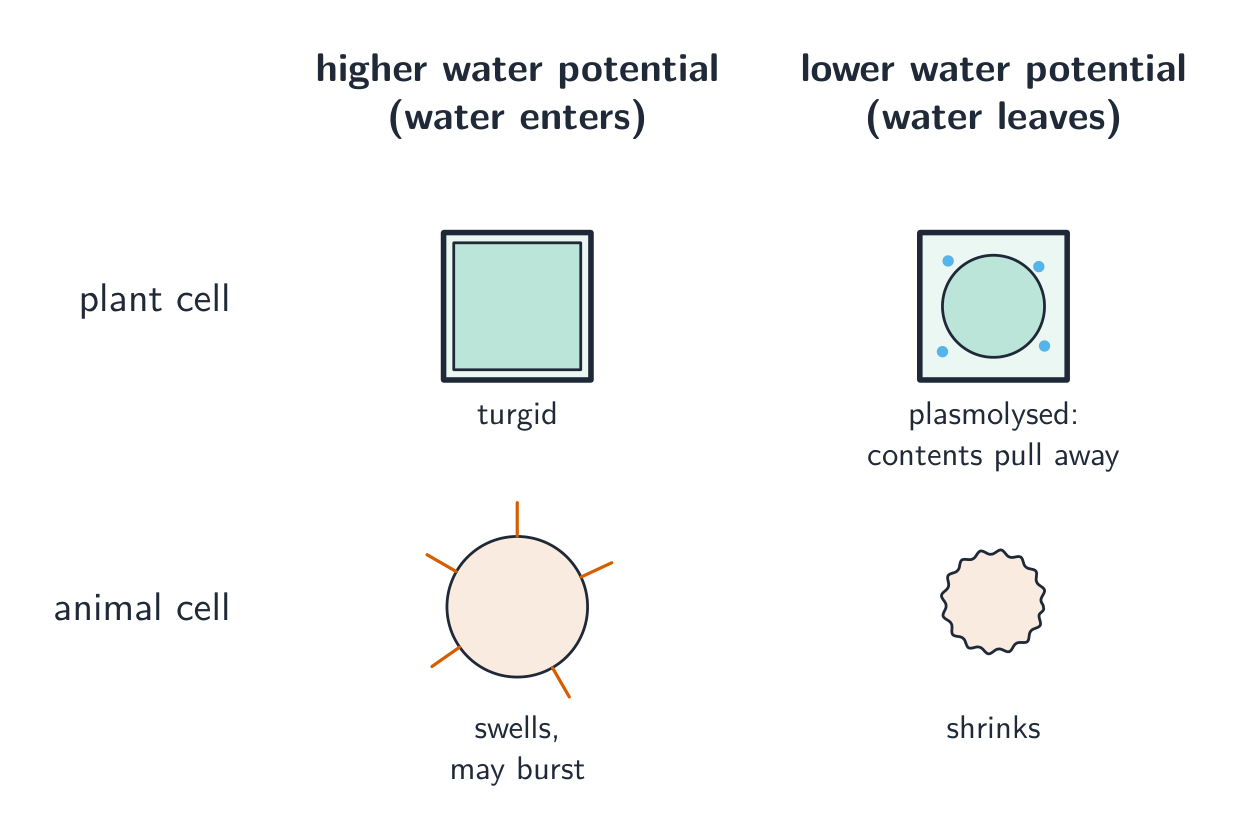
渗透(osmosis)是水穿过一个膜的扩散。张力(tonicity)比较溶质浓度:在一个低渗(hypotonic)溶液里一个细胞获得水(可能胀破);在一个高渗(hypertonic)溶液里它失去水(收缩);在一个等渗(isotonic)溶液里没有净变化。水势(water potential)预测水移动的方向(水移向较低的水势),而且是一个压力项和一个溶质项之和:$\Psi=\Psi_p+\Psi_s$,其中溶质势 $\Psi_s=-iCRT$渗透调节(osmoregulation)是生物如何控制这个平衡。

植物和动物细胞如何对不同水势的溶液反应
植物和动物细胞如何对不同水势的溶液反应

Worked example. 对于一个在一个开放烧杯里(所以压力势 $\Psi_p=0$)、$25\,°\text{C}$($T=298\,\text{K}$,$R=0.0831\ \text{L}\cdot\text{bar/mol}\cdot\text{K}$)的 $0.1\,\text{M}$ 蔗糖溶液($i=1$):$\Psi_s=-iCRT=-(1)(0.1)(0.0831)(298)\approx-2.48\ \text{bar}$,所以 $\Psi\approx-2.48\ \text{bar}$。一个内部为 $\Psi=-1.0\ \text{bar}$ 的植物细胞坐在这个溶液里:因为溶液更负,水移细胞进入溶液,而细胞失去膨压。

探索

Watch water move by osmosis

Water moves across the membrane from high water potential to low, toward the more concentrated (hypertonic) side. Set the concentrations and watch which way the cell swells or shrinks.

词汇表 训练
英文 中文 拼音
Osmosis 渗透 shèn tòu
Tonicity 张力 zhāng lì
hypotonic 低渗 dī shèn
hypertonic 高渗 gāo shèn
isotonic 等渗 děng shèn
Water potential 水势 shuǐ shì
Osmoregulation 渗透调节 shèn tòu tiáo jié
2.8

运输机制

大纲
Big IdeaLearning ObjectiveEssential Knowledge

Big Idea 2 — Energetics
Biological systems use energy and molecular building blocks to grow, reproduce, and maintain dynamic homeostasis.

2.8.A
Describe the processes that allow ions and other molecules to move across membranes.

  • 2.8.A.1 Metabolic energy (such as that from ATP) is required for active transport of molecules across the membrane and to establish and maintain electrochemical gradients.
    • i. Membrane proteins are necessary for active transport.
    • ii. The $\mathrm{Na^+}/\mathrm{K^+}$ pump and ATPase contribute to the maintenance of the membrane potential.

来源:美国大学理事会 AP 课程与考试说明

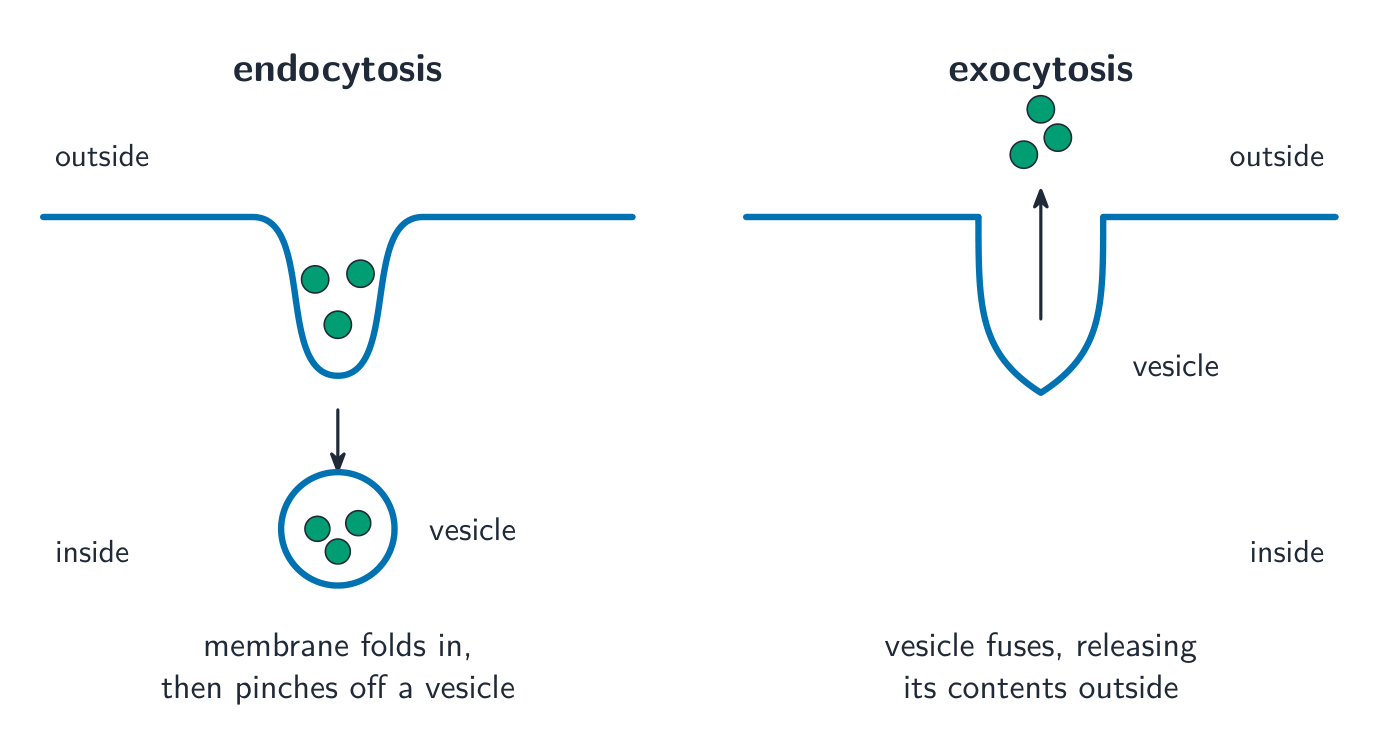
大的物质通过囊泡(vesicles)大批量移动:内吞(endocytosis)把物质带(膜吞没它),而外排(exocytosis)把物质送(一个囊泡与膜融合)。两者都需要能量并让细胞输入和分泌大分子。

内吞把物质带进;外排把它释放出
内吞把物质带进;外排把它释放出
词汇表 训练
英文 中文 拼音
endocytosis 内吞 nèi tūn
exocytosis 外排 wài pái
2.9

细胞区室化

大纲
Big IdeaLearning ObjectiveEssential Knowledge

Big Idea 2 — Energetics
Biological systems use energy and molecular building blocks to grow, reproduce, and maintain dynamic homeostasis.

2.9.A
Describe the membrane-bound structures of the eukaryotic cell.

  • 2.9.A.1 Membranes and membrane-bound organelles in eukaryotic cells compartmentalize intracellular metabolic processes and specific enzymatic reactions.

2.9.B
Explain how internal membranes and membrane-bound organelles contribute to compartmentalization of eukaryotic cell functions.

  • 2.9.B.1 Internal membranes facilitate cellular processes by minimizing competing interactions and by increasing the surface area where reactions can occur.

来源:美国大学理事会 AP 课程与考试说明

膜创造分开的区室(compartments),以便不相容的反应能同时进行而条件(pH、离子水平)能被局部调节。这种组织提升效率——内部的膜也为反应增加表面积。

词汇表 训练
英文 中文 拼音
compartments 区室 qū shì
2.10

细胞区室化的起源

大纲
Big IdeaLearning ObjectiveEssential Knowledge

Big Idea 1 — Evolution
The process of evolution drives the diversity and unity of life.

2.10.A
Describe similarities and/or differences in compartmentalization between prokaryotic and eukaryotic cells.

  • 2.10.A.1 Membrane-bound organelles such as mitochondria and chloroplasts evolved from once free-living prokaryotic cells via endosymbiosis.
  • 2.10.A.2 Prokaryotes typically lack internal membrane-bound organelles but have internal regions with specialized structures and functions.
  • 2.10.A.3 Eukaryotic cells maintain internal membranes that partition the cell into specialized regions.

来源:美国大学理事会 AP 课程与考试说明

内共生学说(endosymbiotic theory)解释线粒体和叶绿体:它们产生于一个较大的细胞吞没了后来住在它里面的自由生活的原核生物时。证据——它们自己的环状 DNA、它们自己的核糖体和双膜——支持这个共同的进化起源。

词汇表 训练
英文 中文 拼音
endosymbiotic theory 内共生学说 nèi gòng shēng xué shuō
2.10

考试技巧

  • 使用两个 AP 公式技能:表面积与体积比(为什么细胞保持小)和水势 $\Psi=\Psi_p+\Psi_s$($\Psi_s=-iCRT$)。
  • 水移向较低(更负)的水势;从张力(低渗/高渗/等渗)预测膨胀或收缩。
  • 被动运输和渗透不需要能量(顺着梯度);主动运输需要 ATP(逆着梯度)。
  • 区分扩散、易化扩散(一个通道/载体蛋白)和主动运输。
  • 磷脂双分子层解释膜的选择性——小的非极性分子穿过,大的/带电的需要帮助。

本主题的互动课程

逐步学习,并即时检测练习。

AP 生物历年真题

AP 生物的更多主题

登录或创建账号

IGCSE, A-Level & AP