跳到主要内容

自然选择

AP 生物 · 第 7 主题

训练
讲义 词汇表
7.1

自然选择导论

大纲
Big IdeaLearning ObjectiveEssential Knowledge

Big Idea 1 — Evolution
The process of evolution drives the diversity and unity of life.

7.1.A
Describe the causes of natural selection.

  • 7.1.A.1 Natural selection is a major mechanism of evolution.
  • 7.1.A.2 According to Darwin's theory of natural selection, competition for limited resources results in differential survival. Individuals with more favorable phenotypes are more likely to survive and produce more offspring, thus passing on those favorable traits to subsequent generations.

7.1.B
Explain how natural selection affects populations.

  • 7.1.B.1 Evolutionary fitness is measured by reproductive success.
  • 7.1.B.2 Biotic and abiotic environments can fluctuate, affecting the rate and direction of evolution. Different genetic variations can be selected in each generation.

来源:美国大学理事会 AP 课程与考试说明

进化(evolution)是一个种群的可遗传性状在世代间的一个变化。自然选择(natural selection)是它的主要驱动力:个体变异、一些变异是可遗传的、产生的后代多于存活的,而那些有更适合环境性状的存活并繁殖得更多。随时间,有帮助的性状变得更常见。

自然选择:最适应的存活、繁殖并传下它们的等位基因
词汇表 训练
英文 中文 拼音
Evolution 进化 jìn huà
Natural selection 自然选择 zì rán xuǎn zé
7.2

自然选择

大纲
Big IdeaLearning ObjectiveEssential Knowledge

Big Idea 1 — Evolution
The process of evolution drives the diversity and unity of life.

7.2.A
Describe the importance of phenotypic variation in a population.

  • 7.2.A.1 Natural selection acts on phenotypic variations in populations.
  • 7.2.A.2 Environments change and apply selective pressures to populations.
    • Illustrative examples for 7.2.A.2: Flowering time in relation to global climate change
  • 7.2.A.3 Some phenotypic variations can increase or decrease the fitness of an organism in particular environments.
    • Illustrative examples for 7.2.A.3: Sickle cell anemia; DDT resistance in insects

7.2.B
Explain how variation in molecules within cells connects to the fitness of an organism.

  • 7.2.B.1 Variation in the number and types of molecules within cells can provide populations a greater ability to survive and reproduce in different environments.

来源:美国大学理事会 AP 课程与考试说明

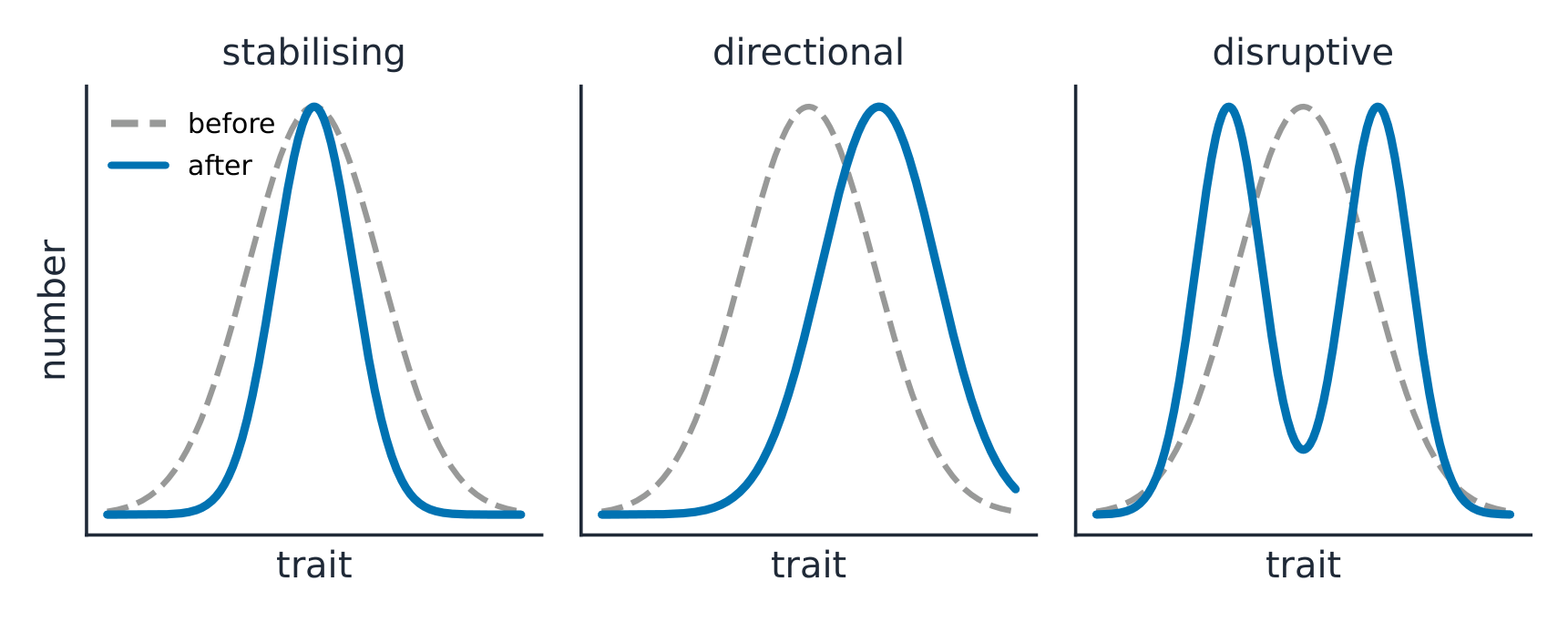
选择作用于变异(variation)。适合度(fitness)意味着繁殖成功,不是力量。选择以几种模式出现:定向(directional)(偏爱一个极端)、稳定(stabilizing)(偏爱平均),和分裂(disruptive)(偏爱两个极端)。环境做"选择",所以在一种环境里有帮助的一个性状在另一种里可能没有。很适合的性状是适应(adaptations)。

稳定、定向和分裂选择
稳定、定向和分裂选择
探索

Watch selection shift a population

Natural selection: individuals better suited to the environment survive and reproduce more, so helpful traits spread. Change the environment and watch the population adapt.

词汇表 训练
英文 中文 拼音
variation 变异 biàn yì
Fitness 适合度 shì hé dù
adaptations 适应 shì yìng
练习卷
7.3

人工选择

大纲
Big IdeaLearning ObjectiveEssential Knowledge

Big Idea 1 — Evolution
The process of evolution drives the diversity and unity of life.

7.3.A
Explain how humans can affect diversity within a population.

  • 7.3.A.1 Through artificial selection, humans affect variation in other species.

来源:美国大学理事会 AP 课程与考试说明

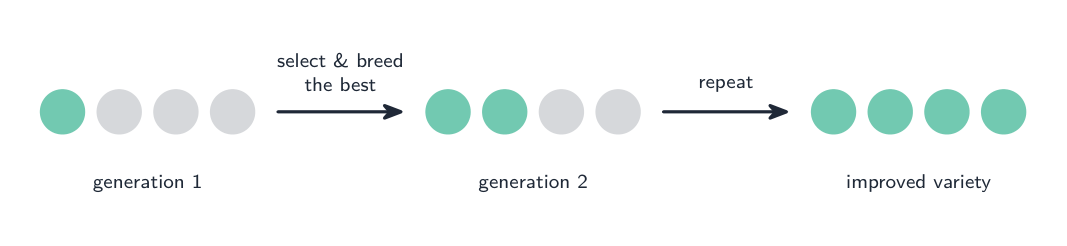
人工选择(artificial selection)里,人类——不是自然——选择哪些个体繁殖,为想要的性状选择(作物、牲畜、狗)。它以与自然选择相同的方式起作用,而且因为快速和可见,是选择能重塑种群的强有力证据。

选择性育种在世代间使一个想要的特征更常见
词汇表 训练
英文 中文 拼音
artificial selection 人工选择 rén gōng xuǎn zé
7.4

群体遗传学

大纲
Big IdeaLearning ObjectiveEssential Knowledge

Big Idea 1 — Evolution
The process of evolution drives the diversity and unity of life.

7.4.A
Explain how random occurrences affect the genetic makeup of a population.

  • 7.4.A.1 Evolution is also driven by random occurrences.
    • i. Mutation is a random process that adds new genetic variation to a population.
    • ii. Genetic drift is a change in allele frequencies attributable to a nonselective process occurring in small populations.
    • iii. The bottleneck effect is a type of genetic drift that occurs when a population size is reduced to a small number of individuals for at least one generation.
    • iv. The founder effect is a type of genetic drift that occurs when a population is separated from other members of the population. The frequency of genes and traits will shift based on the genes in this new founder population.
    • v. Migration can result in gene flow (the addition or removal of alleles from a population).

7.4.B
Describe the role of random processes in the evolution of specific populations.

  • 7.4.B.1 Random processes can lead to changes in allele frequencies in a population.
    • i. Mutations result in genetic variation, which provides phenotypes on which natural selection acts.
    • ii. Genetic drift can allow a small population to diverge from other populations of the same species.
    • iii. Gene flow between two populations prevents them from diverging into separate species.

7.4.C
Describe the change in the genetic makeup of a population over time.

  • 7.4.C.1 Changes in allele frequencies provide evidence for the occurrence of evolution in a population.

来源:美国大学理事会 AP 课程与考试说明

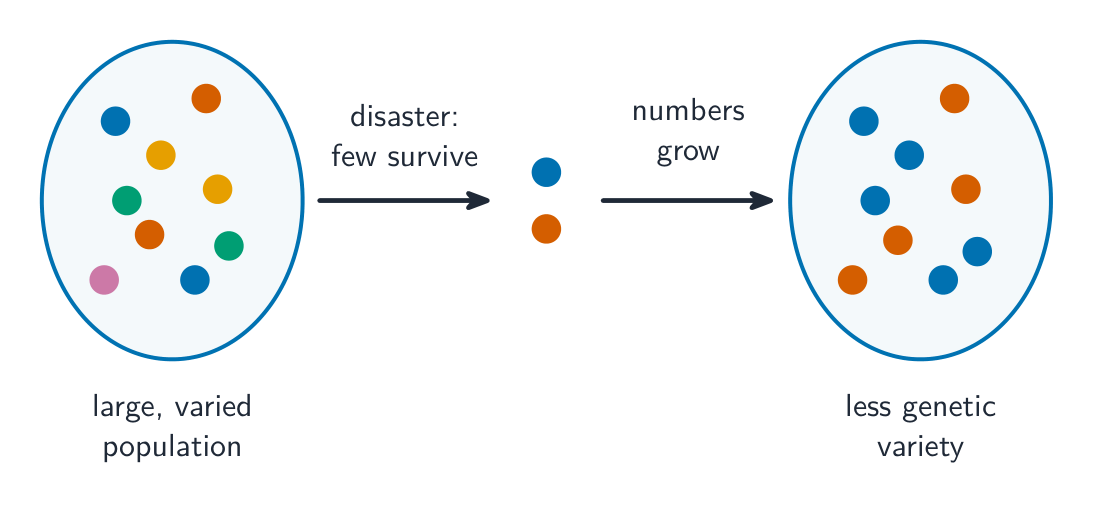
群体遗传学(population genetics)研究一个种群里的等位基因库。进化是等位基因频率(allele frequencies)随时间的一个变化。除了自然选择,等位基因频率通过突变(mutation)(新等位基因)、基因流(gene flow)(迁移),和遗传漂变(genetic drift)(随机变化,在小种群里最强——瓶颈和奠基者效应)而变化。

一次种群瓶颈减少遗传多样性
一次种群瓶颈减少遗传多样性
词汇表 训练
英文 中文 拼音
Population genetics 群体遗传学 qún tǐ yí chuán xué
allele frequencies 等位基因频率 děng wèi jī yīn pín lǜ
gene flow 基因流 jī yīn liú
genetic drift 遗传漂变 yí chuán piāo biàn
7.5

哈迪-温伯格平衡

大纲
Big IdeaLearning ObjectiveEssential Knowledge

Big Idea 1 — Evolution
The process of evolution drives the diversity and unity of life.

7.5.A
Describe the conditions under which allele and genotype frequencies will change in populations.

  • 7.5.A.1 The Hardy–Weinberg Equilibrium is a model for describing and predicting allele frequencies in a non-evolving population. Conditions for a population or an allele to be in Hardy–Weinberg equilibrium are:

    • i. A large population size
    • ii. No migration
    • iii. No new mutations
    • iv. Random mating
    • v. No natural selection

    These conditions are never met, but they provide a valuable null hypothesis.

  • 7.5.A.2 Allele frequencies in a nonevolving population can be calculated from genotype frequencies.

    • Equation: Hardy–Weinberg Equation— $p^2 + 2pq + q^2 = 1$; $p + q = 1$, where: $p$ = frequency of allele 1 in the population; $q$ = frequency of allele 2 in the population
    • Illustrative examples for 7.5.A.2: Graphic analysis of allele frequencies in a population

来源:美国大学理事会 AP 课程与考试说明

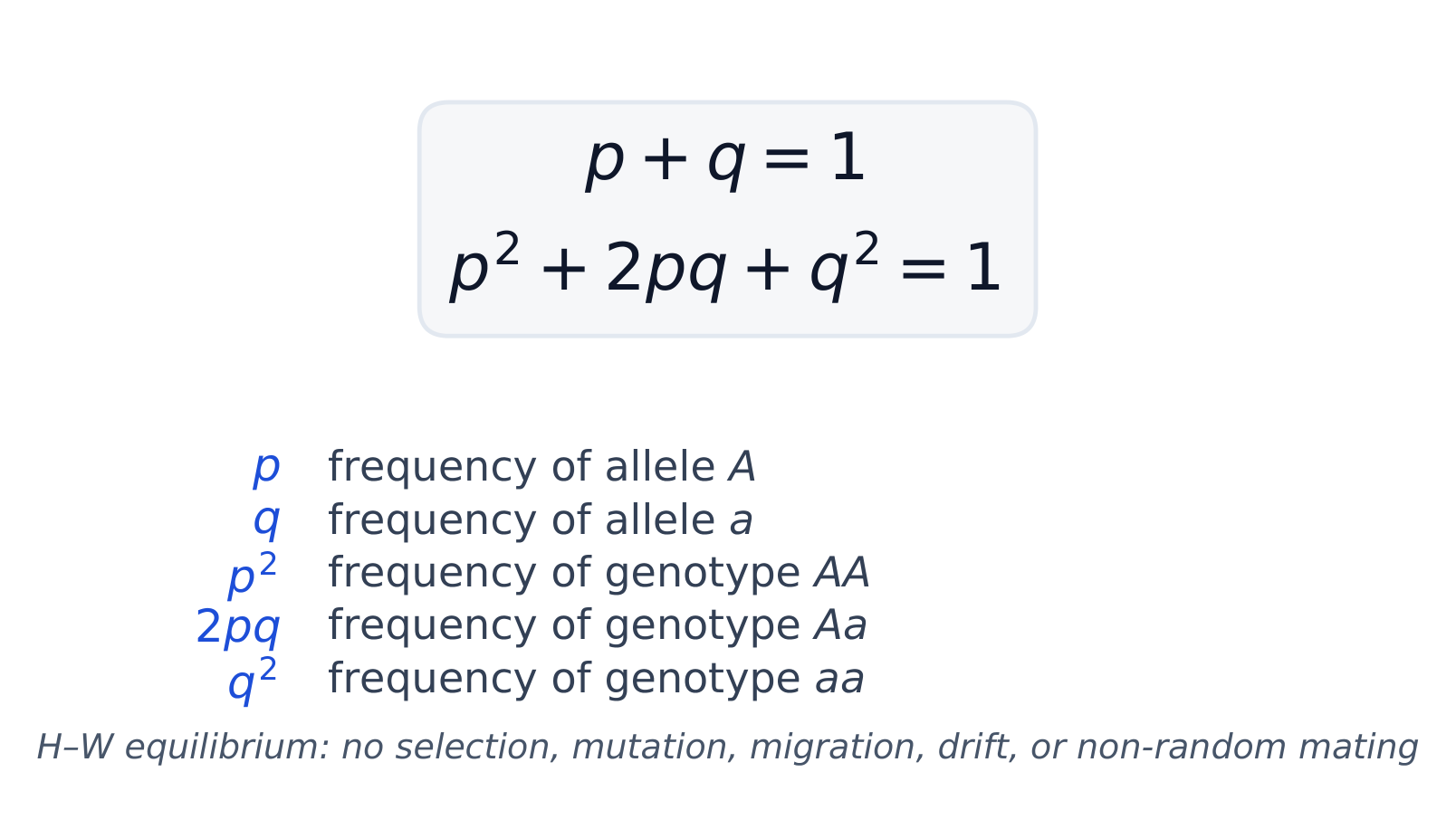
哈迪-温伯格(Hardy–Weinberg)模型给出当一个种群进化时预期的等位基因和基因型频率。以等位基因频率 $p$$q$($p+q=1$):

$$p^2 + 2pq + q^2 = 1,$$
其中 $p^2$$q^2$ 是纯合子而 $2pq$ 是杂合子。它只在五个条件下成立(没有选择、没有突变、没有迁移、随机交配、大种群);当真实数据与预测不同时,种群进化。

Worked example. 在一个种群里,$16\%$ 的个体显示隐性表型,所以 $q^2=0.16$$q=\sqrt{0.16}=0.4$。那么 $p=1-q=0.6$。预测的携带者频率(杂合子)是 $2pq=2(0.6)(0.4)=0.48$,即 $48\%$,而纯合显性是 $p^2=0.6^2=0.36$,即 $36\%$。作为一个检查,$0.36+0.48+0.16=1$。这是标准的路径:隐性表型 $\to q^2\to q\to p\to$ 其他一切。

Hardy–Weinberg: allele frequencies p and q give genotype frequencies p², 2pq, q²
探索

Allele frequencies across a cross

Hardy-Weinberg predicts genotype frequencies ($p^2+2pq+q^2$) in a population that isn't evolving. A Punnett square shows the same allele combining at the population scale.

词汇表 训练
英文 中文 拼音
Hardy–Weinberg 哈迪-温伯格 hā dí - wēn bó gé
7.6

进化的证据

大纲
Big IdeaLearning ObjectiveEssential Knowledge

Big Idea 1 — Evolution
The process of evolution drives the diversity and unity of life.

7.6.A
Describe the types of data that provide evidence for evolution.

  • 7.6.A.1 Evolution is supported by scientific evidence from many disciplines (geographical, geological, physical, biochemical, and mathematical data).

7.6.B
Explain how morphological, biochemical, and geological data provide evidence that organisms have changed over time.

  • 7.6.B.1 Molecular, morphological, and genetic evidence from extant and extinct organisms adds to our understanding of evolution.
    • i. Fossils can be dated by a variety of methods. These include 1) the age of the rocks where a fossil is found; 2) the rate of decay of isotopes including carbon-14; and 3) geographical data.
    • ii. Morphological homologies, including vestigial structures, provide evidence of common ancestry.
  • 7.6.B.2 A comparison of DNA nucleotide sequences and protein amino acid sequences provides evidence for evolution and common ancestry.

来源:美国大学理事会 AP 课程与考试说明

多条独立的线支持进化:化石记录(fossil record)、同源结构(homologous structures)(来自共同祖先的共享解剖)、痕迹器官(vestigial structures)、共享的胚胎学(embryology),和分子证据——近乎普遍的遗传密码和匹配的 DNA/蛋白质序列。

词汇表 训练
英文 中文 拼音
fossil record 化石记录 huà shí jì lù
homologous structures 同源结构 tóng yuán jié gòu
vestigial structures 痕迹器官 hén jì qì guān
7.7

共同祖先

大纲
Big IdeaLearning ObjectiveEssential Knowledge

Big Idea 1 — Evolution
The process of evolution drives the diversity and unity of life.

7.7.A
Describe structural and functional evidence on cellular and molecular levels that provides evidence for the common ancestry of all eukaryotes.

  • 7.7.A.1 Structural and functional evidence indicates common ancestry of all eukaryotes. This evidence includes:
    • i. Membrane-bound organelles
    • ii. Linear chromosomes
    • iii. Genes that contain introns

来源:美国大学理事会 AP 课程与考试说明

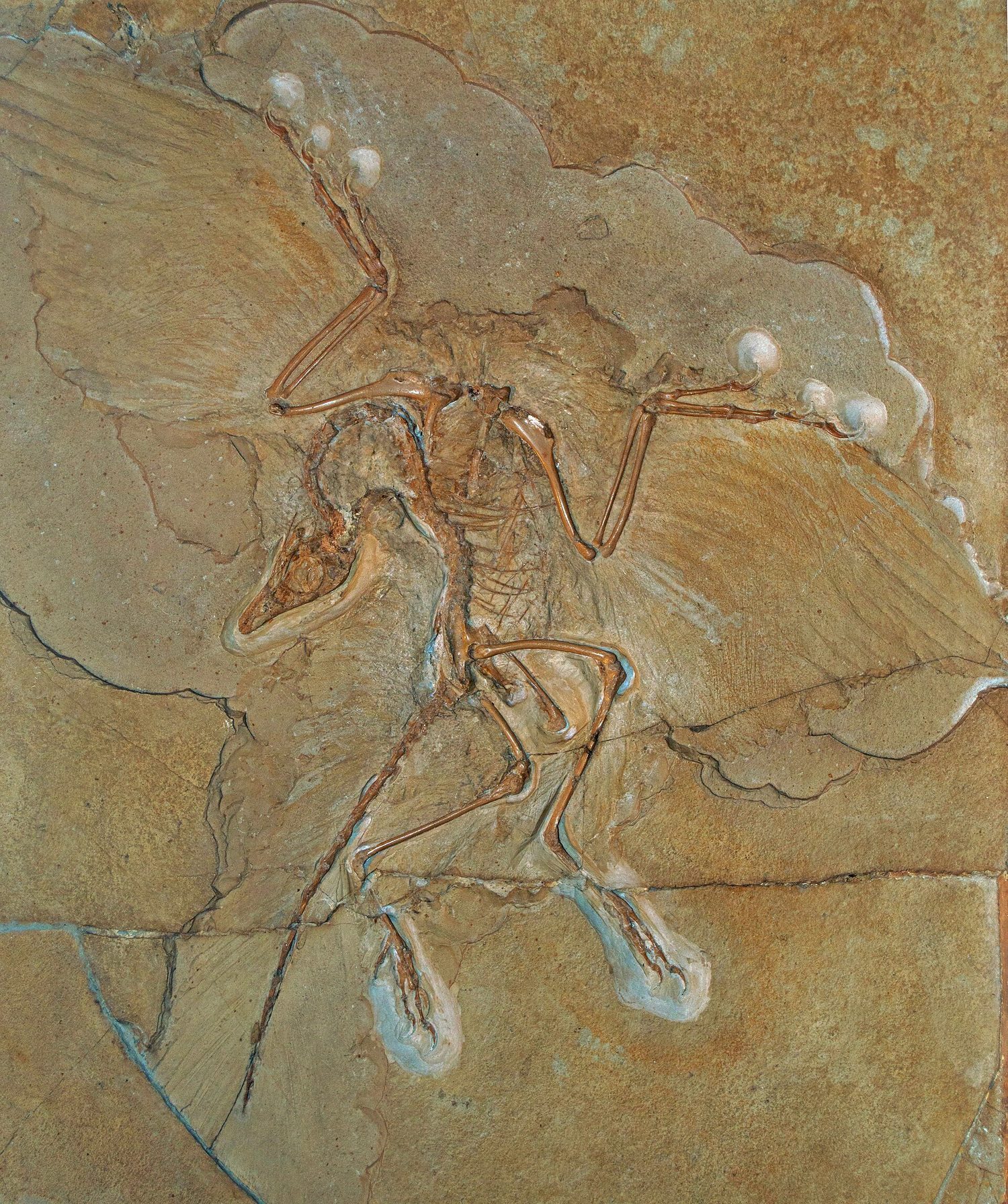
所有生命共享一个共同祖先(common ancestor),由普遍的特征显示:所有生物里相同的 DNA/RNA 机器、相同的遗传密码、核糖体和核心代谢通路。两个物种共享的特征和序列越多,它们分化得越近。

Archaeopteryx: transitional fossils link major groups and support common ancestry
词汇表 训练
英文 中文 拼音
common ancestor 共同祖先 gòng tóng zǔ xiān
7.8

持续进化

大纲
Big IdeaLearning ObjectiveEssential Knowledge

Big Idea 1 — Evolution
The process of evolution drives the diversity and unity of life.

7.8.A
Explain how evolution is an ongoing process in all living organisms.

  • 7.8.A.1 All species have evolved and continue to evolve. Examples include:
    • i. Genomic changes over time
    • ii. Continuous change in the fossil record
    • iii. Evolution of resistance to antibiotics, pesticides, herbicides, or chemotherapy drugs
    • iv. Pathogens evolving and causing emergent diseases

来源:美国大学理事会 AP 课程与考试说明

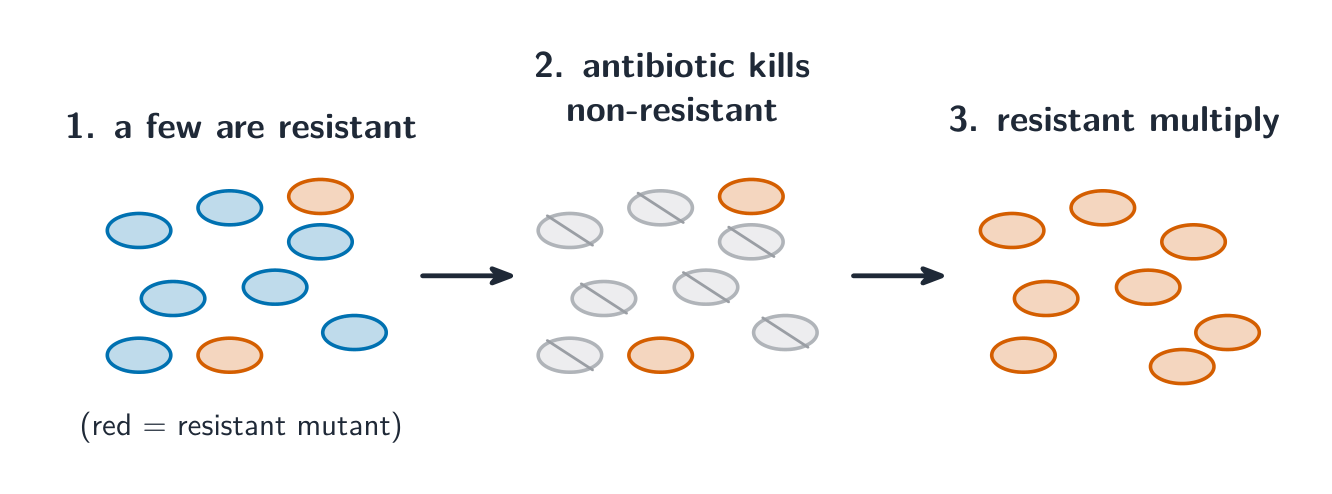
进化是持续的和可观察的:抗生素抗性细菌、杀虫剂抗性昆虫,和快速繁殖物种里的迅速变化。因为环境持续变化,选择持续作用——进化没有终点。

抗生素抗性如何通过自然选择在一个种群里扩散
7.9

系统发育

大纲
Big IdeaLearning ObjectiveEssential Knowledge

Big Idea 1 — Evolution
The process of evolution drives the diversity and unity of life.

7.9.A
Describe the types of evidence that can be used to infer an evolutionary relationship.

  • 7.9.A.1 Phylogenetic trees and cladograms show hypothetical evolutionary relationships among lineages that can be tested.
  • 7.9.A.2 Phylogenetic trees show the amount of change over time calibrated by fossils or a molecular clock, whereas cladograms do not show time scale or the evolutionary difference between groups.
  • 7.9.A.3 Traits that are either gained or lost during evolution can be used to construct phylogenetic trees and cladograms. The out-group represents the lineage that is least closely related to the remainder of the organisms in the phylogenetic tree or cladogram.
    • i. Shared derived characters can be present in more than one lineage and indicate common ancestry. These are informative for the construction of phylogenetic trees and cladograms.
    • ii. Molecular data typically provide more accurate and reliable evidence than morphological traits in the construction of phylogenetic trees or cladograms.

7.9.B
Explain how phylogenetic trees and cladograms can be used to infer evolutionary relatedness.

  • 7.9.B.1 Phylogenetic trees and cladograms can be used to illustrate speciation that has occurred. The nodes on a tree represent the most recent common ancestor of any two groups or lineages.
  • 7.9.B.2 Phylogenetic trees and cladograms can be constructed from morphological similarities of living or fossil species and from DNA and protein sequence similarities.
  • 7.9.B.3 Phylogenetic trees and cladograms represent hypotheses that are constantly being revised based on evidence.

来源:美国大学理事会 AP 课程与考试说明

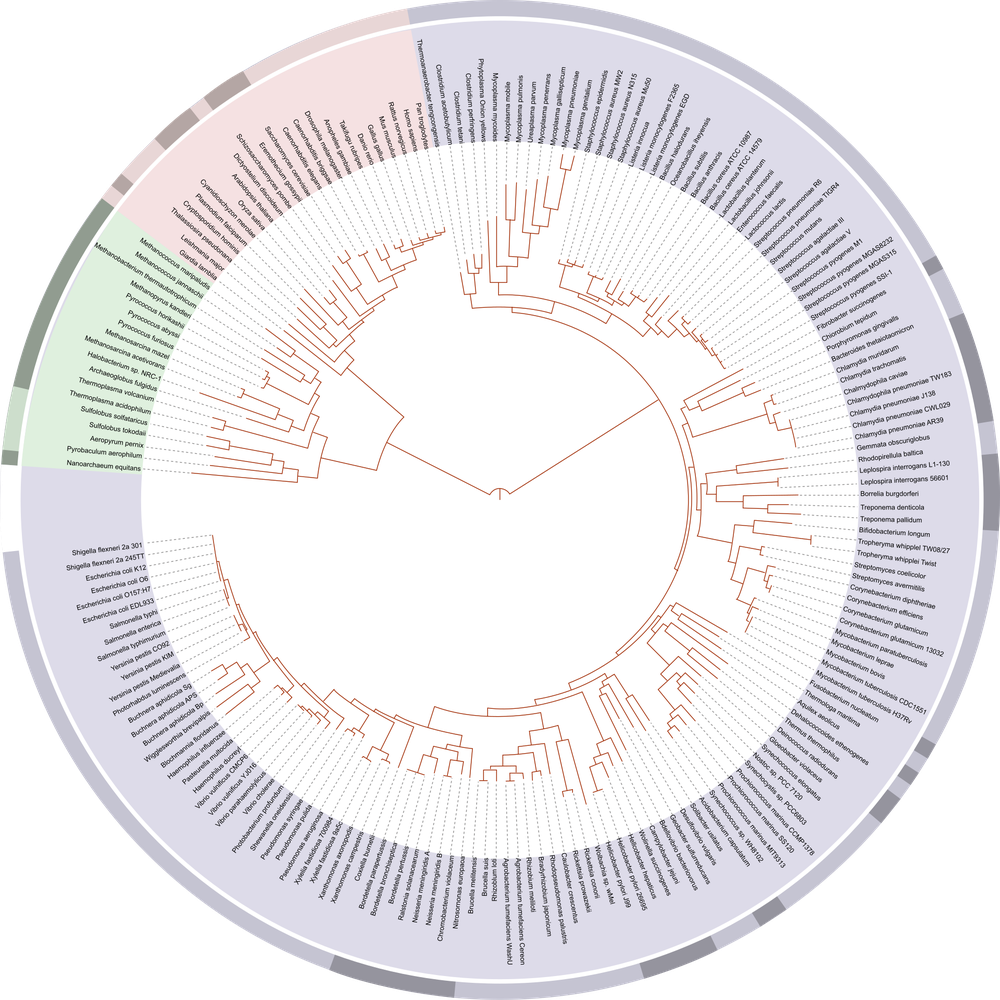
一棵系统发育树(phylogenetic tree)(分支图)图示进化关系,分支点标记共同祖先而共享的衍生性状把相关的物种分组。树是假设,随着新的(尤其是分子的)数据到来而修订。

The tree of life: phylogeny groups organisms by shared ancestry from a common origin
词汇表 训练
英文 中文 拼音
phylogenetic tree 系统发育树 xì tǒng fā yù shù
7.10

物种形成

大纲
Big IdeaLearning ObjectiveEssential Knowledge

Big Idea 1 — Evolution
The process of evolution drives the diversity and unity of life.

7.10.A
Describe the conditions under which new species may arise.

  • 7.10.A.1 Speciation occurs when two populations become reproductively isolated from each other.
  • 7.10.A.2 The biological species concept provides a commonly used definition of a species for sexually reproducing organisms. It states that species can be defined as a group capable of interbreeding and exchanging genetic information to produce viable, fertile offspring.

7.10.B
Describe the rate of evolution and speciation under different ecological conditions.

  • 7.10.B.1 Punctuated equilibrium is when evolution occurs rapidly after a long period of stasis. Gradualism is when evolution occurs slowly over hundreds of thousands or millions of years.
  • 7.10.B.2 Divergent evolution occurs when adaptation to new habitats results in phenotypic diversification. Speciation rates can be especially rapid during times of adaptive radiation as new habitats become available.
  • 7.10.B.3 Convergent evolution occurs when similar selective pressures result in similar phenotypic adaptations in different populations or species.

7.10.C
Explain the processes and mechanisms that drive speciation.

  • 7.10.C.1 Sympatric speciation occurs in populations with geographic overlap. Allopatric speciation occurs in populations that are geographically isolated.
  • 7.10.C.2 Various pre-zygotic and post-zygotic mechanisms can maintain reproductive isolation and prevent gene flow between populations.
  • Illustrative examples for 7.10.C: Hawaiian Drosophila; Caribbean Anolis; Apple maggot Rhagoletis

来源:美国大学理事会 AP 课程与考试说明

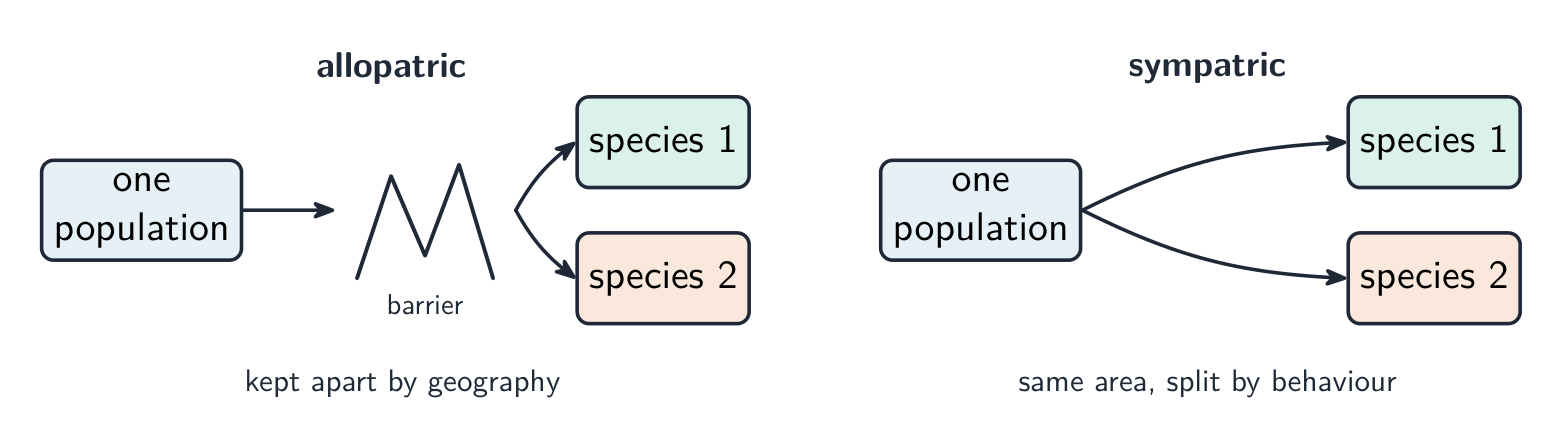
物种形成(speciation)是新物种的起源,通常当种群变得生殖隔离(reproductively isolated)并分化时。异域(allopatric)物种形成跟随一次地理分裂;同域(sympatric)物种形成在没有一次分裂的情况下发生。一旦种群不再能杂交,它们就是分开的物种。

异域和同域物种形成
异域和同域物种形成
词汇表 训练
英文 中文 拼音
Speciation 物种形成 wù zhǒng xíng chéng
reproductively isolated 生殖隔离 shēng zhí gé lí
7.11

群体中的变异

大纲
Big IdeaLearning ObjectiveEssential Knowledge

Big Idea 4 — Systems Interactions
Biological systems interact, and these systems and their interactions exhibit complex properties.

7.11.A
Explain how the genetic diversity of a species or population affects its ability to withstand environmental pressures.

  • 7.11.A.1 The level of variation in a population affects population dynamics.
    • i. The ability of a population to respond to changes in the environment is influenced by genetic diversity. Species and populations with little genetic diversity are at risk of decline or extinction.
    • ii. Genetically diverse populations are more resilient to environmental perturbation because they are more likely to contain individuals that can withstand the environmental pressure.
    • iii. Alleles that are adaptive in one environmental condition may be deleterious in another because of different selective pressures.
    • Illustrative examples for 7.11.A.1: California condors; Black-footed ferrets; Prairie chickens; Potato blight; Corn rust; Genetic diversity and selective pressures; Antibiotic resistance in bacteria (not all individuals in a diverse population are susceptible to a disease outbreak)

来源:美国大学理事会 AP 课程与考试说明

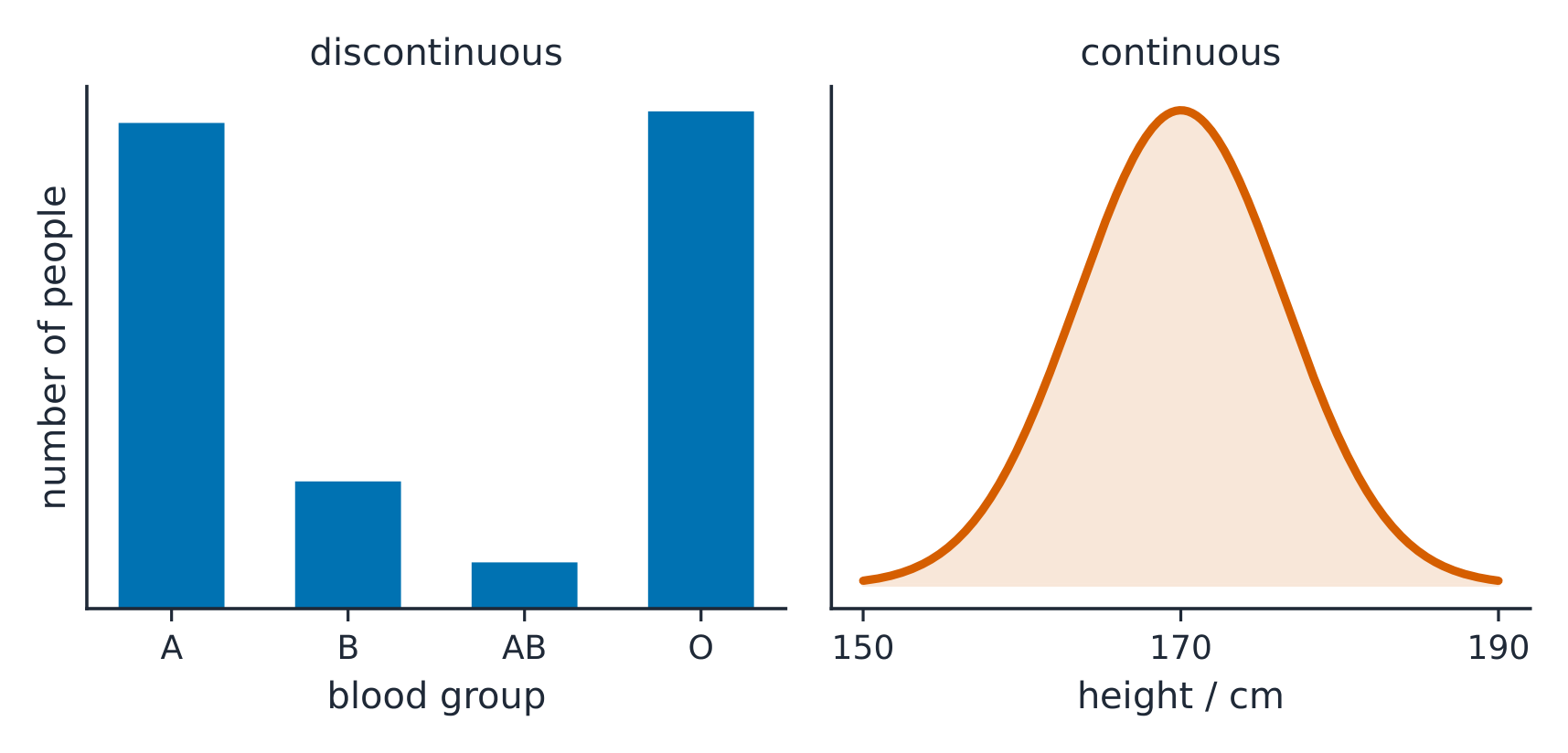
遗传多样性(diversity)帮助一个种群度过变化——若条件转变,一些变体可能已经适合它们。低多样性(如在一个濒危物种里)使一个种群脆弱。变异产生于突变以及减数分裂和有性繁殖的重新洗牌。

不连续和连续变异
不连续和连续变异
词汇表 训练
英文 中文 拼音
diversity 多样性 duō yàng xìng
7.12

地球生命的起源

大纲
Big IdeaLearning ObjectiveEssential Knowledge

Big Idea 4 — Systems Interactions
Biological systems interact, and these systems and their interactions exhibit complex properties.

7.12.A
Describe the scientific evidence that supports models of the origin of life on Earth.

  • 7.12.A.1 The origin of life on Earth is supported by scientific evidence.
    • i. Geological evidence reinforces models of the origin of life on Earth.
    • ii. Earth formed approximately 4.6 billion years ago (bya). The environment was too hostile for life until about 3.9 bya, and the earliest fossil evidence for life dates to 3.5 bya. Taken together, this evidence provides a plausible range of dates for the origin of life.
  • 7.12.A.2 The RNA world hypothesis proposes that RNA could have been the earliest genetic material. There are three assumptions:
    • i. At some point in time, genetic continuity was assured by the replication of RNA.
    • ii. Base-pairing is necessary for replication.
    • iii. Genetically encoded proteins were not involved as catalysts.

来源:美国大学理事会 AP 课程与考试说明

证据表明早期地球的条件能形成简单的有机分子(米勒-尤里类型的实验),它们组装成聚合物、然后自我复制的 RNA("RNA 世界"),并最终成膜的细胞。第一批细胞是原核生物;真核生物后来通过内共生(endosymbiosis)产生。
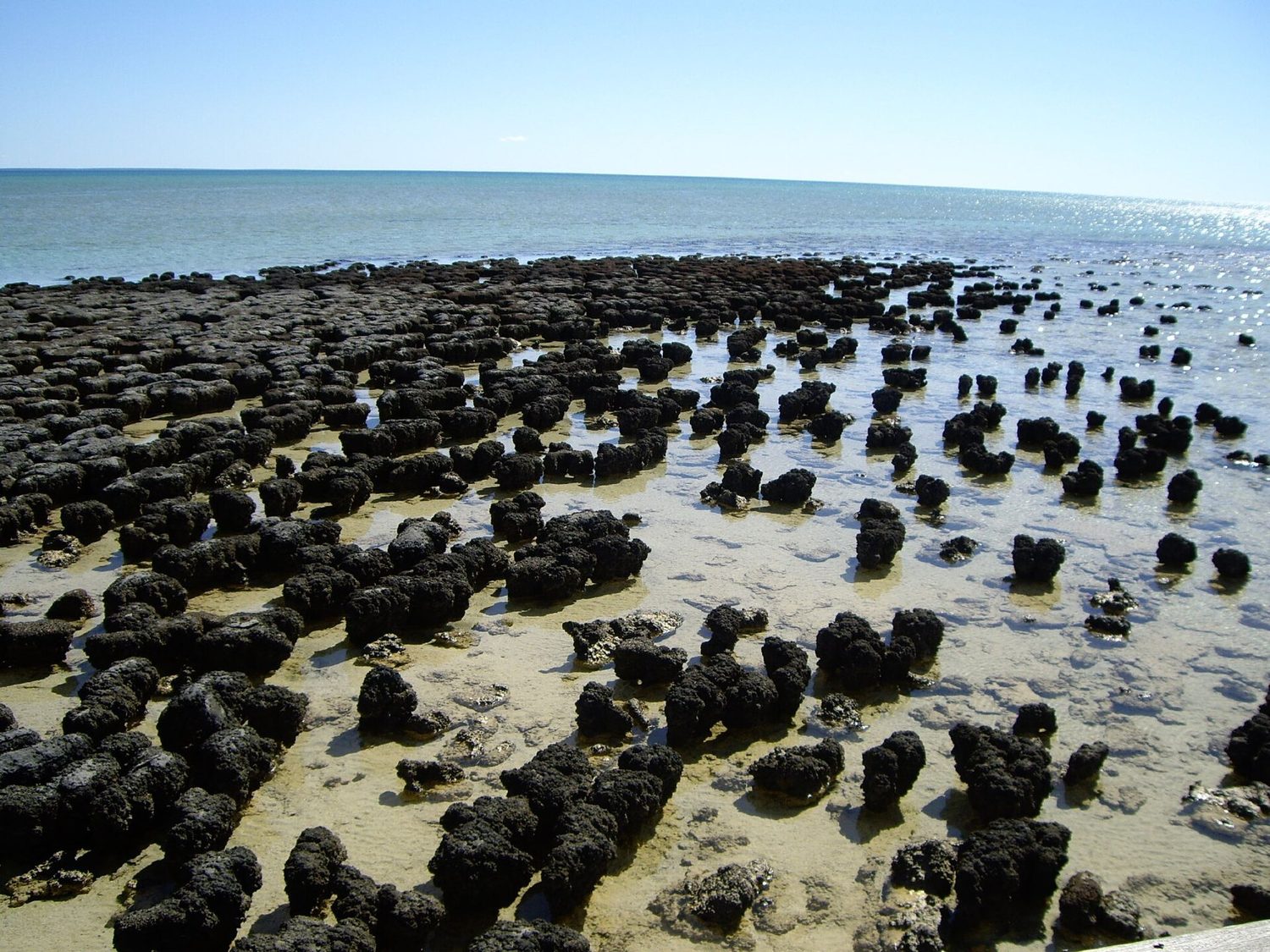
Stromatolites: layered microbial mats are among the oldest evidence of life on Earth
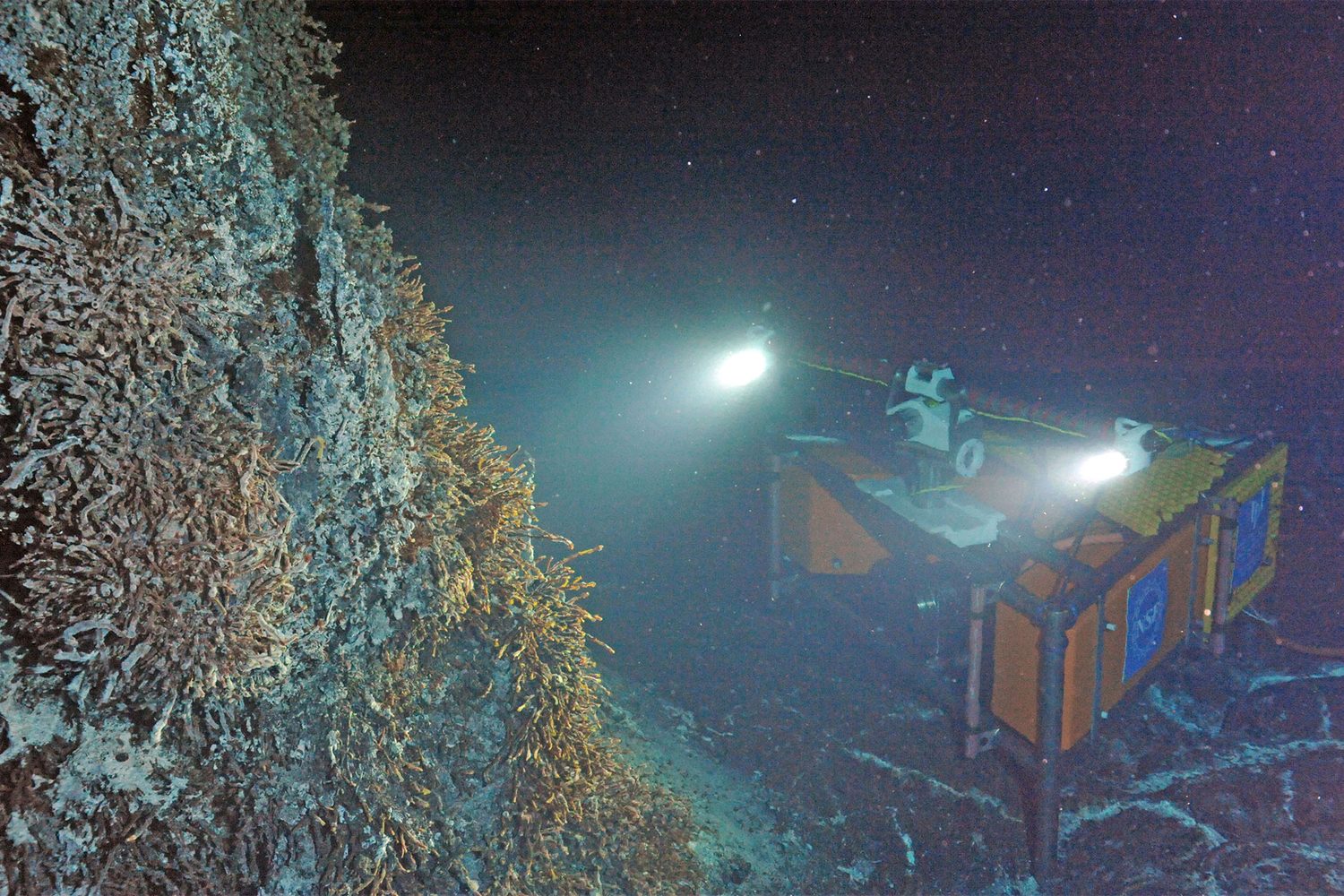
A hydrothermal vent: hot chemical-rich water may have powered early metabolism at life's origin
词汇表 训练
英文 中文 拼音
endosymbiosis 内共生 nèi gòng shēng
7.12

考试技巧

  • 干净地陈述自然选择:变异 → 差异的存活和繁殖 → 有帮助的性状变得常见
  • 适合度 = 繁殖成功,不是力量或健康。
  • 进化是一个种群等位基因频率的一个变化——个体不进化。
  • 哈迪-温伯格($p^2+2pq+q^2=1$):从隐性表型 $q^2\to q\to p$ 开始。
  • 引用独立的证据(化石、同源结构、DNA)并通过生殖隔离解释物种形成。

本主题的互动课程

逐步学习,并即时检测练习。

AP 生物历年真题

AP 生物的更多主题

登录或创建账号

IGCSE, A-Level & AP