| Big Idea | Learning Objective | Essential Knowledge |
|---|---|---|
Big Idea 4 — Systems Interactions | 1.1.A |
|
Chemistry of Life
AP Biology · Topic 1
 9:24
9:24
Chemistry of Life
Drop an ice cube into a glass and it floats. That sounds ordinary, but it is strange. Almost every other solid sinks in its own liquid, because freezing packs…
English narration · English + 中文 subtitles burned in
1.1
Structure of Water and Hydrogen Bonding
Syllabus
Source: College Board AP Course and Exam Description
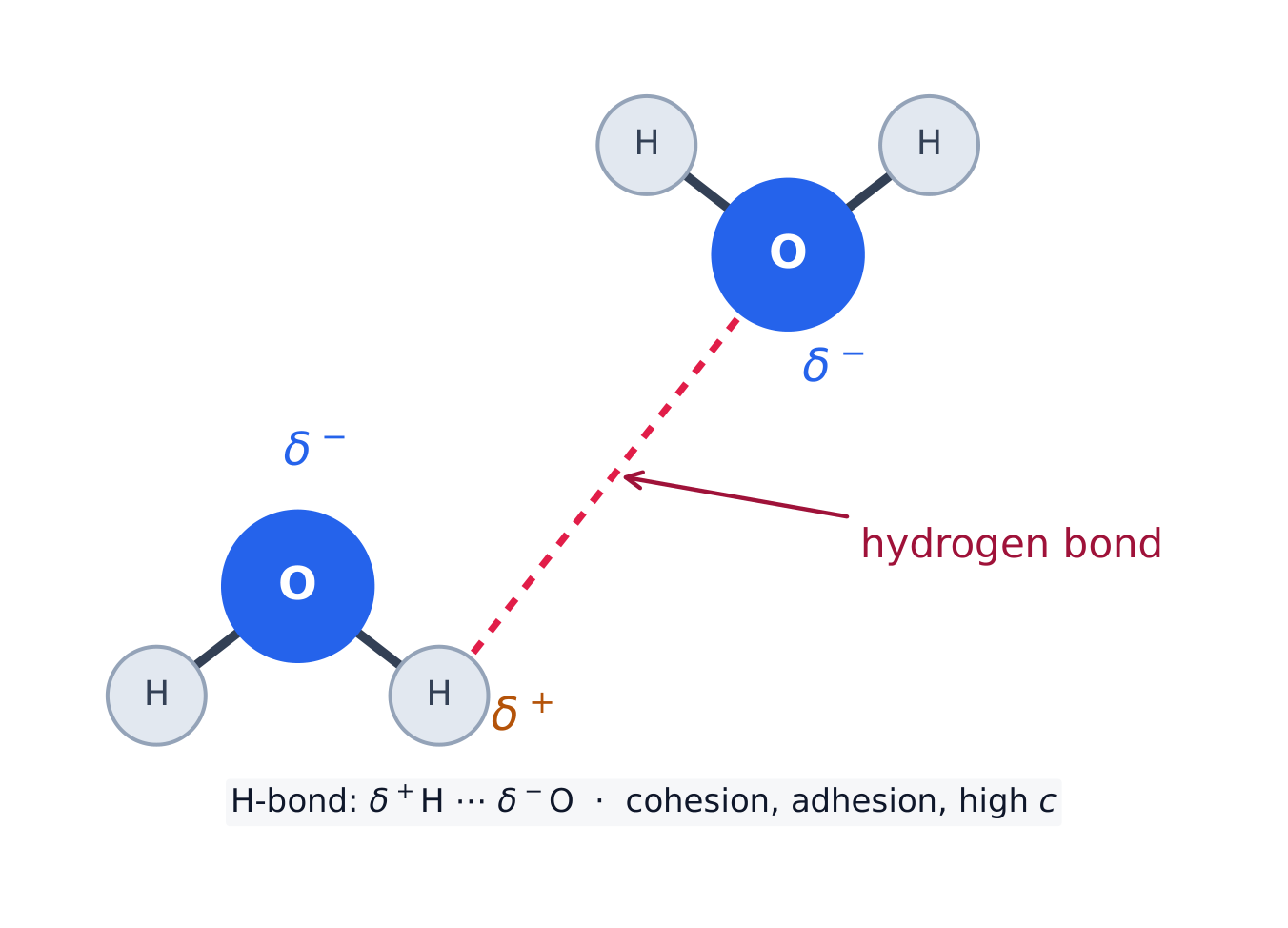
Water is polar 极性: its oxygen pulls electrons more strongly than its hydrogens, giving a slightly negative O and slightly positive H. This lets water molecules form hydrogen bonds 氢键 with each other, which explains water's life-supporting properties:
- Cohesion 内聚力 and adhesion 附着力 (surface tension, capillary action, water rising in plants),
- high specific heat 比热容 (resists temperature change, stabilizing organisms),
- high heat of vaporization (evaporative cooling),
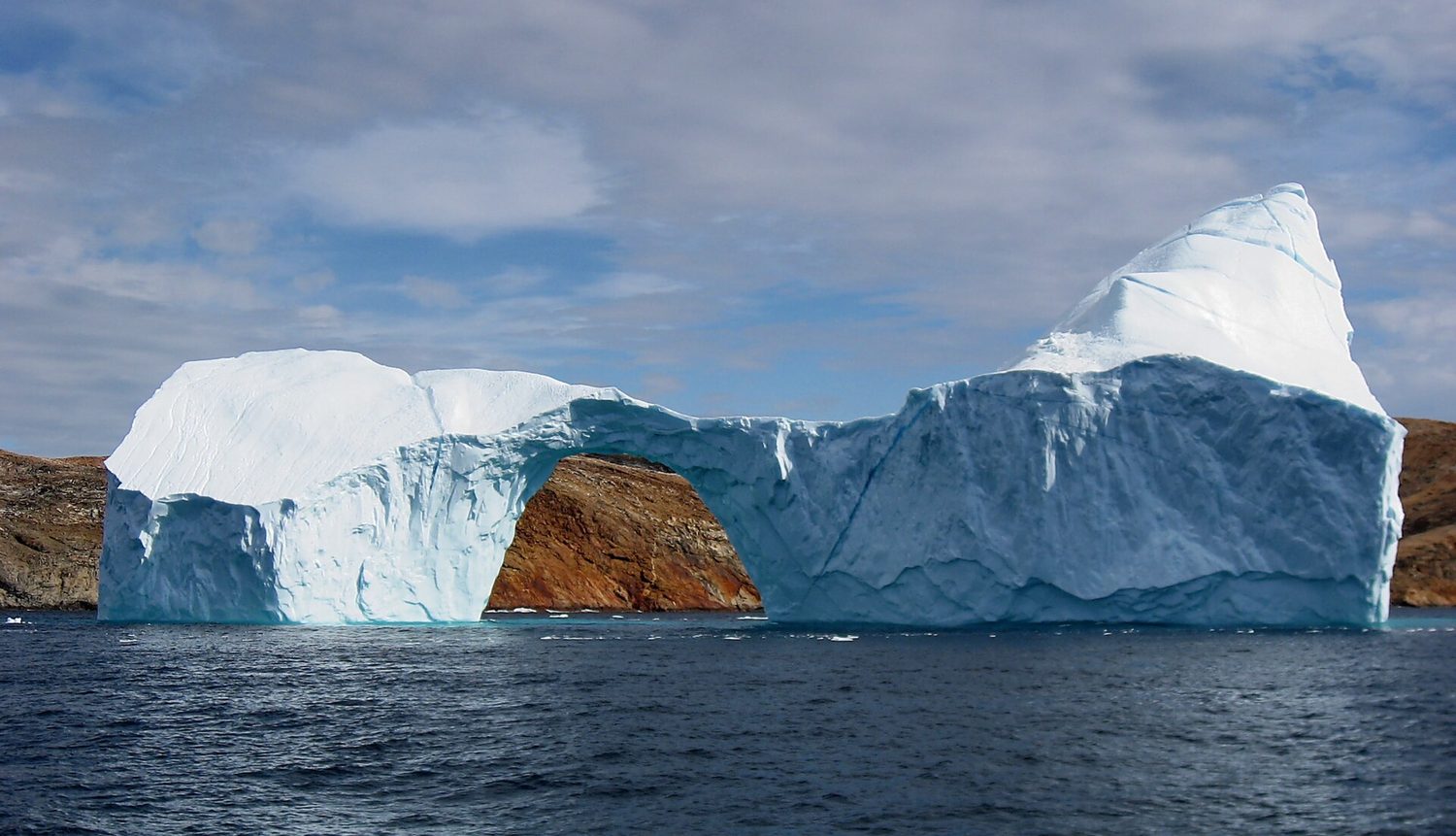
- ice floating (less dense solid), and being a great solvent for polar and ionic substances.
Explore
Explore how a covalent bond shares electrons
Step through two atoms overlapping to share a pair of electrons so each reaches a full shell. In $\text{H}_2$ the two atoms pull equally, so the bond is non-polar — the contrast that makes water's unequal sharing (and its $\delta^+/\delta^-$ dipole) so important.
Vocabulary
Train
| English |
|---|
| polar/ˈpəʊlə/ |
| hydrogen bonds/ˈhaɪdrədʒn bɒndz/ |
| Cohesion/kəʊˈhiːʒn/ |
| adhesion/ədˈhiːʒn/ |
| specific heat/spəˈsɪfɪk hiːt/ |
1.2
Elements of Life
Syllabus
| Big Idea | Learning Objective | Essential Knowledge |
|---|---|---|
Big Idea 2 — Energetics | 1.2.A |
|
Source: College Board AP Course and Exam Description
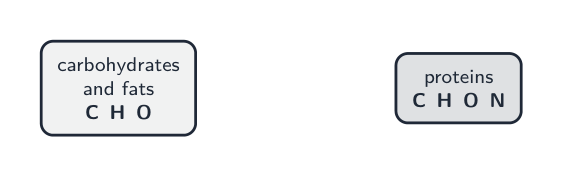
Living matter is built mostly from a few elements – carbon, hydrogen, oxygen, nitrogen, phosphorus, and sulfur. Carbon 碳 is central because it forms four stable covalent bonds, building long chains, branches, and rings – the skeletons of all biological molecules.
Vocabulary
Train
| English |
|---|
| Carbon/ˈkɑːbən/ |
1.3
Introduction to Macromolecules
Syllabus
| Big Idea | Learning Objective | Essential Knowledge |
|---|---|---|
Big Idea 4 — Systems Interactions | 1.3.A |
|
Source: College Board AP Course and Exam Description
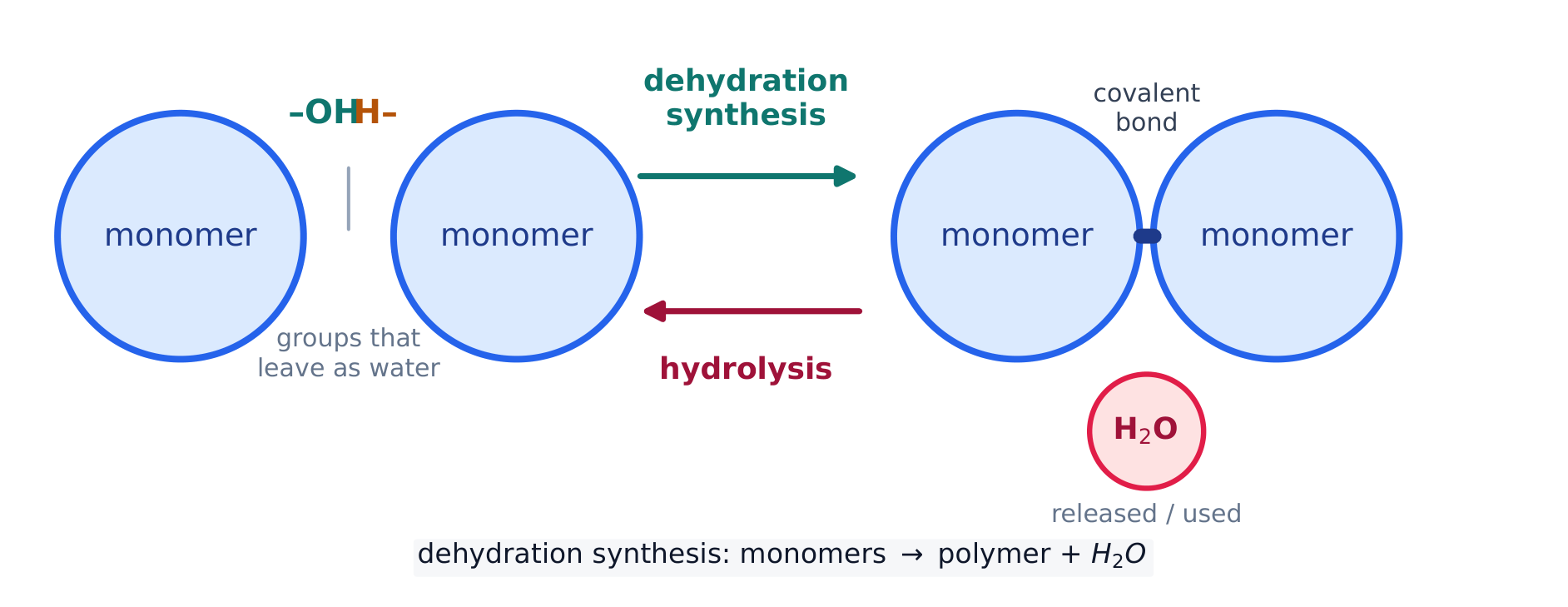
Large biological molecules – macromolecules 大分子 – are polymers 聚合物 built from repeating monomers 单体. Cells join monomers by dehydration synthesis 脱水缩合 (removing water to form a bond) and break polymers by hydrolysis 水解 (adding water). Four classes: carbohydrates, lipids, nucleic acids, and proteins.
Explore
Explore the four classes of macromolecule by their monomer
Sort each clue into the right macromolecule class by matching the monomer that builds it — sugars, nucleotides or amino acids — and notice that lipids are the odd one out that are not true polymers.
Vocabulary
Train
| English |
|---|
| macromolecules/ˈmækrəmɒlɪkjuːlz/ |
| polymers/ˈpɒlɪməz/ |
| monomers/ˈmɒnəʊməz/ |
| dehydration synthesis/ˌdiːhaɪˈdreɪʃn ˈsɪnθəsɪs/ |
| hydrolysis/haɪˈdrɒləsɪs/ |
1.4
Carbohydrates
Syllabus
| Big Idea | Learning Objective | Essential Knowledge |
|---|---|---|
Big Idea 4 — Systems Interactions | 1.4.A |
|
Source: College Board AP Course and Exam Description
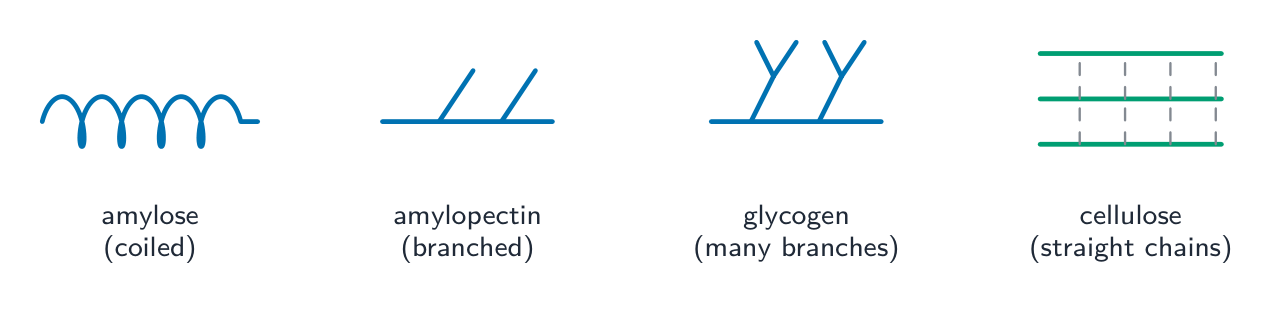
Carbohydrates 碳水化合物 are made of sugar monomers (monosaccharides 单糖 like glucose). They store energy (starch, glycogen) and provide structure (cellulose 纤维素 in plant walls). Their many hydroxyl groups make them polar and water-soluble.
Vocabulary
Train
| English |
|---|
| Carbohydrates/ˌkɑːbəʊˈhaɪdreɪts/ |
| monosaccharides/ˈmɒnəʊsækɑːraɪdz/ |
| cellulose/ˈseljuːləʊs/ |
1.5
Lipids
Syllabus
| Big Idea | Learning Objective | Essential Knowledge |
|---|---|---|
Big Idea 4 — Systems Interactions | 1.5.A |
|
Source: College Board AP Course and Exam Description
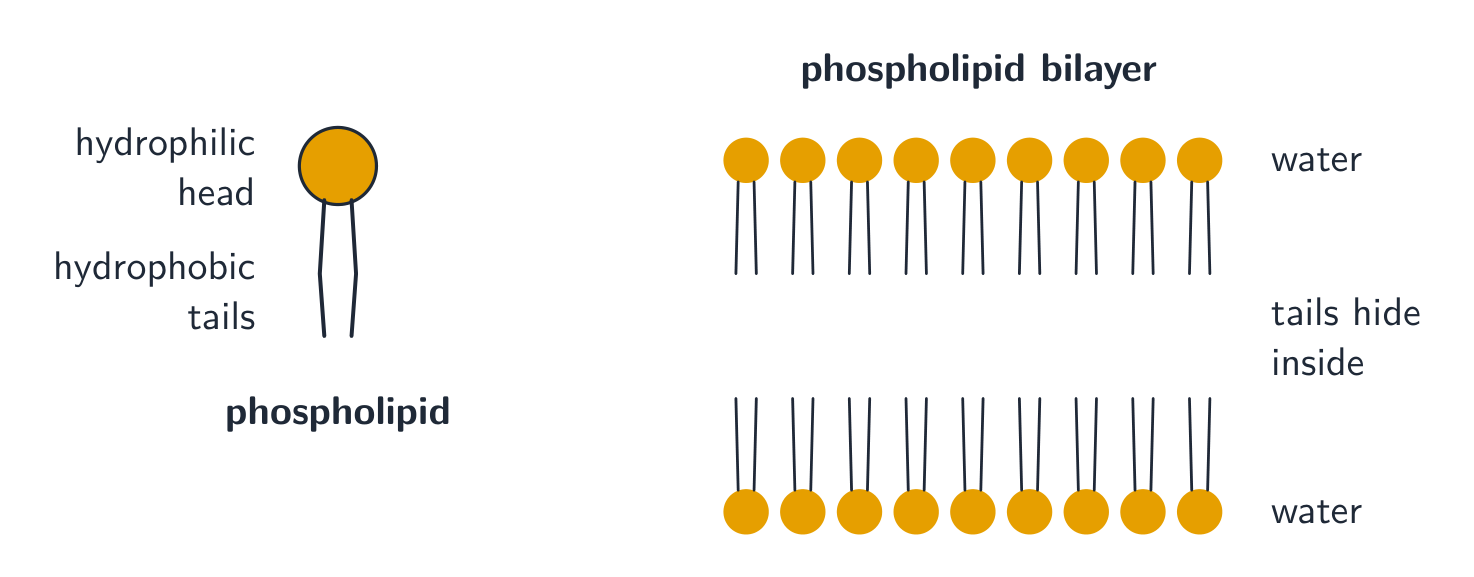
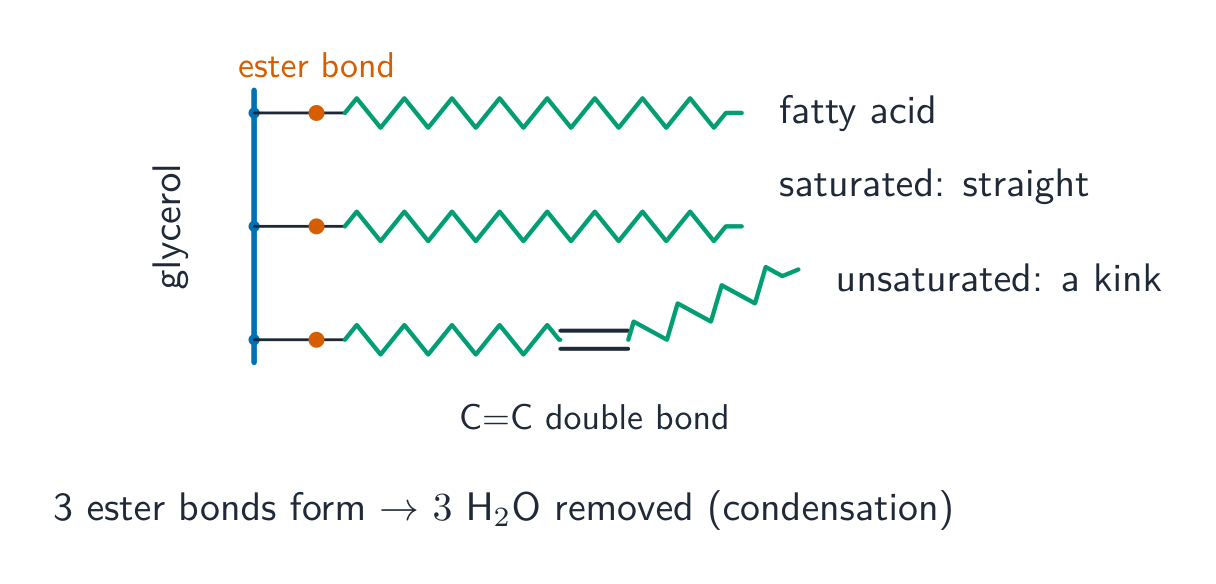
Lipids 脂质 are nonpolar and do not mix with water (hydrophobic 疏水). They include fats (long-term energy storage), phospholipids 磷脂 (which build membranes), and steroids. A phospholipid has a polar "head" and nonpolar "tails," the key to the cell membrane.
Vocabulary
Train
| English |
|---|
| Lipids/ˈlɪpɪdz/ |
| hydrophobic/ˌhaɪdrəˈfəʊbɪk/ |
| phospholipids/ˈfɒsfəlɪpɪdz/ |
1.6
Nucleic Acids
Syllabus
| Big Idea | Learning Objective | Essential Knowledge |
|---|---|---|
Big Idea 3 — Information Storage and Transmission | 1.6.A |
|
Source: College Board AP Course and Exam Description
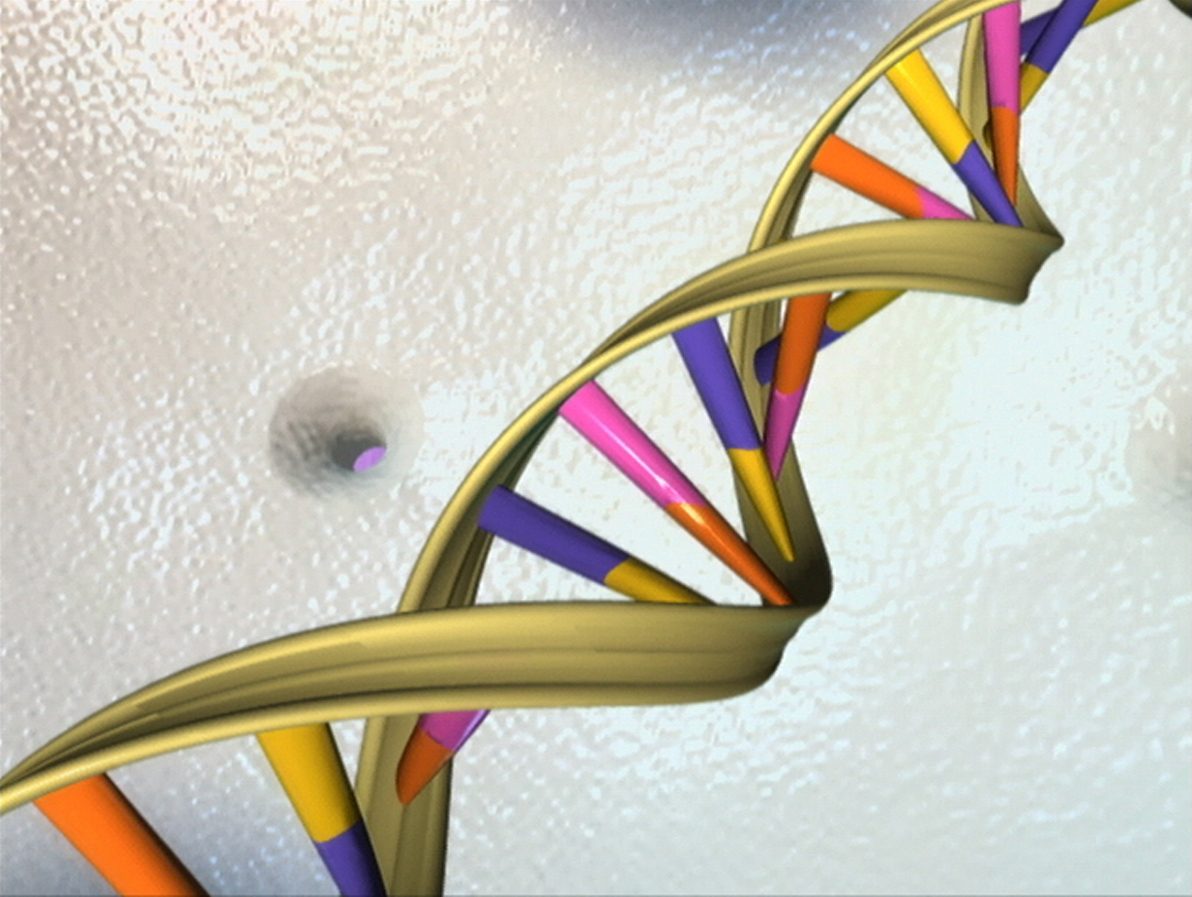
Nucleic acids 核酸 (DNA and RNA) store and carry genetic information. Their monomers are nucleotides 核苷酸, each a sugar, a phosphate, and a nitrogen base. The base sequence encodes instructions; DNA is double-stranded, RNA single-stranded.

Explore
Explore complementary base pairing
Step along a DNA template and watch each base pair to its partner by complementary base pairing ($A$ with $T$, $G$ with $C$) — the rule that lets either strand act as a template to rebuild the other.
Vocabulary
Train
| English |
|---|
| Nucleic acids/njuːˈklɪɪk ˈæsɪdz/ |
| nucleotides/ˈnjuːklɪɒtaɪdz/ |
1.7
Proteins
Syllabus
| Big Idea | Learning Objective | Essential Knowledge |
|---|---|---|
Big Idea 3 — Information Storage and Transmission | 1.7.A |
|
Source: College Board AP Course and Exam Description
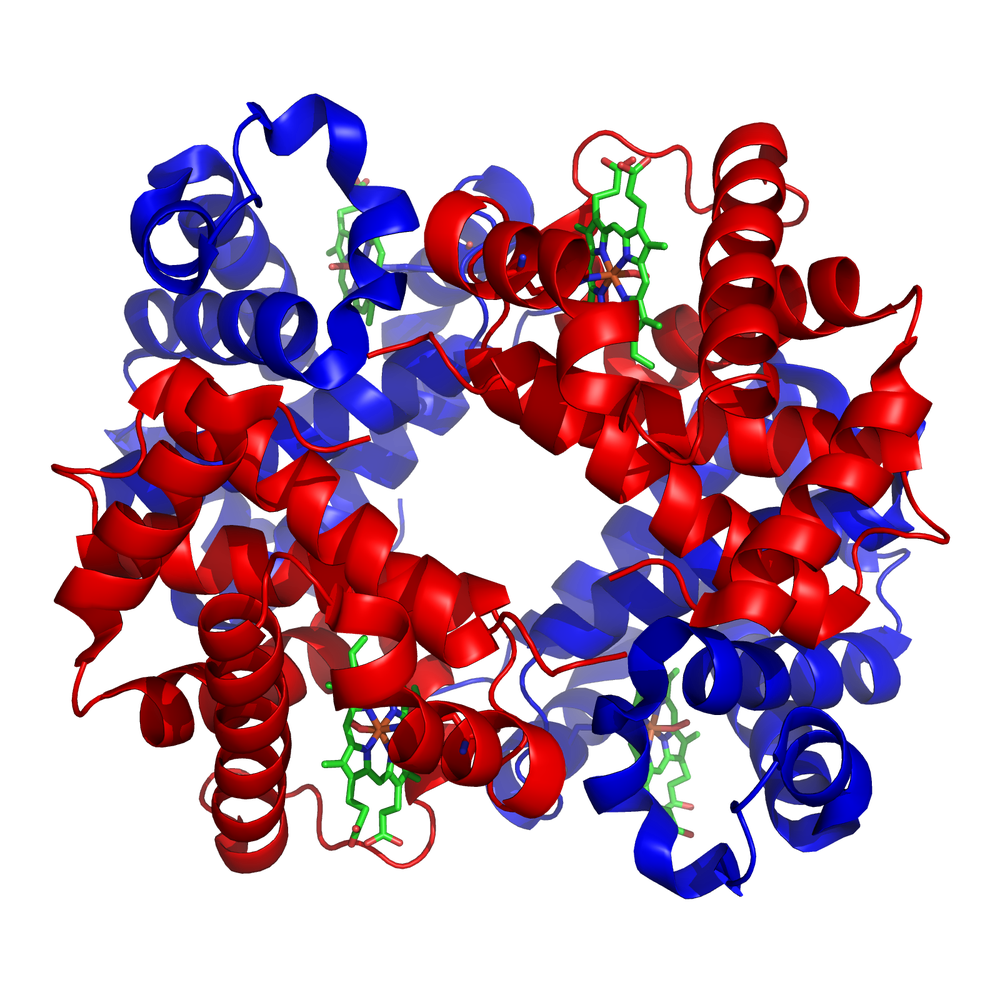
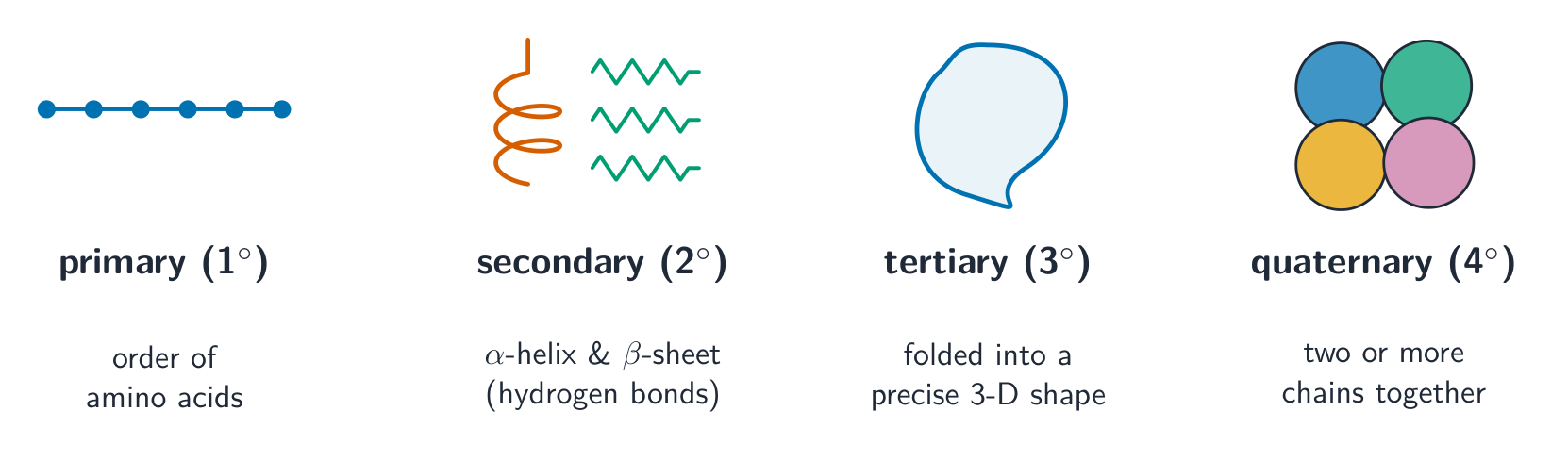
Proteins 蛋白质 are polymers of amino acids 氨基酸 joined by peptide bonds 肽键. Their sequence folds into a specific 3-D shape at four levels (primary, secondary, tertiary, quaternary), and shape determines function – as enzymes, transporters, receptors, and structural parts. Changing the environment (heat, pH) can denature 变性 a protein, unfolding it and stopping its function.
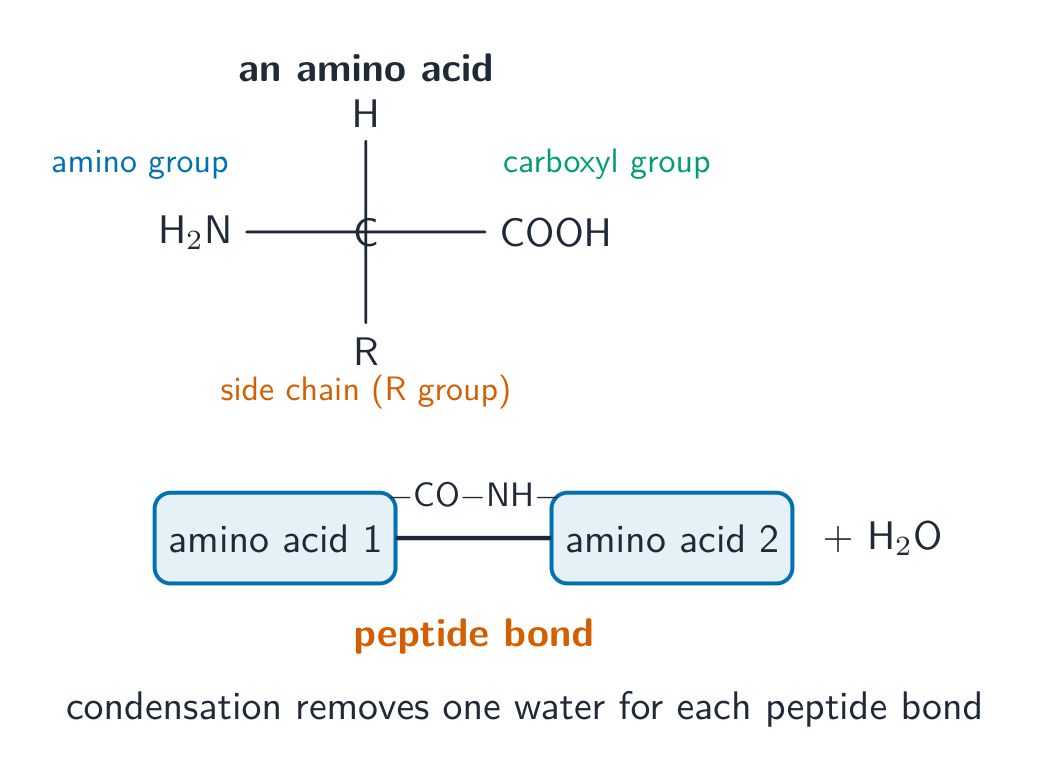
Worked example. Building a polymer from 10 monomers by dehydration synthesis forms 9 bonds and releases 9 water molecules — one per bond, so $N$ monomers release $N-1$ waters. Hydrolysis reverses this exactly: adding those 9 waters breaks the polymer back into 10 monomers. This is why biosynthesis (dehydration) and digestion (hydrolysis) are chemical opposites.
Vocabulary
Train
| English |
|---|
| Proteins/ˈprəʊtiːnz/ |
| amino acids/əˈmiːnəʊ ˈæsɪdz/ |
| peptide bonds/ˈpeptaɪd bɒndz/ |
| denature/ˈdenətʃə/ |
1.7
Exam tips
- Trace every property of water back to its polarity and hydrogen bonding (cohesion, high specific heat, solvent power).
- Know the four macromolecule classes and their monomers; polymers are built by dehydration synthesis and broken by hydrolysis.
- For proteins, structure (shape) determines function — heat or a pH change denatures them and stops them working.
- In DNA the bases pair A–T and C–G on antiparallel strands; RNA is single-stranded and uses U.
- Link each molecule to its role (carbohydrates: energy/structure; lipids: membranes/storage; nucleic acids: information).
Interactive lessons on this topic
Work through it step by step, with instant-check exercises.