Continuing Evolution
Introduced| English |
|---|
| antibiotic resistance/ˌæntɪbaɪˈɒtɪk rɪˈzɪstəns/ |
Evolution is not finished
- Evolution is not just a story about the distant past.
- It is happening right now, all around us.
- In fast-breeding organisms, we can even watch it unfold.
- Nowhere is this clearer than in bacteria facing antibiotics.
Fast lives, fast evolution
- Bacteria can divide every twenty minutes.
- So thousands of generations pass in a matter of days.
- With each generation, selection has another chance to act.
- Evolution that takes millions of years in whales takes weeks in bacteria.
Why can we see evolution happening in bacteria within our lifetime?
Bacteria divide in minutes, so many generations - and much selection - happen in a short time.
Antibiotic resistance
- A few bacteria carry a chance mutation that makes them resistant to a drug.
- When the antibiotic is used, it kills the non-resistant bacteria.
- The resistant survivors multiply, and soon the whole population resists the drug.
- This spread of antibiotic resistance 抗生素耐药性 is natural selection in fast-forward.
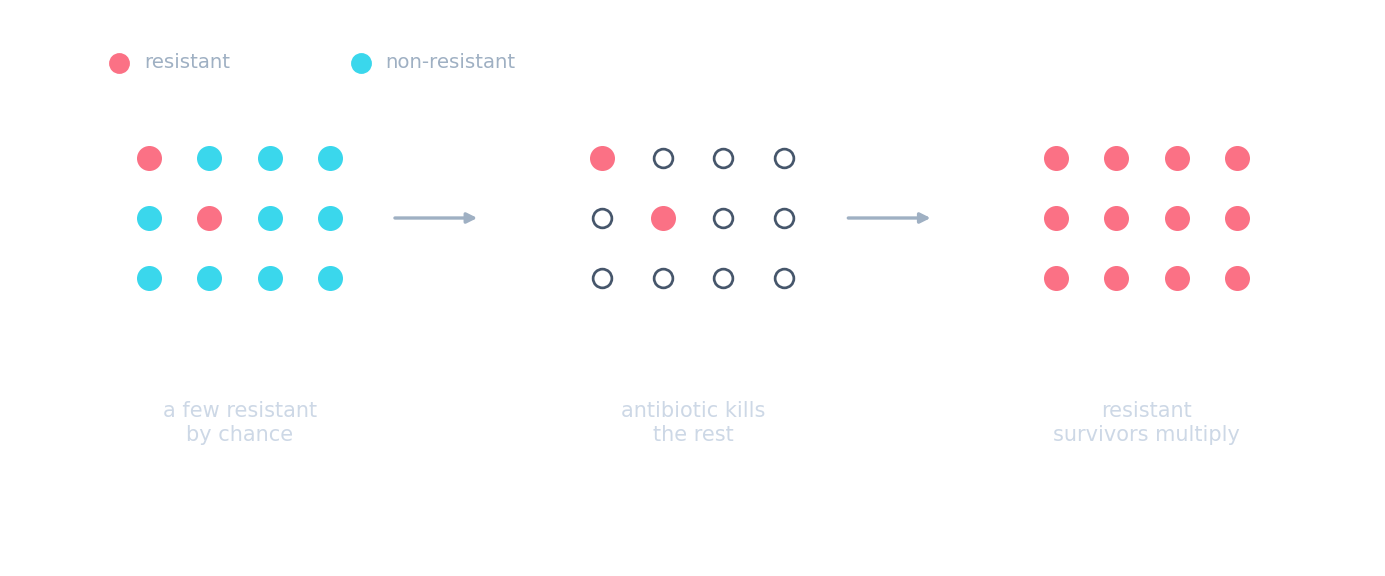
Selection for resistance
Watch how a drug kills most bacteria but the rare resistant ones survive and take over.
How does antibiotic resistance spread through a bacterial population?
A few bacteria are naturally resistant; the antibiotic kills the rest, so the survivors take over.
Resistant bacteria appear first by random ____, not by trying to resist.
A chance mutation makes a bacterium resistant before the drug arrives; selection then favours it.
Why overuse is dangerous
- Every use of an antibiotic favours any resistant bacteria present.
- Overusing them speeds up the evolution of resistance.
- This is why doctors urge us not to misuse antibiotics.
- Resistant "superbugs" are a real and growing danger.
Overusing antibiotics speeds up the evolution of resistant bacteria.
Each use kills non-resistant bacteria and favours resistant ones, so overuse breeds resistance faster.
Select all true statements about continuing evolution.
Bacteria do not choose to resist - resistance arises by random mutation. The other three are correct.
Bacteria do not "try" to become resistant, and the drug does not teach them. Resistance comes first, by random mutation, in a few bacteria. The antibiotic then simply selects those survivors. Evolution has no goal — it only favours what already works.
The rise of a superbug:
- In a patient, one bacterium happens to carry a resistance mutation.
- Antibiotics wipe out its non-resistant neighbours, leaving it to multiply.
- Within days the infection is dominated by resistant bacteria — a superbug, evolved before our eyes.
Evolution continues today, fastest in quick-breeding organisms. Antibiotic resistance spreads when a chance mutation makes a few bacteria resistant, the drug kills the rest, and the survivors multiply. Overusing antibiotics speeds this up. Bacteria do not choose to resist — selection favours those that already can.