跳到主要内容

生命的化学

AP 生物 · 第 1 主题

训练
讲义 词汇表
1.1

水的结构与氢键

大纲
Big IdeaLearning ObjectiveEssential Knowledge

Big Idea 4 — Systems Interactions
Biological systems interact, and these systems and their interactions exhibit complex properties.

1.1.A
Explain how the properties of water that result from its polarity and hydrogen bonding affect its biological function.

  • 1.1.A.1 Living systems depend on the properties of water to sustain life.
    • 1.1.A.1.i Water has polarity, because of the formation of polar covalent bonds between hydrogen and oxygen within water molecules. This polarity contributes to hydrogen bonding between and within biological molecules.
    • 1.1.A.1.ii Water has a high specific heat capacity, which allows for the maintenance of homeostatic body temperature within living organisms.
    • 1.1.A.1.iii Water has a high heat of vaporization, which allows for the evaporative cooling of the surrounding environment. In living organisms, this property allows for body temperature to be maintained.
  • 1.1.A.2 The hydrogen bonds between adjacent polar water molecules result in cohesion, adhesion, and surface tension.

来源:美国大学理事会 AP 课程与考试说明

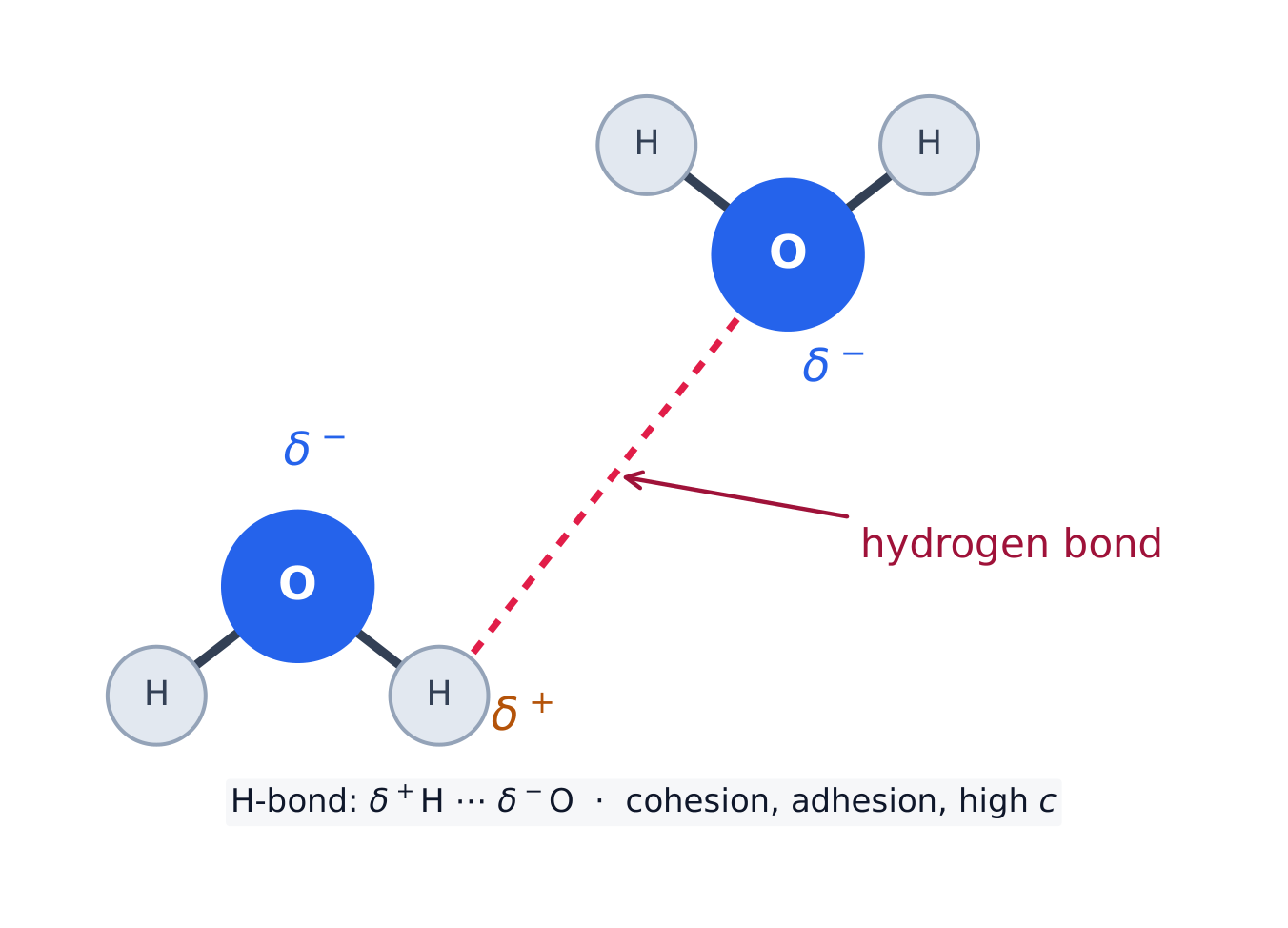
水是极性(polar)的:它的氧比它的氢更强地拉电子,给出一个略带负电的 O 和略带正电的 H。这让水分子彼此形成氢键(hydrogen bonds),这解释了水的支持生命的性质:

  • 内聚力(cohesion)和附着力(adhesion)(表面张力、毛细作用、水在植物里上升),
  • 比热容(specific heat)(抵抗温度变化,稳定生物),
  • 高的汽化热(蒸发冷却),
  • 冰漂浮(密度较小的固体),以及是极性和离子物质的一种极好的溶剂(solvent)。
两个极性水分子之间的一个氢键
两个极性水分子之间的一个氢键
探索

Explore how a covalent bond shares electrons

Step through two atoms overlapping to share a pair of electrons so each reaches a full shell. In $\text{H}_2$ the two atoms pull equally, so the bond is non-polar — the contrast that makes water's unequal sharing (and its $\delta^+/\delta^-$ dipole) so important.

词汇表 训练
英文 中文 拼音
polar 极性 jí xìng
hydrogen bonds 氢键 qīng jiàn
Cohesion 内聚力 nèi jù lì
adhesion 附着力 fù zhuó lì
specific heat 比热容 bǐ rè róng
1.2

生命元素

大纲
Big IdeaLearning ObjectiveEssential Knowledge

Big Idea 2 — Energetics
Biological systems use energy and molecular building blocks to grow, reproduce, and maintain dynamic homeostasis.

1.2.A
Describe the composition of macromolecules required by living organisms.

  • 1.2.A.1 Atoms and molecules from the environment are necessary to build new molecules. Carbon, hydrogen, and oxygen are the most prevalent elements used to build biological molecules such as carbohydrates, proteins, lipids, and nucleic acids. Additionally:
    • 1.2.A.1.i Sulfur is used in the building of proteins.
    • 1.2.A.1.ii Phosphorus is used in the building of phospholipids (a type of lipid) and nucleic acids.
    • 1.2.A.1.iii Nitrogen is used in the building of nucleic acids.

来源:美国大学理事会 AP 课程与考试说明

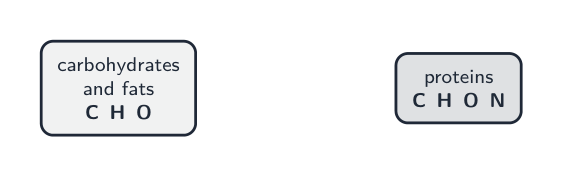
生命物质主要由少数几种元素构建——碳、氢、氧、氮、磷和硫。(carbon)是核心的,因为它形成四个稳定的共价键,构建长链、支链和环——所有生物分子的骨架。

碳水化合物和脂肪含碳、氢和氧;蛋白质还含氮
词汇表 训练
英文 中文 拼音
Carbon tàn
1.3

大分子导论

大纲
Big IdeaLearning ObjectiveEssential Knowledge

Big Idea 4 — Systems Interactions
Biological systems interact, and these systems and their interactions exhibit complex properties.

1.3.A
Describe the chemical reactions that build and break biological macromolecules.

  • 1.3.A.1 Hydrolysis is a chemical reaction involving the cleaving of covalent bonds. This type of reaction breaks down molecules into smaller molecules. When water is added to the bond between monomers in a polymer, the bond is broken. The hydrogen ion from a water molecule is added to one monomer and the hydroxyl group of the water molecule is added to the other monomer, completing the reaction.
  • 1.3.A.2 Dehydration synthesis occurs when two smaller molecules are joined together through covalent bonding. A hydrogen ion is removed from one monomer and a hydroxyl group is removed from the other. This causes the loss of the equivalent of a water molecule from the reactants and the connection of the two remaining monomers. The connection of many monomers is known as polymerization.

来源:美国大学理事会 AP 课程与考试说明

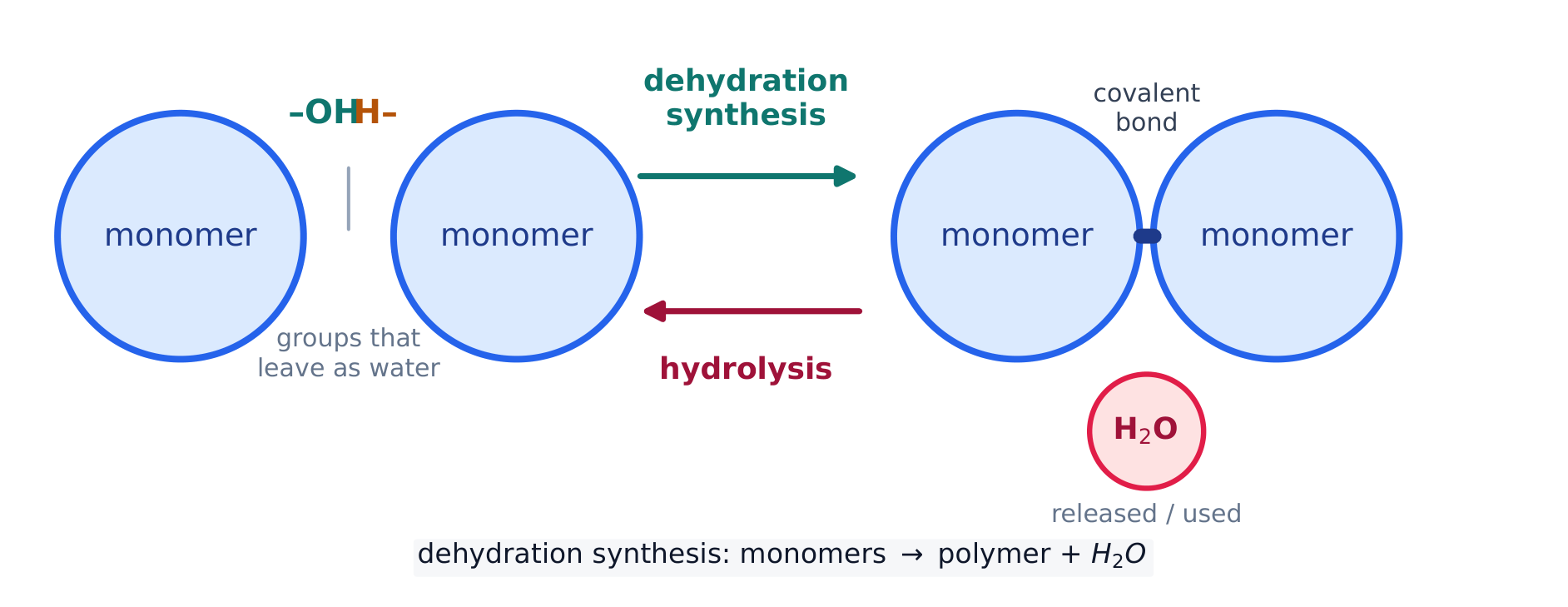
大的生物分子——大分子(macromolecules)——是由重复的单体(monomers)构建的聚合物(polymers)。细胞通过脱水缩合(dehydration synthesis)(移除水以形成一个键)连接单体,并通过水解(hydrolysis)(添加水)断开聚合物。四类:碳水化合物、脂质、核酸和蛋白质。

脱水缩合构建聚合物并释放水;水解将它逆转
探索

Explore the four classes of macromolecule by their monomer

Sort each clue into the right macromolecule class by matching the monomer that builds it — sugars, nucleotides or amino acids — and notice that lipids are the odd one out that are not true polymers.

词汇表 训练
英文 中文 拼音
macromolecules 大分子 dà fēn zi
polymers 聚合物 jù hé wù
monomers 单体 dān tǐ
dehydration synthesis 脱水缩合 tuō shuǐ suō hé
hydrolysis 水解 shuǐ jiě
1.4

碳水化合物

大纲
Big IdeaLearning ObjectiveEssential Knowledge

Big Idea 4 — Systems Interactions
Biological systems interact, and these systems and their interactions exhibit complex properties.

1.4.A
Describe the structure and function of carbohydrates.

  • 1.4.A.1 Monosaccharides (simple sugars) are the monomers for polysaccharides (complex carbohydrates). These monomers are connected by covalent bonds to form polymers such as complex carbohydrates, which may be linear or branched.
    • Illustrative examples for 1.4.A.1:
      • Cellulose
      • Starch
      • Glycogen
    • Exclusion statement: The molecular structure of specific carbohydrate polymers is beyond the scope of the AP Exam.

来源:美国大学理事会 AP 课程与考试说明

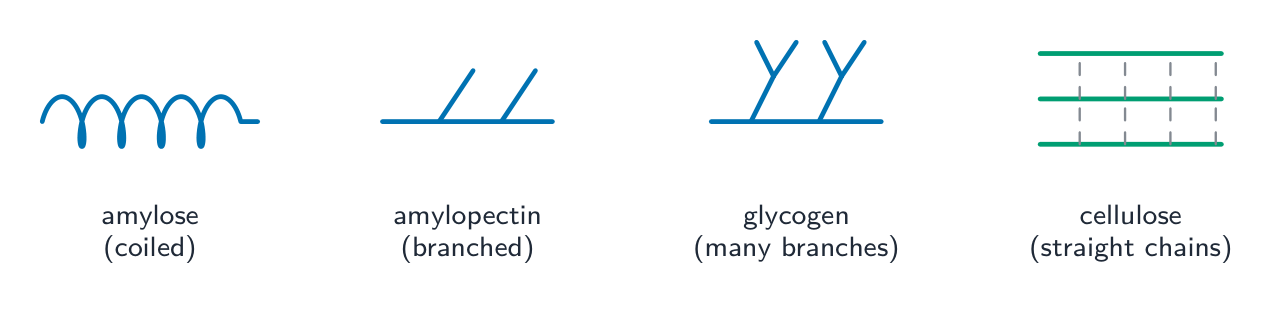
碳水化合物(carbohydrates)由糖单体(单糖(monosaccharides),像葡萄糖)构成。它们储存能量(淀粉、糖原)并提供结构(植物壁里的纤维素(cellulose))。它们许多的羟基使它们极性和水溶。

储存多糖(淀粉、糖原)和结构性纤维素的形状
词汇表 训练
英文 中文 拼音
Carbohydrates 碳水化合物 tàn shuǐ huà hé wù
monosaccharides 单糖 dān táng
cellulose 纤维素 xiān wéi sù
1.5

脂质

大纲
Big IdeaLearning ObjectiveEssential Knowledge

Big Idea 4 — Systems Interactions
Biological systems interact, and these systems and their interactions exhibit complex properties.

1.5.A
Describe the structure and function of lipids.

  • 1.5.A.1 Lipids are typically nonpolar, hydrophobic molecules whose structure and function are derived from the way their subcomponents are assembled. Fatty acids can be described as either saturated or unsaturated.
    • 1.5.A.1.i Saturated fatty acids contain only single bonds between carbon atoms.
    • 1.5.A.1.ii Unsaturated fatty acids contain at least one double bond between carbon atoms, which causes the carbon chain to kink.
    • 1.5.A.1.iii The more double bonds in a fatty acid tail, the more unsaturated the lipid becomes.
    • 1.5.A.1.iv The more unsaturated a lipid is, the more liquid it is at room temperature.
  • 1.5.A.2 Lipids provide a variety of functions for living organisms. Some examples of lipids are fats, steroids including cholesterol, and phospholipids.
    • 1.5.A.2.i Fats provide energy storage and support cell function. In some cases, they can also provide insulation to help keep mammals warm.
    • 1.5.A.2.ii Steroids are hormones that support physiological functions including growth and development, energy metabolism, and homeostasis.
    • 1.5.A.2.iii Cholesterol provides essential structural stability to animal cell membranes.
    • 1.5.A.2.iv Phospholipids group together to form the lipid bilayers found in plasma and cell membranes.
    • Exclusion statement: The molecular structure of specific lipids is beyond the scope of the AP Exam.

来源:美国大学理事会 AP 课程与考试说明

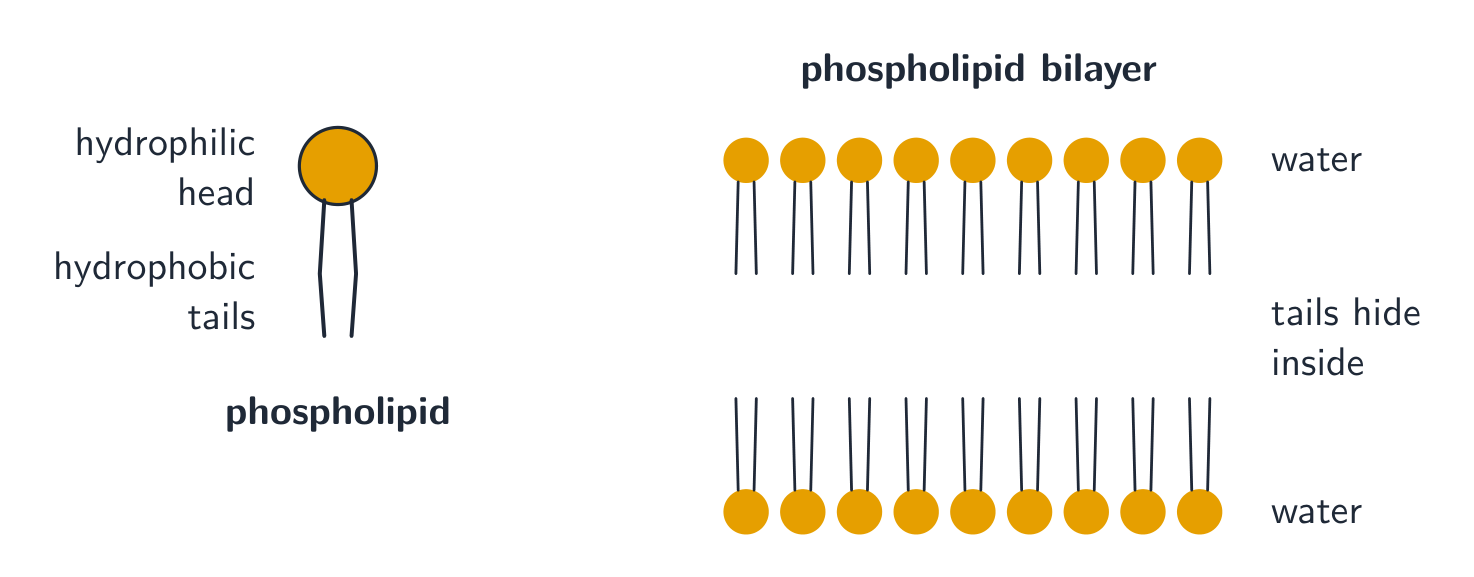
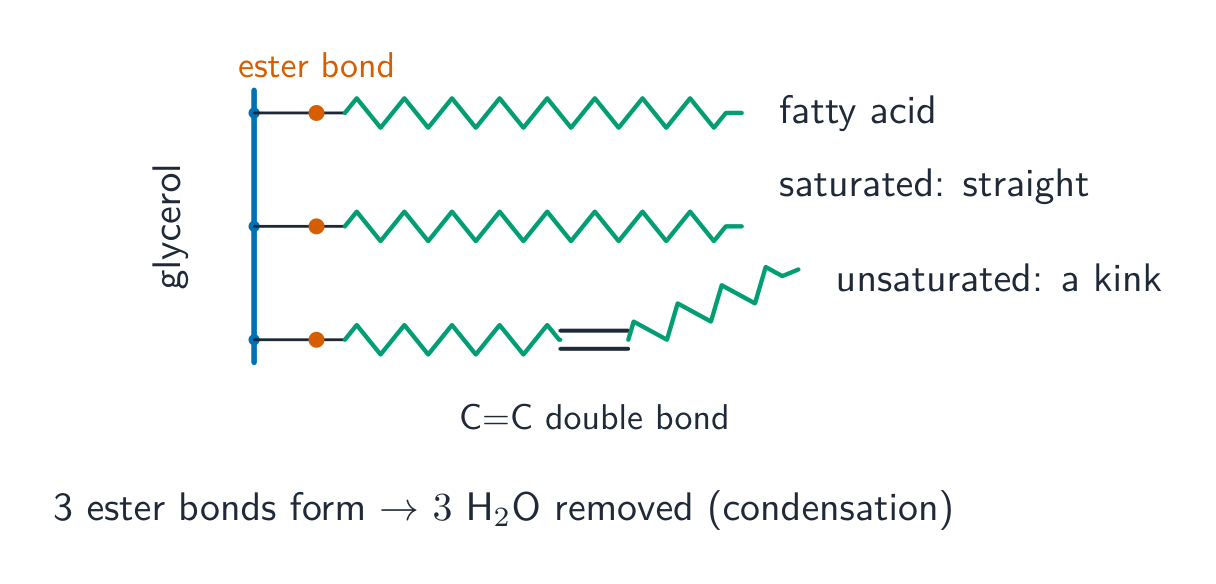
脂质(lipids)是非极性(nonpolar)的并且不与水混合(疏水(hydrophobic))。它们包括脂肪(长期能量储存)、磷脂(phospholipids)(构建膜),和类固醇。一个磷脂有一个极性的"头"和非极性的"尾",是细胞膜的关键。
一个磷脂有一个极性头和两个非极性尾,所以磷脂形成一个双层
一个甘油三酯:甘油连接到三个脂肪酸
一个甘油三酯:甘油连接到三个脂肪酸
词汇表 训练
英文 中文 拼音
Lipids 脂质 zhī zhì
hydrophobic 疏水 shū shuǐ
phospholipids 磷脂 lín zhī
1.6

核酸

大纲
Big IdeaLearning ObjectiveEssential Knowledge

Big Idea 3 — Information Storage and Transmission
Living systems store, retrieve, transmit, and respond to information essential to life processes.

1.6.A
Describe the structure and function of DNA and RNA.

  • 1.6.A.1 In nucleic acids (DNA and RNA), biological information is encoded in sequences of nucleotide monomers. Each nucleotide has the following structural components: a five-carbon sugar (deoxyribose or ribose), a phosphate, and a nitrogenous base (adenine, thymine, guanine, cytosine, or uracil).
  • 1.6.A.2 Nucleic acids have a linear sequence of nucleotides that have ends, defined by the 3' (three prime) hydroxyl and 5' (five prime) phosphates of the sugar in the nucleotide. During nucleic acid synthesis, nucleotides are added to the 3' end of the growing strand, resulting in the formation of covalent bonds between nucleotides.
    • Exclusion statement: The molecular structure of specific nucleotides is beyond the scope of the AP Exam.
  • 1.6.A.3 DNA is structured as an antiparallel double helix, with two strands of nucleotides running in opposite 5' to 3' orientation. In DNA, adenine nucleotides pair with thymine nucleotides via hydrogen bonds (A-T), and cytosine nucleotides pair with guanine nucleotides via hydrogen bonds (C-G). In RNA, adenine pairs with uracil (A-U).
  • 1.6.A.4 Structural differences between DNA and RNA include:
    • 1.6.A.4.i DNA contains the sugar deoxyribose, and RNA contains the sugar ribose.
    • 1.6.A.4.ii DNA contains the nitrogenous base thymine, and RNA contains the nitrogenous base uracil.
    • 1.6.A.4.iii DNA is typically double stranded, while RNA is typically single stranded.

来源:美国大学理事会 AP 课程与考试说明

核酸(nucleic acids)(DNA 和 RNA)储存和携带遗传信息。它们的单体是核苷酸(nucleotides),每个是一个糖、一个磷酸和一个含氮碱基。碱基序列编码指令;DNA 是双链的,RNA 是单链的。

互补碱基配对把 DNA 的两条反平行链维系在一起
探索

Explore complementary base pairing

Step along a DNA template and watch each base pair to its partner by complementary base pairing ($A$ with $T$, $G$ with $C$) — the rule that lets either strand act as a template to rebuild the other.

词汇表 训练
英文 中文 拼音
Nucleic acids 核酸 hé suān
nucleotides 核苷酸 hé gān suān
1.7

蛋白质

大纲
Big IdeaLearning ObjectiveEssential Knowledge

Big Idea 3 — Information Storage and Transmission
Living systems store, retrieve, transmit, and respond to information essential to life processes.

1.7.A
Describe the structure and function of proteins.

  • 1.7.A.1 Proteins comprise linear chains of amino acids connected by the formation of covalent (peptide) bonds that form between a carboxyl group ($-\text{COOH}$) of one amino acid and an amine group ($-\text{NH}_2$) of the next amino acid, resulting in a growing peptide chain.
  • 1.7.A.2 Amino acids are composed of a central carbon atom with a hydrogen atom, a carboxyl group, an amine group, and a variable R group covalently bound to it. The R group of an amino acid can be categorized by three possible chemical properties: hydrophobic/nonpolar, hydrophilic/polar, or ionic. The interactions of these R groups determine the structure and function of that region of the protein.
  • 1.7.A.3 The specific sequence of amino acids in proteins determines the primary structure of a polypeptide as well as the overall shape of the protein.
    • Exclusion statement: The molecular structure of amino acids is beyond the scope of the AP Exam.
  • 1.7.A.4 Secondary structures of proteins are made through the local folding that forms from interactions between atoms of the polypeptide backbone of the amino acid chain. Hydrogen bonding forms shapes such as alpha-helices and beta-pleated sheets.
  • 1.7.A.5 The three-dimensional shape of the tertiary structure of a protein results from the formation of hydrogen bonds, hydrophobic interactions, ionic interactions, or disulfide bridges.
  • 1.7.A.6 The quaternary structure arises from interactions between multiple polypeptides. All four levels of a protein structure determine the function of a protein.

来源:美国大学理事会 AP 课程与考试说明

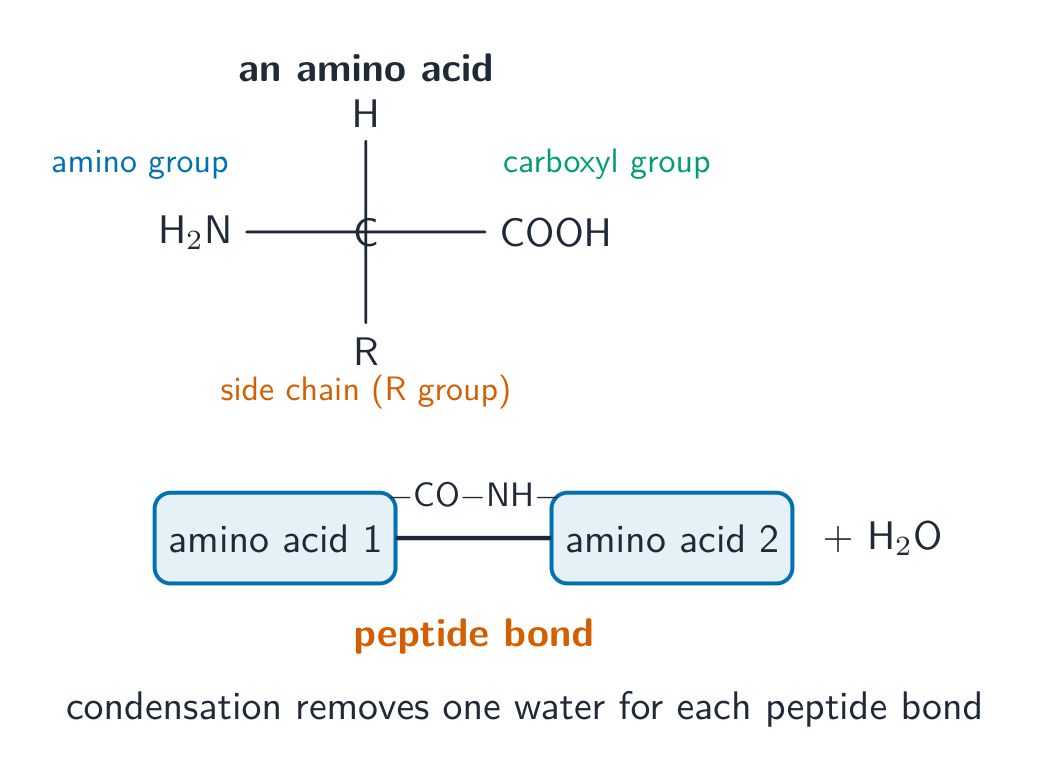
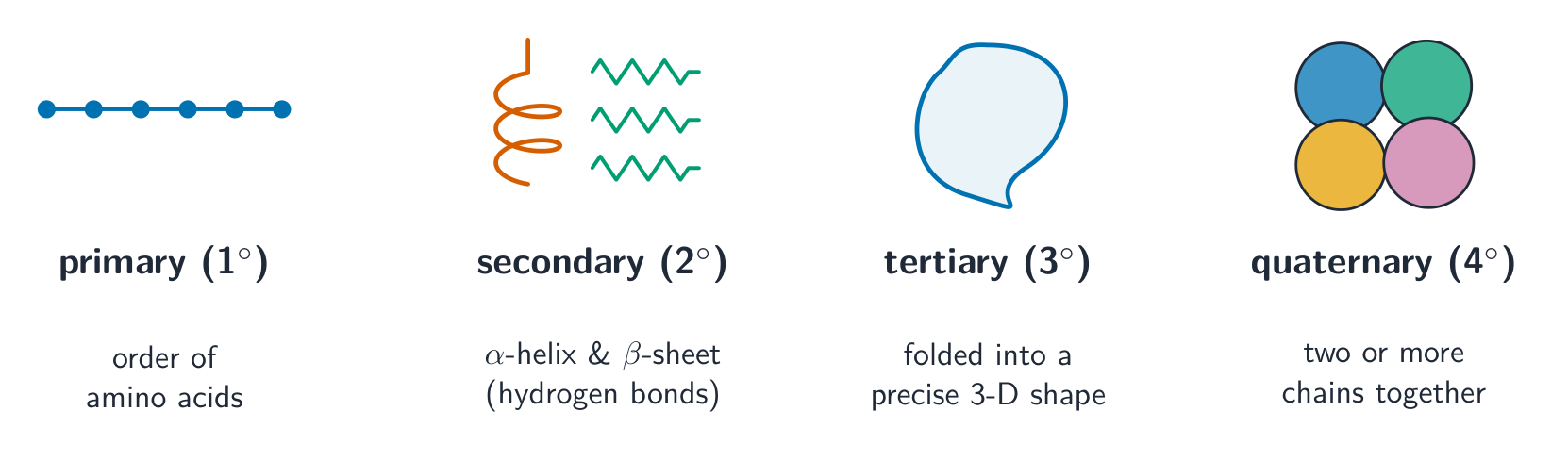
蛋白质(proteins)是由肽键(peptide bonds)连接的氨基酸(amino acids)的聚合物。它们的序列在四个层次(一级、二级、三级、四级)折叠成一个特定的三维形状,而形状决定功能——作为酶、转运体、受体和结构部分。改变环境(热、pH)能使一个蛋白质变性(denature),把它展开并停止它的功能。
一个氨基酸,以及由缩合形成的肽键
一个氨基酸,以及由缩合形成的肽键
蛋白质结构的四个层次
蛋白质结构的四个层次

Worked example. 用脱水缩合把 10 个单体连成一个聚合物会形成 9 个键并释放 9 个水分子——每个键一个,所以 $N$ 个单体释放 $N-1$ 个水。水解精确地逆转它:加上那 9 个水把聚合物断回 10 个单体。这就是为什么生物合成(脱水缩合)和消化(水解)在化学上是相反的。

词汇表 训练
英文 中文 拼音
Proteins 蛋白质 dàn bái zhì
amino acids 氨基酸 ān jī suān
peptide bonds 肽键 tài jiàn
denature 变性 biàn xìng
1.7

考试技巧

  • 把水的每个性质追溯回它的极性和氢键(内聚力、高比热容、溶剂能力)。
  • 知道四个大分子类别和它们的单体;聚合物由脱水缩合构建并由水解断开。
  • 对于蛋白质,结构(形状)决定功能——热或一个 pH 变化使它们变性并停止它们工作。
  • 在 DNA 里碱基在反平行链上配对 A–T 和 C–G;RNA 是单链的并使用 U。
  • 把每个分子与它的角色联系起来(碳水化合物:能量/结构;脂质:膜/储存;核酸:信息)。

本主题的互动课程

逐步学习,并即时检测练习。

AP 生物历年真题

AP 生物的更多主题

登录或创建账号

IGCSE, A-Level & AP