| Big Idea | Learning Objective | Essential Knowledge |
|---|---|---|
Big Idea 4 — Systems Interactions | 1.1.A |
|
AP 生物
学习建议
AP 生物建立在四大概念之上:演化、能量学、信息的储存与传递、系统间相互作用。内容量很大,但考试不考背诵,而是考你能否把生物学用在陌生情境上——一个你没见过的物种、一个你没做过的实验。
科学实践才是真正的考纲:读图、设计实验、指出对照组、用证据支持结论。自由作答部分要的正是这些。
统计是考点。卡方检验、标准误和误差棒经常出现,它们所对应的分数,靠单纯背内容永远拿不到。
笔记覆盖全部八个单元,过程类内容配图——看图比读字更省力。资料库中有公开自由作答题;生物评分细则为把结构与功能联系起来以及正确处理数据给分,示范答案照此组织。
-
1
生命的化学
1.1
水的结构与氢键
大纲
来源:美国大学理事会 AP 课程与考试说明
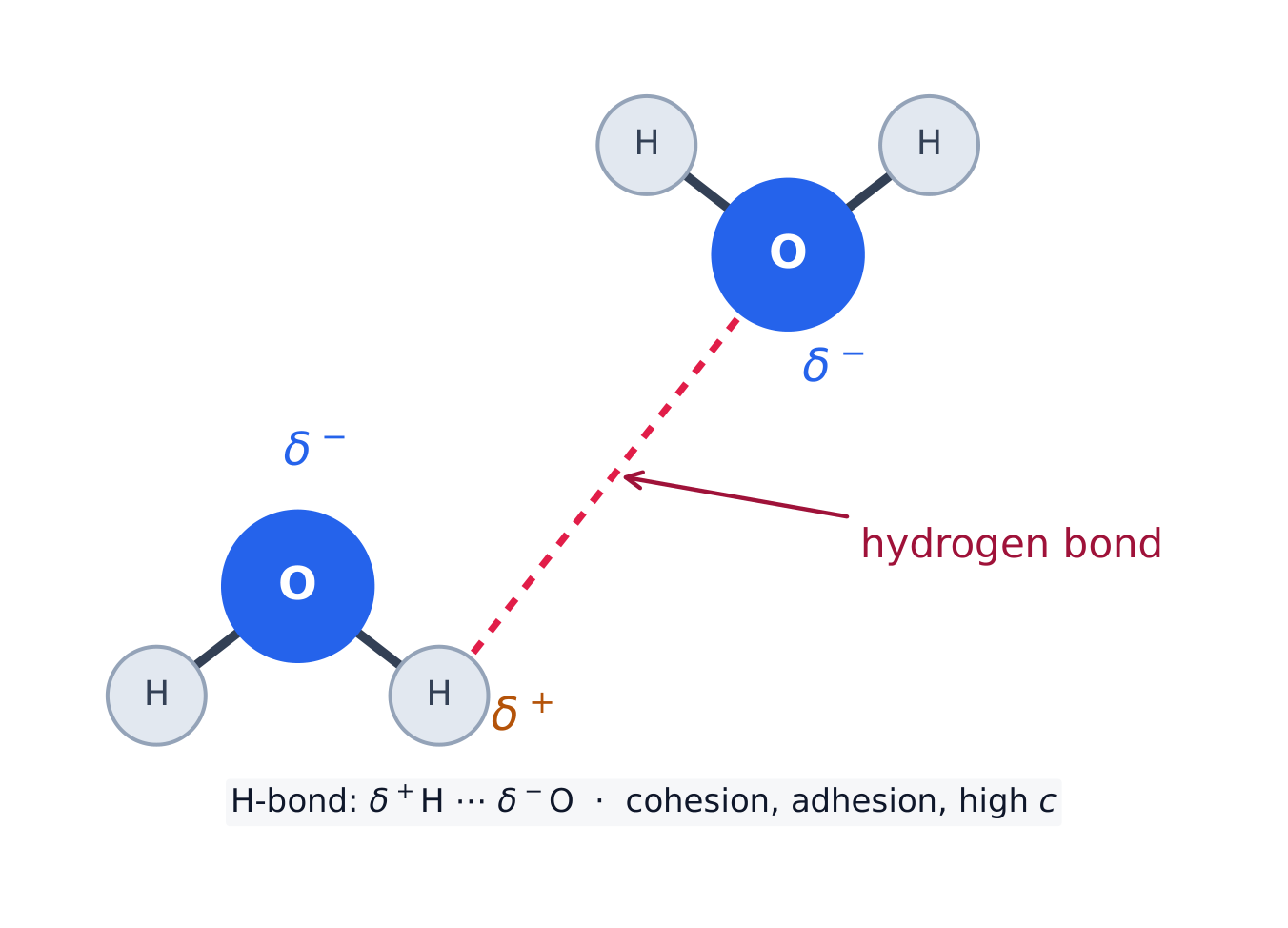
水是极性(polar)的:它的氧比它的氢更强地拉电子,给出一个略带负电的 O 和略带正电的 H。这让水分子彼此形成氢键(hydrogen bonds),这解释了水的支持生命的性质:
- 内聚力(cohesion)和附着力(adhesion)(表面张力、毛细作用、水在植物里上升),
- 高比热容(specific heat)(抵抗温度变化,稳定生物),
- 高的汽化热(蒸发冷却),
- 冰漂浮(密度较小的固体),以及是极性和离子物质的一种极好的溶剂(solvent)。
两个极性水分子之间的一个氢键 探索Explore how a covalent bond shares electrons
Step through two atoms overlapping to share a pair of electrons so each reaches a full shell. In $\text{H}_2$ the two atoms pull equally, so the bond is non-polar — the contrast that makes water's unequal sharing (and its $\delta^+/\delta^-$ dipole) so important.
词汇表 训练英文 中文 拼音 polar/ˈpəʊlə/ 极性 jí xìng hydrogen bonds/ˈhaɪdrədʒn bɒndz/ 氢键 qīng jiàn Cohesion/kəʊˈhiːʒn/ 内聚力 nèi jù lì adhesion/ədˈhiːʒn/ 附着力 fù zhuó lì specific heat/spəˈsɪfɪk hiːt/ 比热容 bǐ rè róng 1.2
生命元素
大纲
Big Idea Learning Objective Essential Knowledge Big Idea 2 — Energetics
Biological systems use energy and molecular building blocks to grow, reproduce, and maintain dynamic homeostasis.1.2.A
Describe the composition of macromolecules required by living organisms.- 1.2.A.1 Atoms and molecules from the environment are necessary to build new molecules. Carbon, hydrogen, and oxygen are the most prevalent elements used to build biological molecules such as carbohydrates, proteins, lipids, and nucleic acids. Additionally:
- 1.2.A.1.i Sulfur is used in the building of proteins.
- 1.2.A.1.ii Phosphorus is used in the building of phospholipids (a type of lipid) and nucleic acids.
- 1.2.A.1.iii Nitrogen is used in the building of nucleic acids.
来源:美国大学理事会 AP 课程与考试说明
生命物质主要由少数几种元素构建——碳、氢、氧、氮、磷和硫。碳(carbon)是核心的,因为它形成四个稳定的共价键,构建长链、支链和环——所有生物分子的骨架。
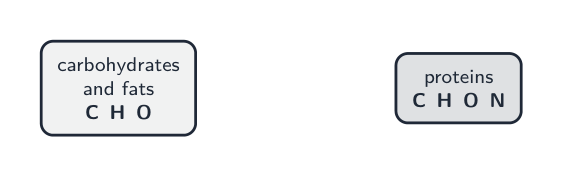
碳水化合物和脂肪含碳、氢和氧;蛋白质还含氮 词汇表 训练英文 中文 拼音 Carbon/ˈkɑːbən/ 碳 tàn 1.3
大分子导论
大纲
Big Idea Learning Objective Essential Knowledge Big Idea 4 — Systems Interactions
Biological systems interact, and these systems and their interactions exhibit complex properties.1.3.A
Describe the chemical reactions that build and break biological macromolecules.- 1.3.A.1 Hydrolysis is a chemical reaction involving the cleaving of covalent bonds. This type of reaction breaks down molecules into smaller molecules. When water is added to the bond between monomers in a polymer, the bond is broken. The hydrogen ion from a water molecule is added to one monomer and the hydroxyl group of the water molecule is added to the other monomer, completing the reaction.
- 1.3.A.2 Dehydration synthesis occurs when two smaller molecules are joined together through covalent bonding. A hydrogen ion is removed from one monomer and a hydroxyl group is removed from the other. This causes the loss of the equivalent of a water molecule from the reactants and the connection of the two remaining monomers. The connection of many monomers is known as polymerization.
来源:美国大学理事会 AP 课程与考试说明
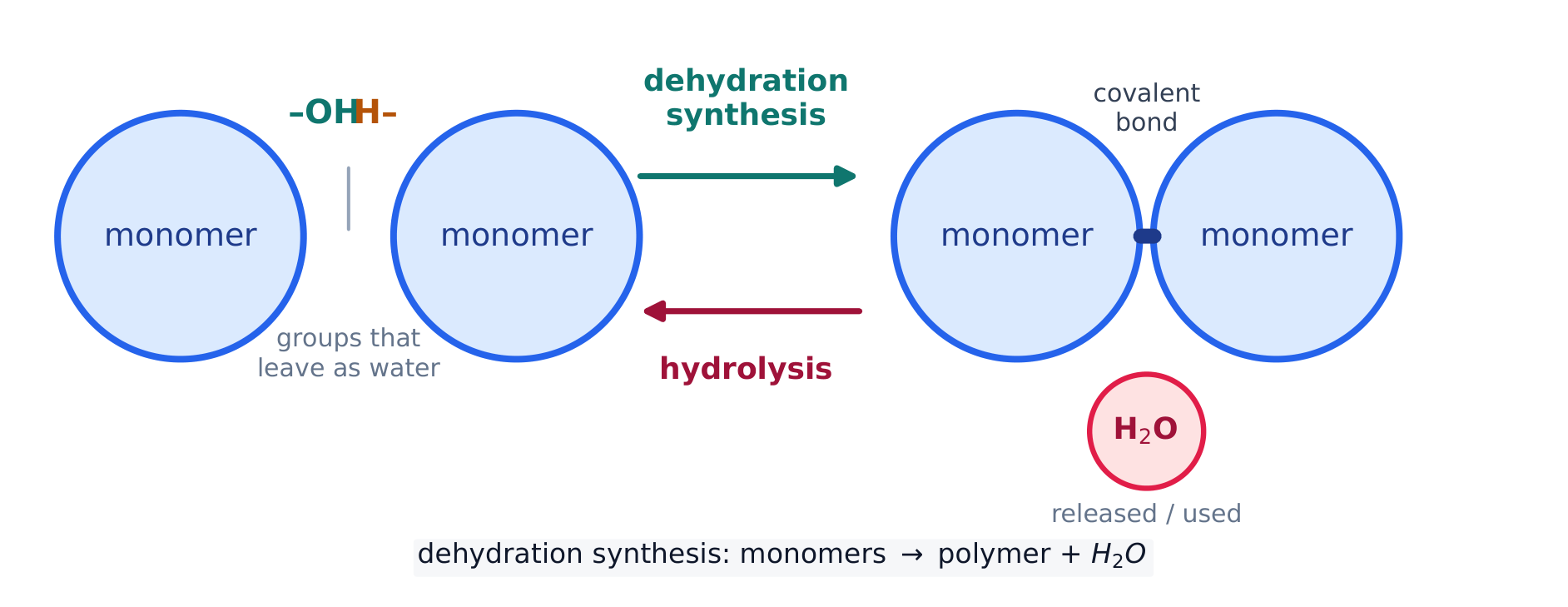
大的生物分子——大分子(macromolecules)——是由重复的单体(monomers)构建的聚合物(polymers)。细胞通过脱水缩合(dehydration synthesis)(移除水以形成一个键)连接单体,并通过水解(hydrolysis)(添加水)断开聚合物。四类:碳水化合物、脂质、核酸和蛋白质。
脱水缩合构建聚合物并释放水;水解将它逆转 探索Explore the four classes of macromolecule by their monomer
Sort each clue into the right macromolecule class by matching the monomer that builds it — sugars, nucleotides or amino acids — and notice that lipids are the odd one out that are not true polymers.
词汇表 训练英文 中文 拼音 macromolecules/ˈmækrəmɒlɪkjuːlz/ 大分子 dà fēn zi polymers/ˈpɒlɪməz/ 聚合物 jù hé wù monomers/ˈmɒnəʊməz/ 单体 dān tǐ dehydration synthesis/ˌdiːhaɪˈdreɪʃn ˈsɪnθəsɪs/ 脱水缩合 tuō shuǐ suō hé hydrolysis/haɪˈdrɒləsɪs/ 水解 shuǐ jiě 1.4
碳水化合物
大纲
Big Idea Learning Objective Essential Knowledge Big Idea 4 — Systems Interactions
Biological systems interact, and these systems and their interactions exhibit complex properties.1.4.A
Describe the structure and function of carbohydrates.- 1.4.A.1 Monosaccharides (simple sugars) are the monomers for polysaccharides (complex carbohydrates). These monomers are connected by covalent bonds to form polymers such as complex carbohydrates, which may be linear or branched.
- Illustrative examples for 1.4.A.1:
- Cellulose
- Starch
- Glycogen
- Exclusion statement: The molecular structure of specific carbohydrate polymers is beyond the scope of the AP Exam.
- Illustrative examples for 1.4.A.1:
来源:美国大学理事会 AP 课程与考试说明
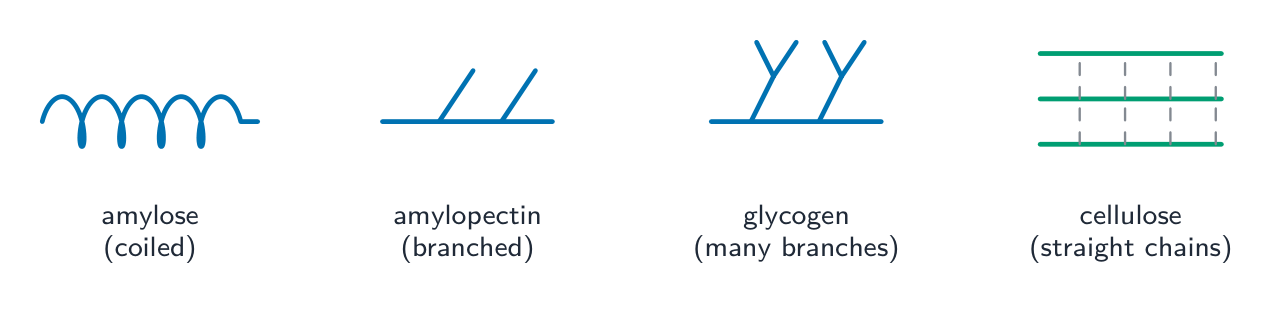
碳水化合物(carbohydrates)由糖单体(单糖(monosaccharides),像葡萄糖)构成。它们储存能量(淀粉、糖原)并提供结构(植物壁里的纤维素(cellulose))。它们许多的羟基使它们极性和水溶。
储存多糖(淀粉、糖原)和结构性纤维素的形状 词汇表 训练英文 中文 拼音 Carbohydrates/ˌkɑːbəʊˈhaɪdreɪts/ 碳水化合物 tàn shuǐ huà hé wù monosaccharides/ˈmɒnəʊsækɑːraɪdz/ 单糖 dān táng cellulose/ˈseljuːləʊs/ 纤维素 xiān wéi sù 1.5
脂质
大纲
Big Idea Learning Objective Essential Knowledge Big Idea 4 — Systems Interactions
Biological systems interact, and these systems and their interactions exhibit complex properties.1.5.A
Describe the structure and function of lipids.- 1.5.A.1 Lipids are typically nonpolar, hydrophobic molecules whose structure and function are derived from the way their subcomponents are assembled. Fatty acids can be described as either saturated or unsaturated.
- 1.5.A.1.i Saturated fatty acids contain only single bonds between carbon atoms.
- 1.5.A.1.ii Unsaturated fatty acids contain at least one double bond between carbon atoms, which causes the carbon chain to kink.
- 1.5.A.1.iii The more double bonds in a fatty acid tail, the more unsaturated the lipid becomes.
- 1.5.A.1.iv The more unsaturated a lipid is, the more liquid it is at room temperature.
- 1.5.A.2 Lipids provide a variety of functions for living organisms. Some examples of lipids are fats, steroids including cholesterol, and phospholipids.
- 1.5.A.2.i Fats provide energy storage and support cell function. In some cases, they can also provide insulation to help keep mammals warm.
- 1.5.A.2.ii Steroids are hormones that support physiological functions including growth and development, energy metabolism, and homeostasis.
- 1.5.A.2.iii Cholesterol provides essential structural stability to animal cell membranes.
- 1.5.A.2.iv Phospholipids group together to form the lipid bilayers found in plasma and cell membranes.
- Exclusion statement: The molecular structure of specific lipids is beyond the scope of the AP Exam.
来源:美国大学理事会 AP 课程与考试说明
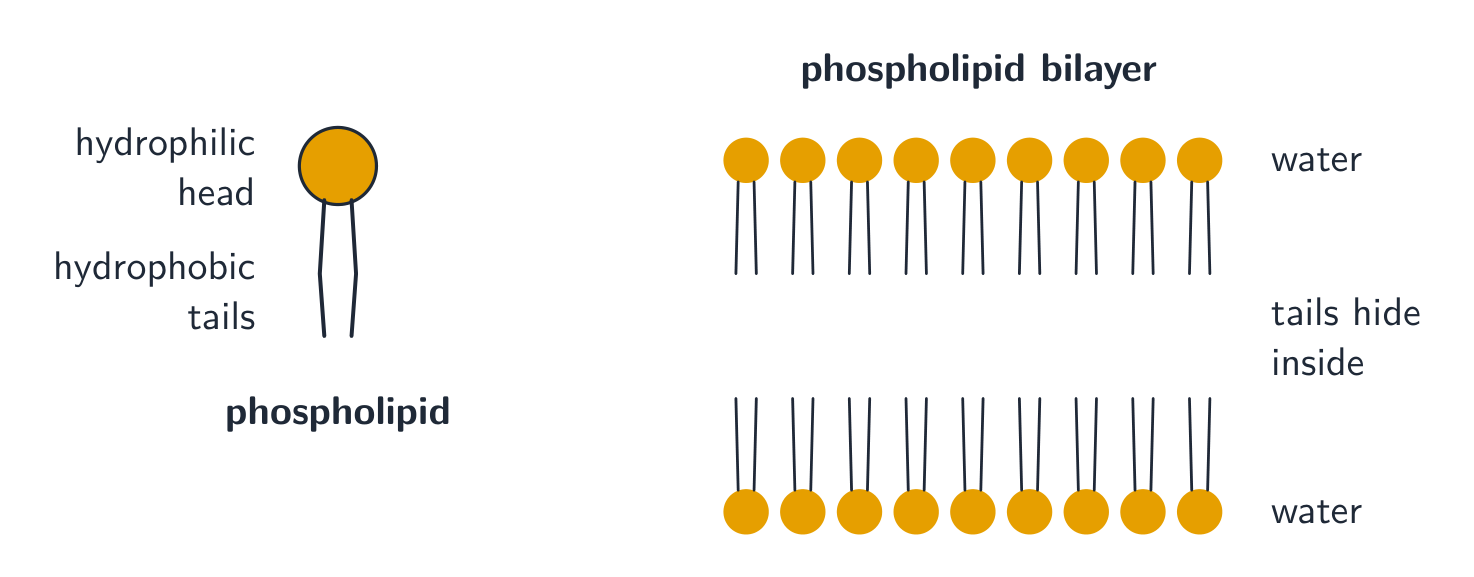
脂质(lipids)是非极性(nonpolar)的并且不与水混合(疏水(hydrophobic))。它们包括脂肪(长期能量储存)、磷脂(phospholipids)(构建膜),和类固醇。一个磷脂有一个极性的"头"和非极性的"尾",是细胞膜的关键。
一个磷脂有一个极性头和两个非极性尾,所以磷脂形成一个双层 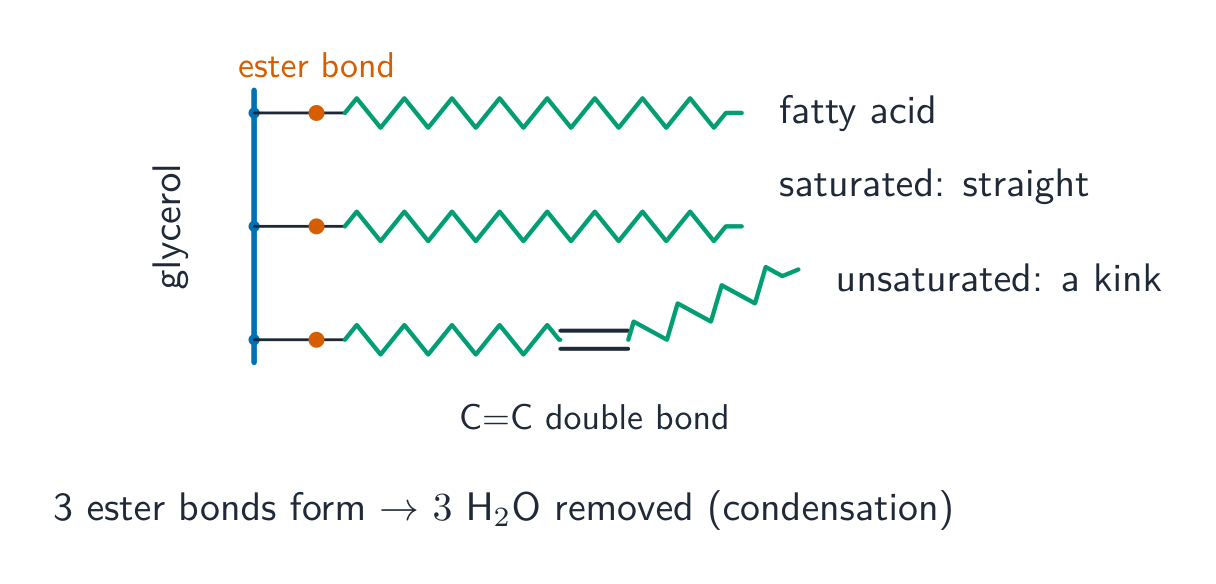
一个甘油三酯:甘油连接到三个脂肪酸 词汇表 训练英文 中文 拼音 Lipids/ˈlɪpɪdz/ 脂质 zhī zhì hydrophobic/ˌhaɪdrəˈfəʊbɪk/ 疏水 shū shuǐ phospholipids/ˈfɒsfəlɪpɪdz/ 磷脂 lín zhī 1.6
核酸

大纲
Big Idea Learning Objective Essential Knowledge Big Idea 3 — Information Storage and Transmission
Living systems store, retrieve, transmit, and respond to information essential to life processes.1.6.A
Describe the structure and function of DNA and RNA.- 1.6.A.1 In nucleic acids (DNA and RNA), biological information is encoded in sequences of nucleotide monomers. Each nucleotide has the following structural components: a five-carbon sugar (deoxyribose or ribose), a phosphate, and a nitrogenous base (adenine, thymine, guanine, cytosine, or uracil).
- 1.6.A.2 Nucleic acids have a linear sequence of nucleotides that have ends, defined by the 3' (three prime) hydroxyl and 5' (five prime) phosphates of the sugar in the nucleotide. During nucleic acid synthesis, nucleotides are added to the 3' end of the growing strand, resulting in the formation of covalent bonds between nucleotides.
- Exclusion statement: The molecular structure of specific nucleotides is beyond the scope of the AP Exam.
- 1.6.A.3 DNA is structured as an antiparallel double helix, with two strands of nucleotides running in opposite 5' to 3' orientation. In DNA, adenine nucleotides pair with thymine nucleotides via hydrogen bonds (A-T), and cytosine nucleotides pair with guanine nucleotides via hydrogen bonds (C-G). In RNA, adenine pairs with uracil (A-U).
- 1.6.A.4 Structural differences between DNA and RNA include:
- 1.6.A.4.i DNA contains the sugar deoxyribose, and RNA contains the sugar ribose.
- 1.6.A.4.ii DNA contains the nitrogenous base thymine, and RNA contains the nitrogenous base uracil.
- 1.6.A.4.iii DNA is typically double stranded, while RNA is typically single stranded.
来源:美国大学理事会 AP 课程与考试说明
核酸(nucleic acids)(DNA 和 RNA)储存和携带遗传信息。它们的单体是核苷酸(nucleotides),每个是一个糖、一个磷酸和一个含氮碱基。碱基序列编码指令;DNA 是双链的,RNA 是单链的。
互补碱基配对把 DNA 的两条反平行链维系在一起 探索Explore complementary base pairing
Step along a DNA template and watch each base pair to its partner by complementary base pairing ($A$ with $T$, $G$ with $C$) — the rule that lets either strand act as a template to rebuild the other.
词汇表 训练英文 中文 拼音 Nucleic acids/njuːˈklɪɪk ˈæsɪdz/ 核酸 hé suān nucleotides/ˈnjuːklɪɒtaɪdz/ 核苷酸 hé gān suān 1.7
蛋白质
大纲
Big Idea Learning Objective Essential Knowledge Big Idea 3 — Information Storage and Transmission
Living systems store, retrieve, transmit, and respond to information essential to life processes.1.7.A
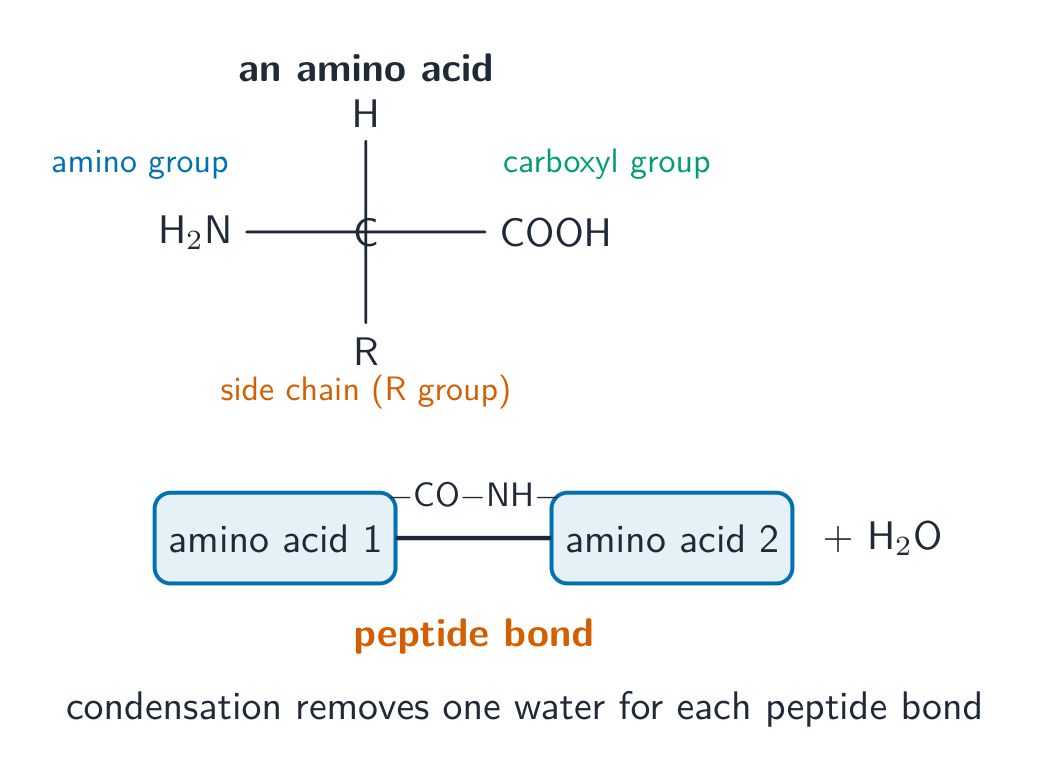
Describe the structure and function of proteins.- 1.7.A.1 Proteins comprise linear chains of amino acids connected by the formation of covalent (peptide) bonds that form between a carboxyl group ($-\text{COOH}$) of one amino acid and an amine group ($-\text{NH}_2$) of the next amino acid, resulting in a growing peptide chain.
- 1.7.A.2 Amino acids are composed of a central carbon atom with a hydrogen atom, a carboxyl group, an amine group, and a variable R group covalently bound to it. The R group of an amino acid can be categorized by three possible chemical properties: hydrophobic/nonpolar, hydrophilic/polar, or ionic. The interactions of these R groups determine the structure and function of that region of the protein.
- 1.7.A.3 The specific sequence of amino acids in proteins determines the primary structure of a polypeptide as well as the overall shape of the protein.
- Exclusion statement: The molecular structure of amino acids is beyond the scope of the AP Exam.
- 1.7.A.4 Secondary structures of proteins are made through the local folding that forms from interactions between atoms of the polypeptide backbone of the amino acid chain. Hydrogen bonding forms shapes such as alpha-helices and beta-pleated sheets.
- 1.7.A.5 The three-dimensional shape of the tertiary structure of a protein results from the formation of hydrogen bonds, hydrophobic interactions, ionic interactions, or disulfide bridges.
- 1.7.A.6 The quaternary structure arises from interactions between multiple polypeptides. All four levels of a protein structure determine the function of a protein.
来源:美国大学理事会 AP 课程与考试说明
蛋白质(proteins)是由肽键(peptide bonds)连接的氨基酸(amino acids)的聚合物。它们的序列在四个层次(一级、二级、三级、四级)折叠成一个特定的三维形状,而形状决定功能——作为酶、转运体、受体和结构部分。改变环境(热、pH)能使一个蛋白质变性(denature),把它展开并停止它的功能。
一个氨基酸,以及由缩合形成的肽键 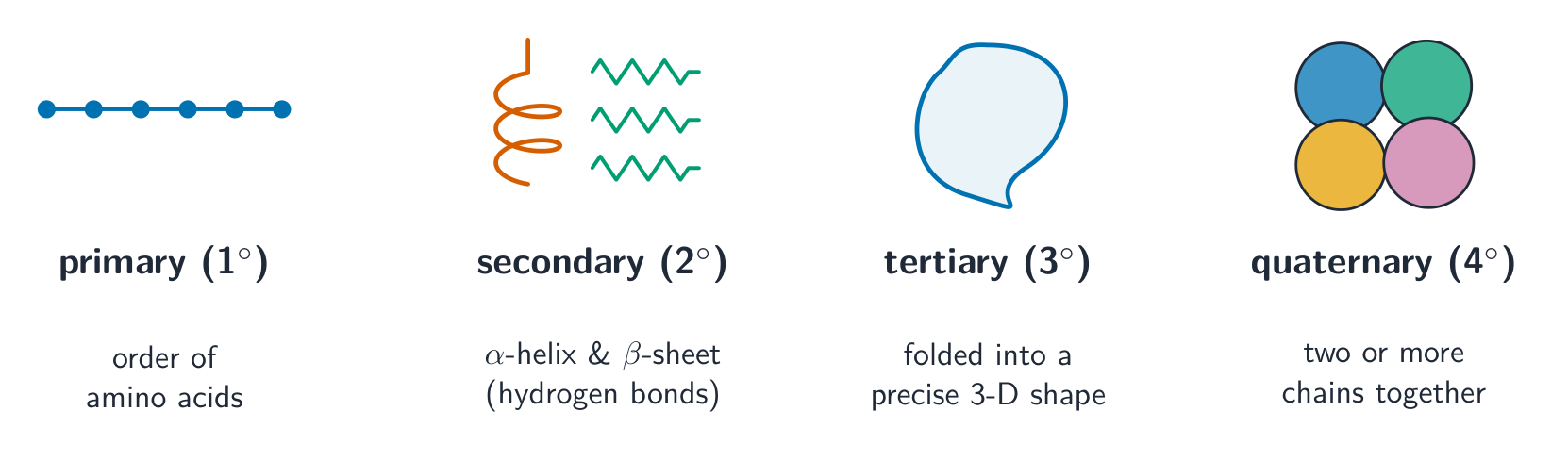
蛋白质结构的四个层次 Worked example. 用脱水缩合把 10 个单体连成一个聚合物会形成 9 个键并释放 9 个水分子——每个键一个,所以 $N$ 个单体释放 $N-1$ 个水。水解精确地逆转它:加上那 9 个水把聚合物断回 10 个单体。这就是为什么生物合成(脱水缩合)和消化(水解)在化学上是相反的。
词汇表 训练英文 中文 拼音 Proteins/ˈprəʊtiːnz/ 蛋白质 dàn bái zhì amino acids/əˈmiːnəʊ ˈæsɪdz/ 氨基酸 ān jī suān peptide bonds/ˈpeptaɪd bɒndz/ 肽键 tài jiàn denature/ˈdenətʃə/ 变性 biàn xìng 1.7
考试技巧
- 把水的每个性质追溯回它的极性和氢键(内聚力、高比热容、溶剂能力)。
- 知道四个大分子类别和它们的单体;聚合物由脱水缩合构建并由水解断开。
- 对于蛋白质,结构(形状)决定功能——热或一个 pH 变化使它们变性并停止它们工作。
- 在 DNA 里碱基在反平行链上配对 A–T 和 C–G;RNA 是单链的并使用 U。
- 把每个分子与它的角色联系起来(碳水化合物:能量/结构;脂质:膜/储存;核酸:信息)。
-
2
细胞结构与功能
2.1
细胞结构与功能
大纲
Big Idea Learning Objective Essential Knowledge Big Idea 4 — Systems Interactions
Biological systems interact, and these systems and their interactions exhibit complex properties.2.1.A
Explain how the structure and function of subcellular components and organelles contribute to the function of cells.- 2.1.A.1 Ribosomes are comprised of ribosomal RNA (rRNA) and protein. These non-membrane, subcellular structures are found in cells in all forms of life and reflect the common ancestry in all known life. Ribosomes synthesize proteins according to messenger RNA (mRNA) sequences.
- 2.1.A.2 The endomembrane system consists of a group of membrane-bound organelles and subcellular components (endoplasmic reticulum (ER), Golgi complex, lysosomes, vacuoles and transport vesicles, the nuclear envelope, and the plasma membrane) that work together to modify, package, and transport polysaccharides, lipids, and proteins intercellularly.
- 2.1.A.3 Endoplasmic reticulum provides mechanical support by helping cells maintain shape and plays a role in intracellular transport.
- i. Rough ER is associated with membrane-bound ribosomes, allows for the compartmentalization of cells, and helps carry out protein synthesis.
- ii. Smooth ER functions include the detoxification of cells and lipid synthesis.
- Exclusion statement: Knowledge of the specific functions of smooth ER in specialized cells is beyond the scope of the AP Exam.
- 2.1.A.4 The Golgi complex is a membrane-bound structure that consists of a series of flattened membrane sacs. Functions of the Golgi include:
- i. Correctly folding and chemically modifying newly synthesized cellular products
- ii. Packaging proteins for trafficking
- Exclusion statement: Knowledge of the role of Golgi in the synthesis of specific phospholipids and packaging of specific enzymes for lysosomes, peroxisomes, and secretory vesicles is beyond the scope of the AP Exam.
- Illustrative examples for 2.1.A.4:
- Glycosylation and other chemical modifications of proteins that take place within the Golgi and determine protein function or targeting
- 2.1.A.5 Mitochondria have a double membrane that provides compartments for different metabolic reactions involved in aerobic cellular respiration. The outer membrane is smooth, while the inner membrane is highly convoluted, forming folds that enable ATP to be synthesized more efficiently.
- 2.1.A.6 Lysosomes are membrane-enclosed sacs that contain hydrolytic enzymes that digest material. Lysosomes also play a role in programmed cell death (apoptosis).
- 2.1.A.7 Vacuoles are membrane-bound sacs that play many different roles.
- i. In plant cells, a specialized large vacuole maintains turgor pressure through nutrient and water storage.
- ii. In animal cells, vacuoles are smaller in size, are more plentiful than in plant cells, and store cellular materials.
- 2.1.A.8 Chloroplasts are specialized organelles that are found in plants and photosynthetic algae. Chloroplasts contain a double membrane and serve as the location for photosynthesis.
来源:美国大学理事会 AP 课程与考试说明
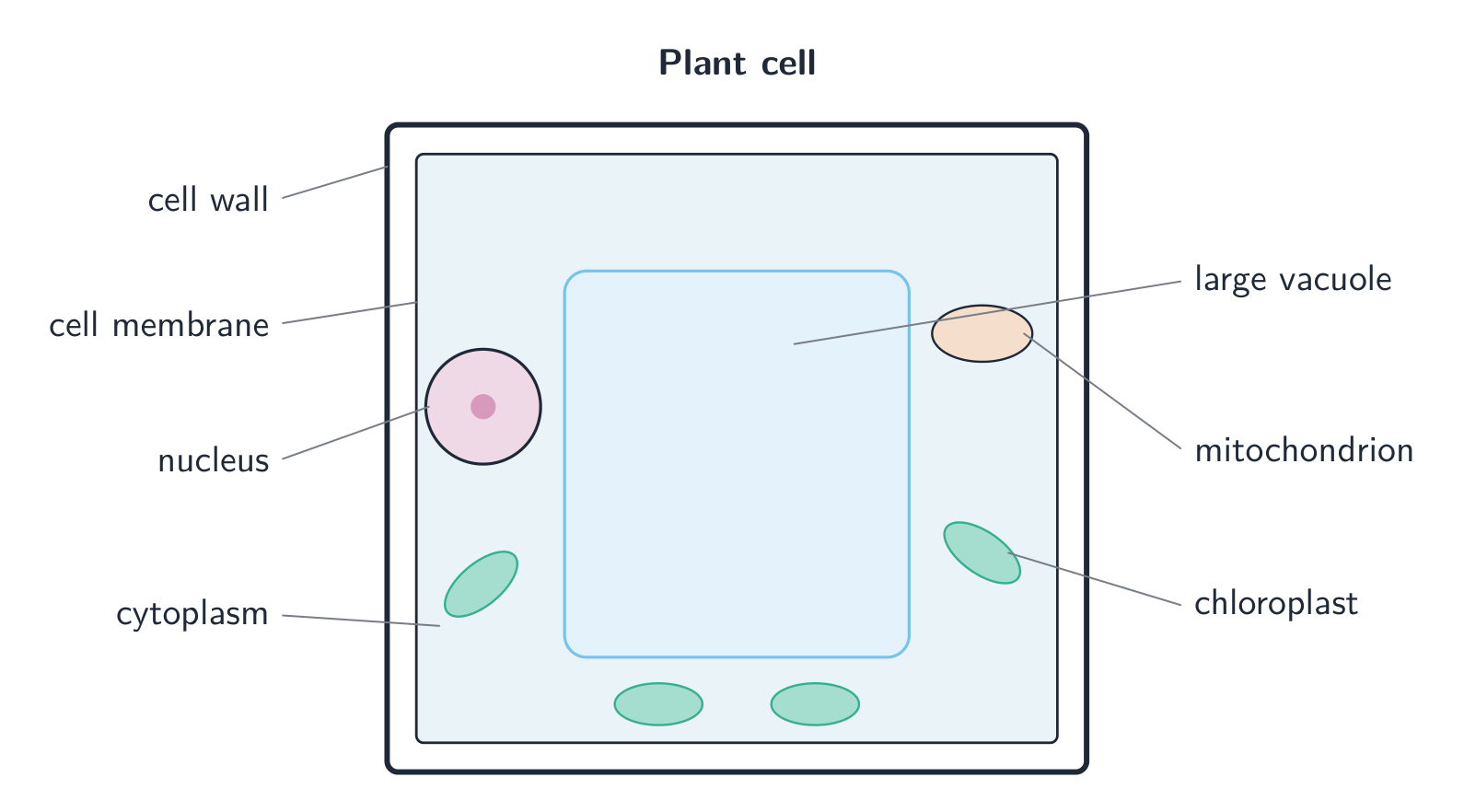
一个真核细胞在细胞器(organelles)之间分工。内膜系统(endomembrane system)是一套相连的组成部分,制造、修饰和运送分子:细胞核(nucleus)(容纳 DNA)、粗面和滑面内质网(endoplasmic reticulum)(蛋白质和脂质合成)、高尔基体(Golgi)(修饰和包装)、溶酶体(lysosomes)(消化),和在它们之间携带物质的囊泡。线粒体(mitochondria)(呼吸)和叶绿体(chloroplasts)(光合作用)有它们自己的膜。
一个植物细胞也有一个细胞壁、一个大液泡和叶绿体 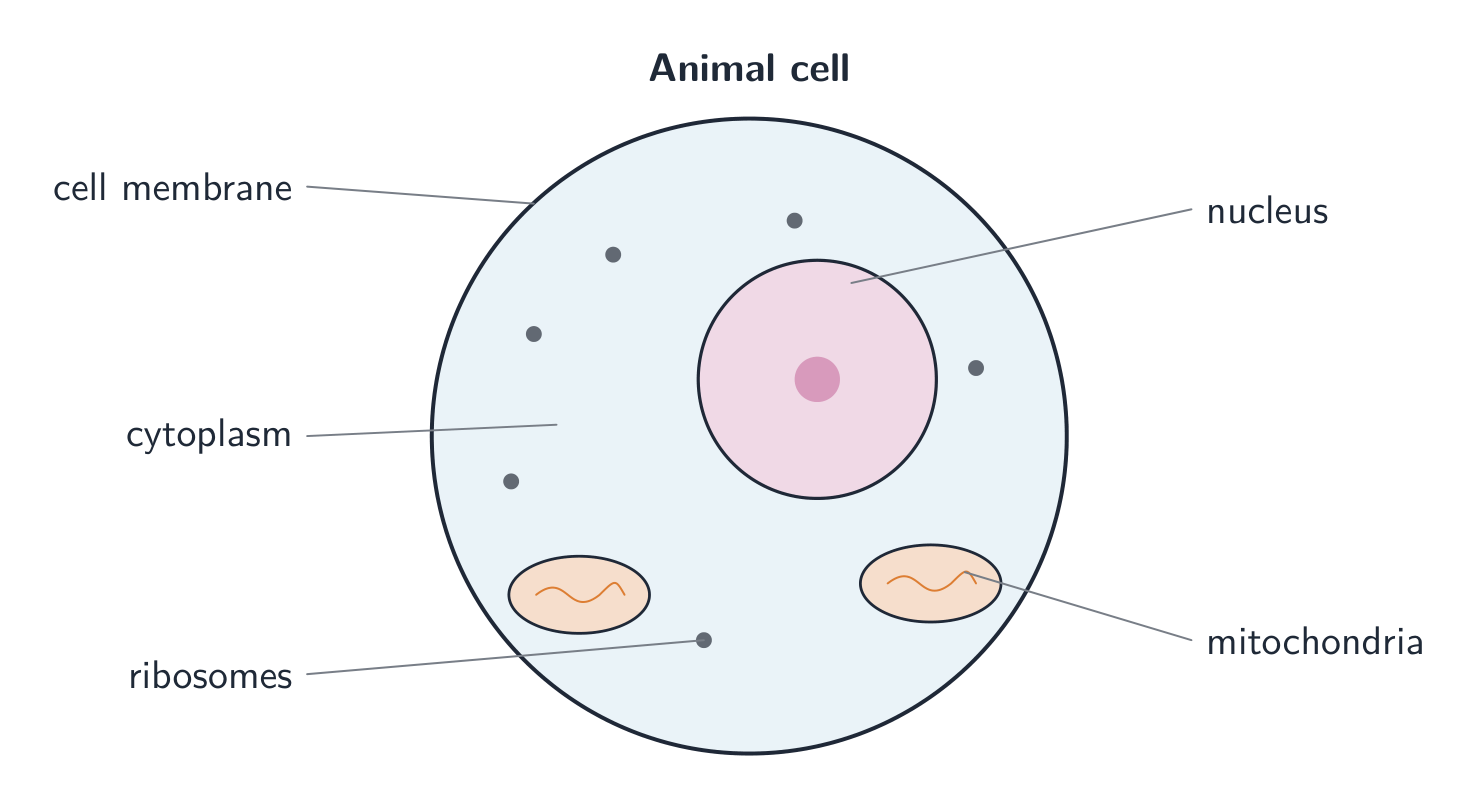
一个概化的动物细胞及其细胞器 每种细胞器到底做什么
考试要求你既能说出结构的名称,又能说出它的功能,所以要成对地记。
核糖体(ribosomes)由核糖体RNA(rRNA)和蛋白质组成。它没有膜,而且在每一种生命形式里都存在——细菌、古菌和真核生物都有。这种共有的存在是共同祖先的证据:如此核心的结构在所有生物的最后共同祖先里就已经出现了。核糖体读取信使RNA(mRNA),并合成它所编码的蛋白质。游离核糖体制造细胞内部使用的蛋白质;结合在粗面内质网上的核糖体制造用于分泌或用于膜的蛋白质。
高尔基复合体(Golgi complex)是一系列扁平的、有膜包被的囊。从内质网运来的蛋白质依次通过这些囊,发生三件事:
- 被正确折叠并进行化学修饰——最常见的是糖基化(glycosylation),即接上短的糖链;
- 被分选和定向,修饰上去的糖基或磷酸基标签决定这个蛋白质被送往哪个区室;
- 被包装进小泡以便运输。
所以高尔基体不是仓库:它是细胞的精加工与发货部门,而且它的修饰决定了一个蛋白质做什么、去哪里。
溶酶体(lysosomes)是有膜包被的囊,里面装着水解酶(hydrolytic enzymes),用来消化物质——老化的细胞器、被吞入的细菌,以及细胞摄入的食物颗粒。这些酶在低 pH 下活性最高,溶酶体在自己内部维持这种低 pH;把它们封闭起来正是为了保护细胞其余部分。溶酶体还参与细胞凋亡(apoptosis),即程序性细胞死亡:细胞被有计划地拆解,例如把胚胎期带蹼的手塑造出手指。
液泡(vacuoles)是有膜包被的囊,作用多种多样:储存水、离子、养分或废物;在植物细胞里,巨大的中央液泡还向外压住细胞壁,使细胞保持坚挺。
线粒体和叶绿体各有双层膜,并拥有自己的环状 DNA 和核糖体——这正是下面内共生学说所依据的证据。
词汇表 训练英文 中文 拼音 organelles/ˌɔːɡəˈnelz/ 细胞器 xì bāo qì endomembrane system/ˈendəʊmembreɪn ˈsɪstəm/ 内膜系统 nèi mó xì tǒng nucleus/ˈnjuːklɪəs/ 细胞核 xì bāo hé endoplasmic reticulum/ˌendəʊˈplæzmɪk reˈtɪkjʊləm/ 内质网 nèi zhì wǎng Golgi/ˈɡɒlɡɪ/ 高尔基体 gāo ěr jī tǐ lysosomes/ˈlaɪsəsəʊmz/ 溶酶体 róng méi tǐ Mitochondria/ˌmaɪtəˈkɒndrɪə/ 线粒体 xiàn lì tǐ chloroplasts/ˈklɔːrəʊplæsts/ 叶绿体 yè lǜ tǐ Ribosomes/ˈrɪbəsəʊmz/ 核糖体 hé táng tǐ ribosomal RNA/ˈrɪbəsɒml ˌɑː en ˈeɪ/ 核糖体核糖核酸 hé táng tǐ hé táng hé suān messenger RNA/ˈmesɪndʒə ˌɑː en ˈeɪ/ 信使核糖核酸 xìn shǐ hé táng hé suān The Golgi complex/ðə ˈɡɒlɡɪ ˈkɒmpleks/ 高尔基复合体 gāo ěr jī fù hé tǐ glycosylation/ˌɡlaɪkəsɪˈleɪʃn/ 糖基化 táng jī huà hydrolytic enzymes/ˌhaɪdrəˈlɪtɪk ˈenzaɪmz/ 水解酶 shuǐ jiě méi apoptosis/əpəpˈtəʊsɪs/ 细胞凋亡 xì bāo diāo wáng Vacuoles/ˈvækjuːəʊlz/ 液泡 yè pào 2.2
细胞大小
大纲
Big Idea Learning Objective Essential Knowledge Big Idea 2 — Energetics
Biological systems use energy and molecular building blocks to grow, reproduce, and maintain dynamic homeostasis.2.2.A
Explain the effect of surface area-to-volume ratios on the exchange of materials between cells or organisms and the environment.- 2.2.A.1 Surface area-to-volume ratios affect the ability of a biological system to obtain necessary nutrients, eliminate waste products, acquire or dissipate thermal energy, and otherwise exchange chemicals and energy with the environment.
- Relevant equations:
- Volume of a Sphere: $V = \dfrac{4}{3}\pi r^3$
- Volume of a Cube: $V = s^3$
- Volume of a Rectangular Solid: $V = lwh$
- Volume of a Cylinder: $V = \pi r^2 h$
- Surface Area of a Sphere: $SA = 4\pi r^2$
- Surface Area of a Cube: $SA = 6s^2$
- Surface Area of a Rectangular Solid: $SA = 2lh + 2lw + 2wh$
- Surface Area of a Cylinder: $SA = 2\pi rh + 2\pi r^2$
- $r$ = radius
- $l$ = length
- $h$ = height
- $w$ = width
- $s$ = length of one side of a cube
- Illustrative examples for 2.2.A.1:
- SA/V Ratios and Exchanges
- Root hairs
- Guard cells
- Gut epithelial cells
- Cilia
- Stomata
- SA/V Ratios and Exchanges
- Relevant equations:
- 2.2.A.2 The surface area of the plasma membrane must be large enough to adequately exchange materials.
- i. The surface area-to-volume ratio can restrict cell size and shape. Smaller cells typically have a higher surface area-to-volume ratio as well as a more efficient exchange of materials with the environment than do larger cells.
- ii. As cells increase in volume, the surface area-to-volume ratio decreases and the demand for internal resources increases.
- iii. More complex cellular structures (e.g., membrane folds) are necessary to adequately exchange materials with the environment.
- iv. As organisms increase in size, their surface area-to-volume ratio decreases, affecting properties like rate of heat exchange with the environment. Smaller amounts of mass exchange proportionally more heat with the ambient environment than do larger masses. As mass increases, both the surface area-to-volume ratio and the rate of heat exchange decrease.
- v. There is a relationship between metabolic rate per unit body mass and the size of multicellular organisms; typically, the smaller the organism, the higher the metabolic rate per unit body mass.
来源:美国大学理事会 AP 课程与考试说明
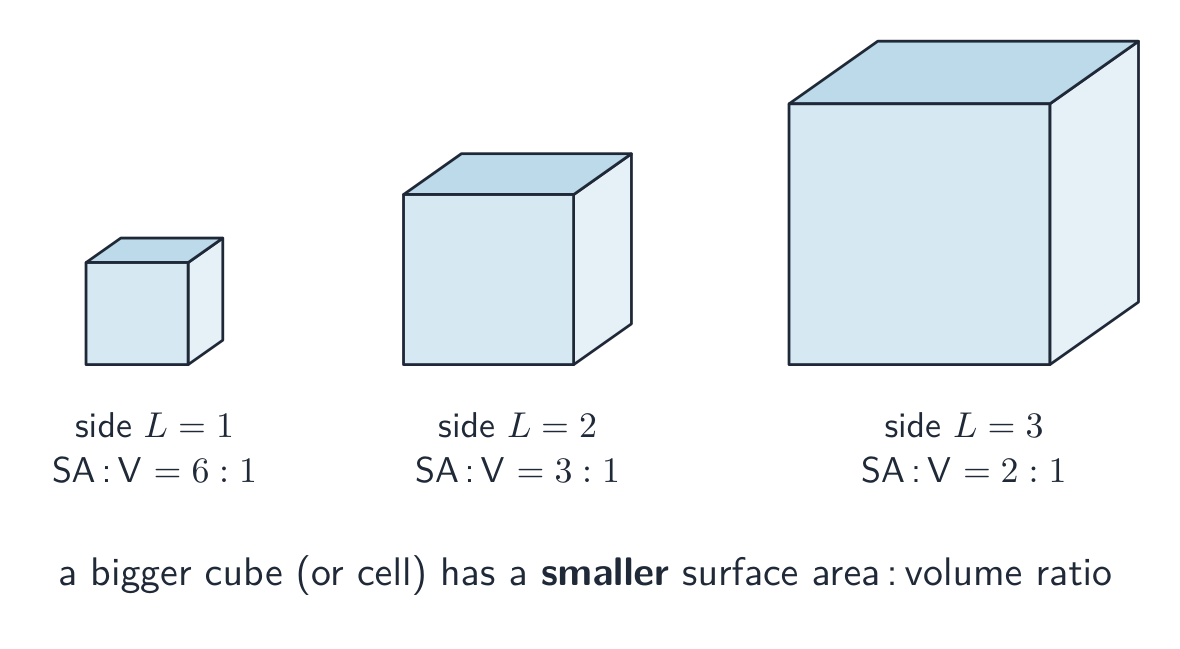
细胞保持小,因为表面积与体积比(surface-area-to-volume ratio)。随着一个细胞生长,它的体积比它的表面积上升得更快,所以它的膜不能为内部足够快地交换物质。保持小(或扁平或折叠)保持足够的表面来服务体积。
随着一个细胞变大表面积与体积比下降 Worked example. 一个边长 $2\ \mu\text{m}$ 的立方体形状的细胞有表面积 $6\times2^2=24\ \mu\text{m}^2$ 和体积 $2^3=8\ \mu\text{m}^3$,所以它的表面积与体积比是 $\tfrac{24}{8}=3$。把边长加倍到 $4\ \mu\text{m}$:表面积 $=6\times4^2=96$,体积 $=4^3=64$,比 $=\tfrac{96}{64}=1.5$。把大小加倍使比减半——较大的细胞每单位内部有远少的膜,这就是为什么细胞保持小。
探索See surface area vs volume as a cube grows
As a cell grows, volume rises faster than surface area, so the surface-area-to-volume ratio falls. A small cell keeps enough membrane to exchange materials fast enough.
词汇表 训练英文 中文 拼音 surface-area-to-volume ratio/ˈsɜːfɪs ˈeərɪə tə ˈvɒljuːm ˈreɪʃɪəʊ/ 表面积与体积比 biǎo miàn jī yǔ tǐ jī bǐ 2.3
质膜
大纲
Big Idea Learning Objective Essential Knowledge Big Idea 2 — Energetics
Biological systems use energy and molecular building blocks to grow, reproduce, and maintain dynamic homeostasis.2.3.A
Describe the roles of each of the components of the cell membrane in maintaining the internal environment of the cell.- 2.3.A.1 Phospholipids have both hydrophilic and hydrophobic regions. The polar hydrophilic phosphate regions of the phospholipids are oriented toward the aqueous external or internal environment, while the nonpolar hydrophobic fatty acid regions face each other within the interior of the membrane.
- 2.3.A.2 Embedded proteins can be hydrophilic (with charged and polar side groups), hydrophobic (with nonpolar side groups), or both.
- i. Hydrophilic regions of the proteins are either inside the interior of the protein or exposed to the cytosol (cytoplasm).
- ii. Hydrophobic regions of proteins make up the protein surface that interacts with the fatty acids in the interior membrane.
2.3.B
Describe the fluid mosaic model of cell membranes.- 2.3.B.1 Plasma membranes consist of a structural framework of phospholipid molecules embedded with proteins, steroids (such as cholesterol in vertebrate animals), glycoproteins, and glycolipids. All of these can move around the surface of the cell within the membrane, as illustrated by the fluid mosaic model.
来源:美国大学理事会 AP 课程与考试说明
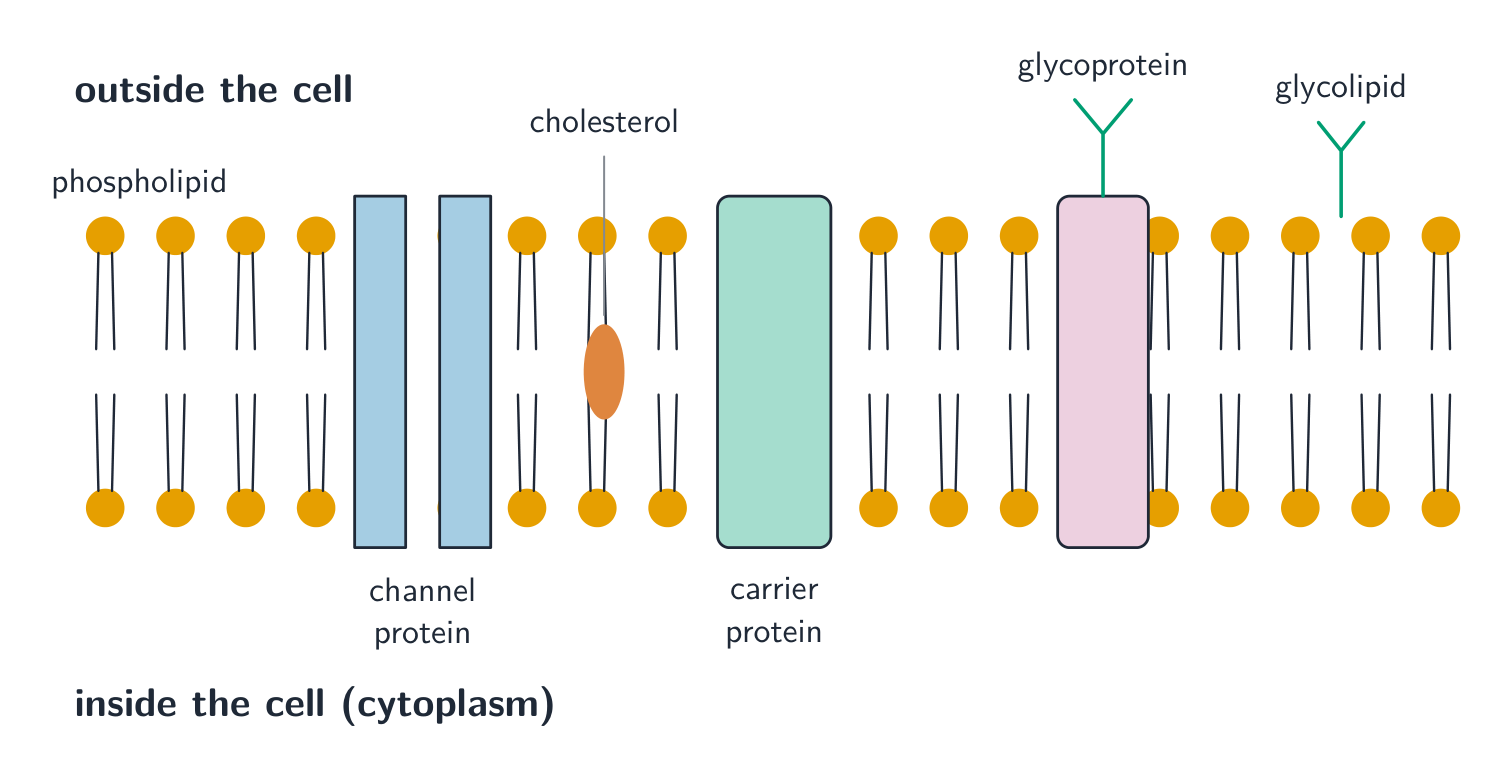
细胞膜是一个磷脂双分子层(phospholipid bilayer)——极性头朝向水、非极性尾在里面——镶嵌着蛋白质。流动镶嵌模型(fluid mosaic model)把它描绘成一张流动的片,其中脂质和蛋白质漂移。胆固醇(cholesterol)和不饱和程度调节它的流动性。
细胞膜的流动镶嵌模型 词汇表 训练英文 中文 拼音 phospholipid bilayer/ˈfɒsfəlɪpɪd ˈbɪleɪə/ 磷脂双分子层 lín zhī shuāng fèn zǐ céng fluid mosaic model/ˈfluːɪd məˈseɪɪk ˈmɒdl/ 流动镶嵌模型 liú dòng xiāng qiàn mó xíng 2.4
膜的通透性
大纲
Big Idea Learning Objective Essential Knowledge Big Idea 2 — Energetics
Biological systems use energy and molecular building blocks to grow, reproduce, and maintain dynamic homeostasis.2.4.A
Explain how the structure of biological membranes influences selective permeability.- 2.4.A.1 Plasma membranes separate the internal environment of the cell from the external environment. Selective permeability is the result of the plasma membrane having a hydrophobic interior.
- 2.4.A.2 Small nonpolar molecules, including $\mathrm{N_2}$, $\mathrm{O_2}$, and $\mathrm{CO_2}$, freely pass across the membrane. Hydrophilic substances, such as large polar molecules and ions, move across the membrane through embedded channels and transport proteins.
- 2.4.A.3 The nonpolar hydrocarbon tails of phospholipids prevent the movement of ions and polar molecules across the membrane. Small polar, uncharged molecules, like $\mathrm{H_2O}$ or $\mathrm{NH_3}$ (ammonia), pass through the membrane in small amounts.
2.4.B
Describe the role of the cell wall in maintaining cell structure and function.- 2.4.B.1 Cell walls of Bacteria, Archaea, Fungi, and plants provide a structural boundary as well as a permeability barrier for some substances to the internal or external cellular environments and protection from osmotic lysis.
来源:美国大学理事会 AP 课程与考试说明
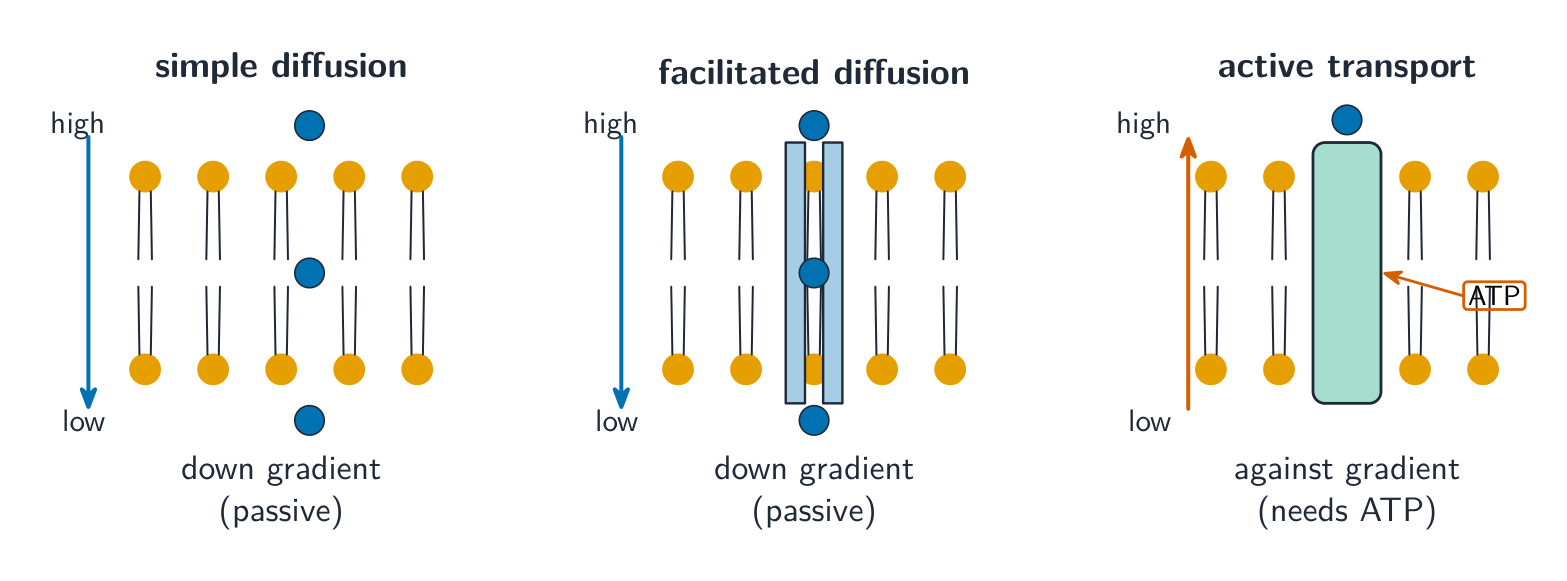
膜是选择透过性(selectively permeable)的。小的非极性分子($\text{O}_2$、$\text{CO}_2$)和水容易穿过;大的或带电/极性的颗粒(离子、葡萄糖)没有帮助不能通过非极性核心。这种选择性让细胞控制它的内部环境。
物质穿过膜的三种方式 词汇表 训练英文 中文 拼音 selectively permeable/sɪˈlektɪvli ˈpɜːməbl/ 选择透过性 xuǎn zé tòu guò xìng 2.5
膜运输
大纲
Big Idea Learning Objective Essential Knowledge Big Idea 2 — Energetics
Biological systems use energy and molecular building blocks to grow, reproduce, and maintain dynamic homeostasis.2.5.A
Describe the mechanisms that organisms use to maintain solute and water balance.- 2.5.A.1 The selective permeability of membranes allows for the formation of concentration gradients of solutes across the membrane.
- 2.5.A.2 Passive transport is the net movement of molecules from regions of high concentration to regions of low concentration without the direct input of metabolic energy.
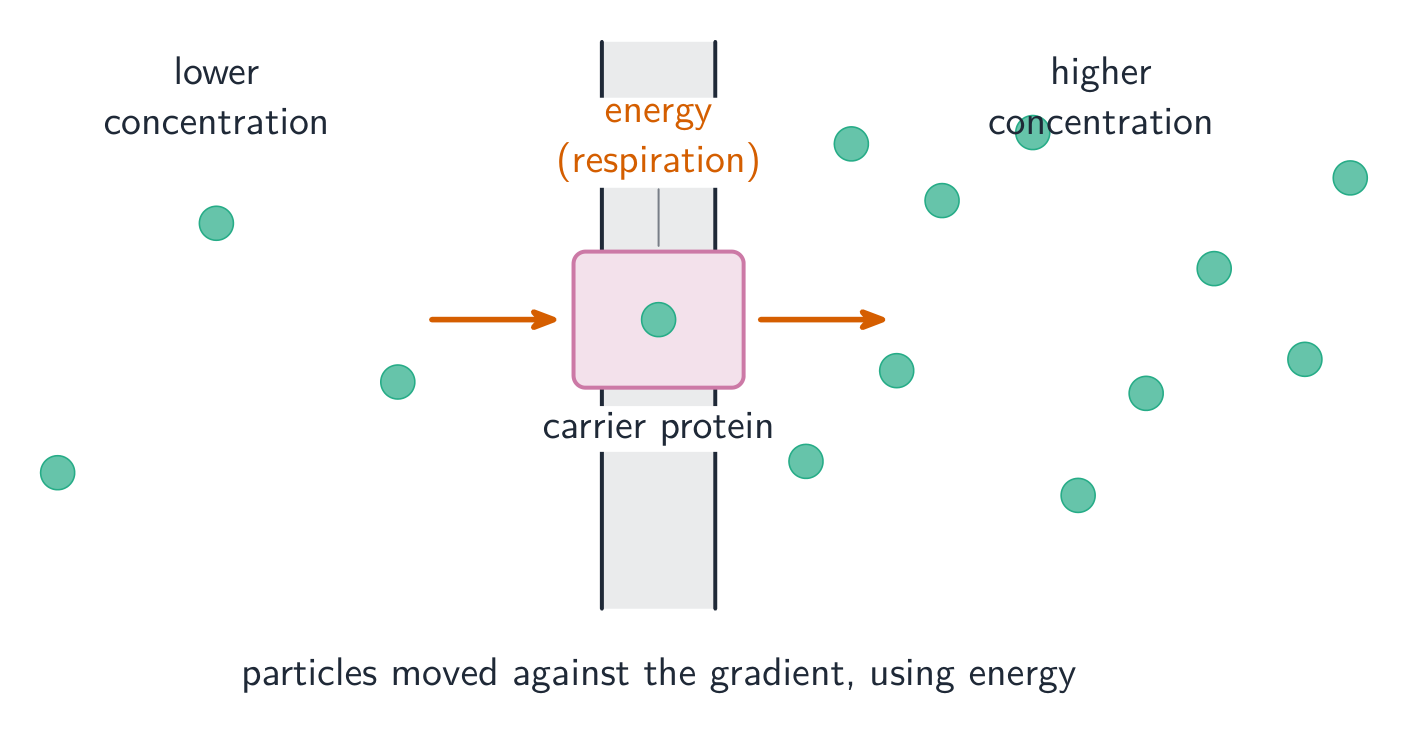
- 2.5.A.3 Active transport requires the direct input of energy to move molecules. In some cases, active transport is utilized to move molecules from regions of low concentration to regions of high concentration.
2.5.B
Describe the mechanisms that organisms use to transport large molecules across the plasma membrane.- 2.5.B.1 The processes of endocytosis and exocytosis require energy to move large substances or large amounts of substances into and out of cells.
- i. In endocytosis, the cell takes in large molecules and particulate matter by folding the plasma membrane in on itself and forming new (small) vesicles that engulf material from the external environment.
- ii. In exocytosis, internal vesicles release material from cells by fusing with the plasma membrane and secreting large molecules from the cell.
来源:美国大学理事会 AP 课程与考试说明
- 被动运输(passive transport)顺着它们的浓度梯度(高 → 低)移动物质,没有能量——扩散(diffusion)。
- 主动运输(active transport)逆着梯度(低 → 高)移动物质,需要能量(ATP),通过像钠钾泵这样的蛋白质泵。
主动运输逆着梯度移动颗粒,使用 ATP 和一个载体蛋白 探索Pump a solute against its gradient
Passive transport moves solutes down their gradient for free; active transport uses ATP to pump them the other way, from low to high concentration.
词汇表 训练英文 中文 拼音 Passive transport/ˈpæsɪv ˈtrænspɔːt/ 被动运输 bèi dòng yùn shū diffusion/dɪˈfjuːʒn/ 扩散 kuò sàn Active transport/ˈæktɪv ˈtrænspɔːt/ 主动运输 zhǔ dòng yùn shū 2.6
易化扩散
大纲
Big Idea Learning Objective Essential Knowledge Big Idea 2 — Energetics
Biological systems use energy and molecular building blocks to grow, reproduce, and maintain dynamic homeostasis.2.6.A
Explain how the structure of a molecule affects its ability to pass through the plasma membrane.- 2.6.A.1 Facilitated diffusion requires transport or channel proteins to enable the movement of charged ions across the membrane.
- i. Membranes may become polarized by the movement of ions across the membrane.
- ii. Charged ions, including $\mathrm{Na^+}$ (sodium) and $\mathrm{K^+}$ (potassium), require channel proteins to move through the membrane.
- 2.6.A.2 Facilitated diffusion enables the movement of large polar molecules through membranes with no energy input. In this type of diffusion, substances move down the concentration gradient.
- 2.6.A.3 Aquaporins transport large quantities of water across membranes.
来源:美国大学理事会 AP 课程与考试说明
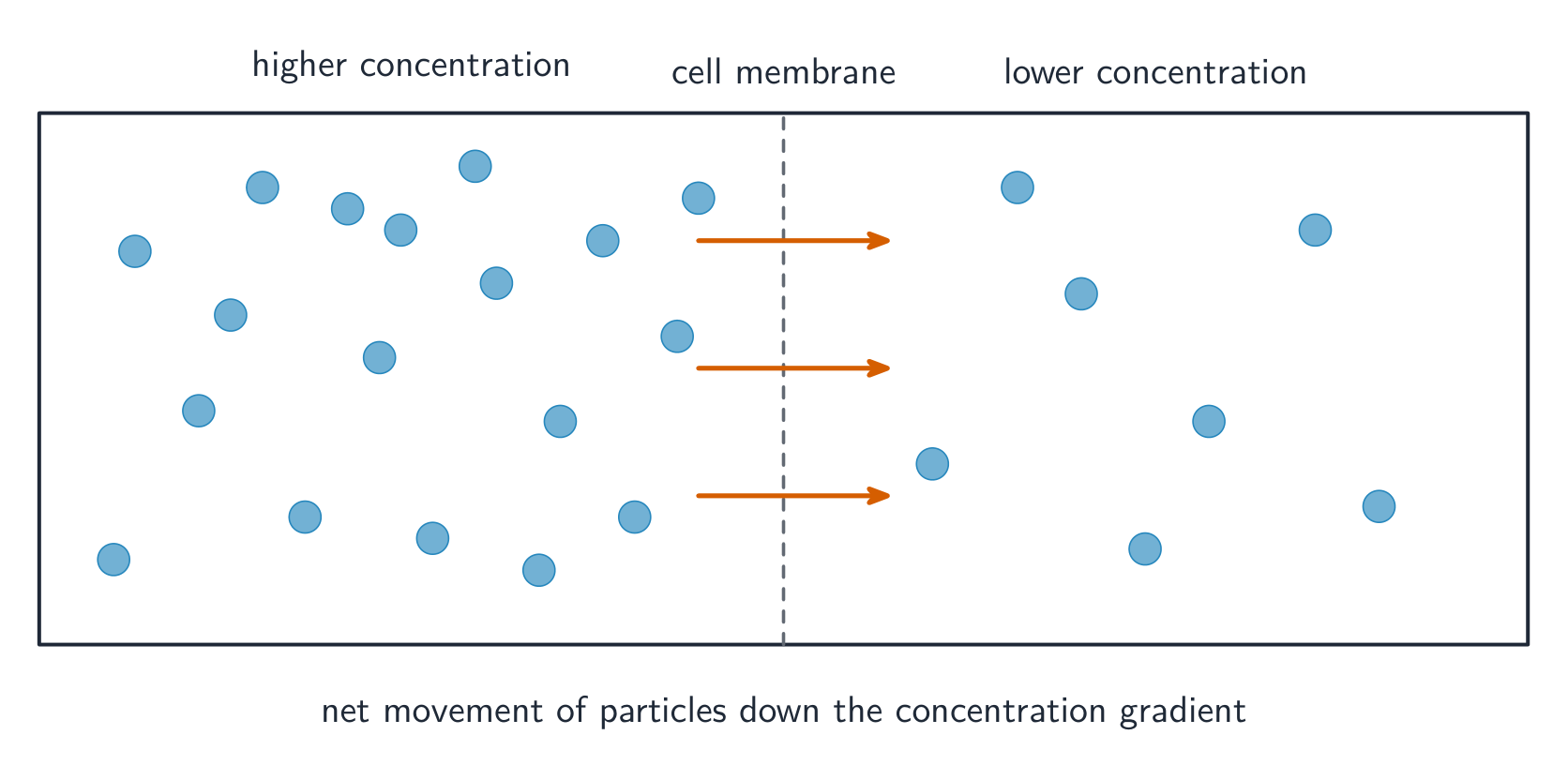
易化扩散(facilitated diffusion)是通过一个膜蛋白——一个通道(channel)或载体(carrier)——的被动运输,用于不能单独穿过脂质的颗粒。它仍然顺着梯度并不需要能量,但当所有蛋白质都忙时它的速率能饱和。
扩散:颗粒从较高浓度向较低浓度扩散,顺着梯度 词汇表 训练英文 中文 拼音 Facilitated diffusion/fəˈsɪlɪteɪtɪd dɪˈfjuːʒn/ 易化扩散 yì huà kuò sàn carrier/ˈkærɪə/ 载体 zài tǐ 2.7
渗透压与渗透调节
大纲
Big Idea Learning Objective Essential Knowledge Big Idea 2 — Energetics
Biological systems use energy and molecular building blocks to grow, reproduce, and maintain dynamic homeostasis.2.7.A
Explain how concentration gradients affect the movement of molecules across membranes.- 2.7.A.1 External environments can be hypotonic, hypertonic, or isotonic to internal environments of cells. Movement of water can also be described as moving from hypotonic to hypertonic regions. Water moves by osmosis from regions of high water potential to regions of low water potential.
- Equation (Water Potential): $\psi = \psi_p + \psi_s$
- where:
- $\psi_p$ = pressure potential
- $\psi_s$ = solute potential
- Illustrative examples for 2.7.A.1:
- Contractile vacuole in protists
- Central vacuole in plant cells
- Equation (Water Potential): $\psi = \psi_p + \psi_s$
2.7.B
Explain how osmoregulatory mechanisms contribute to the health and survival of organisms.- 2.7.B.1 Growth and homeostasis are maintained by the constant movement of molecules across membranes.
- 2.7.B.2 Osmoregulation maintains water balance and allows organisms to control their internal solute composition and water potential. Water moves from regions of low osmolarity or solute concentration to regions of high osmolarity or solute concentration.
- Equation (Solute Potential of a Solution): $\psi_s = -iCRT$
- where:
- $i$ = ionization constant
- $C$ = molar concentration
- $R$ = pressure constant $\left(R = 0.0831 \dfrac{L \cdot bars}{mol \cdot K}\right)$
- $T$ = temperature in Kelvin (°C + 273)
- Equation (Solute Potential of a Solution): $\psi_s = -iCRT$
来源:美国大学理事会 AP 课程与考试说明
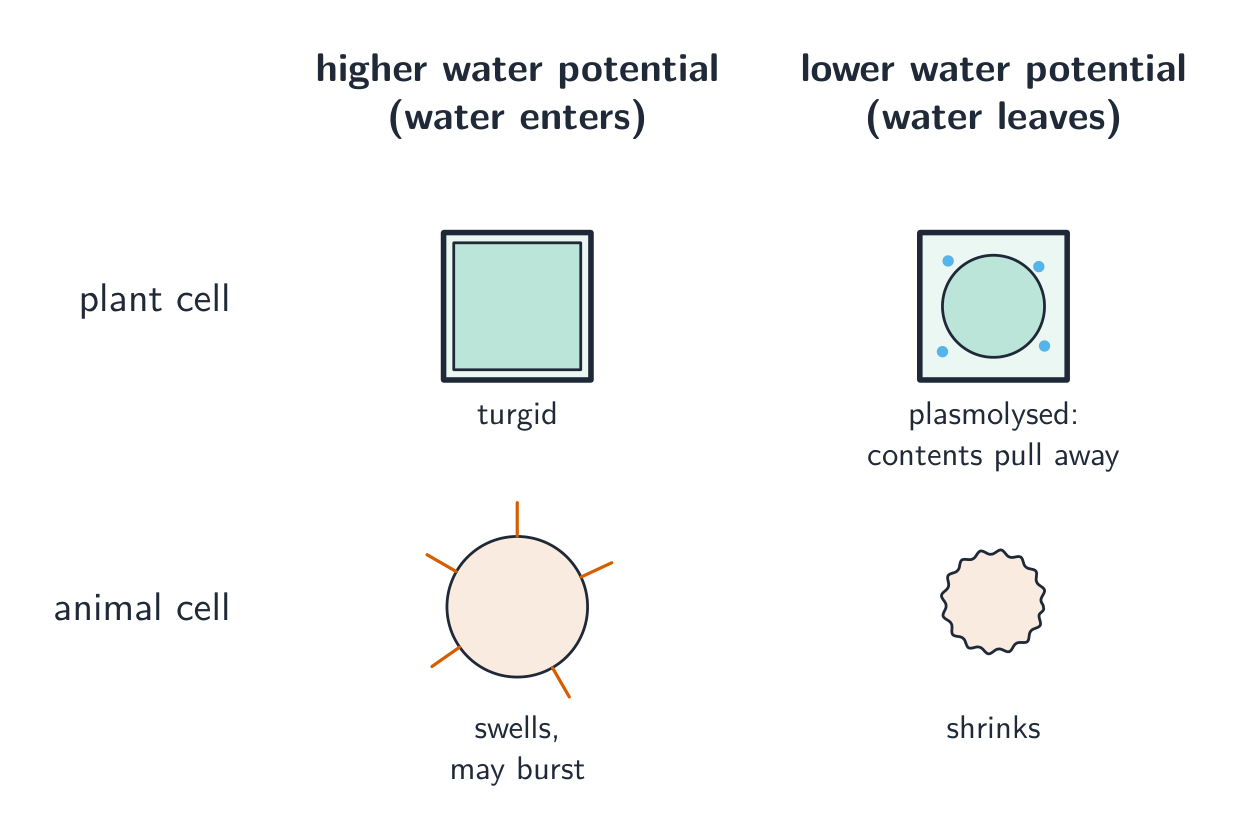
渗透(osmosis)是水穿过一个膜的扩散。张力(tonicity)比较溶质浓度:在一个低渗(hypotonic)溶液里一个细胞获得水(可能胀破);在一个高渗(hypertonic)溶液里它失去水(收缩);在一个等渗(isotonic)溶液里没有净变化。水势(water potential)预测水移动的方向(水移向较低的水势),而且是一个压力项和一个溶质项之和:$\Psi=\Psi_p+\Psi_s$,其中溶质势 $\Psi_s=-iCRT$。渗透调节(osmoregulation)是生物如何控制这个平衡。
植物和动物细胞如何对不同水势的溶液反应 Worked example. 对于一个在一个开放烧杯里(所以压力势 $\Psi_p=0$)、$25\,°\text{C}$($T=298\,\text{K}$,$R=0.0831\ \text{L}\cdot\text{bar/mol}\cdot\text{K}$)的 $0.1\,\text{M}$ 蔗糖溶液($i=1$):$\Psi_s=-iCRT=-(1)(0.1)(0.0831)(298)\approx-2.48\ \text{bar}$,所以 $\Psi\approx-2.48\ \text{bar}$。一个内部为 $\Psi=-1.0\ \text{bar}$ 的植物细胞坐在这个溶液里:因为溶液更负,水移出细胞进入溶液,而细胞失去膨压。
探索Watch water move by osmosis
Water moves across the membrane from high water potential to low, toward the more concentrated (hypertonic) side. Set the concentrations and watch which way the cell swells or shrinks.
词汇表 训练英文 中文 拼音 Osmosis/ɒzˈməʊsɪs/ 渗透 shèn tòu Tonicity/təˈnɪsɪti/ 张力 zhāng lì hypotonic/ˌhaɪpəʊˈtɒnɪk/ 低渗 dī shèn hypertonic/ˌhaɪpəˈtɒnɪk/ 高渗 gāo shèn isotonic/ˌaɪsəˈtɒnɪk/ 等渗 děng shèn Water potential/ˈwɔːtə pəˈtenʃl/ 水势 shuǐ shì Osmoregulation/ˌɒzmɔːɡjʊˈleɪʃn/ 渗透调节 shèn tòu tiáo jié 2.8
运输机制
大纲
Big Idea Learning Objective Essential Knowledge Big Idea 2 — Energetics
Biological systems use energy and molecular building blocks to grow, reproduce, and maintain dynamic homeostasis.2.8.A
Describe the processes that allow ions and other molecules to move across membranes.- 2.8.A.1 Metabolic energy (such as that from ATP) is required for active transport of molecules across the membrane and to establish and maintain electrochemical gradients.
- i. Membrane proteins are necessary for active transport.
- ii. The $\mathrm{Na^+}/\mathrm{K^+}$ pump and ATPase contribute to the maintenance of the membrane potential.
来源:美国大学理事会 AP 课程与考试说明
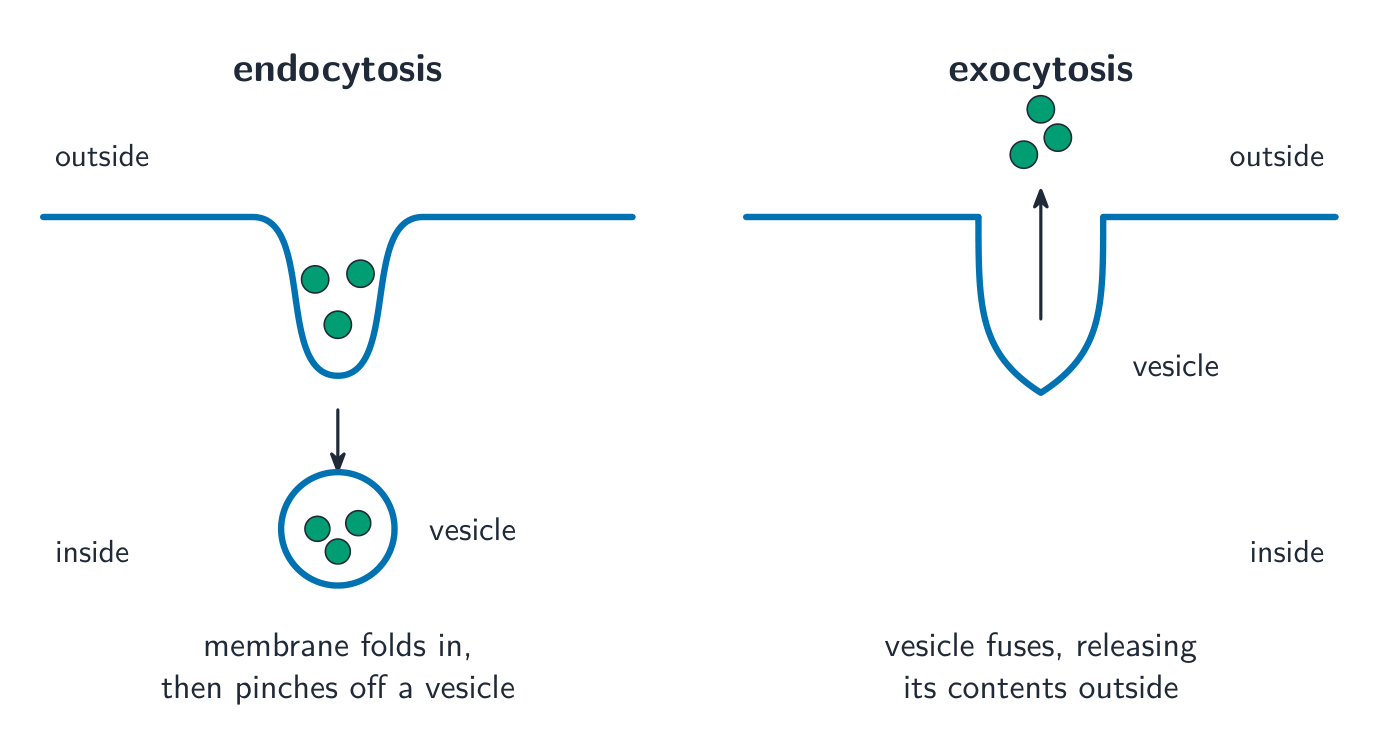
大的物质通过囊泡(vesicles)大批量移动:内吞(endocytosis)把物质带进(膜吞没它),而外排(exocytosis)把物质送出(一个囊泡与膜融合)。两者都需要能量并让细胞输入和分泌大分子。
内吞把物质带进;外排把它释放出 词汇表 训练英文 中文 拼音 endocytosis/ˌendəʊsɪˈtəʊsɪs/ 内吞 nèi tūn exocytosis/eɡˌzɒsɪˈtəʊsɪs/ 外排 wài pái 2.9
细胞区室化
大纲
Big Idea Learning Objective Essential Knowledge Big Idea 2 — Energetics
Biological systems use energy and molecular building blocks to grow, reproduce, and maintain dynamic homeostasis.2.9.A
Describe the membrane-bound structures of the eukaryotic cell.- 2.9.A.1 Membranes and membrane-bound organelles in eukaryotic cells compartmentalize intracellular metabolic processes and specific enzymatic reactions.
2.9.B
Explain how internal membranes and membrane-bound organelles contribute to compartmentalization of eukaryotic cell functions.- 2.9.B.1 Internal membranes facilitate cellular processes by minimizing competing interactions and by increasing the surface area where reactions can occur.
来源:美国大学理事会 AP 课程与考试说明
膜创造分开的区室(compartments),以便不相容的反应能同时进行而条件(pH、离子水平)能被局部调节。这种组织提升效率——内部的膜也为反应增加表面积。
词汇表 训练英文 中文 拼音 compartments/kəmˈpɑːtmənts/ 区室 qū shì 2.10
细胞区室化的起源
大纲
Big Idea Learning Objective Essential Knowledge Big Idea 1 — Evolution
The process of evolution drives the diversity and unity of life.2.10.A
Describe similarities and/or differences in compartmentalization between prokaryotic and eukaryotic cells.- 2.10.A.1 Membrane-bound organelles such as mitochondria and chloroplasts evolved from once free-living prokaryotic cells via endosymbiosis.
- 2.10.A.2 Prokaryotes typically lack internal membrane-bound organelles but have internal regions with specialized structures and functions.
- 2.10.A.3 Eukaryotic cells maintain internal membranes that partition the cell into specialized regions.
来源:美国大学理事会 AP 课程与考试说明
内共生学说(endosymbiotic theory)解释线粒体和叶绿体:它们产生于一个较大的细胞吞没了后来住在它里面的自由生活的原核生物时。证据——它们自己的环状 DNA、它们自己的核糖体和双膜——支持这个共同的进化起源。
词汇表 训练英文 中文 拼音 endosymbiotic theory/ˌendəʊˌsɪmbaɪˈɒtɪk ˈθɪəri/ 内共生学说 nèi gòng shēng xué shuō ribosomal RNA (rRNA)/ˈrɪbəsɒml ˌɑː en ˈeɪ/ 核糖体 hé táng tǐ 2.10
考试技巧
- 使用两个 AP 公式技能:表面积与体积比(为什么细胞保持小)和水势 $\Psi=\Psi_p+\Psi_s$($\Psi_s=-iCRT$)。
- 水移向较低(更负)的水势;从张力(低渗/高渗/等渗)预测膨胀或收缩。
- 被动运输和渗透不需要能量(顺着梯度);主动运输需要 ATP(逆着梯度)。
- 区分扩散、易化扩散(一个通道/载体蛋白)和主动运输。
- 从磷脂双分子层解释膜的选择性——小的非极性分子穿过,大的/带电的需要帮助。
-
3
细胞能量学
3.1
酶
大纲
Big Idea Learning Objective Essential Knowledge Big Idea 2 — Energetics
Biological systems use energy and molecular building blocks to grow, reproduce, and maintain dynamic homeostasis.3.1.A
Explain how enzymes affect the rate of biological reactions.- 3.1.A.1 The structure and function of enzymes contribute to the regulation of biological processes. Enzymes are proteins that are biological catalysts that facilitate chemical reactions in cells by lowering the activation energy.
- 3.1.A.2 For an enzyme-mediated chemical reaction to occur, the shape and charge of the substrate must be compatible with the active site of the enzyme. This is illustrated by the enzyme-substrate complex model.
来源:美国大学理事会 AP 课程与考试说明
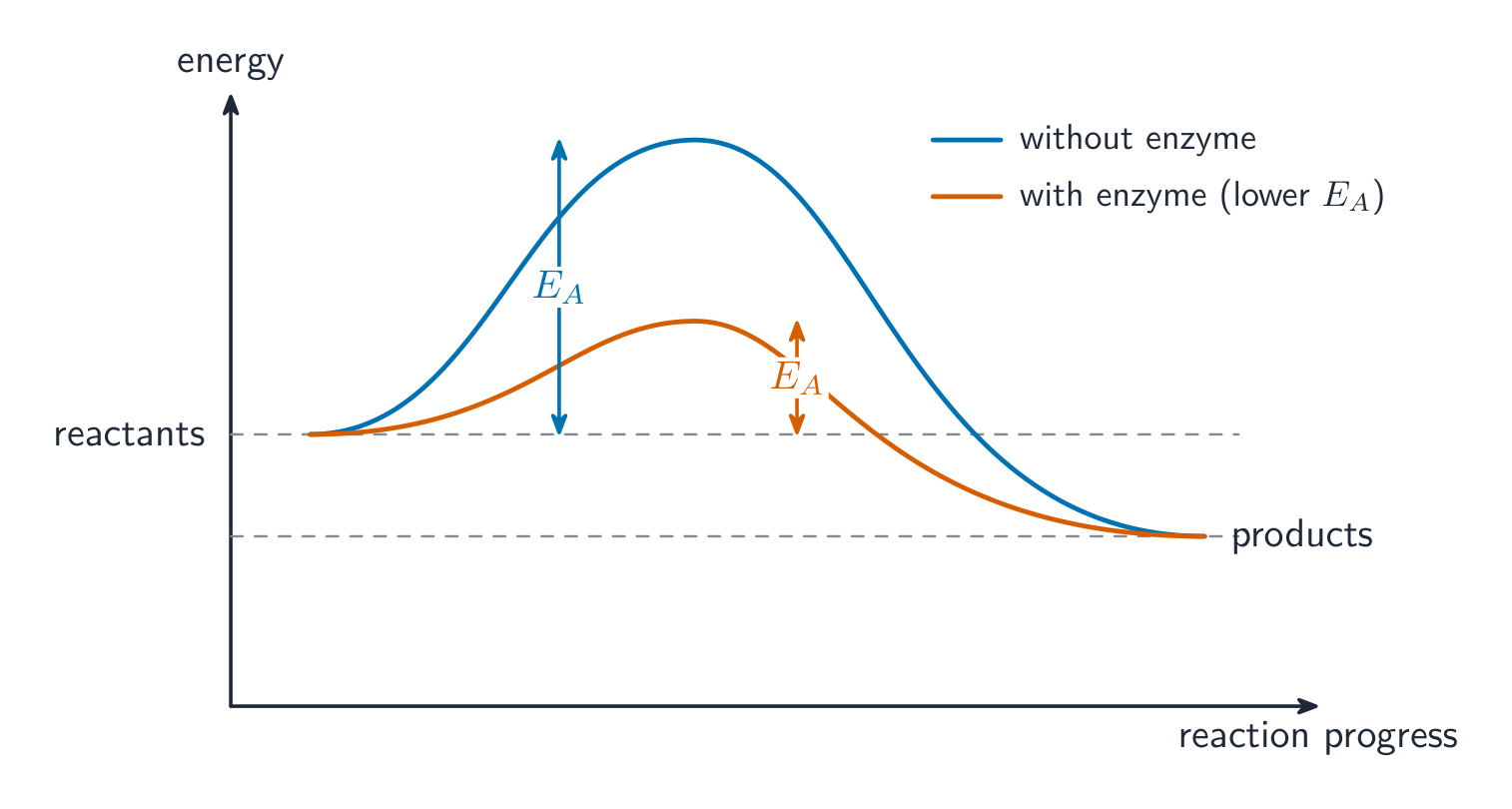
一个酶(enzyme)是一个蛋白质催化剂(catalyst),通过降低反应的活化能(activation energy)加速反应,而不被消耗。每个酶有一个活性位点(active site),结合一个特定的底物(substrate)("锁和钥匙"或诱导契合),所以酶是高度特异的。它们不改变一个反应是否有利——只改变它进行得多快。
一个酶降低一个反应的活化能 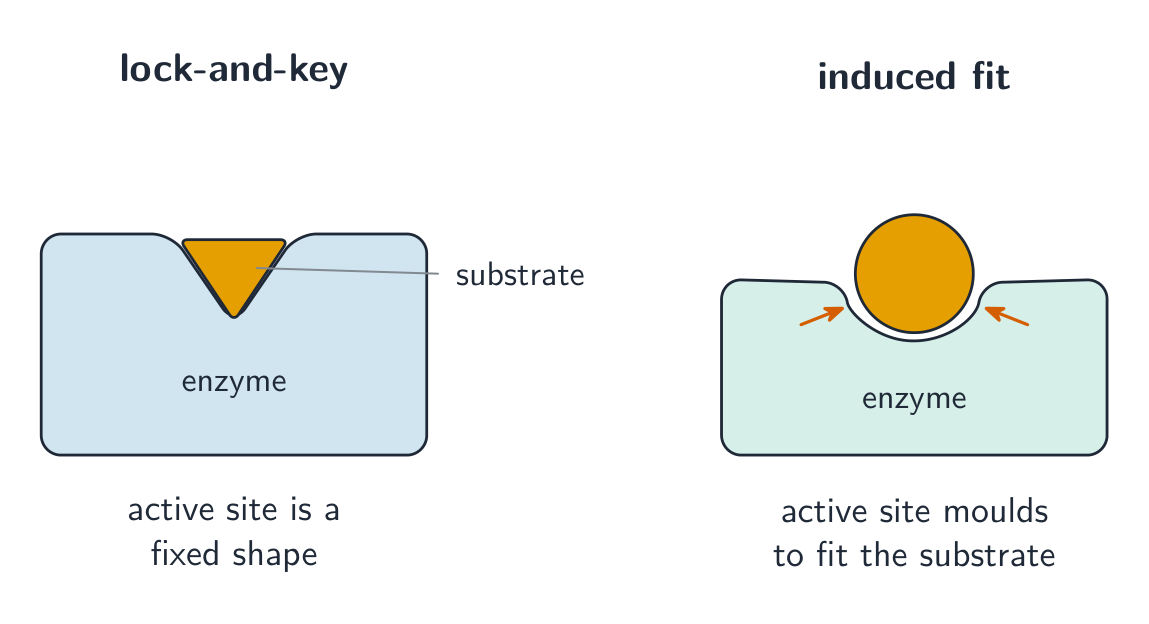
酶作用的锁-钥匙和诱导契合模型 探索Raise substrate and watch the rate saturate
An enzyme speeds a reaction by lowering activation energy. As substrate rises the rate climbs, then levels off once every active site is busy (saturation).
词汇表 训练英文 中文 拼音 enzyme/ˈenzaɪm/ 酶 méi catalyst/ˈkætəlɪst/ 催化剂 cuī huà jì activation energy/ˌæktɪˈveɪʃn ˈenədʒi/ 活化能 huó huà néng active site/ˈæktɪv saɪt/ 活性位点 huó xìng wèi diǎn substrate/ˈsʌbstreɪt/ 底物 dǐ wù 3.2
环境对酶功能的影响
大纲
Big Idea Learning Objective Essential Knowledge Big Idea 2 — Energetics
Biological systems use energy and molecular building blocks to grow, reproduce, and maintain dynamic homeostasis.3.2.A
Explain how changes to the structure of an enzyme may affect its function.- 3.2.A.1 Change to the molecular structure of a component in an enzymatic system may result in a change to its function or efficiency.
- i. Denaturation of proteins, such as enzymes, occurs when the protein structure is disrupted by a change in temperature, pH, or chemical environment, eliminating the ability to catalyze reactions.
- ii. Environmental temperatures and pH outside the optimal range for a given enzyme will cause changes to its structure (by disrupting the hydrogen bonds), altering the efficiency with which it catalyzes reactions.
- 3.2.A.2 In some cases, enzyme denaturation is reversible, allowing the enzyme to regain activity.
3.2.B
Explain how the cellular environment affects enzyme activity.- 3.2.B.1 The relative concentrations of substrates and products determine how efficiently an enzymatic reaction proceeds.
来源:美国大学理事会 AP 课程与考试说明
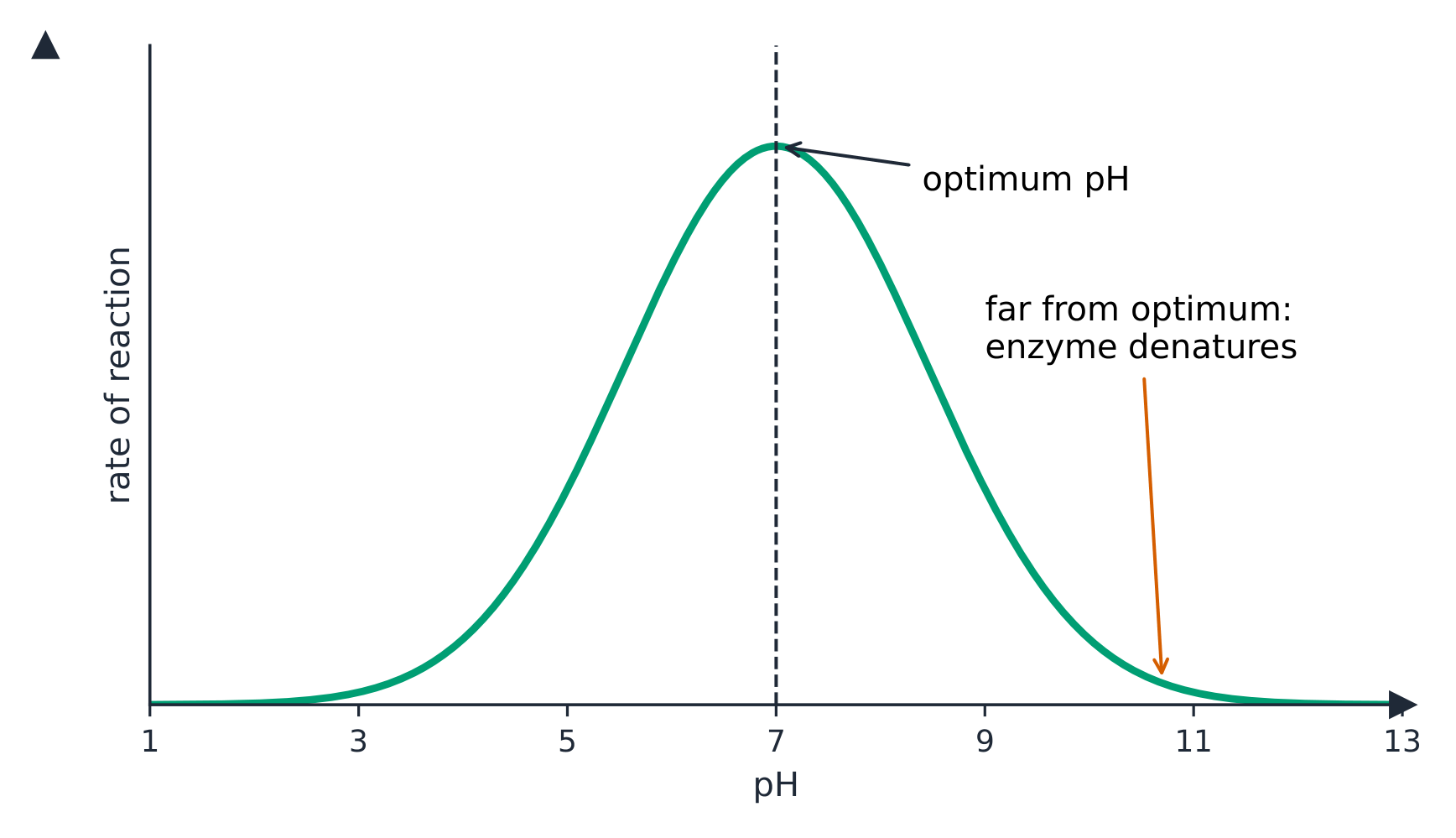
酶的活性取决于条件。每个酶有一个最适温度和 pH;超过它,蛋白质变性(denatures)(失去形状)并停止工作。底物浓度提高速率直到酶饱和。抑制剂(inhibitors)减慢酶——竞争性的堵塞活性位点,非竞争性的结合到别处并改变形状。
每个酶有一个最适 pH 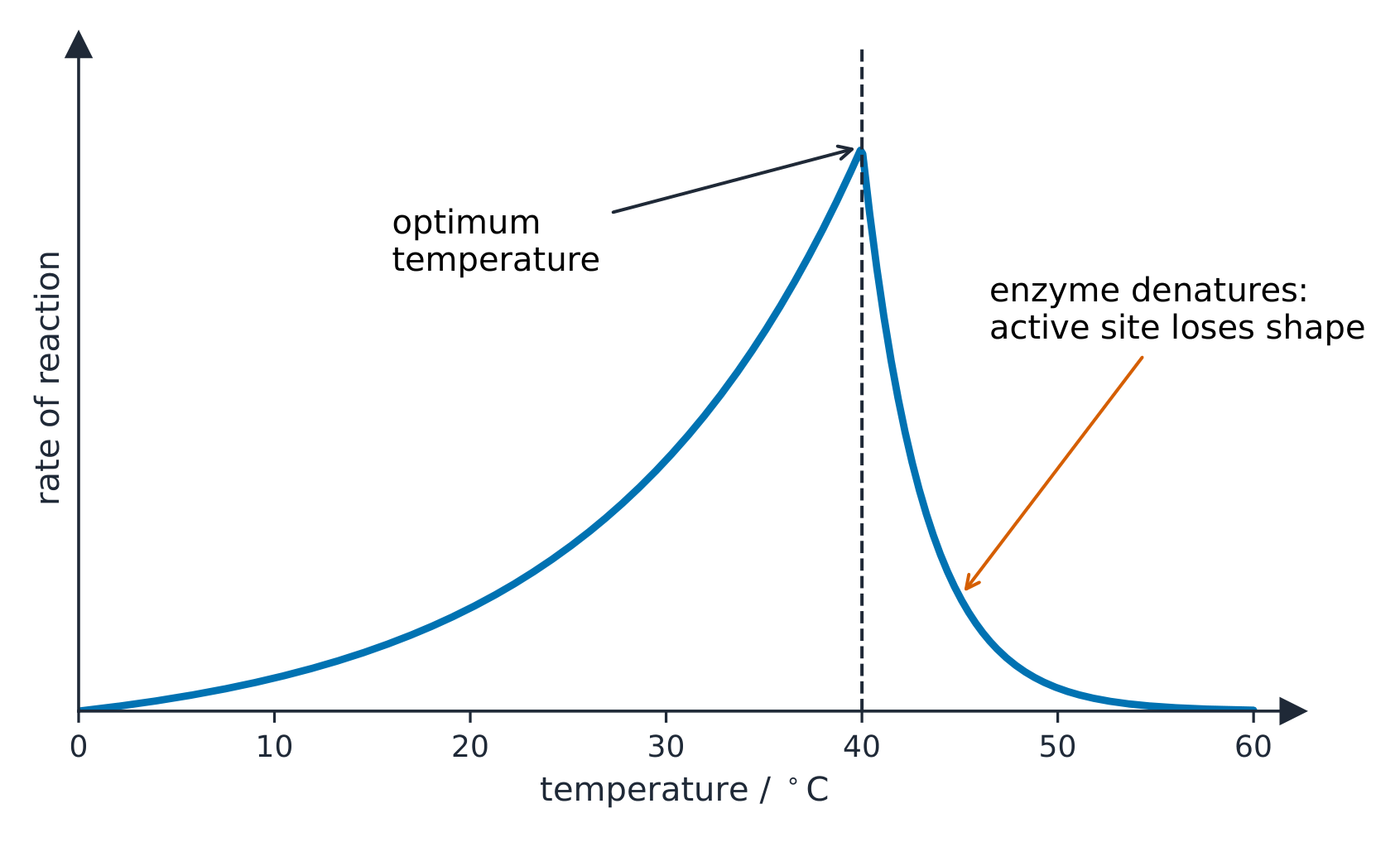
速率上升到一个最适温度,然后随着酶变性而下降 探索Change temperature and watch enzyme activity
Each enzyme has an optimum temperature and pH. Too cold is slow; too hot denatures the enzyme so its active site loses shape and activity crashes.
词汇表 训练英文 中文 拼音 denatures/ˈdenətʃəz/ 变性 biàn xìng Inhibitors/ɪnˈhɪbɪtəz/ 抑制剂 yì zhì jì The first law/ðə fɜːst lɔː/ 热力学第一定律 rè lì xué dì yí dìng lǜ The second law/ðə ˈsekənd lɔː/ 热力学第二定律 rè lì xué dì èr dìng lǜ 3.3
细胞能量
大纲
Big Idea Learning Objective Essential Knowledge Big Idea 2 — Energetics
Biological systems use energy and molecular building blocks to grow, reproduce, and maintain dynamic homeostasis.3.3.A
Describe the role of energy in living organisms.- 3.3.A.1 All living systems require an input of energy.
- 3.3.A.2 Life requires a highly ordered system and does not violate the first and second laws of thermodynamics.
- i. Energy input must exceed energy loss to maintain order and to power cellular processes.
- ii. Cellular processes that release energy may be coupled with cellular processes that require energy.
- iii. Significant loss of order or energy flow results in death.
- Exclusion statement: Students will need to understand the concept of energy, but the equation for Gibbs free energy is beyond the scope of the AP Exam.
- 3.3.A.3 Energy-related pathways in biological systems are sequential to allow for a more controlled transfer of energy. A product of a reaction in a metabolic pathway is typically the reactant for the subsequent step in the pathway.
3.3.B
Explain how shared, conserved, and fundamental processes and features support the concept of common ancestry for all organisms.- 3.3.B.1 Core metabolic pathways (e.g., glycolysis, oxidative phosphorylation) are conserved across all currently recognized domains (Archaea, Bacteria, and Eukarya).
来源:美国大学理事会 AP 课程与考试说明
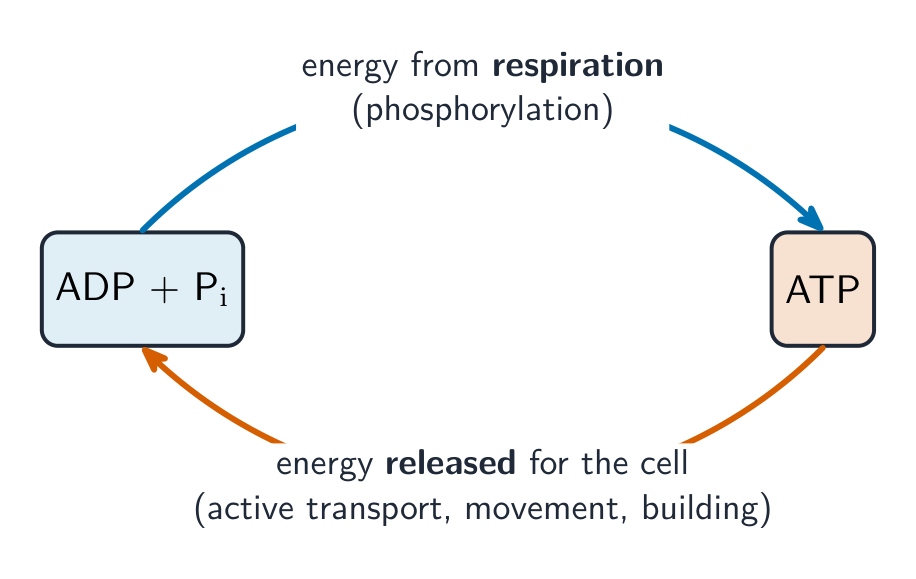
ATP(三磷酸腺苷)是细胞的能量货币。能量储存在它的磷酸键里;断掉一个磷酸(ATP → ADP)释放能量来驱动细胞工作,而重新附上一个储存能量。细胞不断回收 ATP,把释放能量的反应与需要能量的反应耦合。
ATP-ADP 循环储存和释放能量 生命与热力学定律
活细胞高度有序,这种有序常被误认为违反了物理定律。其实并没有。
- 热力学第一定律说能量守恒:它可以改变形式,但既不能被创造也不能被消灭。细胞并不"制造"能量——它把葡萄糖的化学能,或太阳的光能,转化为 ATP 的化学能。
- 热力学第二定律说,任何能量转移都会有一部分能量以热的形式散失,宇宙的熵(entropy)因此增加。细胞在自己内部建立秩序,但代价是向环境释放出更多的无序,主要以热的形式。
所以生命需要从外界持续输入自由能(free energy)。这就是为什么一个被切断能量来源的生物体会死亡:维持秩序不是免费的,输入一停止,这个有序系统就会衰败。
词汇表 训练英文 中文 拼音 entropy/ˈentrəpi/ 熵 shāng constant input of free energy/ˈkɒnstənt ˈɪnpʊt ɒv friː ˈenədʒi/ 自由能 zì yóu néng 3.4
光合作用
大纲
Big Idea Learning Objective Essential Knowledge Big Idea 2 — Energetics
Biological systems use energy and molecular building blocks to grow, reproduce, and maintain dynamic homeostasis.3.4.A
Describe the photosynthetic processes and structural features of the chloroplast that allow organisms to capture and store energy.- 3.4.A.1 Photosynthesis is the series of reactions that use carbon dioxide $(\mathrm{CO_2})$, water $(\mathrm{H_2O})$, and light energy to make carbohydrates and oxygen $(\mathrm{O_2})$.
- i. Photosynthetic organisms capture energy from the sun and produce sugars that can be used in biological processes or stored.
- ii. Photosynthesis first evolved in prokaryotic organisms.
- iii. Scientific evidence supports the claim that prokaryotic (cyanobacterial) photosynthesis was responsible for the production of an oxygenated atmosphere.
- iv. Prokaryotic photosynthetic pathways were the foundation of eukaryotic photosynthesis.
- Exclusion statement: Memorization of the steps in the Calvin cycle, the structure of the molecules, and the names of the enzymes involved, with the exception of ATP synthase, is beyond the scope of the AP Exam.
- 3.4.A.2 Stroma and thylakoids are found within the chloroplast.
- i. The stroma is the fluid within the inner chloroplast membrane and outside the thylakoid. The carbon fixation (Calvin cycle) reactions of photosynthesis occur in the stroma.
- ii. The thylakoid membranes contain chlorophyll pigments organized into two photosystems, as well as electron transport proteins.
- iii. Thylakoids are organized in stacks called grana. The light reactions of photosynthesis occur in the grana.
- 3.4.A.3 The light reactions of photosynthesis in eukaryotes involve a series of coordinated reaction pathways that capture energy present in light to yield ATP and NADPH, which power the production of organic molecules in the Calvin cycle. This provides energy for metabolic processes.
3.4.B
Explain how cells capture energy from light and transfer it to biological molecules for storage and use.- 3.4.B.1 Electron transport chain (ETC) reactions occur in chloroplasts, in mitochondria, and across prokaryotic plasma membranes. In photosynthesis, electrons that pass through the thylakoid membrane are picked up and ultimately transferred to $\mathrm{NADP^+}$ reducing it to NADPH in photosystem I.
- Exclusion statement: The full names of the specific electron carriers in the electron transport chain are beyond the scope of the AP Exam.
- Exclusion statement: Specific steps, names of enzymes, and intermediates of the pathways for these processes are beyond the scope of this course and the AP Exam.
- 3.4.B.2 During photosynthesis, chlorophylls absorb energy from light, boosting electrons to a higher energy level in photosystems I and II. Water then splits, supplying electrons to replace those lost from photosystem II.
- 3.4.B.3 Photosystems I and II are embedded in the thylakoid membranes of chloroplasts and are connected by the transfer of electrons through an ETC.
- 3.4.B.4 When electrons are transferred between molecules in a series of oxidation/reduction reactions as they pass through the ETC, an electrochemical gradient of protons (hydrogen ions) is established across the thylakoid membrane. The membrane separates a region of low proton concentration outside the thylakoid membrane from a region of high proton concentration inside the thylakoid membrane.
- 3.4.B.5 The formation of the proton gradient is linked to the synthesis of ATP from ADP and inorganic phosphate via ATP synthase. The flow of protons back through membrane-bound ATP synthase by chemiosmosis drives the formation of ATP from ADP and inorganic phosphate; this is known as photophosphorylation.
- 3.4.B.6 The energy captured in the light reactions and transferred to ATP and NADPH powers the production of carbohydrates from carbon dioxide in the Calvin cycle. This occurs in the stroma of the chloroplast.
来源:美国大学理事会 AP 课程与考试说明
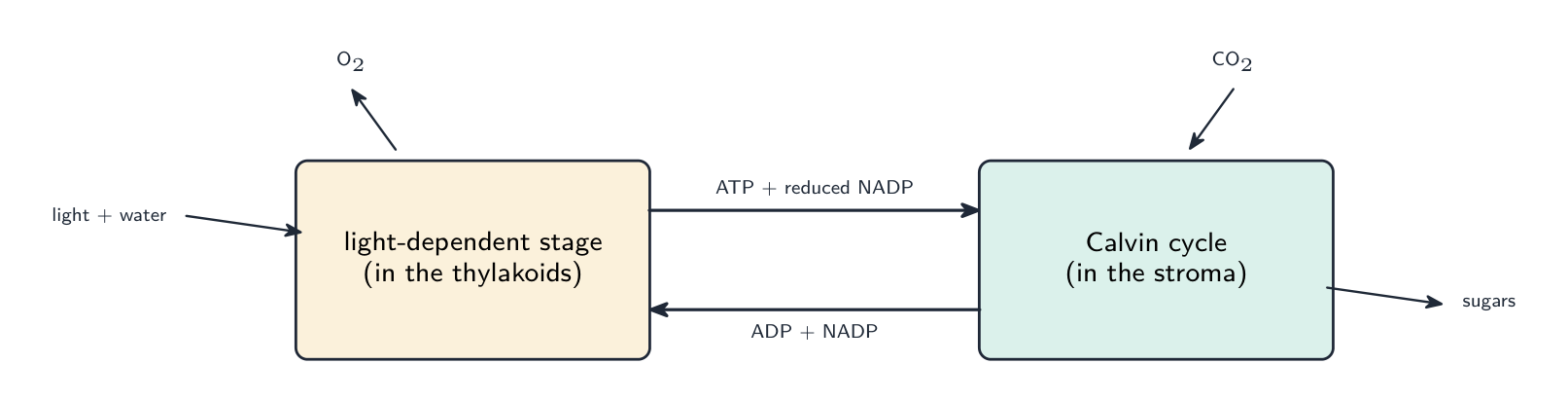
光合作用(photosynthesis)捕获光能以从 $\text{CO}_2$ 和水构建糖,释放 $\text{O}_2$。它有两个阶段:
光合作用的两个阶段由 ATP 和 NADPH 联系 - 光反应(light reactions)(在类囊体膜里)用光制造 ATP 和 NADPH 并分裂水,释放氧。
- 卡尔文循环(Calvin cycle)(在基质里)用那些 ATP 和 NADPH 把 $\text{CO}_2$ 固定成糖。
所以光能变成储存在葡萄糖里的化学能。
空气中的氧气是从哪里来的
光合作用不仅养活了最早的生物,它还改变了整颗行星。科学证据支持这样一个论断:原核生物(prokaryotes)的光合作用——具体地说是蓝细菌(cyanobacteria)——产生了构成地球含氧大气(oxygenated atmosphere)的氧气。
证据是实物性的:约 24 亿年前岩石中的条带状铁建造(banded iron formations)记录了溶解在海洋里的铁被氧化并沉淀出来,而这需要游离氧。在这一被称为大氧化事件的过程之前,大气中几乎没有氧气。
有两个后果对后面的课程很重要。游离氧使有氧呼吸成为可能,它每分子葡萄糖释放的 ATP 远多于无氧途径。而它对当时已经存在的许多厌氧生物是致命的,所以这也算得上地球历史上最大的灭绝事件之一——生物改变自身环境的一个早期例子。
词汇表 训练英文 中文 拼音 Photosynthesis/ˌfəʊtəʊˈsɪnθəsɪs/ 光合作用 guāng hé zuò yòng Calvin cycle/ˈkælvɪn ˈsaɪkl/ 卡尔文循环 kǎ ěr wén xún huán prokaryotes/ˈprɒkərɪəʊts/ 原核生物 yuán hé shēng wù cyanobacteria/ˌsaɪəˌnɒbəkˈtɪərɪə/ 蓝细菌 lán xì jūn oxygenated atmosphere/ˈɒksɪdʒeneɪtɪd ˈætməsfɪə/ 含氧大气 hán yǎng dà qì banded iron formations/ˈbændɪd ˈaɪən fɔːˈmeɪʃnz/ 条带状铁建造 tiáo dài zhuàng tiě jiàn zào 3.5
细胞呼吸
大纲
Big Idea Learning Objective Essential Knowledge Big Idea 2 — Energetics
Biological systems use energy and molecular building blocks to grow, reproduce, and maintain dynamic homeostasis.3.5.A
Describe the processes and structural features of mitochondria that allow organisms to use energy stored in biological macromolecules.- 3.5.A.1 Cellular respiration uses energy from biological macromolecules to synthesize ATP. Respiration and fermentation are characteristic of all forms of life.
- 3.5.A.2 Aerobic cellular respiration in eukaryotes involves a series of coordinated enzyme-catalyzed reactions that capture energy from biological macromolecules.
- 3.5.A.3 The ETC transfers electrons in a series of oxidation-reduction reactions that establish an electrochemical gradient across membranes.
- i. In cellular respiration, electrons delivered by NADH and $\mathrm{FADH_2}$ are passed to a series of electron acceptors as they move toward the terminal electron acceptor, oxygen. Aerobic prokaryotes use oxygen as a terminal electron acceptor, while anaerobic prokaryotes use other molecules.
- ii. The transfer of electrons, through the ETC, is accompanied by the formation of a proton gradient across the inner mitochondrial membrane, with the membrane(s) separating a region of high proton concentration outside the membrane from a region of low proton concentration inside the membrane. The folding of the inner membrane increases the surface area, which allows for more ATP to be synthesized. In prokaryotes, the passage of electrons is accompanied by the movement of protons across the plasma membrane.
- iii. The flow of protons back through membrane-bound ATP synthase by chemiosmosis drives the formation of ATP from ADP and inorganic phosphate. This is known as oxidative phosphorylation in aerobic cellular respiration.
- iv. In aerobic cellular respiration, decoupling oxidative phosphorylation from electron transport generates heat. This heat can be used by endothermic organisms to regulate body temperature.
- Exclusion statement: The full names of the specific electron carriers in the electron transport chain are beyond the scope of the AP Exam.
- Exclusion statement: Specific steps, names of enzymes, and intermediates of the pathways for these processes are beyond the scope of this course and the AP Exam.
3.5.B
Explain how cells obtain energy from biological macromolecules in order to power cellular functions.- 3.5.B.1 Glycolysis is a biochemical pathway that releases the energy in glucose molecules to form ATP (from ADP and inorganic phosphate), NADH (from $\mathrm{NAD^+}$), and pyruvate.
- 3.5.B.2 Pyruvate is transported from the cytosol to the mitochondrion where oxidation occurs. This process releases electrons during the Krebs (citric acid) cycle, reducing $\mathrm{NAD^+}$ to NADH and FAD to $\mathrm{FADH_2}$, and releasing $\mathrm{CO_2}$.
- 3.5.B.3 The Krebs cycle takes place in the mitochondrial matrix. During the Krebs cycle, carbon dioxide is released from organic intermediates, ATP is synthesized from ADP and inorganic phosphate, and electrons are transferred by the coenzymes $\mathrm{NAD^+}$ and FAD.
- 3.5.B.4 Electrons extracted in glycolysis and Krebs cycle reactions are transferred by NADH and $\mathrm{FADH_2}$ to the ETC in the inner mitochondrial membrane.
- 3.5.B.5 When electrons are transferred between molecules in a sequence of reactions as they pass through the ETC, an electrochemical gradient of protons (hydrogen ions) across the inner mitochondrial membrane is established. The pH inside the mitochondrial matrix is higher than in the intermembrane space.
- 3.5.B.6 Fermentation allows glycolysis to proceed in the absence of oxygen and produces organic molecules such as alcohol and lactic acid.
- Exclusion statement: Memorization of the steps in glycolysis and the Krebs cycle, and of the structures of the molecules and the names of the enzymes involved, is beyond the scope of this course and the AP Exam.
来源:美国大学理事会 AP 课程与考试说明
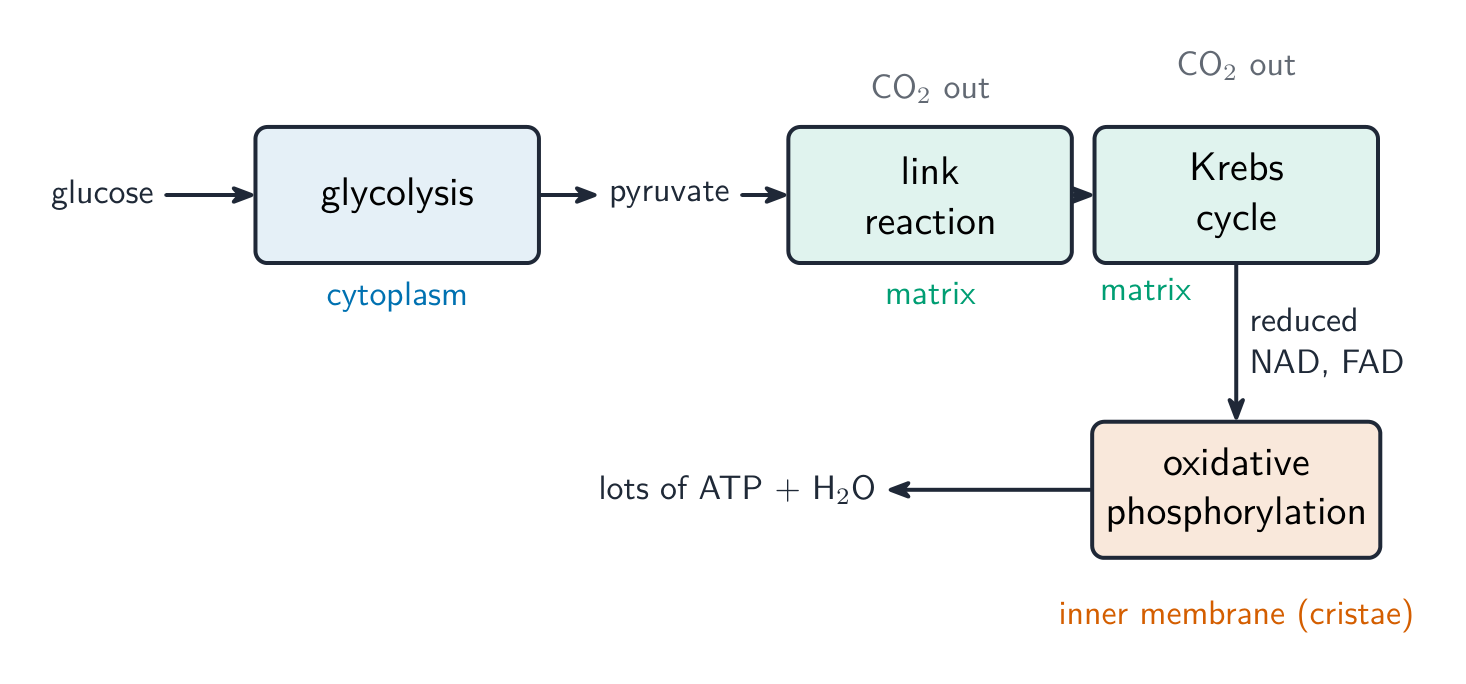
细胞呼吸(cellular respiration)释放葡萄糖里的能量来制造 ATP,大多使用氧。它的阶段:
有氧呼吸的阶段以及它们在细胞里何处发生 - 糖酵解(glycolysis)(在细胞质里)分裂葡萄糖,制造少量 ATP。
- 克雷布斯循环(Krebs cycle)(线粒体基质)释放 $\text{CO}_2$ 并装载电子载体。
- 电子传递链(electron transport chain)(内膜)用那些电子泵送质子并制造大部分 ATP,以氧作为最终电子受体。
没有氧,细胞用发酵(fermentation)来保持糖酵解运行,制造远少的 ATP。光合作用和呼吸是互补的——一个的产物是另一个的反应物。
Worked example. 一分子葡萄糖的有氧呼吸大约净得糖酵解的 2 ATP、克雷布斯循环的 2 ATP,和氧化磷酸化的约 28 ATP,共 $\approx$ 32 ATP。没有氧时只有糖酵解运行,所以发酵每分子葡萄糖只净得 2 ATP——大约少 16 倍的能量,这就是为什么有氧途径在富氧细胞中占主导。
词汇表 训练英文 中文 拼音 Cellular respiration/ˈseljʊlə ˌrespɪˈreɪʃn/ 细胞呼吸 xì bāo hū xī Glycolysis/ɡlaɪˈkɒləsɪs/ 糖酵解 táng jiào jiě Krebs cycle/krebz ˈsaɪkl/ 克雷布斯循环 kè léi bù sī xún huán electron transport chain/ɪˈlektrɒn ˈtrænspɔːt tʃeɪn/ 电子传递链 diàn zi chuán dì liàn fermentation/fɜːmənˈteɪʃn/ 发酵 fā jiào 3.5
考试技巧
- 一个酶降低活化能并不被消耗;它的活性位点对一个底物是特异的(锁和钥匙)。
- 速率只随温度上升到最适值——超过它酶变性而速率下降(不像一个普通的反应)。
- 知道 ATP↔ADP 循环:断掉一个磷酸释放能量来驱动细胞。
- 写总方程:光合作用储存能量(构建葡萄糖);呼吸释放它(分解葡萄糖)——它们是相反的。
- 把每个阶段匹配到它的位置以及它是否需要氧。
-
4
细胞通讯与细胞周期
4.1
细胞通讯
大纲
Big Idea Learning Objective Essential Knowledge Big Idea 3 — Information Storage and Transmission
Living systems store, retrieve, transmit, and respond to information essential to life processes.4.1.A
Describe the ways that cells can communicate with one another.- 4.1.A.1 Cells communicate with one another through direct contact with other cells or from a distance via chemical signaling.
- Illustrative examples for 4.1.A.1:
- Immune cells interact through cell-to-cell contact, antigen-presenting cells (APCs), helper T-cells, and killer T-cells.
- Illustrative examples for 4.1.A.1:
4.1.B
Explain how cells communicate with one another over short and long distances.- 4.1.B.1 Cells communicate over short distances by using local regulators that target cells in the vicinity of the signal-emitting cell.
- Illustrative examples for 4.1.B.1:
- Neurotransmitters
- Plant immune response
- Quorum sensing in bacteria
- Morphogens in embryonic development
- Illustrative examples for 4.1.B.1:
- 4.1.B.2 Signals released by one cell type can travel long distances to target cells of another type.
- Illustrative examples for 4.1.B.2:
- Insulin
- Human growth hormone
- Thyroid hormones
- Testosterone
- Estrogen
- Illustrative examples for 4.1.B.2:
来源:美国大学理事会 AP 课程与考试说明
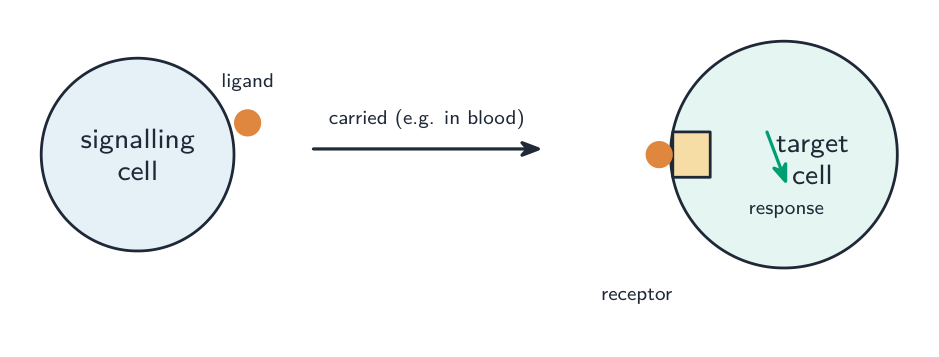
细胞通过发送和接收化学信号(signals)来协调。一个信号细胞释放一个配体(ligand),它结合一个目标细胞上的一个受体(receptor)。信号在不同范围上传播:直接接触(direct contact)(细胞连接)、局部(local)信号传递(附近的细胞,像神经递质),和长距离(long-distance)信号传递(通过血液的激素(hormones))。
一个信号分子(配体)结合目标细胞上一个匹配的受体 词汇表 训练英文 中文 拼音 signals/ˈsɪɡnlz/ 信号 xìn hào ligand/ˈlɪɡænd/ 配体 pèi tǐ receptor/rɪˈseptə/ 受体 shòu tǐ hormones/ˈhɔːməʊnz/ 激素 jī sù 4.2
信号转导导论
大纲
Big Idea Learning Objective Essential Knowledge Big Idea 3 — Information Storage and Transmission
Living systems store, retrieve, transmit, and respond to information essential to life processes.4.2.A
Describe the components of a signal transduction pathway.- 4.2.A.1 Signal transduction pathways link signal receptions with cellular responses.
- 4.2.A.2 Many signal transduction pathways include protein modifications and involve phosphorylation cascades.
4.2.B
Describe the role of components of a signal transduction pathway in producing a cellular response.- 4.2.B.1 Signaling begins with the recognition of a chemical messenger—a ligand—by a receptor protein in a target cell.
- i. The ligand-binding domain of a receptor recognizes a specific chemical messenger, which can be a peptide (protein) or a small molecule.
- ii. G protein-coupled receptors are an example of a receptor protein in eukaryotes.
- iii. Receptors may be located on the surface of a target cell or in the cytoplasm or nucleus of the target cell.
- 4.2.B.2 Signaling cascades relay signals from receptors to cell targets, often amplifying the incoming signals, resulting in the appropriate responses by the cell. Responses could include cell growth, secretion of molecules, or gene expression.
- i. After the ligand binds, the intracellular domain of a receptor protein changes shape, initiating transduction of the signal.
- ii. Enzymes and second messengers such as cyclic AMP (cAMP) relay and amplify the intracellular signal.
- iii. Hormones are an example of a signaling messenger that can travel long distances in the bloodstream.
- iv. The binding of ligands to ligand-gated channels can cause the channel to open or close.
来源:美国大学理事会 AP 课程与考试说明
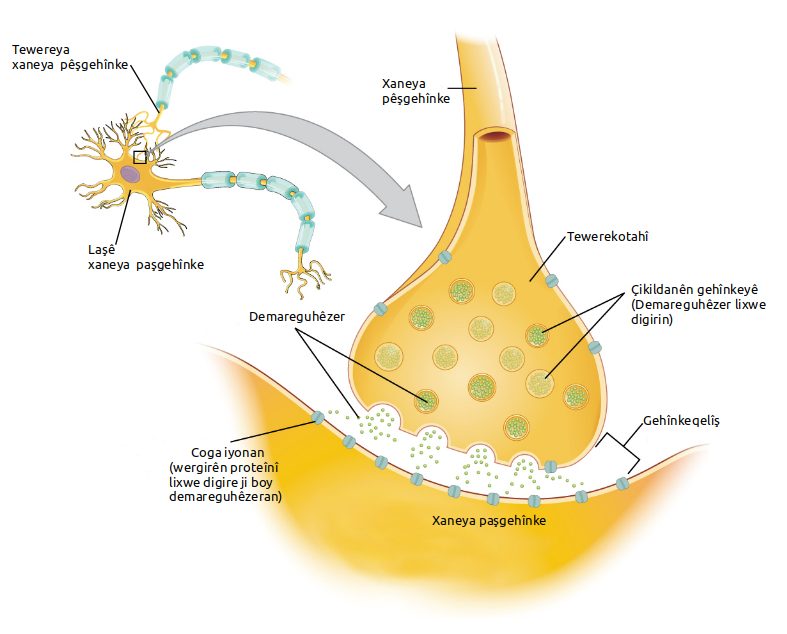
信号转导(signal transduction)分三个阶段把一个外部信号转换成一个细胞反应:接收(reception)(配体结合受体)、转导(transduction)(细胞里面分子的一次接力),和反应(response)(细胞活动的一个变化,例如开启一个基因)。受体是特异的,所以一个细胞只对它能接收的信号反应。
A chemical synapse: signal transduction passes a message across a gap with a ligand and receptor 词汇表 训练英文 中文 拼音 Signal transduction/ˈsɪɡnl trænsˈdʌkʃn/ 信号转导 xìn hào zhuǎn dǎo 4.3
信号转导通路
大纲
Big Idea Learning Objective Essential Knowledge Big Idea 3 — Information Storage and Transmission
Living systems store, retrieve, transmit, and respond to information essential to life processes.4.3.A
Describe the different types of cellular responses elicited by a signal transduction pathway.- 4.3.A.1 Signal transduction may result in changes in gene expressions and cell function, which may alter phenotype or result in programmed cell death (apoptosis).
- Illustrative examples for 4.3.A.1:
- Use of chemical messengers by microbes to communicate with other nearby cells and to regulate specific pathways in response to population density (quorum sensing)
- Epinephrine stimulation of glycogen breakdown in mammals
- Illustrative examples for 4.3.A.1:
4.3.B
Explain how a change in the structure of any signaling molecule affects the activity of the signaling pathway.- 4.3.B.1 Changes in signal transduction pathways can alter cellular responses. Mutations in any domain of the receptor protein or in any component of the signaling pathway may affect the downstream components by altering the subsequent transduction of the signal.
- Illustrative examples for 4.3.B.1:
- Cytokines regulate gene expression to allow for cell replication and division.
- Mating pheromones in yeast trigger mating gene expression.
- Ethylene levels cause changes in the production of different enzymes allowing fruits to ripen.
- HOX genes regulate animal body plans during embryonic development.
- Illustrative examples for 4.3.B.1:
- 4.3.B.2 Chemicals that interact with any component of the signaling pathway may activate or inhibit the pathway.
来源:美国大学理事会 AP 课程与考试说明
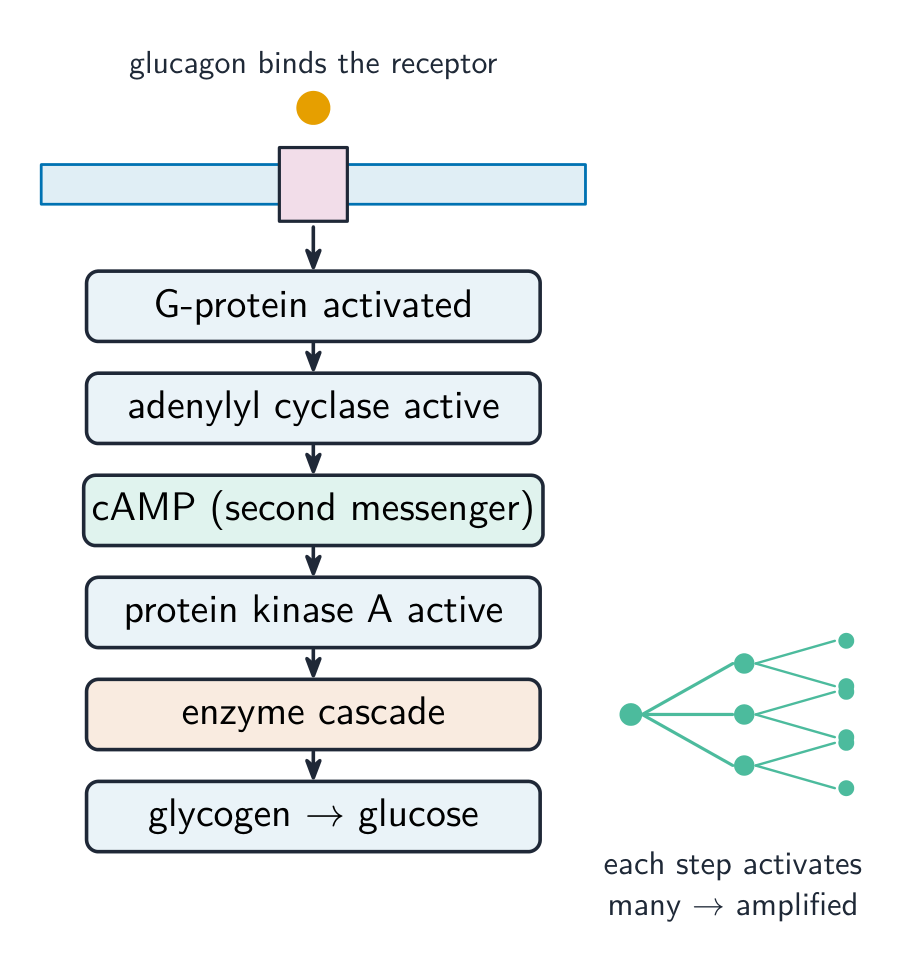
在转导阶段,信号通过一条通路(pathway)——常常是一串互相激活的蛋白质,频繁地放大信号,以便少数配体触发一个大的反应。第二信使(second messengers)(像环腺苷酸或钙离子)快速把信号扩散穿过细胞。一步的一个变化能改变整个结果。
一个信号级联在细胞里面放大信息 4.4
反馈
大纲
Big Idea Learning Objective Essential Knowledge Big Idea 2 — Energetics
Biological systems use energy and molecular building blocks to grow, reproduce, and maintain dynamic homeostasis.4.4.A
Explain how positive and negative feedback helps maintain homeostasis.- 4.4.A.1 Organisms use feedback mechanisms to maintain their internal environments in response to internal and external changes.
- i. Negative feedback mechanisms maintain homeostasis by reducing the initial stimulus to regulate physiological processes. If a system is perturbed or disrupted, negative feedback mechanisms return the system back to its target set point. These processes operate at the molecular, cellular, and organismal levels.
- Illustrative examples for 4.4.A.1.i:
- Blood sugar regulation by insulin/glucagon
- Illustrative examples for 4.4.A.1.i:
- ii. Positive feedback mechanisms amplify responses and processes in biological organisms. The variable initiating the response is moved further away from the initial set point. Amplification occurs when the stimulus is further intensified, which, in turn, initiates an additional response that produces system change.
- Illustrative examples for 4.4.A.1.ii:
- Lactation in mammals
- Onset of labor in childbirth
- Ripening of fruit
- Illustrative examples for 4.4.A.1.ii:
- i. Negative feedback mechanisms maintain homeostasis by reducing the initial stimulus to regulate physiological processes. If a system is perturbed or disrupted, negative feedback mechanisms return the system back to its target set point. These processes operate at the molecular, cellular, and organismal levels.
来源:美国大学理事会 AP 课程与考试说明
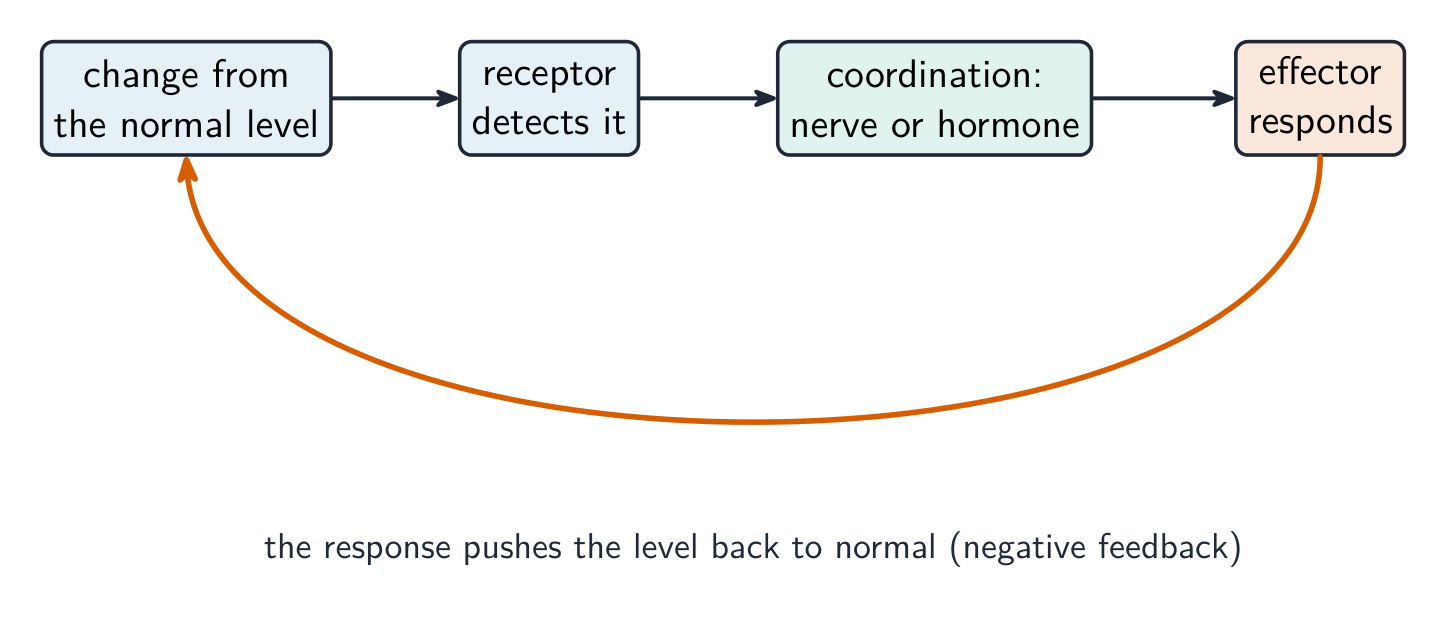
反馈(feedback)保持系统平衡:
负反馈检测并纠正一个变化 - 负反馈(negative feedback)抵消一个变化以恢复一个设定点(像一个恒温器)——它维持稳态(homeostasis)。
- 正反馈(positive feedback)放大一个变化以推动一个过程到完成(像分娩收缩或血液凝固)。
探索Negative feedback keeps things steady
Negative feedback senses a change and reverses it, holding a variable (like blood glucose) near a set point. Push it away and watch the system correct.
词汇表 训练英文 中文 拼音 Feedback/ˈfiːdbæk/ 反馈 fǎn kuì Negative feedback/ˈneɡətɪv ˈfiːdbæk/ 负反馈 fù fǎn kuì homeostasis/ˌhəʊmiːəˈstɑːsiz/ 稳态 wěn tài Positive feedback/ˈpɒzɪtɪv ˈfiːdbæk/ 正反馈 zhèng fǎn kuì 4.5
细胞周期
大纲
Big Idea Learning Objective Essential Knowledge Big Idea 3 — Information Storage and Transmission
Living systems store, retrieve, transmit, and respond to information essential to life processes.4.5.A
Describe the events that occur in the cell cycle.- 4.5.A.1 The cell cycle is a highly regulated series of events that controls the growth and reproduction of eukaryotic cells.
- i. The cell cycle consists of sequential stages of interphase (G1, S, G2), mitosis, and cytokinesis.
- ii. G1 phase: The cell is metabolically active, duplicating organelles and cytosolic components.
- iii. S phase: DNA is in the form of chromatin and replicates to form two sister chromatids connected at a centromere.
- iv. G2 phase: Protein synthesis occurs, ATP is produced in large quantities, and centrosomes replicate.
- v. A cell can enter a stage (G0) in which it no longer divides, but it can reenter the cell cycle in response to appropriate cues.
- vi. Nondividing cells may exit the cell cycle or be held at a particular stage in the cell cycle.
4.5.B
Explain how mitosis results in the transmission of chromosomes from one generation of cells to the next.- 4.5.B.1 Mitosis is a process that ensures the transfer of a complete genome from a parent cell to two genetically identical daughter cells in eukaryotes.
- i. Mitosis plays a role in growth, tissue repair, and asexual reproduction.
- ii. Mitosis occurs in sequential steps (prophase, metaphase, anaphase, telophase) and alternates with interphase in the cell cycle.
- iii. Prophase: Sister chromatids condense, mitotic spindle begins to form, and centrosomes move to opposite poles of the cell.
- iv. Metaphase: Spindle fibers align chromosomes along the equator of the cell.
- v. Anaphase: Paired sister chromatids separate as spindle fibers pull chromatids toward poles.
- vi. Telophase: Mitotic spindle breaks down, a new nuclear envelope develops, and then the cytoplasm divides.
- vii. Cytokinesis: A cleavage furrow forms in animal cells or a cell plate forms in plant cells, resulting in two new daughter cells.
来源:美国大学理事会 AP 课程与考试说明
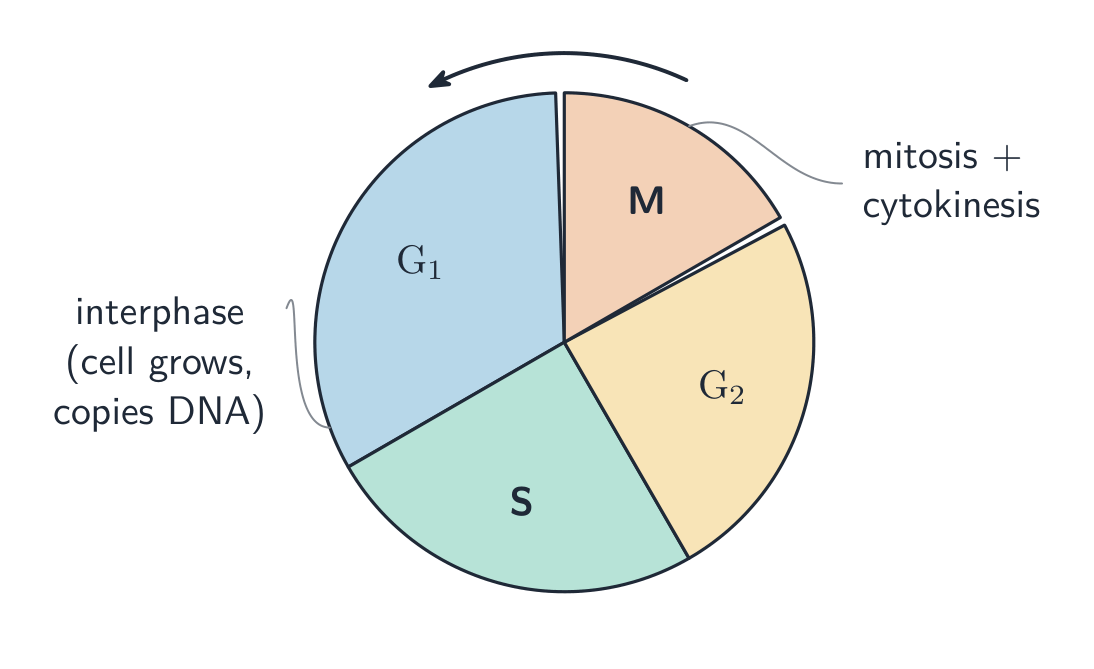
细胞周期(cell cycle)是一个细胞从一次分裂到下一次的生命:间期(interphase)(G1 生长、S DNA 复制、G2 准备)后接有丝分裂(mitosis)(M)和胞质分裂,它们产生两个相同的子细胞。间期占用大部分时间;DNA 只在 S 期被复制。
细胞周期:间期,然后有丝分裂和胞质分裂 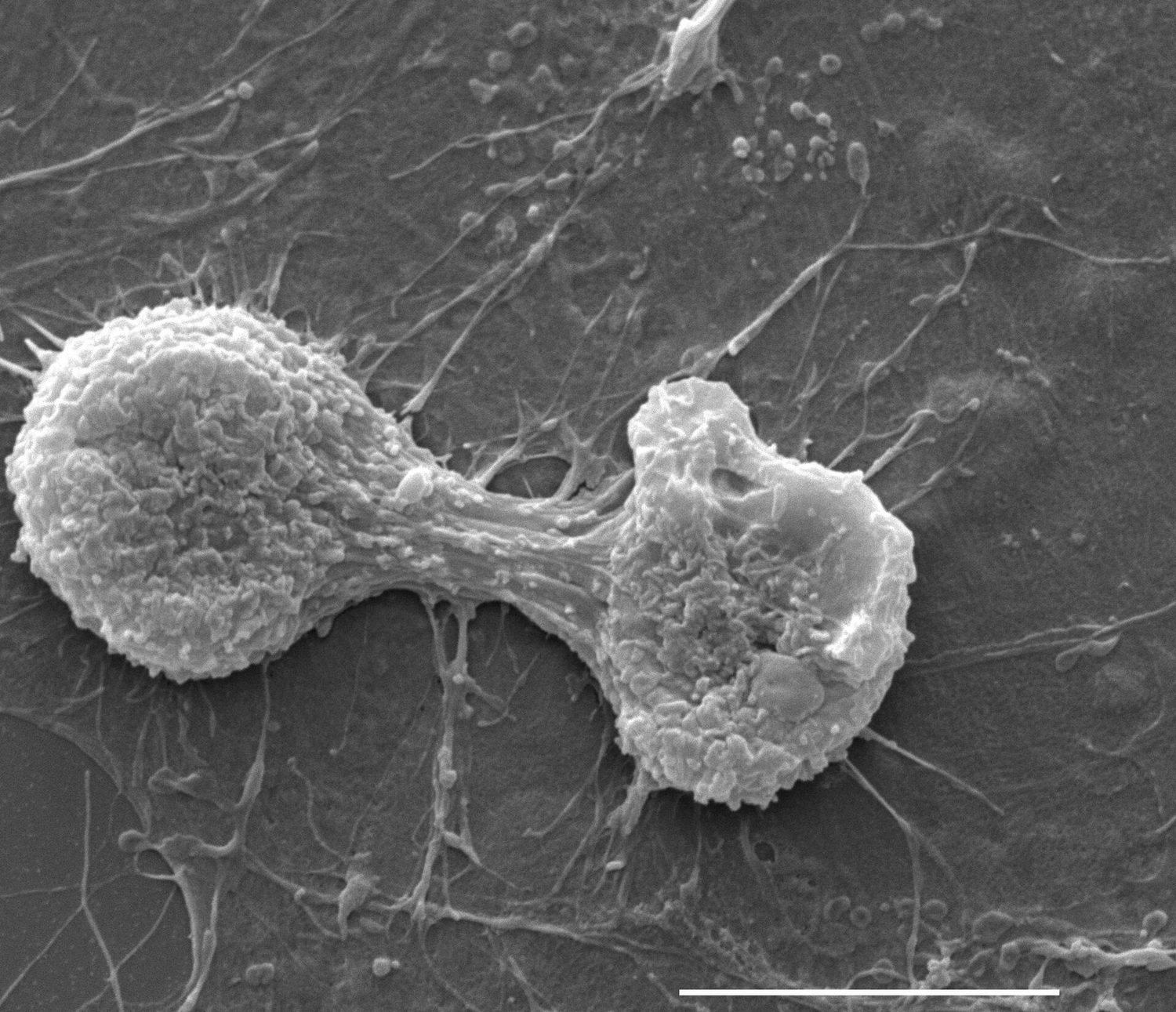
A fibroblast dividing: cytokinesis splits one cell into two after mitosis finishes 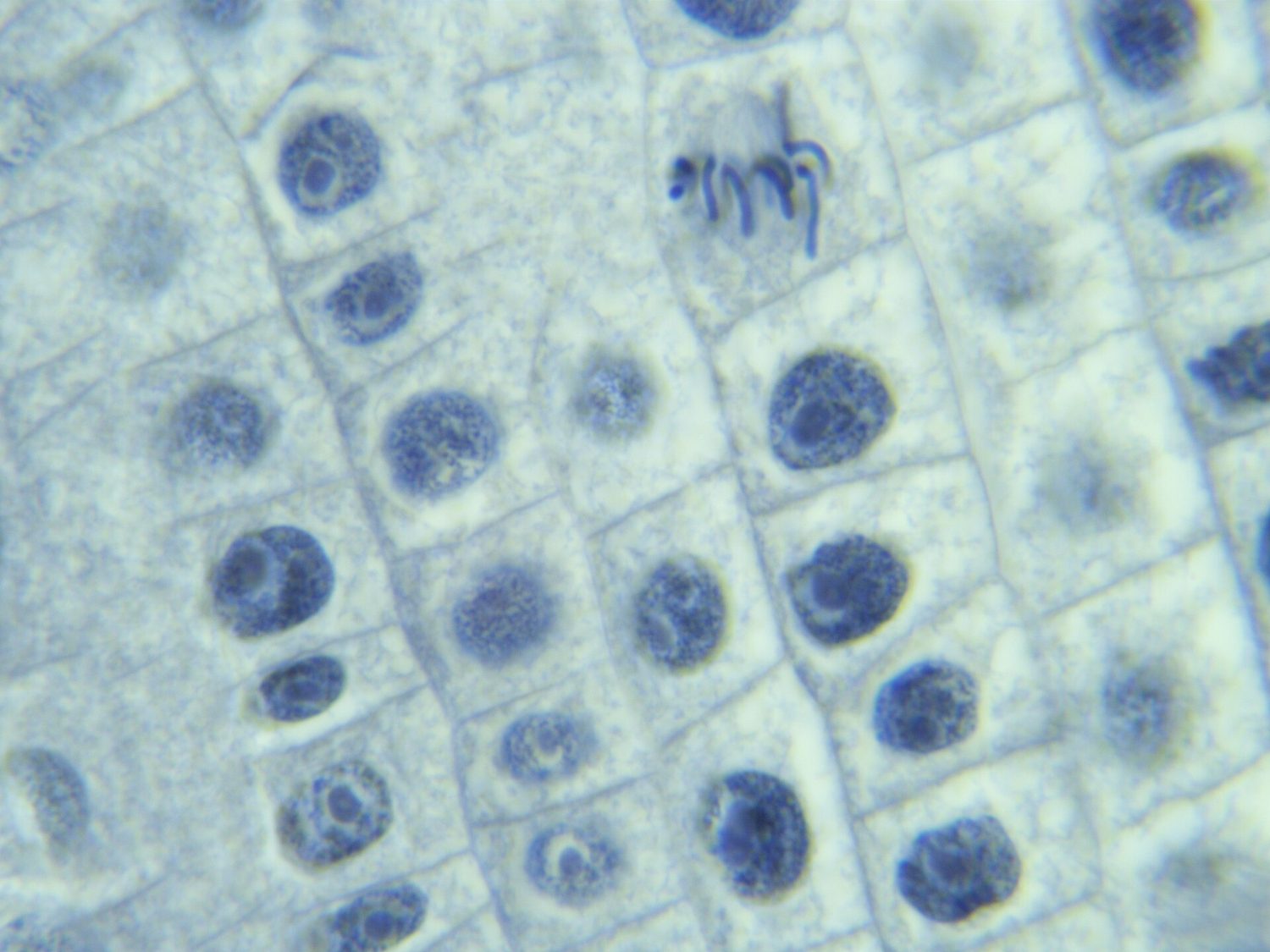
Onion root tip at metaphase: chromosomes line up before sister chromatids separate 探索Step through the cell cycle
The cell cycle copies the DNA (S phase) then splits it evenly in mitosis, producing two identical cells. Step through the stages.
词汇表 训练英文 中文 拼音 cell cycle/sel ˈsaɪkl/ 细胞周期 xì bāo zhōu qī interphase/ˌɪntəˈfeɪz/ 间期 jiān qī mitosis/maɪˈtəʊsɪs/ 有丝分裂 yǒu sī fēn liè 4.6
细胞周期的调控
大纲
Big Idea Learning Objective Essential Knowledge Big Idea 3 — Information Storage and Transmission
Living systems store, retrieve, transmit, and respond to information essential to life processes.4.6.A
Describe the role of checkpoints in regulating the cell cycle.- 4.6.A.1 A number of internal controls or checkpoints regulate progression through the cell cycle.
- 4.6.A.2 Interactions between cyclins and cyclin-dependent kinases control the cell cycle.
- Exclusion statement: Knowledge of specific cyclin-CdK pairs or growth factors is beyond the scope of the AP Exam.
4.6.B
Describe the effects of disruptions to the cell cycle on the cell or organism.- 4.6.B.1 Disruptions to the cell cycle may result in cancer or apoptosis (programmed cell death).
来源:美国大学理事会 AP 课程与考试说明
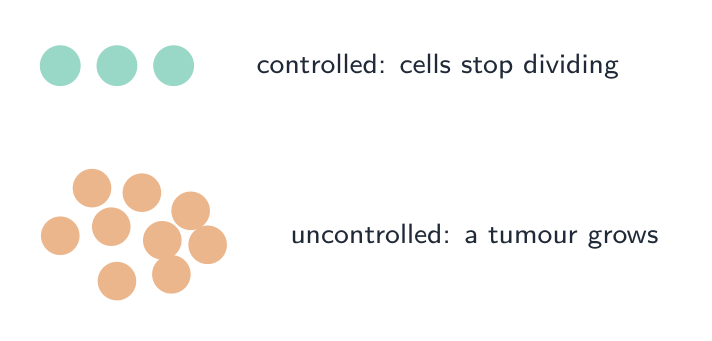
周期在检查点(checkpoints)受控制,它们在继续之前核实条件(DNA 完整吗?染色体附着了吗?)。内部信号(周期蛋白及其激酶)和外部信号驱动周期向前。当这个控制失败时——例如,一个忽略一个检查点的突变——细胞不受控制地分裂,这是癌症(cancer)的基础。
来自失败检查点的不受控制的分裂形成一个肿瘤 Worked example. 级联中的信号放大:一个激素激活一个受体,它开启约 100 个中继蛋白,每一个又制造约 1,000 个第二信使分子——所以单个信号产生大约 $100 \times 1000 = 10^{5}$ 个产物分子。这就是为什么低至 $10^{-9}\,\text{M}$ 的激素浓度就能触发一个大的细胞反应。
词汇表 训练英文 中文 拼音 checkpoints/ˈtʃekpɔɪnts/ 检查点 jiǎn chá diǎn cancer/ˈkænsə/ 癌症 ái zhèng 4.6
考试技巧
- 在信号转导里命名三个阶段:接收 → 转导 → 反应。
- 负反馈逆转一个变化以保持条件稳定(稳态);正反馈放大一个变化到完成(分娩、凝固)。
- 排序细胞周期:间期(生长、在 S 期复制 DNA)然后有丝分裂 → 两个相同的子细胞。
- DNA 被复制一次,在 S 期,所以每个子细胞得到一个完整的副本。
- 失败的检查点允许不受控制的分裂 → 癌症。
- 4.1.A.1 Cells communicate with one another through direct contact with other cells or from a distance via chemical signaling.
-
5
遗传
5.1
减数分裂
大纲
Big Idea Learning Objective Essential Knowledge Big Idea 3 — Information Storage and Transmission
Living systems store, retrieve, transmit, and respond to information essential to life processes.5.1.A
Explain how meiosis results in the transmission of chromosomes from one generation to the next.- 5.1.A.1 Meiosis is a process that ensures the formation of haploid gamete cells, sometimes referred to as daughter cells, in sexually reproducing diploid organisms.
- 5.1.A.2 Meiosis I involves the following steps:
- i. Prophase I: Homologous chromosomes pair up and condense, synapsis occurs and then chiasmata may form, meiotic spindle begins to form, centrosomes move to opposite poles of the cell, and the nuclear envelope breaks down.
- ii. Metaphase I: Meiotic spindle fibers align homologous pairs of chromosomes along the equator of the cell at the metaphase plate.
- iii. Anaphase I: Homologous chromosomes separate, while sister chromatids remain attached, as meiotic spindle fibers pull chromosomes toward poles.
- iv. Telophase I: Meiotic spindle breaks down, a new nuclear envelope develops, a cleavage furrow (animal cell) or cell plate (plant cell) forms, and cytokinesis occurs. Two haploid daughter cells are formed (at the end of meiosis I).
- 5.1.A.3 Meiosis II involves the following steps:
- i. Prophase II: Meiotic spindle forms; sister chromatids connected at the centromere attach to meiotic spindle.
- ii. Metaphase II: Chromosomes align along the metaphase plate; the kinetochore of each chromatid is attached to a microtubule extending from the poles.
- iii. Anaphase II: Proteins at the centromeres break down, and sister chromatids are pulled apart and toward opposite poles in the cell.
- iv. Telophase II: Meiotic spindle breaks down, a new nuclear envelope develops, a cleavage furrow (animal cell) or a cell plate (plant cell) forms, chromatids begin to decondense, and cytokinesis occurs. Four haploid daughter cells are formed, each with an unduplicated chromatid.
5.1.B
Describe similarities and differences between the phases and outcomes of mitosis and meiosis.- 5.1.B.1 Mitosis and meiosis are similar in the use of a spindle apparatus to move chromosomes but differ in the number of cells produced and the genetic content of the daughter cells.
来源:美国大学理事会 AP 课程与考试说明
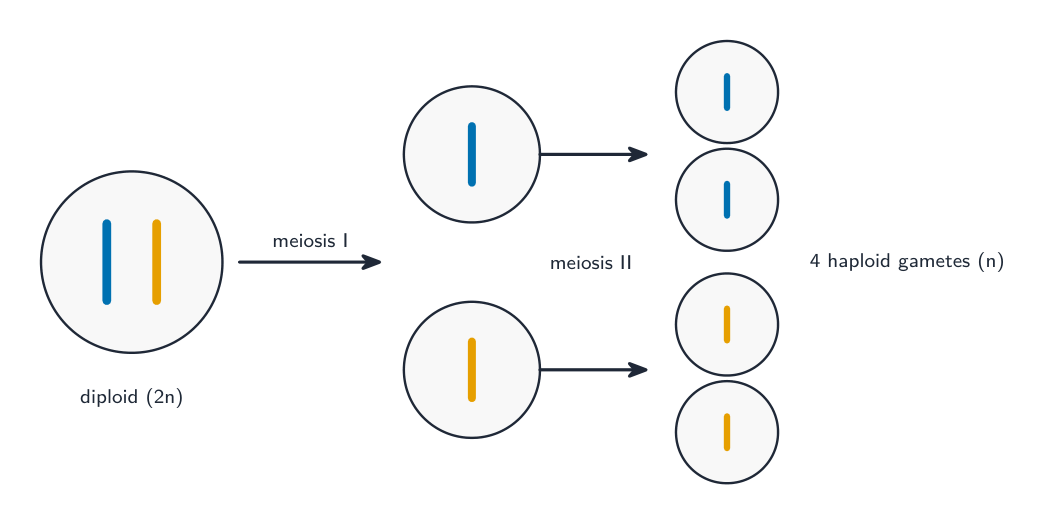
减数分裂(meiosis)制造染色体数目减半的配子(gametes)(卵和精子),所以受精恢复完整的一套。一个二倍体细胞分裂两次以给出四个单倍体细胞。减数分裂 I 分开同源染色体(homologous chromosomes)(减少数目);减数分裂 II 分开姐妹染色单体(像有丝分裂)。
减数分裂在两次分裂中把染色体数目减半 探索Divide a cell's chromosomes
Meiosis halves the chromosome number and shuffles genes, making four genetically varied gametes. Step through to see the divisions.
词汇表 训练英文 中文 拼音 Meiosis/meɪˈəʊsɪs/ 减数分裂 jiǎn shù fēn liè gametes/ˈɡæmiːts/ 配子 pèi zi homologous chromosomes/həˈmɒləɡəs ˈkrəʊməsəʊmz/ 同源染色体 tóng yuán rǎn sè tǐ 5.2
减数分裂与遗传多样性
大纲
Big Idea Learning Objective Essential Knowledge Big Idea 3 — Information Storage and Transmission
Living systems store, retrieve, transmit, and respond to information essential to life processes.5.2.A
Explain how the process of meiosis generates genetic diversity.- 5.2.A.1 Correct separation of the homologous chromosomes in meiosis I and sister chromatids in meiosis II ensures that each gamete receives a haploid (1n) set of chromosomes that comprises an assortment of both maternal and paternal chromosomes. When incorrect separation occurs (nondisjunction), gametes are no longer haploid.
- 5.2.A.2 During prophase I of meiosis, non-sister chromatids exchange genetic material via a process called crossing over (recombination), which increases genetic diversity among the resultant gametes.
- 5.2.A.3 Sexual reproduction in eukaryotes increases genetic variation, including crossing over, random assortment of chromosomes during meiosis, and subsequent fertilization of gametes.
- Exclusion statement: Knowledge of the details of sexual reproduction cycles in various plants and animals is beyond the scope of the AP Exam.
来源:美国大学理事会 AP 课程与考试说明
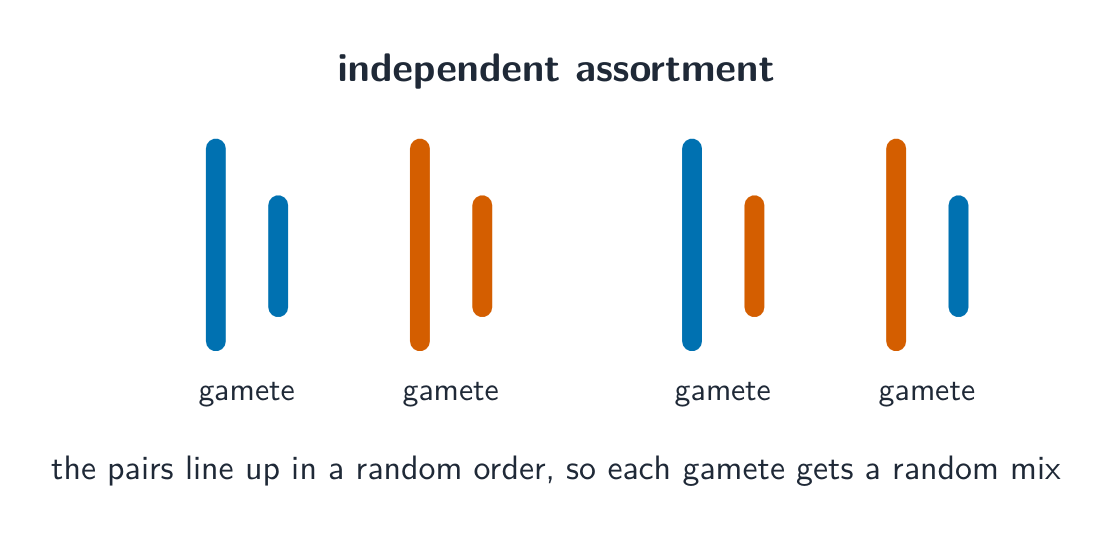
减数分裂以三种方式打乱基因,所以后代不同于亲代和彼此:
自由组合产生许多配子组合 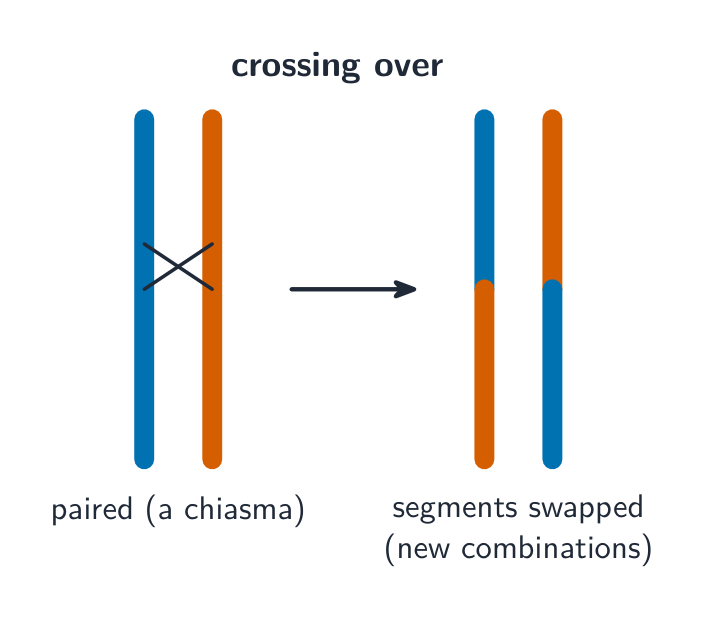
交叉互换在同源染色体之间交换片段 - 交叉互换(crossing over):同源染色体在减数分裂 I 中交换片段。
- 自由组合(independent assortment):每一对同源染色体随机地排列和分开。
- 随机受精(random fertilization):任何精子能遇到任何卵。
它们一起创造巨大的变异——进化的原材料。
词汇表 训练英文 中文 拼音 Crossing over/ˈkrɒsɪŋ ˈəʊvə/ 交叉互换 jiāo chā hù huàn Independent assortment/ˌɪndɪˈpendənt əˈsɔːtmənt/ 自由组合 zì yóu zǔ hé 5.3
孟德尔遗传学
大纲
Big Idea Learning Objective Essential Knowledge Big Idea 3 — Information Storage and Transmission
Living systems store, retrieve, transmit, and respond to information essential to life processes.5.3.A
Explain the inheritance of genes and traits as described by Mendel's laws.- 5.3.A.1 Mendel's laws of segregation and independent assortment can be applied to genes that are on different chromosomes.
- 5.3.A.2 In most cases, fertilization involves the fusion of two haploid gametes, restoring the diploid number of chromosomes and increasing genetic variation in populations by creating new combinations of alleles in the zygote.
- i. Rules of probability can be applied to analyze the passing of single-gene traits from parent to offspring.
- ii. Monohybrid, dihybrid, and test crosses can be used to determine whether alleles are dominant or recessive.
- iii. An organism's genotype is the set of alleles inherited for one or more genes by an individual organism. An organism's genotype can be homozygous or heterozygous for each gene.
- iv. An organism's phenotype is the observable expression of the inherited traits.
- v. Patterns of inheritance (autosomal, genetically linked, sex-linked) and whether an allele is dominant or recessive can often be predicted from data, including pedigrees. Punnett squares can be used to predict the genotypes and phenotypes of parents and offspring.
- Equation (Laws of Probability): If $A$ and $B$ are mutually exclusive, then: $P(A \text{ or } B) = P(A) + P(B)$
- Equation (Laws of Probability): If $A$ and $B$ are independent, then: $P(A \text{ and } B) = P(A) \times P(B)$
来源:美国大学理事会 AP 课程与考试说明
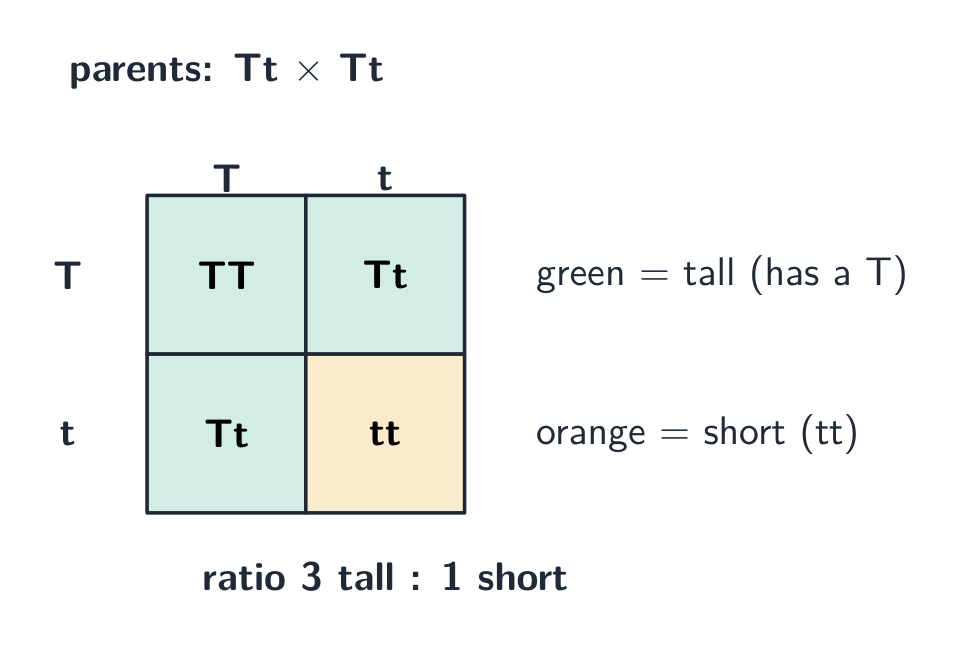
一个基因的替代版本是等位基因(alleles)。一个生物的基因型(genotype)(它的等位基因)产生它的表型(phenotype)(它的性状)。孟德尔的规则:一个显性(dominant)等位基因掩盖一个隐性(recessive)的;这两个等位基因分离(segregate)进入不同的配子(分离定律);不同性状的基因独立地组合。一个庞纳特方格(Punnett square)预测后代比例(一个杂合杂交给出 3:1)。纯合(homozygous)意味着两个相同的等位基因;杂合(heterozygous)意味着两个不同的。
一个单杂交庞纳特方格给出一个 3:1 比例 Worked example. 对于两个独立基因的一个双杂交(dihybrid)杂交,$AaBb\times AaBb$,用乘法规则而不是一个 $16$ 格方格。每个基因单独给出 $\tfrac34$ 显性,所以一个后代显示两个显性性状的机会是 $\tfrac34\times\tfrac34=\tfrac{9}{16}$,而完全隐性 $aabb$ 的机会是 $\tfrac14\times\tfrac14=\tfrac{1}{16}$。把两个独立的 $3{:}1$ 比例相乘就产生经典的 $9{:}3{:}3{:}1$ 模式。
探索Cross two parents
A Punnett square combines each parent's alleles to predict the offspring ratios. Set the parent genotypes and read off the expected proportions.
词汇表 训练英文 中文 拼音 alleles/əˈliːlz/ 等位基因 děng wèi jī yīn genotype/ˈdʒenətaɪp/ 基因型 jī yīn xíng phenotype/ˈfenətaɪp/ 表型 biǎo xíng dominant/ˈdɒmɪnənt/ 显性 xiǎn xìng recessive/rɪˈsesɪv/ 隐性 yǐn xìng Punnett square/ˈpʌnɪt skweə/ 庞纳特方格 páng nà tè fāng gé Homozygous/ˌhɒməˈzɪɡəs/ 纯合 chún hé heterozygous/ˌhetrəˈzɪɡəs/ 杂合 zá hé 5.4
非孟德尔遗传学
大纲
Big Idea Learning Objective Essential Knowledge Big Idea 3 — Information Storage and Transmission
Living systems store, retrieve, transmit, and respond to information essential to life processes.5.4.A
Explain deviations from Mendel's model of the inheritance of traits.- 5.4.A.1 Patterns of inheritance of many traits do not follow the ratios predicted by Mendel's laws and can be identified by quantitative analysis, when the observed phenotypic ratios statistically differ from the predicted ratios.
- i. Genes located on the same chromosome are referred to as being genetically linked. The probability that these linked genes segregate together during meiosis can be used to calculate the map distance (or map units) between them on a chromosome. This calculation is called gene or genetic mapping.
- ii. Codominance occurs when the phenotype from both alleles is expressed such that the heterozygote would have a different phenotype than either homozygote.
- iii. Incomplete dominance occurs when neither allele of a gene can mask the other, so the phenotype of the heterozygote is a blended version of the dominant and recessive phenotypes.
- 5.4.A.2 Some traits, known as sex-linked traits (X- or Y-linked), are determined by genes on sex chromosomes. The pattern of inheritance of sex-linked traits can often be predicted from data, including pedigrees, indicating the genotypes and phenotypes of both parents and offspring.
- Illustrative examples for EK 5.4.A.2:
- Sex-linked traits (X- or Y-linked) reside on sex chromosomes.
- Sex-linked traits (X- or Y-linked) are inherited at higher rates in XY individuals than they are in XX individuals.
- In certain species, the chromosomal basis of sex determination is not based on X and Y chromosomes (e.g., ZW in birds, haplodiploidy in bees).
- Illustrative examples for EK 5.4.A.2:
- 5.4.A.3 Pleiotropy is a phenomenon in which the expression of a single gene results in multiple traits or effects; these traits therefore do not segregate independently.
- 5.4.A.4 Some traits result from non-nuclear inheritance.
- i. Chloroplasts and mitochondria are randomly assorted to gametes and daughter cells; thus, traits determined by chloroplast and mitochondrial DNA do not follow simple Mendelian rules.
- ii. In animals, mitochondria are usually transmitted by the egg and not by sperm; thus, traits determined by the mitochondrial DNA are typically maternally inherited.
- iii. In plants, mitochondria and chloroplasts are transmitted in the ovule and not in the pollen; as such, mitochondria-determined and chloroplast-determined traits are typically maternally inherited.
来源:美国大学理事会 AP 课程与考试说明
许多性状不遵循简单的显性:
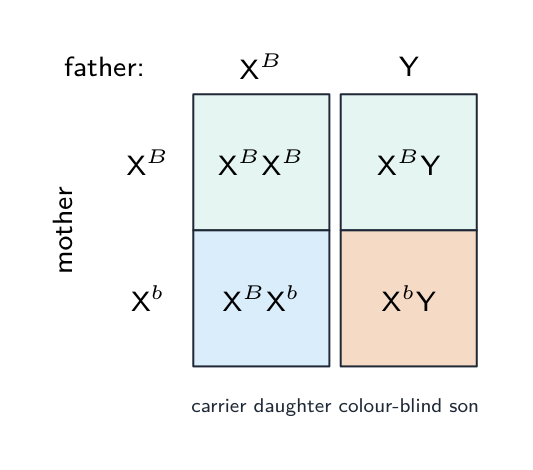
伴性遗传对儿子和女儿给出不同的结果 - 不完全显性(incomplete dominance):杂合子是一个混合(红 × 白 → 粉红)。
- 共显性(codominance):两个等位基因都完全显示(AB 血型)。
- 多重等位基因(multiple alleles)、多基因(polygenic)性状(许多基因,像身高)、多效性(pleiotropy)(一个基因,许多效应),和伴性(sex-linked)基因(在 X 染色体上)都给出更复杂的比例。
Worked example (chi-square test). 要检查真实数据是否符合一个预测的比例,用 $\chi^2=\sum\dfrac{(o-e)^2}{e}$。一个单杂交预测 $3{:}1$,所以在 $80$ 个后代中你期望 $60$ 个显性和 $20$ 个隐性,但你观察到 $55$ 和 $25$。那么 $\chi^2=\dfrac{(55-60)^2}{60}+\dfrac{(25-20)^2}{20}=\dfrac{25}{60}+\dfrac{25}{20}=0.42+1.25=1.67$。以 $1$ 个自由度,$p=0.05$ 处的临界值是 $3.84$;因为 $1.67<3.84$,我们不能拒绝零假设——偏差在机会之内。
词汇表 训练英文 中文 拼音 Incomplete dominance/ɪŋkəmˈpliːt ˈdɒmɪnəns/ 不完全显性 bù wán quán xiǎn xìng Codominance/ˈkəʊdəmɪnəns/ 共显性 gòng xiǎn xìng polygenic/ˌpɒlɪˈdʒenɪk/ 多基因 duō jī yīn sex-linked/seks lɪŋkt/ 伴性 bàn xìng 5.5
环境对表型的影响
大纲
Big Idea Learning Objective Essential Knowledge Big Idea 4 — Systems Interactions
Biological systems interact, and these systems and their interactions exhibit complex properties.5.5.A
Explain how the same genotype can result in multiple phenotypes under different environmental conditions.- 5.5.A.1 Environmental conditions influence gene expression and can lead to phenotypic plasticity (e.g., the ability of individual genotypes to produce different phenotypes).
- Illustrative examples for EK 5.5.A.1:
- Height and weight in humans
- Flower color based on soil pH
- Seasonal fur color in arctic animals
- Sex determination in reptiles
- Effect of increased UV on melanin production in animals
- Presence of the opposite mating type on pheromone production in yeast and other fungi
- Illustrative examples for EK 5.5.A.1:
来源:美国大学理事会 AP 课程与考试说明
表型不是仅由基因决定的——环境也重要。温度、营养和其他因素能改变基因如何表达(一只喜马拉雅兔在冷的地方的深色毛、一株植物在更多阳光下的高度)。所以相同的基因型在不同的条件下能给出不同的表型。
5.5
考试技巧
- 对比有丝分裂(2 个相同、完整的染色体数目)和减数分裂(4 个不相同的配子、数目的一半)。
- 从交叉互换、自由组合和随机受精解释变异。
- 对双杂交用乘法规则(每个基因的 $3{:}1$ 相乘),并用一个卡方(chi-square)检验($\chi^2=\sum\frac{(o-e)^2}{e}$)来判断观察值 vs 期望值比例。
- 把基因型(等位基因)与表型(你看到的)分开——$AA$ 和 $Aa$ 能看起来相同。
- 辨认非孟德尔模式:不完全显性、共显性和伴性遗传。
-
6
基因表达与调控
6.1
DNA 与 RNA 的结构
大纲
Big Idea Learning Objective Essential Knowledge Big Idea 3 — Information Storage and Transmission
Living systems store, retrieve, transmit, and respond to information essential to life processes.6.1.A
Describe the structures involved in passing hereditary information from one generation to the next.- 6.1.A.1 Genetic information is stored in and passed to subsequent generations through DNA molecules and, in some cases, RNA molecules.
- 6.1.A.1.i Prokaryotic organisms typically have circular chromosomes.
- 6.1.A.1.ii Eukaryotic organisms typically have multiple linear chromosomes that are comprised of DNA. These chromosomes are condensed using histones and associated proteins.
- 6.1.A.2 Prokaryotes and eukaryotes can contain plasmids, which are extra-chromosomal circular molecules of DNA.
6.1.B
Describe the characteristics of DNA that allow it to be used as hereditary material.- 6.1.B.1 Nucleic acids exhibit specific nucleotide base pairing that is conserved through evolution.
- 6.1.B.1.i Purines (guanine and adenine) have a double ring structure.
- 6.1.B.1.ii Pyrimidines (cytosine, thymine, and uracil) have a single ring structure.
- 6.1.B.1.iii Purines pair with pyrimidines: adenine with thymine (or uracil in RNA) and guanine with cytosine.
来源:美国大学理事会 AP 课程与考试说明
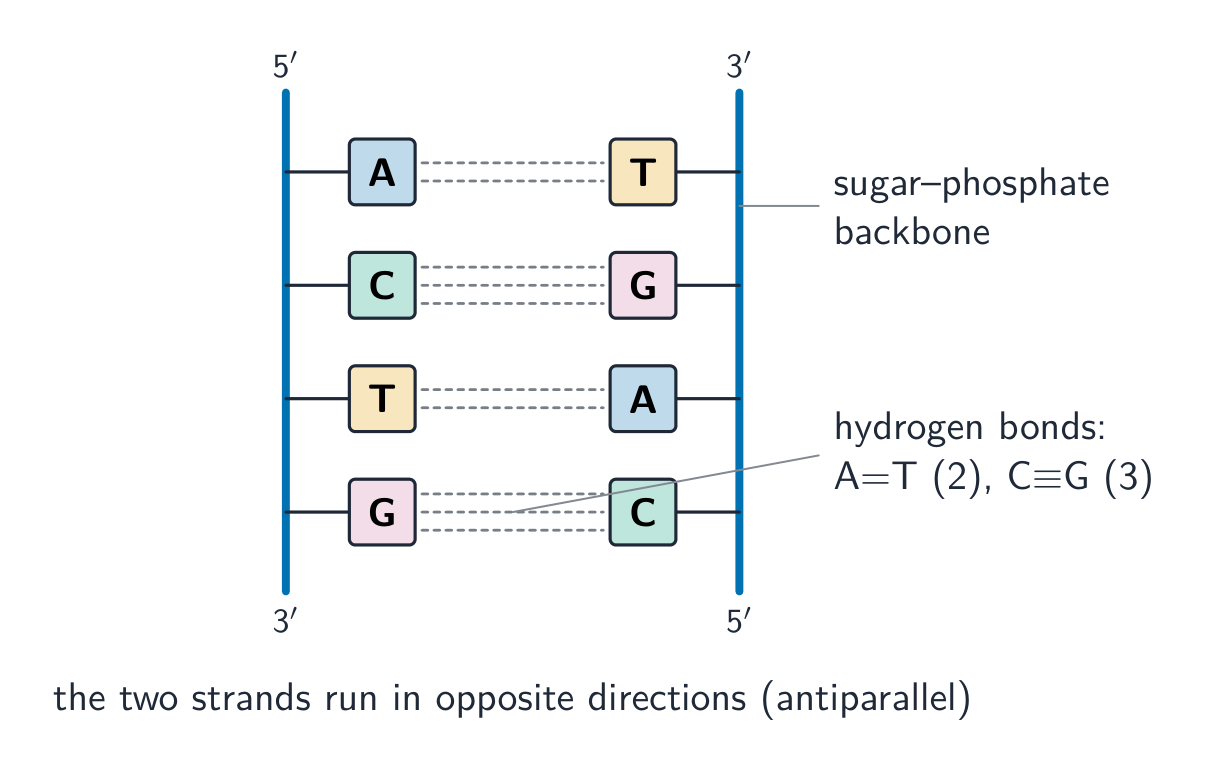
DNA 作为两条链的一个双螺旋(double helix)携带遗传信息。它的核苷酸(nucleotides)按规则配对——A 与 T、G 与 C(互补配对(complementary base pairing))——所以一条链指定另一条。这两条链反平行(antiparallel)地运行。RNA 是单链的,用尿嘧啶(uracil)(U)代替胸腺嘧啶,并有核糖。
DNA:由互补碱基对维系的两条反平行链 DNA 的包装方式在两个域之间不同,CED 两者都要求。
- 原核生物通常在细胞质中有一条环状染色体(circular chromosome),往往还带有称为质粒的额外小环。
- 真核生物通常有多条线性染色体(linear chromosomes),每一条都通过缠绕在称为组蛋白(histones)的蛋白质上而被压缩。正是这种包装把两米长的 DNA 装进几微米大的细胞核——而且由于缠绕紧密的区域难以让转录机器接近,这种包装本身就是一层基因调控。
词汇表 训练英文 中文 拼音 double helix/ˈdʌbl ˈhiːlɪks/ 双螺旋 shuāng luó xuán nucleotides/ˈnjuːklɪɒtaɪdz/ 核苷酸 hé gān suān complementary base pairing/ˌkɒmplɪˈmentəri beɪs ˈpeərɪŋ/ 互补配对 hù bǔ pèi duì antiparallel/ˌæntɪˈpærəlel/ 反平行 fǎn píng xíng single circular chromosome/ˈsɪŋɡl ˈsɜːkjʊlə ˈkrəʊməsəʊm/ 环状染色体 huán zhuàng rǎn sè tǐ multiple linear chromosomes/ˈmʌltɪpl ˈlɪnɪə ˈkrəʊməsəʊmz/ 线性染色体 xiàn xìng rǎn sè tǐ condensed by wrapping around proteins called histones/kənˈdenst baɪ ˈræpɪŋ əˈraʊnd ˈprəʊtiːnz kɔːld ˈhɪstəʊnz/ 组蛋白 zǔ dàn bái 6.2
DNA 复制
大纲
Big Idea Learning Objective Essential Knowledge Big Idea 3 — Information Storage and Transmission
Living systems store, retrieve, transmit, and respond to information essential to life processes.6.2.A
Describe the mechanisms by which genetic information is copied for transmission between generations.- 6.2.A.1 DNA replication ensures continuity of hereditary information.
- 6.2.A.1.i DNA is synthesized in the 5' to 3' direction.
- 6.2.A.1.ii Replication is a semiconservative process, meaning one strand of DNA serves as the template for a new strand of complementary DNA.
- 6.2.A.1.iii Helicase unwinds the DNA strands.
- 6.2.A.1.iv Topoisomerase relaxes supercoiling in front of the replication fork.
- 6.2.A.1.v DNA polymerase requires RNA primers to initiate DNA synthesis.
- 6.2.A.1.vi DNA polymerase synthesizes new strands of DNA continuously on the leading strand and discontinuously on the lagging strand.
- 6.2.A.1.vii Ligase joins the fragments on the lagging strand.
- Exclusion statement: The names of the steps and particular enzymes involved, excluding DNA polymerase, ligase, RNA polymerase, helicase, and topoisomerase, are beyond the scope of the AP Exam.
来源:美国大学理事会 AP 课程与考试说明
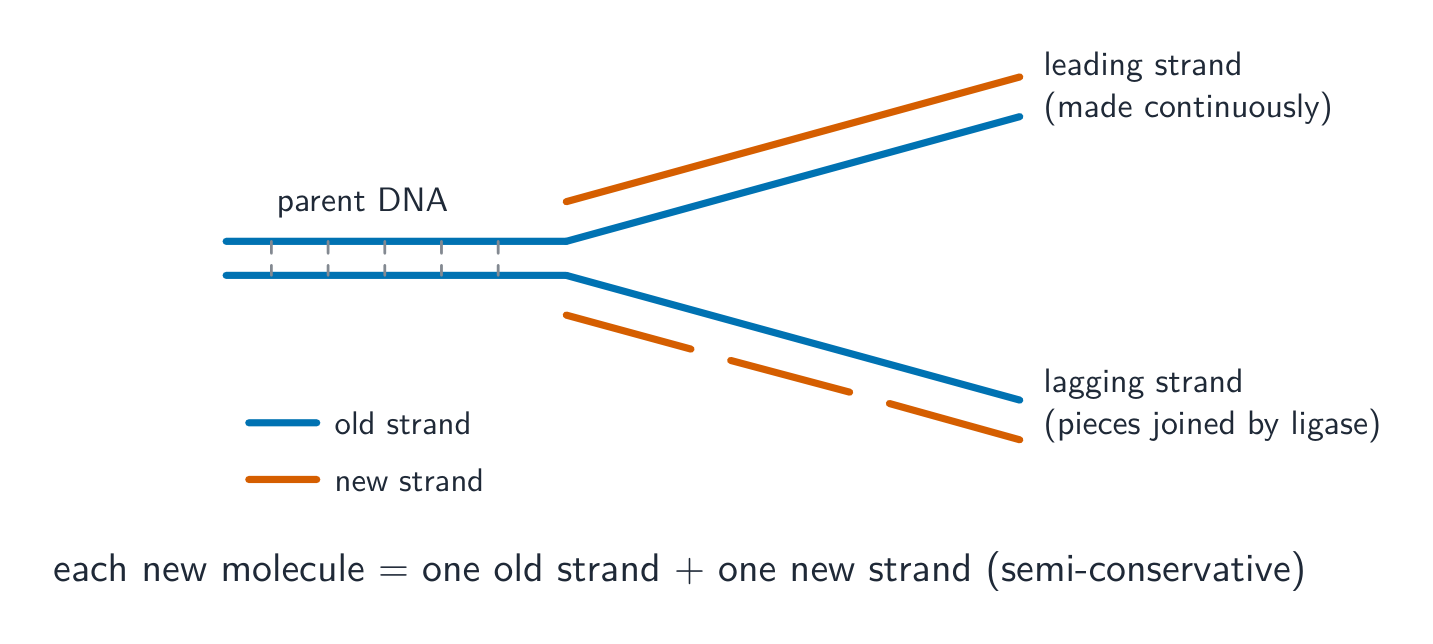
在一个细胞分裂之前,DNA 被半保留复制(semiconservatively):螺旋解开而每条旧链模板化一条新链,所以每个子螺旋有一条旧链和一条新链。聚合酶(DNA polymerase)遵循碱基配对规则添加核苷酸,构建新链并边进行边校对。
在一个复制叉处的半保留 DNA 复制 词汇表 训练英文 中文 拼音 semiconservatively/ˌsemɪkənˈsɜːvətɪvli/ 半保留复制 bàn bǎo liú fù zhì DNA polymerase/ˌdiː en ˈeɪ ˌpɒlɪməˈreɪz/ 聚合酶 jù hé méi 6.3
转录与 RNA 加工
大纲
Big Idea Learning Objective Essential Knowledge Big Idea 3 — Information Storage and Transmission
Living systems store, retrieve, transmit, and respond to information essential to life processes.6.3.A
Describe the mechanisms by which genetic information flows from DNA to RNA to protein.- 6.3.A.1 The sequence of the RNA bases, together with the structure of the RNA molecule, determines RNA function.
- 6.3.A.1.i Messenger RNA (mRNA) molecules carry information from DNA in the nucleus to the ribosome in the cytoplasm.
- 6.3.A.1.ii Distinct transfer RNA (tRNA) molecules bind specific amino acids and have anticodon sequences that base pair with the codons of mRNA. tRNA is recruited to the ribosome during translation to generate the primary peptide sequence based on the mRNA sequence.
- 6.3.A.1.iii Ribosomal RNA (rRNA) molecules are functional building blocks of ribosomes.
- 6.3.A.2 RNA polymerases use a single template strand of DNA to direct the inclusion of bases in the newly formed RNA molecule. This process is known as transcription.
- 6.3.A.3 The enzyme RNA polymerase synthesizes mRNA molecules in the 5' to 3' direction by reading the template DNA strand in the 3' to 5' direction.
- 6.3.A.4 In eukaryotic cells the mRNA transcript undergoes a series of enzyme-mediated modifications.
- 6.3.A.4.i The addition of a poly-A tail makes mRNA more stable.
- 6.3.A.4.ii The addition of a GTP cap helps with ribosomal recognition.
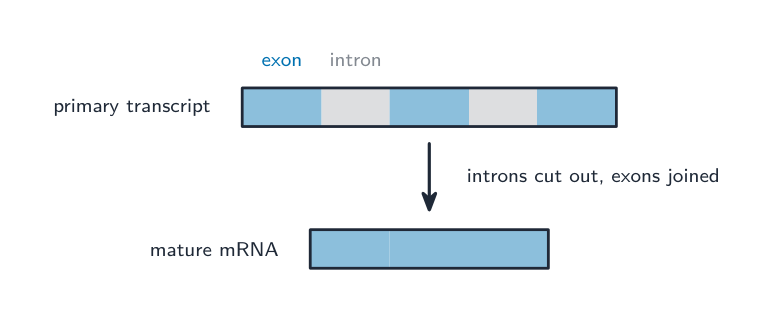
- 6.3.A.4.iii The excision of introns, along with the splicing and retention of exons, generates different versions of the resulting mature mRNA molecule. This process is known as alternative splicing.
来源:美国大学理事会 AP 课程与考试说明
转录(transcription)把一个基因的 DNA 复制成信使RNA(messenger RNA,mRNA)。RNA 聚合酶(RNA polymerase)读取模板链并构建一条互补的 RNA。在真核生物里 mRNA 然后被加工:一个帽和尾被添加,而内含子(introns)(非编码部分)被剪接掉,留下外显子(exons)。
内含子被移除而外显子被连接以制造成熟的 mRNA 加工过程中加上的 5′ 帽是一个修饰过的鸟嘌呤核苷酸,即 GTP 帽(GTP cap),它的作用是识别:它帮助核糖体识别并结合这条 mRNA,同时在转录本离开细胞核时保护它不被降解。
探索Transcribe DNA into messenger RNA
Transcription copies a DNA template into mRNA, pairing A→U, T→A, C→G, G→C. Step through to build the RNA strand base by base.
词汇表 训练英文 中文 拼音 Transcription/trænˈskrɪpʃn/ 转录 zhuǎn lù messenger RNA/ˈmesɪndʒə ˌɑː en ˈeɪ/ 信使 xìn shǐ introns/ɪnˈtrɒnz/ 内含子 nèi hán zi exons/eɡˈzɒnz/ 外显子 wài xiǎn zi 6.4
翻译
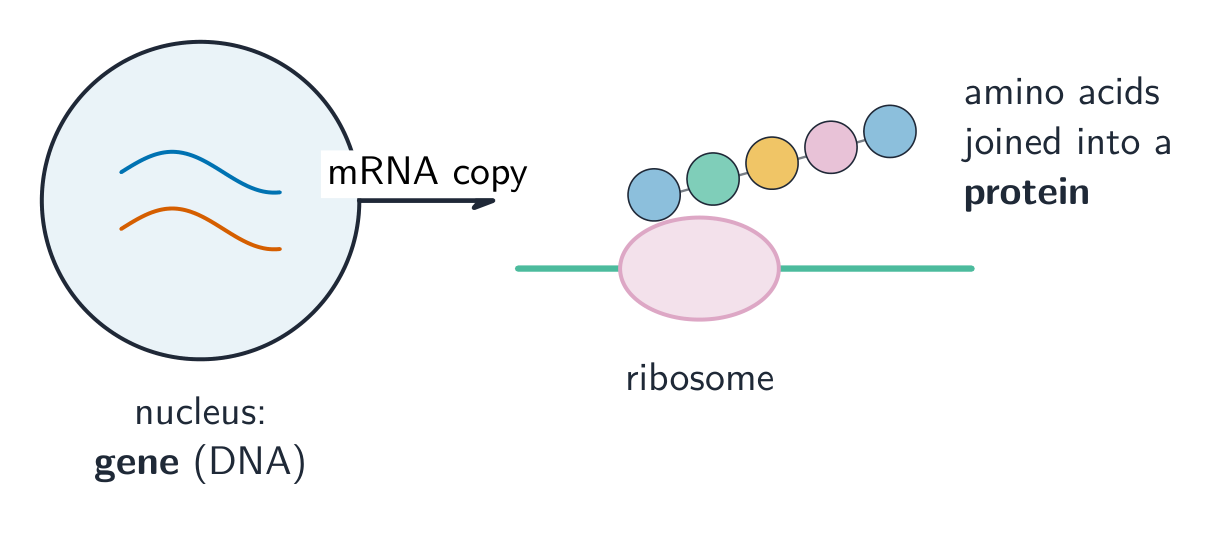
大纲
Big Idea Learning Objective Essential Knowledge Big Idea 3 — Information Storage and Transmission
Living systems store, retrieve, transmit, and respond to information essential to life processes.6.4.A
Explain how the phenotype of an organism is determined by its genotype.- 6.4.A.1 Translation of the mRNA to generate a polypeptide occurs on ribosomes that are present in the cytoplasm of both prokaryotic and eukaryotic cells, as well as the cytoplasmic surface of the rough ER of eukaryotic cells.
- 6.4.A.2 In prokaryotic organisms, translation of the mRNA molecule occurs while it is being transcribed.
- 6.4.A.3 Translation involves many sequential steps, including initiation, elongation, and termination. The salient features of translation include:
- 6.4.A.3.i Translation is initiated when the rRNA in the ribosome interacts with the mRNA at the start codon (AUG, coding for the amino acid methionine).
- 6.4.A.3.ii The sequence of nucleotides on the mRNA is read in triplets, called codons.
- 6.4.A.3.iii Each codon encodes a specific amino acid, which can be deduced by using a genetic code chart. Many amino acids are encoded by more than one codon.
- 6.4.A.3.iv Nearly all living organisms use the same genetic code, which is evidence for the common ancestry of all living organisms.
- 6.4.A.3.v tRNA brings the correct amino acid to the place specified by the codon on the mRNA.
- 6.4.A.3.vi The amino acid is transferred to the growing polypeptide chain.
- 6.4.A.3.vii The process continues along the mRNA until a stop codon is reached.
- 6.4.A.3.viii Translation terminates with the release of the newly synthesized protein.
- Exclusion statement: The details and names of the enzymes and factors involved in each of these steps are beyond the scope of the AP Exam.
- Exclusion statement: Memorization of the genetic code, with the exception of the start codon AUG, is beyond the scope of the AP Exam.
- 6.4.A.4 Genetic information in retroviruses is a special case and has an alternate flow of information: from RNA to DNA, made possible by reverse transcriptase, an enzyme that copies the viral RNA genome into DNA. This DNA integrates into the host genome and is transcribed and translated for the assembly of new viral progeny.
来源:美国大学理事会 AP 课程与考试说明
翻译(translation)在核糖体(ribosome)从 mRNA 构建一个蛋白质。mRNA 以三个碱基的密码子(codons)被读取,每个指定一个氨基酸(遗传密码)。转运RNA(transfer RNA)带来匹配的氨基酸,而核糖体把它们连接成一条多肽,直到一个终止密码子结束它。这是"中心法则":DNA → RNA → 蛋白质。
mRNA 被一个核糖体读取以从氨基酸构建一个蛋白质 词汇表 训练英文 中文 拼音 Translation/trænˈsleɪʃn/ 翻译 fān yì ribosome/ˈriːbəʊsəʊm/ 核糖体 hé táng tǐ codons/ˈkəʊdɒnz/ 密码子 mì mǎ zi Transfer RNA/ˈtrænsfɜː ˌɑː en ˈeɪ/ 转运 zhuǎn yùn 6.5
基因表达的调控
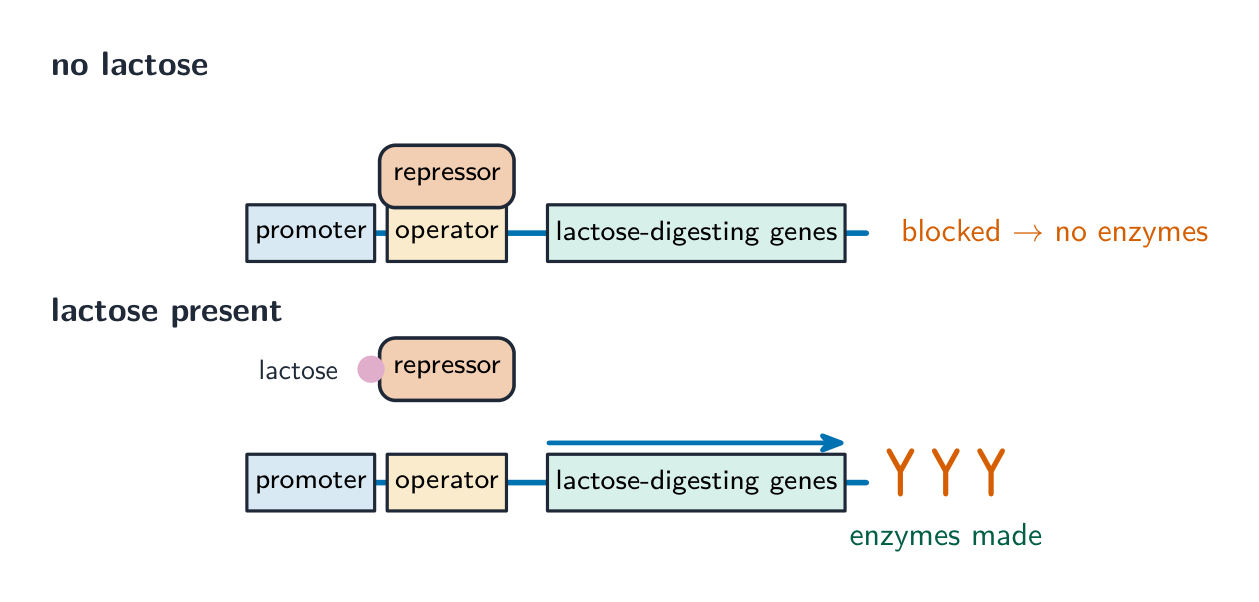
大纲
Big Idea Learning Objective Essential Knowledge Big Idea 3 — Information Storage and Transmission
Living systems store, retrieve, transmit, and respond to information essential to life processes.6.5.A
Describe the types of interactions that regulate gene expression.- 6.5.A.1 Regulatory sequences are stretches of DNA that interact with regulatory proteins to control transcription. Some genes are constitutively expressed, and others are inducible.
- 6.5.A.2 Epigenetic changes can affect gene expression through reversible modifications of DNA or histones.
- 6.5.A.3 The phenotype of a cell or an organism is determined by the combination of genes that are expressed and the levels at which they are expressed.
- 6.5.A.3.i Observable cell differentiation results from the expression of genes for tissue-specific proteins.
- 6.5.A.3.ii Induction of transcription factors during development results in sequential gene expression.
- 6.5.A.3.iii The function and amount of gene products determine the phenotype of organisms.
6.5.B
Explain how the location of regulatory sequences relates to their function.- 6.5.B.1 Both prokaryotes and eukaryotes have groups of genes that are coordinately regulated.
- 6.5.B.1.i Prokaryotes regulate operons in an inducible or repressible system.
- 6.5.B.1.ii In eukaryotes, groups of genes may be influenced by the same transcription factors to coordinately regulate expression.
来源:美国大学理事会 AP 课程与考试说明
细胞控制哪些基因被表达以及何时。在原核生物里,操纵子(operons)把成组的基因开或关。在真核生物里,调节发生在许多层次——哪些基因被转录(转录因子、启动子、增强子)、RNA 加工,以及翻译之后。这让一个细胞在不改变它 DNA 的情况下对它的环境反应。
乳糖操纵子只在乳糖存在时把基因开启 词汇表 训练英文 中文 拼音 operons/ˈɒpərənz/ 操纵子 cāo zòng zi 6.6
基因表达与细胞特化
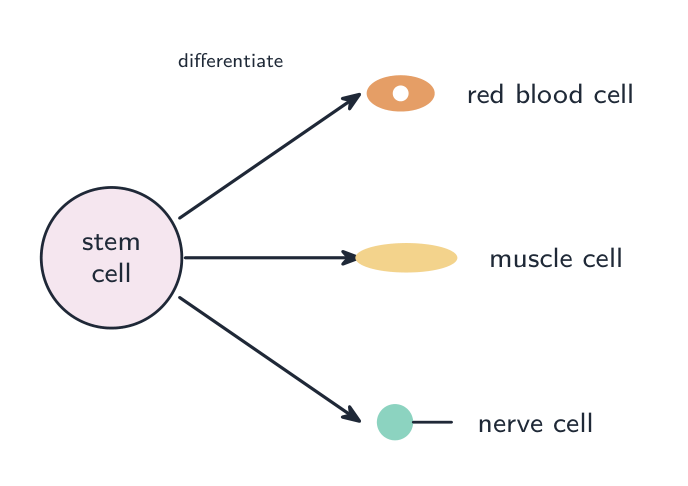
大纲
Big Idea Learning Objective Essential Knowledge Big Idea 3 — Information Storage and Transmission
Living systems store, retrieve, transmit, and respond to information essential to life processes.6.6.A
Explain how the binding of transcription factors to promoter regions affects gene expression and the phenotype of the organism.- 6.6.A.1 RNA polymerase and transcription factors bind to promoter or enhancer DNA sequences to initiate transcription. These sequences can be upstream or downstream of the transcription start site.
- 6.6.A.2 Negative regulatory molecules inhibit gene expression by binding to DNA and blocking transcription.
6.6.B
Explain the connection between the regulation of gene expression and phenotypic differences in cells and organisms.- 6.6.B.1 Gene regulation results in differential gene expression and influences cell products and functions.
- 6.6.B.2 Certain small RNA molecules have roles in regulating gene expression.
来源:美国大学理事会 AP 课程与考试说明
一个身体里的每个细胞有相同的 DNA,然而细胞不同,因为它们表达不同的基因——差异表达(differential gene expression)。这就是一个受精卵如何产生许多特化的细胞类型(肌肉、神经、皮肤);发育期间的信号把特定的基因开和关。
一个干细胞分化成特化的细胞类型 词汇表 训练英文 中文 拼音 differential gene expression/ˌdɪfəˈrenʃl dʒiːn ekˈspreʃn/ 差异表达 chā yì biǎo dá 6.7
突变
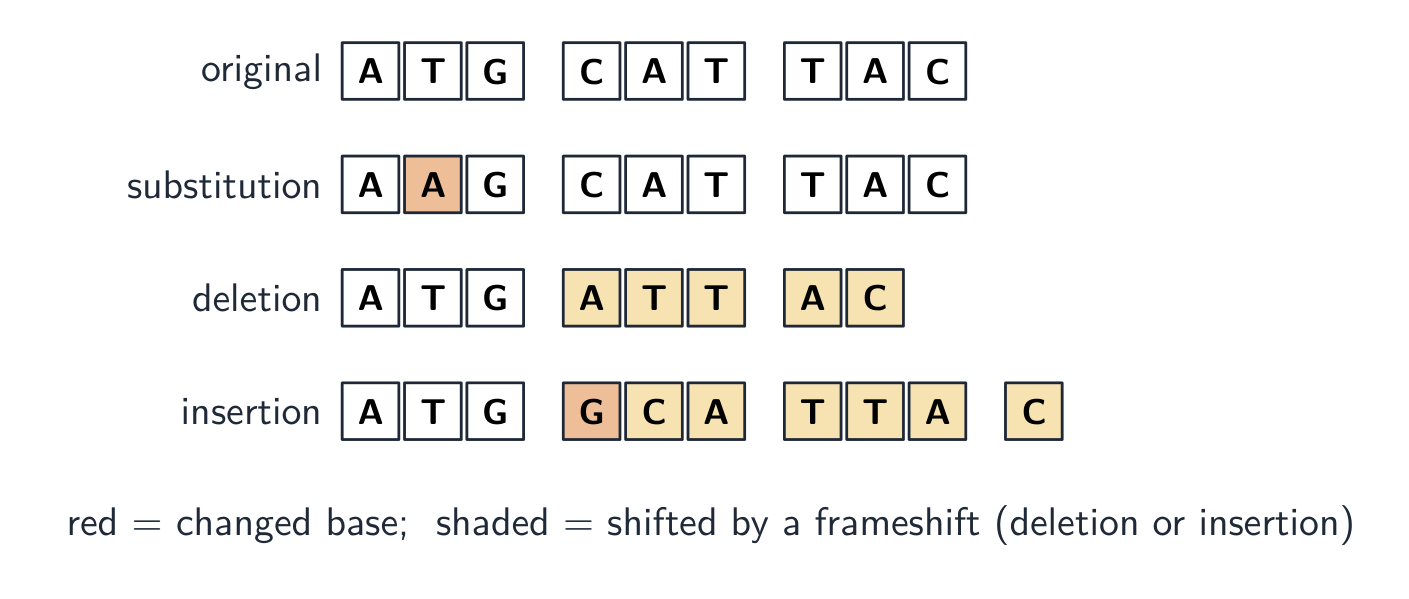
大纲
Big Idea Learning Objective Essential Knowledge Big Idea 3 — Information Storage and Transmission
Living systems store, retrieve, transmit, and respond to information essential to life processes.6.7.A
Describe the various types of mutation.- 6.7.A.1 Alterations in a DNA sequence are mutations that can cause changes in the type or amount of the protein produced and the consequent phenotype. DNA mutations can be beneficial, detrimental, or neutral based on the effect or the lack of effect they have on the resulting nucleic acid or protein and the phenotypes that are conferred by the protein.
- 6.7.A.1.i Point mutations occur when one nucleotide has been substituted for a different nucleotide.
- 6.7.A.1.ii Frameshift mutations occur when one or more nucleotides are inserted or deleted, causing the reading frame to be shifted.
- 6.7.A.1.iii Nonsense mutations occur when there is a point mutation that causes a premature stop.
- 6.7.A.1.iv Silent mutations occur when the change in the nucleotide sequence has no effect on the amino acid sequence.
- Illustrative examples for 6.7.A.1:
- Mutations in the CFTR gene disrupt ion transport and result in cystic fibrosis.
- Mutations in the MC1R gene give adaptive melanism in pocket mice.
- Exclusion statement: Knowledge of specific mutations and their effects is beyond the scope of the AP Exam.
6.7.B
Explain how changes in genotype may result in changes in phenotype.- 6.7.B.1 Errors in DNA replication or DNA repair mechanisms as well as external factors, including radiation and reactive chemicals, can cause random mutations in the DNA.
- 6.7.B.1.i Whether a mutation is beneficial, detrimental, or neutral depends on the environmental context.
- 6.7.B.1.ii Mutations are a source of genetic variation.
- 6.7.B.2 Errors in mitosis or meiosis can result in changes in phenotype.
- 6.7.B.2.i Changes in chromosome number resulting from nondisjunction often result in new phenotypes caused by triploidy (aneuploidy).
- 6.7.B.2.ii Changes in chromosome number often result in disorders with developmental limitations.
- 6.7.B.2.iii Alterations in chromosome structure lead to genetic disorders.
- Exclusion statement: Knowledge of specific disorders related to changes in chromosome number is beyond the scope of the AP Exam.
6.7.C
Explain how alterations in DNA sequences contribute to variation that can be subject to natural selection.- 6.7.C.1 Changes in genotype may affect phenotypes that are subject to natural selection. Genetic changes that enhance survival and reproduction can be selected for by environmental conditions.
- 6.7.C.1.i The horizontal acquisitions of genetic information in prokaryotes via transformation (uptake of DNA), transduction (viral transmission of genetic information), conjugation (cell-to-cell transfer of DNA), and transposition (movement of DNA segments within and between DNA molecules) increase genetic variation.
- 6.7.C.1.ii Related viruses can recombine genetic information if they infect the same host cell.
- 6.7.C.1.iii Reproductive processes that increase genetic variation are evolutionarily conserved and are shared by various organisms.
- Illustrative examples for 6.7.C.1: Sickle cell anemia
来源:美国大学理事会 AP 课程与考试说明
一个突变(mutation)是 DNA 序列的一个变化。点突变(point mutations)改变一个碱基(沉默、错义,或无义);插入/缺失(insertions/deletions)能造成一次移码(frameshift),它把下游的一切弄乱。配子里的突变是可遗传的;它们可能是有害的、中性的,或有益的——而有益的提供自然选择的变异。
替换、缺失和插入突变 整条染色体层面的错误同样改变表型。 突变不只是碱基的改变:有丝分裂或减数分裂中的错误可以导致表型改变。如果染色体未能分离——不分离(nondisjunction)——一个配子就会多得到一条或一条也没有,由此形成的合子染色体数目异常(非整倍性,aneuploidy)。21 三体是人们熟悉的例子。由于一整条染色体携带数以百计的基因,其表型影响远比一个点突变广泛。
词汇表 训练英文 中文 拼音 mutation/mjuːˈteɪʃn/ 突变 tū biàn frameshift/ˈfreɪmʃɪft/ 移码 yí mǎ nondisjunction/ˌnɒndɪsˈdʒʌŋkʃn/ 不分离 bù fēn lí aneuploidy/ˈeɪnəplɔɪdi/ 非整倍性 fēi zhěng bèi xìng 6.8
生物技术
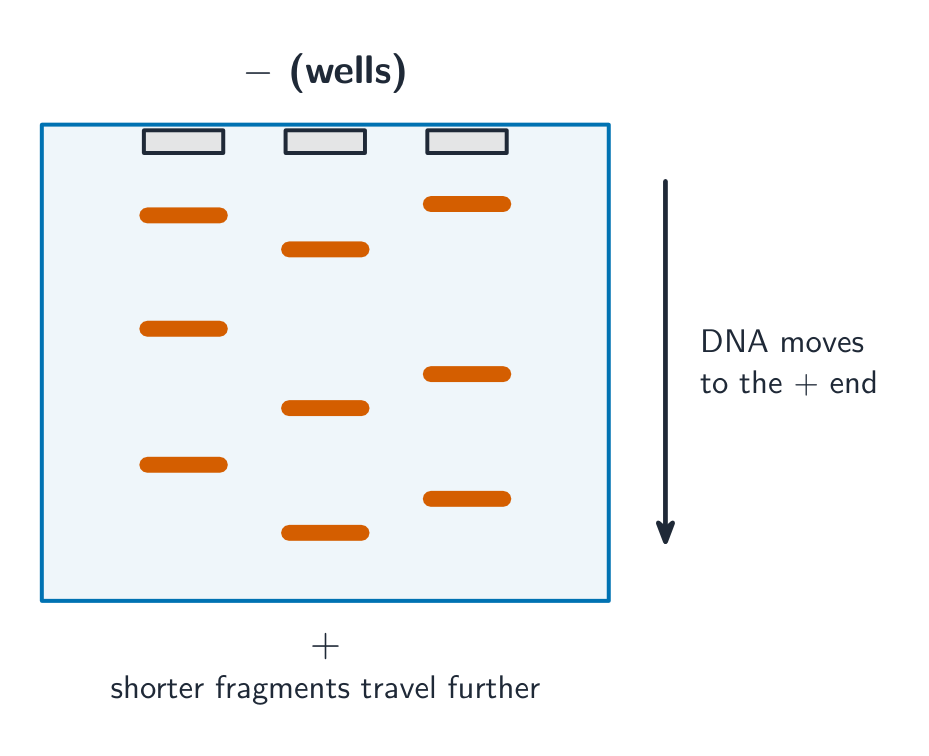
大纲
Big Idea Learning Objective Essential Knowledge Big Idea 3 — Information Storage and Transmission
Living systems store, retrieve, transmit, and respond to information essential to life processes.6.8.A
Explain the use of genetic engineering techniques in analyzing or manipulating DNA.- 6.8.A.1 Genetic engineering techniques can be used to analyze and manipulate DNA and RNA.
- 6.8.A.1.i Gel electrophoresis is a process that separates DNA fragments by size and charge.
- 6.8.A.1.ii During polymerase chain reaction (PCR), DNA fragments are amplified by denaturing DNA, annealing primers to the original strand, and extending the new DNA molecule.
- 6.8.A.1.iii Bacterial transformation introduces foreign DNA into bacterial cells.
- 6.8.A.1.iv DNA sequencing technology determines the order of nucleotides in a DNA molecule. Typically, these techniques result in a DNA fingerprint that allows for the comparison of DNA sequences from various samples.
- Illustrative examples for 6.8.A.1:
- Amplified DNA fragments can be used to identify organisms and perform phylogenetic analysis.
- Analysis of DNA can be used for forensic identification.
- Genetically modified organisms include transgenic animals.
- Gene cloning allows propagation of DNA fragments.
- Exclusion statement: Knowledge of the details of each of these genetic engineering techniques is beyond the scope of the AP Exam.
来源:美国大学理事会 AP 课程与考试说明
生物技术(biotechnology)工具操纵遗传物质:聚合酶链反应(PCR)复制 DNA、凝胶电泳(gel electrophoresis)按大小分开 DNA 片段、限制酶(restriction enzymes)和克隆在生物之间移动基因,而 CRISPR 编辑序列。这些技术使基因检测、工程化生物和医学治疗成为可能。
凝胶电泳按长度分开 DNA 片段 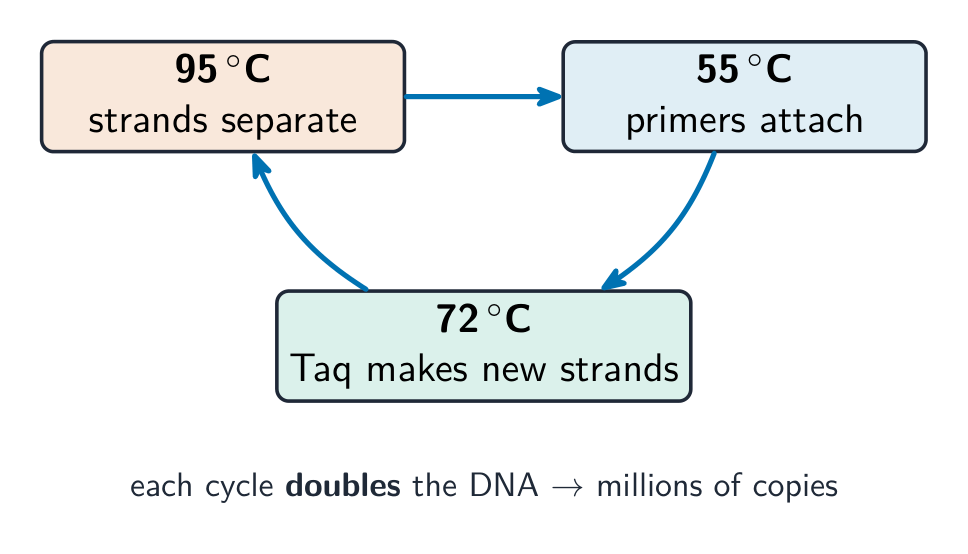
聚合酶链反应每个循环使 DNA 加倍 Worked example. 模板 DNA 链
3'-TAC GGA TTC-5'被转录成 mRNA5'-AUG CCU AAG-3'。一个核糖体读取三个密码子:AUG = 甲硫氨酸 Met(起始)、CCU = 脯氨酸 Pro、AAG = 赖氨酸 Lys——编码 Met–Pro–Lys。改变一个密码子的第三个碱基常常给出相同的氨基酸,因为遗传密码是简并的,这软化了许多突变的影响。读取 DNA 可以鉴定个体。 由于某些非编码位点上的重复次数因人而异,对 DNA 的分析可以用于法医鉴定:用 PCR 扩增这些区域,用凝胶电泳把片段分开,再把条带位置的图样与参照样本比较。一次匹配是关于概率的陈述而不是确定性,这正是要检测多个位点而非一个位点的原因。
词汇表 训练英文 中文 拼音 Biotechnology/ˌbaɪəʊtekˈnɒlədʒi/ 生物技术 shēng wù jì shù PCR/ˌpiː siː ˈɑː/ 聚合酶链反应 jù hé méi liàn fǎn yìng gel electrophoresis/dʒel ɪˌlektrəʊfɔːˈriːsɪs/ 凝胶电泳 níng jiāo diàn yǒng 6.8
考试技巧
- 知道中心法则 DNA → RNA → 蛋白质:转录制造 mRNA,翻译在核糖体以三个碱基的密码子读取它。
- 记住 RNA 是单链的并用 U 代替 T;复制是半保留的。
- 每个细胞有相同的 DNA——细胞不同,因为它们表达不同的基因(差异表达)。
- 一个突变是 DNA 序列的一个变化,可能是有害的、中性的,或有益的(选择的原材料)。
- 把生物技术工具与它们的工作联系起来:PCR 复制 DNA;凝胶电泳按大小分开片段。
- 6.1.A.1 Genetic information is stored in and passed to subsequent generations through DNA molecules and, in some cases, RNA molecules.
-
7
自然选择
7.1
自然选择导论

大纲
Big Idea Learning Objective Essential Knowledge Big Idea 1 — Evolution
The process of evolution drives the diversity and unity of life.7.1.A
Describe the causes of natural selection.- 7.1.A.1 Natural selection is a major mechanism of evolution.
- 7.1.A.2 According to Darwin's theory of natural selection, competition for limited resources results in differential survival. Individuals with more favorable phenotypes are more likely to survive and produce more offspring, thus passing on those favorable traits to subsequent generations.
7.1.B
Explain how natural selection affects populations.- 7.1.B.1 Evolutionary fitness is measured by reproductive success.
- 7.1.B.2 Biotic and abiotic environments can fluctuate, affecting the rate and direction of evolution. Different genetic variations can be selected in each generation.
来源:美国大学理事会 AP 课程与考试说明
进化(evolution)是一个种群的可遗传性状在世代间的一个变化。自然选择(natural selection)是它的主要驱动力:个体变异、一些变异是可遗传的、产生的后代多于存活的,而那些有更适合环境性状的存活并繁殖得更多。随时间,有帮助的性状变得更常见。
自然选择:最适应的存活、繁殖并传下它们的等位基因 词汇表 训练英文 中文 拼音 Evolution/ɪvəˈluːʃn/ 进化 jìn huà Natural selection/ˈnætʃərəl sɪˈlekʃn/ 自然选择 zì rán xuǎn zé 7.2
自然选择
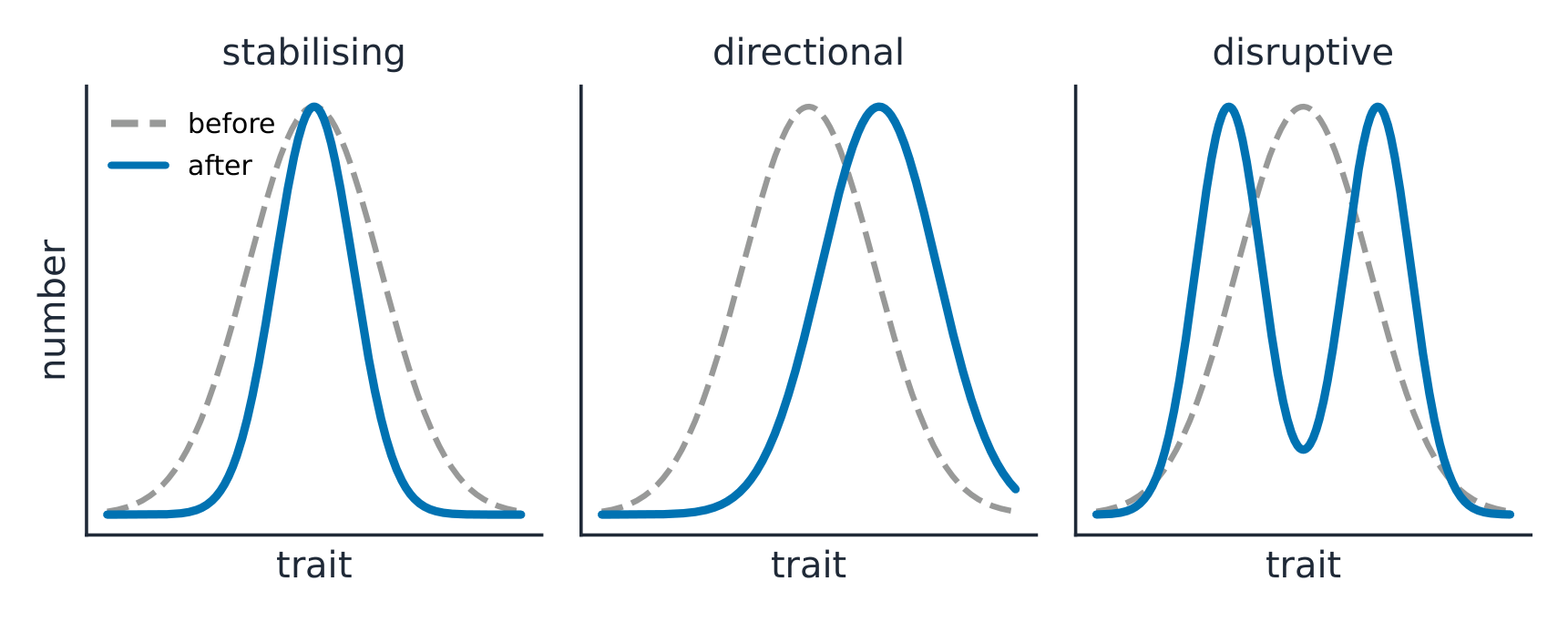
大纲
Big Idea Learning Objective Essential Knowledge Big Idea 1 — Evolution
The process of evolution drives the diversity and unity of life.7.2.A
Describe the importance of phenotypic variation in a population.- 7.2.A.1 Natural selection acts on phenotypic variations in populations.
- 7.2.A.2 Environments change and apply selective pressures to populations.
- Illustrative examples for 7.2.A.2: Flowering time in relation to global climate change
- 7.2.A.3 Some phenotypic variations can increase or decrease the fitness of an organism in particular environments.
- Illustrative examples for 7.2.A.3: Sickle cell anemia; DDT resistance in insects
7.2.B
Explain how variation in molecules within cells connects to the fitness of an organism.- 7.2.B.1 Variation in the number and types of molecules within cells can provide populations a greater ability to survive and reproduce in different environments.
来源:美国大学理事会 AP 课程与考试说明
选择作用于变异(variation)。适合度(fitness)意味着繁殖成功,不是力量。选择以几种模式出现:定向(directional)(偏爱一个极端)、稳定(stabilizing)(偏爱平均),和分裂(disruptive)(偏爱两个极端)。环境做"选择",所以在一种环境里有帮助的一个性状在另一种里可能没有。很适合的性状是适应(adaptations)。
稳定、定向和分裂选择 探索Watch selection shift a population
Natural selection: individuals better suited to the environment survive and reproduce more, so helpful traits spread. Change the environment and watch the population adapt.
词汇表 训练英文 中文 拼音 variation/ˌveərɪˈeɪʃn/ 变异 biàn yì Fitness/ˈfɪtnəs/ 适合度 shì hé dù adaptations/ˌædæpˈteɪʃnz/ 适应 shì yìng 7.3
人工选择
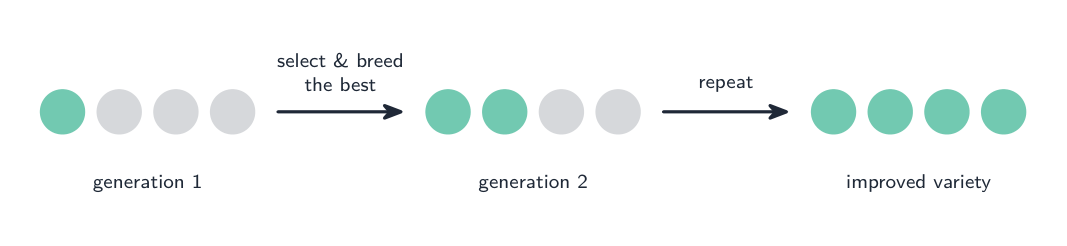
大纲
Big Idea Learning Objective Essential Knowledge Big Idea 1 — Evolution
The process of evolution drives the diversity and unity of life.7.3.A
Explain how humans can affect diversity within a population.- 7.3.A.1 Through artificial selection, humans affect variation in other species.
来源:美国大学理事会 AP 课程与考试说明
在人工选择(artificial selection)里,人类——不是自然——选择哪些个体繁殖,为想要的性状选择(作物、牲畜、狗)。它以与自然选择相同的方式起作用,而且因为快速和可见,是选择能重塑种群的强有力证据。
选择性育种在世代间使一个想要的特征更常见 词汇表 训练英文 中文 拼音 artificial selection/ˌɑːtɪˈfɪʃl sɪˈlekʃn/ 人工选择 rén gōng xuǎn zé 7.4
群体遗传学
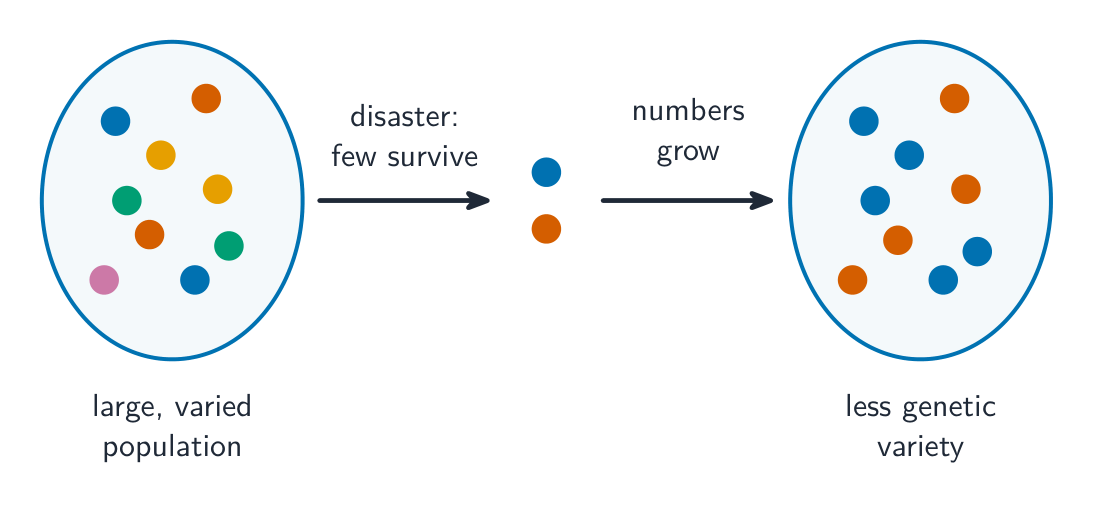
大纲
Big Idea Learning Objective Essential Knowledge Big Idea 1 — Evolution
The process of evolution drives the diversity and unity of life.7.4.A
Explain how random occurrences affect the genetic makeup of a population.- 7.4.A.1 Evolution is also driven by random occurrences.
- i. Mutation is a random process that adds new genetic variation to a population.
- ii. Genetic drift is a change in allele frequencies attributable to a nonselective process occurring in small populations.
- iii. The bottleneck effect is a type of genetic drift that occurs when a population size is reduced to a small number of individuals for at least one generation.
- iv. The founder effect is a type of genetic drift that occurs when a population is separated from other members of the population. The frequency of genes and traits will shift based on the genes in this new founder population.
- v. Migration can result in gene flow (the addition or removal of alleles from a population).
7.4.B
Describe the role of random processes in the evolution of specific populations.- 7.4.B.1 Random processes can lead to changes in allele frequencies in a population.
- i. Mutations result in genetic variation, which provides phenotypes on which natural selection acts.
- ii. Genetic drift can allow a small population to diverge from other populations of the same species.
- iii. Gene flow between two populations prevents them from diverging into separate species.
7.4.C
Describe the change in the genetic makeup of a population over time.- 7.4.C.1 Changes in allele frequencies provide evidence for the occurrence of evolution in a population.
来源:美国大学理事会 AP 课程与考试说明
群体遗传学(population genetics)研究一个种群里的等位基因库。进化是等位基因频率(allele frequencies)随时间的一个变化。除了自然选择,等位基因频率通过突变(mutation)(新等位基因)、基因流(gene flow)(迁移),和遗传漂变(genetic drift)(随机变化,在小种群里最强——瓶颈和奠基者效应)而变化。
一次种群瓶颈减少遗传多样性 词汇表 训练英文 中文 拼音 Population genetics/ˌpɒpjʊˈleɪʃn dʒɪˈnetɪks/ 群体遗传学 qún tǐ yí chuán xué allele frequencies/əˈliːl ˈfriːkwənsiz/ 等位基因频率 děng wèi jī yīn pín lǜ gene flow/dʒiːn fləʊ/ 基因流 jī yīn liú genetic drift/dʒɪˈnetɪk drɪft/ 遗传漂变 yí chuán piāo biàn 7.5
哈迪-温伯格平衡
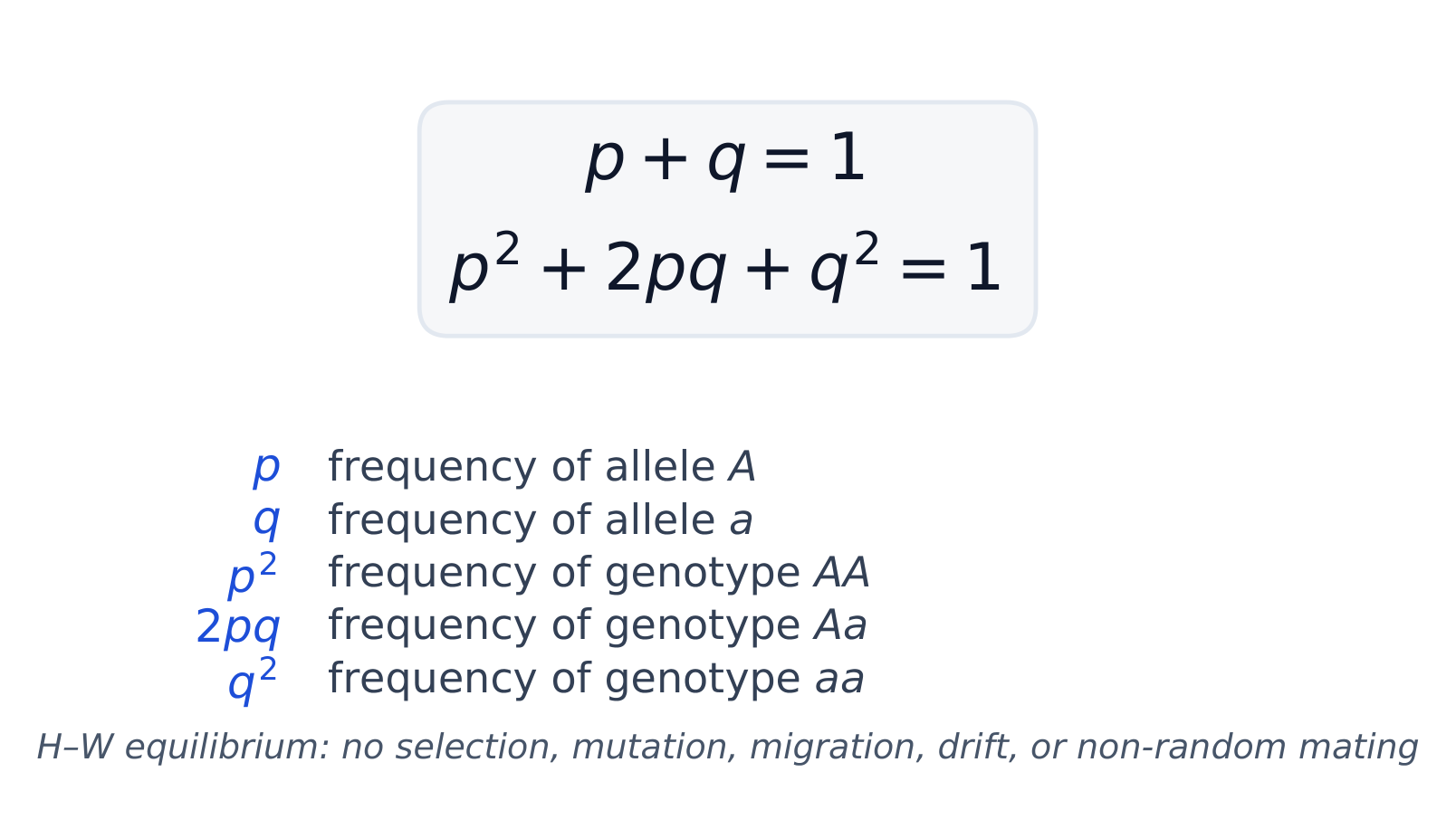
大纲
Big Idea Learning Objective Essential Knowledge Big Idea 1 — Evolution
The process of evolution drives the diversity and unity of life.7.5.A
Describe the conditions under which allele and genotype frequencies will change in populations.-
7.5.A.1 The Hardy–Weinberg Equilibrium is a model for describing and predicting allele frequencies in a non-evolving population. Conditions for a population or an allele to be in Hardy–Weinberg equilibrium are:
- i. A large population size
- ii. No migration
- iii. No new mutations
- iv. Random mating
- v. No natural selection
These conditions are never met, but they provide a valuable null hypothesis.
-
7.5.A.2 Allele frequencies in a nonevolving population can be calculated from genotype frequencies.
- Equation: Hardy–Weinberg Equation— $p^2 + 2pq + q^2 = 1$; $p + q = 1$, where: $p$ = frequency of allele 1 in the population; $q$ = frequency of allele 2 in the population
- Illustrative examples for 7.5.A.2: Graphic analysis of allele frequencies in a population
来源:美国大学理事会 AP 课程与考试说明
哈迪-温伯格(Hardy–Weinberg)模型给出当一个种群不进化时预期的等位基因和基因型频率。以等位基因频率 $p$ 和 $q$($p+q=1$):
$$p^2 + 2pq + q^2 = 1,$$其中 $p^2$ 和 $q^2$ 是纯合子而 $2pq$ 是杂合子。它只在五个条件下成立(没有选择、没有突变、没有迁移、随机交配、大种群);当真实数据与预测不同时,种群在进化。Worked example. 在一个种群里,$16\%$ 的个体显示隐性表型,所以 $q^2=0.16$ 而 $q=\sqrt{0.16}=0.4$。那么 $p=1-q=0.6$。预测的携带者频率(杂合子)是 $2pq=2(0.6)(0.4)=0.48$,即 $48\%$,而纯合显性是 $p^2=0.6^2=0.36$,即 $36\%$。作为一个检查,$0.36+0.48+0.16=1$。这是标准的路径:隐性表型 $\to q^2\to q\to p\to$ 其他一切。
Hardy–Weinberg: allele frequencies p and q give genotype frequencies p², 2pq, q² 探索Allele frequencies across a cross
Hardy-Weinberg predicts genotype frequencies ($p^2+2pq+q^2$) in a population that isn't evolving. A Punnett square shows the same allele combining at the population scale.
词汇表 训练英文 中文 拼音 Hardy–Weinberg/ˈhɑːdi ˈwaɪnbɜːɡ/ 哈迪-温伯格 hā dí - wēn bó gé 7.6
进化的证据
大纲
Big Idea Learning Objective Essential Knowledge Big Idea 1 — Evolution
The process of evolution drives the diversity and unity of life.7.6.A
Describe the types of data that provide evidence for evolution.- 7.6.A.1 Evolution is supported by scientific evidence from many disciplines (geographical, geological, physical, biochemical, and mathematical data).
7.6.B
Explain how morphological, biochemical, and geological data provide evidence that organisms have changed over time.- 7.6.B.1 Molecular, morphological, and genetic evidence from extant and extinct organisms adds to our understanding of evolution.
- i. Fossils can be dated by a variety of methods. These include 1) the age of the rocks where a fossil is found; 2) the rate of decay of isotopes including carbon-14; and 3) geographical data.
- ii. Morphological homologies, including vestigial structures, provide evidence of common ancestry.
- 7.6.B.2 A comparison of DNA nucleotide sequences and protein amino acid sequences provides evidence for evolution and common ancestry.
来源:美国大学理事会 AP 课程与考试说明
多条独立的线支持进化:化石记录(fossil record)、同源结构(homologous structures)(来自共同祖先的共享解剖)、痕迹器官(vestigial structures)、共享的胚胎学(embryology),和分子证据——近乎普遍的遗传密码和匹配的 DNA/蛋白质序列。
词汇表 训练英文 中文 拼音 fossil record/ˈfɒsl ˈrekɔːd/ 化石记录 huà shí jì lù homologous structures/həˈmɒləɡəs ˈstrʌktʃəz/ 同源结构 tóng yuán jié gòu vestigial structures/ˈvestɪdʒl ˈstrʌktʃəz/ 痕迹器官 hén jì qì guān 7.7
共同祖先
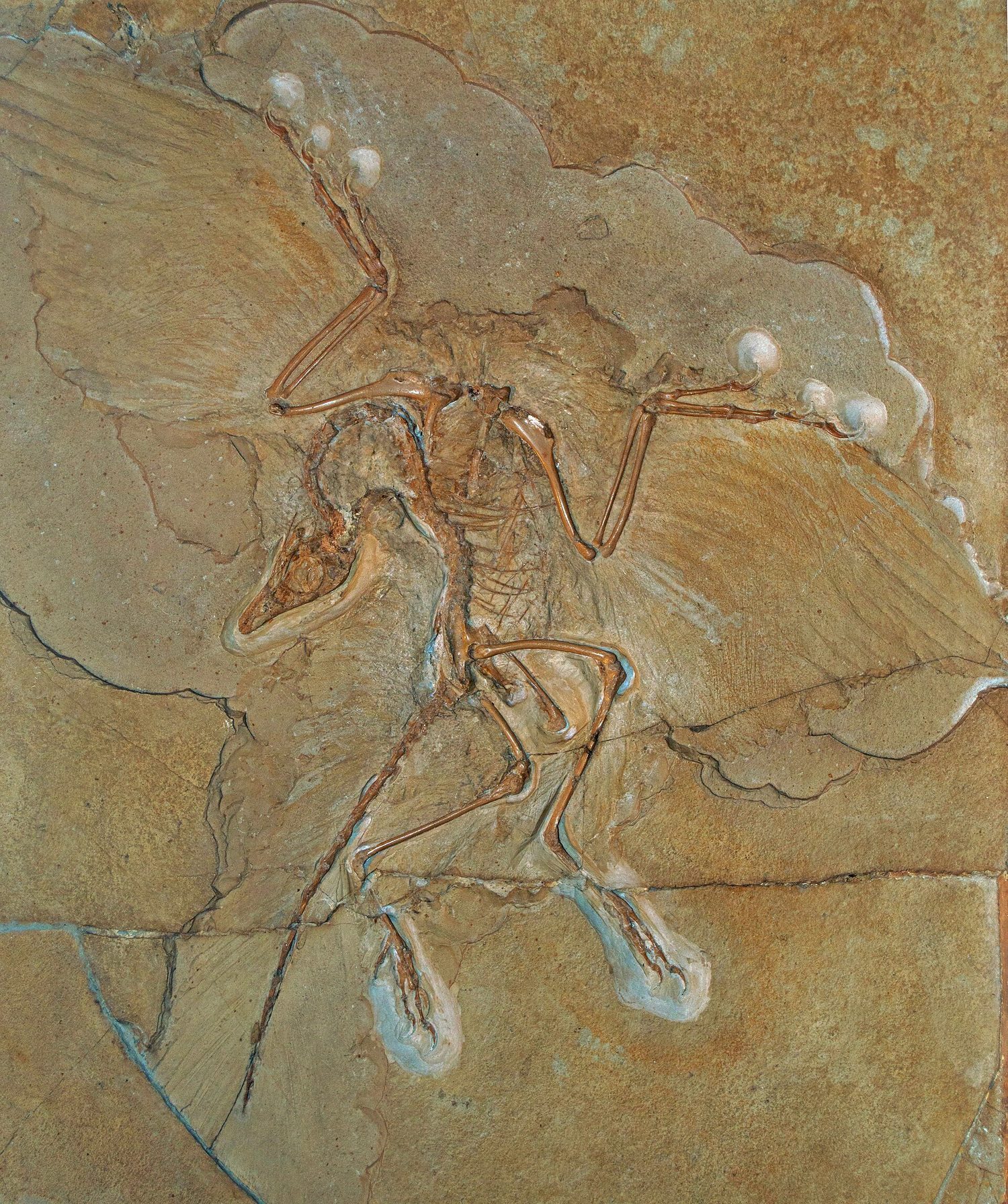
大纲
Big Idea Learning Objective Essential Knowledge Big Idea 1 — Evolution
The process of evolution drives the diversity and unity of life.7.7.A
Describe structural and functional evidence on cellular and molecular levels that provides evidence for the common ancestry of all eukaryotes.- 7.7.A.1 Structural and functional evidence indicates common ancestry of all eukaryotes. This evidence includes:
- i. Membrane-bound organelles
- ii. Linear chromosomes
- iii. Genes that contain introns
来源:美国大学理事会 AP 课程与考试说明
所有生命共享一个共同祖先(common ancestor),由普遍的特征显示:所有生物里相同的 DNA/RNA 机器、相同的遗传密码、核糖体和核心代谢通路。两个物种共享的特征和序列越多,它们分化得越近。
Archaeopteryx: transitional fossils link major groups and support common ancestry 词汇表 训练英文 中文 拼音 common ancestor/ˈkɒmən ˈænsestə/ 共同祖先 gòng tóng zǔ xiān 7.8
持续进化
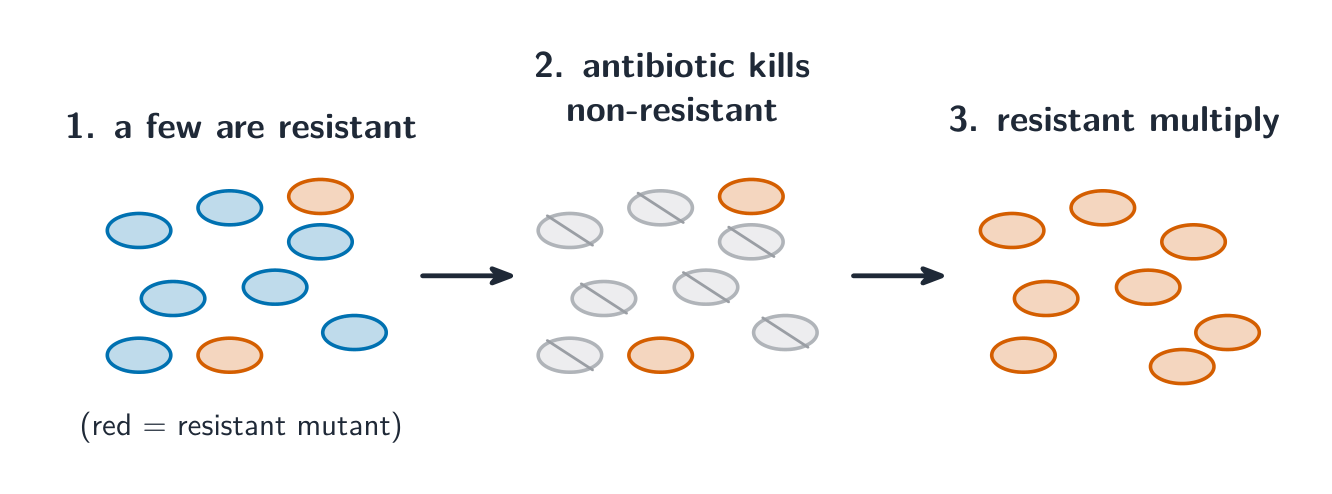
大纲
Big Idea Learning Objective Essential Knowledge Big Idea 1 — Evolution
The process of evolution drives the diversity and unity of life.7.8.A
Explain how evolution is an ongoing process in all living organisms.- 7.8.A.1 All species have evolved and continue to evolve. Examples include:
- i. Genomic changes over time
- ii. Continuous change in the fossil record
- iii. Evolution of resistance to antibiotics, pesticides, herbicides, or chemotherapy drugs
- iv. Pathogens evolving and causing emergent diseases
来源:美国大学理事会 AP 课程与考试说明
进化是持续的和可观察的:抗生素抗性细菌、杀虫剂抗性昆虫,和快速繁殖物种里的迅速变化。因为环境持续变化,选择持续作用——进化没有终点。
抗生素抗性如何通过自然选择在一个种群里扩散 7.9
系统发育
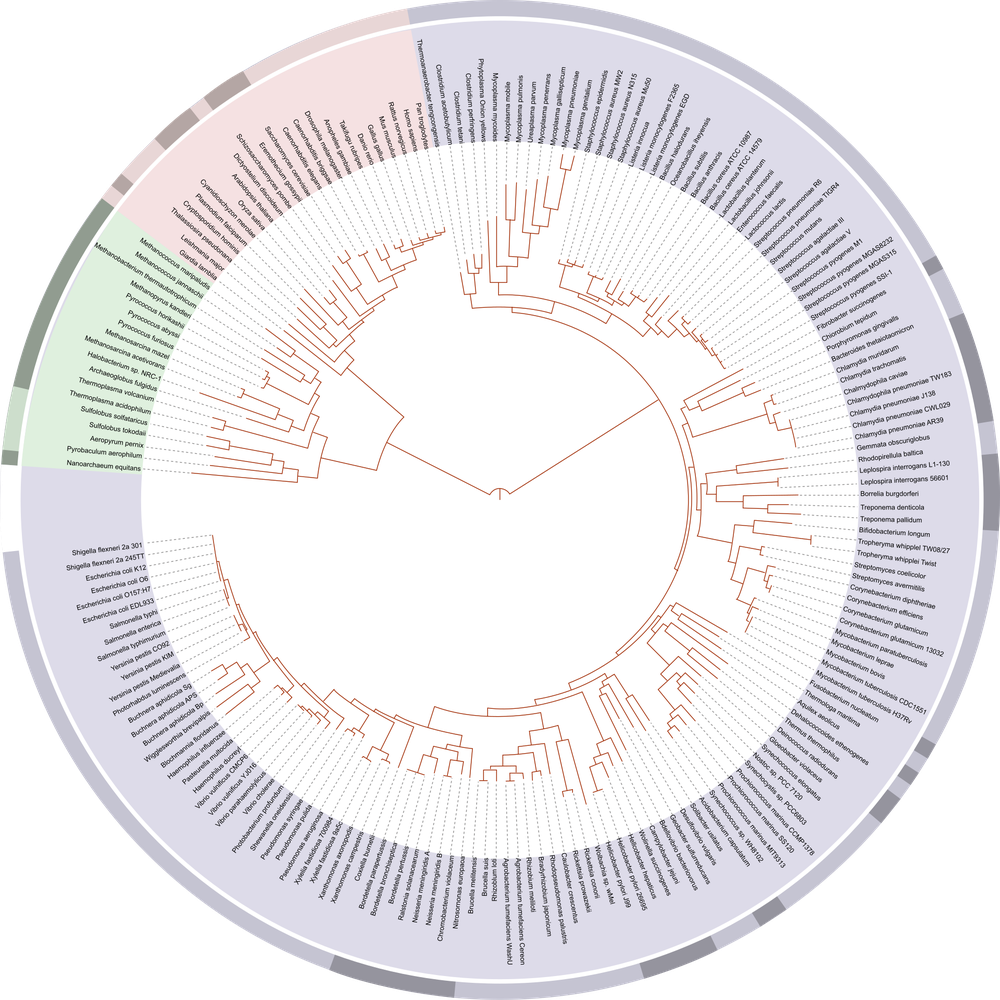
大纲
Big Idea Learning Objective Essential Knowledge Big Idea 1 — Evolution
The process of evolution drives the diversity and unity of life.7.9.A
Describe the types of evidence that can be used to infer an evolutionary relationship.- 7.9.A.1 Phylogenetic trees and cladograms show hypothetical evolutionary relationships among lineages that can be tested.
- 7.9.A.2 Phylogenetic trees show the amount of change over time calibrated by fossils or a molecular clock, whereas cladograms do not show time scale or the evolutionary difference between groups.
- 7.9.A.3 Traits that are either gained or lost during evolution can be used to construct phylogenetic trees and cladograms. The out-group represents the lineage that is least closely related to the remainder of the organisms in the phylogenetic tree or cladogram.
- i. Shared derived characters can be present in more than one lineage and indicate common ancestry. These are informative for the construction of phylogenetic trees and cladograms.
- ii. Molecular data typically provide more accurate and reliable evidence than morphological traits in the construction of phylogenetic trees or cladograms.
7.9.B
Explain how phylogenetic trees and cladograms can be used to infer evolutionary relatedness.- 7.9.B.1 Phylogenetic trees and cladograms can be used to illustrate speciation that has occurred. The nodes on a tree represent the most recent common ancestor of any two groups or lineages.
- 7.9.B.2 Phylogenetic trees and cladograms can be constructed from morphological similarities of living or fossil species and from DNA and protein sequence similarities.
- 7.9.B.3 Phylogenetic trees and cladograms represent hypotheses that are constantly being revised based on evidence.
来源:美国大学理事会 AP 课程与考试说明
一棵系统发育树(phylogenetic tree)(分支图)图示进化关系,分支点标记共同祖先而共享的衍生性状把相关的物种分组。树是假设,随着新的(尤其是分子的)数据到来而修订。
The tree of life: phylogeny groups organisms by shared ancestry from a common origin 词汇表 训练英文 中文 拼音 phylogenetic tree/ˌfaɪləʊdʒˈnetɪk triː/ 系统发育树 xì tǒng fā yù shù 7.10
物种形成
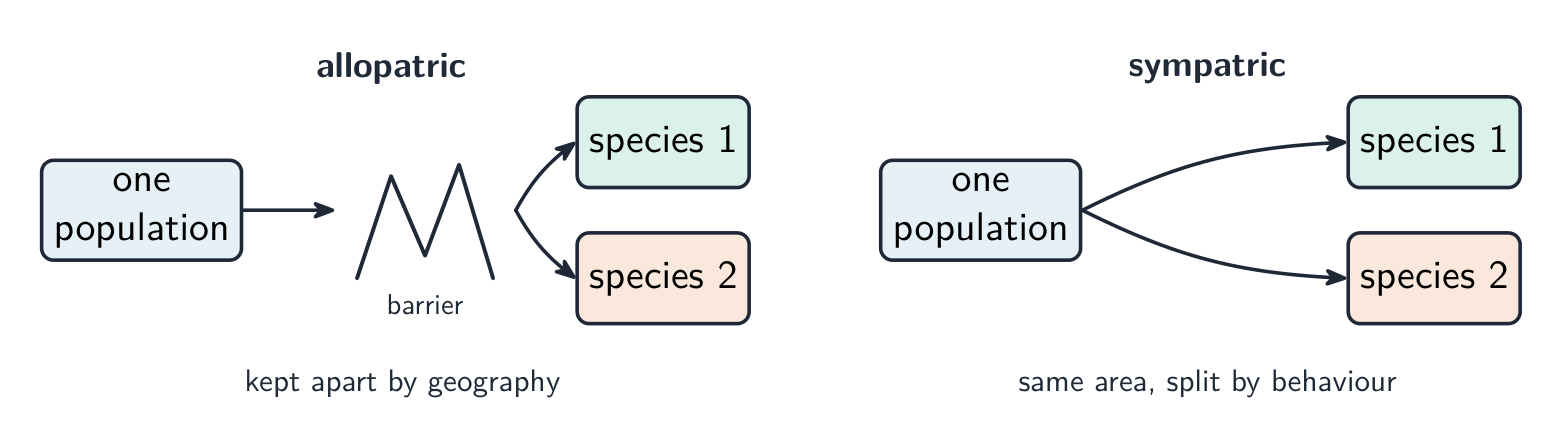
大纲
Big Idea Learning Objective Essential Knowledge Big Idea 1 — Evolution
The process of evolution drives the diversity and unity of life.7.10.A
Describe the conditions under which new species may arise.- 7.10.A.1 Speciation occurs when two populations become reproductively isolated from each other.
- 7.10.A.2 The biological species concept provides a commonly used definition of a species for sexually reproducing organisms. It states that species can be defined as a group capable of interbreeding and exchanging genetic information to produce viable, fertile offspring.
7.10.B
Describe the rate of evolution and speciation under different ecological conditions.- 7.10.B.1 Punctuated equilibrium is when evolution occurs rapidly after a long period of stasis. Gradualism is when evolution occurs slowly over hundreds of thousands or millions of years.
- 7.10.B.2 Divergent evolution occurs when adaptation to new habitats results in phenotypic diversification. Speciation rates can be especially rapid during times of adaptive radiation as new habitats become available.
- 7.10.B.3 Convergent evolution occurs when similar selective pressures result in similar phenotypic adaptations in different populations or species.
7.10.C
Explain the processes and mechanisms that drive speciation.- 7.10.C.1 Sympatric speciation occurs in populations with geographic overlap. Allopatric speciation occurs in populations that are geographically isolated.
- 7.10.C.2 Various pre-zygotic and post-zygotic mechanisms can maintain reproductive isolation and prevent gene flow between populations.
- Illustrative examples for 7.10.C: Hawaiian Drosophila; Caribbean Anolis; Apple maggot Rhagoletis
来源:美国大学理事会 AP 课程与考试说明
物种形成(speciation)是新物种的起源,通常当种群变得生殖隔离(reproductively isolated)并分化时。异域(allopatric)物种形成跟随一次地理分裂;同域(sympatric)物种形成在没有一次分裂的情况下发生。一旦种群不再能杂交,它们就是分开的物种。
异域和同域物种形成 词汇表 训练英文 中文 拼音 Speciation/ˌspiːʃɪˈeɪʃn/ 物种形成 wù zhǒng xíng chéng reproductively isolated/rɪprəˈdʌktɪvli ˈaɪsəleɪtɪd/ 生殖隔离 shēng zhí gé lí 7.11
群体中的变异
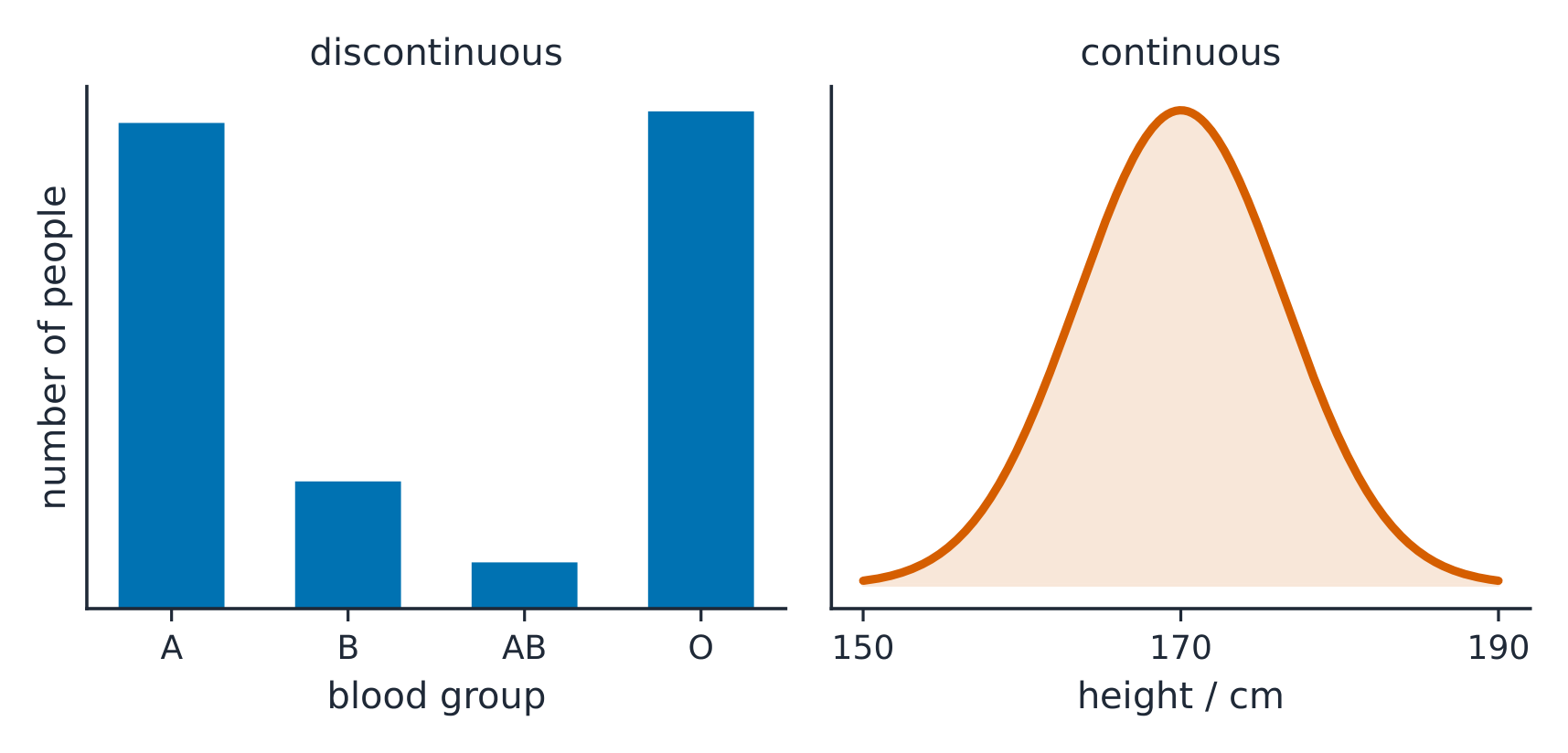
大纲
Big Idea Learning Objective Essential Knowledge Big Idea 4 — Systems Interactions
Biological systems interact, and these systems and their interactions exhibit complex properties.7.11.A
Explain how the genetic diversity of a species or population affects its ability to withstand environmental pressures.- 7.11.A.1 The level of variation in a population affects population dynamics.
- i. The ability of a population to respond to changes in the environment is influenced by genetic diversity. Species and populations with little genetic diversity are at risk of decline or extinction.
- ii. Genetically diverse populations are more resilient to environmental perturbation because they are more likely to contain individuals that can withstand the environmental pressure.
- iii. Alleles that are adaptive in one environmental condition may be deleterious in another because of different selective pressures.
- Illustrative examples for 7.11.A.1: California condors; Black-footed ferrets; Prairie chickens; Potato blight; Corn rust; Genetic diversity and selective pressures; Antibiotic resistance in bacteria (not all individuals in a diverse population are susceptible to a disease outbreak)
来源:美国大学理事会 AP 课程与考试说明
遗传多样性(diversity)帮助一个种群度过变化——若条件转变,一些变体可能已经适合它们。低多样性(如在一个濒危物种里)使一个种群脆弱。变异产生于突变以及减数分裂和有性繁殖的重新洗牌。
不连续和连续变异 词汇表 训练英文 中文 拼音 diversity/daɪˈvɜːsɪti/ 多样性 duō yàng xìng 7.12
地球生命的起源
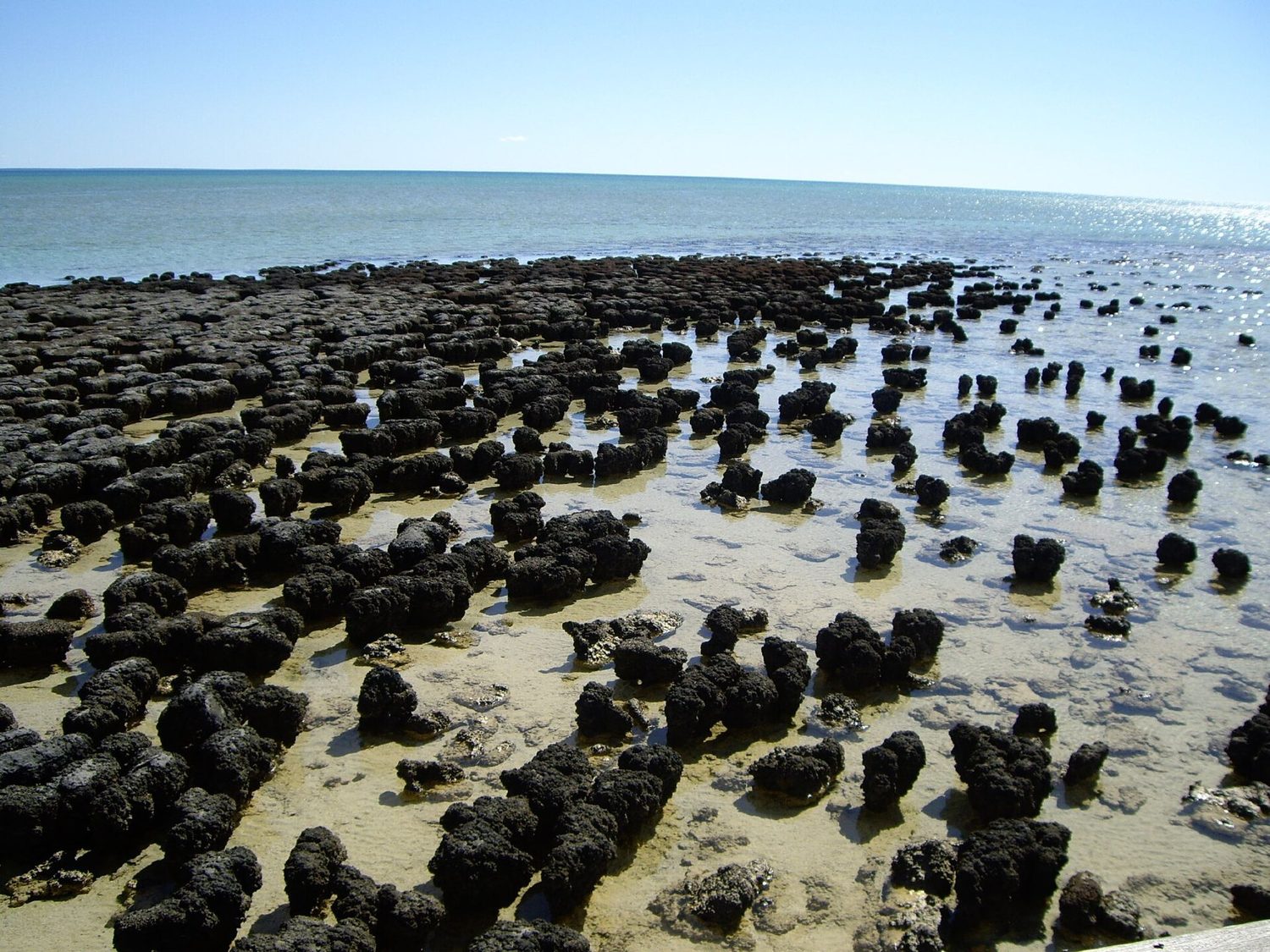
大纲
Big Idea Learning Objective Essential Knowledge Big Idea 4 — Systems Interactions
Biological systems interact, and these systems and their interactions exhibit complex properties.7.12.A
Describe the scientific evidence that supports models of the origin of life on Earth.- 7.12.A.1 The origin of life on Earth is supported by scientific evidence.
- i. Geological evidence reinforces models of the origin of life on Earth.
- ii. Earth formed approximately 4.6 billion years ago (bya). The environment was too hostile for life until about 3.9 bya, and the earliest fossil evidence for life dates to 3.5 bya. Taken together, this evidence provides a plausible range of dates for the origin of life.
- 7.12.A.2 The RNA world hypothesis proposes that RNA could have been the earliest genetic material. There are three assumptions:
- i. At some point in time, genetic continuity was assured by the replication of RNA.
- ii. Base-pairing is necessary for replication.
- iii. Genetically encoded proteins were not involved as catalysts.
来源:美国大学理事会 AP 课程与考试说明
证据表明早期地球的条件能形成简单的有机分子(米勒-尤里类型的实验),它们组装成聚合物、然后自我复制的 RNA("RNA 世界"),并最终成膜的细胞。第一批细胞是原核生物;真核生物后来通过内共生(endosymbiosis)产生。
Stromatolites: layered microbial mats are among the oldest evidence of life on Earth 
A hydrothermal vent: hot chemical-rich water may have powered early metabolism at life's origin 词汇表 训练英文 中文 拼音 endosymbiosis/ˌendəʊˌsɪmbaɪˈəʊsɪs/ 内共生 nèi gòng shēng 7.12
考试技巧
- 干净地陈述自然选择:变异 → 差异的存活和繁殖 → 有帮助的性状变得常见。
- 适合度 = 繁殖成功,不是力量或健康。
- 进化是一个种群里等位基因频率的一个变化——个体不进化。
- 用哈迪-温伯格($p^2+2pq+q^2=1$):从隐性表型 $q^2\to q\to p$ 开始。
- 引用独立的证据(化石、同源结构、DNA)并通过生殖隔离解释物种形成。
-
8
生态学
8.1
对环境的响应
大纲
Big Idea Learning Objective Essential Knowledge Big Idea 2 — Energetics
Biological systems use energy and molecular building blocks to grow, reproduce, and maintain dynamic homeostasis.8.1.A
Explain how the behavioral and physiological response of an organism is related to changes in internal or external environment.- 8.1.A.1 Organisms respond to changes in their environment through behavioral and physiological mechanisms.
- Exclusion statement: Knowledge of specific behavioral or physiological mechanisms is beyond the scope of the AP Exam.
- Illustrative examples for 8.1.A.1:
- Photoperiodism and phototropism in plants
- Taxis and kinesis in animals
- Nocturnal and diurnal activity
- 8.1.A.2 Organisms exchange information with one another in response to internal changes and external cues, which can change behavior.
- Illustrative examples for 8.1.A.2:
- Fight-or-flight response
- Predator warnings
- Plant responses to herbivory
- Illustrative examples for 8.1.A.2:
Big Idea 3 — Information Storage and Transmission
Living systems store, retrieve, transmit, and respond to information essential to life processes.8.1.B
Explain how the behavioral responses of organisms affect their overall fitness and may contribute to the success of a population.- 8.1.B.1 Organisms communicate through various mechanisms (visual, audible, tactile, electrical, and/or chemical signals).
- i. Organisms have a variety of signaling behaviors that produce changes in the behavior of other organisms and can result in differential reproductive success.
- ii. Animals use signals to indicate dominance, find food, establish territory, and ensure reproductive success.
- Exclusion statement: Knowledge of specific mechanisms of communication is beyond the scope of the AP Exam.
- Illustrative examples for 8.1.B.1:
- Territorial marking in mammals
- Coloration in flowering plants and animals
- Bird songs
- Pack behaviors in animals
- Predatory warnings
- 8.1.B.2 Responses to information and communication of information are vital to natural selection and evolution.
- i. Fitness favors innate and learned behaviors that increase survival and reproductive success.
- ii. Cooperative behavior tends to increase the fitness of the individual and the survival of the population.
- Exclusion statement: The details of the various communications and community behavioral systems are beyond the scope of the AP Exam.
- Illustrative examples for 8.1.B.2.i:
- Parent and offspring interactions
- Courtship and mating behaviors
- Foraging by bees and other animals
- Illustrative examples for 8.1.B.2.ii:
- Pack behavior in animals
- Herd, flock, and schooling behavior in animals
- Predator warnings
- Colony and swarming behavior in insects
- Kin selection
来源:美国大学理事会 AP 课程与考试说明
生物以有助于存活和繁殖的方式感知并对它们的环境反应。行为(behaviors)可能是先天的(innate)(遗传的,像反射和本能)或习得的(learned)。像迁徙、冬眠和向光性这样的反应,以及生物之间的信号,由自然选择塑造,因为它们改善适合度。
Sunflowers face the light: organisms detect and respond to environmental stimuli CED 点名列出的那些行为
考题的情境就是从这些示例行为里搭出来的,所以要弄清每一个是什么、以及它给生物带来什么:
行为 是什么 为什么有利于适合度 趋性(taxis) 朝向或远离刺激的有方向的移动 找到食物、光或水分,或躲开危险 动性(kinesis) 随机移动速率的改变,没有方向 在有利条件下移动得少、在别处移动得多,从而留在有利处 夜行性、昼行性(nocturnal / diurnal) 在夜间活动,或在白天活动 避开捕食者或高温,并让活动时间与食物出现的时间相匹配 领域标记(territorial marking) 用气味、声音或视觉标记宣示一片区域 不必反复打斗就保住食物、巢址和配偶 体色(coloration) 动物与开花植物中的色素分布 警戒、伪装、吸引配偶——在花中则是吸引传粉者 觅食(foraging),蜜蜂等 搜寻并采集食物 高效的觅食带回的能量多于付出的能量,而选择作用的正是这一点 ⚠️ 趋性与动性是最常被混淆的一对。 趋性有方向:鼠妇朝潮湿处走。动性只有速率:鼠妇在干燥空气中走得快、转向频繁,在潮湿处慢下来,于是它从未"朝那里走"却最终停在潮湿处。
生活史策略(life-history strategy)是一个生物何时生长、何时繁殖、何时死亡的模式,它同样受选择塑造:二年生(biennial)植物第一年储存资源、第二年开花;生殖滞育(reproductive diapause)把发育暂停到条件转好为止,使后代在能够存活的时候出生。两者都是在繁殖的时机与繁殖成功的机会之间做权衡。
词汇表 训练英文 中文 拼音 taxis/ˈtæksiz/ 趋性 qū xìng kinesis/kəˈniːsɪs/ 动性 dòng xìng nocturnal and diurnal activity/nɒkˈtɜːnl ænd ˈdɪɜːnl ækˈtɪvɪti/ 夜行性与昼行性 yè xíng xìng yǔ zhòu xíng xìng territorial marking/ˌterɪˈtɔːrɪəl ˈmɑːkɪŋ/ 领域标记 lǐng yù biāo jì coloration/ˌkʌləˈreɪʃn/ 体色 tǐ sè foraging/ˈfɒrɪdʒɪŋ/ 觅食 mì shí Life-history strategy/laɪf ˈhɪstəri ˈstrætədʒi/ 生活史策略 shēng huó shǐ cè lüè 8.2
生态系统中的能量流动
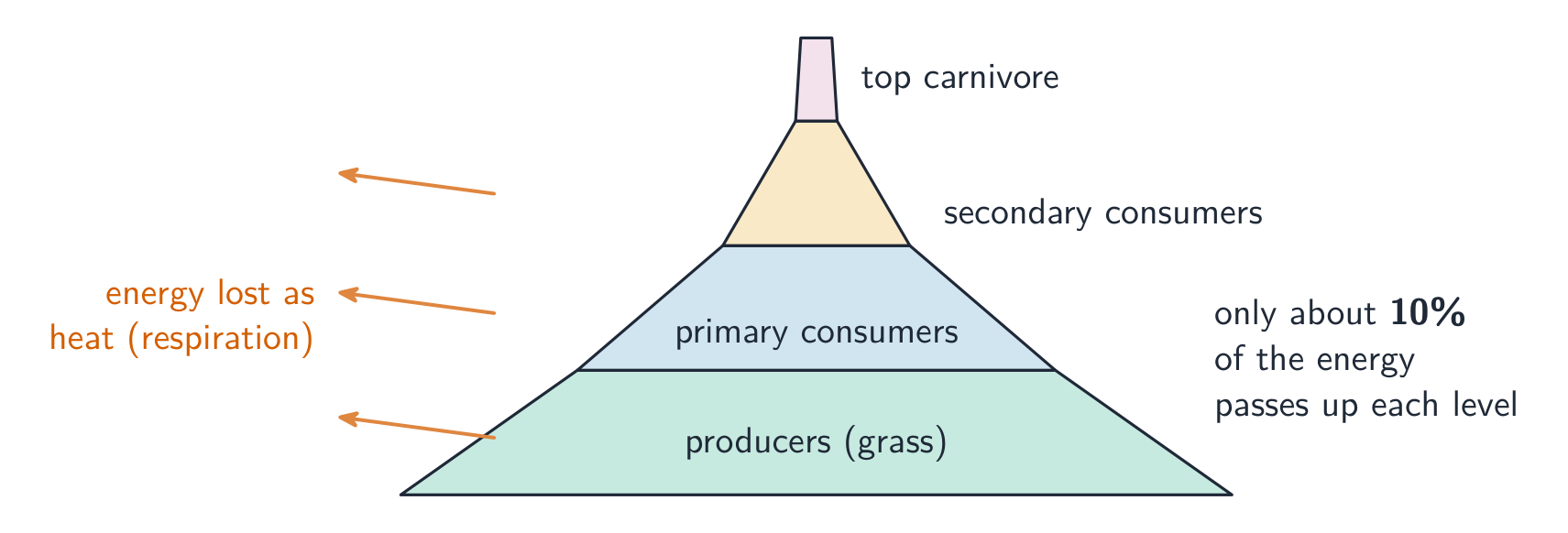
大纲
Big Idea Learning Objective Essential Knowledge Big Idea 2 — Energetics
Biological systems use energy and molecular building blocks to grow, reproduce, and maintain dynamic homeostasis.8.2.A
Describe the strategies organisms use to acquire and use energy.- 8.2.A.1 Organisms use energy to organize, grow, reproduce, and maintain homeostasis.
- i. Organisms use different strategies to regulate body temperature and metabolism. Endotherms use thermal energy generated by metabolism to maintain homeostatic body temperatures. Ectotherms lack efficient internal mechanisms for maintaining body temperature, although they may regulate their temperature behaviorally by moving into the sun or shade or by aggregating with other individuals.
- ii. A net gain in energy results in energy storage, the growth of an organism, and increased reproductive output.
- iii. A net loss of energy results in loss of mass, a decrease in reproductive output, and, eventually, the death of an organism.
- 8.2.A.2 Different organisms use various reproductive strategies in response to energy availability. Some organisms alternate between asexual and sexual reproduction in response to energy availability.
- Illustrative examples for 8.2.A:
- Seasonal reproduction in animals and plants
- Life-history strategy (biennial plants, reproductive diapause)
- Illustrative examples for 8.2.A:
8.2.B
Explain how energy flows and matter cycles through trophic levels.- 8.2.B.1 Ecological levels of organization include populations, communities, ecosystems, and biomes.
- 8.2.B.2 Energy flows through ecosystems, while matter and nutrients cycle between the environment and organisms via biogeochemical cycles. The cycles are essential for life, and each cycle demonstrates the conservation of matter. The cycles are interdependent.
- 8.2.B.3 Biogeochemical cycles include abiotic and biotic reservoirs, as well as processes that cycle matter between reservoirs.
- 8.2.B.4 The hydrologic (water) cycle involves water movement and storage within the hydrosphere. Reservoirs include oceans, surface water, the atmosphere, and living organisms. Processes include evaporation, condensation, precipitation, and transpiration.
- 8.2.B.5 The carbon cycle involves recycling carbon atoms through Earth's biosphere into organisms as carbohydrates and back into the atmosphere as carbon dioxide $\left(\mathrm{CO_2}\right)$. At the highest levels of organization, the carbon cycle can be simplified into four parts: photosynthesis, cellular respiration, decomposition, and combustion.
- 8.2.B.6 The nitrogen cycle involves several steps, including nitrogen fixation, assimilation, ammonification, nitrification, and denitrification. These steps are performed by microorganisms in the soil. The largest reservoir of nitrogen is the atmosphere. In nitrogen fixation, nitrogen gas $\left(\mathrm{N_2}\right)$ is fixed into ammonia $\left(\mathrm{NH_3}\right)$, which ionizes to ammonium $\left(\mathrm{NH_4^+}\right)$ by acquiring hydrogen ions from the soil solution.
- 8.2.B.7 The phosphorus cycle involves weathering rocks releasing phosphate $\left(\mathrm{PO_4^{3-}}\right)$ into soil and groundwater. Producers take in phosphate, which is incorporated into biological molecules; consumers eat producers, transferring phosphate to animals. Phosphorus returns to the soil via decomposition of biomass, or excretion. Phosphate can also be incorporated back into the environment via decomposition of decaying organic matter.
8.2.C
Explain how changes in energy availability affect populations, communities, and ecosystems.- 8.2.C.1 Changes in energy availability can result in changes in population size.
- 8.2.C.2 Changes in energy availability can result in disruptions to an ecosystem.
- i. A change in energy resources such as sunlight can affect the number and size of the trophic levels. Trophic levels include producers; primary, secondary, tertiary, and quaternary consumers; and decomposers.
- ii. A change in the biomass or number of producers in a given geographic area can affect the number and size of other trophic levels.
8.2.D
Explain how the activities of autotrophs and heterotrophs enable the flow of energy within an ecosystem.- 8.2.D.1 Autotrophs capture energy from physical or chemical sources in the environment.
- i. Photosynthetic organisms capture energy present in sunlight contributing to primary productivity.
- ii. Chemosynthetic organisms capture energy from small inorganic molecules present in their environment, which can occur in the absence of oxygen.
- 8.2.D.2 Heterotrophs, which include carnivores, herbivores, omnivores, decomposers, and scavengers, metabolize carbohydrates, lipids, and proteins as sources of energy. Heterotrophs capture the energy present in carbon compounds by consuming organic matter derived from autotrophs incorporating matter into their tissues.
来源:美国大学理事会 AP 课程与考试说明
能量作为阳光进入大多数生态系统(ecosystems),被生产者(producers)(光合作用者)捕获,并沿着一条食物链(food chain)传给消费者(consumers)。每一层是一个营养级(trophic level)。只有约 10% 的能量向上转移每一级(其余作为热损失),所以食物链是短的而生产者是最丰富的。能量流(flows)过并被损失,而物质(碳、氮)循环(cycles)。
只有约 10% 的能量传给下一个营养级 Worked example. 假设生产者捕获 $10{,}000\ \text{kcal}$。应用 $10\%$ 规则,初级消费者接收约 $1{,}000\ \text{kcal}$、次级消费者 $100\ \text{kcal}$,而三级消费者只有 $10\ \text{kcal}$。在每一步作为热损失 $90\%$ 正是为什么食物链很少超过四或五级——剩下的能量太少不足以支持另一级。
探索Energy up a food chain
Only about 10% of energy passes to the next trophic level; the rest is lost as heat. That's why food chains are short and top predators are few.
词汇表 训练英文 中文 拼音 ecosystems/ˈiːkəʊsɪstəmz/ 生态系统 shēng tài xì tǒng producers/prəˈdjuːsəz/ 生产者 shēng chǎn zhě consumers/kənˈsuːməz/ 消费者 xiāo fèi zhě food chain/fuːd tʃeɪn/ 食物链 shí wù liàn trophic level/ˈtrəʊfɪk ˈlevl/ 营养级 yíng yǎng jí 8.3
种群生态学
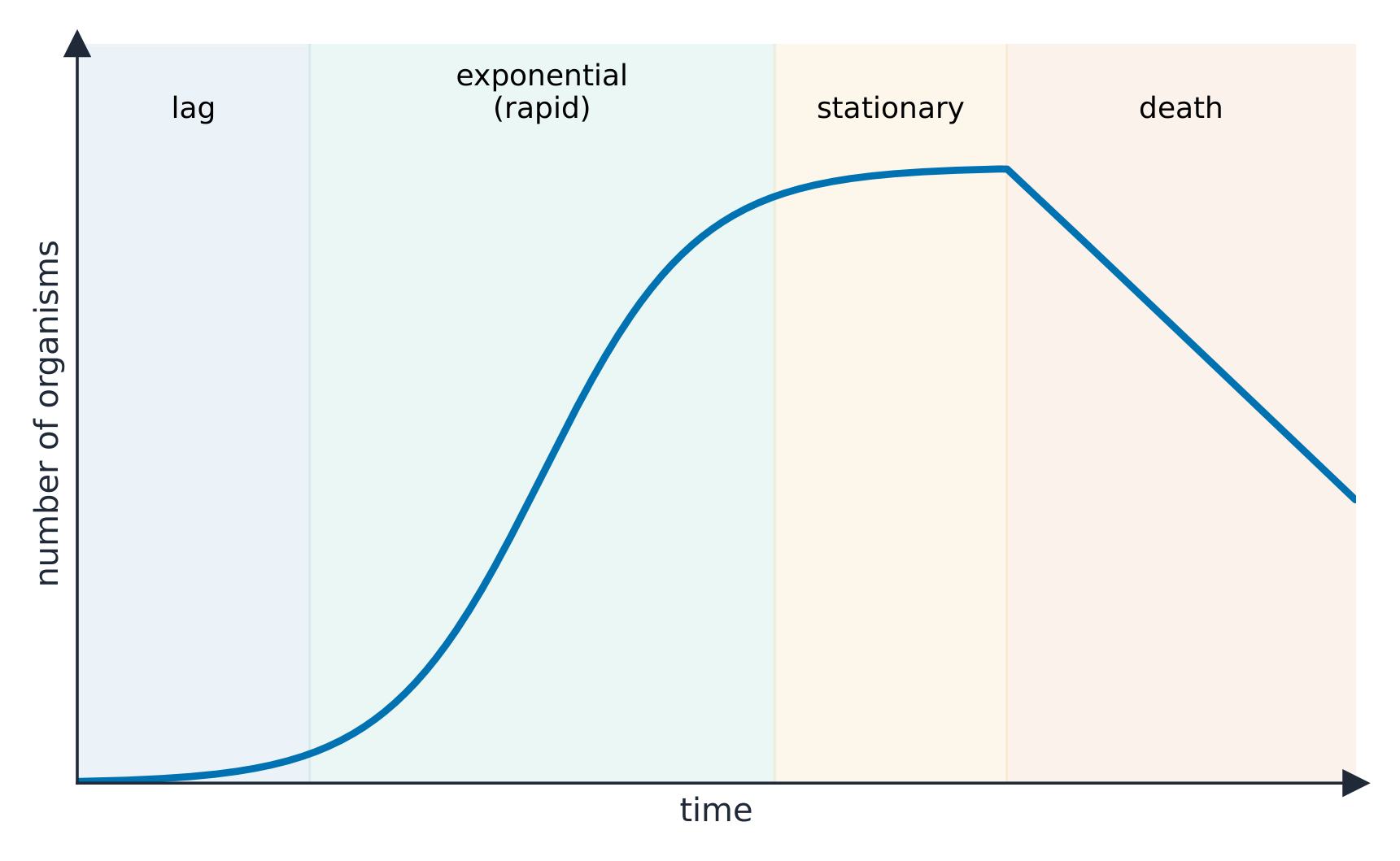
大纲
Big Idea Learning Objective Essential Knowledge Big Idea 3 — Information Storage and Transmission
Living systems store, retrieve, transmit, and respond to information essential to life processes.8.3.A
Describe factors that influence growth dynamics of populations.- 8.3.A.1 Populations comprise individual organisms of the same species that interact with one another and with the environment in complex ways.
- 8.3.A.2 Many adaptations in organisms are related to obtaining and using energy and matter in a particular environment.
- i. Population growth dynamics depend on birth rate, death rate, and population size.
- Equation: Population Growth — $\dfrac{dN}{dt} = B - D$ where $dt$ = chage in time; $B$ = birth rate; $D$ = death rate; $N$ = population size; $dN$ = change in population size
- ii. Reproduction without constraints results in the exponential growth of a population.
- Equation: Exponential Growth — $\dfrac{dN}{dt} = r_{max} N$ where $dt$ = change in time; $N$ = population size; $dN$ = change in population size; $r_{max}$ = maximum per capita growth rate of population
- i. Population growth dynamics depend on birth rate, death rate, and population size.
来源:美国大学理事会 AP 课程与考试说明
一个种群(population)是一个区域里一个物种的个体。它的增长取决于出生、死亡、迁入和迁出。指数增长(exponential growth)($J$ 形)在无限资源下发生;逻辑斯蒂增长(logistic growth)($S$ 形)在环境容纳量(carrying capacity)$K$——环境能维持的最大值——处趋平,遵循 $\dfrac{dN}{dt}=r_{\max}N\dfrac{K-N}{K}$。
种群增长:滞后、指数,然后在环境容纳量处趋平 Worked example. 一个种群有 $r_{\max}=0.5\ \text{yr}^{-1}$、环境容纳量 $K=1000$,和当前大小 $N=400$。那么 $\dfrac{dN}{dt}=0.5\times400\times\dfrac{1000-400}{1000}=0.5\times400\times0.6=120$ 个个体每年。$\frac{K-N}{K}$ 项是为什么增长在 $N=K/2$ 附近最快而随着 $N$ 接近 $K$ 减慢向零。
探索Grow a population to carrying capacity
A population grows fast when small, then slows as it nears its carrying capacity $K$ — logistic growth. Raise the growth rate and watch it level off.
词汇表 训练英文 中文 拼音 population/ˌpɒpjʊˈleɪʃn/ 种群 zhǒng qún Exponential growth/ˌekspəˈnenʃl ɡrəʊθ/ 指数增长 zhǐ shù zēng zhǎng logistic growth/ləˈdʒɪstɪk ɡrəʊθ/ 逻辑斯蒂增长 luó jí sī dì zēng zhǎng carrying capacity/ˈkæriɪŋ kəˈpæsɪti/ 环境容纳量 huán jìng róng nà liàng 8.4
密度对种群的影响
大纲
Big Idea Learning Objective Essential Knowledge Big Idea 4 — Systems Interactions
Biological systems interact, and these systems and their interactions exhibit complex properties.8.4.A
Explain how the density of a population affects and is determined by resource availability in the environment.- 8.4.A.1 Carrying capacity is the sustainable abundance of a species that can be supported by the ecosystem's total available resources.
- 8.4.A.2 As limits to growth attributable to density-dependent and density-independent factors are imposed, a logistic growth model typically ensues.
- Equation: Logistical Growth — $\dfrac{dN}{dt} = r_{max} N \left( \dfrac{K - N}{K} \right)$ where $dt$ = change in time; $N$ = population size; $dN$ = change in population size; $r_{max}$ = maximum per capita growth rate of population; $K$ = carrying capacity
来源:美国大学理事会 AP 课程与考试说明
一些因素取决于拥挤,另一些不:
- 密度制约(density-dependent)因素随着一个种群增长而加剧——竞争、捕食、疾病。
- 非密度制约(density-independent)因素不管密度都作用——天气、自然灾害。
这些因素在环境容纳量附近调节种群大小。
A dense deer herd: density-dependent factors such as disease and food competition intensify as numbers rise 词汇表 训练英文 中文 拼音 Density-dependent/ˈdensɪti dɪˈpendənt/ 密度制约 mì dù zhì yuē Density-independent/ˈdensɪti ˌɪndɪˈpendənt/ 非密度制约 fēi mì dù zhì yuē competition/ˌkɒmpəˈtɪʃn/ 竞争 jìng zhēng 8.5
群落生态学
大纲
Big Idea Learning Objective Essential Knowledge Big Idea 2 — Energetics
Biological systems use energy and molecular building blocks to grow, reproduce, and maintain dynamic homeostasis.8.5.A
Describe the structure of a community according to its species composition and diversity.- 8.5.A.1 The structure of a community is measured and described in terms of species composition and species diversity.
- Equation: Simpson's Diversity Index — $\text{Diversity Index} = 1 - \sum \left( \dfrac{n}{N} \right)^2$ where $n$ = total number of organisms of a particular species; $N$ = total number of organisms of all species
8.5.B
Explain how interactions within and among populations influence community structure.- 8.5.B.1 Communities are groups of interacting populations of different species that change over time based on the interactions between those populations.
- 8.5.B.2 Interactions among populations determine how they access energy and matter within a community.
- 8.5.B.3 Relationships among interacting populations can be characterized by positive and negative effects and can be modeled. Examples include predator/prey interactions, cooperation, trophic cascades, and niche partitioning.
- 8.5.B.4 Competition, predation, and symbioses, including parasitism, mutualism, and commensalism, can drive population dynamics.
来源:美国大学理事会 AP 课程与考试说明
一个群落(community)是一个区域里所有相互作用的种群。关键的相互作用:竞争(competition)(为共享的资源)、捕食(predation)、共生(symbiosis)——互利共生(mutualism)(两者都受益)、偏利共生(commensalism)(一个受益,另一个不受影响),和寄生(parasitism)(一个受益,另一个受害)。这些关系塑造哪些物种共存。
一个食物网把几条食物链连接在一起 词汇表 训练英文 中文 拼音 community/kəˈmjuːnɪti/ 群落 qún luò predation/prɪˈdeɪʃn/ 捕食 bǔ shí symbiosis/ˌsɪmbaɪˈəʊsɪs/ 共生 gòng shēng 8.6
生物多样性
大纲
Big Idea Learning Objective Essential Knowledge Big Idea 4 — Systems Interactions
Biological systems interact, and these systems and their interactions exhibit complex properties.8.6.A
Describe the relationship between ecosystem diversity and its resilience to changes in the environment.- 8.6.A.1 Natural and artificial ecosystems with fewer component parts, and with little diversity among the parts, are often less resilient to changes in the environment.
- 8.6.A.2 Keystone species, producers, and essential abiotic and biotic factors contribute to maintaining the diversity of an ecosystem.
8.6.B
Explain how the addition or removal of any component of an ecosystem will affect its overall short-term and long-term structure.- 8.6.B.1 The effects of keystone species on the ecosystem are disproportionate relative to their abundance in the ecosystem. When they are removed from the ecosystem, it often collapses.
来源:美国大学理事会 AP 课程与考试说明
生物多样性(biodiversity)是生命的多样性——基因、物种和生态系统。更高的多样性一般使一个群落更有韧性(resilient),更能够承受干扰并从中恢复。一个关键种(keystone species)有一个超大的影响,所以失去它能使群落崩溃。
三个层次的生物多样性:遗传、物种和栖息地 词汇表 训练英文 中文 拼音 Biodiversity/ˌbaɪəʊdaɪˈvɜːsɪti/ 生物多样性 shēng wù duō yàng xìng resilient/rɪˈsɪlɪənt/ 有韧性 yǒu rèn xìng keystone species/ˈkiːstəʊn ˈspiːsiːz/ 关键种 guān jiàn zhǒng 8.7
生态系统的干扰
大纲
Big Idea Learning Objective Essential Knowledge Big Idea 1 — Evolution
The process of evolution drives the diversity and unity of life.8.7.A
Explain the interaction between the environment and random or preexisting variations in populations.- 8.7.A.1 An adaptation is a genetic variation that is favored by selection and manifests as a trait that provides an advantage to an organism in a particular environment.
- 8.7.A.2 Heterozygote advantage is when the heterozygous genotype has a higher relative fitness than either the homozygous dominant or homozygous recessive genotype.
- 8.7.A.3 Mutations are not directed by specific environmental pressures.
Big Idea 4 — Systems Interactions
Biological systems interact, and these systems and their interactions exhibit complex properties.8.7.B
Explain how invasive species affect ecosystem dynamics.- 8.7.B.1 The intentional or unintentional introduction of an invasive species can allow the species to exploit a new niche free of predators or competitors or to outcompete native species for resources.
- Illustrative examples for 8.7.B.1:
- Kudzu
- Zebra mussels
- Illustrative examples for 8.7.B.1:
8.7.C
Describe human activities that lead to changes in ecosystem structure and dynamics.- 8.7.C.1 Human impact accelerates changes at local and global levels. These activities can drive changes in ecosystems, such as the following, that cause extinctions to occur:
- i. Biomagnification
- ii. Eutrophication
- Illustrative examples for 8.7.C.1:
- Dutch elm disease
- Potato blight
8.7.D
Explain how geological and meteorological activity leads to changes in ecosystem structure and dynamics.- 8.7.D.1 Geological and meteorological events affect habitat change and ecosystem distribution. Biogeographical studies illustrate these changes.
- Illustrative examples for 8.7.D.1:
- Global climate change
- Logging
- Urbanization
- Monocropping
- El Nino
- Continental drift
- Meteor impact on dinosaurs
- Illustrative examples for 8.7.D.1:
来源:美国大学理事会 AP 课程与考试说明
生态系统因自然和人类原因而变化——气候转变、入侵物种、栖息地丧失和污染。一次干扰能触发生态演替(ecological succession)(群落随时间重建)。因为物种相互连接,对一个物种的一个变化——尤其是一个关键种或一个营养级——能波及整个生态系统。
森林砍伐降低生物多样性并造成侵蚀、洪水和更高的 CO2 词汇表 训练英文 中文 拼音 ecological succession/ˌekəˈlɒdʒɪkl səkˈseʃn/ 生态演替 shēng tài yǎn tì 8.7
考试技巧
- 应用 10% 规则:约 90% 的能量在每个营养级损失,所以食物链是短的。
- 区分指数($J$)和逻辑斯蒂($S$)增长;后者在环境容纳量处趋平($\frac{dN}{dt}=r_{\max}N\frac{K-N}{K}$)。
- 把密度制约(竞争、疾病、捕食)与非密度制约(天气)限制因素分开。
- 命名群落的相互作用(竞争、捕食、共生)以及一个关键种的效应。
- 解释干扰一个物种——尤其是一个关键种或一个整个营养级——如何波及生态系统。
- 8.1.A.1 Organisms respond to changes in their environment through behavioral and physiological mechanisms.