跳到主要内容

细胞能量学

AP 生物 · 第 3 主题

训练
讲义 词汇表
3.1

大纲
Big IdeaLearning ObjectiveEssential Knowledge

Big Idea 2 — Energetics
Biological systems use energy and molecular building blocks to grow, reproduce, and maintain dynamic homeostasis.

3.1.A
Explain how enzymes affect the rate of biological reactions.

  • 3.1.A.1 The structure and function of enzymes contribute to the regulation of biological processes. Enzymes are proteins that are biological catalysts that facilitate chemical reactions in cells by lowering the activation energy.
  • 3.1.A.2 For an enzyme-mediated chemical reaction to occur, the shape and charge of the substrate must be compatible with the active site of the enzyme. This is illustrated by the enzyme-substrate complex model.

来源:美国大学理事会 AP 课程与考试说明

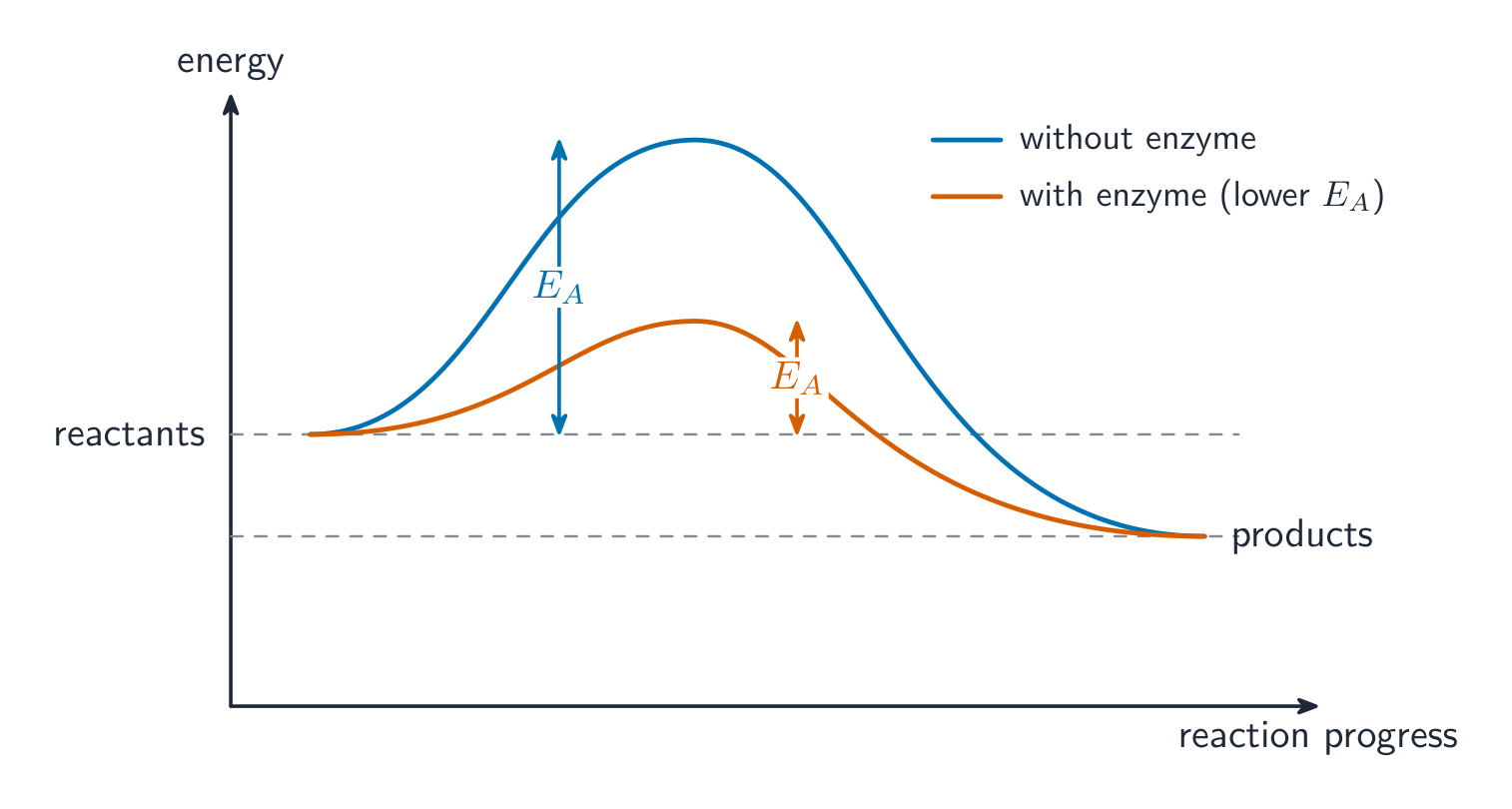
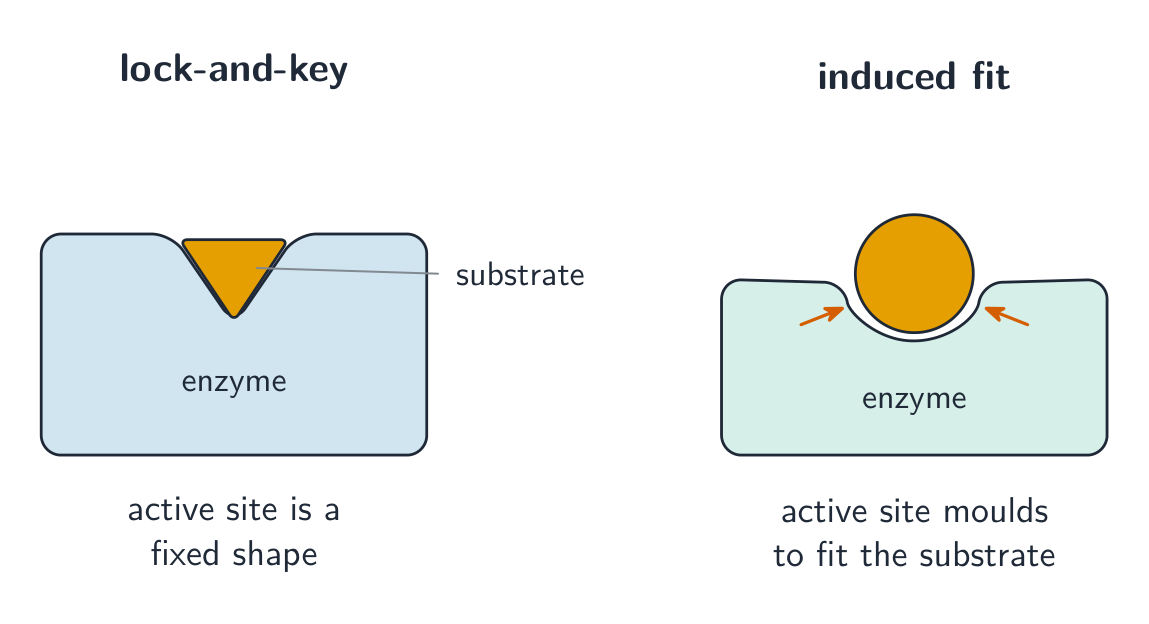
一个(enzyme)是一个蛋白质催化剂(catalyst),通过降低反应的活化能(activation energy)加速反应,而不被消耗。每个酶有一个活性位点(active site),结合一个特定的底物(substrate)("锁和钥匙"或诱导契合),所以酶是高度特异的。它们不改变一个反应是否有利——只改变它进行得多快。
一个酶降低一个反应的活化能
一个酶降低一个反应的活化能
酶作用的锁-钥匙和诱导契合模型
酶作用的锁-钥匙和诱导契合模型
探索

Raise substrate and watch the rate saturate

An enzyme speeds a reaction by lowering activation energy. As substrate rises the rate climbs, then levels off once every active site is busy (saturation).

词汇表 训练
英文 中文 拼音
enzyme méi
catalyst 催化剂 cuī huà jì
activation energy 活化能 huó huà néng
active site 活性位点 huó xìng wèi diǎn
substrate 底物 dǐ wù
3.2

环境对酶功能的影响

大纲
Big IdeaLearning ObjectiveEssential Knowledge

Big Idea 2 — Energetics
Biological systems use energy and molecular building blocks to grow, reproduce, and maintain dynamic homeostasis.

3.2.A
Explain how changes to the structure of an enzyme may affect its function.

  • 3.2.A.1 Change to the molecular structure of a component in an enzymatic system may result in a change to its function or efficiency.
    • i. Denaturation of proteins, such as enzymes, occurs when the protein structure is disrupted by a change in temperature, pH, or chemical environment, eliminating the ability to catalyze reactions.
    • ii. Environmental temperatures and pH outside the optimal range for a given enzyme will cause changes to its structure (by disrupting the hydrogen bonds), altering the efficiency with which it catalyzes reactions.
  • 3.2.A.2 In some cases, enzyme denaturation is reversible, allowing the enzyme to regain activity.

3.2.B
Explain how the cellular environment affects enzyme activity.

  • 3.2.B.1 The relative concentrations of substrates and products determine how efficiently an enzymatic reaction proceeds.

来源:美国大学理事会 AP 课程与考试说明

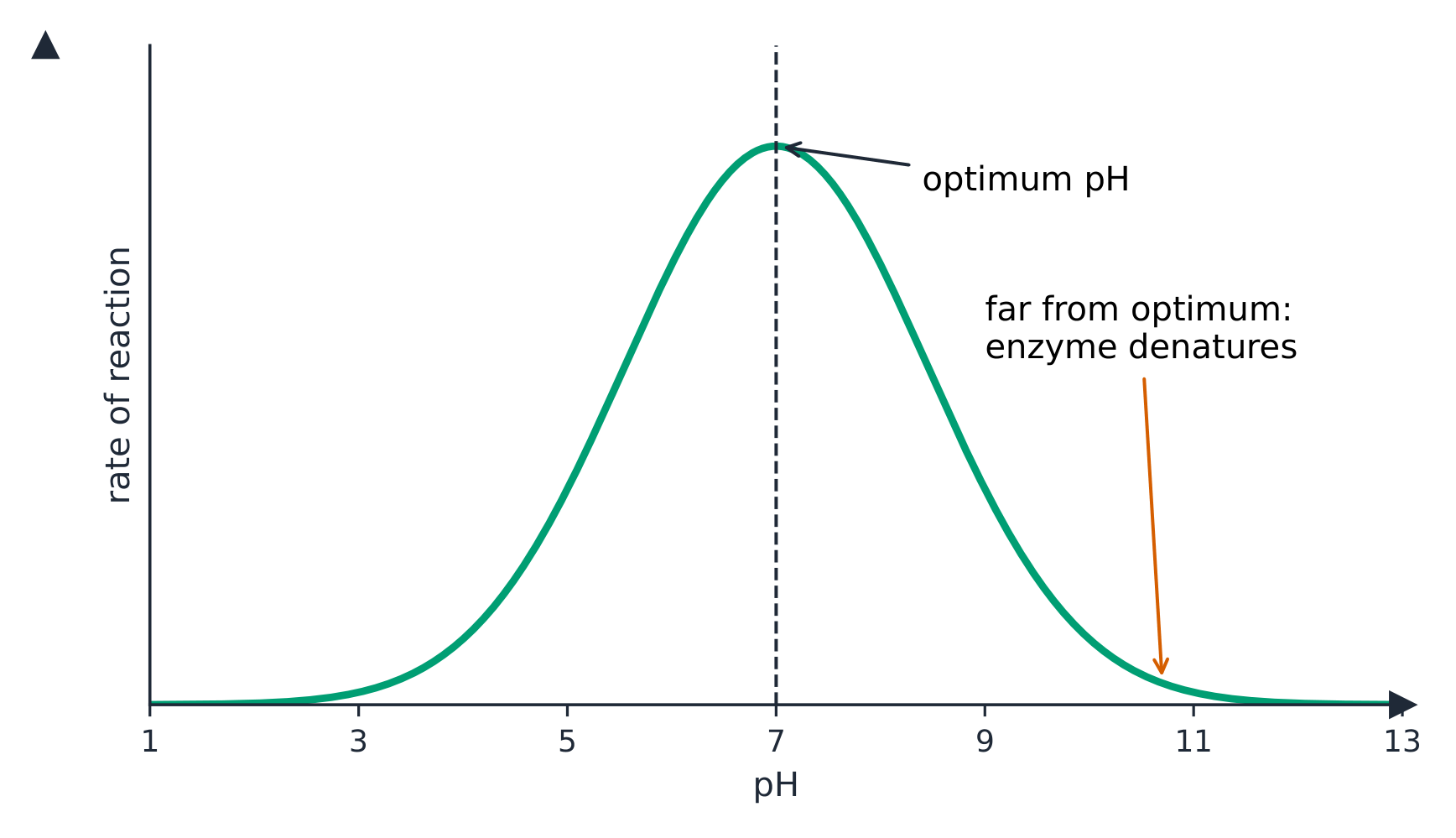
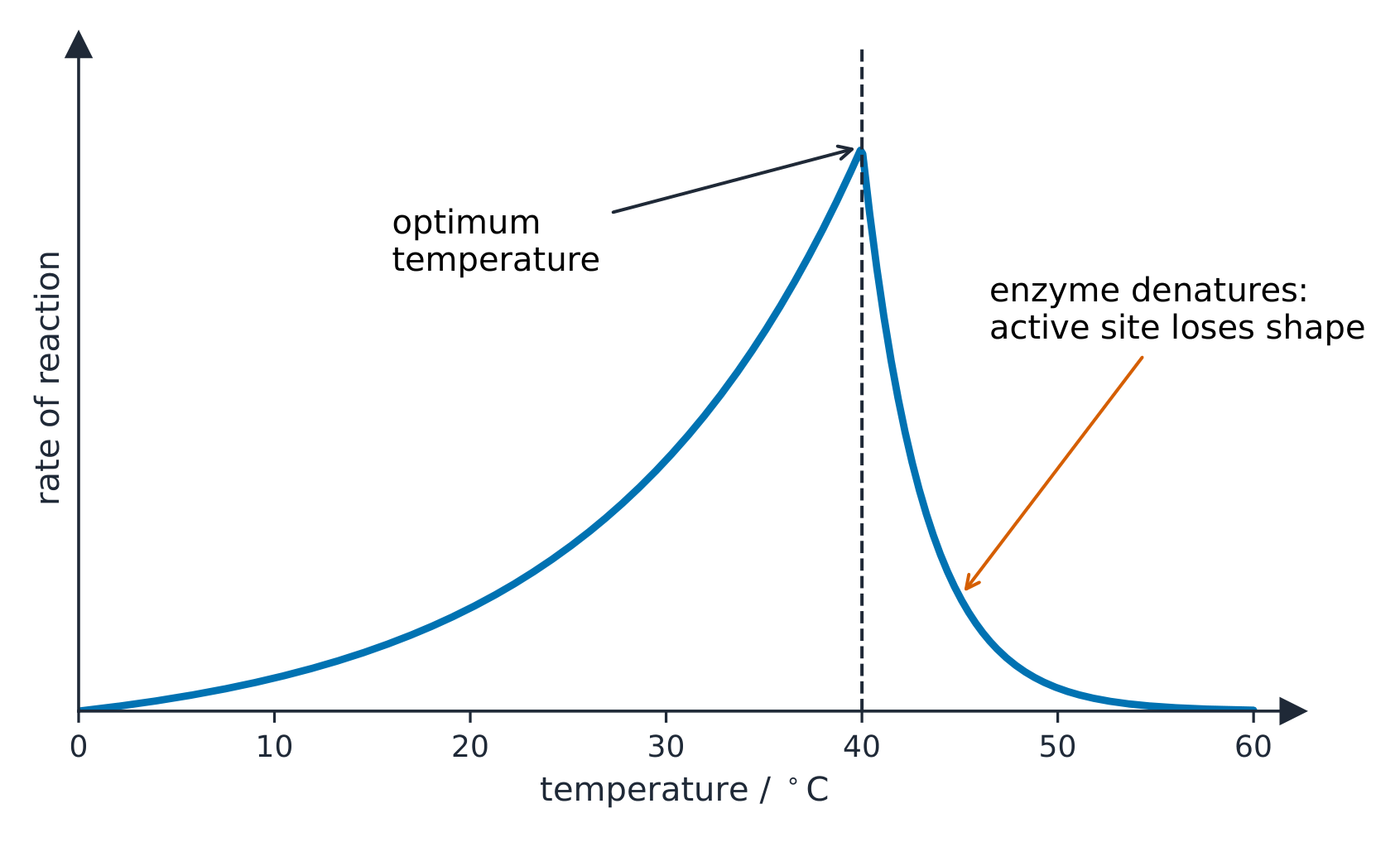
酶的活性取决于条件。每个酶有一个最适温度和 pH;超过它,蛋白质变性(denatures)(失去形状)并停止工作。底物浓度提高速率直到酶饱和。抑制剂(inhibitors)减慢酶——竞争性的堵塞活性位点,非竞争性的结合到别处并改变形状。
每个酶有一个最适 pH
每个酶有一个最适 pH
速率上升到一个最适温度,然后随着酶变性而下降
探索

Change temperature and watch enzyme activity

Each enzyme has an optimum temperature and pH. Too cold is slow; too hot denatures the enzyme so its active site loses shape and activity crashes.

词汇表 训练
英文 中文 拼音
denatures 变性 biàn xìng
Inhibitors 抑制剂 yì zhì jì
3.3

细胞能量

大纲
Big IdeaLearning ObjectiveEssential Knowledge

Big Idea 2 — Energetics
Biological systems use energy and molecular building blocks to grow, reproduce, and maintain dynamic homeostasis.

3.3.A
Describe the role of energy in living organisms.

  • 3.3.A.1 All living systems require an input of energy.
  • 3.3.A.2 Life requires a highly ordered system and does not violate the first and second laws of thermodynamics.
    • i. Energy input must exceed energy loss to maintain order and to power cellular processes.
    • ii. Cellular processes that release energy may be coupled with cellular processes that require energy.
    • iii. Significant loss of order or energy flow results in death.
    • Exclusion statement: Students will need to understand the concept of energy, but the equation for Gibbs free energy is beyond the scope of the AP Exam.
  • 3.3.A.3 Energy-related pathways in biological systems are sequential to allow for a more controlled transfer of energy. A product of a reaction in a metabolic pathway is typically the reactant for the subsequent step in the pathway.

3.3.B
Explain how shared, conserved, and fundamental processes and features support the concept of common ancestry for all organisms.

  • 3.3.B.1 Core metabolic pathways (e.g., glycolysis, oxidative phosphorylation) are conserved across all currently recognized domains (Archaea, Bacteria, and Eukarya).

来源:美国大学理事会 AP 课程与考试说明

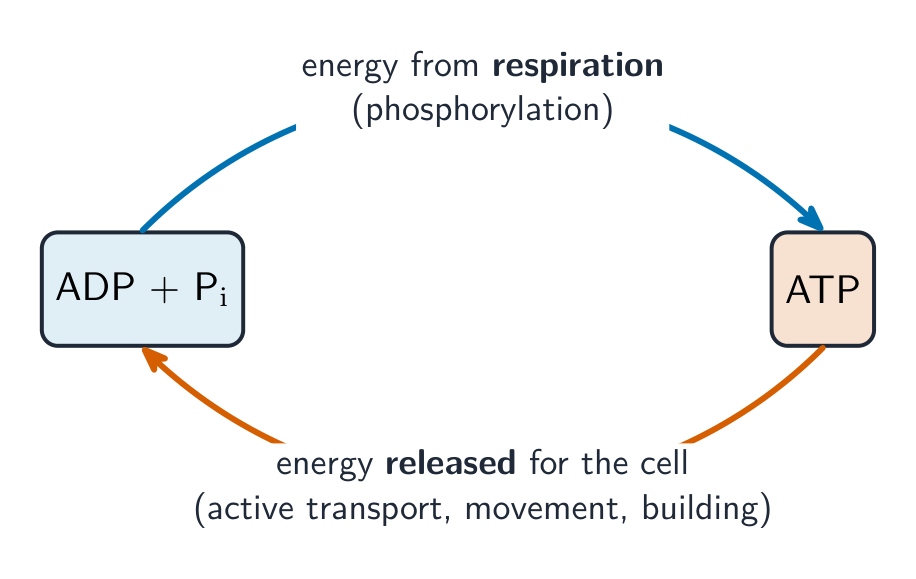
ATP(三磷酸腺苷)是细胞的能量货币。能量储存在它的磷酸键里;断掉一个磷酸(ATP → ADP)释放能量来驱动细胞工作,而重新附上一个储存能量。细胞不断回收 ATP,把释放能量的反应与需要能量的反应耦合。

ATP-ADP 循环储存和释放能量
ATP-ADP 循环储存和释放能量
3.4

光合作用

大纲
Big IdeaLearning ObjectiveEssential Knowledge

Big Idea 2 — Energetics
Biological systems use energy and molecular building blocks to grow, reproduce, and maintain dynamic homeostasis.

3.4.A
Describe the photosynthetic processes and structural features of the chloroplast that allow organisms to capture and store energy.

  • 3.4.A.1 Photosynthesis is the series of reactions that use carbon dioxide $(\mathrm{CO_2})$, water $(\mathrm{H_2O})$, and light energy to make carbohydrates and oxygen $(\mathrm{O_2})$.
    • i. Photosynthetic organisms capture energy from the sun and produce sugars that can be used in biological processes or stored.
    • ii. Photosynthesis first evolved in prokaryotic organisms.
    • iii. Scientific evidence supports the claim that prokaryotic (cyanobacterial) photosynthesis was responsible for the production of an oxygenated atmosphere.
    • iv. Prokaryotic photosynthetic pathways were the foundation of eukaryotic photosynthesis.
    • Exclusion statement: Memorization of the steps in the Calvin cycle, the structure of the molecules, and the names of the enzymes involved, with the exception of ATP synthase, is beyond the scope of the AP Exam.
  • 3.4.A.2 Stroma and thylakoids are found within the chloroplast.
    • i. The stroma is the fluid within the inner chloroplast membrane and outside the thylakoid. The carbon fixation (Calvin cycle) reactions of photosynthesis occur in the stroma.
    • ii. The thylakoid membranes contain chlorophyll pigments organized into two photosystems, as well as electron transport proteins.
    • iii. Thylakoids are organized in stacks called grana. The light reactions of photosynthesis occur in the grana.
  • 3.4.A.3 The light reactions of photosynthesis in eukaryotes involve a series of coordinated reaction pathways that capture energy present in light to yield ATP and NADPH, which power the production of organic molecules in the Calvin cycle. This provides energy for metabolic processes.

3.4.B
Explain how cells capture energy from light and transfer it to biological molecules for storage and use.

  • 3.4.B.1 Electron transport chain (ETC) reactions occur in chloroplasts, in mitochondria, and across prokaryotic plasma membranes. In photosynthesis, electrons that pass through the thylakoid membrane are picked up and ultimately transferred to $\mathrm{NADP^+}$ reducing it to NADPH in photosystem I.
    • Exclusion statement: The full names of the specific electron carriers in the electron transport chain are beyond the scope of the AP Exam.
    • Exclusion statement: Specific steps, names of enzymes, and intermediates of the pathways for these processes are beyond the scope of this course and the AP Exam.
  • 3.4.B.2 During photosynthesis, chlorophylls absorb energy from light, boosting electrons to a higher energy level in photosystems I and II. Water then splits, supplying electrons to replace those lost from photosystem II.
  • 3.4.B.3 Photosystems I and II are embedded in the thylakoid membranes of chloroplasts and are connected by the transfer of electrons through an ETC.
  • 3.4.B.4 When electrons are transferred between molecules in a series of oxidation/reduction reactions as they pass through the ETC, an electrochemical gradient of protons (hydrogen ions) is established across the thylakoid membrane. The membrane separates a region of low proton concentration outside the thylakoid membrane from a region of high proton concentration inside the thylakoid membrane.
  • 3.4.B.5 The formation of the proton gradient is linked to the synthesis of ATP from ADP and inorganic phosphate via ATP synthase. The flow of protons back through membrane-bound ATP synthase by chemiosmosis drives the formation of ATP from ADP and inorganic phosphate; this is known as photophosphorylation.
  • 3.4.B.6 The energy captured in the light reactions and transferred to ATP and NADPH powers the production of carbohydrates from carbon dioxide in the Calvin cycle. This occurs in the stroma of the chloroplast.

来源:美国大学理事会 AP 课程与考试说明

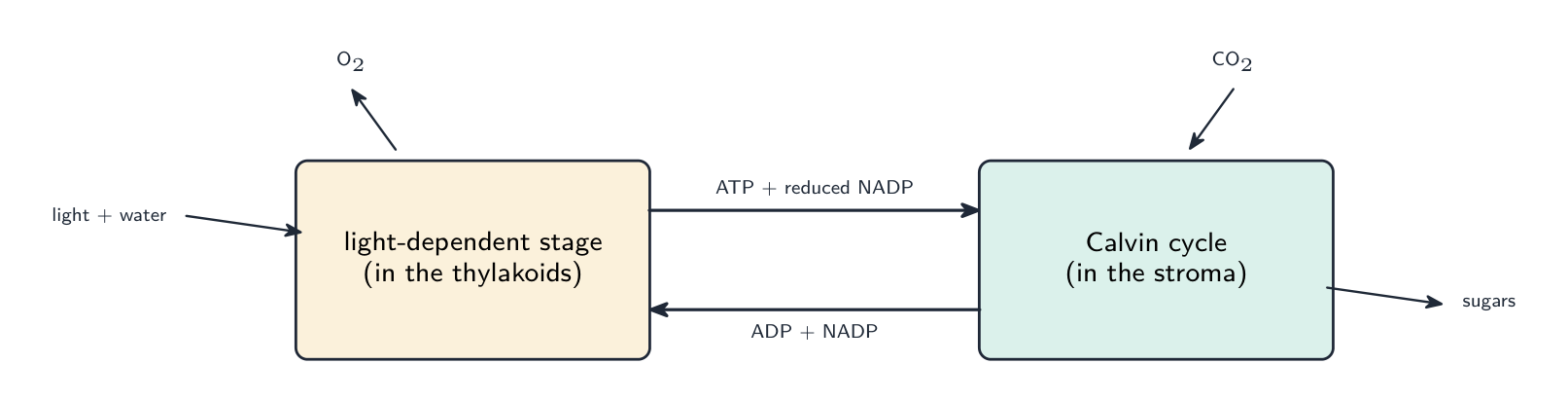
光合作用(photosynthesis)捕获光能以从 $\text{CO}_2$ 和水构建糖,释放 $\text{O}_2$。它有两个阶段:

光合作用的两个阶段由 ATP 和 NADPH 联系
  • 光反应(light reactions)(在类囊体膜里)用光制造 ATP 和 NADPH 并分裂水,释放氧。
  • 卡尔文循环(Calvin cycle)(在基质里)用那些 ATP 和 NADPH 把 $\text{CO}_2$ 固定成糖。

所以光能变成储存在葡萄糖里的化学能。

词汇表 训练
英文 中文 拼音
Photosynthesis 光合作用 guāng hé zuò yòng
Calvin cycle 卡尔文循环 kǎ ěr wén xún huán
3.5

细胞呼吸

大纲
Big IdeaLearning ObjectiveEssential Knowledge

Big Idea 2 — Energetics
Biological systems use energy and molecular building blocks to grow, reproduce, and maintain dynamic homeostasis.

3.5.A
Describe the processes and structural features of mitochondria that allow organisms to use energy stored in biological macromolecules.

  • 3.5.A.1 Cellular respiration uses energy from biological macromolecules to synthesize ATP. Respiration and fermentation are characteristic of all forms of life.
  • 3.5.A.2 Aerobic cellular respiration in eukaryotes involves a series of coordinated enzyme-catalyzed reactions that capture energy from biological macromolecules.
  • 3.5.A.3 The ETC transfers electrons in a series of oxidation-reduction reactions that establish an electrochemical gradient across membranes.
    • i. In cellular respiration, electrons delivered by NADH and $\mathrm{FADH_2}$ are passed to a series of electron acceptors as they move toward the terminal electron acceptor, oxygen. Aerobic prokaryotes use oxygen as a terminal electron acceptor, while anaerobic prokaryotes use other molecules.
    • ii. The transfer of electrons, through the ETC, is accompanied by the formation of a proton gradient across the inner mitochondrial membrane, with the membrane(s) separating a region of high proton concentration outside the membrane from a region of low proton concentration inside the membrane. The folding of the inner membrane increases the surface area, which allows for more ATP to be synthesized. In prokaryotes, the passage of electrons is accompanied by the movement of protons across the plasma membrane.
    • iii. The flow of protons back through membrane-bound ATP synthase by chemiosmosis drives the formation of ATP from ADP and inorganic phosphate. This is known as oxidative phosphorylation in aerobic cellular respiration.
    • iv. In aerobic cellular respiration, decoupling oxidative phosphorylation from electron transport generates heat. This heat can be used by endothermic organisms to regulate body temperature.
    • Exclusion statement: The full names of the specific electron carriers in the electron transport chain are beyond the scope of the AP Exam.
    • Exclusion statement: Specific steps, names of enzymes, and intermediates of the pathways for these processes are beyond the scope of this course and the AP Exam.

3.5.B
Explain how cells obtain energy from biological macromolecules in order to power cellular functions.

  • 3.5.B.1 Glycolysis is a biochemical pathway that releases the energy in glucose molecules to form ATP (from ADP and inorganic phosphate), NADH (from $\mathrm{NAD^+}$), and pyruvate.
  • 3.5.B.2 Pyruvate is transported from the cytosol to the mitochondrion where oxidation occurs. This process releases electrons during the Krebs (citric acid) cycle, reducing $\mathrm{NAD^+}$ to NADH and FAD to $\mathrm{FADH_2}$, and releasing $\mathrm{CO_2}$.
  • 3.5.B.3 The Krebs cycle takes place in the mitochondrial matrix. During the Krebs cycle, carbon dioxide is released from organic intermediates, ATP is synthesized from ADP and inorganic phosphate, and electrons are transferred by the coenzymes $\mathrm{NAD^+}$ and FAD.
  • 3.5.B.4 Electrons extracted in glycolysis and Krebs cycle reactions are transferred by NADH and $\mathrm{FADH_2}$ to the ETC in the inner mitochondrial membrane.
  • 3.5.B.5 When electrons are transferred between molecules in a sequence of reactions as they pass through the ETC, an electrochemical gradient of protons (hydrogen ions) across the inner mitochondrial membrane is established. The pH inside the mitochondrial matrix is higher than in the intermembrane space.
  • 3.5.B.6 Fermentation allows glycolysis to proceed in the absence of oxygen and produces organic molecules such as alcohol and lactic acid.
    • Exclusion statement: Memorization of the steps in glycolysis and the Krebs cycle, and of the structures of the molecules and the names of the enzymes involved, is beyond the scope of this course and the AP Exam.

来源:美国大学理事会 AP 课程与考试说明

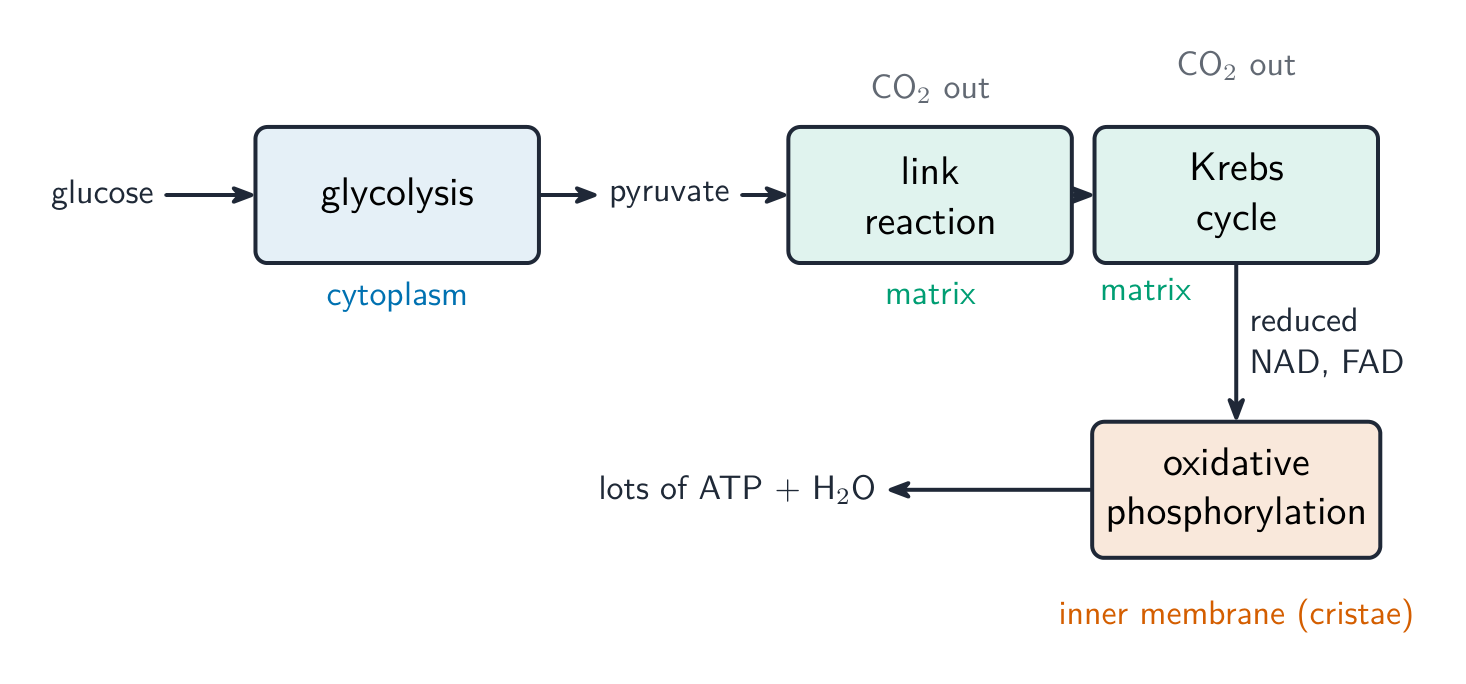
细胞呼吸(cellular respiration)释放葡萄糖里的能量来制造 ATP,大多使用氧。它的阶段:

有氧呼吸的阶段以及它们在细胞里何处发生
有氧呼吸的阶段以及它们在细胞里何处发生
  • 糖酵解(glycolysis)(在细胞质里)分裂葡萄糖,制造少量 ATP。
  • 克雷布斯循环(Krebs cycle)(线粒体基质)释放 $\text{CO}_2$ 并装载电子载体。
  • 电子传递链(electron transport chain)(内膜)用那些电子泵送质子并制造大部分 ATP,以氧作为最终电子受体。

没有氧,细胞用发酵(fermentation)来保持糖酵解运行,制造远少的 ATP。光合作用和呼吸是互补的——一个的产物是另一个的反应物。

Worked example. 一分子葡萄糖的有氧呼吸大约净得糖酵解的 2 ATP、克雷布斯循环的 2 ATP,和氧化磷酸化的约 28 ATP,共 $\approx$ 32 ATP。没有氧时只有糖酵解运行,所以发酵每分子葡萄糖只净得 2 ATP——大约少 16 倍的能量,这就是为什么有氧途径在富氧细胞中占主导。

词汇表 训练
英文 中文 拼音
Cellular respiration 细胞呼吸 xì bāo hū xī
Glycolysis 糖酵解 táng jiào jiě
Krebs cycle 克雷布斯循环 kè léi bù sī xún huán
electron transport chain 电子传递链 diàn zi chuán dì liàn
fermentation 发酵 fā jiào
3.5

考试技巧

  • 一个酶降低活化能并不被消耗;它的活性位点对一个底物是特异的(锁和钥匙)。
  • 速率只随温度上升到最适值——超过它酶变性而速率下降(不像一个普通的反应)。
  • 知道 ATP↔ADP 循环:断掉一个磷酸释放能量来驱动细胞。
  • 写总方程:光合作用储存能量(构建葡萄糖);呼吸释放它(分解葡萄糖)——它们是相反的。
  • 把每个阶段匹配到它的位置以及它是否需要氧。

本主题的互动课程

逐步学习,并即时检测练习。

AP 生物历年真题

AP 生物的更多主题

登录或创建账号

IGCSE, A-Level & AP