跳到主要内容

生态学

AP 生物 · 第 8 主题

训练
讲义 词汇表
8.1

对环境的响应

大纲
Big IdeaLearning ObjectiveEssential Knowledge

Big Idea 2 — Energetics
Biological systems use energy and molecular building blocks to grow, reproduce, and maintain dynamic homeostasis.

8.1.A
Explain how the behavioral and physiological response of an organism is related to changes in internal or external environment.

  • 8.1.A.1 Organisms respond to changes in their environment through behavioral and physiological mechanisms.
    • Exclusion statement: Knowledge of specific behavioral or physiological mechanisms is beyond the scope of the AP Exam.
    • Illustrative examples for 8.1.A.1:
      • Photoperiodism and phototropism in plants
      • Taxis and kinesis in animals
      • Nocturnal and diurnal activity
  • 8.1.A.2 Organisms exchange information with one another in response to internal changes and external cues, which can change behavior.
    • Illustrative examples for 8.1.A.2:
      • Fight-or-flight response
      • Predator warnings
      • Plant responses to herbivory

Big Idea 3 — Information Storage and Transmission
Living systems store, retrieve, transmit, and respond to information essential to life processes.

8.1.B
Explain how the behavioral responses of organisms affect their overall fitness and may contribute to the success of a population.

  • 8.1.B.1 Organisms communicate through various mechanisms (visual, audible, tactile, electrical, and/or chemical signals).
    • i. Organisms have a variety of signaling behaviors that produce changes in the behavior of other organisms and can result in differential reproductive success.
    • ii. Animals use signals to indicate dominance, find food, establish territory, and ensure reproductive success.
    • Exclusion statement: Knowledge of specific mechanisms of communication is beyond the scope of the AP Exam.
    • Illustrative examples for 8.1.B.1:
      • Territorial marking in mammals
      • Coloration in flowering plants and animals
      • Bird songs
      • Pack behaviors in animals
      • Predatory warnings
  • 8.1.B.2 Responses to information and communication of information are vital to natural selection and evolution.
    • i. Fitness favors innate and learned behaviors that increase survival and reproductive success.
    • ii. Cooperative behavior tends to increase the fitness of the individual and the survival of the population.
    • Exclusion statement: The details of the various communications and community behavioral systems are beyond the scope of the AP Exam.
    • Illustrative examples for 8.1.B.2.i:
      • Parent and offspring interactions
      • Courtship and mating behaviors
      • Foraging by bees and other animals
    • Illustrative examples for 8.1.B.2.ii:
      • Pack behavior in animals
      • Herd, flock, and schooling behavior in animals
      • Predator warnings
      • Colony and swarming behavior in insects
      • Kin selection

来源:美国大学理事会 AP 课程与考试说明

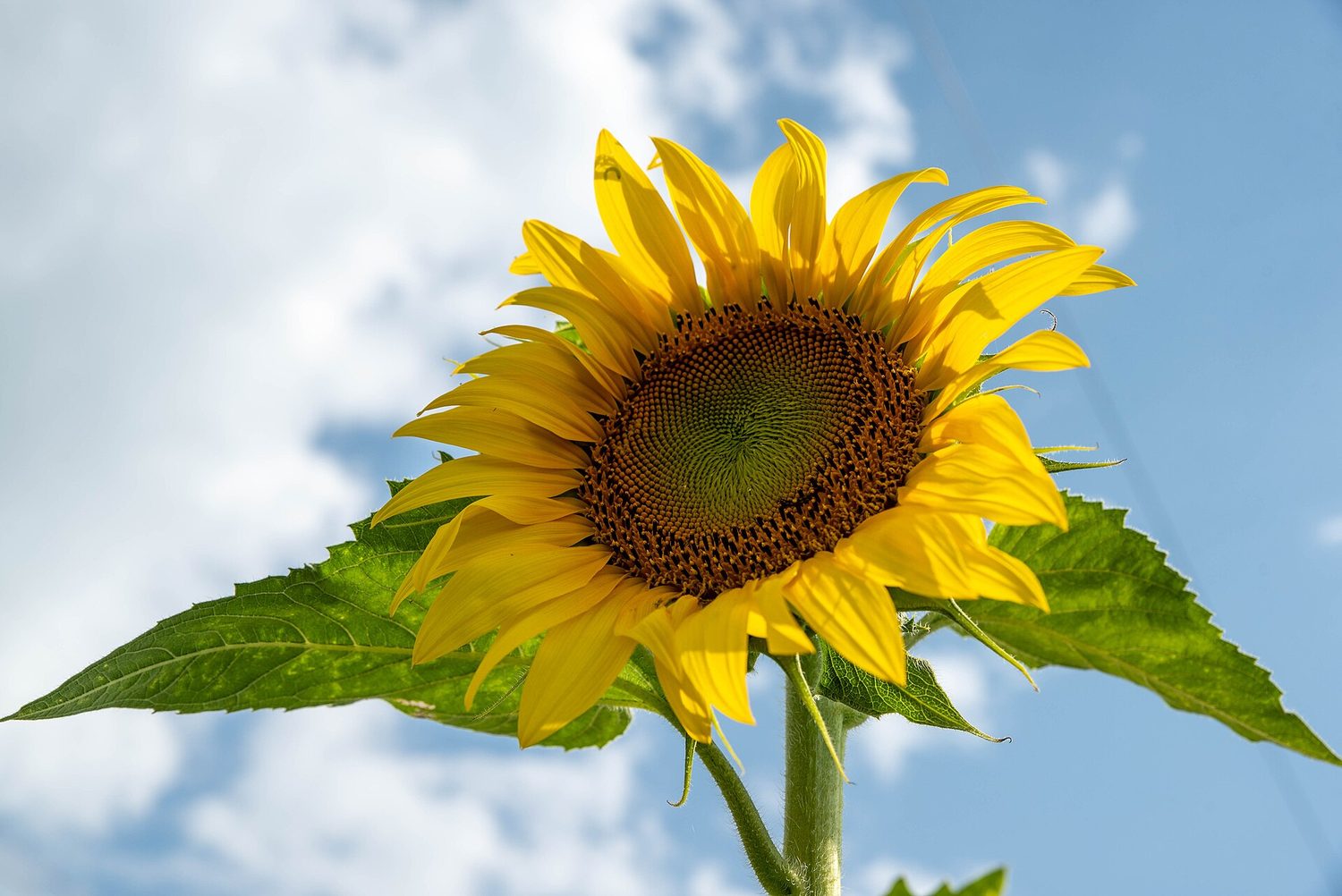
生物以有助于存活和繁殖的方式感知并对它们的环境反应。行为(behaviors)可能是先天的(innate)(遗传的,像反射和本能)或习得的(learned)。像迁徙、冬眠和向光性这样的反应,以及生物之间的信号,由自然选择塑造,因为它们改善适合度。

Sunflowers face the light: organisms detect and respond to environmental stimuli
8.2

生态系统中的能量流动

大纲
Big IdeaLearning ObjectiveEssential Knowledge

Big Idea 2 — Energetics
Biological systems use energy and molecular building blocks to grow, reproduce, and maintain dynamic homeostasis.

8.2.A
Describe the strategies organisms use to acquire and use energy.

  • 8.2.A.1 Organisms use energy to organize, grow, reproduce, and maintain homeostasis.
    • i. Organisms use different strategies to regulate body temperature and metabolism. Endotherms use thermal energy generated by metabolism to maintain homeostatic body temperatures. Ectotherms lack efficient internal mechanisms for maintaining body temperature, although they may regulate their temperature behaviorally by moving into the sun or shade or by aggregating with other individuals.
    • ii. A net gain in energy results in energy storage, the growth of an organism, and increased reproductive output.
    • iii. A net loss of energy results in loss of mass, a decrease in reproductive output, and, eventually, the death of an organism.
  • 8.2.A.2 Different organisms use various reproductive strategies in response to energy availability. Some organisms alternate between asexual and sexual reproduction in response to energy availability.
    • Illustrative examples for 8.2.A:
      • Seasonal reproduction in animals and plants
      • Life-history strategy (biennial plants, reproductive diapause)

8.2.B
Explain how energy flows and matter cycles through trophic levels.

  • 8.2.B.1 Ecological levels of organization include populations, communities, ecosystems, and biomes.
  • 8.2.B.2 Energy flows through ecosystems, while matter and nutrients cycle between the environment and organisms via biogeochemical cycles. The cycles are essential for life, and each cycle demonstrates the conservation of matter. The cycles are interdependent.
  • 8.2.B.3 Biogeochemical cycles include abiotic and biotic reservoirs, as well as processes that cycle matter between reservoirs.
  • 8.2.B.4 The hydrologic (water) cycle involves water movement and storage within the hydrosphere. Reservoirs include oceans, surface water, the atmosphere, and living organisms. Processes include evaporation, condensation, precipitation, and transpiration.
  • 8.2.B.5 The carbon cycle involves recycling carbon atoms through Earth's biosphere into organisms as carbohydrates and back into the atmosphere as carbon dioxide $\left(\mathrm{CO_2}\right)$. At the highest levels of organization, the carbon cycle can be simplified into four parts: photosynthesis, cellular respiration, decomposition, and combustion.
  • 8.2.B.6 The nitrogen cycle involves several steps, including nitrogen fixation, assimilation, ammonification, nitrification, and denitrification. These steps are performed by microorganisms in the soil. The largest reservoir of nitrogen is the atmosphere. In nitrogen fixation, nitrogen gas $\left(\mathrm{N_2}\right)$ is fixed into ammonia $\left(\mathrm{NH_3}\right)$, which ionizes to ammonium $\left(\mathrm{NH_4^+}\right)$ by acquiring hydrogen ions from the soil solution.
  • 8.2.B.7 The phosphorus cycle involves weathering rocks releasing phosphate $\left(\mathrm{PO_4^{3-}}\right)$ into soil and groundwater. Producers take in phosphate, which is incorporated into biological molecules; consumers eat producers, transferring phosphate to animals. Phosphorus returns to the soil via decomposition of biomass, or excretion. Phosphate can also be incorporated back into the environment via decomposition of decaying organic matter.

8.2.C
Explain how changes in energy availability affect populations, communities, and ecosystems.

  • 8.2.C.1 Changes in energy availability can result in changes in population size.
  • 8.2.C.2 Changes in energy availability can result in disruptions to an ecosystem.
    • i. A change in energy resources such as sunlight can affect the number and size of the trophic levels. Trophic levels include producers; primary, secondary, tertiary, and quaternary consumers; and decomposers.
    • ii. A change in the biomass or number of producers in a given geographic area can affect the number and size of other trophic levels.

8.2.D
Explain how the activities of autotrophs and heterotrophs enable the flow of energy within an ecosystem.

  • 8.2.D.1 Autotrophs capture energy from physical or chemical sources in the environment.
    • i. Photosynthetic organisms capture energy present in sunlight contributing to primary productivity.
    • ii. Chemosynthetic organisms capture energy from small inorganic molecules present in their environment, which can occur in the absence of oxygen.
  • 8.2.D.2 Heterotrophs, which include carnivores, herbivores, omnivores, decomposers, and scavengers, metabolize carbohydrates, lipids, and proteins as sources of energy. Heterotrophs capture the energy present in carbon compounds by consuming organic matter derived from autotrophs incorporating matter into their tissues.

来源:美国大学理事会 AP 课程与考试说明

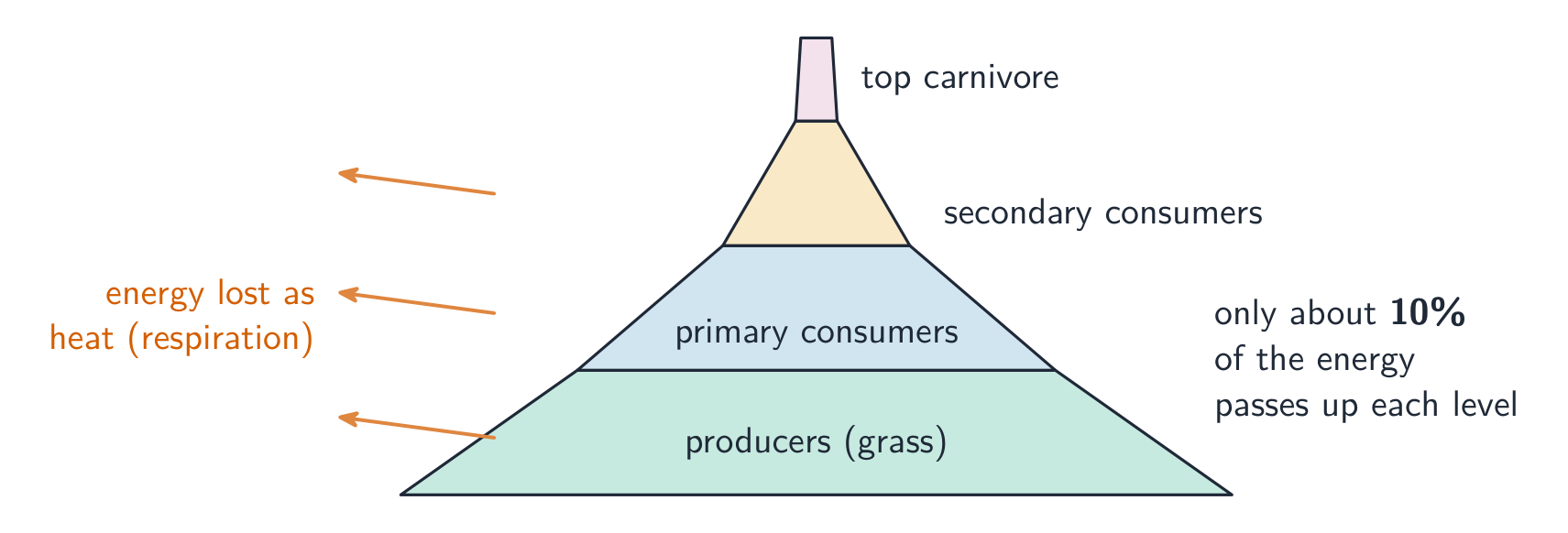
能量作为阳光进入大多数生态系统(ecosystems),被生产者(producers)(光合作用者)捕获,并沿着一条食物链(food chain)传给消费者(consumers)。每一层是一个营养级(trophic level)。只有约 10% 的能量向上转移每一级(其余作为热损失),所以食物链是短的而生产者是最丰富的。能量(flows)过并被损失,而物质(碳、氮)循环(cycles)。

只有约 10% 的能量传给下一个营养级
只有约 10% 的能量传给下一个营养级

Worked example. 假设生产者捕获 $10{,}000\ \text{kcal}$。应用 $10\%$ 规则,初级消费者接收约 $1{,}000\ \text{kcal}$、次级消费者 $100\ \text{kcal}$,而三级消费者只有 $10\ \text{kcal}$。在每一步作为热损失 $90\%$ 正是为什么食物链很少超过四或五级——剩下的能量太少不足以支持另一级。

探索

Energy up a food chain

Only about 10% of energy passes to the next trophic level; the rest is lost as heat. That's why food chains are short and top predators are few.

词汇表 训练
英文 中文 拼音
ecosystems 生态系统 shēng tài xì tǒng
producers 生产者 shēng chǎn zhě
consumers 消费者 xiāo fèi zhě
food chain 食物链 shí wù liàn
trophic level 营养级 yíng yǎng jí
8.3

种群生态学

大纲
Big IdeaLearning ObjectiveEssential Knowledge

Big Idea 3 — Information Storage and Transmission
Living systems store, retrieve, transmit, and respond to information essential to life processes.

8.3.A
Describe factors that influence growth dynamics of populations.

  • 8.3.A.1 Populations comprise individual organisms of the same species that interact with one another and with the environment in complex ways.
  • 8.3.A.2 Many adaptations in organisms are related to obtaining and using energy and matter in a particular environment.
    • i. Population growth dynamics depend on birth rate, death rate, and population size.
      • Equation: Population Growth — $\dfrac{dN}{dt} = B - D$ where $dt$ = chage in time; $B$ = birth rate; $D$ = death rate; $N$ = population size; $dN$ = change in population size
    • ii. Reproduction without constraints results in the exponential growth of a population.
      • Equation: Exponential Growth — $\dfrac{dN}{dt} = r_{max} N$ where $dt$ = change in time; $N$ = population size; $dN$ = change in population size; $r_{max}$ = maximum per capita growth rate of population

来源:美国大学理事会 AP 课程与考试说明

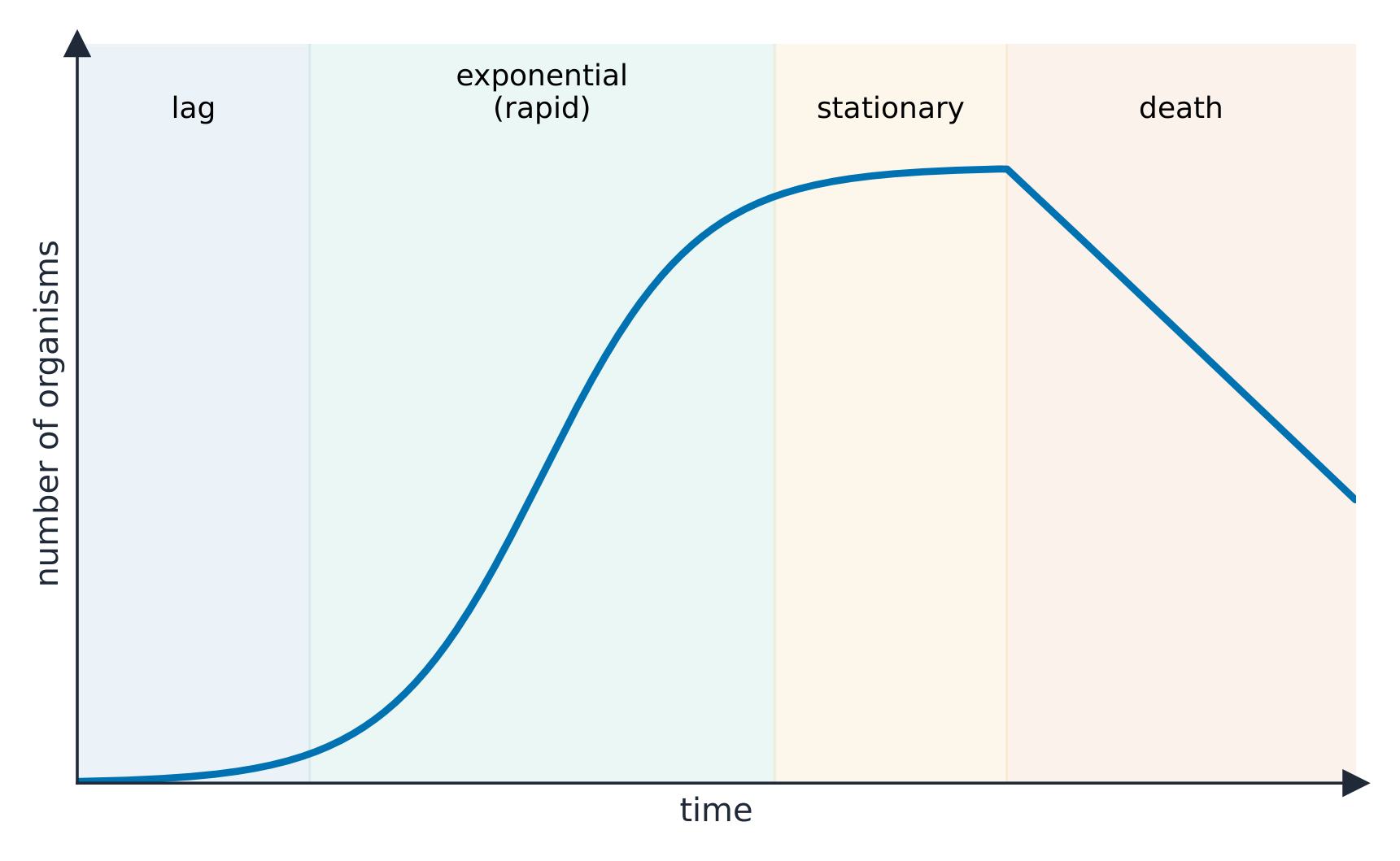
一个种群(population)是一个区域里一个物种的个体。它的增长取决于出生、死亡、迁入和迁出。指数增长(exponential growth)($J$ 形)在无限资源下发生;逻辑斯蒂增长(logistic growth)($S$ 形)在环境容纳量(carrying capacity)$K$——环境能维持的最大值——处趋平,遵循 $\dfrac{dN}{dt}=r_{\max}N\dfrac{K-N}{K}$

种群增长:滞后、指数,然后在环境容纳量处趋平

Worked example. 一个种群有 $r_{\max}=0.5\ \text{yr}^{-1}$、环境容纳量 $K=1000$,和当前大小 $N=400$。那么 $\dfrac{dN}{dt}=0.5\times400\times\dfrac{1000-400}{1000}=0.5\times400\times0.6=120$ 个个体每年。$\frac{K-N}{K}$ 项是为什么增长在 $N=K/2$ 附近最快而随着 $N$ 接近 $K$ 减慢向零。

探索

Grow a population to carrying capacity

A population grows fast when small, then slows as it nears its carrying capacity $K$ — logistic growth. Raise the growth rate and watch it level off.

词汇表 训练
英文 中文 拼音
population 种群 zhǒng qún
Exponential growth 指数增长 zhǐ shù zēng zhǎng
logistic growth 逻辑斯蒂增长 luó jí sī dì zēng zhǎng
carrying capacity 环境容纳量 huán jìng róng nà liàng
8.4

密度对种群的影响

大纲
Big IdeaLearning ObjectiveEssential Knowledge

Big Idea 4 — Systems Interactions
Biological systems interact, and these systems and their interactions exhibit complex properties.

8.4.A
Explain how the density of a population affects and is determined by resource availability in the environment.

  • 8.4.A.1 Carrying capacity is the sustainable abundance of a species that can be supported by the ecosystem's total available resources.
  • 8.4.A.2 As limits to growth attributable to density-dependent and density-independent factors are imposed, a logistic growth model typically ensues.
    • Equation: Logistical Growth — $\dfrac{dN}{dt} = r_{max} N \left( \dfrac{K - N}{K} \right)$ where $dt$ = change in time; $N$ = population size; $dN$ = change in population size; $r_{max}$ = maximum per capita growth rate of population; $K$ = carrying capacity

来源:美国大学理事会 AP 课程与考试说明

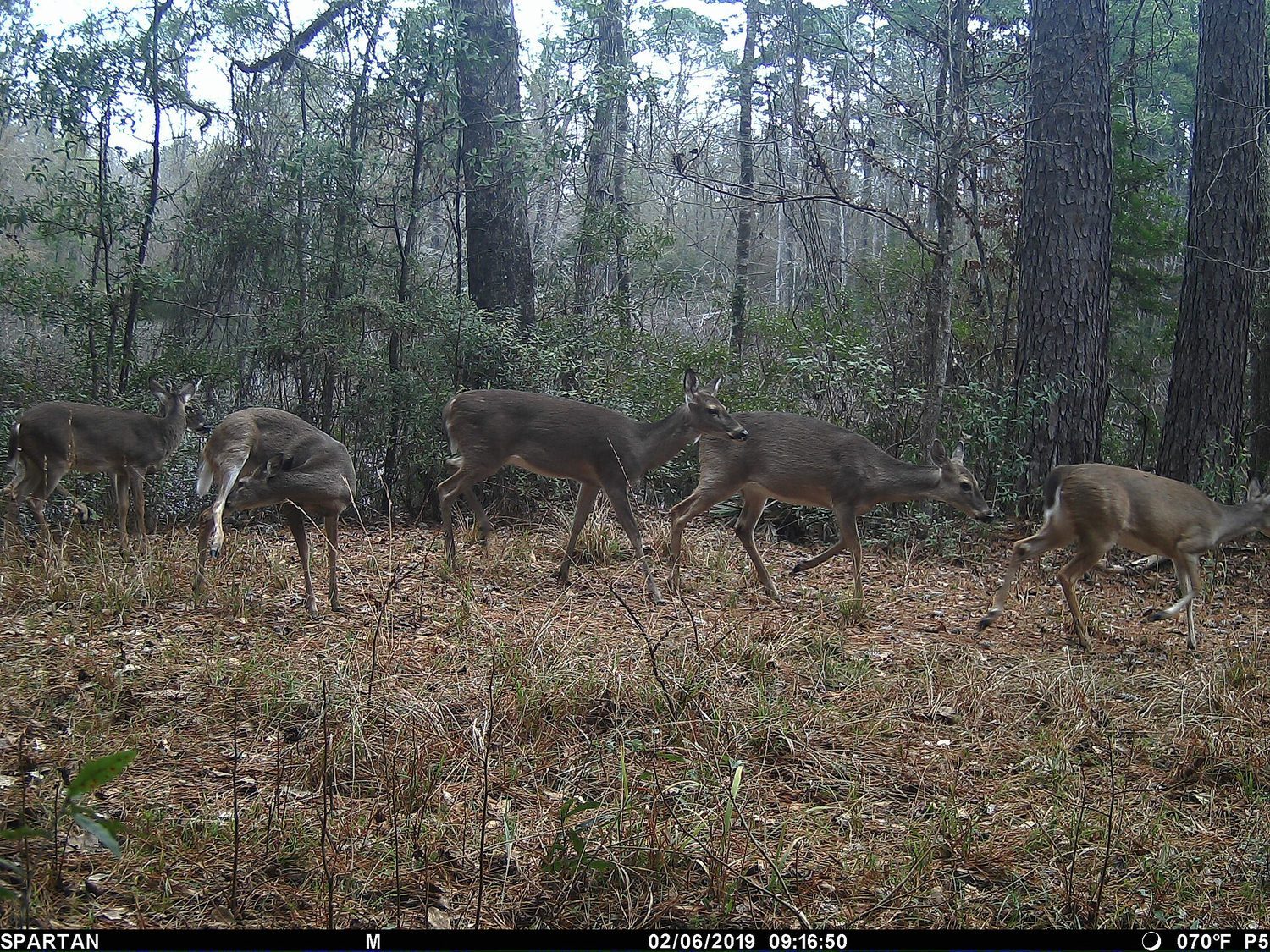
一些因素取决于拥挤,另一些不:

  • 密度制约(density-dependent)因素随着一个种群增长而加剧——竞争、捕食、疾病。
  • 非密度制约(density-independent)因素不管密度都作用——天气、自然灾害。

这些因素在环境容纳量附近调节种群大小。

A dense deer herd: density-dependent factors such as disease and food competition intensify as numbers rise
词汇表 训练
英文 中文 拼音
Density-dependent 密度制约 mì dù zhì yuē
Density-independent 非密度制约 fēi mì dù zhì yuē
competition 竞争 jìng zhēng
8.5

群落生态学

大纲
Big IdeaLearning ObjectiveEssential Knowledge

Big Idea 2 — Energetics
Biological systems use energy and molecular building blocks to grow, reproduce, and maintain dynamic homeostasis.

8.5.A
Describe the structure of a community according to its species composition and diversity.

  • 8.5.A.1 The structure of a community is measured and described in terms of species composition and species diversity.
    • Equation: Simpson's Diversity Index — $\text{Diversity Index} = 1 - \sum \left( \dfrac{n}{N} \right)^2$ where $n$ = total number of organisms of a particular species; $N$ = total number of organisms of all species

8.5.B
Explain how interactions within and among populations influence community structure.

  • 8.5.B.1 Communities are groups of interacting populations of different species that change over time based on the interactions between those populations.
  • 8.5.B.2 Interactions among populations determine how they access energy and matter within a community.
  • 8.5.B.3 Relationships among interacting populations can be characterized by positive and negative effects and can be modeled. Examples include predator/prey interactions, cooperation, trophic cascades, and niche partitioning.
  • 8.5.B.4 Competition, predation, and symbioses, including parasitism, mutualism, and commensalism, can drive population dynamics.

来源:美国大学理事会 AP 课程与考试说明

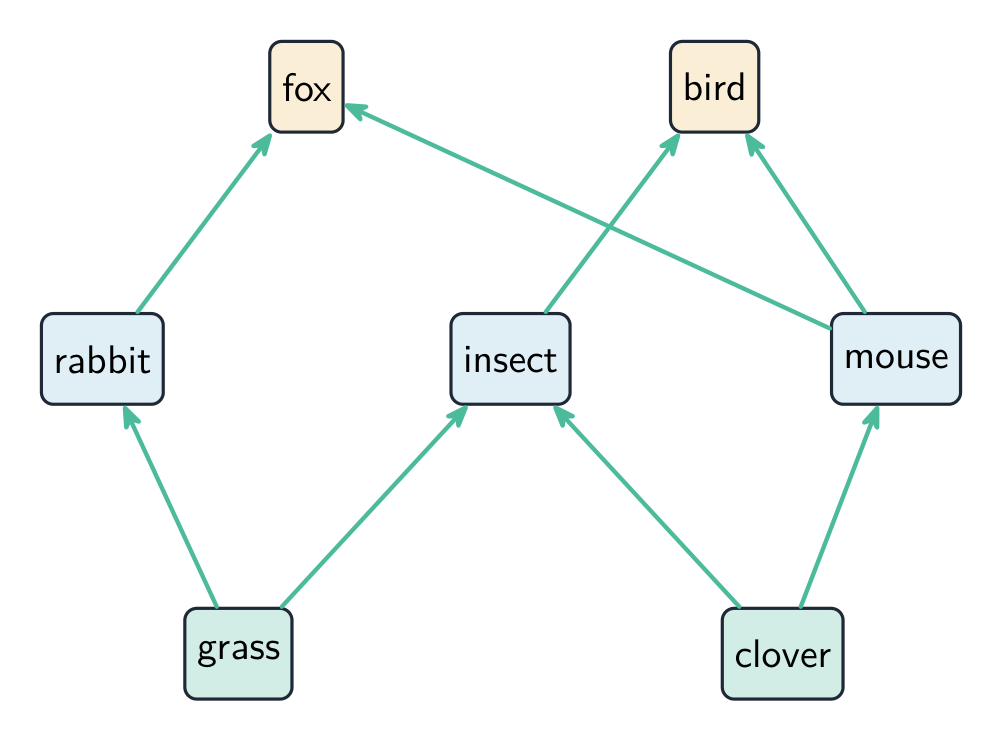
一个群落(community)是一个区域里所有相互作用的种群。关键的相互作用:竞争(competition)(为共享的资源)、捕食(predation)、共生(symbiosis)——互利共生(mutualism)(两者都受益)、偏利共生(commensalism)(一个受益,另一个不受影响),和寄生(parasitism)(一个受益,另一个受害)。这些关系塑造哪些物种共存。

一个食物网把几条食物链连接在一起
一个食物网把几条食物链连接在一起
词汇表 训练
英文 中文 拼音
community 群落 qún luò
predation 捕食 bǔ shí
symbiosis 共生 gòng shēng
8.6

生物多样性

大纲
Big IdeaLearning ObjectiveEssential Knowledge

Big Idea 4 — Systems Interactions
Biological systems interact, and these systems and their interactions exhibit complex properties.

8.6.A
Describe the relationship between ecosystem diversity and its resilience to changes in the environment.

  • 8.6.A.1 Natural and artificial ecosystems with fewer component parts, and with little diversity among the parts, are often less resilient to changes in the environment.
  • 8.6.A.2 Keystone species, producers, and essential abiotic and biotic factors contribute to maintaining the diversity of an ecosystem.

8.6.B
Explain how the addition or removal of any component of an ecosystem will affect its overall short-term and long-term structure.

  • 8.6.B.1 The effects of keystone species on the ecosystem are disproportionate relative to their abundance in the ecosystem. When they are removed from the ecosystem, it often collapses.

来源:美国大学理事会 AP 课程与考试说明

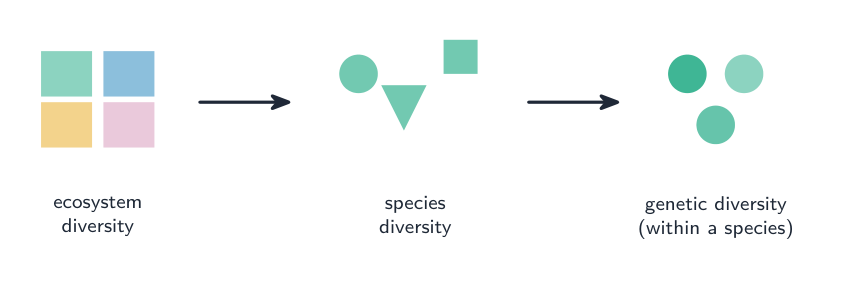
生物多样性(biodiversity)是生命的多样性——基因、物种和生态系统。更高的多样性一般使一个群落更有韧性(resilient),更能够承受干扰并从中恢复。一个关键种(keystone species)有一个超大的影响,所以失去它能使群落崩溃。

三个层次的生物多样性:遗传、物种和栖息地
词汇表 训练
英文 中文 拼音
Biodiversity 生物多样性 shēng wù duō yàng xìng
resilient 有韧性 yǒu rèn xìng
keystone species 关键种 guān jiàn zhǒng
8.7

生态系统的干扰

大纲
Big IdeaLearning ObjectiveEssential Knowledge

Big Idea 1 — Evolution
The process of evolution drives the diversity and unity of life.

8.7.A
Explain the interaction between the environment and random or preexisting variations in populations.

  • 8.7.A.1 An adaptation is a genetic variation that is favored by selection and manifests as a trait that provides an advantage to an organism in a particular environment.
  • 8.7.A.2 Heterozygote advantage is when the heterozygous genotype has a higher relative fitness than either the homozygous dominant or homozygous recessive genotype.
  • 8.7.A.3 Mutations are not directed by specific environmental pressures.

Big Idea 4 — Systems Interactions
Biological systems interact, and these systems and their interactions exhibit complex properties.

8.7.B
Explain how invasive species affect ecosystem dynamics.

  • 8.7.B.1 The intentional or unintentional introduction of an invasive species can allow the species to exploit a new niche free of predators or competitors or to outcompete native species for resources.
    • Illustrative examples for 8.7.B.1:
      • Kudzu
      • Zebra mussels

8.7.C
Describe human activities that lead to changes in ecosystem structure and dynamics.

  • 8.7.C.1 Human impact accelerates changes at local and global levels. These activities can drive changes in ecosystems, such as the following, that cause extinctions to occur:
    • i. Biomagnification
    • ii. Eutrophication
    • Illustrative examples for 8.7.C.1:
      • Dutch elm disease
      • Potato blight

8.7.D
Explain how geological and meteorological activity leads to changes in ecosystem structure and dynamics.

  • 8.7.D.1 Geological and meteorological events affect habitat change and ecosystem distribution. Biogeographical studies illustrate these changes.
    • Illustrative examples for 8.7.D.1:
      • Global climate change
      • Logging
      • Urbanization
      • Monocropping
      • El Nino
      • Continental drift
      • Meteor impact on dinosaurs

来源:美国大学理事会 AP 课程与考试说明

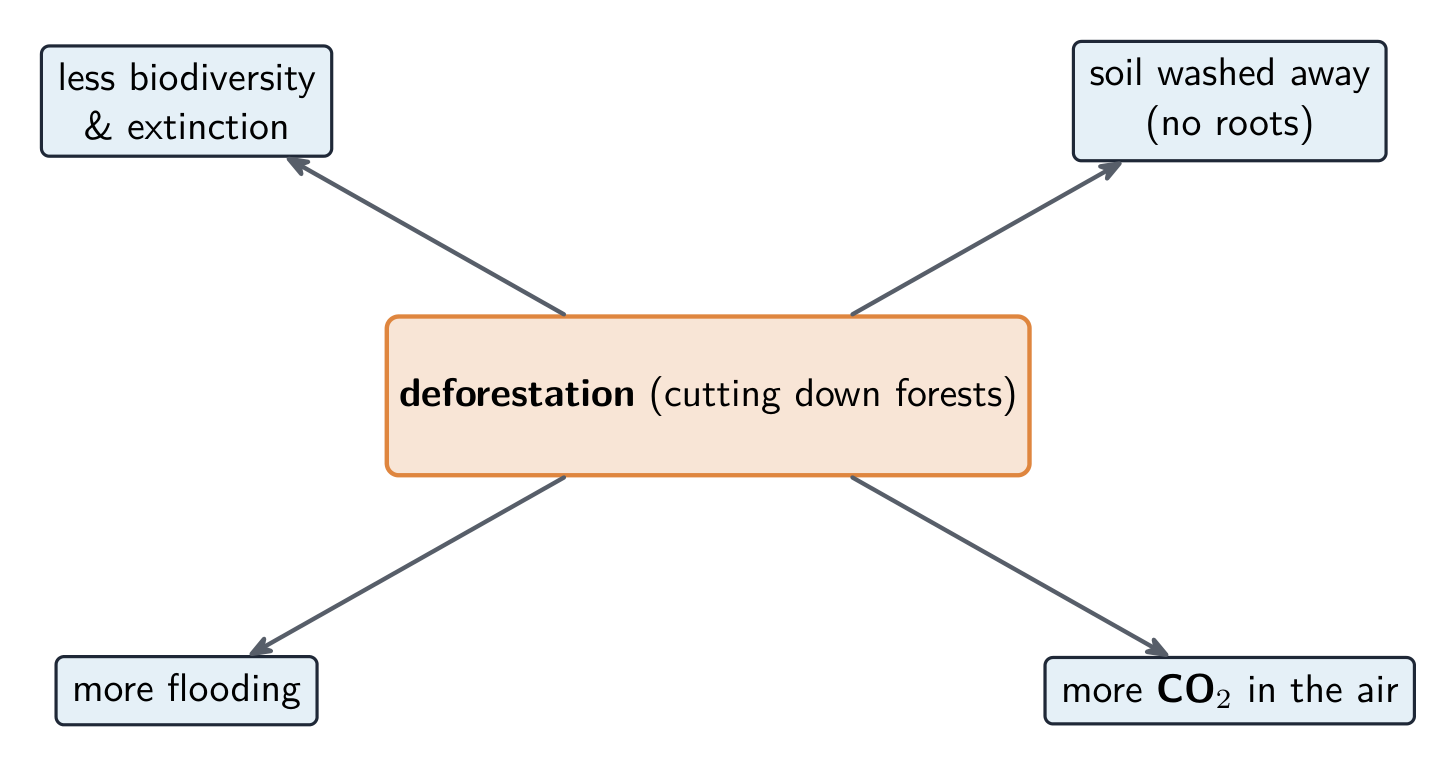
生态系统因自然和人类原因而变化——气候转变、入侵物种、栖息地丧失和污染。一次干扰能触发生态演替(ecological succession)(群落随时间重建)。因为物种相互连接,对一个物种的一个变化——尤其是一个关键种或一个营养级——能波及整个生态系统。

森林砍伐降低生物多样性并造成侵蚀、洪水和更高的 CO2
词汇表 训练
英文 中文 拼音
ecological succession 生态演替 shēng tài yǎn tì
8.7

考试技巧

  • 应用 10% 规则:约 90% 的能量在每个营养级损失,所以食物链是短的。
  • 区分指数($J$)和逻辑斯蒂($S$)增长;后者在环境容纳量处趋平($\frac{dN}{dt}=r_{\max}N\frac{K-N}{K}$)。
  • 密度制约(竞争、疾病、捕食)与非密度制约(天气)限制因素分开。
  • 命名群落的相互作用(竞争、捕食、共生)以及一个关键种的效应。
  • 解释干扰一个物种——尤其是一个关键种或一个整个营养级——如何波及生态系统。

本主题的互动课程

逐步学习,并即时检测练习。

AP 生物历年真题

AP 生物的更多主题

登录或创建账号

IGCSE, A-Level & AP