跳到主要内容

遗传

AP 生物 · 第 5 主题

训练
讲义 词汇表
5.1

减数分裂

大纲
Big IdeaLearning ObjectiveEssential Knowledge

Big Idea 3 — Information Storage and Transmission
Living systems store, retrieve, transmit, and respond to information essential to life processes.

5.1.A
Explain how meiosis results in the transmission of chromosomes from one generation to the next.

  • 5.1.A.1 Meiosis is a process that ensures the formation of haploid gamete cells, sometimes referred to as daughter cells, in sexually reproducing diploid organisms.
  • 5.1.A.2 Meiosis I involves the following steps:
    • i. Prophase I: Homologous chromosomes pair up and condense, synapsis occurs and then chiasmata may form, meiotic spindle begins to form, centrosomes move to opposite poles of the cell, and the nuclear envelope breaks down.
    • ii. Metaphase I: Meiotic spindle fibers align homologous pairs of chromosomes along the equator of the cell at the metaphase plate.
    • iii. Anaphase I: Homologous chromosomes separate, while sister chromatids remain attached, as meiotic spindle fibers pull chromosomes toward poles.
    • iv. Telophase I: Meiotic spindle breaks down, a new nuclear envelope develops, a cleavage furrow (animal cell) or cell plate (plant cell) forms, and cytokinesis occurs. Two haploid daughter cells are formed (at the end of meiosis I).
  • 5.1.A.3 Meiosis II involves the following steps:
    • i. Prophase II: Meiotic spindle forms; sister chromatids connected at the centromere attach to meiotic spindle.
    • ii. Metaphase II: Chromosomes align along the metaphase plate; the kinetochore of each chromatid is attached to a microtubule extending from the poles.
    • iii. Anaphase II: Proteins at the centromeres break down, and sister chromatids are pulled apart and toward opposite poles in the cell.
    • iv. Telophase II: Meiotic spindle breaks down, a new nuclear envelope develops, a cleavage furrow (animal cell) or a cell plate (plant cell) forms, chromatids begin to decondense, and cytokinesis occurs. Four haploid daughter cells are formed, each with an unduplicated chromatid.

5.1.B
Describe similarities and differences between the phases and outcomes of mitosis and meiosis.

  • 5.1.B.1 Mitosis and meiosis are similar in the use of a spindle apparatus to move chromosomes but differ in the number of cells produced and the genetic content of the daughter cells.

来源:美国大学理事会 AP 课程与考试说明

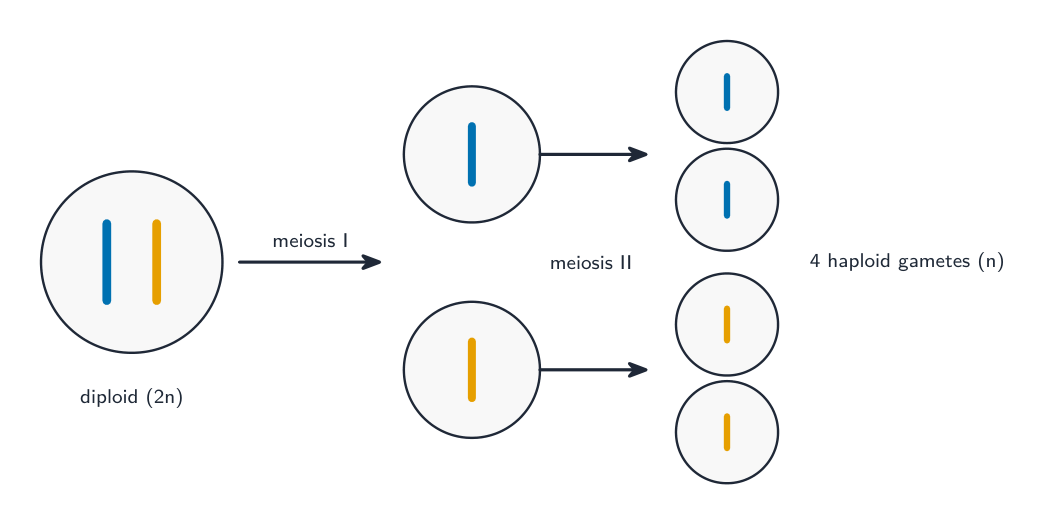
减数分裂(meiosis)制造染色体数目减半配子(gametes)(卵和精子),所以受精恢复完整的一套。一个二倍体细胞分裂两次以给出四个单倍体细胞。减数分裂 I 分开同源染色体(homologous chromosomes)(减少数目);减数分裂 II 分开姐妹染色单体(像有丝分裂)。

减数分裂在两次分裂中把染色体数目减半
减数分裂在两次分裂中把染色体数目减半
探索

Divide a cell's chromosomes

Meiosis halves the chromosome number and shuffles genes, making four genetically varied gametes. Step through to see the divisions.

词汇表 训练
英文 中文 拼音
Meiosis 减数分裂 jiǎn shù fēn liè
gametes 配子 pèi zi
homologous chromosomes 同源染色体 tóng yuán rǎn sè tǐ
5.2

减数分裂与遗传多样性

大纲
Big IdeaLearning ObjectiveEssential Knowledge

Big Idea 3 — Information Storage and Transmission
Living systems store, retrieve, transmit, and respond to information essential to life processes.

5.2.A
Explain how the process of meiosis generates genetic diversity.

  • 5.2.A.1 Correct separation of the homologous chromosomes in meiosis I and sister chromatids in meiosis II ensures that each gamete receives a haploid (1n) set of chromosomes that comprises an assortment of both maternal and paternal chromosomes. When incorrect separation occurs (nondisjunction), gametes are no longer haploid.
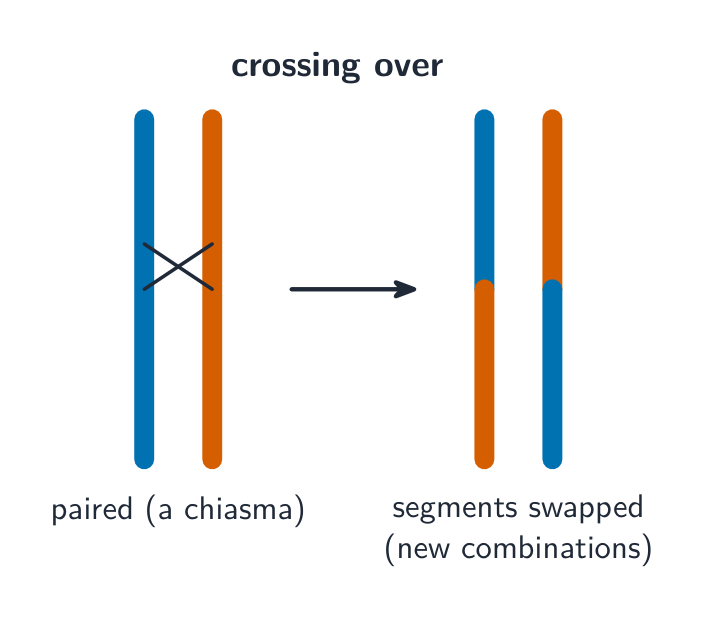
  • 5.2.A.2 During prophase I of meiosis, non-sister chromatids exchange genetic material via a process called crossing over (recombination), which increases genetic diversity among the resultant gametes.
  • 5.2.A.3 Sexual reproduction in eukaryotes increases genetic variation, including crossing over, random assortment of chromosomes during meiosis, and subsequent fertilization of gametes.
    • Exclusion statement: Knowledge of the details of sexual reproduction cycles in various plants and animals is beyond the scope of the AP Exam.

来源:美国大学理事会 AP 课程与考试说明

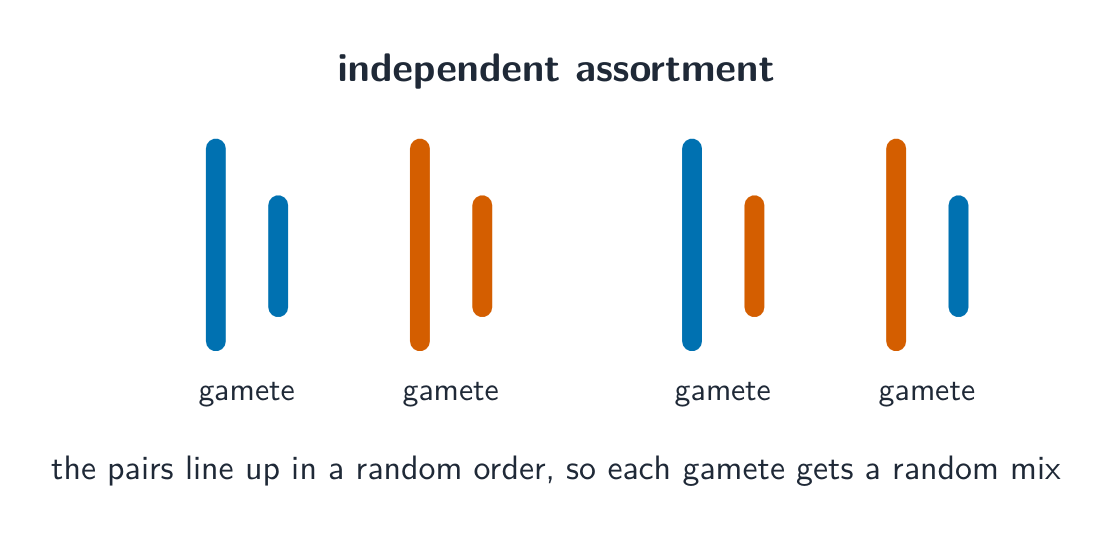
减数分裂以三种方式打乱基因,所以后代不同于亲代和彼此:
自由组合产生许多配子组合
自由组合产生许多配子组合
交叉互换在同源染色体之间交换片段
交叉互换在同源染色体之间交换片段
  • 交叉互换(crossing over):同源染色体在减数分裂 I 中交换片段。
  • 自由组合(independent assortment):每一对同源染色体随机地排列和分开。
  • 随机受精(random fertilization):任何精子能遇到任何卵。

它们一起创造巨大的变异——进化的原材料。

词汇表 训练
英文 中文 拼音
Crossing over 交叉互换 jiāo chā hù huàn
Independent assortment 自由组合 zì yóu zǔ hé
5.3

孟德尔遗传学

大纲
Big IdeaLearning ObjectiveEssential Knowledge

Big Idea 3 — Information Storage and Transmission
Living systems store, retrieve, transmit, and respond to information essential to life processes.

5.3.A
Explain the inheritance of genes and traits as described by Mendel's laws.

  • 5.3.A.1 Mendel's laws of segregation and independent assortment can be applied to genes that are on different chromosomes.
  • 5.3.A.2 In most cases, fertilization involves the fusion of two haploid gametes, restoring the diploid number of chromosomes and increasing genetic variation in populations by creating new combinations of alleles in the zygote.
    • i. Rules of probability can be applied to analyze the passing of single-gene traits from parent to offspring.
    • ii. Monohybrid, dihybrid, and test crosses can be used to determine whether alleles are dominant or recessive.
    • iii. An organism's genotype is the set of alleles inherited for one or more genes by an individual organism. An organism's genotype can be homozygous or heterozygous for each gene.
    • iv. An organism's phenotype is the observable expression of the inherited traits.
    • v. Patterns of inheritance (autosomal, genetically linked, sex-linked) and whether an allele is dominant or recessive can often be predicted from data, including pedigrees. Punnett squares can be used to predict the genotypes and phenotypes of parents and offspring.
    • Equation (Laws of Probability): If $A$ and $B$ are mutually exclusive, then: $P(A \text{ or } B) = P(A) + P(B)$
    • Equation (Laws of Probability): If $A$ and $B$ are independent, then: $P(A \text{ and } B) = P(A) \times P(B)$

来源:美国大学理事会 AP 课程与考试说明

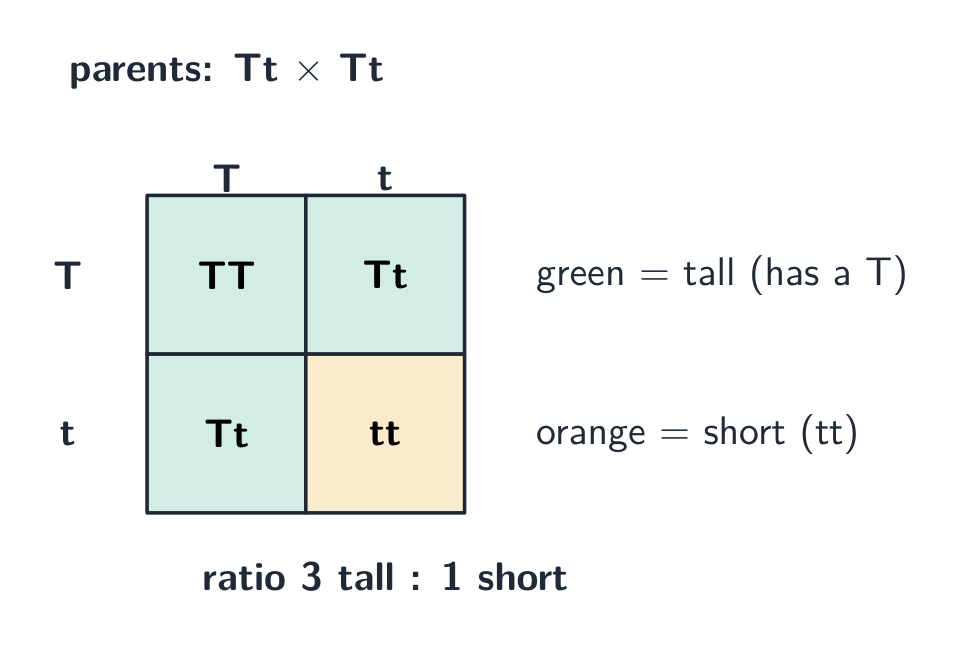
一个基因的替代版本是等位基因(alleles)。一个生物的基因型(genotype)(它的等位基因)产生它的表型(phenotype)(它的性状)。孟德尔的规则:一个显性(dominant)等位基因掩盖一个隐性(recessive)的;这两个等位基因分离(segregate)进入不同的配子(分离定律);不同性状的基因独立地组合。一个庞纳特方格(Punnett square)预测后代比例(一个杂合杂交给出 3:1)。纯合(homozygous)意味着两个相同的等位基因;杂合(heterozygous)意味着两个不同的。

一个单杂交庞纳特方格给出一个 3:1 比例

Worked example. 对于两个独立基因的一个双杂交(dihybrid)杂交,$AaBb\times AaBb$,用乘法规则而不是一个 $16$ 格方格。每个基因单独给出 $\tfrac34$ 显性,所以一个后代显示两个显性性状的机会是 $\tfrac34\times\tfrac34=\tfrac{9}{16}$,而完全隐性 $aabb$ 的机会是 $\tfrac14\times\tfrac14=\tfrac{1}{16}$。把两个独立的 $3{:}1$ 比例相乘就产生经典的 $9{:}3{:}3{:}1$ 模式。

探索

Cross two parents

A Punnett square combines each parent's alleles to predict the offspring ratios. Set the parent genotypes and read off the expected proportions.

词汇表 训练
英文 中文 拼音
alleles 等位基因 děng wèi jī yīn
genotype 基因型 jī yīn xíng
phenotype 表型 biǎo xíng
dominant 显性 xiǎn xìng
recessive 隐性 yǐn xìng
Punnett square 庞纳特方格 páng nà tè fāng gé
Homozygous 纯合 chún hé
heterozygous 杂合 zá hé
5.4

非孟德尔遗传学

大纲
Big IdeaLearning ObjectiveEssential Knowledge

Big Idea 3 — Information Storage and Transmission
Living systems store, retrieve, transmit, and respond to information essential to life processes.

5.4.A
Explain deviations from Mendel's model of the inheritance of traits.

  • 5.4.A.1 Patterns of inheritance of many traits do not follow the ratios predicted by Mendel's laws and can be identified by quantitative analysis, when the observed phenotypic ratios statistically differ from the predicted ratios.
    • i. Genes located on the same chromosome are referred to as being genetically linked. The probability that these linked genes segregate together during meiosis can be used to calculate the map distance (or map units) between them on a chromosome. This calculation is called gene or genetic mapping.
    • ii. Codominance occurs when the phenotype from both alleles is expressed such that the heterozygote would have a different phenotype than either homozygote.
    • iii. Incomplete dominance occurs when neither allele of a gene can mask the other, so the phenotype of the heterozygote is a blended version of the dominant and recessive phenotypes.
  • 5.4.A.2 Some traits, known as sex-linked traits (X- or Y-linked), are determined by genes on sex chromosomes. The pattern of inheritance of sex-linked traits can often be predicted from data, including pedigrees, indicating the genotypes and phenotypes of both parents and offspring.
    • Illustrative examples for EK 5.4.A.2:
      • Sex-linked traits (X- or Y-linked) reside on sex chromosomes.
      • Sex-linked traits (X- or Y-linked) are inherited at higher rates in XY individuals than they are in XX individuals.
      • In certain species, the chromosomal basis of sex determination is not based on X and Y chromosomes (e.g., ZW in birds, haplodiploidy in bees).
  • 5.4.A.3 Pleiotropy is a phenomenon in which the expression of a single gene results in multiple traits or effects; these traits therefore do not segregate independently.
  • 5.4.A.4 Some traits result from non-nuclear inheritance.
    • i. Chloroplasts and mitochondria are randomly assorted to gametes and daughter cells; thus, traits determined by chloroplast and mitochondrial DNA do not follow simple Mendelian rules.
    • ii. In animals, mitochondria are usually transmitted by the egg and not by sperm; thus, traits determined by the mitochondrial DNA are typically maternally inherited.
    • iii. In plants, mitochondria and chloroplasts are transmitted in the ovule and not in the pollen; as such, mitochondria-determined and chloroplast-determined traits are typically maternally inherited.

来源:美国大学理事会 AP 课程与考试说明

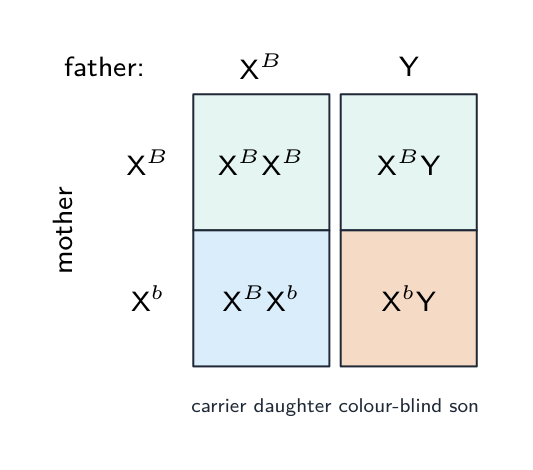
许多性状不遵循简单的显性:

伴性遗传对儿子和女儿给出不同的结果
伴性遗传对儿子和女儿给出不同的结果
  • 不完全显性(incomplete dominance):杂合子是一个混合(红 × 白 → 粉红)。
  • 共显性(codominance):两个等位基因都完全显示(AB 血型)。
  • 多重等位基因(multiple alleles)、多基因(polygenic)性状(许多基因,像身高)、多效性(pleiotropy)(一个基因,许多效应),和伴性(sex-linked)基因(在 X 染色体上)都给出更复杂的比例。

Worked example (chi-square test). 要检查真实数据是否符合一个预测的比例,用 $\chi^2=\sum\dfrac{(o-e)^2}{e}$。一个单杂交预测 $3{:}1$,所以在 $80$ 个后代中你期望 $60$ 个显性和 $20$ 个隐性,但你观察到 $55$$25$。那么 $\chi^2=\dfrac{(55-60)^2}{60}+\dfrac{(25-20)^2}{20}=\dfrac{25}{60}+\dfrac{25}{20}=0.42+1.25=1.67$。以 $1$ 个自由度,$p=0.05$ 处的临界值是 $3.84$;因为 $1.67<3.84$,我们不能拒绝零假设——偏差在机会之内。

词汇表 训练
英文 中文 拼音
Incomplete dominance 不完全显性 bù wán quán xiǎn xìng
Codominance 共显性 gòng xiǎn xìng
polygenic 多基因 duō jī yīn
sex-linked 伴性 bàn xìng
5.5

环境对表型的影响

大纲
Big IdeaLearning ObjectiveEssential Knowledge

Big Idea 4 — Systems Interactions
Biological systems interact, and these systems and their interactions exhibit complex properties.

5.5.A
Explain how the same genotype can result in multiple phenotypes under different environmental conditions.

  • 5.5.A.1 Environmental conditions influence gene expression and can lead to phenotypic plasticity (e.g., the ability of individual genotypes to produce different phenotypes).
    • Illustrative examples for EK 5.5.A.1:
      • Height and weight in humans
      • Flower color based on soil pH
      • Seasonal fur color in arctic animals
      • Sex determination in reptiles
      • Effect of increased UV on melanin production in animals
      • Presence of the opposite mating type on pheromone production in yeast and other fungi

来源:美国大学理事会 AP 课程与考试说明

表型不是仅由基因决定的——环境也重要。温度、营养和其他因素能改变基因如何表达(一只喜马拉雅兔在冷的地方的深色毛、一株植物在更多阳光下的高度)。所以相同的基因型在不同的条件下能给出不同的表型。

5.5

考试技巧

  • 对比有丝分裂(2 个相同、完整的染色体数目)和减数分裂(4 个不相同的配子、数目的一半)。
  • 交叉互换、自由组合和随机受精解释变异。
  • 对双杂交用乘法规则(每个基因的 $3{:}1$ 相乘),并用一个卡方(chi-square)检验($\chi^2=\sum\frac{(o-e)^2}{e}$)来判断观察值 vs 期望值比例。
  • 基因型(等位基因)与表型(你看到的)分开——$AA$$Aa$ 能看起来相同。
  • 辨认非孟德尔模式:不完全显性、共显性和伴性遗传。

本主题的互动课程

逐步学习,并即时检测练习。

AP 生物历年真题

AP 生物的更多主题

登录或创建账号

IGCSE, A-Level & AP