词汇
| English | 释义 | 拼音 |
|---|---|---|
| reservoir/ˈrezəvwɑː/ | 储库 | chǔ kù |
| transpiration/trænspəˈreɪʃn/ | 蒸腾作用 | zhēng téng zuò yòng |
| nitrogen fixation/ˈnaɪtrədʒn fɪkˈseɪʃn/ | 固氮 | gù dàn |
| nitrification/ˌnaɪtrɪfɪˈkeɪʃn/ | 硝化作用 | xiāo huà zuò yòng |
| assimilation/əˌsɪmɪˈleɪʃn/ | 同化作用 | tóng huà zuò yòng |
| ammonification/ˌæməˌnɪfɪˈkeɪʃn/ | 氨化作用 | ān huà zuò yòng |
| denitrification/diːˌnaɪtrɪfɪˈkeɪʃn/ | 反硝化作用 | fǎn xiāo huà zuò yòng |
English
The same atom can feed many organisms
- A carbon atom in a fallen leaf can enter a decomposer, return to the air and later enter a new plant. Matter is reused; energy disperses as heat and needs a continuing external supply.
- A reservoir 储库 stores matter. Living organisms are biotic reservoirs; air, water, soil and rocks are abiotic reservoirs. A cycle describes the processes that move atoms between them.
练习
哪个是非生物碳库?
难度 1/5 · 今日首次完成可获 100 金币及少量额外奖励
空气是非生物的;叶片和昆虫是生物碳库。
English
Water moves between air, land and life
- Evaporation moves liquid water into the atmosphere; transpiration 蒸腾作用 releases water vapour from plants. Condensation forms droplets, and precipitation returns water to land or oceans.
- Runoff and infiltration move water into surface water, soil and groundwater. Organisms take up water and return it through wastes, respiration and decay: oceans are a major reservoir, not the whole cycle.
练习
哪种过程将水蒸气从植物释放到大气中?
难度 1/5 · 今日首次完成可获 100 金币及少量额外奖励
蒸腾作用释放植物的水蒸气。
English
Carbon enters food and returns to reservoirs
- Photosynthesis moves carbon from CO₂ into organic molecules. Feeding transfers that carbon between organisms; cellular respiration returns some as CO₂.
- Decomposition recycles carbon from dead organisms. Combustion releases carbon from fuels or biomass; long-term reservoirs include soils, sediments and fossil fuels. These processes move carbon, rather than creating new carbon atoms.
练习
光合作用创造了此前不存在的新的碳原子。
难度 1/5 · 今日首次完成可获 100 金币及少量额外奖励
它将 CO₂ 中的现有碳整合到有机分子中。
English
Make atmospheric nitrogen available
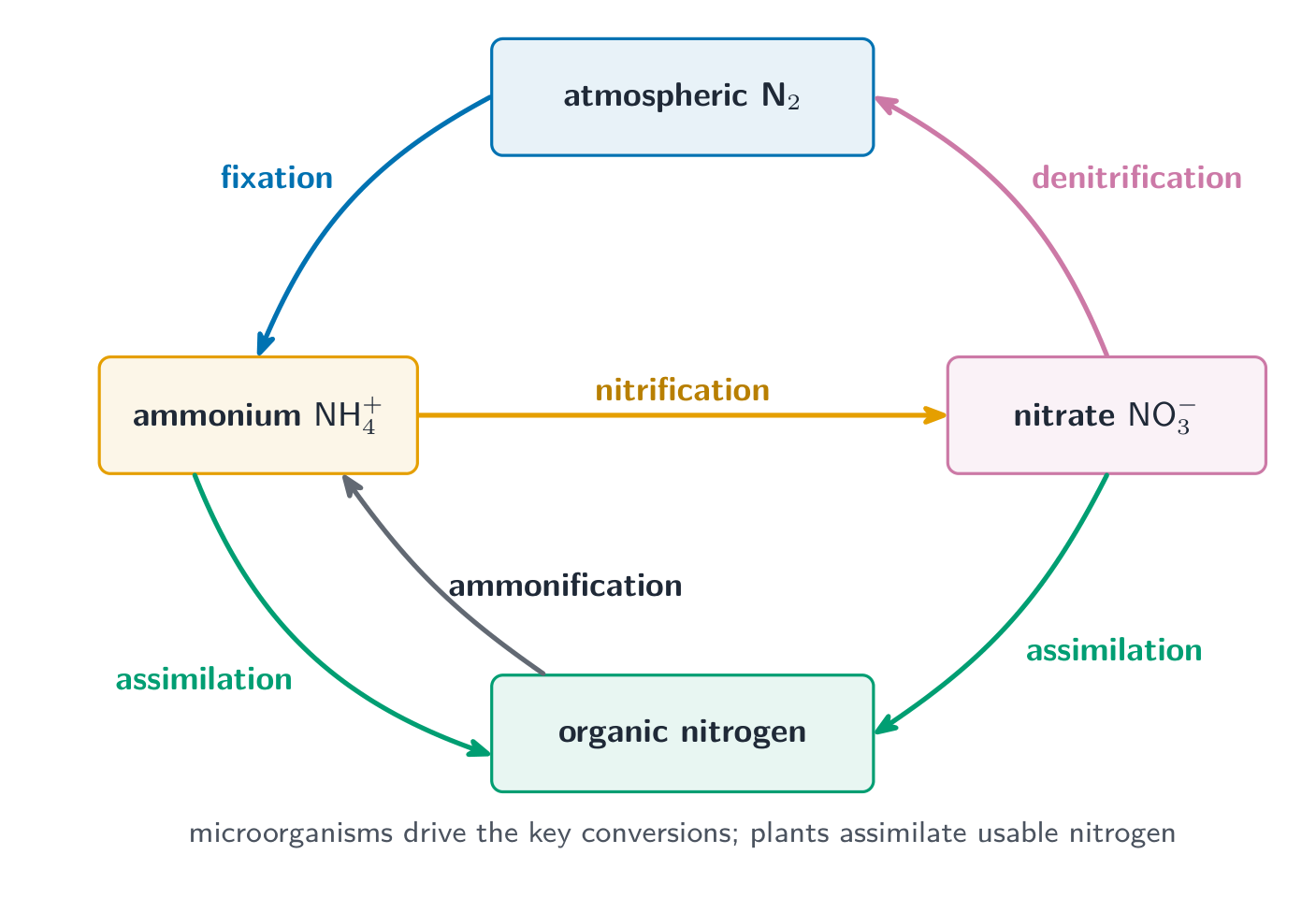
- Most organisms cannot directly use atmospheric N₂. Nitrogen fixation 固氮 by some microorganisms converts it into ammonia, which can become ammonium in soil.
- Nitrification 硝化作用 converts ammonium through nitrite into nitrate. Assimilation 同化作用 incorporates usable nitrogen into organic molecules: plants can take up ammonium or nitrate, and consumers gain nitrogen by eating.
练习
哪种过程将大气N₂转化为氨?
难度 1/5 · 今日首次完成可获 100 金币及少量额外奖励
固氮作用使大气氮以还原化学形式变得可利用。
English
Return nitrogen from organisms and soil
- Ammonification 氨化作用 releases ammonium from organic nitrogen during decomposition. Denitrification 反硝化作用 converts nitrate to nitrogen gases, returning nitrogen to the atmosphere.
- Worked trace: atmospheric N₂ → ammonium → nitrate → plant protein → decomposer-released ammonium. To return to N₂, nitrogen can pass through nitrification and then denitrification. Not every atom follows every process in one turn.
练习
哪种过程将硝酸盐氮返回大气氮气?
难度 1/5 · 今日首次完成可获 100 金币及少量额外奖励
反硝化作用将氮返回大气。
练习
分解者从有机氮中释放铵。这是哪种过程?
难度 1/5 · 今日首次完成可获 100 金币及少量额外奖励
氨化作用将有机氮以铵盐形式循环。
English
Phosphorus travels mainly through rocks, soil and water
- Weathering releases phosphate from rocks into soil and water. Producers absorb phosphate and use it in molecules such as DNA and ATP; feeding passes it to consumers.
- Excretion and decomposition return phosphate to the environment. Sedimentation stores it in sediments, and geological processes can form or expose rock again. This cycle has no major atmospheric gas reservoir like the nitrogen cycle.
练习
磷循环具有巨大的大气磷酸盐气体储库,类似于大气N₂。
难度 1/5 · 今日首次完成可获 100 金币及少量额外奖励
磷主要通过岩石、土壤、水体和生物体进行循环。
English
Worked investigation: a nutrient pulse in a lake
- Runoff adds nitrogen and phosphorus to a lake. If either was limiting, producer growth can rise; when much biomass dies, decomposers respire and consume dissolved oxygen.
- The same event connects nutrient, carbon and water cycles. Measure nutrients, biomass and oxygen before concluding a cause; low oxygen alone does not identify which nutrient entered.
练习
藻华死亡后,下列哪个过程会降低溶解氧含量?
难度 1/5 · 今日首次完成可获 100 金币及少量额外奖励
分解者在呼吸分解死亡有机物时会消耗氧气。
English
Choose the process, then follow the atom
- Ask where the atom starts and ends: N₂ to ammonium is fixation; organic nitrogen to ammonium is ammonification; nitrate to nitrogen gas is denitrification.
- Matter is conserved even when its chemical form changes. Link these cycles to energy flow and organism energy budgets, keeping atoms and energy as different quantities.
练习
按顺序排列以下可能的碳循环路径。
难度 3/5 · 今日首次完成可获 200 金币及少量额外奖励
通过上述过程,碳可以在非生物与生物储库之间移动。
English
Key idea
- Water, carbon, nitrogen and phosphorus move between living and nonliving reservoirs; their atoms are conserved as chemical forms change.
- Identify each transfer process. Energy enters from external sources and disperses as heat, while matter is recycled.
Write from this case
- A carbon atom in carbon dioxide is fixed into glucose by a producer.
- A consumer eats the producer and respires.
练习
那个碳原子接下来去哪里?
碳在二氧化碳和有机分子之间循环。
练习
呼吸作用后碳原子发生了什么?
难度 1/5 · 今日首次完成可获 100 金币及少量额外奖励
呼吸作用释放的二氧化碳可被生产者再次固定。