| English | 释义 | 拼音 |
|---|---|---|
| producer/prəˈdjuːsə/ | 生产者 | shēng chǎn zhě |
| consumer/kənˈsuːmə/ | 消费者 | xiāo fèi zhě |
| food chain/fuːd tʃeɪn/ | 食物链 | shí wù liàn |
| trophic level/ˈtrəʊfɪk ˈlevl/ | 营养级 | yíng yǎng jí |
| autotroph/ˌɔːtəʊˈtrɒf/ | 自养生物 | zì yǎng shēng wù |
| heterotroph/ˈhetrətrɒf/ | 异养生物 | yì yǎng shēng wù |
| endotherm/ˈendəʊθɜːm/ | 内温动物 | nèi wēn dòng wù |
| ectotherm/ˈektəðɜːm/ | 外温动物 | wài wēn dòng wù |
How can a food web survive in the dark?
- A deep-sea vent receives no sunlight, but chemosynthetic producers 生产者 capture energy from chemical reactions. Consumers 消费者 obtain that stored energy by feeding.
- Compare this with a sunlit food web. Energy sources can differ, yet each organism still needs an energy budget and each feeding transfer is incomplete.
Producers capture the energy
- A producer makes organic food using light or chemical energy.
- Producers form the base of every food chain 食物链.
- They store the Sun's energy as chemical energy in sugar.
- Everything else in the ecosystem depends on this stored energy.
大多数生态系统中的能量最初来自哪里?
难度 1/5 · 今日首次完成可获 100 金币及少量额外奖励
阳光被生产者(植物)通过光合作用捕获,喂养整个生态系统。
生态系统中的生产者是一个……的生物。
难度 1/5 · 今日首次完成可获 100 金币及少量额外奖励
生产者自己制造食物(光合作用);消费者吃其他生物。
Consumers and trophic levels 营养级
- A consumer eats other organisms to get energy.
- Each feeding step is a trophic level: producer, then primary consumer, then secondary, and so on.
- Energy passes up a food chain from level to level.
- But only a fraction of it makes it to the next step.
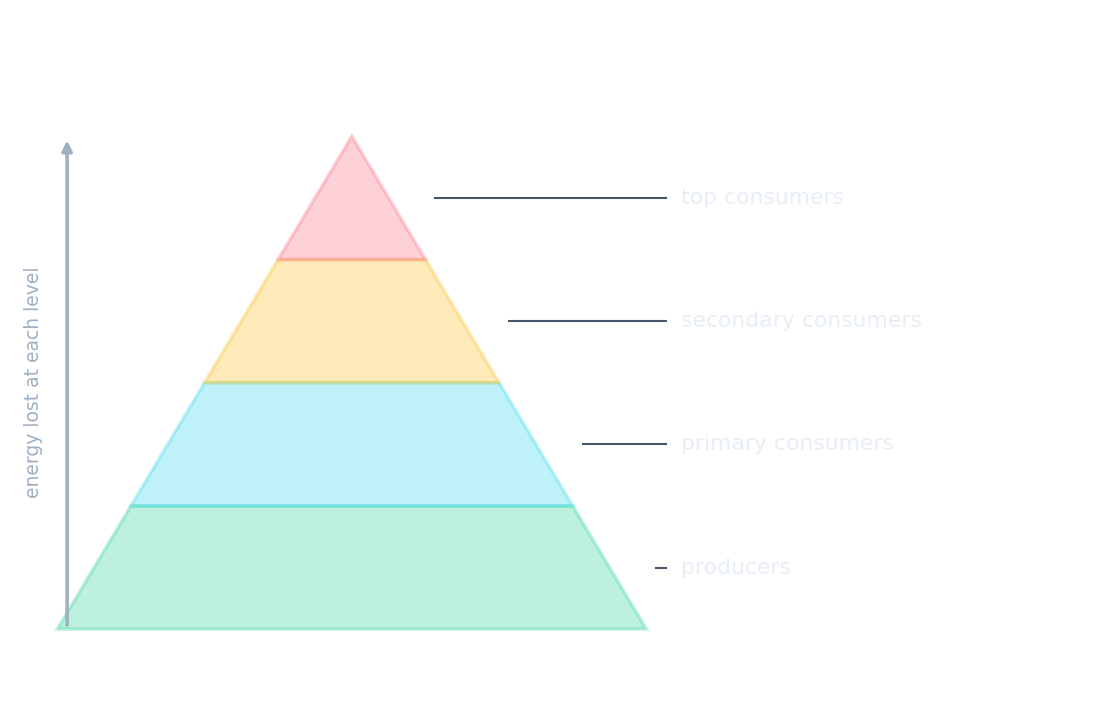
构建能量金字塔
拖动植物捕获的能量,看只有十分之一在每一级向上传递——所以顶级捕食者几乎什么都不剩。
假设本例中的传递效率为10%。从10,000单位能量出发,有多少能到达下一个营养级?
难度 2/5 · 今日首次完成可获 140 金币及少量额外奖励
根据给定的10%假设,10,000 × 0.1 = 1,000。实际的传递效率会有所不同。
食物链中每个摄食步骤——生产者,然后消费者——是一个____级。
难度 1/5 · 今日首次完成可获 100 金币及少量额外奖励
营养级是一个摄食步骤;能量在每个更高的级别下降。
Transfer is incomplete
- An illustrative transfer efficiency is 10%; measured efficiencies vary.
- The rest is lost, mostly as heat from respiration.
- So each higher level holds far less energy than the one below.
- This is why food chains are short and top predators are rare.
选出关于能量流动的所有正确说法。
难度 2/5 · 今日首次完成可获 140 金币及少量额外奖励
能量通过生产者进入生态系统,但传递是不完全的。它最终以热能形式散失,而不是在食物网中无限循环。
Sunlight is not the only entry point
- An autotroph 自养生物 builds organic molecules using an external energy source. Photosynthetic organisms capture light; chemosynthetic organisms capture energy from reactions involving inorganic chemicals, such as those available near some deep-sea vents.
- A heterotroph 异养生物 obtains organic matter from other organisms and metabolizes carbohydrates, lipids or proteins. Decomposers and scavengers are heterotrophs too, not a separate source of new energy.
靠近黑暗热液喷口的一种生产者利用无机化学反应释放的能量。它是……
难度 1/5 · 今日首次完成可获 100 金币及少量额外奖励
自养生物既可以利用光能,也可以利用化学能。
Energy budgets affect survival and reproduction
- An endotherm 内温动物 generates substantial metabolic heat to regulate body temperature. An ectotherm 外温动物 relies more on environmental heat and can move into sun or shade; both still use energy for cellular work.
- Energy gained minus maintenance costs is available for growth, storage and reproduction. If costs exceed intake, body reserves and reproductive output can fall. Seasonal breeding or switching reproductive strategies can reflect changing energy availability.
持续低于维持成本的能量摄入会降低繁殖产出。
难度 1/5 · 今日首次完成可获 100 金币及少量额外奖励
可用于生长或繁殖的能量减少,储存的储备可能被消耗。
Worked example: use measured transfer efficiency
- Producer production is 20,000 kJ over a stated area and time; primary-consumer production is 2,400 kJ over the same area and time. Transfer efficiency = 2,400 ÷ 20,000 × 100 = 12%.
- If secondary-consumer production is 240 kJ, the next transfer is 10%. Efficiencies differ; do not impose a universal 10% rule. Lower producer production can support less consumer production unless another resource compensates.
生产者的产量为20,000 kJ,消费者的产量为2,400 kJ。传递效率的百分比是多少?
难度 2/5 · 今日首次完成可获 140 金币及少量额外奖励
2400 ÷ 20000 × 100 = 12%.
Energy flows; atoms cycle
- Energy changes form and ultimately disperses as heat; it is not destroyed or recycled back into sunlight. New energy input sustains the ecosystem. Matter moves between living organisms and nonliving reservoirs.
- Follow water, carbon, nitrogen and phosphorus in Matter cycling through ecosystems. Distinguish a reservoir, where matter is stored, from a process that moves it.
呼吸作用会消耗能量,使其不再以任何形式存在。
难度 1/5 · 今日首次完成可获 100 金币及少量额外奖励
能量守恒,但转化为无法用于下一营养级传递的分散热量。
Energy is not recycled through a food chain — it is steadily lost. Some energy is dispersed as heat; uneaten or undigested organic matter can enter detrital pathways. A 10% transfer is a useful example, not a fixed law. Unlike nutrients, energy makes a one-way trip and requires continuing input from sunlight or chemical sources.
Following 10,000 units of energy:
- Plants capture 10,000 units of the Sun's energy.
- The primary consumers that eat them get about 1,000 (10%).
- The secondary consumers get about 100 — so little is left that a fourth or fifth level can barely be fed.
Energy enters an ecosystem as sunlight, captured by producers. It flows up a food chain through consumers, one trophic level at a time. Transfer is incomplete and variable; much energy ultimately disperses as heat — so food chains are short and top predators are few.
Write from the data given
- Producers store 5000 kilojoules.
- Transfer efficiency in this example is 10 percent. The lesson's 10000 units give 1000, and 2400 of 20000 is 12 percent.
多少千焦耳到达下一个营养级?
10百分比的传递意味着仅保留生产者能量的十分之一。
在 10% 的效率下,有多少 5000 千焦耳能量到达下一级?
难度 1/5 · 今日首次完成可获 100 金币及少量额外奖励
5000的十分之一是500。其他选项——1000(另一示例);12(另一效率百分比)。