Matter Cycling Through Ecosystems
Introduced| English | Meaning |
|---|---|
| reservoir/ˈrezəvwɑː/ | reservoir |
| transpiration/trænspəˈreɪʃn/ | The loss of water vapour from a plant's aerial parts, mainly through its stomata. |
| nitrogen fixation/ˈnaɪtrədʒn fɪkˈseɪʃn/ | nitrogen fixation |
| nitrification/ˌnaɪtrɪfɪˈkeɪʃn/ | soil bacteria turning ammonium into nitrite and then nitrate |
| assimilation/əˌsɪmɪˈleɪʃn/ | The incorporation of absorbed nutrients into an organism's own cells and tissues. |
| ammonification/ˌæməˌnɪfɪˈkeɪʃn/ | decomposers turning nitrogen in dead matter and wastes into ammonium |
| denitrification/diːˌnaɪtrɪfɪˈkeɪʃn/ | The microbial conversion of nitrate or nitrite into gaseous nitrogen compounds, returning nitrogen from soil or water to the atmosphere. |
The same atom can feed many organisms
- A carbon atom in a fallen leaf can enter a decomposer, return to the air and later enter a new plant. Matter is reused; energy disperses as heat and needs a continuing external supply.
- A reservoir 储库 stores matter. Living organisms are biotic reservoirs; air, water, soil and rocks are abiotic reservoirs. A cycle describes the processes that move atoms between them.
Which is an abiotic carbon reservoir?
Difficulty 1/5 · 100 coins + a small bonus on first completion today
Air is nonliving; the leaf and insect are biotic reservoirs.
Water moves between air, land and life
- Evaporation moves liquid water into the atmosphere; transpiration 蒸腾作用 releases water vapour from plants. Condensation forms droplets, and precipitation returns water to land or oceans.
- Runoff and infiltration move water into surface water, soil and groundwater. Organisms take up water and return it through wastes, respiration and decay: oceans are a major reservoir, not the whole cycle.
Which process moves water vapour from a plant into the atmosphere?
Difficulty 1/5 · 100 coins + a small bonus on first completion today
Transpiration releases water vapour from plants.
Carbon enters food and returns to reservoirs
- Photosynthesis moves carbon from CO₂ into organic molecules. Feeding transfers that carbon between organisms; cellular respiration returns some as CO₂.
- Decomposition recycles carbon from dead organisms. Combustion releases carbon from fuels or biomass; long-term reservoirs include soils, sediments and fossil fuels. These processes move carbon, rather than creating new carbon atoms.
Photosynthesis creates new carbon atoms that did not exist before.
Difficulty 1/5 · 100 coins + a small bonus on first completion today
It incorporates existing carbon from CO₂ into organic molecules.
Make atmospheric nitrogen available
- Most organisms cannot directly use atmospheric N₂. Nitrogen fixation 固氮 by some microorganisms converts it into ammonia, which can become ammonium in soil.
- Nitrification 硝化作用 converts ammonium through nitrite into nitrate. Assimilation 同化作用 incorporates usable nitrogen into organic molecules: plants can take up ammonium or nitrate, and consumers gain nitrogen by eating.
Which process changes atmospheric N₂ into ammonia?
Difficulty 1/5 · 100 coins + a small bonus on first completion today
Fixation makes atmospheric nitrogen available in reduced chemical form.
Return nitrogen from organisms and soil
- Ammonification 氨化作用 releases ammonium from organic nitrogen during decomposition. Denitrification 反硝化作用 converts nitrate to nitrogen gases, returning nitrogen to the atmosphere.
- Worked trace: atmospheric N₂ → ammonium → nitrate → plant protein → decomposer-released ammonium. To return to N₂, nitrogen can pass through nitrification and then denitrification. Not every atom follows every process in one turn.
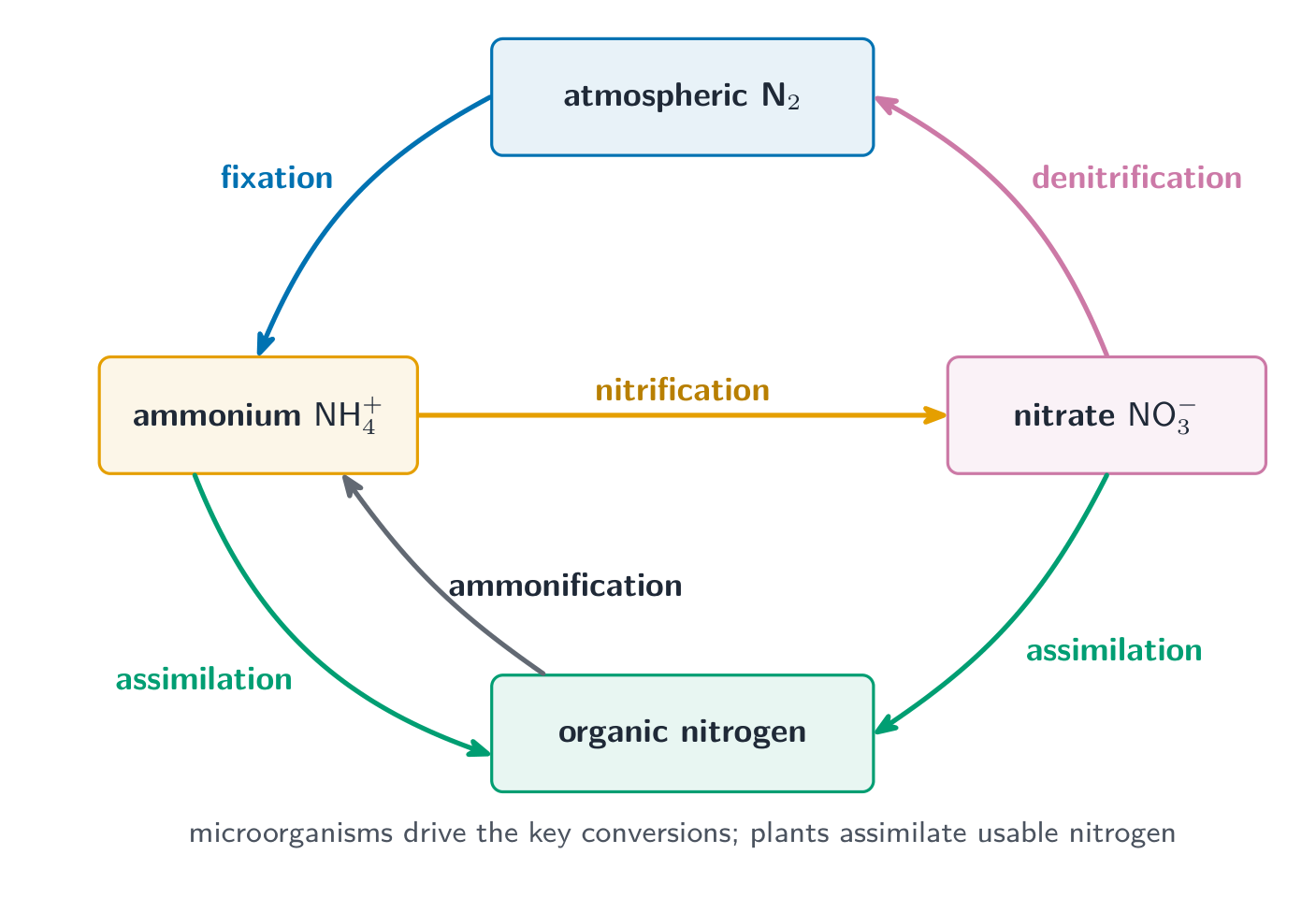
Which process returns nitrate nitrogen to atmospheric nitrogen gases?
Difficulty 1/5 · 100 coins + a small bonus on first completion today
Denitrification returns nitrogen to the atmosphere.
Decomposers release ammonium from organic nitrogen. Which process is this?
Difficulty 1/5 · 100 coins + a small bonus on first completion today
Ammonification recycles organic nitrogen as ammonium.
Phosphorus travels mainly through rocks, soil and water
- Weathering releases phosphate from rocks into soil and water. Producers absorb phosphate and use it in molecules such as DNA and ATP; feeding passes it to consumers.
- Excretion and decomposition return phosphate to the environment. Sedimentation stores it in sediments, and geological processes can form or expose rock again. This cycle has no major atmospheric gas reservoir like the nitrogen cycle.
The phosphorus cycle has a large atmospheric phosphate-gas reservoir like atmospheric N₂.
Difficulty 1/5 · 100 coins + a small bonus on first completion today
Phosphorus cycles mainly through rock, soil, water and organisms.
Worked investigation: a nutrient pulse in a lake
- Runoff adds nitrogen and phosphorus to a lake. If either was limiting, producer growth can rise; when much biomass dies, decomposers respire and consume dissolved oxygen.
- The same event connects nutrient, carbon and water cycles. Measure nutrients, biomass and oxygen before concluding a cause; low oxygen alone does not identify which nutrient entered.
After an algal bloom dies, which process can lower dissolved oxygen?
Difficulty 1/5 · 100 coins + a small bonus on first completion today
Decomposers consume oxygen while respiring the dead organic matter.
Choose the process, then follow the atom
- Ask where the atom starts and ends: N₂ to ammonium is fixation; organic nitrogen to ammonium is ammonification; nitrate to nitrogen gas is denitrification.
- Matter is conserved even when its chemical form changes. Link these cycles to energy flow and organism energy budgets, keeping atoms and energy as different quantities.
Follow this possible carbon route in order.
Difficulty 3/5 · 200 coins + a small bonus on first completion today
Carbon can move between abiotic and biotic reservoirs by these processes.
- Water, carbon, nitrogen and phosphorus move between living and nonliving reservoirs; their atoms are conserved as chemical forms change.
- Identify each transfer process. Energy enters from external sources and disperses as heat, while matter is recycled.
Write from this case
- A carbon atom in carbon dioxide is fixed into glucose by a producer.
- A consumer eats the producer and respires.
Where can that carbon atom go next?
Carbon cycles between carbon dioxide and organic molecules.
What happens to the carbon atom after respiration?
Difficulty 1/5 · 100 coins + a small bonus on first completion today
Respiration releases carbon dioxide that producers can fix again.