| English | 释义 | 拼音 |
|---|---|---|
| community/kəˈmjuːnɪti/ | 群落 | qún luò |
| food web/fuːd web/ | 食物网 | shí wù wǎng |
| predation/prɪˈdeɪʃn/ | 捕食 | bǔ shí |
| competition/ˌkɒmpəˈtɪʃn/ | 竞争 | jìng zhēng |
| mutualism/ˈmjuːtʃuːəlɪzəm/ | 互利共生 | hù lì gòng shēng |
| parasitism/ˈpærəsɪtɪzəm/ | 寄生 | jì shēng |
Species living together
- No species lives alone — each shares its home with many others.
- They hunt, compete, help, and depend on one another.
- All these species and their interactions form a community.
- Community ecology studies how they fit together.
Communities and food webs
- A community 群落 is all the different species living and interacting in an area.
- Their feeding links form a food web 食物网 — many food chains joined together.
- One animal may eat several kinds of prey and be eaten by several predators.
- So the web connects nearly every species in the community.
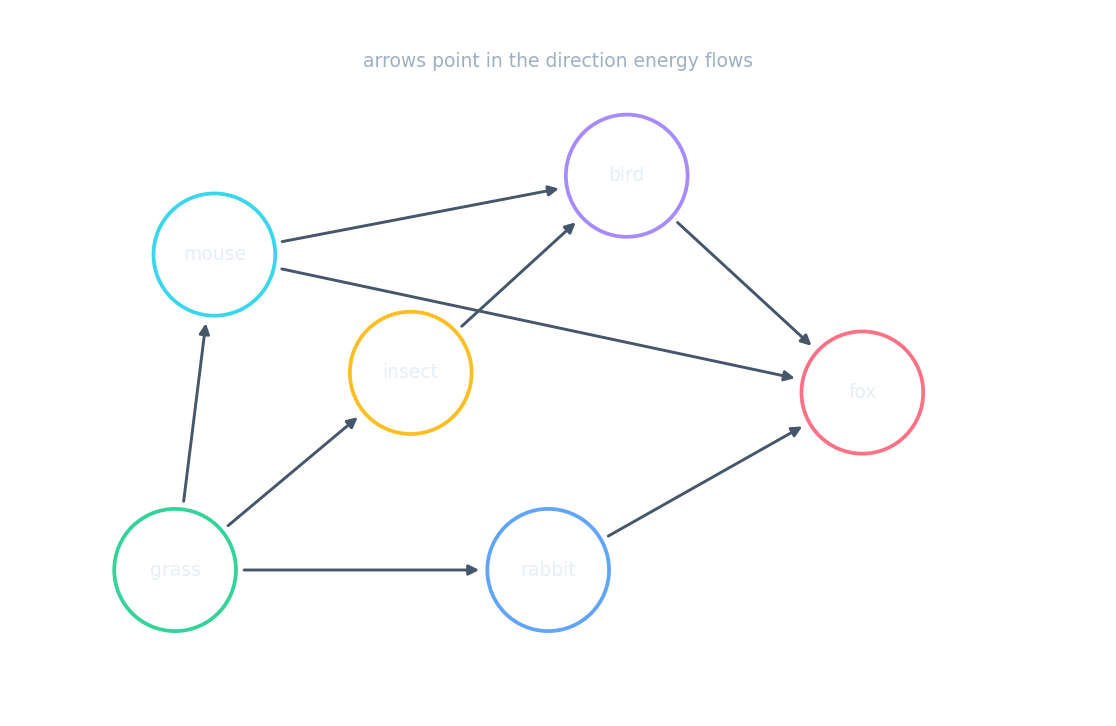
A community in ecology is…
难度 1/5 · 今日首次完成可获 100 金币及少量额外奖励
A community is all the interacting populations of different species sharing an area.
A food web is best described as…
难度 1/5 · 今日首次完成可获 100 金币及少量额外奖励
A food web links many food chains, showing the many feeding relationships in a community.
Predation and competition
- In predation 捕食, one species hunts and eats another.
- Predators keep prey numbers in check, and prey shape predator numbers.
- In competition 竞争, two species need the same limited resource.
- The better competitor gets more of the food, space, or light.
The interaction where one species hunts and eats another is called ____.
难度 1/5 · 今日首次完成可获 100 金币及少量额外奖励
In predation, a predator hunts and eats its prey.
Living together: symbiosis
- Some species live in close partnership, called symbiosis.
- In mutualism 互利共生, both species benefit — like a bee and a flower.
- In parasitism 寄生, one benefits while the other is harmed — like a tick on a dog.
- These close relationships shape how the whole community works.
Name the interaction
Sort each relationship between species by the type of interaction it is.
In mutualism, one species benefits and the other is harmed.
难度 1/5 · 今日首次完成可获 100 金币及少量额外奖励
False. That is parasitism. In mutualism both partners benefit, like a bee getting nectar while pollinating a flower.
Select 所有 true statements about communities.
难度 2/5 · 今日首次完成可获 140 金币及少量额外奖励
A community is defined by its interactions, so species definitely interact. The other three are correct.
A food web is deeply interconnected, so removing one species can ripple through many others. Take away a top predator and its prey may explode in number, then overgraze the plants. In a community, no species stands alone.
Removing the predator:
- In a lake, a predator fish keeps the smaller fish in check.
- Remove the predator, and the smaller fish multiply out of control.
- They eat too much of the plankton, and the whole web is thrown off balance — one change, many effects.
A community is all the species interacting in an area, connected by a food web of many food chains. Species interact through predation (one eats another), competition (both need a resource), and symbiosis — mutualism (both benefit) and parasitism (one benefits, one is harmed). Removing one species can affect many.
Write from this case
- A bee gets nectar.
- The flower gets its pollen carried to another flower.
What interaction is this?
Plus and plus is mutualism.
What is the bee and flower interaction?
难度 1/5 · 今日首次完成可获 100 金币及少量额外奖励
Both partners gain.