| English | 释义 | 拼音 |
|---|---|---|
| starch/stɑːtʃ/ | 淀粉 | diàn fěn |
| monosaccharide/ˈmɒnəʊsækɑːraɪd/ | 单糖 | dān táng |
| glucose/ˈɡluːkəʊs/ | 葡萄糖 | pú táo táng |
| polysaccharide/ˌpɒlɪˈsækɑːraɪd/ | 多糖 | duō táng |
| glycogen/ˈɡlaɪkədʒn/ | 糖原 | táng yuán |
| cellulose/ˈseljuːləʊs/ | 纤维素 | xiān wéi sù |
| disaccharide/ˌdɪsəkˈhɑːraɪd/ | 二糖 | èr táng |
Sugars and starches
- Carbohydrates are the cell's fast fuel and some of its building material.
- They range from a single sweet sugar to giant storage molecules.
- Bread, fruit, pasta, and plant fibres are all carbohydrates.
- Their size decides whether they give quick energy or long-term storage.
Monosaccharides: single sugars
- A monosaccharide 单糖 is one sugar unit — the simplest carbohydrate.
- Glucose 葡萄糖 is the most important: the cell's main fuel for respiration.
- Fructose (in fruit) and galactose are other single sugars.
- Most have the formula around $\text{C}_6\text{H}_{12}\text{O}_6$.
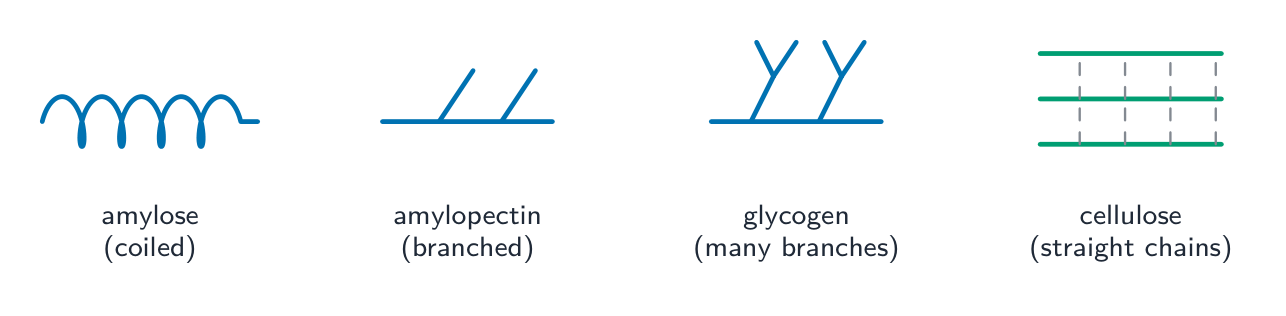
The shapes of storage polysaccharides 多糖 (starch, glycogen 糖原) and structural cellulose 纤维素
单糖是……
难度 1/5 · 今日首次完成可获 100 金币及少量额外奖励
单糖("一个糖")是单个的糖单元——葡萄糖和果糖是例子。
葡萄糖是细胞分解以获取能量的主要糖。
难度 1/5 · 今日首次完成可获 100 金币及少量额外奖励
葡萄糖是细胞的主要燃料——呼吸作用把它分解以释放能量。
Disaccharides: two joined
- A disaccharide 二糖 is two monosaccharides joined by condensation.
- Sucrose (table sugar) = glucose + fructose.
- Lactose (milk sugar) = glucose + galactose.
- One condensation reaction links them and releases water.
食糖(蔗糖)是由葡萄糖和 ____ 组成的二糖。
难度 1/5 · 今日首次完成可获 100 金币及少量额外奖励
蔗糖 = 葡萄糖 + 果糖,由缩合反应连接。
Polysaccharides: many joined
- A polysaccharide is a long chain of many sugar units.
- Starch 淀粉 stores glucose in plants; glycogen stores it in animals.
- Cellulose is a tough polysaccharide that builds plant cell walls.
- Same glucose monomer, different bonds, very different roles.
给糖分类
按照含有多少个糖单元,给每种碳水化合物分组。
动物用哪种多糖来储存葡萄糖?
难度 1/5 · 今日首次完成可获 100 金币及少量额外奖励
动物把葡萄糖储存为糖原(在肝脏和肌肉中);植物用淀粉。
选出关于碳水化合物的所有正确说法。
难度 2/5 · 今日首次完成可获 140 金币及少量额外奖励
碳水化合物从单个糖到巨大的聚合物都有,所以并非都是单个单元。
Starch and cellulose are both chains of glucose, yet you can digest starch and not cellulose. The glucose units are joined by different bonds, and human enzymes can only break the starch type. That is why plant fibre passes through you.
Glycogen: your body's glucose battery.
- After a meal, spare glucose is joined into glycogen in your liver and muscles.
- Between meals, hydrolysis breaks glycogen back into glucose.
- This keeps your blood glucose steady when you are not eating.
Carbohydrates are sugars, grouped by size: a monosaccharide is one unit (like glucose), a disaccharide is two, and a polysaccharide is many. Starch and glycogen store glucose; cellulose builds plant walls. Size sets the job — quick fuel or long-term storage.
Write from the data given
- Eight glucose units join into one unbranched chain.
- Each new link is a dehydration.
释放了多少水分子?
八个单元排成一线有七个连接点。
八个葡萄糖单位结合时会产生多少水分子?
难度 1/5 · 今日首次完成可获 100 金币及少量额外奖励
连接数等于单体数减一。