| English | 释义 | 拼音 |
|---|---|---|
| diffusion/dɪˈfjuːʒn/ | 扩散 | kuò sàn |
| concentration gradient/ˌkɒnsənˈtreɪʃn ˈɡreɪdɪənt/ | 浓度梯度 | nóng dù tī dù |
| passive/ˈpæsɪv/ | 被动的 | bèi dòng de |
Some molecules slip through, others are stopped
- Oxygen crosses a cell membrane in a tiny fraction of a second. A pure lipid bilayer, with no proteins, lets sodium ions through about a billion times more slowly than water.
- The plasma membrane separates the inside of the cell from the outside, and it is selectively permeable 选择透过性: some substances cross easily, others hardly at all. The reason is the membrane's structure.
Why: a hydrophobic interior
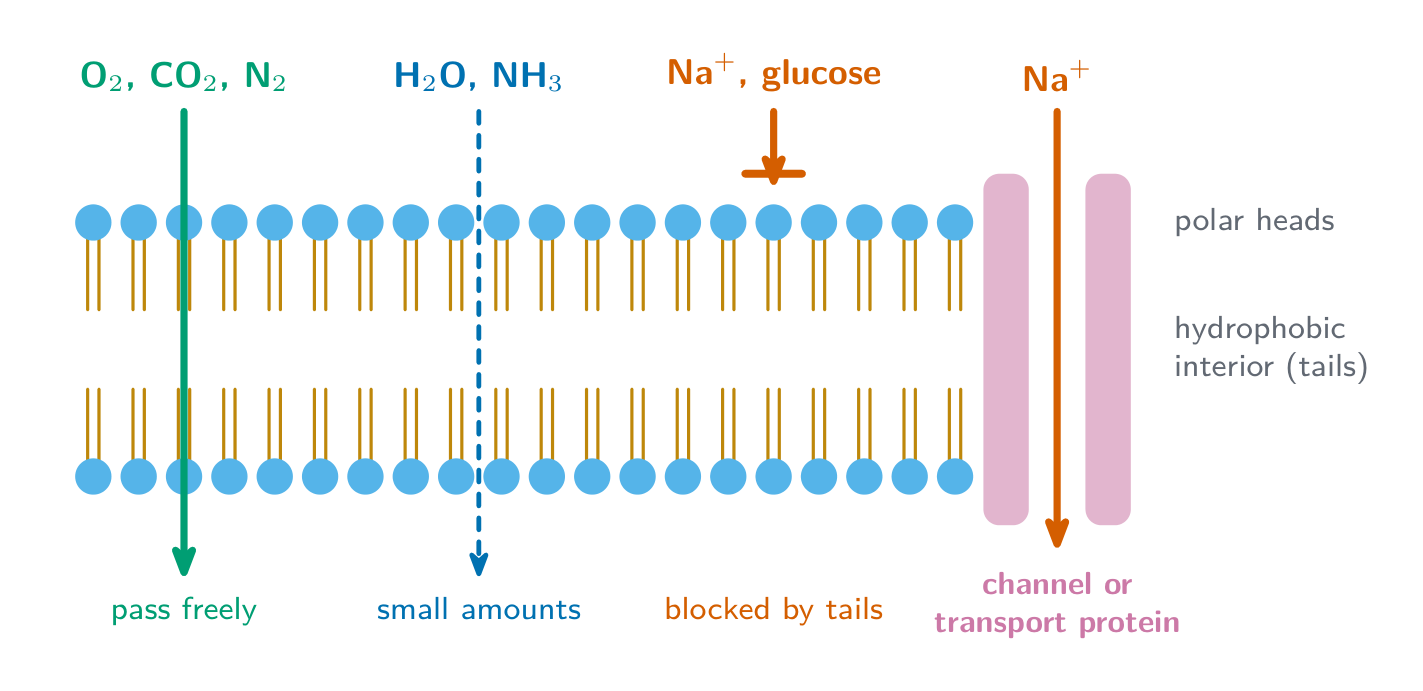
- The membrane is a phospholipid bilayer. The polar heads face the water on both sides; the nonpolar hydrocarbon tails form a hydrophobic 疏水 layer in the middle.
- Anything that crosses must pass through this oily middle. Nonpolar molecules dissolve in it easily; ions and polar molecules are attracted to water and are blocked by the tails.
Which part of the membrane stops ions from crossing the bilayer?
难度 1/5 · 今日首次完成可获 100 金币及少量额外奖励
The hydrophobic interior made of fatty-acid tails repels charged and polar substances.
What crosses, and how
| Substance | Example | Crosses the bilayer? |
|---|---|---|
| small nonpolar | O₂, CO₂, N₂ | freely |
| small polar, uncharged | H₂O, NH₃ | in small amounts |
| large polar | glucose | needs a protein |
| ions (charged) | Na⁺, K⁺, Cl⁻ | needs a protein |
- Hydrophilic substances (large polar molecules and ions) cross through channel proteins and transport proteins embedded in the membrane. Cells move most water through protein channels called aquaporins 水通道蛋白.
Which crosses the bilayer without a protein?
难度 1/5 · 今日首次完成可获 100 金币及少量额外奖励
Charge stops an ion from crossing the oily tails.
Match each substance to how it crosses a plasma membrane.
难度 2/5 · 今日首次完成可获 140 金币及少量额外奖励
Nonpolar molecules cross freely; small polar molecules cross slowly; ions need proteins.
Simple diffusion through the bilayer
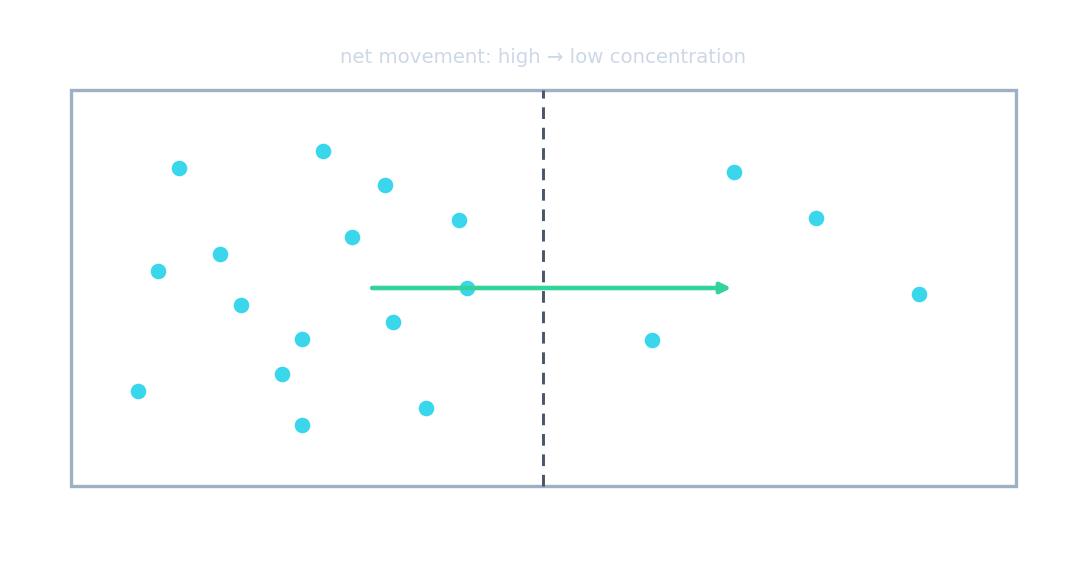
- Molecules that cross the bilayer directly move by simple diffusion: from high to low concentration (down their concentration gradient 浓度梯度), with no energy from the cell.
- This is how O₂ enters and CO₂ leaves a cell during respiration: the gradient alone drives them.
跨膜扩散
Drag the concentrations. Particles diffuse down their gradient until both sides are equal.
In diffusion, particles move…
难度 1/5 · 今日首次完成可获 100 金币及少量额外奖励
扩散 is the net movement of particles down their concentration gradient — high to low.
Diffusion is passive — it needs no energy from the cell.
难度 1/5 · 今日首次完成可获 100 金币及少量额外奖励
Diffusion is passive: particles move on their own random motion, so the cell spends no ATP.
Which change makes diffusion across a membrane 更快?
难度 1/5 · 今日首次完成可获 100 金币及少量额外奖励
A steeper gradient (plus a thin membrane, big area, and warmth) speeds diffusion.
The cell wall
- Bacteria, archaea, fungi and plants also have a cell wall outside the plasma membrane: plants use cellulose, fungi chitin, bacteria peptidoglycan.
- The wall gives structure, is a barrier to some substances, and protects against osmotic lysis 渗透性裂解: when water rushes in, the wall pushes back, so the cell does not burst. Animal cells have no wall, so they can burst in pure water.
A plant cell and a red blood cell are both placed in pure water. Which statement is correct?
难度 1/5 · 今日首次完成可获 100 金币及少量额外奖励
Water enters both cells by osmosis, but the cell wall protects the plant cell from osmotic lysis.
Worked FRQ answer
Researchers make artificial vesicles from a pure phospholipid bilayer (no proteins), fill them with a solution, and place them in solutions containing O₂, glucose or K⁺.
(A) Identify which substance enters the vesicles fastest, and explain why. O₂. It is small and nonpolar, so it dissolves in the hydrophobic interior and diffuses straight through.
(B) Explain why K⁺ barely enters the vesicles. K⁺ is charged. The nonpolar tails in the middle of the bilayer repel it, and there are no channel proteins for it to pass through.
(C) Predict the effect of adding K⁺ channel proteins to the vesicle membranes, and justify. K⁺ enters much faster, down its concentration gradient. The channel gives a hydrophilic path through the hydrophobic interior.
- Why it scores: each answer links a property of the substance (size, polarity, charge) to the structure of the membrane (hydrophobic interior, proteins).
- Water is polar, so only small amounts cross the bilayer itself; most water uses aquaporins.
- Size alone does not decide. A small ion like Na⁺ is blocked because it is charged.
- The cell wall does not replace the plasma membrane. Cells with walls still have a membrane inside the wall.
The plasma membrane is selectively permeable because of its hydrophobic interior. Small nonpolar molecules (O₂, CO₂, N₂) pass freely; small polar uncharged molecules (H₂O, NH₃) pass in small amounts; ions and large polar molecules need channel or transport proteins. Cell walls of bacteria, archaea, fungi and plants give structure, act as a barrier, and prevent osmotic lysis.