| English | 释义 | 拼音 |
|---|---|---|
| osmosis/ɒzˈməʊsɪs/ | 渗透 | shèn tòu |
| hypertonic/ˌhaɪpəˈtɒnɪk/ | 高渗的 | gāo shèn de |
| hypotonic/ˌhaɪpəʊˈtɒnɪk/ | 低渗的 | dī shèn de |
| isotonic/ˌaɪsəˈtɒnɪk/ | 等渗的 | děng shèn de |
| osmoregulation/ˌɒzmɔːɡjʊˈleɪʃn/ | 渗透调节 | shèn tòu tiáo jié |
Water on the move
- Cells sit in watery surroundings, and water crosses the membrane constantly.
- Too much water in and a cell swells; too much out and it shrivels.
- Which way water moves depends on what is dissolved on each side.
- Getting this balance right is a matter of life and death for a cell.
Osmosis: water follows solute
- Osmosis 渗透 is the diffusion of water across a membrane.
- Water moves toward the side with more dissolved solute.
- The membrane lets water through but blocks most of the solute.
- So water flows to even out the concentrations.
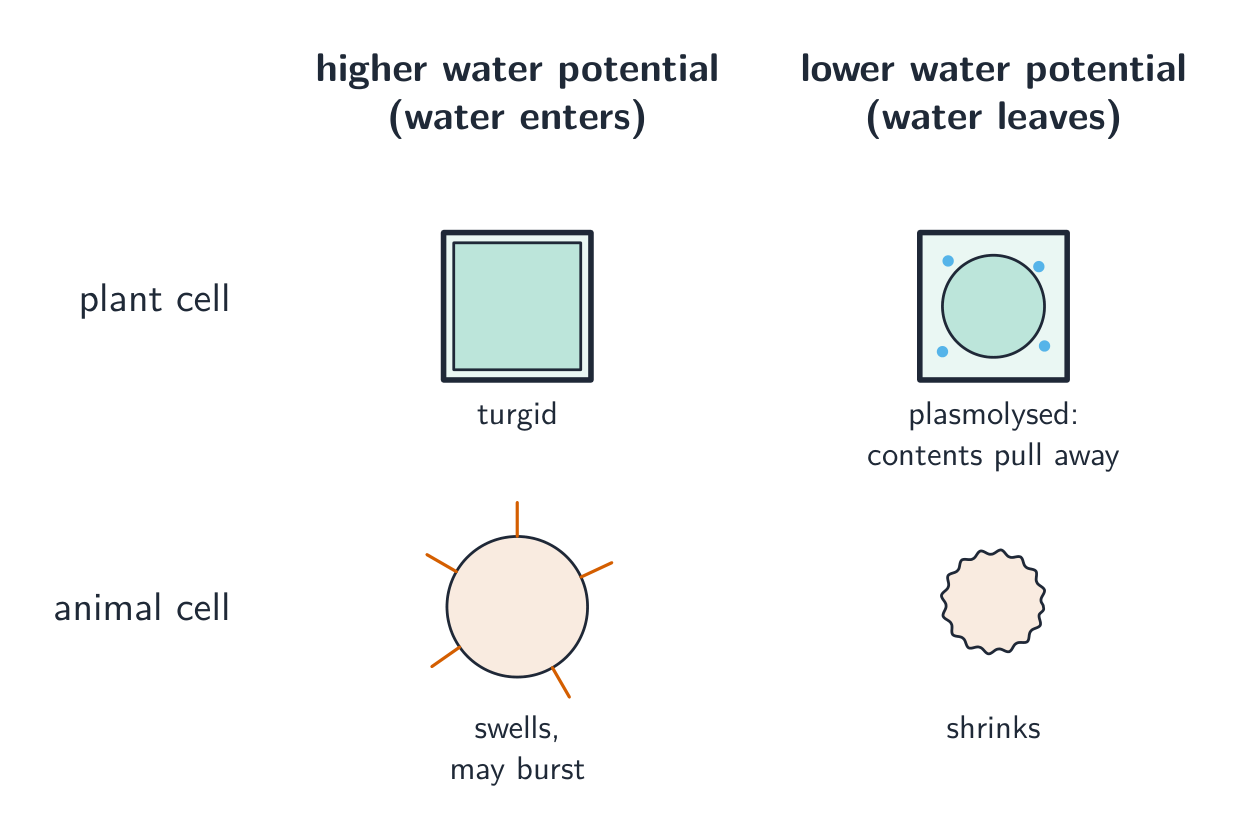
How plant and animal cells respond to solutions of different water potential
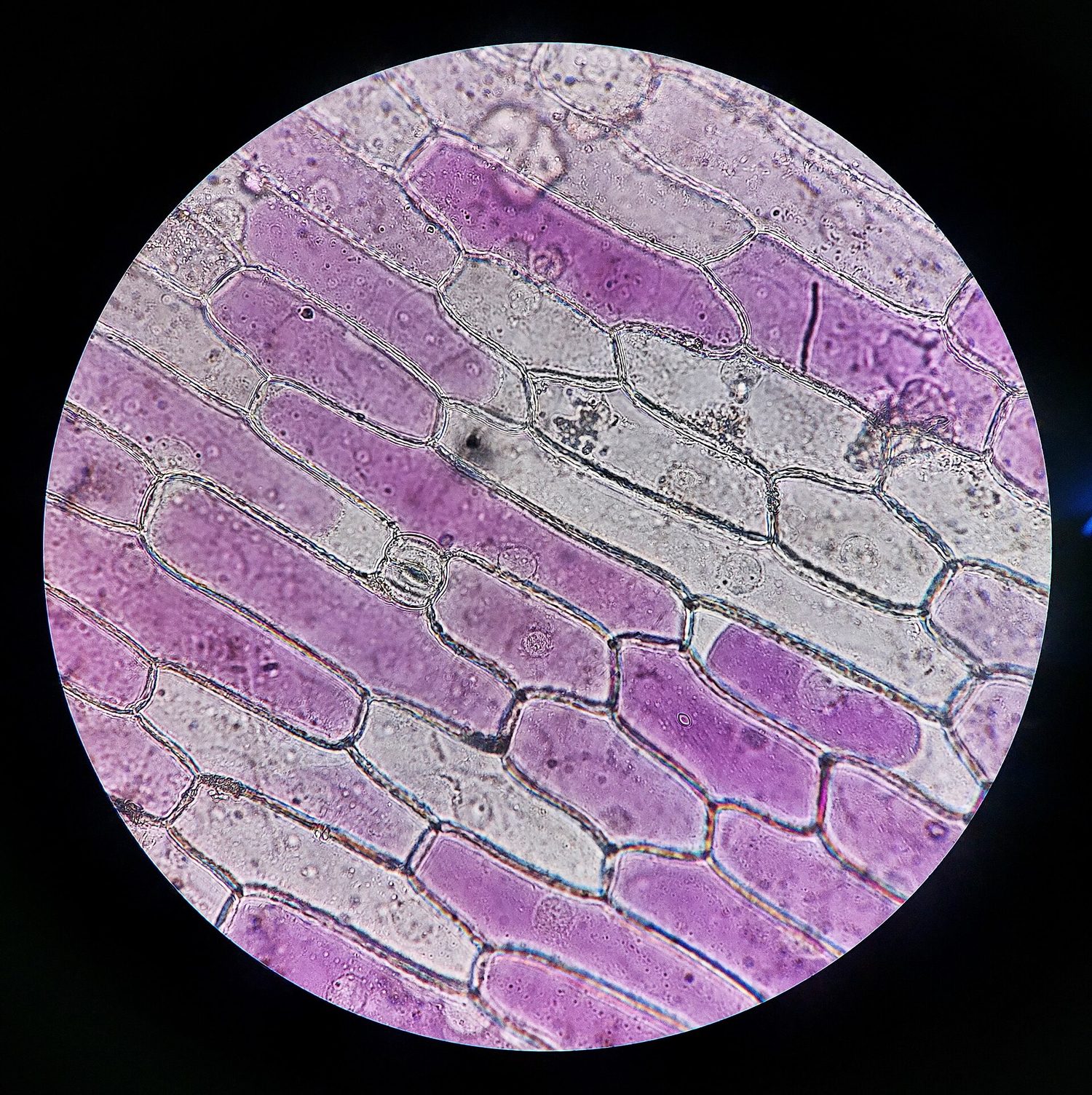
Red onion cells in hypertonic 高渗的 solution: the membrane pulls away from the wall (plasmolysis)
渗透 is the movement of…
难度 1/5 · 今日首次完成可获 100 金币及少量额外奖励
渗透 is the diffusion of water across a membrane, from a dilute to a more concentrated solution.
Three kinds of surroundings
- Hypertonic: more solute outside — water leaves, the cell shrinks.
- Hypotonic 低渗的: less solute outside — water enters, the cell swells.
- Isotonic 等渗的: solute equal both sides — no net water movement.
- Tonicity simply describes the outside compared with the cell.
Osmosis and tonicity
Set the outside solute concentration and watch which way water moves — toward the more concentrated side.
A cell placed in a hypertonic solution (more solute outside) will…
难度 1/5 · 今日首次完成可获 100 金币及少量额外奖励
在 hypertonic solution water leaves the cell (toward the higher solute), so the cell shrinks.
在 hypotonic solution (less solute outside), a cell loses water and shrinks.
难度 1/5 · 今日首次完成可获 100 金币及少量额外奖励
False. With less solute outside, water moves into the cell toward the higher solute concentration, so the cell swells and an animal cell may burst. Cells shrink in a hypertonic solution.
When the solute is equal inside and out, with no net water movement, the solution is ____.
难度 1/5 · 今日首次完成可获 100 金币及少量额外奖励
在 isotonic solution the concentrations match, so there is no net osmosis.
Osmoregulation
- Osmoregulation 渗透调节 is how an organism controls its water balance.
- Your kidneys adjust how much water they keep or release.
- A freshwater fish constantly pumps out the water flooding in.
- Without this control, cells would swell or shrink out of action.
Select 所有 true statements about tonicity.
难度 2/5 · 今日首次完成可获 140 金币及少量额外奖励
Osmosis moves 水, not salt. The other three are correct.
Water moves toward the side with more solute — that can feel backwards. Think "water follows salt": put a cell in salty (hypertonic) water and it loses water and shrinks, because water flows out toward the saltier side.
A red blood cell in pure water:
- Pure water is hypotonic — far less solute than inside the cell.
- Water rushes in toward the higher solute inside.
- With no cell wall to stop it, the animal cell swells and bursts.
Osmosis moves water across a membrane toward the more concentrated side. A hypertonic outside shrinks a cell, a hypotonic outside swells it, and an isotonic outside leaves it unchanged. Osmoregulation is how organisms keep their water balance steady.
Write from this case
- An animal cell is placed in a solution with a higher solute concentration than its cytosol.
- The membrane lets water through more freely than the solute.
What happens to the cell's volume?
Water moves toward the higher solute concentration.
What happens to this animal cell?
难度 1/5 · 今日首次完成可获 100 金币及少量额外奖励
A hypertonic bath draws water out.